lock AUDI A3 CABRIOLET 2015 Workshop Manual
[x] Cancel search | Manufacturer: AUDI, Model Year: 2015, Model line: A3 CABRIOLET, Model: AUDI A3 CABRIOLET 2015Pages: 302, PDF Size: 73.83 MB
Page 178 of 302
1 76 Child Safety
& WARNING
Not using a child safety seat, using the
wrong child safety seat or improperly in
stalling a child restraint increases the risk of serious personal injury and death in a
crash .
- Never install rear-facing child safety
seats or infant carriers on the front pas
senger seat - even with an Advanced Air
bag System. A child will be seriously in
jured and can be killed when the inflat
ing airbag hits the child safety seat or in
fant carrier with great force and smashes
the child safety seat and child against
the backrest, door or roof¢
page 148,
Child restraints on the front seat -some
important things to know.
- Always install rear-facing child safety
seats or infant carriers on the rear seat.
- Never install a rear-facing child restraint
in the forward-facing direction . Such re
straints are designed for the special
needs of infants and very small children
and cannot protect them properly if the
seat is forward-facing.
- If you must install a rearward facing
child safety seat on the front passenger
seat because of exceptional circumstan
ces and the
PASSENGER AIR BAG OFF
light does not come on and stay on, im
mediately install the rear-facing child
safety seat in a rear seating position and
have the airbag system inspected by your
Audi dealer.
- Never place or use any electrical device
(such as a laptop, CO player, electronic
games device, power inverter or seat
heater for child seats) on the front pas
senger seat if the device is connected to
the 12-volt socket or the cigarette light
er socket.
- If a seat heater has been retrofitted or
otherwise added to the front passenger
seat, never install any child restraint sys
tem on this seat.
- Make sure that there are no wet objects
(such as a wet towel) and no water or other liquids on the front passenger seat
cushion.
- Never place objects on the seat (such as
a laptop, CO player, electronic games de
vice, power inverter or seat heater for
child seats). These may influence the
electrical capacitance measured by the
capacitive passenger detection system
and can also fly around in an accident
and cause serious personal injury.
- Always read and heed all WARNINGS
whenever using a child restrained in ave
hicle is being used
~page 138, Safety
belts,
~ page 146, Airbag system and
¢ page 169, Important things to know.
Convertible child safety seats
Properly used convertible child safety seats
can help protect toddlers and children over
age one who weigh between 20 and 40 lbs. (9
and 18 kg) in a crash.
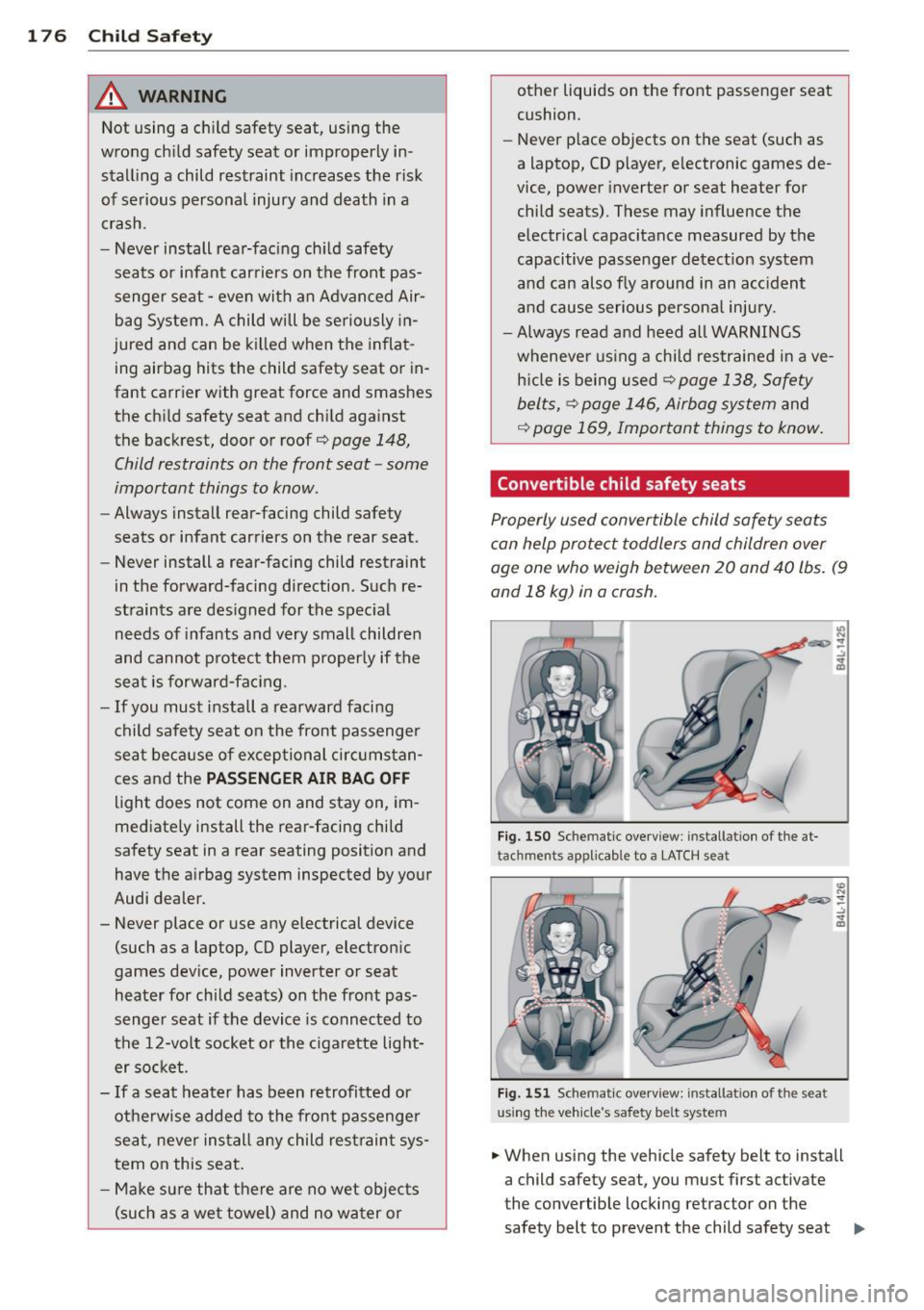
Fig . 150 Sc hema tic overview: installat ion of the at
tachments applicab le to a LATCH seat
Fig. 151 Schemat ic overv iew: inst allation of the seat
u sing the vehicl e's safety belt system
.. When using the vehicle safety belt to install
a child safety seat, you must first activate
the convertib le locking retractor on the
safety belt to prevent the child safety seat ..,_
Page 180 of 302
1 78 Child Safety
- Always move the front passenger seat in
to the rearmost position of the passen
ger seat's fore and aft adjustment range,
and as far away from the airbag as possi
ble before installing the child restraint .
- Always make sure that nothing prevents
the front passenger's seat from being
moved to the rearmost position in its
fore and aft adjustment range.
- Always make sure the backrest is in an
upright position .
- Never place or use any electrical device
(such as a laptop, CD player, electronic
games device, power inverter or seat
heater for child seats) on the front pas
senger seat if the device is connected to
the 12-volt socket or the cigarette light
er socket.
- If a seat heater has been retrofitted or
otherwise added to the front passenger
seat, never install any child restraint sys
tem on this seat.
- Make sure that there are no wet objects
(such as a wet towel) and no water or
other liquids on the front passenger seat
cushion.
- Never place objects on the seat (such as
a laptop, CD player, electronic games de
vice, power inverter or seat heater for
child seats). These may influence the
electrical capacitance measured by the
capacitive passenger detection system
and can also fly around in an accident
and cause serious personal injury .
- Make sure that the
PASSENGER AIR BAG
OFF
light comes on and stays on all the
time whenever the ignition is switched
on.
- If the PASSENGER AIR BAG OFF light
does not come on and stay on, immedi
ately install the forward-facing child seat
at a seating position on the rear seat and
have the airbag system inspected by your
authorized Audi dealer.
- Take the child restraint off the front pas
senger seat and install it properly at one
of the rear seat positions if the
PASSEN- GER AIR BAG OFF
light
does not stay on
whenever the ignition is switched on.
Booster seats and safety belts
Properly used booster seats can help protect
children weighing between about 40 lbs. and
80 lbs. (18 kg and 36 kg) who are less than 4
ft. 9 in. tall. 9 in. (57 inches/1.45 meters)
tall.
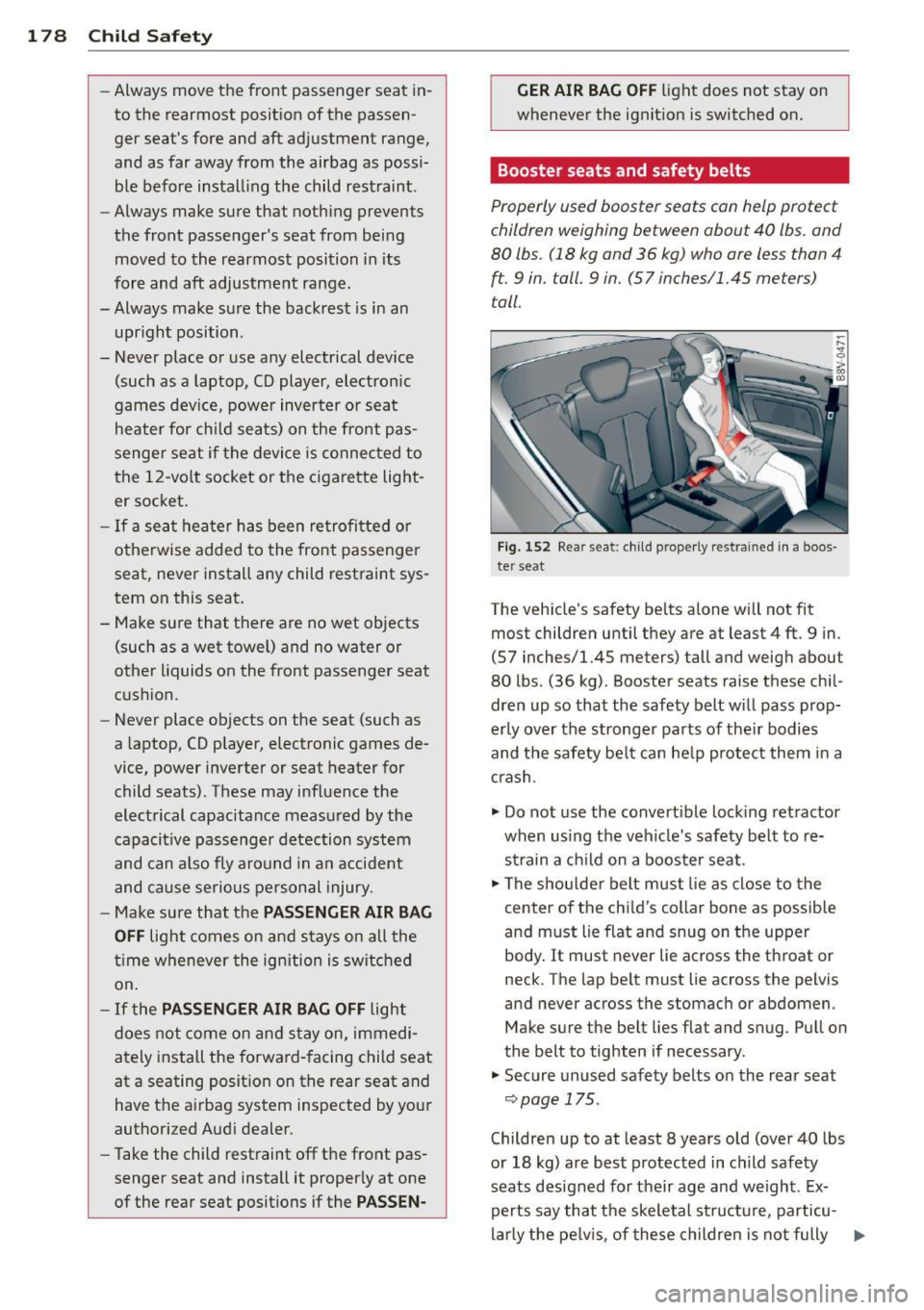
Fig. 1S2 Rear seat : child properly restrained in a boos·
te r seat
The vehicle 's safety belts alone will not fit
most children until they are at least 4 ft. 9 in.
(57 inches/1.45 meters) tall and weigh about
80 lbs .
(36 kg). Booster seats raise these chil
dren up so that the safety belt will pass prop
erly over the stronger parts of their bodies
and the safety belt can help protect them in a
crash.
" Do not use the convertible locking retractor
when using the vehicle's safety belt to re
strain a child on a booster seat.
"The shoulder belt must lie as close to the
center of the child's collar bone as possible
and must lie flat and snug on the upper
body. It must never lie across the throat or
neck . The lap belt must lie across the pelvis
and never across the stomach or abdomen.
Make sure the belt lies flat and snug . Pull on
the belt to tighten if necessary .
"Secure unused safety belts on the rear seat
~page 175.
Children up to at least 8 years old (over 40 lbs
or 18 kg) are best protected in child safety
seats designed for their age and weight . Ex
perts say that the skeletal structure, particu
larly the pelvis, of these children is not fully ...
Page 182 of 302
180 Child Safety
-Always remember that a child leaning
forward, sitting sideways or out of posi
tion in any way during an accident can be
struck by a deploying airbag . This will re
sult in serious personal injury or death .
- If you must install a booster seat on the
front passenger seat because of excep
tional circumstances the
PASSENGER
AIR BAG OFF
light must come on and
stay on, whenever the ignition is switch
ed on.
- If the
PASSENGER AIR BAG OFF light
does not come on and stay on, perform
the checks described¢
page 158, Moni
toring the Advanced Airbag System.
- Take the child restraint off the front pas
senger seat and install it properly at one
of the rear seat positions if the
PASSEN
GER AIR BAG OFF
light does not stay on
whenever the ignition is switched on.
- Always read and heed all WARNINGS
whenever using a child restrained in
ave
hicle is being used¢ page 138, Safety
belts,¢ page 146, Airbag system
and
¢page 169, Important things to know .
Installing a child safety
seat
Securing a child safety seat using a
safety belt
Safety belts for the rear seats and the front
passenger can be locked with the convertible
locking retractor to properly secure child
safety seats.
The safety belts emergency locking retractors
for the rear seats safe ty belts and for the
front passenger's seat safety belt have a con
vertible locking retractor for child restraints.
The safety belt must be locked so that belt
webbing cannot unreel. The retractor can be
activated to lock the safety belt and prevent
the safety belt webbing from loosening up
during normal driving. A child safety seat can
only be properly installed when the safety belt
is locked so that the child and child safety
seat will stay in place. Always
remember: Even though your vehicle is
equipped with an Advanced Airbag system, all
children, especially those 12 years and young
er , should always ride in the back seat proper
ly restrained for their age and si ze.
A WARNING
=
Improperly installed child safety seats in -
crease the risk of serious personal injury
and death in a collision .
- Always make sure that the safety belt re
tractor is locked when installing a child
safety seat. An unlocked safety belt re
tractor cannot hold the child safety seat
in place during normal driving or in a
crash.
- Always buckle the child safety seat firmly
in place even if a child is not sitting in it.
A loose child safety seat can fly around
during a sudden stop or in a collision.
- If the backrest is not securely latched,
the child and the child restraint will be
thrown forward together with the back
rest and will strike parts of the vehicle
interior. The child can be seriously in
jured or killed .
- Never install rear-facing child safety
seats or infant carriers on the front pas
senger seat. A child will be seriously in
jured and can be killed when the passen
ger airbag inflates.
- The inflating airbag will hit the child
safety seat or infant carrier with great
force and will smash the child safety seat and child against the backrest, center
armrest, door or roof.
- Always install rear-facing child safety
seats or infant carriers on the rear seat.
- Forward-facing child safety seats or in
fant carriers installed on the front pas senger's seat may interfere with the de
ployment of the airbag and cause serious
injury to the child.
- It is safer to install a forward-facing
child safety seat on the rear seat.
- Always read and heed all WARNINGS
whenever using a child restrained in ave-
hicle is being used
¢ page 169. Special ..,.
Page 184 of 302
182 Child Safety
Activating the convertible locking retractor
Use the convertible locking retractor to se
cure a child restraint.
Always heed the child safety seat manufactur
er's instructions when installing a child re
straint in your vehicle. To activate the conver
tible locking retractor:
• Place the child restraint on a seat, prefera
bly on the rear seat.
• Slowly pull the belt
all the way out.
• Route it around or through the child re
straint belt path¢.&_ .
• Push the child safety seat down w ith your
full weight to get the safety belt really tight.
• Insert the belt tongue into the buckle for
that seating position.
• Guide the safety belt back into the retractor
until the belt lies flat and snug on the child
safety seat .
• You should hear a "clicking " noise as the
belt winds back into the inertia reel. Test the
convertible locking retractor by pulling on
the belt. You should no longer be able to
pull the belt out of the retractor. The con
vertible locking retractor is now activated.
• Make sure that the red release button is fac
ing away from the child restraint so that it
can be unbuckled quickly .
•Pullon the belt to make sure the safety belt
is properly tight and fastened so that the
seat cannot move forward or sideways more
than one inch (2.5 cm).
.&_ WARNING
Using the wrong child restraint or an im
properly installed child restraint can cause
serious personal injury or death in a crash.
- Always make sure that the safety belt re-
tractor is locked when installing a child
safety seat. An unlocked safety belt re
tractor cannot hold the child safety seat in place during normal driving or in a
crash .
- Always buckle the child safety seat firmly
in place even if a child is not sitting in it.
-
A loose child safety seat can fly around
during a sudden stop or in a crash.
- Always make sure the seat backrest to
which the child restraint is installed is in
an upright position and securely latched
into place and cannot fold forward. Oth
erwise, the seatback with the child safety
seat attached to it could fly forward in
the event of an accident or other emer
gency situation.
- Always read and heed all WARNINGS
whenever using a child restrained in ave
hicle is being used
¢page 169. Special
precautions apply when installing a child
safety seat on the front passenger seat
¢ page 148, Child restraints on the front
seat -some important things to know.
'
Deactivating the convertible locking
retractor
T he convertible locking retractor for child re
strain ts will be deactiva ted automatically
when the bel t is wound all the way back in to
the retractor .
• Press the red button on the safety belt buck
le . The belt tongue will pop out of the buck
le .
• Guide the safety belt all the way back into
its stowed position .
Always let the safety bel t retract completely
into its stowed position . The safety belt can
now be used as an ordinary safety belt with
out the convertible locking retractor for child
restraints.
If the convertible locking retractor should be
activated inadvertently, the safety belt must be unfastened and guided completely back in
to its stowed position to deactivate this fea
ture. If the convertible locking retractor is not
deactivated , the safety belt will gradually be-
come tighter and uncomfortable to wear.
11>-
Page 185 of 302
M N
" > co ,...., \!) 1.1'1 ,...., 1.1'1 ,....,
A WARNING 1= •
Improperly installed child safety seats in-
crease the risk of serious personal injury
and death in a collision .
- Never unfasten the safety belt to deacti
vate the convert ible lock ing retractor for
child restraints while the veh icle is mov
ing. You would not be rest rained and
c ou ld be ser iously injured in an ac cident.
- Always read and heed all WARNINGS
whenever using a child rest rained in ave
hicle is being used
~page 169. Special
precautions apply when installing a ch ild
safety sea t on the front passenger seat
~ page 148, Child restraints on the front
seat -some important things to know.
LATCH Lower
anchorages and tethers
for children
Child Restraint System anchors and how
are they related to child safety
To provide a s imp ler and mor e pract icable way
to attach the ch ild restraint on the vehicle
seat, Fede ral regu lations requi re speci al lower
a ncho rages in veh icles and dev ices on new
chi ld res traints to attach to the vehicle ancho
rages .
The combination of the tether anchorages and
the lower anchorages is now generally called
the
LATCH system for " Lower Anchorages and
T ethers for Children ."
F orward -facing child rest rain ts manuf actured
a ft er Sep tembe r 1, 1999, are require d by U .S .
federal regulations to comply with new child
h ead movement performance requirements .
T hese new performance requirements make a
tether necessary on most new chi ld seats.
Instal ling a child restraint that req uir es a top
tether witho ut one can serio usly impair the
performance of the chi ld restraint and its ab il
ity to protect the ch ild in a co llision . Installing
a child restraint that requires a top tether
Child Sa fet y 183
without the top tether may be a violat ion o f
state law.
Child rest rain t manufacture rs offer LA TCH
lower anchorages on their child seats w ith
hook -on or push -on connectors attached to
adjustable straps.
In add it ion to the LATCH lower anchorages,
these ch ild restraint systems usually requi re
the use o f tether straps to he lp keep the chi ld
restraint firm ly in place.
A WARNING
Improper installation of child restra ints
will increase the r isk of injury and death in
a crash.
-Always follow the instr uctions provided
by the manufacturer of the child re
straint you intend to install in your vehi
cle .
- Never install a child restraint without a
properly attached top tether strap if the
child restraint manufacture r's instruc
tions require the top tether st rap to be
used.
- Improper use of child rest raint LATC H
lowe r ancho rage points can lead to injury
in a collision. The LATC H lowe r anchorage
points are designe d to withstand o nly
those loads impose d by correctly fitted
child restraints .
- Never mo unt two child restra int systems
on one LATCH lower anchorage point.
- Never secure or attach any lugg age or
o ther item to the LAT CH lower anchorag
es.
(D Tips
- I n Canada, the terms "top tether" w ith
" lower universal anchorages" (or "lower
universal anchorage bars") are used to
describe the system.
- In o ther coun tries, the term " ISO FIX" is
used to describe the lower anchorages .
-
•
•
•
Page 187 of 302
....,
N
r--. > co
rl I.O
"' rl
"' rl
Installing a child restraint with LATCH
lower anchorages
Applies to vehicles: with Top Tether
Whenev er you install a child res traint always
follow the child restraint manufacturer's in
structions.
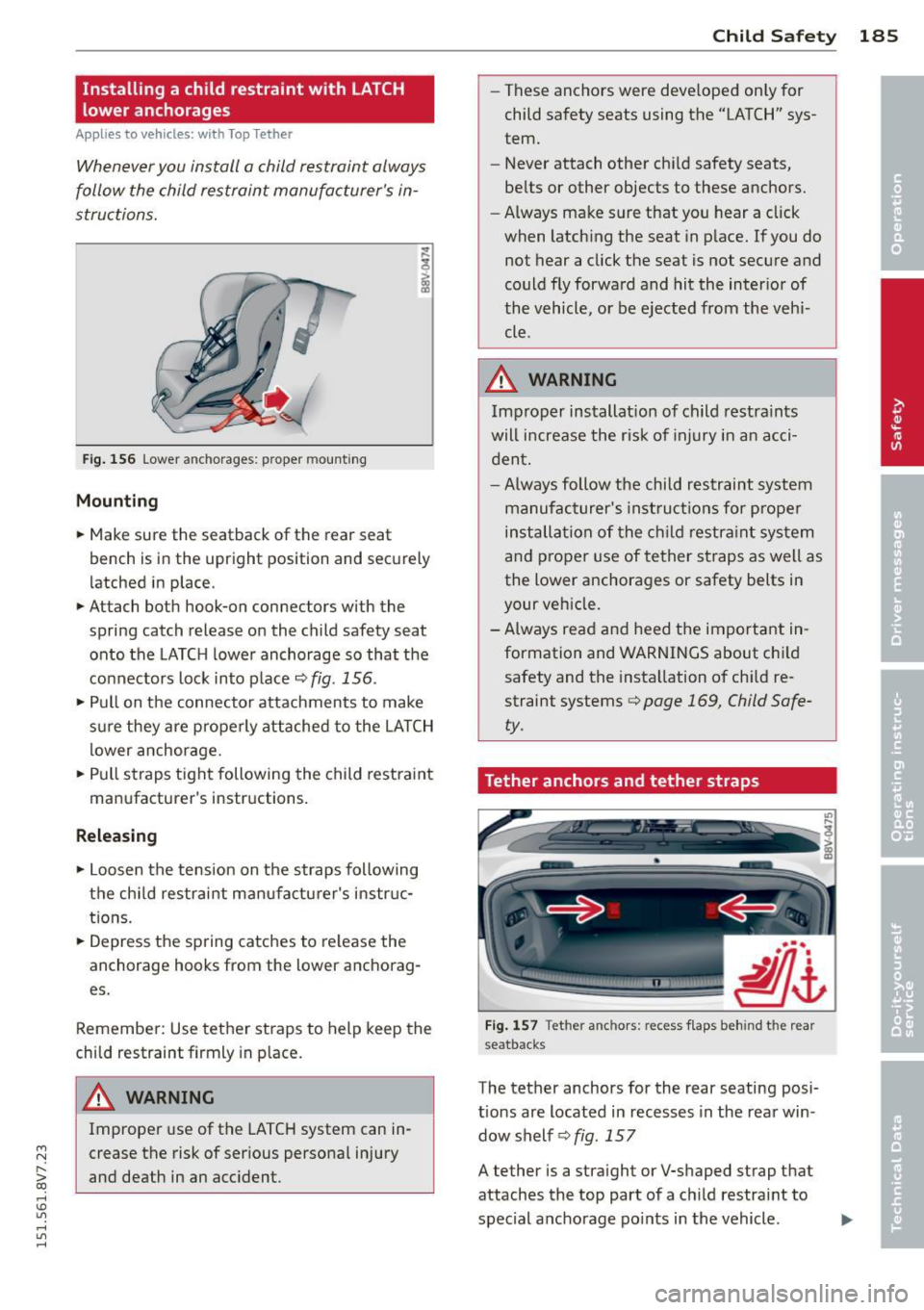
F ig . 156 Lowe r anch ora ges: proper mount ing
Mount ing
.. Make sure th e seatback of the rear seat
bench is in th e upright posit ion and s ecur ely
latched in place .
.. Attach bo th hook-on connectors wi th the
spring c atch release on the child safety seat
onto the LATC H lower anchorage so that the
connectors lock into place~
fig. 156.
.. Pull on the connector attachments to make
su re they are properly attached to the LATCH
lower anchorage .
.. Pull straps tight following the child restra int
manufacturer's instruct ions.
Releasing
.. Loosen the tens ion on the straps following
the chi ld restraint manufacturer's instr uc
t ions .
.. Depress the spring catches to re lease the
anchorage hooks from the lowe r anchorag
es.
Remember: Use tether straps to help keep the
ch ild restraint firmly in p lace.
A WARNING
Improper use of the LATC H system can in
crease the risk of ser ious personal injury
and death in an acc ident.
Child S afety 185
-These anchors were deve loped only for
child safety seats using the "LATCH" sys
tem.
- Never attach other chi ld safety seats,
be lts or other objects to these anchors.
- Always make sure that you hear a click
when latch ing the seat in p lace. If you do
not hear a click the seat is not secure and
could fly forward and hit the interior of
the vehicle, or be e jected from the veh i
cle .
A WARNING
Imp roper installat ion of ch ild rest ra ints
will increase the risk of injury in an acci
dent.
- Always follow the child restraint system
manufac turer's inst ruct io ns for prope r
installation of the c hild restra int system
and p roper use of te ther s traps as well as
the lower anchorages or safety belts in
your vehicle .
- Always read and heed the im portant in
formation and WARNINGS about chi ld
safety and the insta llation of ch ild re
straint systems ~
page 169, Child Safe
ty .
Tether anchors and tether straps
Fig . 1 57 Tether an ch or s: re cess f lap s behi nd the re ar
seatbac ks
T he tether anchors for the rear seating posi
t ions are located in recesses in the rear win
dow shelf ~
fig. 157
A tether is a s tra ight or V- shaped strap that
attaches the top part of a ch ild restraint to
special anchorage po ints in the vehicle .
-
Page 190 of 302
188 Smart Technology
Smart Technology
Information about
data recorded by
vehicle control
modules
Your vehicle is not equipped with a crash data
recorder. This device is insta lled by some vehi
cle manufacturers to record data about crash
es so tha t it can be analy zed later. Crash data
recorders are also called "Event Data Record
ers (EDR)" .
In some legal jurisdictions, it is not permitted
to access or download data recorded by pre
installed crash data recorders in order to eval
uate a crash without clear consent of the vehi
cle owner .
Your veh icle is not equipped with a crash data
recorder. However it does contain a var iety of
e lectronic control modules for various vehicle
systems such as eng ine funct ion, exhaust
treatment or airbags and safety belts .
These electron ic control modules record vehi
cle data during normal driv ing for diagnosis
and repair purposes. The recording capab ility
of the electron ic control modules is lim ited to
data only- no sound is reco rded.
If t he control
mo dule detects a sys tem m alfu nction or other
change in sta tus, a very lim ited amount of da
ta is recorded for an extreme ly sma ll period of
time . Data t hat is recorded in s uch a case may
include veh icle speed, driving direction, the
load on the brakes and head restraints and
performance in the event of an acc iden t or
other change in status . The stored data can
only be read o r down loaded w ith specia l dev i
ces.
Electronic stabilization
control (ESC)
Description
The E lectronic Stabilization Cont rol (ESC) con
tr ibutes to d river safety. It reduces the risk of
slipp ing and improves driving stability. ESC detects critical situations such as the veh
icle
oversteering and understeering or the whee ls
are spinning . The vehicle is stabilized by ap
plying the brakes or reducing engine torq ue.
Once the ESC is activated, the ind icator light
Bl blinks in the instrument cluster .
The following systems are integrated in the ESC:
Anti -lock braking s ystem (ABS)
ABS prevents the whee ls from locking when
braking . The vehicle can still be steered even
during hard braking . App ly steady pressure to
the brake peda l. Do not pump the peda l. A
puls ing in the brake peda l ind icates that the
system is act ing to stabilize the ve hicle.
Brake assi st sy st e m
The brake assist system can decrease braking
distance .
It increases braking power when the
driver presses the brake peda l quickly in emer
gency s ituations. You m ust press and hold the
brake pedal until the dangerous situation is
over . In vehicles with adaptive cruise control*,
the brake assist system is more sens it ive if the
distance detected to the vehicle ahead is too
small.
Anti-slip regu lation (ASR )
ASR reduces engine power when the drive
wheels begin sp inning and adapts the force to
the road conditions. This makes it easier to
sta rt , accelerate and dr ive up inclines .
Electronic differenti al lock (EDL )
The EDL brakes whee ls that are spinning and
transfers the drive power to the other drive
wheel or wheels if the vehicle is equ ipped with
all wheel drive *). This function is not ava ilable
at h igher speeds .
In extreme cases, EDL automatically sw itches
off to keep t he b rake on the braked wheel
from overheat ing. The ve hicle is still working
co rrect ly. EDL w ill switch o n aga in automat i
ca lly when cond itions have ret urned to no r-
mal. .,._
Page 194 of 302
192 Smart Technology
the brakes. If you need to brake addition
ally, brake in intervals and not continu
ously.
(D Tips
- If the brake booster is not working, you
must press the brake pedal with much
more force then norma l.
- If you retrofit your vehicle with a front
spoiler, wheel covers or similar items,
make sure that the air flow to the front
wheels is not interrupted. Otherwise the
brake system can become too hot.
Electromechanical
steering
The electromechanical steering supports the
driver's steering movements .
Power steering adapts electronically based on
the vehicle speed.
The vehicle still has full steering functionality if the power steering fai ls or when the engine
is stopped (towing). To steer, you must apply
much more force than usual.
Indicator lights and messages
• Do not drive vehicle: steering defective
If this indicator light turns on and stays on
and this message appears, the power steering may have failed.
Do
not continue driving. See an authorized
Audi dea ler or authorized Audi Service Facility
for assistance.
• Do not drive vehicle: steering defective
There is a malfunct ion in the electron ic steer
ing lock. You cannot turn the ign ition on.
Do
not tow your vehicle because it cannot be
steered. See an authorized Aud i dealer or au
thor ized Audi Serv ice Facility for ass istance.
'I j Steering malfunction: you can continue
driving
If the indicator light turns on, the steering
wheel may be more difficult to move or more sensitive than usual.
The stee ring wheel may
also be at an angle when driving straight.
Drive slowly to your authorized Audi dealer or
qualified wo rkshop to have the malf u nct ion
corrected.
II Steering lock : system fault! Please con
tact Service
There is a malfunction in the electronic steer
ing lock .
Drive to an authorized Audi dealer or author
ized Audi Service Facility immediately to have
the malfunction corrected.
A WARNING ,___
Have the system malfunction corrected as
soon as possible by an authorized Aud i
dealer or authorized Audi Service Facility,
as this increases the risk o f an accident.
@ Tips
If the . or ,~ n ind icator light only stays
on for a short tim e, you may continue dr iv
in g.
All wheel drive
(quattro)
Applies to vehicles: with all wheel drive
In all wheel drive, all four wheels are pow
ered.
General information
In all whee l drive, the driving power is divided
between a ll four wheels . This happens auto
matically depending on your driving behavior
as well as the current road conditions. Refer
to
¢ page 188, Electronic stabilization con
trol (£SC) .
The all wheel drive concept is designed for
high engine power. Your vehicle is exception
ally powerful and has excellent driving charac
teristics both under normal driving cond itions
and on snow and ice . Always read and follow
safety p recaut ions
Q ,& . .,.
Page 205 of 302
M N
" > co ,...., \!) 1.1"1 ,...., 1.1"1 ,....,
different weight distribution. Safety, perform
ance and economy wi ll greatly depend on how
carefu lly you load your trailer and operate
your rig.
Before you actually tow your trailer, practice
turning, stopping and backing up in an area
away from traffic. Keep practicing until you
have become comp letely familiar with the way
your vehicle- trailer combination behaves and
responds .
Backing up is d ifficult and requires practice.
Backing up with a trai ler generally requires
stee ring action opposite to that when backing
up your vehicle without a trailer .
Maintain a greater distance between your ve
hicle and the one in front of you. You will need
more room to stop. To compensate for the
trailer, you will need a larger than normal
turn ing radius.
When passing, remember that you cannot ac
celerate as fast as you normally would be
cause of the added load. Make sure you have
enough room to pass . After passing, allow
p lenty of room for your tra iler before chang
ing lanes again.
Avoid jerky starts, sharp turns or rapid lane
changes.
(D Tips
- Do not tow a tra iler during the break-in
period of your vehicle.
- If you tow a trailer, your Audi may re
quire more frequent maintenance due to
the extra load
¢ page 282 .
Parking on a slope
Do not park on a slope with a trailer. If i t can
not be avoided, do so only after doing the fol
lowing:
When parking:
.. Apply the foot brake.
.. Have someone place chocks under both the
vehicle and the trailer wheels.
Trailer towing 203
.. With chocks in place, slowly release the
brakes until the wheel chocks absorb the
load .
.. Turn the wheels towards the curb.
.. Apply the parking brake.
.. Select the P selector lever posit ion.
When re starting after parking:
.. App ly the foot brake.
.. Start the engine.
.. Select the
0/5 selector lever position.
.. Release the parking brake and slowly pull
out and away from the wheel chocks .
.. Stop and have someone retr ieve the wheel
chocks.
(D Tips
If you move the selector lever of the auto
matic transmission to
P before applying
the parking brake and before blocking the
whee ls, you may have to use more force
lat er to move the lever out of the
P posi
tion.
•
•
•
Page 213 of 302
M N
" > co ,...., \!) ..,.,
,...., ..,., ,....,
Many gasoline grades are blended to perform
especially well for winter or summer driving. During seasonal change-over , we suggest that
you fill up at busy gas stations where the sea sonal adjustment is more likely to be made in
time.
Q;) Note
- Methanol fuels which do not meet these requirements may cause corrosion and
damage to plastic and rubber compo
nents in the fuel system .
- Do not use fuels that fail to meet the
specified criteria in this chapter .
- If you are unable to determine whether
or not a particular fuel blend meets the
specificat ions, ask your service station or
i ts fuel supp lier .
- Do not use fuel for which the contents cannot be identified .
- Fuel system damage and performance
problems resulting from the use of fuels
different from those specified are not
the responsibility of Audi and are not
covered under the New Vehicle or the
Emission Control System Warranties.
- If you experience a loss of fuel economy
or driveability and performance prob
lems due to the use of one of these fuel
blends, we recommend that you switch
to unblended fuel.
Gasoline additives
A major concern among many auto manufac
turers is carbon deposit build-up caused by
the type of gasoline you use .
Although gasoline grades differ from one manufacturer to another, they have cer tain
things in common. All gasoline grades contain substances that can cause deposits to collect
on vital engine parts, such as fuel injectors
and intake valves. Although most gasoline
brands include additives to keep engine and
fuel systems clean, they are not equally effec
tive.
Checking and Filling 211
Audi recommends using TOP TIER Detergent
Gasoline . For more information on TOP TIER
Detergent Gasoline, please go to the official
website (www .toptiergas .com) .
After an extended period of using inadequate
fuels, carbon deposit build-ups can rob your engine of peak performance.
CJ) Note
Damage or malfunction due to poor fuel
quality is not covered by the Audi New Ve
hicle Limited Warranty.
Fuel tank
Fuel filler neck
The fuel filler neck is located on the right rear
side panel behind the fuel filler flap.
If the power locking system should fail, you
can still open the flap manually -for detailed
instructions see~
page 213.
You can find the fuel tank capacity of your ve
hicle in
~ page 280.
The label on the inside of the fuel filler flap
tells you the correct fuel for your vehicle. For
more information about fuel specifications,
see
~ page 210 .
Your vehicle fuel tank has an on board refuel
ling vapor recovery system. This feature helps
to prevent fuel vapors from escaping from the
tank and polluting the environment while you refuel your vehicle. In order to fill the tank
properly while protecting the environment,
please follow this refueling procedure careful
ly .
A WARNING ~
Under normal operating conditions, never
carry additional fuel containers in your car.
Gas canisters and other containers used to
transport fuel can be dangerous. Such con
tainers, full or empty, may leak and could
cause a fire in a collision . If you must
transport fuel to use for your lawn mower, ..,.
•
•
•