brake AUDI A3 CABRIOLET 2015 Repair Manual
[x] Cancel search | Manufacturer: AUDI, Model Year: 2015, Model line: A3 CABRIOLET, Model: AUDI A3 CABRIOLET 2015Pages: 302, PDF Size: 73.83 MB
Page 234 of 302
232 Tires a nd whee ls
Ma ximum load rating
means the load rating for a tire
at the maximum permissible in
flation pressure for that tire.
Maximum loaded vehicle
weight
means the sum of:
(a) Curb weight
(b) Accessory weight
(c) Vehicle capacity weight, and
(d) Production options weight
Maximum (permissible)
inflation pressure
means the maximum cold infla
tion pressure to which a tire
may be inflated. Also called
"maximum inflation pressure."
Normal occupant weight
means 150 lbs. (68 k ilograms)
times the number of occupants seated in the vehicle up to the
total seat ing capac ity of your
vehicle.
Occupant distribution
means distribution of occu
pants in a vehicle .
Outer diameter
means the overall diameter of
an inflated new tire.
Overall width
means the linear distance be
tween the ex teriors of the side
walls of an inflated tire, includ
ing elevations due to labeling,
decorations, or protect ive
bands or ribs .
Ply
means a layer of rubber -coated
parallel cords .
Production options weight
means the comb ined we ight of
those installed regular produc
tion op tions weighing over 5
lbs . (2. 3 kg) in excess of those
standard items which they re
place, no t prev iously consid
ered in curb weight or accessory
weight , incl uding heavy duty
brakes, ride leve lers, roof rac k,
heavy duty bat tery, and spec ial
trim.
Radial ply tire
means a pneumatic tire in
wh ich the p ly c ords that extend
t o the beads are laid at sub
stantially 90 degrees to the
centerline of the t read .
Page 241 of 302
Tires and wheels 239
technically referred to as the not be able to stop the vehi-
vehicle's Gross Vehicle Weight cle within a safe distance.
Rating ("GVWR"). The Gross -Tires on a vehicle that has
Axle Weight Rating ("GAWR") is been overloaded can fail
the maximum load that can be suddenly causing loss of
' •
•
applied at each of the vehicle's control and a crash.
two axles. The Gross Vehicle -Always make sure that the
Weight Rating and the Gross total load being transported
Axle Weight Rating are listed -including the weight of a
on the safety compliance stick- trailer hitch and the tongue
er label located on the driver's weight of a loaded trailer -
side B-pillar. The tire pressure does not make the vehicle
label on your Audi lists the heavier than the vehicles
maximum combined weight of Gross Vehicle Weight Rat-
all of the occupants and lug- 1ng.
gage or other cargo that the ve-
A WARNING hicle can carry. For the location
of the tire pressure label -Incorrect tire pressures
¢ fig
. 172. and/or underinflation can
lead to a serious or fatal ac-
A WARNING
-cident.
Overloading a vehicle can -Incorrect tire pressures
cause loss of vehicle control, and/or underinflation cause
a crash or other accident, se- increased tire wear and can
rious personal injury, and affect the handling of the
even death. vehicle.
-Carrying more weight than -Incorrect tire pressures
your vehicle was designed and/or underinflation can
to carry will prevent the ve- also lead to sudden tire fail-
hicle from handling properly ure, including a blowout
and increase the risk of a and sudden deflation, caus-
' • M loss of vehicle control.
ing loss of vehicle control. N
" >
-The brakes on a vehicle that co ...... \!)
has been overloaded may
1.1'1
...... 1.1'1 ......
Page 247 of 302
M N
" > co ,...., \!) 1.1'1 ,...., 1.1'1 ,....,
-The brakes on a vehicle that
has been overloaded may
not be able to stop the vehi
cle within a safe distance.
-Tires on a vehicle that has been overloaded can fail
suddenly, including a blow
out and sudden deflation,
causing loss of control and a
crash.
-Always make sure that the total load being transported
- including the weight of a
trailer hitch and the tongue
weight of a loaded trailer -
does not make the vehicle
heavier than the vehicles
Gross Vehicle Weight Rat
ing.
Determining correct load
limit
Use the example below to cal
culate the total weight of the
passengers and luggage or oth
er things that you plan to trans
port so that you can make sure
that your vehicle will not be overloaded.
Tires and wheels 245
Steps for Determining
Correct Load Limit
1. Locate the statement "THE
COMBINED WEIGHT OF OC
CUPANTS AND CARGO
SHOULD NEVER EXCEED XXX KG OR XXX LBS" on your ve
hicle's placard (tire inflation
pressure label)
¢ page 235,
fig. 172.
2. Determine the combined
weight of the driver and passengers that will be riding in
your vehicle.
3. Subtract the combined
weight of the driver and pas
sengers from
"XXX" kilo
grams or
"XXX" pounds
shown on the sticker
r:::> page 235, fig. 172.
4. The resulting figure equals the available amount of cargo and luggage load capaci
ty. For example, if the
"XXX"
amount equals 1400 lbs.
and there will be five 150 lbs. passengers in your vehi
cle, the amount of available
cargo and luggage load ca
pacity is 650 lbs. (1400-7 50
(5
X 150) = 650 lbs.)
5. Determine the combined
weight of luggage and cargo ""
' •
•
' •
Page 250 of 302
248 Tires and wheels
A WARNING
Sudden tire failure can lead
to loss of control, a crash and serious personal injury!
-Never drive a vehicle when the tread on any tire is worn down to the wear indica
tors.
-Worn tires are a safety haz
ard, they do not grip well on
wet roads and increase your risk of "hydroplaning" and
loss of control.
-Always keep chemicals that
can cause tire damage, such
as grease, oil, gasoline and brake fluid away from tires.
-Tires age even if they are
not being used and can fail
suddenly, especially at high
speeds. Tires that are more
than 6 years old can only be used in an emergency and
then with special care and at lower speeds.
-Never mount used tires on your vehicle if you are not sure of their "previous histo
ry." Old used tires may have
been damaged even though
the damage cannot be seen
that can lead to sudden tire
-failure and loss of vehicle control.
New tires and replacing
tires and wheels
New tires and wheels have to
be broken in.
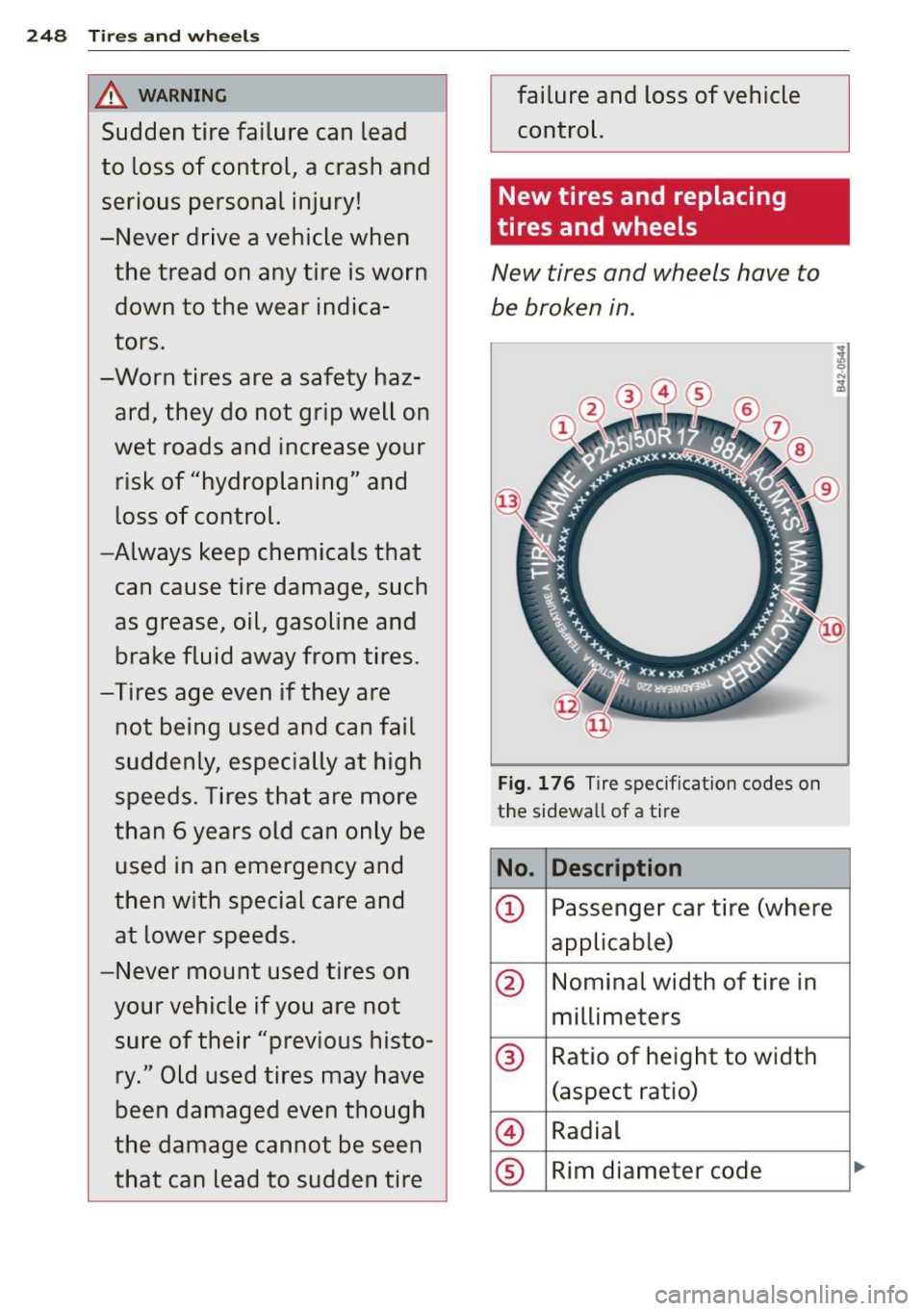
Fig. 176 Tire specification codes on
the sidewall of a tire
No. Description
CD Passenger car tire (where
applicable)
@ Nominal width of tire in
millimeters
® Ratio of height to width
(aspect ratio)
@ Radial
® Rim diameter code
Page 255 of 302
Tires and wheels 253
sure of their "previous histo-and sudden deflation and
ry." Old used tires may have loss of control.
been damaged even though -Temperature grades apply
the damage cannot be seen to tires that are properly in-
that can lead to sudden tire flated and not over or un-
' •
•
failure and loss of vehicle derinflated.
control. -For technical reasons it is
-All four wheels must be fit- not always possible to use
ted with radial tires of the wheels from other vehicles -
same type , size (rolling cir-
in some cases not even
cumference) and the same wheels from the same vehi-
tread pattern. Driving with cle model.
different tires reduces vehi- -If you install wheel trim
cle handling and can lead to discs on the vehicle wheels,
a loss of control. make sure that the air flow
-If the spare tire is not the to the brakes is not blocked.
same as the tires that are Reduced airflow to the
mounted on the vehicle - for brakes can them to over-
example with winter tires - heat, increasing stopping
only use the spare tire for a distances and causing a col-
short period of time and lision.
drive with extra ca re. Refit -Run flat tires may only be
the normal road wheel as used on vehicles that were
soon as safely possible. equipped with them at the
-Never drive faster than the factory. The vehicle must
maximum speed for which have a chassis designed for
the tires on your vehicle are run flat tires. Incorrect use
rated because tires that are of run flat tires can lead to
driven faster than their rat- vehicle damage or acci-
ed speed can fail suddenly. dents. Check with an au-
-Overloading tires cause heat thorized Audi dealer or tire
' M • N
" build-up, sudden tire fail- specialist to see if your vehi-> co ......
ure, including a blowout cle can be equipped with ... \!) 1.1'1
...... 1.1'1 ......
Page 258 of 302
256 Tires and wheels
loss of control, crashes and serious per
sona l injuries . Have worn or damaged tires
replaced immediate ly.
- Winter tires have maximum speed rating
that may be lower than your vehicle's
maximum speed .
- Never drive faster than the speed for
which the winter or other tires installed
on your vehicle are rated.
A WARNING
Always adjust your driving to the road and
traffic conditions. Never let the good ac
celeration of the winter tires and all-wheel
drive tempt you into taking extra risks. Al
ways remember:
- When braking, an all-wheel drive vehicle
handles in the same way as a front drive
vehicle .
- Drive carefully and reduce your speed on
icy and slippery roads, even winter tires
cannot help under black ice conditions.
@) For the sake of the environment
Use summer tires when weather condi
tions permit. They are quieter, do not wear
as quickly and reduce fuel consumption.
Snow chains
Snow chains may be fitted only to the front
wheels, and only to certain tire sizes. Ask your
authorized Audi dealer on which tire sizes
snow chains can be used.
If you are going to use snow chains, then you
must install them on the front wheels at
l east.
The snow chains must have low-profile links
and must not be thicker than 0.53 inch
(13.5 mm), including the lock.
Remove wheel center covers and trim discs
before putting snow chains on your vehicle
q 0 . For safety reasons cover caps must then
be fitted over the wheel bolts. These are avail
able from authorized Audi dealers.
A WARNING
Using the wrong snow chains for your vehi
cle or installing them incorrectly can in
crease the risk of loss of control leading to
serious personal injury.
- Snow chains are available in different
sizes . Always make sure to follow the in
structions provided by the snow chain
manufacturer.
- When driving with snow chains never
drive faster than the speed permitted for
your specific snow chains.
- Always observe local regulations.
@ Note
-Remove snow chains before driving on
roads not covered with snow to avoid
damaging tires and wearing the snow
chains down unnecessarily .
- Snow chains, which come into direct con
tact with the wheel rim, can scratch or
damage it. Therefore, make sure that the
snow chains are suitably covered. Check
the position of the snow chains after
driving a few yards and correct if neces
sary. Follow the instructions from the
snow chain manufacturer when doing so.
@ Tips
Where snow chains are mandatory on cer
tain roads, this normally also applies to
vehicles with all-wheel drive .
Wheel bolts
Wheel bolts must always be tightened to the
correct torque.
The design of wheel bolts is matched to the
factory installed rims. If different rims are fit
ted, the correct wheel bolts with the right
length and correct ly shaped bolt heads must
be used. This ensures that wheels are fitted
securely and that the brake system functions
correctly . .,..
Page 263 of 302
....,
N
r--. > co
rl I.O
"' rl
"' rl
What do I do now? Luggage compartment
lid emergency release
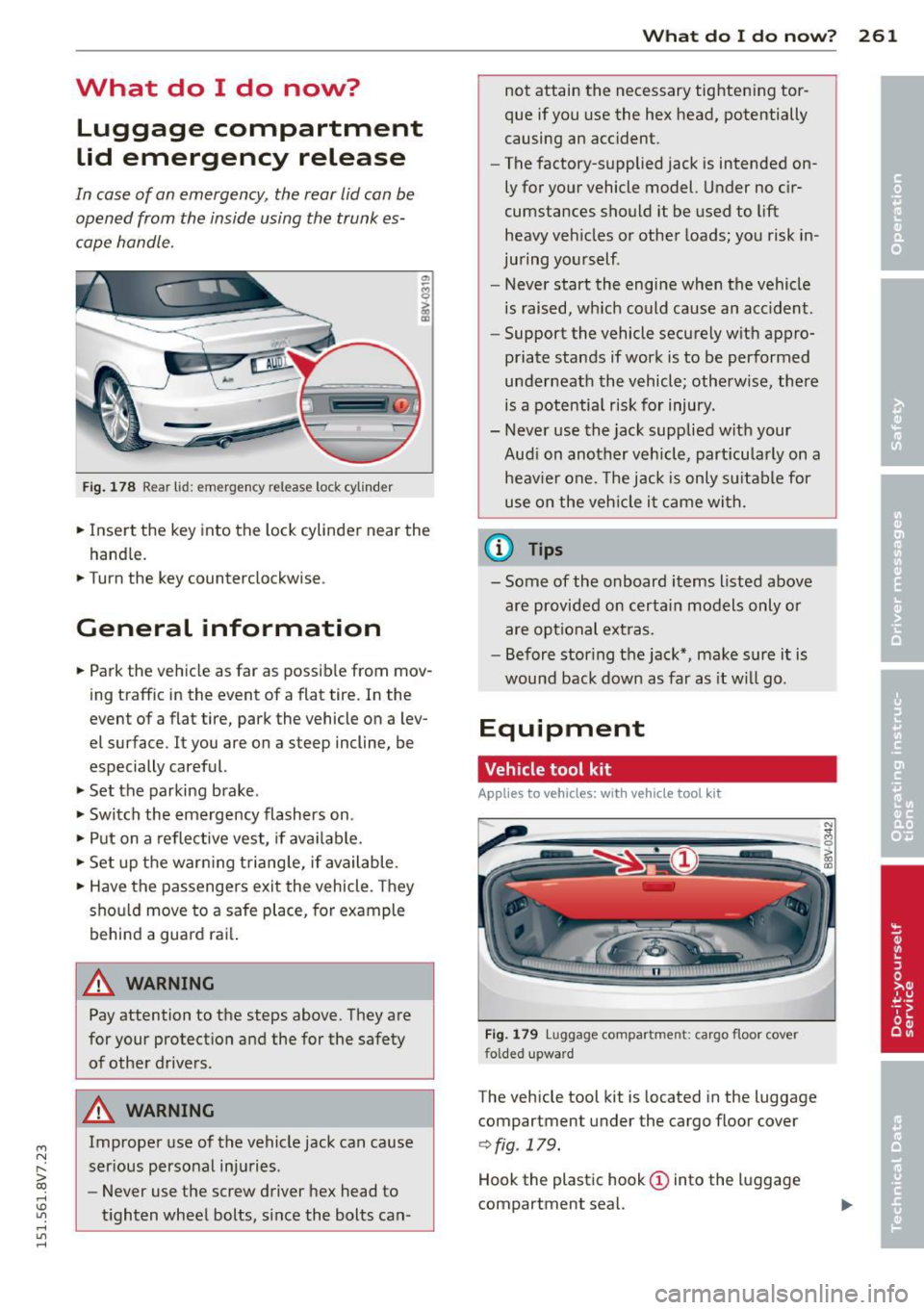
In case of an emergency, the rear lid can be
opened from the inside using the trunk es
cape handle .
Fig. 178 Rear lid: emergency release lock cylinder
.,. Insert the key into the lock cylinder near the
hand le .
.,. Turn the key counterclockwise .
General information
.,. Park the vehicle as far as possib le from mov
ing traff ic in the event of a flat tire. In the
event of a flat tire, park the vehicle on a lev
el surface. It you are on a steep incline, be
especially careful.
.,. Set the parking brake .
.,. Switch the emergency flashers on .
.,. Put on a reflective vest, if avai lable .
.,. Set up the warn ing t riang le, if available .
.,. Have the passengers exit the vehicle. They
shou ld move to a safe place, for example
behind a guard rail.
.&_ WARNING
Pay attention to the steps above . They are
for your protection and the for the safety
of other drivers.
.&_ WARNING
Improper use of the vehicle jack can cause
ser ious personal inju ries .
- Never use the screw driver hex head to
tighten wheel bolts, since the bolts can-
What do I d o now ? 261
not attain the necessary tightening tor
que if you use the hex head, potentially
causing an accident.
- The factory-supplied jack is intended on
ly for your vehicle model. Under no c ir
cumstances should it be used to lift
heavy veh icles o r other loads; you risk i n
juring yourself .
- Never start the engine when the vehicle
is raised, wh ich could cause an acc ident.
- Support the vehicle securely with appro
priate stands if work is to be performed
underneath the vehicle; otherwise , there
is a pote ntia l risk for injury .
- Never use the jack supplied with your Aud i on another vehicle , part icularly on a
heav ier one. The jack is only su itable for
use on the veh icle it came with .
a) Tips
- Some of the onboard items listed above
are provided on certai n models only or
are opt ional ext ras.
- Before stor ing the jack*, ma ke sure it is
wound back down as far as it w ill go.
Equipment
Vehicle tool kit
Applies to vehicles: with vehicle tool kit
Fig. 179 Luggag e compar tment: cargo floor cover
folde d upward
The vehicle tool kit is located in the luggage
compartment under the cargo floor cover
¢fig . 179 .
Hook the plast ic hook CD into the luggage
compartment seal.
Page 265 of 302
the tire chain before mounting the wheel
and tire is recommended.
- Loose items in the passenger compart
ment can cause serious personal injury
during hard braking or in an accident.
Never store the inf latab le spare tire or
jack and tools in the passenger compart
ment.
- Normal summer or winter tires must not
be mounted on the compact spare wheel
rim.
Removing the subwoofer
A pp lies to vehicles: with s ubwoofer
The subwoofer must be removed before the
spare wheel* can be removed.
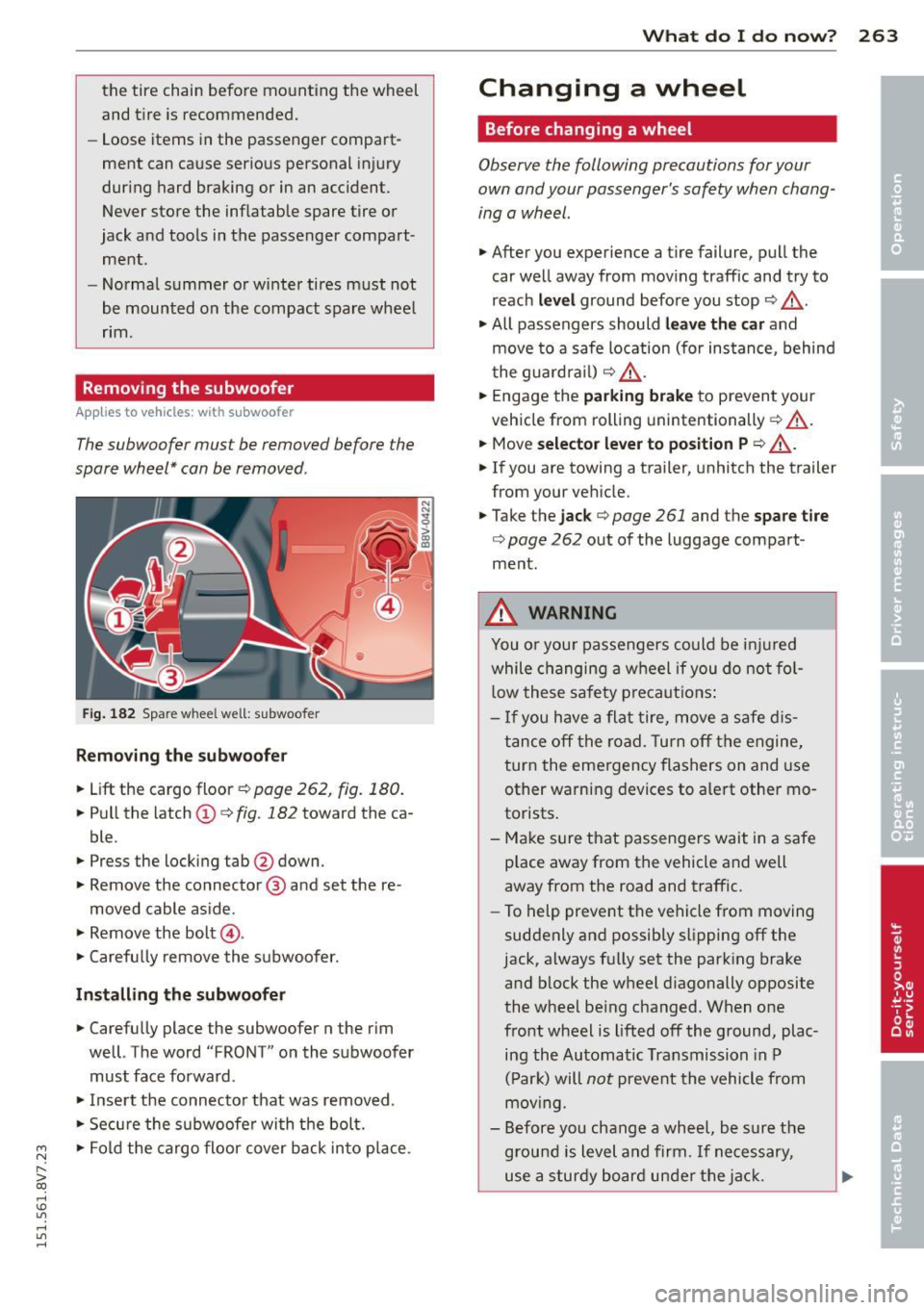
Fig. 182 Spare wheel well: subwoofer
Removing the subwoofer
• Lift the cargo floor c:, page 262, fig. 180.
• Pull the latch (D c:> fig. 182 toward the ca
ble.
• Press the locking tab @down .
• Remove the connector @ and set the re-
moved cable aside.
• Remove the bolt@.
• Carefully remove the subwoofer.
Installing the subwoofer
• Carefully place the subwoofer n the rim
well. The word "FRONT" on the subwoofer
must face forward .
• Insert the connector that was removed .
• Secure the subwoofer with the bolt.
~ • Fold the cargo floor cover back into place.
r--. > co
rl I.O
"' rl
"' rl
What do I do now? 263
Changing a wheel
Before changing a wheel
Observe the following precautions for your
own and your passenger's safety when chang
ing a wheel.
• After you experience a tire failure, pull the
car well away from moving traffic and try to
reach
level ground before you stop c:> _&..
• All passengers should leave the car and
move to a safe location (for instance, behind
the guardrail)
c:> _&..
• Engage the parking brake to prevent your
vehicle from rolling unintentionally
c:> _&. .
• Move selector lever to position P c:> ,&..
• If you are towing a trailer, unhitch the trailer
from your vehicle.
• Take the
jack c:, page 261 and the spare tire
r:> page 262 out of the luggage compart
ment .
A WARNING
You or your passengers could be injured
while changing a wheel if you do not fol
low these safety precautions:
-If you have a flat tire, move a safe dis
tance off the road. Turn off the engine,
turn the eme rgency flashers on and use
other warning devices to alert other mo
torists.
- Make sure that passengers wait in a safe
place away from the vehicle and well
away from the road and traffic.
- To help prevent the vehicle from moving
suddenly and possibly slipping off the
jack, always fully set the parking brake
and block the wheel diagonally opposite
the wheel being changed. When one
front wheel is lifted off the ground, plac ing the Automatic Transmission in P
(Park) will
not prevent the vehicle from
mov ing .
- Before you change a wheel, be sure the
ground is level and firm. If necessary,
use a sturdy board under the jack.
-
Page 272 of 302
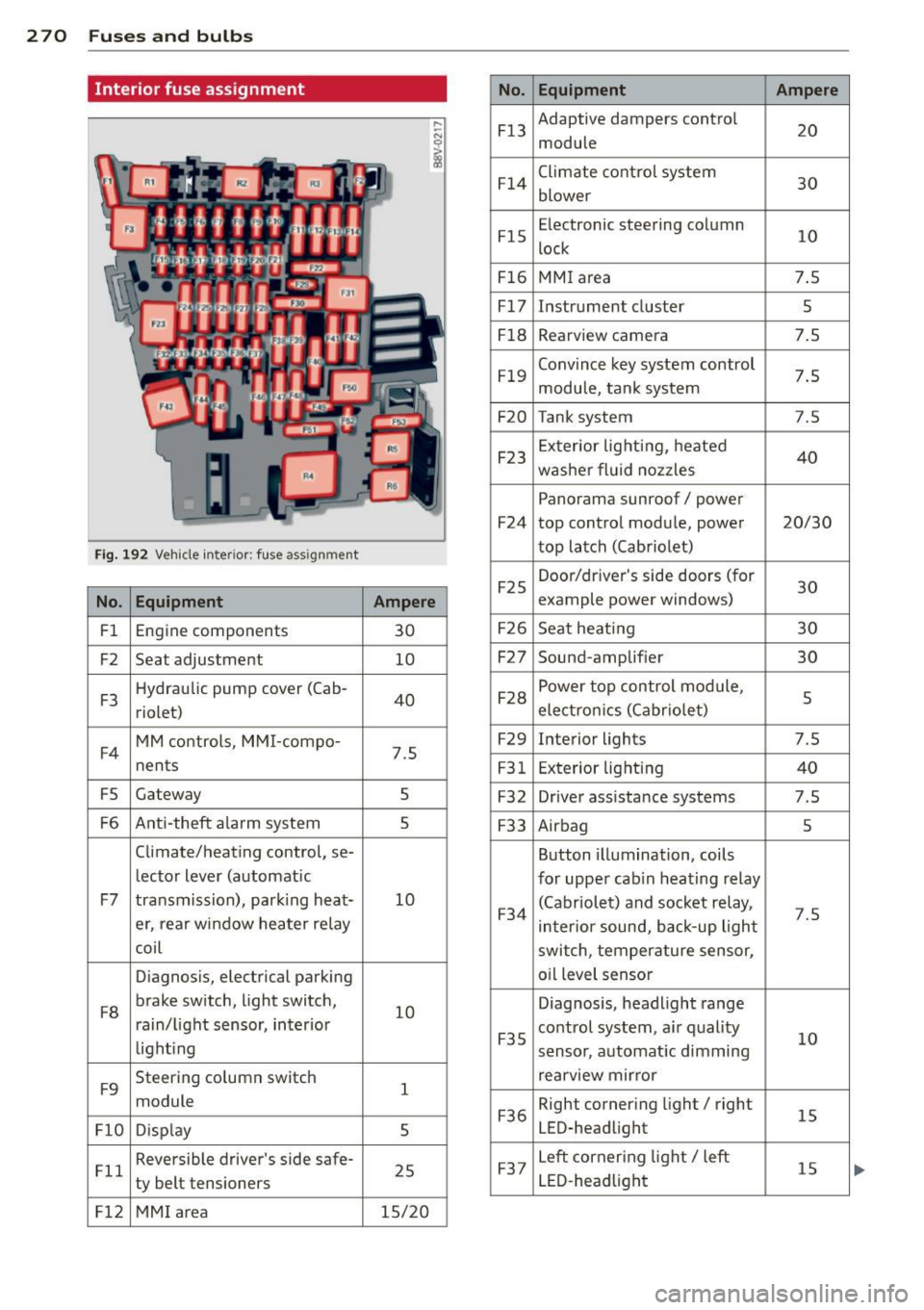
2 70 Fuses and bulbs
Interior fuse assignment
No. Equipment Ampere
Fl 3 Adaptive dampers contro
l
20
module
Fl4 Climate
control system
30
blower
Fl S E
lectronic steering column
10
lock
Fl6 MM I area 7.5
Fl7 Instrument cluster 5
Fl8 Rearview camera
7.5
F l9 Convince key
system control
7.5
module, tank system
F20 Tank system
7.5
F23 E
xterior lighti ng, heated
40
washe r fl ui d nozzles
Panorama sunroof/ power
F24 top control module, power 20/30
Fig. 192 Vehicle inter ior : fuse assignment top latch (Cabriolet)
No. Equipment Ampere
F25 Door/dr
iver's side doors (for
30
example power windows)
Fl Engine components 30 F26 Seat heat
ing 30
F2 Seat adjustment 10 F27
Sound-amplif
ier
30
F3 Hydraulic pump
cover (Cab-
40
riolet) F28
Power top control module,
5
elect ro ni cs (Cabr io let)
F4 M
M co ntrols, M MI-compo-
7.5
nents F29
Inte
rior lights
7.5
F3 1 E xterior lighting
40
F5 Gateway
5
F32 Driver ass istance systems 7.5
F 6 Anti-theft a
larm system
s F33 Airbag 5
Climate/heating control, se-
Button illumination, coils
lector lever (automatic
for upper cab in heating relay
F7 transmission), park ing heat- 10
er, rear window heater re lay F34 (Cabriolet) and socket relay,
7.5
in ter ior sound, back-up light
coil switch, temperature sensor,
Diagnosis, electrical parking oil level sensor
F 8 brake
switch, light switch,
10
rain/ light sensor, interior
light ing Diagnosis, headlight range
F35 co
ntrol system, a ir quality
10
sensor, a utomat ic dimming
F9 Steering column
switch
1
module
Fl0 D isp lay 5 rearview mir
ror
F36 Right
corner ing light/ right
15
LED-headlight
Fll Reversible driver's
side safe-
25
ty belt tensioners F37
Left corner
ing light/ left
15
L E D- headlight
Fl 2 M MI area 15/20
Page 273 of 302
....,
N
" > co
rl I.O
"' rl
"' rl
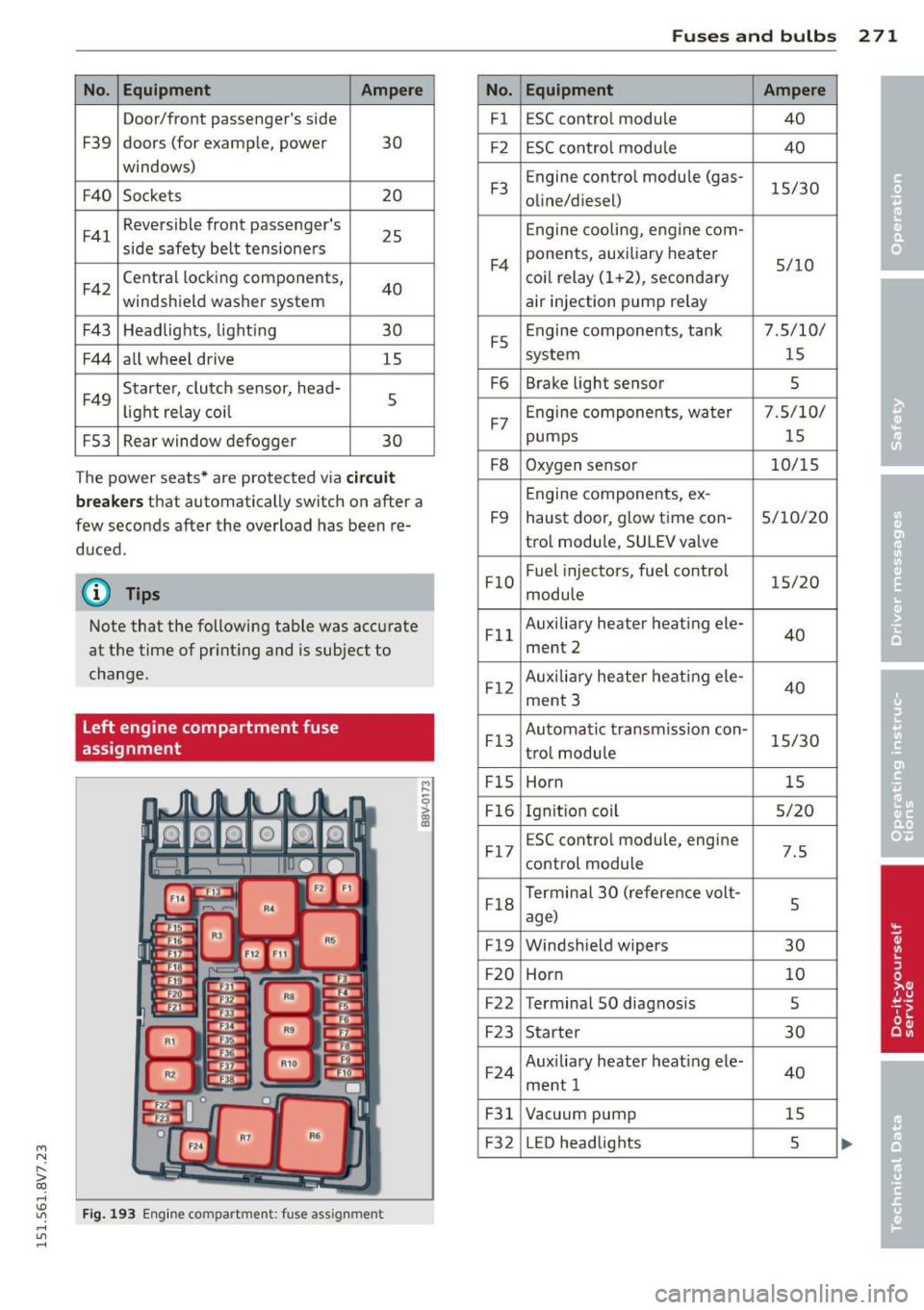
No. Equipment Ampere
Door/front passenger's side
F39 doors (for examp le, power
30
windows)
F40 Sockets 20
F41 Reversible front
passenger's
25
side safety belt tensioners
F42 Central locking components,
40
windshield washer system
F43 Headlights, light ing 30
F44 all wheel drive
15
F49 Starte
r, clutch sensor, head-
5
light re lay coil
FS3 Rear window defogger 30
The power seats* are protected v ia
ci rc uit
b reaker s
that automatically sw itch on after a
few seconds after the overload has been re
duced.
(D Tips
Note that the following table was accurate
at the time of print ing and is subject to
change.
Left engine compartment fuse
assignment
F ig. 193 Engine compartme nt: fuse assignment
No.
Fl
F2
F3
F4
F5
F6
F7
F8
F9
FlO
F ll
F12
Fl3
FlS
F l 6
F l 7
Fl8
F19
F20
F22
F23
F24
F3 1
F32
Fu se s and bulb s 2 71
Equipment Ampere
E5C contro l modu le 40
ESC contro l modu le 40
Engine control module (gas-
15/30
oli ne/d iesel)
Engine cooling, eng ine com-
ponents, auxiliary heater 5/10
coi l relay (1+2), secondary
air injection pump relay
Engine components, tank 7.5/10/
system 15
Brake light sensor 5
Engine components, wa ter 7.5/10/
pumps 15
Oxygen sensor
10/15
Engine compone nts, ex-
haust door, glow time con- 5/10/20
tro l module, SU LEV valve
Fuel injectors, fuel control
15/20
module
Auxiliary heater heating ele- 40
ment 2
Auxilia ry heater heat ing ele-
40
ment 3
Automat ic transmiss ion con-
15/30
t ro l module
Horn 15
Ignit ion coil 5/20
ESC contro l module, engine
7.5
control module
T ermina l 30 (reference volt-
5
age)
Windsh ie ld wipers
30
Horn 10
Termina l 50 diagnosis
5
Starter 30
Auxilia ry heater heat ing ele-
40
ment 1
Vacuum pump 15
L E D head lights 5