brake AUDI A3 CABRIOLET 2015 Workshop Manual
[x] Cancel search | Manufacturer: AUDI, Model Year: 2015, Model line: A3 CABRIOLET, Model: AUDI A3 CABRIOLET 2015Pages: 302, PDF Size: 73.83 MB
Page 203 of 302
M N
" > co ,...., \!) ..,.,
,...., ..,., ,....,
Trailer towing Driving with a trailer
General information
Your Audi was designed primarily for passen
ger transportation .
If you plan to tow a tra iler, p lease remember
that the addit ional load will affect durab ility,
economy and performance .
Trailer towing not on ly places more stress on
the vehicle, it also calls for more concentra
tion from the driver.
F or this reason, a lways fo llow the operating
a n d driving instr uctions provided and use
common sense.
Technical requirements
Traile r hitch
Use a weight-carrying hitch conforming to the
gross trailer we ight. The hitch must be suita
b le for your veh icle and trailer and must be
mounted secure ly on t he veh icle's chassis at a
technically sound location . Use only a t railer
h itch w ith a removab le ball moun t. A lways
check with the tr ailer hitch man ufac tur er to
make sure that you are using the correct
hitch.
Do not use a bumper hitch.
T he hitc h must be installed in such a way that
it does not inte rfe re with the impac t-absorb
i ng b umper syst em. No modifica tions should
be made to the vehicle exhaus t and b rake sys
tems . From t ime to time, check that a ll hitch
mo unt ing bolt s remain securely fas tened.
W hen you are not tow ing a trailer, remove the
trai le r hi tch ball moun t. T h is prevents the
hi tch from causing damage sho uld your ve hi
cle be str uck from be hind
¢ &. .
Trailer brakes
If yo ur tra iler is equ ipped w it h a braking sys
tem, check to be su re that it conforms to a ll
r eg ulat io ns .
Trailer towin g 201
The trailer hyd ra ulic bra ke system must not be
direct ly connected to the vehicle's hydraulic
brake system .
Safety chains
Alw ays use saf ety chains between your ve hicle
and t he tra ile r.
Trailer lights
Tra iler lights must meet all reg ulations . Be
su re to check with your Audi dea ler fo r cor re ct
wir ing, swi tches and relays.
Mirrors
If you a re unable to see the traffic behind you
u sing the regula r outside m irrors, then you
must i nsta ll ext ended mir rors . It is important
t h at you
always have clea r vis ion to the rear .
.8, WARNING
-
Afte r removing the trailer hit ch, do no t
s tore i t in yo ur vehicle . In case of sudden
b raking, the h itch cou ld fly forwar d an d in
ju re you or yo ur passengers .
Operating instructions
Maximum trailer weight
A tra ile r fo r you r vehicle is limited to a ty pical
cl ass 1 or class 2 tra ile r.
Trailer load distribution
B e sure the loa d in the tr aile r is held secure ly
i n place to p reven t it from shift ing forw ard,
ba ckward or sideways.
Never allow a passenger to ride in a trailer
¢ &. in Driving instru ctions on page 20 2.
Engine cooling system
Towing a trailer makes the engine work hard
er . It is impo rtant that the cooling system's
perfo rmance is up to the additional load .
Make sure that the coo ling syst em has enough
f lui d.
Tire pressure
When towing a trailer , inflate the tires of your
vehicle to t he cold tire pressure listed under .,..
•
•
•
Page 204 of 302
202 Trailer towing
"Full load" on the label located on the driver's
side B-pillar (visible when the door is open).
Inflate trailer tires to trai ler and t ire manufac
turers' specif ications.
Lights
Check to make sure both vehicle and trailer
lights are working properly.
Safety chains
Be sure trailer safety chains are properly con
nected from the trailer to the hitch on the ve
hicle. Leave enough slack in the chains to per
mit turning corners. When you install safety
chains, make sure they wi ll not drag on the
road when you are driving.
The chains should cross under the trailer
tongue to prevent it from dropping in case of
separation from the hitch.
Driving instructions
Driving with a trailer always requires extra
care and consideration.
To obtain the best possible handling of vehicle
and trailer, please note the following:
.. Do not tow a loaded tra iler when your car it
self is not loaded.
.,. Be espec ially car efu l when passing other
vehicles.
.. Observe speed limits.
.. Do not drive at the maximum permissible
speed.
.. Always apply brakes early .
.. Monitor the temperature gauge.
Weight distribution
Towing a loa ded trai ler with an empty ca r re
sults in a high ly unstable distribution of
weight . If this cannot be avoided, drive at very
low speeds only to avoid the risk of losing
steering control.
A "balanced" rig is easier to operate and con
trol. This means that the tow vehicle should be loaded to the extent poss ible and permissi
ble, while keeping the trailer as light as possi
ble under the circumstances . Whenever possi- ble,
transfer some cargo to the luggage com
partment of the tow vehicle while observing
tong ue load requirements and vehicle loading
considerations.
Speed
T he higher the speed, the more difficult it be
comes for the driver to control the rig. Do not
drive at the maximum permissible speed . Re
duce your speed even more if load, weather or
wind conditions are unfavorable -particularly
when going downhill.
Reduce vehicle speed
immediately if the trail
er shows the slightest sign of sway ing.
Do not
try to stop the swaying by accelerating.
Observe speed limits . In some areas, speeds
for vehicles towing trai lers are lower than for
regular vehicles .
Always apply brakes early. When driving
downhi ll, shift into a lower gear to use the en
gine braking effect to s low the vehicle. Use of
the brakes alone can cause them to overheat
and fail.
Coolant temperature
The coolant temperature gauge~ page 12
must be observed carefu lly. The coolant tem
perature can increase if you drive on long in
clines in a low gear at high engine speeds. Re
duce your speed immediately if the LEDs in
the top part of the d isplay turn on .
For more information about indicator lights,
refer to. ~
page 19 .
A WARNING
Anyone not properly restrained in a mov
ing vehicle is at a much greater risk in an
accident. Never let anyone ride in your car
who is not properly wearing the restraints
provided by Audi.
Trailer towing tips
Important to know
Your vehicle handles differently when towing
a trai ler because of the additional weight and ..,.
Page 205 of 302
M N
" > co ,...., \!) 1.1"1 ,...., 1.1"1 ,....,
different weight distribution. Safety, perform
ance and economy wi ll greatly depend on how
carefu lly you load your trailer and operate
your rig.
Before you actually tow your trailer, practice
turning, stopping and backing up in an area
away from traffic. Keep practicing until you
have become comp letely familiar with the way
your vehicle- trailer combination behaves and
responds .
Backing up is d ifficult and requires practice.
Backing up with a trai ler generally requires
stee ring action opposite to that when backing
up your vehicle without a trailer .
Maintain a greater distance between your ve
hicle and the one in front of you. You will need
more room to stop. To compensate for the
trailer, you will need a larger than normal
turn ing radius.
When passing, remember that you cannot ac
celerate as fast as you normally would be
cause of the added load. Make sure you have
enough room to pass . After passing, allow
p lenty of room for your tra iler before chang
ing lanes again.
Avoid jerky starts, sharp turns or rapid lane
changes.
(D Tips
- Do not tow a tra iler during the break-in
period of your vehicle.
- If you tow a trailer, your Audi may re
quire more frequent maintenance due to
the extra load
¢ page 282 .
Parking on a slope
Do not park on a slope with a trailer. If i t can
not be avoided, do so only after doing the fol
lowing:
When parking:
.. Apply the foot brake.
.. Have someone place chocks under both the
vehicle and the trailer wheels.
Trailer towing 203
.. With chocks in place, slowly release the
brakes until the wheel chocks absorb the
load .
.. Turn the wheels towards the curb.
.. Apply the parking brake.
.. Select the P selector lever posit ion.
When re starting after parking:
.. App ly the foot brake.
.. Start the engine.
.. Select the
0/5 selector lever position.
.. Release the parking brake and slowly pull
out and away from the wheel chocks .
.. Stop and have someone retr ieve the wheel
chocks.
(D Tips
If you move the selector lever of the auto
matic transmission to
P before applying
the parking brake and before blocking the
whee ls, you may have to use more force
lat er to move the lever out of the
P posi
tion.
•
•
•
Page 207 of 302
M N
" > co ,...., \!) ..,.,
,...., ..,., ,....,
Care and cleanin g 205
& WARNING
- Only wash the vehicle when the ignition
is off and follow the instructions from
the car wash operato r to reduce the risk
of accidents.
- To reduce the risk of cuts, protect your
self from sharp metal components when
wash ing the underbody or the inside of
the whee l housings.
- After washing the vehicle, the braking ef
fect may be delayed due to mo isture on
the brake rotors or ice in the winter . The
brakes must be dried first with a few
careful brake applicat io ns.
{[) Note
- If you wash th e vehicle in an automatic
ca r wash, yo u m ust fold the exterior m ir
ro rs in to reduce the r isk of damage to
the mirrors . Power foldi ng exterior m ir
r o rs* must o nly be folded in and out us
i ng the power folding function.
- To prevent pa int damage, do not wash
th e veh icle in direc t sun ligh t. -
To reduce the r is k of damage, do no t
wash the powe r top with a pressure
washer.
- To reduce the r is k of damage to the sur
face, do not use i nsect removing spong
es, kitchen sponges or similar items.
- Matte finish painted vehicle compo
nents:
- To reduce the risk of damage to the
surfac e, do not use polishi ng agents or
ha rd wax.
- Neve r use prot ective wax. It can de
stroy the matte fin is h effect.
- Do not place any stickers o r magnet ic
signs on vehicle parts painted w it h
ma tte fi nish pa in t. The pa int cou ld be
da maged whe n the stickers o r m ag nets
ar e removed.
@ For the sake of the environment
Only wash t he ve hicl e in facili ties spe cially
d es igned for th at p urpose . Th is will re duce
the r is k of d irty wate r contam ina ted with
oil from entering t he sewer system.
Cleaning and care information
When clea ning and caring for individua l vehi
cle components, refe r to the fo llow ing tab les .
The informa tion contained there is s imp ly rec
ommendations. Fo r quest ions or for compo -n
ents that are not listed , refer to an author
i z ed Audi dea ler. Also follow the info rma tion
fo und in ~ &, .
Exterior cleaning
Component Situation Solution
Wind shield wip-
Deposits ¢ page 54, Cleaning windshield wiper blades
er bl ade s
Headlights /
Deposits Soft sponge with a m ild soap solution3>
Tail lights
Sensors /
Deposits Sensors: soft cloth w ith a so lvent-free cleaning product
camera lenses Camera lenses: soft cloth with an alcohol-free cleaning
so lution
Snow/ ice Hand brush/so
lve nt-free de -icing spray
Wheels Road sa lt Water
Brake dust Acid
-free special cleaning so lu tion
E x haust tail Road sa lt Water, cleaning solut ion suitable for stainless steel, if
pipes necessary •
•
•
Page 216 of 302
214 Check ing and F illin g
•Pullon the cover carefu lly ¢ fig. 162. The
tab on the cover must point forward in the direction you are pulling when pu lling on
the cover.
• To open the fuel filler door, press on the left
side
¢ page 212, fig . 160 .
{Q) Note
Only pull on the cover unt il you feel resist
ance. You will not hear it release . Other
w ise you could damage the emergency re
lease mechanism.
Hood
Working in the engine compartment
Special care is required if you are working in the engine compartment
F o r w ork in th e eng in e c omp artm ent su ch as
c h ecking and fi llin g fluid s, t he re i s a risk of
inj ury, sca lding, accid ents, a nd b urn s. Fo r
thi s re aso n, follow all the follow in g listed
war ning s and ge neral safety p recaution s.
T he engine compartment is a d ang ero us
area. ¢,& .
A WARNING
To reduce the risk of injur ies, complete the
following steps before opening the hood:
- Turn the engine off.
- Switch the ignition off.
- Set the parking brake.
- Place the selector lever in the P position .
- Let the engine coo l down.
- Never open the hood when you see that
steam o r coolant drips from the engine
c ompartment- there is a danger of
burns! Wait until no steam or coolant
flows out.
- Keep chi ldren away from the engine com
partment.
- Never spill flu ids on a hot eng ine. These
fluids (such as the freeze protection con
tained in the coolant) can catch fire .
- Avo id short circuits in the electrical sys
tem, especially the battery . -
When working in the engine compart
ment, remember that the radiator fan
can switch on even if the ignition is
sw itched off, which increases the risk of
personal injury.
- Never open the cap on the coolant ex
pans ion tank when the eng ine is warm.
The cooling system is unde r pressure.
- To protect your face, hands, and arms
from hot steam or coolant, cover the cap
with a large cloth when opening .
- Do not remove the engine cover under any circumstances. This increases the
risk of burns .
- If tests need to be performed with the engine runn ing, there is add itiona l dan
ge r due to moving components (such as
the ribbed belt, generator and radiator
fan) and from the high voltage ignit ion
system.
- Never reach into the radiator fan. The
electric auxilia ry fan is controlled by
temperature and can switch on sudden ly .
- Pay attention to the fo llow ing warnings
listed when work on the fuel system or
on the e lectrica l equipment is required.
- Always disconnect the vehicle battery
from the vehicle e lectr ical system
- Do not smoke
- Never work near open flames
- Always have a working fire exting uisher
nearby
- To reduce the risk of electric s hock and
inj ury, never touch the fo llowing compo
nents when the engine is running or is
be ing started :
- Ig nition cable
- Other compone nts in the electronic
high voltage ign it ion system
- If you must check or perform work on the eng ine while it is runn ing:
- Set the parking brake and place these
lector lever in the P (park) position
first.
- Always proceed with extreme caution
so that clot hing, jewe lry or long hai r do
not become caught in the radiator fan, ..,.
Page 218 of 302
216 Checking and Filling
Closing the hood
,. Push the hood down until the force of the
strut is overcome.
,. Then lower the hood and let it fall into the
engine hood latch -you do
not have to press
on the hood after it is locked.~
A-
_& WARNING
If the hood is not latched completely, it
could fly up while you are driving and ob
struct your vision .
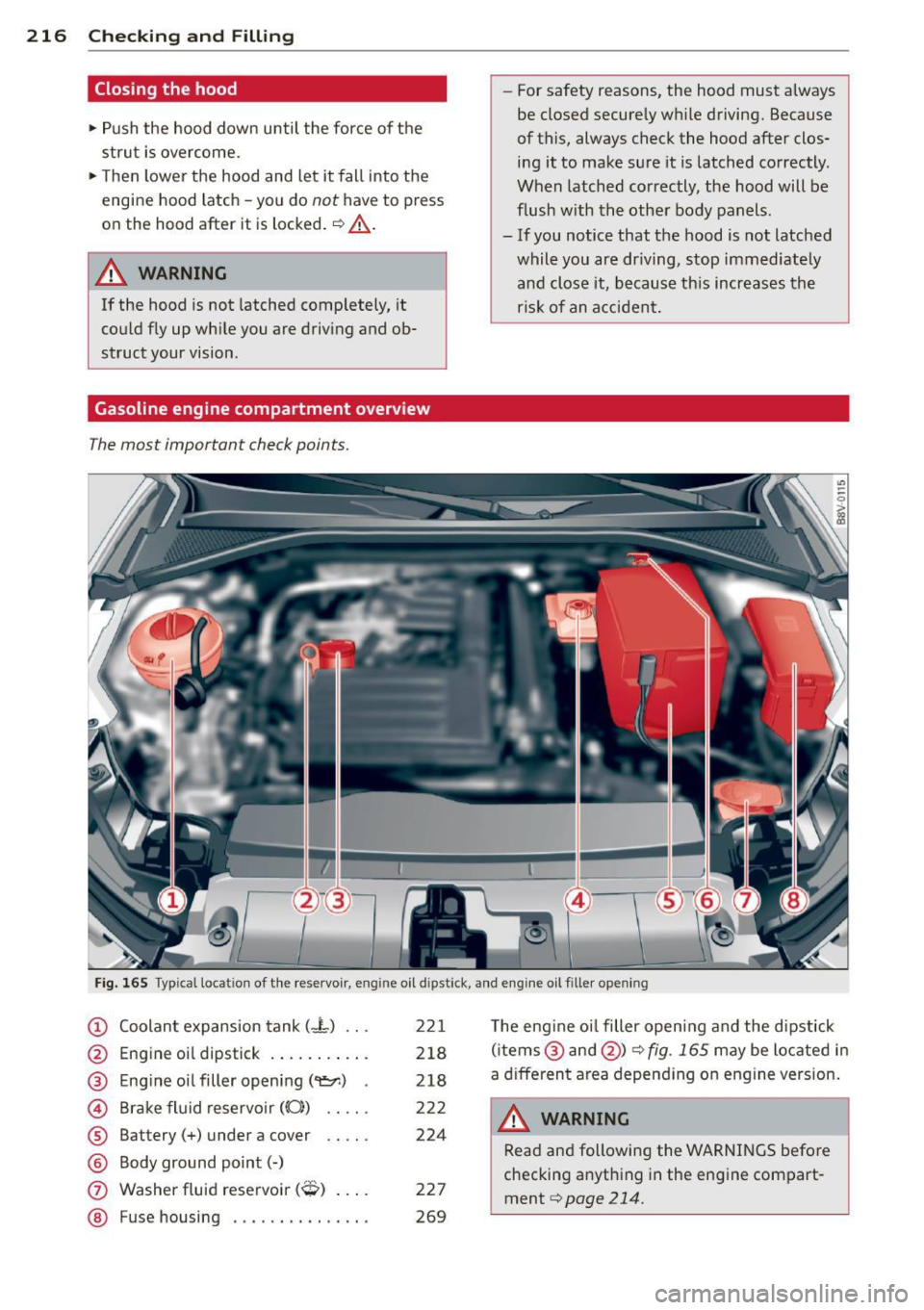
Gasoline engine compartment overview
The most important check points.
-
-For safety reasons , the hood must a lways
be closed secure ly while driving. Because
of this, always check the hood after clos
ing it to make sure it is latched correctly.
When latched correctly , the hood will be
f lush w ith the other body panels.
- If you notice that the hood is not latched
while you are dr iving, stop immediately
and close it, because this increases the
risk of an acciden t.
Fig. 165 Typica l locat ion of the reservoir, engine o il dipst ick, and engine o il filler open ing
@ Coolant expansion tank (- L) .. . 221 The engine oi l filler opening and the dipstick
@ Engine oil dipstick .......
... .
218 (items @ and @) c> fig. 165 may be located in
® Eng ine oil filler opening ('e::r.) 218 a different area depending on engine version.
© Brake fluid reservoir ((0) .. .. . 222 A WARNING
® Battery(+) under a cover .. .. . 224
® Body ground point(-) Read
and following the WARNINGS before
checking anything in the engine compart-
(J) Washer f luid reservoir (0) ... . 227 ment c> page 214.
® Fuse housing .......... .... . 269
Page 224 of 302
222 Checking and Filling
After you switch the engine off, the auxiliary
fan can continue running for up to 10 minutes
- even with the ignition off. It can even switch
on again later by itself
c:> .&. , if
- the temperature of the engine coolant rises
due to the heat build-up from the engine in
the engine compartment, or
- the engine compartment heats up beca use
the vehicle is parked in intense sunlight.
A WARNING
- To reduce the risk of personal injury
nev
er touch the radiator fan.
- The auxiliary electr ic fan is temperature
contro lled and can switch on sudden ly
even when the engine is not running.
- The auxiliary radiator fan switches on au tomatically when the engine coolant
reaches a certain temperature and will
continue to run until the coolant temper
ature drops.
Brake fluid
Checking brake fluid level
N
N
;;;
" 00 co
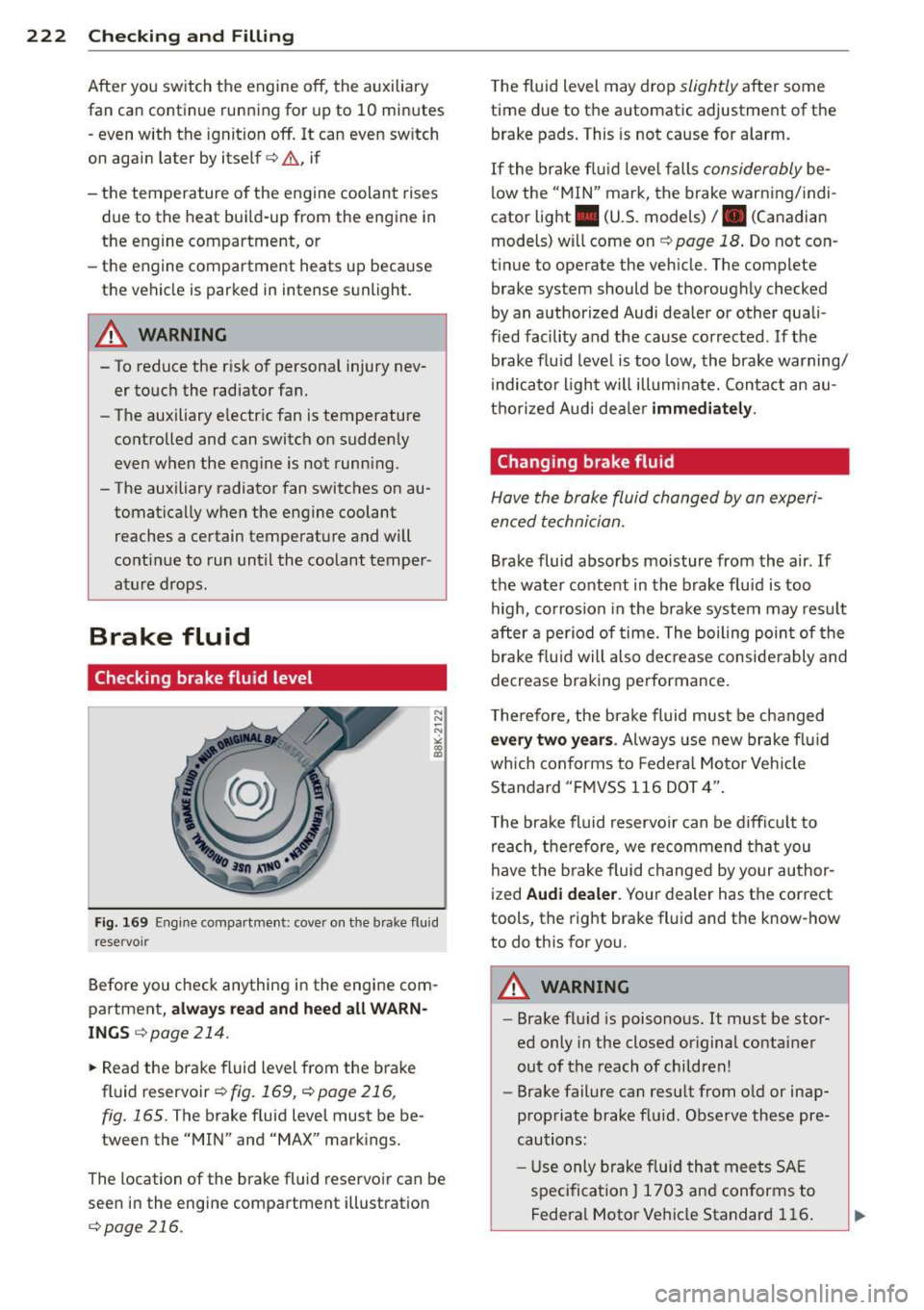
Fig . 169 Engine compartment : cove r on the brake flu id
r eservoir
Before you check anything in the engine com
partment,
always read and heed all WARN ·
INGS c:> page 214.
.. Read the brake fluid level from the brake
fluid reservoir
c:> fig.169, c:>poge216 ,
fig. 165.
The brake f luid level must be be
tween the "MIN" and "MAX" markings.
The location of the brake fluid reservoir can be
seen in the engine compartment illustration
c:> page 216 .
The fluid level may drop slightly after some
time due to the automatic adjustment of the
brake pads . This is not cause for a larm.
If the brake f luid level falls
considerably be
low the "MIN" mark, the brake warning/indi
cator light . (U.S. models)
I. (Canad ian
models) will come on
c:> page 18 . Do not con
tinue to operate the vehicle. The complete brake system should be thoroughly checked
by an authorized Audi dealer or other quali
fied facility and the cause corrected. If the
brake fluid level is too low, the brake warning/
indicator ligh t will illuminate. Contact an au
thorized Audi dea ler
immediately.
Changing brake fluid
Have the broke fluid changed by an experi
enced technician.
Brake fluid absorbs moisture from the air. If
the water content in the brake f luid is too
high, corrosion in the brake system may result
after a period of time. The boiling point of the
brake fluid will also decrease considerably and
decrease braking performance.
T he refo re, the brake fluid must be changed
every two years. Always use new brake fluid
wh ich conforms to Federal Motor Vehicle
Standard "FMVSS 116 DOT 4".
T he brake fluid reservoir can be difficult to
reach, therefore, we recommend that you
have the b rake fluid changed by your author
ized
Audi dealer. Your dealer has the correct
tools, the right brake fluid and the know-how
to do this for you .
A WARNING
---Brake flu id is poisonous. It must be stor
ed only in the closed or iginal container
out of the reach of children!
- Brake failure can resu lt from o ld or inap·
propriate brake flu id. Observe these pre·
cautions:
- Us e only brake fluid that meets SAE
specification
J 1703 and conforms to
Federa l Motor Vehicle Standard 116.
Page 225 of 302
M N
" > co ,...., \!) ..,.,
,...., ..,., ,....,
Always check with your authorized Audi
deale r to make s ure you are using the
correct brake f luid. The correct type of
b rake fluid is a lso indicated on the
b rake fluid reservoir .
- The brake f luid must be new. Heavy use
of the brakes can cause a vapor lock if
the brake fl uid is left in t he system too
long. This ca n ser ious ly aff ect th e effi
ciency of the bra kes a s well as yo ur
safety. This could resul t in an accid ent.
(D Note
Brake fl uid will damage the paint of your
ve hicle .
@ For the sake of the environment
Because of the problem of proper d isposa l
of brake flu id as we ll as the special tools
req uired and the necessa ry expert ise, we
recom mend tha t you have t he b rake fluid
changed by your aut hor ized Audi de aler.
Battery
General information
The batte ry in you r Audi does not need any
maintenance unde r
normal operating condi
tions . Aud i recommends having the elect ro
l y te level check by a n author ized Audi dealer
or author ized A udi Se rv ice F acili ty when there
a re
high outside tempe ra tur es or when dr iv ing
all day. The e lec trolyte level sho uld also be
checked each time the battery is charged
¢ page 225.
Have the bat tery c hecked w hen you br ing yo ur
ve hicl e in for an inspec tion. I t is a good idea
to re place the battery if it is mo re than 5 years
old .
D uring certa in types of a irbag deploymen ts,
t he bat tery is disconnected from the vehi cle
e lectrical system fo r safety reasons ~ &.
in
Repair, care and disposal of the airbags on
page 162.
Checking and Fillin g 223
Disconnecting the battery terminals
Some vehi cle fu nctions (such as power w in
dows) a re not ava ilable when the batte ry is
disco nnected . These fu nctions must be p ro
grammed afte r the battery is reconnected . To
avo id hav ing to do this, only disconnect the
battery from the vehicle electrical system
whe n that is necessary to perform repairs .
To reprogram the functions, proceed as fo l
lows:
Function Reprogramming
Power window one -¢ page 40, Correcting
touch up/down power window ma/-
function functions
Remo te control key If the vehicle does no t
or r
eact to the key, i t
convenience key must be synchronized
¢ page33
Dig ita l cl ock ¢pag e 10
ESC indicator light The indicator light
goes out after driv ing
a few meters
Not running the vehicle for long period s
of time
If you do not drive your vehicle fo r several
days or weeks, elect rical componen ts are
gradua lly reduc ed o r switched off. This re
duces e nergy consumption and maintai ns the
vehicle 's ability to star t ove r a long per iod of
t ime ~
page 193. Some co nvenience func
tions, s uch as in terior lighting or power sea ts*
may not work . These convenience functions
will be ava ilab le again once you switc h the ig
nit ion on and sta rt the engine.
Winter operation
D uring the winte r mon ths, i t is common for
the battery capacity to dec rease as the tem
peratures become lower . This is because more
power is needed to start the vehicle and com
ponents such as the head lights and the rear
window defogger are used more frequently . .,..
•
•
•
Page 230 of 302
228 Tires an d whee ls
Tires and wheels
Tires
General notes
Tires may be the least appreci
ated and most abused parts of
a motor vehicle.
Ti res may be the least appreci
ated and most abused parts of
a motor vehicle. Tires are, how
ever, one of the most important
parts of a vehicle, particularly
considering the comparatively
small patch of r ubber on each
tire that assures that all-impor
tant contact between you, your
vehicle and the road.
Maintaining the co rrect tire
p ressure, making sure that your
vehicle and its tires do not have
to carry more we ight than they
can safe ly handle, avoiding
damage from road hazards and
regularly inspecting tires for
damage including cuts, s lashes
irregular wear and overall con
d ition are the most important
things that you can do to help
avoid sudden tire failure inc lud
ing tread separation and blow
outs.
Avoiding damage
If you have to drive over a curb
or similar obstacle, drive very
slowly and as close as possible
at a right angle to the curb.
Always keep chemicals includ
ing grease, oil, gasoline and
brake fluid off the tires.
Inspect the tires regularly for
damage (cuts, cracks or blis
ters, etc.). Remove any foreign
bodies embedded in the treads.
Storing tires
Mark tires when you remove
them to indicate the direction
of rotation. This ensures you to be able to mount them correct
ly when you reinstall them.
When removed, the wheels or
tires should be stored in a cool,
dry and preferably dark p lace.
Store tires in a vertical position if they are not mounted on
rims, in a horizontal position if
they are mounted on rims.
New tires
New tires have to be broken in
¢ &.
The tread depth of new tires
may vary, according to the type .,.
Page 232 of 302
230 Tires and wheels
-If you notice unusual vibra
tion or if the vehicle pulls to
one side when driving, al
ways stop as soon as it is
safe to do so and check the
wheels and tires for dam
age.
0 Note
-Please note that summer and winter tires are de
signed for the conditions
that are typical in those sea
sons. Audi recommends us
ing winter tires during the
winter months. Low tem peratures significantly de
crease the elasticity of
summer tires, which affects
traction and braking ability. If summer tires are used
in
very cold temperatures, cracks can form on the tread
bars, resulting in perma
nent tire damage that can
cause loud driving noise and
unbalanced tires. Audi is not
responsible for this type of
damage.
-Burnished, polished or chromed rims must not be used in winter road condi
tions. The surface of the
rims does not have suffi
cient corrosion protection
for this and could be perma
nently damaged by road salt
or similar substances.
Glossary of tire and loading terminology
Accessory weight
means the combined weight (in
excess of those standard items
which may be replaced) of auto matic transmission, power
steering, power brakes, power
windows, power seats, radio, and heater, to the extent that
these items are available as fac
tory-installed equipment (whether installed or not).
Aspect ratio
means the ratio of the height to
the width of the tire in percent.
Numbers of 55 or lower indi
cate a low sidewall for im
proved steering response and
better overall handling on dry
pavement.
...