airbag off AUDI A3 CABRIOLET 2015 Owners Manual
[x] Cancel search | Manufacturer: AUDI, Model Year: 2015, Model line: A3 CABRIOLET, Model: AUDI A3 CABRIOLET 2015Pages: 302, PDF Size: 73.83 MB
Page 11 of 302
M N ,....
> co ...... \!) 1.1'1
...... 1.1'1 ......
CD
@
®
©
®
®
(J)
®
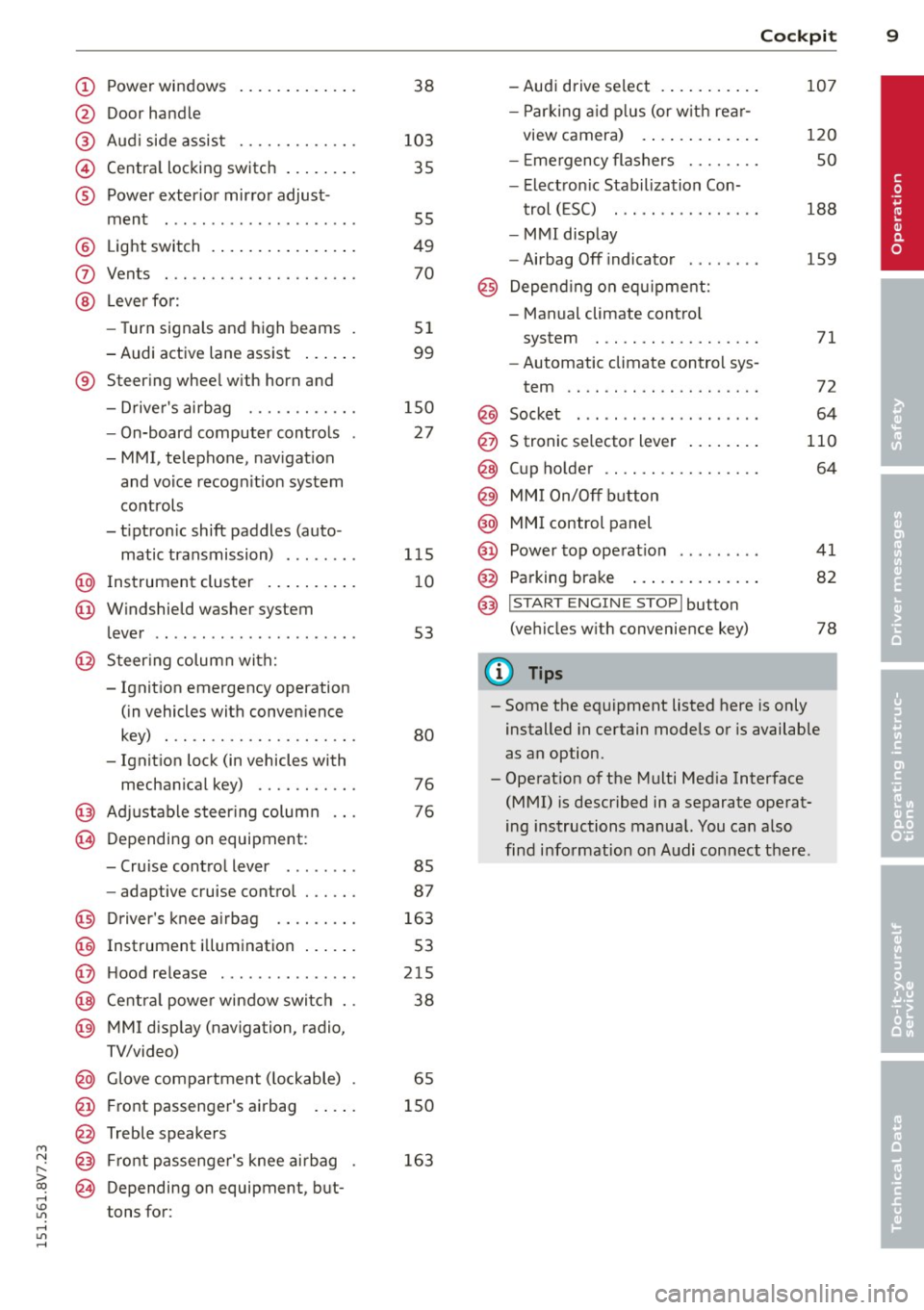
Power windows
Door handle
Aud i side assist ........ .... .
Centra l locking switch ... .. .. .
Powe r exter ior mirror adjust
ment
Light switch . ... .... ... .. .. .
Vents
L eve r fo r:
- Turn signals and high beams .
- Audi active lane assist ... .. .
® Steer ing wheel w ith horn and
- Drive r's airbag ........... .
- On-board computer controls
-MMI, telephone, navigat ion
and voice recogn it ion system
controls
- tiptron ic shift paddles (auto-
matic transmission) ....... .
@ Instrument cluster .. ... .. .. .
@ W indshield washer system
l ever
' .................... .
@ S teer ing column with:
- Ignit ion emergency operation
(in vehicles with conven ience
key) . .. ................. .
- Ignit ion lock (in vehicles with
mechanical key) .......... .
@ Adjustable s teer ing column
@ Depending on equipment:
- Cruise contro l lever ....... . 38
103 35
55
49
70
51
99
150 27
1 15
1 0
53
80
76
76
85
- adaptive cruise contro l . . . . . . 87
@ Driver's knee a irbag . . . . . . . . . 163
@ Instrument i llumination . . . . . . 53
@ H ood re lease . . . . . . . . . . . . . . . 215
@ Centra l power window swi tc h . . 38
@ MMI disp lay (navigation, radio,
TV/video)
@ Glove compartment ( lockable) . 65
@ Front passenger 's airbag . . . . . 150
@ Treble speakers
@ Front passenge r's knee ai rbag .
@ Depending on equipment, b ut
tons for: 163
Cockpi
t 9
-Audi drive select . .. ..... .. .
- P arking a id p lus (or w ith re ar-
view camera) . .. .. .. ..... .
- E mergency flashers ....... .
- Elect ron ic Stabilization Con-
t rol ( ESC) . .. .... ........ .
- MMI display
- Airbag Off indicator .... ... .
@ Depend ing o n equ ipment:
- Manual climate contro l
system
- Automatic climate control sys
tem
.. .. .. .. .. .. .........
Socket
S tronic se lector lever ..... .. .
Cup holder .. .. ............ .
MM I On/Off b utton
@ MMI control panel
@ Power top ope rat ion ... ..... .
@ Parking brake .... .. .. ..... .
@ I S T ART ENGINE STOPI button
(vehicles w ith convenience key)
(D Tips
107
120
so
188
159
71
72
64
110
64
41
82
78
- Some the eq uipment listed here is only
installed in certain models or is available
as an option.
- Operat ion of the Multi Med ia Interface
(MMI) is described in a separate operat
ing instructions manual. You can a lso
find info rmat ion on A udi connect ther e.
•
Page 34 of 302
32 Opening and closing
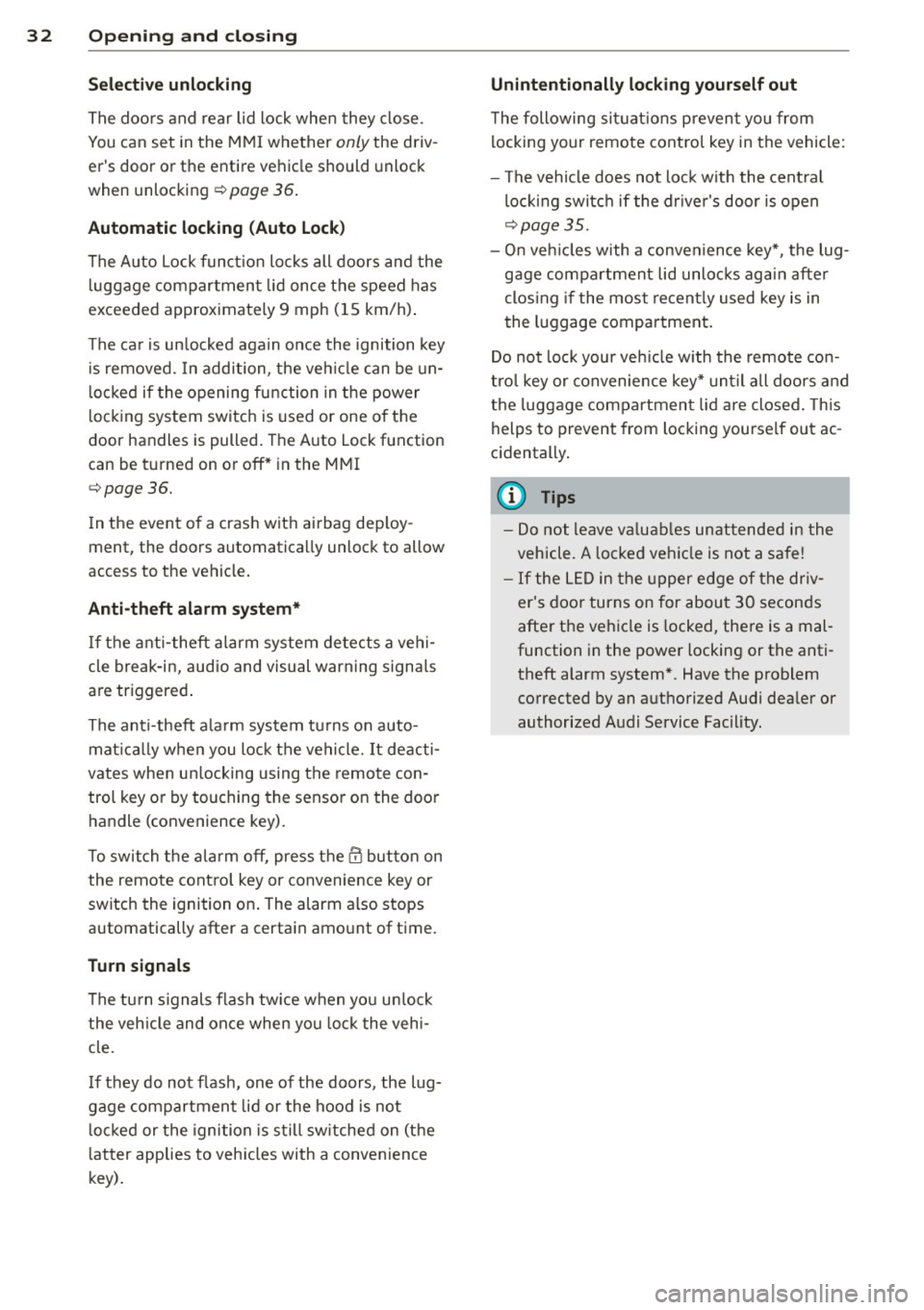
Selective unlocking
The doors and rear lid lock when they close.
You can set in the MMI whether
only the driv
er's door or the entire vehicle should unlock
when unlocking
¢ page 36.
Automatic locking (Auto Lock)
The Auto Lock funct ion locks all doors and the
l uggage compartment lid once the speed has
exceeded approximately 9 mph (15 km/h) .
The car is un locked again once the ignition key
is removed. In addition, the vehicle can be un
l ocked if the opening function in the power
locking system switch is used or one of the
door handles is pulled. The Auto Lock function
can be turned on or off* in the MMI
c::>page36.
In the event of a crash with airbag dep loy
ment, the doors automatically unlock to allow
access to the vehicle.
Anti -theft alarm system*
If the anti-theft alarm system detects a vehi
cle break-in, audio and visual warning signa ls
are triggered .
The anti-theft alarm system turns on auto mat ically when you lock the vehicle.
It deacti
vates when un locking using the remote con
trol key or by touching the sensor on the door
handle (convenience key) .
To switch the alarm off, press them button on
the remote control key or convenience key or
switch the ignition on . The alarm also stops
automatically after a certain amount of time.
Turn signals
The turn signals flash twice when you unlock
the vehicle and once when yo u lock the vehi
cle.
If they do not flash, one of the doors, the lug
gage compartment lid or the hood is not
lock ed or the ignition is still sw itched on (the
latter applies to vehicles with a convenience
key) .
Unintentionally locking yourself out
The following situations prevent you from
locking your remote control key in the vehicle:
- The vehicle does not lock w ith the cent ral
lock ing switc h if the driver's door is open
c::> page 3 5.
-On veh icles with a convenience key* , the lug
gage compartment lid unlocks again after
clos ing if the most recent ly used key is in
the luggage compartment.
Do not lock your veh icle w ith the remote con
trol key or convenience key* until all doors and
the luggage compartment lid are closed. This
helps to prevent from locking yourself out ac
cidentally .
(D Tips
-Do not leave va luab les unattended in the
vehicle. A locked vehicle is not a safe!
- If the LED in the upper edge of the driv
er's door turns on for about 30 seconds
after the vehicle is locked, there is a mal
function in the power locking or the anti
theft alarm system* . Have the problem
corrected by an authorized Audi dea ler or
authorized Audi Service Facility.
Page 37 of 302
....,
N
r--. > co
rl I.O
"' rl
"' rl
WARNING
----Read and following all WARNINGS. ¢ & in
Key set on page 31
@ Tips
If your vehicle is left standing for a long
period of time, note the following:
- The proximity sensor switches off after a
few days to save energy. You then have
to pull once on the door handle to unlock
the vehicle and a second time to open it.
- To prevent the battery from draining and
to retain the starting ability of yo ur vehi
cle as long as possible, the energy man
agement system gradua lly tuns off un
necessary convenience functions You
may not be able to unlock your vehicle
using the convenience key .
- For an explanation on conformity with
the FCC regulations in the United States
and the Industry Canada regulations, re
fer to¢
page 285.
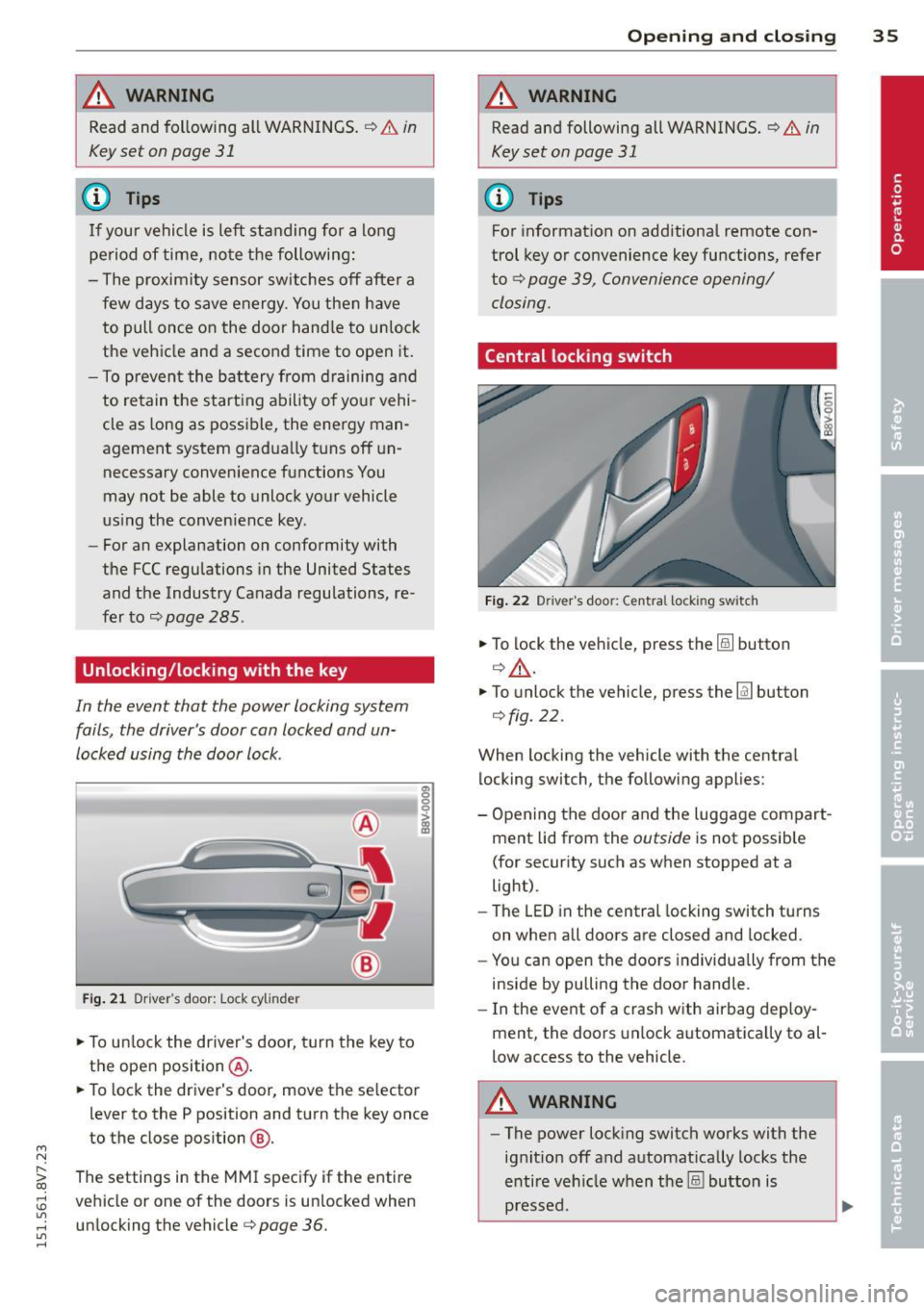
Unlocking/locking with the key
In the event that the power locking system
fails, the driver's door can locked and un
locked using the door lock .
Fig. 21 Driver 's door: Lock cy linder
.,. To unlock the driver's door, turn the key to
the ope n position @ .
en 0 g
~
.,. To lock the driver's door, move the se lector
lever to the P position and turn the key once
to the close position
@ .
The settings in the MMI specify if the entire
vehicle or one of the doors is un locked when
unlocking the vehicle¢
page 36.
Opening and closing 35
A WARNING
Read and following all WARNINGS. ¢ & in
Key set on page 31
(D Tips
For information on additional remote con
trol key or convenience key functions, refer
to ¢
page 39, Convenience opening/
closing.
Central locking switch
Fig. 22 Drive r's doo r: Centra l locki ng sw itch
.,. To lock the vehicle, press the@! button
¢.&, .
.,. To unlo ck the vehicle, press the @J button
¢fig. 22.
When locking the vehicle with the central
locking switch, the following applies:
- Opening the door and the Luggage compart
ment lid from the
outside is not possible
(for security such as when stopped at a
light).
- The
LED in the central locking switch turns
on when all doors are closed and locked .
- You can open the doors individually from the
inside by pulling the door handle.
- In the event of a crash with airbag deploy
ment, the doors unlock automatica lly to al
low access to the vehicle.
A WARNING
- The power locking switch works with the
ignit ion off and automat ically locks the
entire vehicle when the@! button is
pressed.
Page 61 of 302
M N ,....
> co ,...., \!) ..,.,
,...., ..,., ,....,
Seats and storage
General information
Important information
A WARNING
Refer to the chapter Driving Safely
¢ page 126, Driving safety for important
information, tips, suggestions and warn
ings that you should read and follow for
your own safety and the safety of your pas sengers.
The safety belts and the airbag system con
only provide maximum protection if the front
seats ore correctly adjusted.
There are various ways of adjusting the front
seats to provide safe and comfortable support
for the driver and the front passenger. Adjust
your seat properly so that :
- you can easily and quick ly reach all the
switches and controls in the instrument
panel
- your body is properly supported thus reduc
ing physical stress and fatigue
- the safety be lts and airbag system can offer
maximum protection
¢ page 146.
In the following sections, you will see exactly
how you can best adjust your seats .
There are special regulations and instructions
for installing a child seat on the front pas
senger's seat. Always follow the information
regarding chi ld safety provided in
¢ page 169, Child Safety.
A WARNING
Incorrect seating position of the driver and
all other passengers can result in serious
personal injury.
- Always keep your feet on the floor when
the vehicle is in motion -never put your
feet on top of the instrument panel, out
of the window or on top of the seat cush ion. This applies especially to the passen-
Seats and storage 59
gers. If your seating position is incorrect,
you increase the risk of injury in the case
of sudden braking or an accident. If the
airbag inflates and the seating position is incorrect, this could result in pe rsonal
injury or even death.
- It is important for both the driver and
front passenger to keep a distance of at
least 10 inches (25 cm) between them
selves and the steering wheel and/or in
strument panel. If you're sitting any
closer than this, the airbag system can
not protect you properly. In addition, the
front seats and head restraints must be
adjusted to your body height so that they
can give you maximum protect ion.
- Always try to keep as much distance as
possible between yourself and the steer
ing wheel or instrument panel.
- Do not adjust the driver's or front pas
senger's seat whi le the vehicle is moving.
Your seat may move unexpectedly, caus
ing sudden loss of veh icle control and
personal injury. If you adjust your seat
while the veh icle is moving, you are out
of posit ion.
Driver's seat
The correct seat position is important for safe
and relaxed driving .
We recommend that you adjust the dr iver's
seat in the follow ing manner:
"" Adjust the seat in fore and aft direction so
that you can easily push the pedals to the
floor wh ile keeping your knees slightly bent
¢ &, on page 59.
"" Adjust the backrest so that when you sit
w ith your back against the backrest, you can
still hold the top of the steering wheel.
""For adjustab le head restra ints: adjust the
head restraint so the uppe r edge is as even
as possible with the top of your head. If that
is not possible , try to adjust the head re
straint so that it is as close to this position ..,_
•
Page 63 of 302
....,
N
r--. > co
rl I.O
"' rl
"' rl
driving or riding. The safety belts and air
bag system can provide the greatest pro
tection possible when the backrests are
in the upright position and the safety
belts are worn correctly. The more a
backrest is reclined, the greater the risk
of inju ry due to an incorrect seating posi
tion and safety belt position .
Power seat adjustment
Applies to vehicles: with power adjustable seats
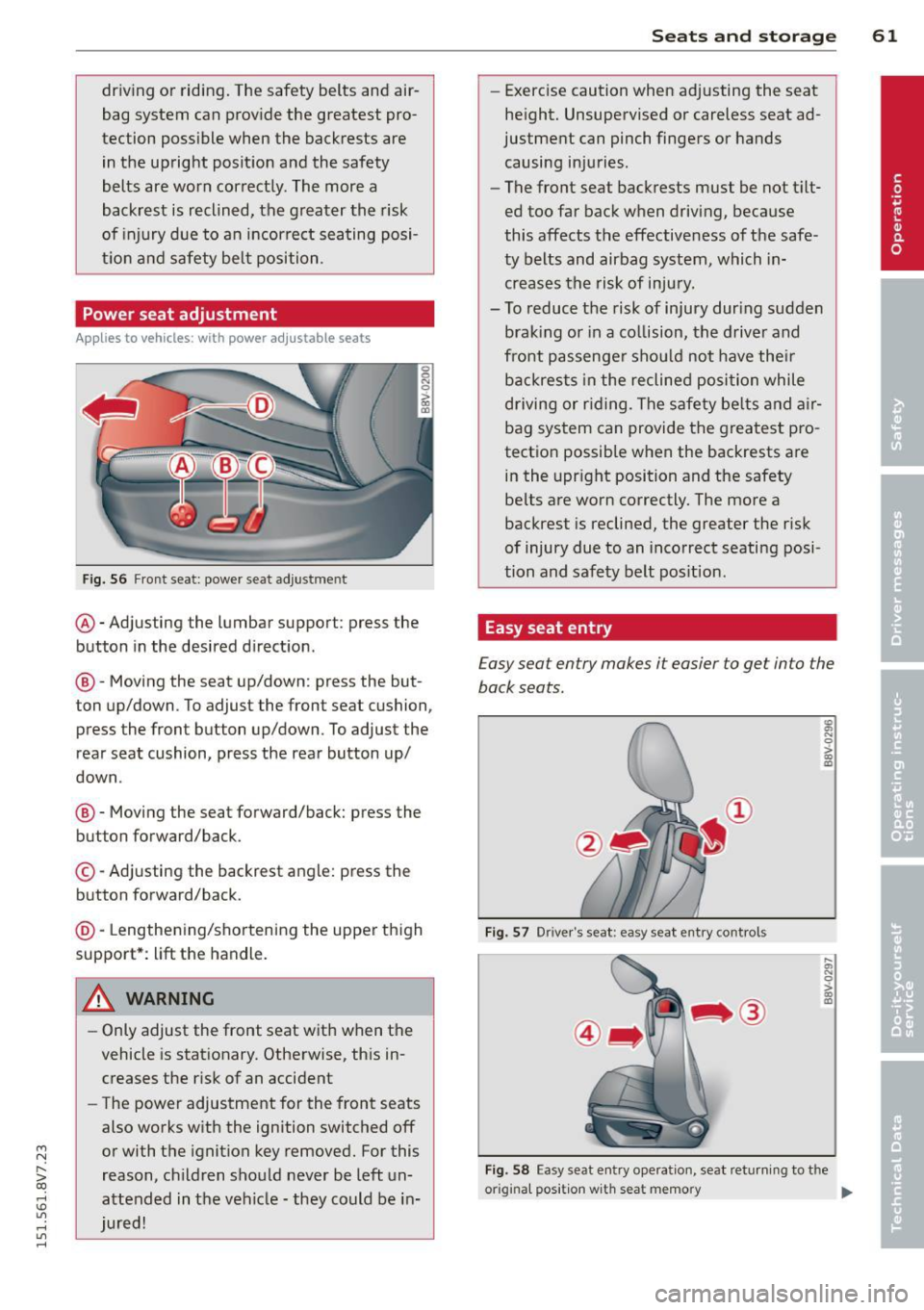
Fig. 56 Fr ont seat: power seat adjustment
@ -Adjusting the lumbar support: press the
button in the desired d irection.
@ -Moving the seat up/down : press the but
ton up/down. To adjust the front seat cushion,
press the front button up/down. To adjust the
rear seat cushion, press the rear button up/
down .
@-Moving the seat forward/back: press the
button forward/back.
© -Adj usting the backrest angle: press the
button forward/back.
@ -Lengthening/shortening the upper thigh
support*: lift the handle.
A WARNING ,-
- Only adjust the front seat w ith when the
vehicle is stationary. Otherwise, this in
creases the r isk of an accident
- The power adjustment for the front seats
also works with the ignition switched off
or with the ignition key removed. For this
reason, ch ildren should never be left un
attended in the vehicle -they co uld be in
jured!
Seats and storage 61
-Exercise caution when adjusting the seat
height. Unsupervised or careless seat ad
justment can pinch fingers or hands
causing injuries.
- The front seat backrests must be not t ilt
ed too far back when driving, because
this affects the effective ness of the safe
ty belts and airbag system, which in
creases the risk of injury.
- To reduce the risk of injury dur ing sudden
braking or in a co llision, the driver and
front passenger shou ld not have their
backrests in the reclined position while
driving or rid ing. The safety be lts and air
bag system can provide the greatest pro
tection possible when the backrests are in the upright position and the safety
be lts are worn correctly. The more a
backrest is reclined, the greater the risk
of injury due to an incorrect seating posi
tion and safety belt position.
Easy seat entry
Easy seat entry makes it easier to get into the
back seats.
Fig. 57 Driver's seat: easy seat entry controls
~ N 0 > m a,
....
l1l 0 > m a,
Fig . 58 Easy seat entry operation, seat returning to the
origina l pos it ion w ith seat memory
Ill>
Page 97 of 302
M N ,....
> co ,...., \!) 1.1'1 ,...., 1.1'1 ,....,
Audi pre sense Introduction
Applies to vehicles: with Audi pre se nse basic or Aud i pre
sense front
W ithin the limits of the system, pre sense ba
sic and pre sense front can initiate steps to
protect vehicle occupants in certa in danger
ous situations.
Critical driving situat ions can be recognized by
the pre sense front via a network of different
veh icle systems and can take steps to prepare
the vehicle occupants for a potentia l co llision.
The pre sense front wo rks with a radar sensor
and a video camera*.
It also functions within
the limits of the system when adaptive cruise
control* is switched off.
General information
General information
Applies to vehicles: with Audi pre sense front or Audi adaptive cruise control
A WARNING
Also follow the general information found
on
~ page 8 7, General information.
Audi pre sense basic
Description
Applies to vehicles : with Audi pre se nse basic
The function of the pre sense basic is activat
ed at a speed of 20 mph (30 km/h) or higher.
The following functions can be triggered un
der certain conditions within the limits of the
system:
- T ensioning of the safety be lts (for example,
during heavy braking) : The front safety belts
have reversible belt pretensioners. If a colli
s ion does not occur, the safety belts loosen
slight ly and are ready to trigger again .
- Closing the windows (for example, if under
or oversteering): The windows close until
there is only a small gap open.
Audi pre sense 95
Audi drive select: The dep loyment time is
adapted in dynamic mode.
A WARNING
The pre sense basic cannot overcome natu ral physical laws. It is a system designed to
assist and it cannot prevent a collis ion. Do
not let the increased safety provided
tempt you into taking risks. This could in
crease your r isk of a collis ion.
- The system can deploy incorrectly due to
system-specific limits.
(D Tips
- Certa in pre sense bas ic functions switch
off when ESC is switched off (sport
mode) or when dr iving in reverse.
- The pre sense basic functions may not be
available if there is a ma lfunction in the
ESC system or the airbag control mod
ule.
- Note that with pre sense bas ic, the rever
sible safety belt pretensioner on the
front passenger's side deactivates when
t he fron t passenger's airbag is deactivat
ed.
Audi pre sense front
Description
Applies to vehicles : wit h Audi pre sense front or Audi
adaptive crui se con trol
Pre sense front informs you if the distance to
the vehicle ahead falls below the safe distance
for an extended period of time. It can warn of
a possible collision and initiate braking ma neuvers, within the limits of the system.
When detected in time, the system can assess
dangerous situat ions where an object ahead
brakes suddenly or if your own veh icle is trav
el ing at a high speed and approaching an ob
ject that is moving more slow ly . If detection is
not poss ible, then pre sense front does not re
act.
•
Page 142 of 302
140 Safety belts
occupant will slam violently into the steering
wheel, instrument panel, windshield, or what
ever else is in the way
c::> fig. 133. This imp act
with the vehicle interior has all the energy
t hey had just before the crash.
Never rely on a irbags alone for protection.
Even when they deploy, airbags provide only
additional protection. Airbags are not sup
posed to deploy in all kinds of accidents. Al
though your Audi is equipped with airbags, all
vehicle occupants, including the driver , must
wear safety belts correctly in order to mini
mize the risk of severe injury or death in a
crash.
Remember too, that airbags will deploy only
once and that your safety belts are always
there to offer protection in those accidents in
which airbags are not supposed to deploy or
when they have already deployed . Unbelted
occupants can also be thrown out of the vehi
cle where even more severe or fatal injuries
can occur.
It is also important for the rear passengers to
wear safety belts correctly. Unbelted passen
gers in the rear seats endanger not only them
selves but also the driver and othe r passen
gers ~
fig. 134. In a frontal collision they will
be thrown forward violently, where they can
hit and injure the driver and/or front seat pas
senger .
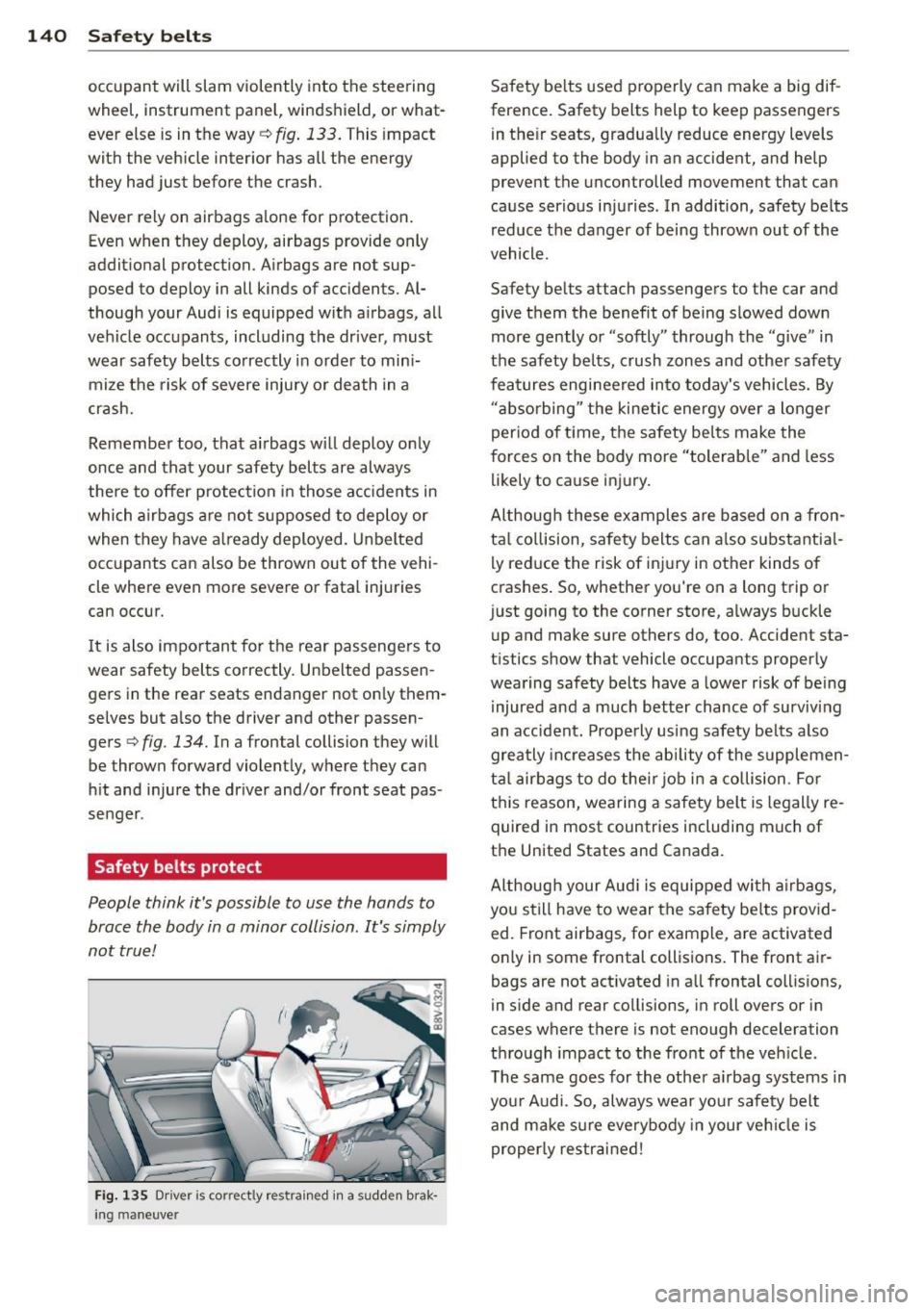
Safety belts protect
People think it's possible to use the hands to
brace the body in a minor collision . It's simply
not true !
Fig. 135 Driver is co rr ect ly re strain ed in a sudd en brak
ing maneuve r
Safety belts used properly can make a big dif
ference. Safety belts help to keep passengers
in their seats, gradually reduce energy levels
applied to the body in an accident, and help
prevent the uncontrolled movement tha t can
cause serious injuries . In addition, safety belts
reduce the danger of being thrown out of the
vehicle .
Safety belts attach passengers to the car and
give them the benefit of being slowed down
more gently or "softly" through the "give" in
the safety belts, crush zones and other safety
features engineered into today's vehicles. By
"absorbing " the kinetic energy over a longer
period of ti me, the safety belts make the
forces on the body more "tolerable" and less
likely to cause injury.
Although these examples are based on a fron
tal collision, safety belts can also substantial
ly reduce the r isk of injury in other kinds of
crashes. So, whether you're on a long trip or
just going to the corner store, always buckle up and make sure others do, too. Accident sta
tistics show that vehicle occupants properly
wearing safety belts have a lower risk of being
injured and a much better chance of surviving
an accident. Properly using safety belts also
greatly increases the ability of the supplemen
tal airbags to do their job in a collision . For
this reason, wearing a safety belt is legally re
quired in most countries including much of
the United States and Canada.
Although your Audi is equipped with airbags,
you still have to wear the safety belts provid
ed. Front airbags , for example, are activated
only in some frontal collisions. The front air
bags are not activated in all frontal collisions,
in side and rear collisions, in roll overs or in
cases where there is no t enough decelera tion
through impact to the front of the vehicle .
The same goes for the other airbag systems in
your Audi . So, always wear your safety belt
and make sure everybody in your vehicle is
properly restrained!
Page 148 of 302
146 Airbag system
Airbag system
Important things to know
Importance of wearing safety belts and
sitting properly
Airbags are only supplemental restraints. For
airbags to do their job , occupants must al
ways properly wear their safety belts and be
in a proper seating position.
F or your safety and the safety of your passen
gers, before driving off, always:
• Adjust the driver's seat and steering wheel
properly
¢ page 127,
• Adjust the front passenger's seat properly
¢ page 60,
• Wear safety be lts properly ¢ page 141,
• Always properly use the proper child re-
straint to protect children ¢
page 169.
In a collision, airbags must inflate within the
blink of an eye and with considerable force.
The supplemental airbags can cause injuries if
the driver or the front seat passenger is not
seated properly . Therefore in order to help the
a ir bag to do its job, it is important, both as a
d river and as a passenger to sit prope rly at all
times.
By keeping room between your body and the
steering wheel and the front of the passenger
compartment, the airbag can inflate fully and
comp letely and provide supplemental protec
tion in ce rtain frontal collisions
¢page 127,
Proper occupant seating positions.
F or details
on the operation of the seat adjustment con
t rols ¢
page 60.
It's especially important that children are
properly restrained ¢
page 169.
There is a lot that the driver and the passen
ge rs can and must do to help the individual
safety features installed in your Audi work to
gether as a system.
Proper seating pos ition is important so that
the front airbag on the driver side can do its
job. If you have a physical impairment or con- dition that
prevents you from sitting properly
on the driver seat with the safety belt properly
fastened and reaching the pedals , or if you
have concerns with regard to the function or
operation of the Advanced Airbag System ,
please contact your author ized Audi dealer or
qualified workshop, or call Audi Customer Re
lations at 1-800-822-2834 for possible modi
ficat ions to your veh icle.
When the airbag system deploys, a gas gener
ator will f ill the a irbags, break open t he pad
ded cove rs, and inflate between the steering
whee l and the dr iver and between the instru
ment panel and the front passenger. The air
bags will deflate immediately after deploy
ment so that the front occupants can see
t hr ough the windshie ld again without inter
ruption .
All of this takes pla ce in the blink of an eye, so
fast that many peop le don't even realize tha t
the airbags have deployed. The airbags a lso
inflate with a great dea l of force and nothing
should be in their w ay when they deploy.
Front airbags in combination with properly
worn safety belts slow down and lim it the oc
cupant's forward movement . T ogether they
help to prevent the drive r and front seat pas
senger from hitting parts of the inside of the
vehicle while reducing the forces acting on the
occupant during the crash . In this way they
help to reduce the risk of injury to the head
and upper body in the crash. Airbags do not
protect the arms or the lower parts of the
body.
Both front airbags wi ll not inflate in all fronta l
collisions . The triggering of the airbag system
depends on the vehicle dece lerat ion rate
caused by the co llision and registered by the
electron ic control unit. If this rate is below
the reference value programmed into the con
t rol unit , the airbags will not be triggered,
even though the car may be badly damaged as
a res ult of the collision . Vehicle damage, re
pair costs or even the lack of vehicle damage
is not necessari ly an indication of whether an
airbag shou ld inflate or not.
IJll-
Page 149 of 302
Airbag system 147
Since the circumstances will vary considerab ly
also at greater risk of injury or death
between on e collision and another , it is not
through contact with an inflating airbag .
possible to define a range of veh icle speeds
-If you are unrestrained, leaning forward,
that will cover every possible k ind and angle
sitting sideways or out of position in any
of impact that will always trigger the a irbags .
way, your risk of injury is much higher.
Important factors include, for example, the -You will a lso receive serious injuries and
nature (hard or soft) of the object which the could even be killed if you are up against
•
car h its, the ang le of impact, vehicle speed ,
• the airbag or too close to it when it in-
etc. The front airbags will a lso not inflate in
flates - even with an Advanced A irbag.
side or rea r collisions, or in ro ll-overs .
-To reduce the risk of injury when an air-
Alwa ys re memb er: Airbags will deploy only bag inflates, always wear safety belts
once, and only in certa in kinds of co llisions. properly
c::;, page 141, Safety belts
.
Your safety belts are always there to offe r pro- -
Always make certain that ch ildren age 12
tection in those s ituations in which airbags or younger always ride in the rear seat. If
are not supposed to deploy , or when they have children a
re not properly restrained , they
already deployed ; for example , when your ve- may be severe
ly inju red or killed when an
hide strikes or is struck by another vehicle af- airbag inf
lates.
ter the first collision . -
Never let ch ildren ride un restra ined o r
This is just one of the reasons why an a irbag is improperly restrained
in the vehicle . Ad-
just the front sea ts prope rly.
a supp lementary restraint and is not a s ubsti -
-Never ride with the back rest reclined .
tute for a safety belt . The airbag system
-Always sit as far as possible from the
works most effect ively when used with the
steering whee l or the instrument panel
safety belts. Therefore, always properly wear
c::;, page 127 . your safety belts c::;, page 138 .
- Always sit upright with your back against
A WARNING the backrest of yo ur seat.
- Never p lace your feet on the instrument
Sitting too close to the steer ing whee l or
panel or on the seat . Always keep both
instrument panel will dec rease the effec-
feet on the floor in front of the seat to
tiveness of the airbags and will inc rease
help prevent serious in ju ries to the legs
the risk of pe rsonal injury in a co llision.
and hips if the airbag in fla te s.
- Never si t closer than 10 inches (2S cm)
-Never recline the front passenger's sea t
to the stee ring wheel or instr ument pan-
to transport objects. Items can a lso
el. move into the area of the s ide a irb ag or
- If you cannot si t mo re than 10 inches
the front airbag during bra king or in a
( 2 5 cm) from the steer ing whee l, investi-
sudden maneuver. Objects near the air-
ga te whethe r adap tive equipmen t may
bags can become projectiles and cause
be available to help you reach the pedals injury when an airbag inflates.
and increase your seating distance from
the steering wheel.
A WARNING
- All veh icle occupants and especia lly chil -
dren m ust be restrained properly when- A
irbags that have deployed in a crash must
ever riding in a vehicle . An unrestra ined be replaced.
or improperly restrained child could be -
Use on ly orig inal equipment airbags ap-
M injured by striking the inter ior or by be- proved by Audi and installed by a trained • N technician who has the necessary too
ls ~ ,.... ing ejected from the vehicle during a > co sudden maneuver or impact . An unre-...... \!) ..,., strained or imp roperly rest rained child is ...... ..,., ......
Page 150 of 302
148 Airbag sys tem
and dia gnostic equipment to properly re
place any a irbag in your vehicle and
assure system effectiveness in a crash.
- Never permit salvaged or recycled a ir
bags to be installed in your veh icle.
Child restraints on the front seat - some
important things to know
~ Be sure to read the impo rtant informat ion
and heed the WARNINGS for impo rtant de
ta ils about ch ild ren and Advanced Airbags
Qpage 169.
Even though you r vehicle is equ ipped with an
Advanced Airbag Sys tem, ma ke certain that
all c hildren, especially those 12 years and
younger, a lways ride in the back sea t properly
restrained for their age and size . The airbag
on the passenger side makes the front seat a potentially dangerous place for a child to ride.
The front seat is not the safest place for a
child in a forward-facing child seat. It can be a
ve ry dangerous p lace for an infant or a ch ild in
a rearward-facing seat.
The Advanced Airbag System i n your veh icle
has been certified to comply with the require
ments of United States Federa l Motor Ve hicle
Safety Standard 208 as applicable at the time
your ve hicle was manufactured.
The Standard requires the front a irbag on the
passenger side to be turned off ("sup
p ressed") if a c hild up to about one year of
age restra ined in one of the rear-facing o r fo r
ward -facing infan t restra ints listed in Federal
M otor Vehicle Safety Standard 208 with w hich
the Advanced A irbag System in your vehicle
was certified has been installed on the front
passenger seat. Fo r a listing of the child re
straints that were used to certify compliance
with the US Safety Standard
Q page 171.
The PASSENGER AIR BAG OFF light in the in
strument panel te lls you when the front Ad
vanced Airbag on the passenger side has been turned off by the e lectronic control unit. E
ach time you switch on the ignition, the
PAS
SENGER AIR BAG O FF
light will come on for a
f ew seconds and :
- w ill stay on if the fro nt passenge r seat is not
occupied,
- w ill stay on i f the e lec tric al ca pacit ance
meas ured by the capacitive passenger de
tection system for the front passenger seat equa ls the combined capacitance of an in
fant up to about one year of age and one of
the rearward-facing or forward-fac ing ch ild
restraints listed in Federal Motor Vehicle
Safety Standard 208 with wh ich the Ad
vanced Airbag System in your vehicle was
c e rt ified . Fo r a listing of t he chi ld restraints
t ha t were used to certify you r vehi cle's com
p lian ce w it h t he U.S. Safety Stand ard
Q page 171.
-w ill stay on if there is a small ch ild or child
restr aint on the front passenge r seat,
- will go off if t he front pa ssenge r seat is oc
cupied by an adult as regis tered by the ca
pacitive passenge r de tection sys tem
c::> page 158, Monitoring the Advanced Air·
bag System.
The PASSENGER AIR BAG OFF light comes on
when e lec trica l capacitance registered on the
front passenger seat is eq ua l to or less tha n
t h e comb ined capacitance of a typica l 1 year
o ld infant and one of the rearward-facing or
forward-facing chi ld restraints listed in Fede r
al Motor Vehicle Safety Standard 208 w ith
wh ich the Advanced Airbag System in your ve
hicle was certified.
If the total e lectr ica l capacitance registered
on the front passenger seat is more than that
of a typical 1 year -o ld child but less than the
weight of a small adu lt , the front airbag on
t h e passenger side can deploy (the
PASSEN
GER AIR BAG OFF
light does not come on).
If the
PASSENGER AIR BAG OFF light does
not come on, the front airbag on the passen
ger side has not been turned off by t he e lec
t ro nic cont ro l unit a nd can deploy if the con
t ro l u nit se nses an impact tha t mee ts the con-
di tions s tored in its memory .
1J1>