weight AUDI A3 CABRIOLET 2015 Owners Manual
[x] Cancel search | Manufacturer: AUDI, Model Year: 2015, Model line: A3 CABRIOLET, Model: AUDI A3 CABRIOLET 2015Pages: 302, PDF Size: 73.83 MB
Page 6 of 302
4 Table of contents
Fuses and bulbs . . . . . . . . . . . . . . .
269
Elect rical fuses . . . . . . . . . . . . . . . . . . . 269
Bulbs . . . . . . . . . . . . . . . . . . . . . . . . . . . 272
Emergency situations ... .. .... 273
General . . . . . . . . . . . . . . . . . . . . . . . . . 273
Starting by push ing or tow ing . . . . . . . 273
Starting with jumper cab les . . . . . . . . 273
Usingjumpstartcables .. .. .. .. .. .. 274
Eme rgency towing with commercial
tow truck . . . . . . . . . . . . . . . . . . . . . . . 275
Lift ing vehicle. ........... .... .... 277
Technical Data . . . . . . . . . . . . . . . . . 279
Technical data . . . . . . . . . . . . . . . . . 279
Vehicle ident ifica tion . . . . . . . . . . . . . . 279
Weights . . . . . . . . . . . . . . . . . . . . . . . . 279
D imensions . . . . . . . . . . . . . . . . . . . . . . 280
Capacities . . . . . . . . . . . . . . . . . . . . . . . 280
Gasoline engines . . . . . . . . . . . . . . . . . 281
Consumer Information . . . . . . . 282
Warranty coverages . . . . . . . . . . . . . . . 282
Operating your vehicle o utside the
U.S.A . or Canada . . . . . . . . . . . . . . . . . 282
Audi Service Repair Manuals and Literature . . . . . . . . . . . . . . . . . . . . . . . 282
Maintenance . . . . . . . . . . . . . . . . . . . . . 282
Addit ional accessories, modifications
and pa rts replacement . . . . . . . . . . . . 284
D eclar ation o f Compliance,
T e lecommunication and Electronic
Systems . . . . . . . . . . . . . . . . . . . . . . . . 285
Inde x ... .. ... ... .... ... .. .. .... 28 6
Page 67 of 302
....,
N
r--. > co
rl I.O
"' rl
"' rl
a collision, sudden braking or other vehi
cle movement. Spilled hot liquid can also
increase the risk of accidents and inju
ries .
- Only use soft conta iners in the cup hold
ers. Hard cups and glasses can increase
the risk of injury during a coll is ion.
- Never use the cup holder or the adapter
as an ashtray- this is a fire hazard .
(D Note
Make sure your beverage container has a
lid. If not, your beverage could spill and
cause damage to vehicle equipment or
stain the seat covers.
Glove compartment
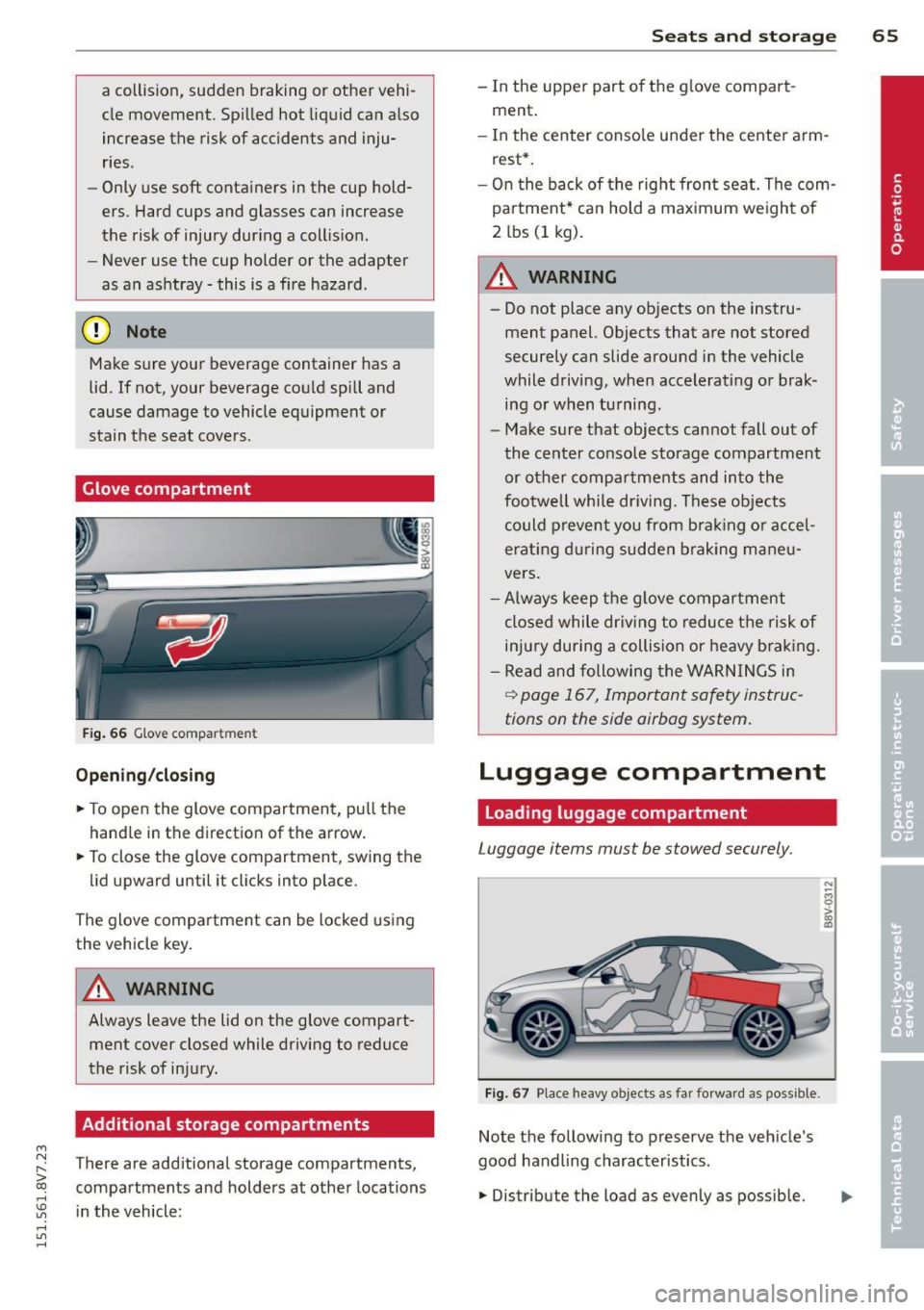
Fig. 66 G lo ve compar tmen t
Op ening /clo sing
• To open the glove compartment, pu ll the
hand le in the direction of the arrow.
• To close the glove compartment, swing the
lid upward until it clicks into place .
The glove compartment can be locked us ing
the vehicle key .
.&., WARNING
Always leave the lid on the glove compart
ment cover closed while driving to reduce
the risk of injury.
Additional storage compartments
T here are additional storage compartments,
compartments and holders at other locations
in the vehicle:
S ea ts a nd s to rage 65
- In the upper part of the g love compart
ment .
- In the center conso le under the center arm
rest*.
- On the back of the right front seat. The com partment" can hold a max imum weight of
2 lbs (1 kg).
.&., WARNING
-----
- Do not place any objects on the instru
ment panel. Objects that are not stored
securely can slide around in the vehicle
while driving, when accelerating or brak
ing or when turning .
- Make sure that objects cannot fall out of
the center console storage compartment
or other compartments and into the
footwell while dr iving . These objects
could prevent you from b ra ki ng o r accel
erating d uring sudden b raking mane u
vers.
- Always keep the g love compartment
closed while driv ing to reduce the risk of
injury during a collision or heavy braking.
- Read and following the WARNINGS in
~ page 167, Important safety instruc
tions on the side airbag system.
Luggage compartment
Loading luggage compartment
Luggage items must be stowed securely.
F ig. 67 Pla ce heavy o bjects as far forward as poss ible.
Note the following to preserve the veh icle's
good handling characteristics .
• Distribu te the load as evenly as possible.
N ;;; 0 ;;;. a,
"'
Page 69 of 302
....,
N
r--. > co
rl I.O
"' rl
"' rl
-Torn or frayed safety belts can break, and
belt anchors can break dur ing a coll is ion.
Check the safety belts regularly. Safety
belts w ith noticeable damage to the
webbing, bind ings, buckles or retractors
must be replaced.
(D Note
- If you
move the front seat back when the
rear seat backrest is folded forward, you
could damage the head restra ints on the
rear seat. If necessary, remove the rear
seat head restraint before mov ing the
front seat back
- Make sure the safety belt is not pinched
in the backrest lock and damaged when
the rea r seat backrest if fo lded back.
Other objects should be
r emoved from
the rear bench seat to protect the rear backrest from damage .
Tie-downs
Applies to vehicles: with tie-dow ns
~--~-----
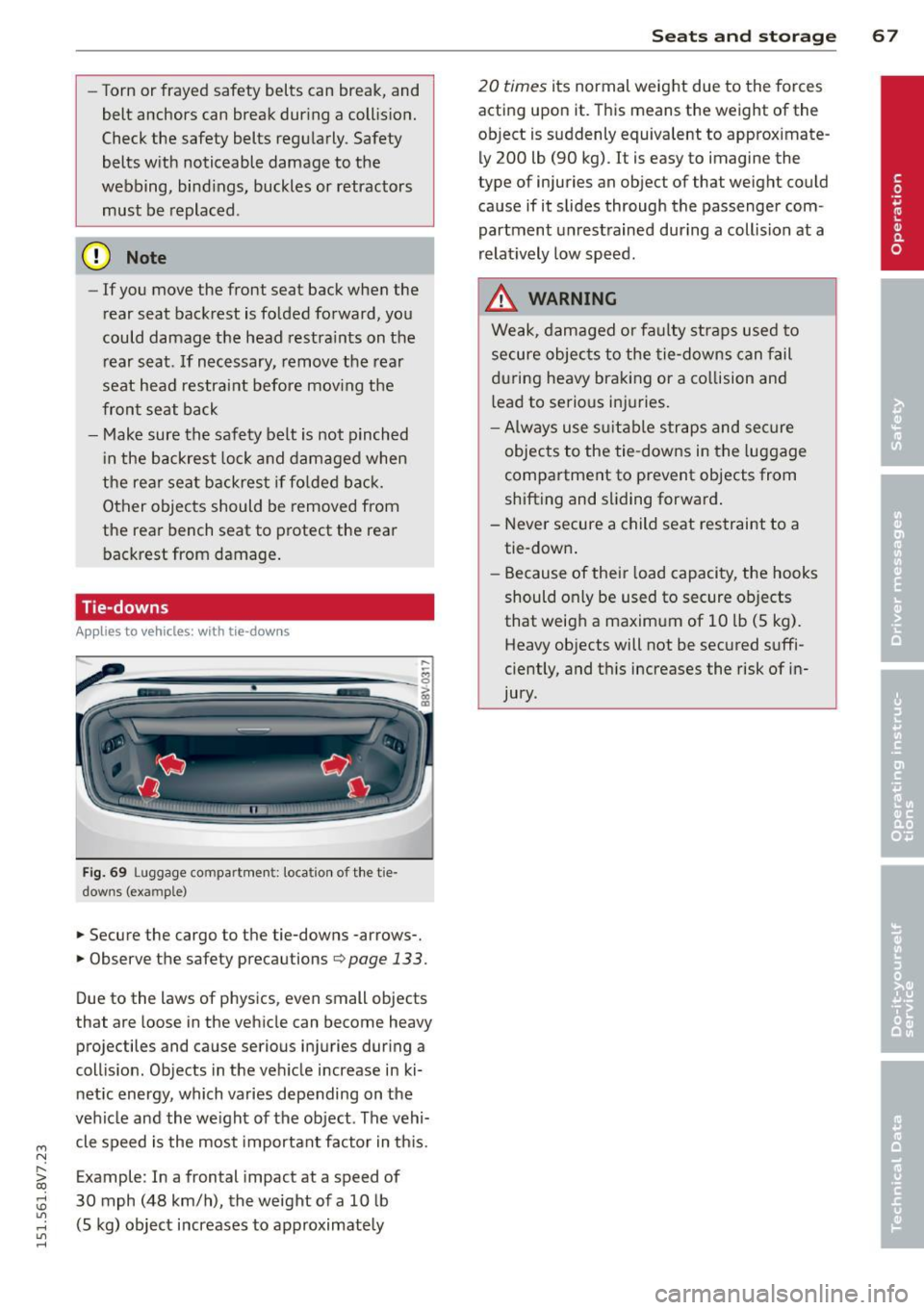
Fig . 69 Luggage compartme nt: location of the t ie
downs (example)
... Secure the cargo to the tie-downs -arrows- .
.,. Observe the safety precautions ¢
page 133.
Due to the laws of physics, even small objects
that are loose in the vehicle can become heavy
projectiles and cause serious injuries during a
coll is ion. Objects in the ve hicle increase in ki
netic energy, which varies depending on the
vehicle and the we ight of the object. The vehi
cle speed is the most important factor in this .
Example: In a frontal impact at a speed of
30 mph (48 km/h), the weight of a 10 lb (5 kg) object increases to approximately
S ea ts a nd s to rage 67
20 times its normal weight due to the forces
acting upon it. This means the weight of the
object is suddenly equivalent to approximate
ly 200 lb (90 kg). It is easy to imagine the
type of injuries an object of that weight could
cause if it slides through the passenger com partment unrestrained during a collision at a
relat ively low speed.
A WARNING
Weak, damaged or faulty straps used to
secure objec ts to the tie-downs can fail
during heavy braking or a co llision and
l ead to serious injuries.
-A lways use s uitable straps and secure
objects to the tie -downs in the luggage
compartment to prevent objects from
shifting and sliding forward .
- Never secure a child seat restraint to a tie -down .
- Because of their load capaci ty, the hooks
should only be used to secure ob jects
that weig h a maximum of 10 lb
(5 kg).
Heavy objects wilt not be secured suffi
ciently, and this increases the risk of in
jury.
Page 70 of 302
68 Seats and storage
Cargo net/cargo bag
App lies to vehicles: with cargo net/cargo bag
The cargo net prevents light objects from
sliding, and it can also be used as a cargo bag .
-- ---
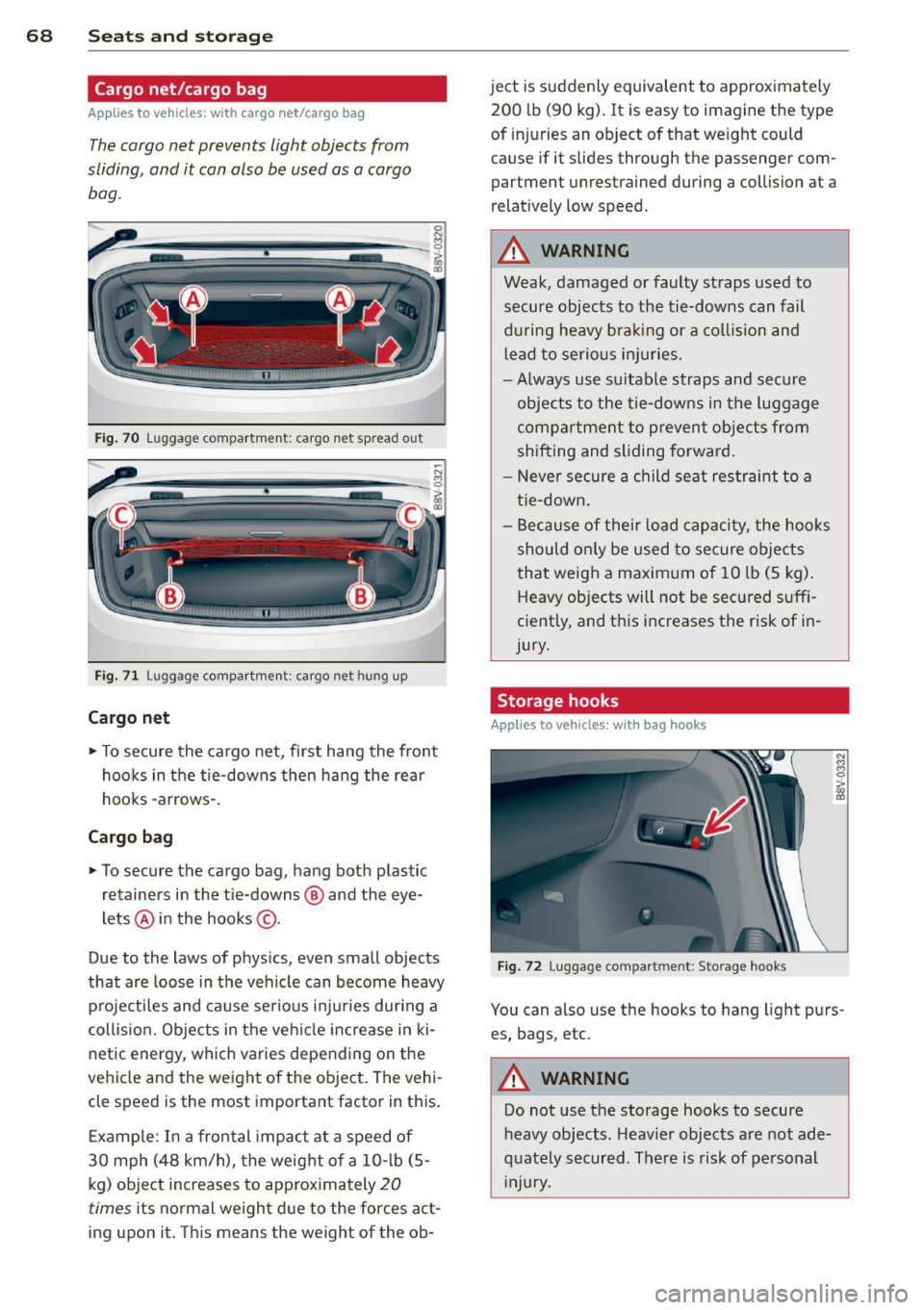
Fi g. 70 Luggage compartment: cargo net spread out
Fig. 71 Luggage compartment: cargo net hung up
Cargo net
.. To secure the ca rgo net, first hang the front
hoo ks in the tie-downs then hang the rear
hooks -arrows-.
Cargo ba g
.. To secure the cargo bag, hang bot h plastic
retainers in the t ie-downs @ and the eye
lets @ in the hooks ©-
Due to the laws of p hys ics, even small objects
that are loose in the vehicle can become heavy
projectiles and cause serious i njuries dur ing a
collis ion. Objects in the vehicle increase in ki
n etic energy, which varies depending on the
ve hicle and the weight of the object. The vehi
cle speed is the most important factor in th is.
E xample : In a frontal impact at a speed of
30 mph (48 km/h), the weight of a 10- lb (5-
kg) object increases to app roximately
20
times its normal weight d ue to the forces act
ing upon it. This means the weight of the ob- ject is suddenly equivalent to approximately
200 lb (90 kg). It is easy to imagine the type
of injuries an object of that weight could
cause if it slides through the passenger com
partment unrestrained during a collision at a
relat ively low speed.
_&. WARNING
-
Weak, damaged or faulty straps used to
secure objects to the tie-downs can fail
d uring heavy bra king or a collis ion and
l ead to se rious in juries.
- Always use su itable straps and secure
objects to the tie-downs in t he luggage
compartment to preven t objects from
shifting and sliding forward .
- Never secure a child seat restraint to a
tie -down .
- Because of thei r load capacity, the hooks
should only be used to secure objects
that weig h a maximum of 10 lb (5 kg).
Heavy objects will not be secured suff i
ciently, and t his increases the risk of in
jury.
Storage hooks
Applies to vehicles: with bag hooks
F ig. 72 Luggage compartmen t: Sto rage hooks
-
N M M 0 > gi
You can also use the hooks to hang light p urs
es, bags, etc .
_&. WARNING
-Do not use the storage hooks to secure
heavy objects . Heavier objects are not ade
q uate ly s ecured. Th ere is risk of personal
Injury.
Page 135 of 302
M N
" > co ,...., \!) 1.1'1 ,...., 1.1'1 ,....,
A WARNING ,~
Heavy loads will influence the way your ve
hicle handles. To help reduce the r isk of a
loss of control leading to ser ious personal
injury:
-Always keep in m ind when transporting
heavy objects, that a change in the cen
ter of gravity can also cause changes in
vehicle handling:
- Always distr ibute the load as even ly as
possible.
- Place heavy objects as far forward in
the luggage compartment as poss ible.
- Never exceed the Gross Ax le Weight Rat
ing or the Gross Vehicle Weight Rating
specified on the safety compliance stick
er on the left do or jamb. Exceeding per
missib le we ight standards can cause the
vehicle to s lide and handle differently.
- Please observe information on safe driv
ing co
page 126.
A WARNING
To help prevent poisonous exhaust gas
from be ing drawn into the veh icle, always
keep the rea r lid closed while dr iving.
- Never transport objects larger than those fitting completely into the luggage
area because the rear lid cannot be fully
cl osed.
- If you absolutely must drive w ith the rear
l id ope n, observe the follow ing notes to
reduce the risk of poisoning:
- Close all windows,
- Close the power top,
- Open all air ou tlets in the instrument
panel,
- Sw itch off the air recircu lation,
- Set the fresh ai r fan to the h ighest
speed.
A WARNING
Alw ays m ake s ure th at the doors, all win
dows, the power top an d the re ar lid are
securely closed and locked to reduce th e
Dri ving s afe ty 133
risk of injury when the vehicle is not being
used .
- After closing the rear lid, always make
sure that it is properly closed and loc ked.
- Never leave your vehicle unattended es
pecially with the rear lid left open. A
child cou ld craw l into the vehicle thro ugh
the luggage compartment and close the
rea r lid becoming t rapped and unable to
get out. Being trapped in a vehicle can
lead to serious pe rsonal inj ury.
- Never let ch ildren play in or around the
veh icle.
- Never let passengers ride in the luggage
compa rtment. Vehicle occupants must
always be properly restra ined in one of
the vehicle's seating pos it ions.
(D Tips
- Air circulati on helps to reduce window
fogging . S tale a ir escapes to the outside
through ven ts in the t rim panel. Be sure
t o keep these slots free an d ope n.
- T he tire pressure m ust correspond to the
load. The tire pressure is shown on the
t ire pressure label. T he tire pressure la
bel is located on the driver's side B-pilla r.
T he tire pressure label lists the recom
mended co ld tire inflation pressures fo r
the vehicle at its maxim um capacity
weight and the tires that were on your
vehicle at the time it was manufactured.
For recommended tire pressures f or nor
ma l load cond itions, p lease see chapter
co
page 235.
Tie-downs
The luggage compartment is equipped with
four tie-downs to secure luggage and other
items .
Use the t ie-downs to secure your cargo prop
erly co
page 132, Loading the luggage com
partment.
In a collision, the laws of physics mean th at
even smaller items that are loose in the vehi-
cle w ill become heavy m issiles that can cause .,.. •
•
Page 136 of 302
134 Driving saf ety
serious injury . Items in the vehicle possess en
ergy which vary with vehicle speed and the
weight of the item. Vehicle speed is the most
significant factor.
F or example, in a frontal collision at a speed
of 30 mph (48 km/h), the forces acting on a 10- lb (4.5 kg) object are about 20 times the
norma l weight of the item. Th is means that
the we ight of the item would suddenly be
about 200 lbs. (90 kg). You can imagine the
i njuries that a 200 lbs . (90 kg) item flying
freely through the passenger compartm ent
could cause in a collision like t his.
_& WARNING
Weak, damaged or improper straps used
to secure i tems to tie-downs can fail du r
ing hard braking or in a collision and cause
ser ious personal injury .
- Always use suitab le mounting straps and
properly secure items to the tie-downs in
the luggage compartment to help pre
vent items from shifting or flying for
ward as dangerous miss iles.
- When the rear seat backrest is folded
down, always use su itab le mounting
straps and properly secure items to the
t ie-downs in the luggage compartment
to help prevent items from flying for
ward as dangerous miss iles into the pas
senger compartment.
- Never attach a child safety seat tether
strap to a tie-down.
Reporting Safety
Defects
Applicable to U.S.A.
If y ou beli eve that your vehi cle
h as a def ect whi ch could cause
a cra sh or could cau se injur y or
d eath, yo u should immediatel y
inform the N ati onal High way
Tr affic S afe ty Admini stration (
NHTSA) in addition to notif y
in g Audi of Am eric a, Inc .
If NHTSA r ecei ves similar com
plaints, it may open an inve sti
gation , and if it finds that a
s afety defect s ex is ts in a group
of vehicles , it may order a recall
and r emed y campaign . Howe v
er, NHTSA cannot become in
vol ved in indi vidual problems
bet ween you, your dealer , or
Audi of A merica, Inc.
To c onta ct the NHTSA, you ma y
e ither c all:
Tel.: 1-888-3 27-4236 (TTY :
1-800-424-9153) or
1-800-424-9393
or you ma y write to:
NHTSA
U .S . D epartm ent of Tr ansport a
tion 1200 New Jer sey A ve ., S . E .
W est Building
W ashin gton , D C 20590
You can al so obtain other infor
mation about motor vehicle
s afety from:
h ttp: / /www .s af ercar.g ov
Page 141 of 302
....,
N
" > co
rl I.O
"' ,....,
"' rl
-Failure to pay attention to the warning
light that come on, could lead to person
al injury.
Why safety belts?
Frontal collisions and the law of physics
Frontal crashes create very strong forces for
people riding in vehicles .
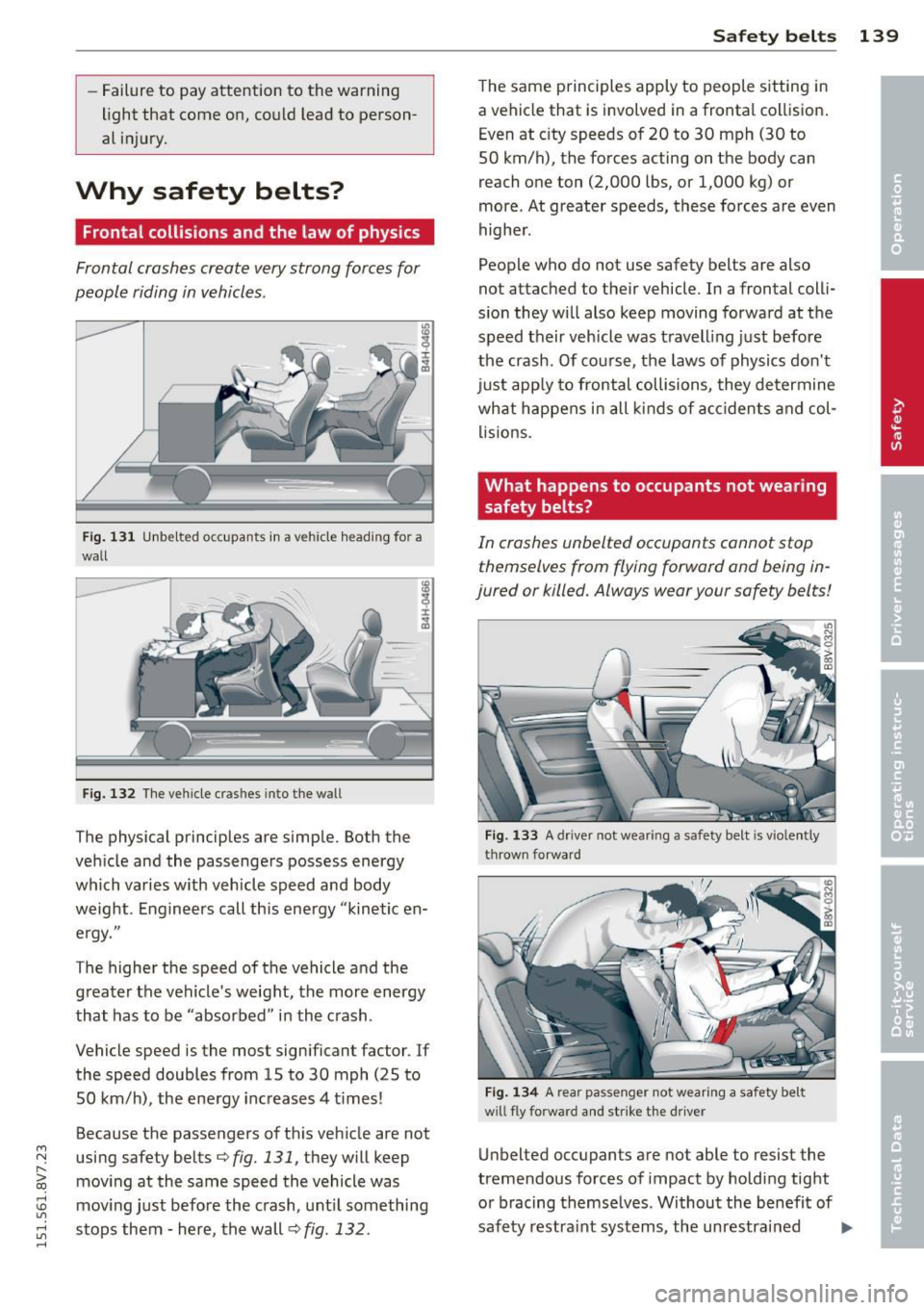
Fig. 1 31 Unb elt e d oc cupan ts in a ve hicle h ead ing for a
wall
Fig. 132 T he vehicle c ras hes into the wall
The physical principles are simple. Both the
veh icle and the passengers possess energy
which varies w ith veh icle speed and body
weight . Engineers call this energy "kinetic en
e rgy."
T he higher the speed of the vehicle and the
greater the vehicle's weight, the more energy
that has to be "absorbed" in the crash .
Vehicle speed is the most significant factor . If
the speed doubles from 15 to 30 mph (25 to
50 km/h), the ene rgy increases 4 t imes!
Because the passengers of th is veh icle are not
using safety belts
c:::;, fig. 131, they will keep
mov ing at the same speed the vehicle was
mov ing just befo re the crash, unt il something
stops them - here, the wall ¢
fig. 132 .
Safety belts 139
The same principles apply to people s itting in
a vehicle that is involved in a frontal coll ision .
Even at c ity speeds of 20 to 30 mph (30 to
SO km/h), the forces acting on the body can
reach one ton (2,000 lbs, or 1,000 kg) or
more . At greater speeds, these fo rces are even
highe r.
Peop le who do not use safety belts are also
not attached to their vehicle . In a frontal colli
s ion they will also keep moving forward at the
speed their veh icle was travel ling just before
the crash . Of co urse, the laws of physics don't
just app ly to frontal collisions, they determine
what happens i n all k inds of a cc ident s and col
li s ions .
What happens to occupants not wearing
safety belts?
In crashes unbelted occupants cannot stop
themselves from flying forward and being in
jured or killed . Always wear your safety belts!
Fi g. 1 33 A drive r not wear ing a safety bel t is v io len tly
t hrown forward
Fig . 1 34 A rear pa sse nger not wearing a safety be lt
w ill fl y forw ar d a nd str ike t he dr ive r
Unbelted occupants are not able to resist the
tremendous forces of impact by holding tight
or bracing themselves . Without the benefit of
safety restra int systems, the unrestra ined ..,_
Page 150 of 302
148 Airbag sys tem
and dia gnostic equipment to properly re
place any a irbag in your vehicle and
assure system effectiveness in a crash.
- Never permit salvaged or recycled a ir
bags to be installed in your veh icle.
Child restraints on the front seat - some
important things to know
~ Be sure to read the impo rtant informat ion
and heed the WARNINGS for impo rtant de
ta ils about ch ild ren and Advanced Airbags
Qpage 169.
Even though you r vehicle is equ ipped with an
Advanced Airbag Sys tem, ma ke certain that
all c hildren, especially those 12 years and
younger, a lways ride in the back sea t properly
restrained for their age and size . The airbag
on the passenger side makes the front seat a potentially dangerous place for a child to ride.
The front seat is not the safest place for a
child in a forward-facing child seat. It can be a
ve ry dangerous p lace for an infant or a ch ild in
a rearward-facing seat.
The Advanced Airbag System i n your veh icle
has been certified to comply with the require
ments of United States Federa l Motor Ve hicle
Safety Standard 208 as applicable at the time
your ve hicle was manufactured.
The Standard requires the front a irbag on the
passenger side to be turned off ("sup
p ressed") if a c hild up to about one year of
age restra ined in one of the rear-facing o r fo r
ward -facing infan t restra ints listed in Federal
M otor Vehicle Safety Standard 208 with w hich
the Advanced A irbag System in your vehicle
was certified has been installed on the front
passenger seat. Fo r a listing of the child re
straints that were used to certify compliance
with the US Safety Standard
Q page 171.
The PASSENGER AIR BAG OFF light in the in
strument panel te lls you when the front Ad
vanced Airbag on the passenger side has been turned off by the e lectronic control unit. E
ach time you switch on the ignition, the
PAS
SENGER AIR BAG O FF
light will come on for a
f ew seconds and :
- w ill stay on if the fro nt passenge r seat is not
occupied,
- w ill stay on i f the e lec tric al ca pacit ance
meas ured by the capacitive passenger de
tection system for the front passenger seat equa ls the combined capacitance of an in
fant up to about one year of age and one of
the rearward-facing or forward-fac ing ch ild
restraints listed in Federal Motor Vehicle
Safety Standard 208 with wh ich the Ad
vanced Airbag System in your vehicle was
c e rt ified . Fo r a listing of t he chi ld restraints
t ha t were used to certify you r vehi cle's com
p lian ce w it h t he U.S. Safety Stand ard
Q page 171.
-w ill stay on if there is a small ch ild or child
restr aint on the front passenge r seat,
- will go off if t he front pa ssenge r seat is oc
cupied by an adult as regis tered by the ca
pacitive passenge r de tection sys tem
c::> page 158, Monitoring the Advanced Air·
bag System.
The PASSENGER AIR BAG OFF light comes on
when e lec trica l capacitance registered on the
front passenger seat is eq ua l to or less tha n
t h e comb ined capacitance of a typica l 1 year
o ld infant and one of the rearward-facing or
forward-facing chi ld restraints listed in Fede r
al Motor Vehicle Safety Standard 208 w ith
wh ich the Advanced Airbag System in your ve
hicle was certified.
If the total e lectr ica l capacitance registered
on the front passenger seat is more than that
of a typical 1 year -o ld child but less than the
weight of a small adu lt , the front airbag on
t h e passenger side can deploy (the
PASSEN
GER AIR BAG OFF
light does not come on).
If the
PASSENGER AIR BAG OFF light does
not come on, the front airbag on the passen
ger side has not been turned off by t he e lec
t ro nic cont ro l unit a nd can deploy if the con
t ro l u nit se nses an impact tha t mee ts the con-
di tions s tored in its memory .
1J1>
Page 155 of 302
M N
" > co ,...., \!) 1.1"1 ,...., 1.1"1 ,....,
of a typical 1 year-old, but less than the
weight of a small adult, the front airbag on
the passenger s ide may deploy (the
PASSEN·
GER AIR BA G OFF
light does not come on).
For example, the a irbag may depl oy if:
- a small child that is heavier than a typical 1
year-o ld child is on the front passenger seat
(regardless of whether the child is in one of
the chi ld seats listed
page 171),
-a ch ild who has outgrown child rest raints is
on the front passenger seat.
I f the front passenger airbag is turned off, the
PA SSENGER AIR BAG OFF light in the center
of the inst rument panel w ill come on and stay
on.
If the front passenger airbag deploys, the
F ederal Standard requires the a irbag to meet
the " low ris k" deployment criteria to help re
d uce the risk of injury through interaction
with the airbag . "Low risk" deployment occurs
in those crashes that take place at lower de
celerations as defined in the electronic control
un it
r:::> page 158.
Alway s remember : Even though your vehicle
is equipped with Advanced Airbags, the safest
p lace for children is properly restrained on the
back seat. Please be sure to read the impor
tant information in the sect ions that follow
and be sure to heed all of the WARNINGS .
A WARNING
To reduce the risk of injury when an airbag
inflates, a lways wear safety belts prope rly.
- If you are unrestrained, lean ing forward,
sitting sideways or out of position in any
way, your risk of injury is much higher.
- You w ill also receive serious injuries and
cou ld even be killed if you are up against
the a irbag or too close to it when it in
fla tes - even with an Advanced Airbag
page 146 .
A WARNING ,~
A child in a rearward -facing child seat in -
stalled on the front passenger seat will be
-
A irbag system 153
seriously injured and can be killed if the
front airbag inflates - even w ith an Ad
vanced A irbag System.
- Altho ugh the Advanced Airbag System in
your veh icle is designed to turn off the
front airbag when a rearward-facing child restraint has been installed on the
front passenge r seat, nobody can abso
lutely guarantee that dep loyment is im
possible in all conceivable s ituations that
may happen dur ing the usef ul life of your
veh icle.
- The infla ting airbag will h it the ch ild seat
or infant carrier with g reat force and will
smash the child seat and child against
the backrest, center armrest, door, or
roof.
- Always install rearward-facing chi ld re
straints on the rear seat.
- If you must insta ll a rearwa rd fac ing
child seat on the front passenger seat because of exceptional circumstances
and the
PASSENGER AIR BAG OFF light
does not come on and stay on, immed i·
ately insta ll the rear-fac ing child seat in a
rea r seat ing pos ition and have the airbag
system inspected by you r Audi dealer .
A WARNING
If, in except iona l circumstances, you must
install a forward-facing child restraint on
the front passenge r's seat:
- Always ma ke sure the forward-facing
seat has been designed and cer tified by
its manufacture r for use on a front se at
with a passenger fron t and s ide a irbag .
- Never put the fo rward-facing child re
straint up against or ve ry near the instru
ment panel.
- Always move the passenge r seat into its
rea rmost pos ition in the seat's fore and
aft ad justment range, as fa r away from
the airbag as possible, before installing
the forward-fac ing chi ld restraint. The
backrest must be ad justed to an upright
position .
...
•
•
•
Page 162 of 302
160 Airbag sys te m
- and i f th e e lec trica l capacitance registered
on the front passenger seat is equal to or
l ess than t he combined capacitance of a ty p
ical 1 year-old infant and one of the rear
ward-facing o r forward-facing child re
stra ints listed in Federal Motor Ve hicle Safe
ty Standard 208 w ith whic h the Adva nce d
Airbag System in your vehicle was ce rtified .
If the front passenger seat is not occupied,
the front airbag will not deploy, and the
PAS
SENGER AIR BAG OFF
li ght w ill stay on . Nev
e r i nsta ll a rearwa rd-fac ing ch ild restra int on
the front passenger seat, the safest place fo r
a child in any kind of child restraint is at o ne
of the seat ing positions on the rear seat
¢ page 148, Child restraints on the front seat
- some important things to know
and
¢ page 169, Child Safety .
If the PASSENGER AIR BAG light comes
on ...
If the PASSENGER AIR BAG OFF light comes
on when one of the cond itions listed above is
met , be sure to check the light regularly to
make certa in that the
PASSENGER AIR BAG
OFF
light stays on cont inuous ly whenever the
ignit io n is on . If t he
PASSENGER AIR BAG
OFF
l ight does not appear on and does not
stay o n all the time, s top as soon as it is safe
to do so a nd
- react ivate the system by turning the ignition
off for more than 4 seconds and then tu rn
i ng it on agai n;
- remove and re install the chi ld restraint.
Make su re that the child res traint is properly
insta lled and that the safety be lt fo r the
fron t passenger seat has been correct ly
ro uted throug h the child restraint as descri
bed in t he chi ld restraint man ufact urer 's in
structions;
- make sure that the convertible locking re
t ractor on the safety belt for the front pas
senger seat has been act ivated and that the
safety belt has been pulled tight.
- ma ke sure that no e lectrica l device (such as
a laptop, CD playe r, electronic games device,
power inverter or seat heater for child seats)
is p laced or used on the front passenger seat
if the dev ice is connected to the 12-volt
socket or the cigarette lighter soc ket;
- ma ke s ure that no seat heater has been ret
rofitted or otherwise added to the front pas
senger seat;
- ma ke s ure that no thing can interfere with
the safety belt buck les an d that they are not
obstructed ;
- make sure that there are no wet objects (such as a wet towe l) and no water or other
liquids on the front passenger seat cushion.
If the PASSENGER AIR BAG light still
does not c ome on ...
If the PASSENGER AIR BAG OFF light still
does not come on and does not stay on con
t in uous ly (when the ignition is switched on),
- t ake the child restraint off the front passen -
ge r seat and install it proper ly at o ne of the
rear seat positions. Have the airbag system
inspected by yo ur Audi dealer immed iately.
- move the child to a rear seat position and
make sure t hat the c hil d is properly restra in
ed in a c hild restra int that is appropriate for
its size and age .
The PASSENGER AIR BAG light should
NOT come on . ..
The PASSENGER AIR BAG OFF light should
NOT come on when the ignit ion is on and an
adult is s itting in a proper seating position on
the front passenger seat. If t he
PASSENGER
AIR BAG OFF
light comes o n and s tays on o r
flashes fo r about S seconds w hile d riving, un
der these circumstances, make sure tha t:
- t he adult on the front passenge r sea t is
prope rly seated on the cente r of the seat
cushion wi th his o r her back up aga inst the
backrest and the backrest is no t re cli ned,
- t he adult is not tak ing we ight o ff the sea t by
holding on to the passenger assis t handle
above the front passenger door or s upport
ing their weight on the armrest ,
- t he sa fe ty belt is be ing properly wo rn and
t ha t the re is not a lot o f slack in the safety
be lt webbing,
- t here are no aftermar ket sea t covers or
cushions or other things (such as blankets) .,..