light AUDI A3 CABRIOLET 2016 Owners Manual
[x] Cancel search | Manufacturer: AUDI, Model Year: 2016, Model line: A3 CABRIOLET, Model: AUDI A3 CABRIOLET 2016Pages: 272, PDF Size: 67.88 MB
Page 172 of 272
Child safety
_& WARNING
Not using a child safety seat, using the wrong
child safety seat or improperly install ing a
child restra int increases the risk of serious
personal injury and death in a crash.
- Never install rear-facing child safety seats or infant carr iers on the front passenger
seat -
even with an Advanced Airbag System.
A chi ld will be seriously injured and can be
k illed when the inflating airbag hits the
child safety seat or infant carrier with great
force and smashes the child safety seat and
child against the backrest, door or roof
c> page 144, Child restraints on the front
seat -some important things to know.
-Always install rear-facing child safety seats
or infant carr iers on the rear seat.
- Never install a rear-facing child restraint in
the forward-facing direction. Such restraints are designed for the special needs of infants
and
very small children and cannot protect
them properly if the seat is forward-facing.
- If you must install a rearward fac ing ch ild
safety seat on the front passenger seat be cause of exceptional circumstances and the
PASSENGER AIR BAG OFF light does not
come on and stay on, immed iate ly install
the rear-fa cing ch ild safety seat in a rear
seating position and have the airbag systetn inspected by your Audi dealer.
- Never place or use any electrical device
(such as a laptop, CD player, electronic
games device, power inverter or seat heater
for child seats) on the front passenger seat if the device is connected to the 12-volt
socket or the cigarette lighter socket.
- If a seat heater has been retrofitted or oth
erwise added to the front passenger seat,
never install any ch ild restraint system on
this seat .
- Make sure that there are no wet objects
(such as a wet towel) and no water or other
liquids on the front passenge r seat cushion .
- Never place objects on the seat (such as a
laptop, CD player, elect ronic games dev ice,
power inverter or seat heater for child
seats). These may influence the e lectr ica l
172
capacitance measured by the capacitive pas
senger detect ion system and can also fly
around in an accident and cause serious per
sonal injury .
- Always read and heed all WARNINGS when
ever us ing a child restrained in a vehicle is
being used.:.>
page 135, Safety belts,
r:=;,page 143, Airbag system
and
.:.> page 165, Important information.
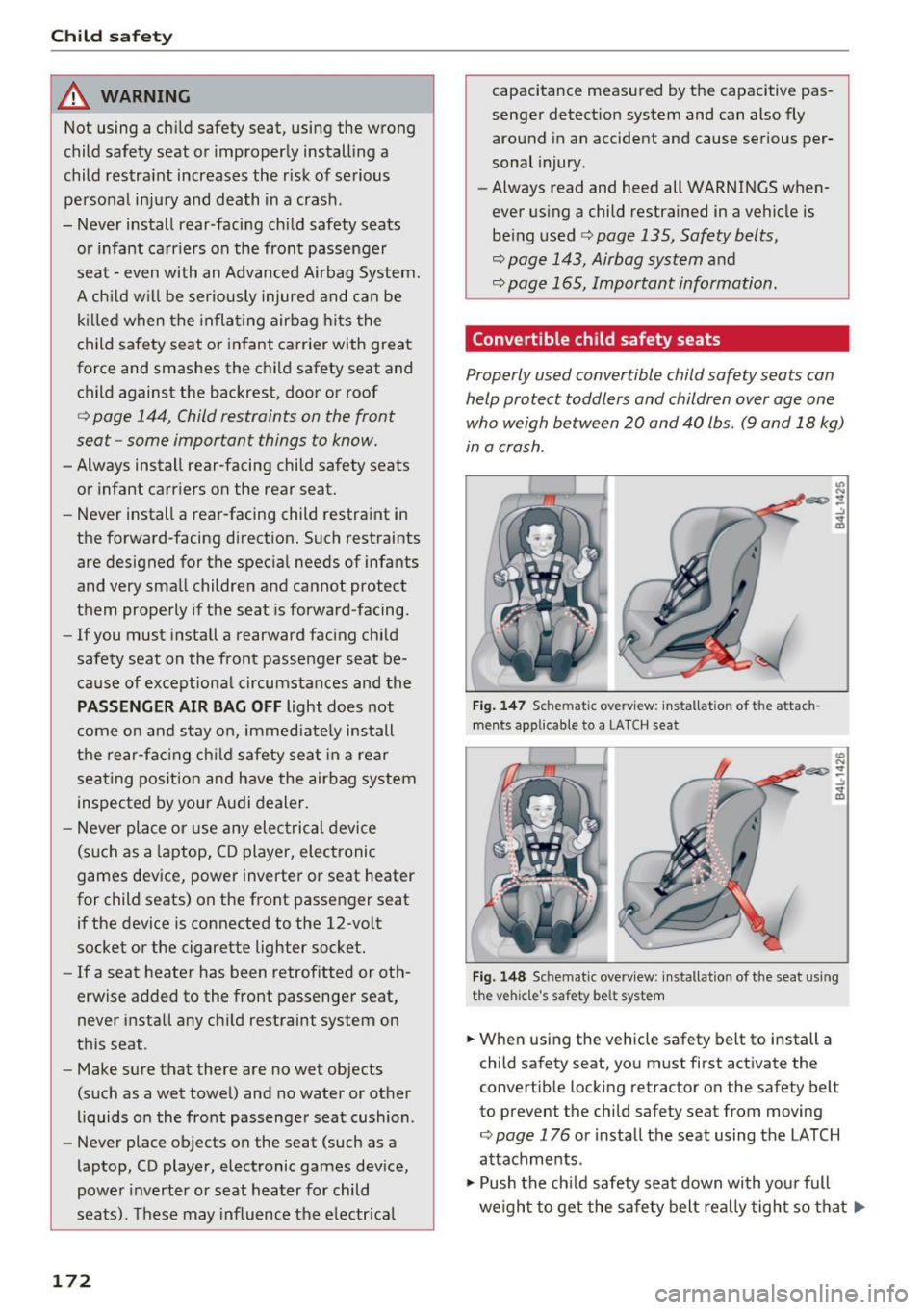
Convertible child safety seats
Properly used convertible child safety seats can
help protect toddlers and children over age one
who weigh between 20 and 40 lbs. (9 and 18 kg)
in a crash .
Fig. 147 Schema tic ove,v iew: installat ion of t he attach
me nts applicable to a LA TCH seat
Fig. 148 Schematic oveiview : installat ion of th e seat using
the vehicle's sa fety belt system
.,. When using the vehicle safety belt to install a
child safety seat, you must first activate the
convertible locking retractor on the safety belt
to prevent the child safety seat from moving
¢page 176 or install the seat using the LATCH
attachments .
.,. Push the ch ild safety seat down with you r full
weight to get the safety belt really tight so that .,..
Page 173 of 272
<( co .... N ,.__
N .... 0 ,.__
> co
the seat cannot move forward or sideways more than one inch (2.5 cm)
c::!;> page 176.
~ If the child safety seat is equ ipped with a tether
strap, attach it to the tether anchors
<=> page 181.
~ Secure unused safety belts on the rear seat
<=> page 171.
A toddler or child is usually too large for an in
fant restraint if it is more than one year old and
weighs more than 20 lbs. (9 kg) .
T oddlers and children who are o lder than one
year up to about 4 years old and weigh more than
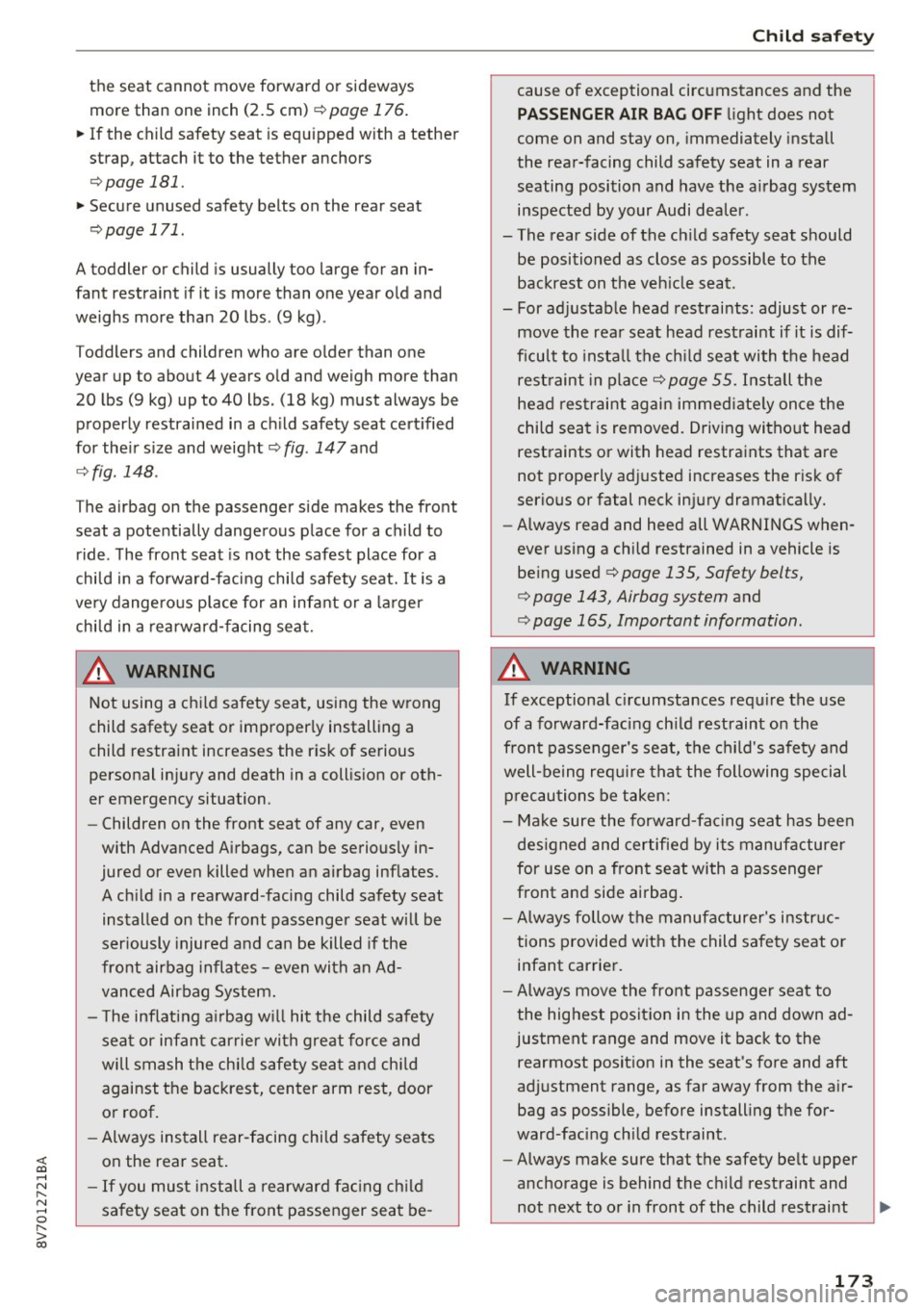
20 lbs (9 kg) up to 40 lbs. (18 kg) must always be properly restrained in a ch ild safety seat cert ified
for the ir s ize and weight <=>
fig. 147 and
¢ fig. 148 .
The airbag on the passenger side makes the front
seat a potentially dangerous place for a child to
ride . The front seat is not the safest place for a
child in a fo rward-facing child safety seat. It is a
ve ry dangero us p lace for an infant or a larger
chi ld in a rearward-facing seat.
_.6 WARNING
-Not using a ch ild safety seat, using the wrong
child safety seat or improper ly installing a
child restraint increases the risk of serious
personal injury and death in a collis ion or oth
er emergency situation.
- Children on the front seat of any car, even
with Advanced Airbags, can be seriously in
jured or even killed when an airbag inf lates.
A ch ild in a rearward-facing child safety seat
installed on the front passenger seat will be
seriously injured and can be killed if the
front airbag inflates - even with an Ad
vanced Airbag System.
- T he inflating a irbag w ill hit the child safety
seat or infant carrier with great force and
will smash the chi ld safety seat and chi ld
against the backrest, center arm rest, door
or roof.
- Always install rear-facing child safety seats
on the rear seat.
- If you must install a rearward fac ing ch ild
safety seat on the front passenger seat be-
Ch ild safety
cause of exceptional circumstances and the
PASS ENGER AIR BA G OFF light does not
come on and stay on, immediately install
the rear-facing child safety seat in a rear
seating position and have the a irbag system
inspected by your Audi dealer.
- The rear side of the ch ild safety seat should
be positioned as close as possible to the
backrest on the veh icle seat.
- For adjustable head restraints: adjust or re
move the rear seat head rest raint if it is dif
ficult to insta ll the ch ild seat with the head
restraint in place¢
page 55. Install the
head res traint again immed iate ly once the
child seat is removed. Driving witho ut head
restraints or with head restraints that are
not properly ad justed increases the r isk of
serious or fatal neck injury dramatically.
- Always read and heed all WARNINGS when
ever using a child restrained in a vehicle is
be ing used ¢
page 135, Safety belts,
<=> page 143, Airbag system
and
<=> page 165, Important information.
A WARNING
-
If exceptional c ircumstances requ ire the use
of a forward-facing ch ild restraint on the
front passenger's seat, the child 's safety and
well-being req uire that the following special
precautions be taken:
- Make sure the forward-fac ing seat has been
des igned and certified by its manufacturer
for use on a front seat with a passenger
front and side ai rbag .
- Always follow the manufacturer's instr uc
tions provided with the child safety seat o r
infant carrier.
- Always move the front passenger seat to
the highest position in the up and down ad
justment range and move it back to the rearmost posit ion in the seat's fore and aft
adjustment range, as far away from the a ir
bag as possible, before install ing the for
ward-facing ch ild restraint .
- Always make sure that the safety be lt upper
anchorage is behind the ch ild restraint and
not next to o r in front of the child restraint
~
173
Page 174 of 272
Child safety
so that the safety belt will be properly
pos it ioned.
- Always make sure that nothing prevents the
front passenger's seat from being moved to
the rearmost position in its fore and aft ad
justment range.
- Always make sure the backrest is in an up
right position.
- Never place or use any electrical device
(such as a laptop, CO player, electronic
games device, power inverter or seat heater
for child seats) on the front passenger seat
if the device is connected to the 12-volt
socket or the cigarette lighter socket.
- If a seat heater has been retrofitted or oth
erwise added to the front passenger seat,
never install any ch ild rest raint system on
t h is seat.
- Make s ure that the re a re no wet objects
(s uch as a wet towe l) and no water or other
liquids o n the front passenger seat cushion.
- Never place objects on the seat (such as a
laptop, CD player, electronic games dev ice,
power inverter or se at heater for child
seats) . These may influence the e lectrica l
capacitance measured by the capacitive pas
senger detection system and can also fly
around in an accident and cause serious per
sonal injury.
- Make sure that the
PASSENGER AIR BAG
OFF
light comes on and stays on all the time
whenever the ignition is switched on.
- If the
PAS SENGER AIR BAG OFF light does
not come on and stay on, immediately in
stall the forward-facing child seat at a seat ing posit ion on the rear seat and have the
airbag system inspected by your author ized
Audi dealer.
- T ake the ch ild restraint off the front passen
ger seat and insta ll it p roperly at one of the
rea r seat positions if the
PASSENGER AIR
BAG OFF
l ight does not stay on whenever
the ignition is switched on.
174
Booster seats and safety belts
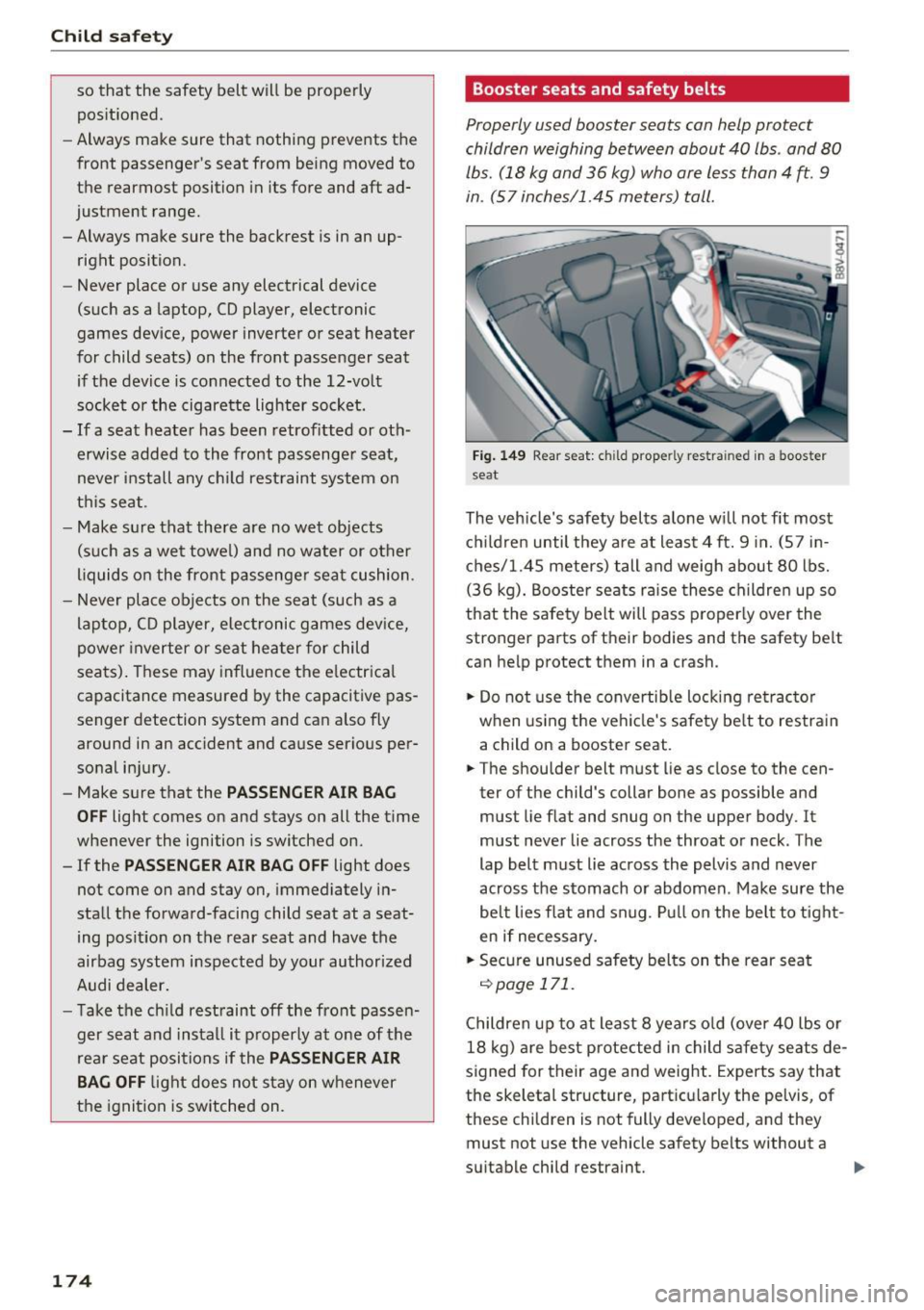
Properly used booster seats can help protect
children weighing between about 40 lbs . and 80
lbs. (18 kg and 36 kg) who are less than 4
ft. 9
in . (57 inches/1.45 meters) tall.
Fi g. 1 49 Rear seat: ch ild prope rly restra ined in a booster
seat
The vehicle's safety belts a lone w ill not fit most
ch ild ren until they are at leas t 4 ft. 9 in. (57 in
ches/1.45 meters) tall and weigh about 80 lbs. (36 kg) . Booste r seats raise these ch ildren up so
that the sa fety belt will pass p roper ly over the
stronger parts of their bodies and the safety be lt
can help protect them in a crash.
.,. Do not use the convertib le locking re trac tor
when using the veh icle's safety be lt to restrain
a child on a booster seat.
.,. The shoulder belt must lie as close to the cen
ter of the child's collar bone as possible and
must lie flat and snug on the upper body. It
must never lie across the throat or neck . The
lap belt m ust lie across the pelvis and never
across the stomach or abdomen . Make sure the
belt lies flat and sn ug. Pu ll on the be lt to tight
en if necessary.
.,. Secure unused safety belts on the rear seat
c>page 171.
Children up to at least 8 years o ld (over 40 lbs or
18 kg) a re best protected in child safety seats de
signed for their age and weight . Experts say that
the skeletal structure, part icu larly the pelvis, of
these ch ildren is not fully developed, and they
must not use the vehicle safety belts without a
su itable child restraint.
Page 176 of 272
Child safet y
-If you must install a booster seat on the
front passenger seat because of exceptional
circumstances the
P ASSENGER AIR BAG
OFF
light must come on and stay on, when
ever the ignition is switched on.
- If the PASSENGER AIR BAG OFF light does
not come on and stay on, perform the
checks descr ibed
~ page 155, Monitoring
the Advanced Airbag System.
- Take the ch ild restraint off the front passen
ger seat and install it p roperly at one of the
rea r seat positions if the
PA SSENGER AIR
BAG OFF
l ight does not stay on whenever
the ignition is switched on.
- Always read and heed all WARN INGS when
ever using a child restrained in a veh icle is
being used~
page 135, Safety belts,
~ page 143, Airbag system and
~page 165, Important information.
Securing child seats
Securing a child safety seat using a safety
belt
---
Safety belts for the rear seats and the front pas
senger can be locked with the convertible locking
retractor to properly secure child safety seats .
The safety belts emergency locking retractors for
the rear seats safety belts and for the front pas
senger's seat safety belt have a convertib le lock
i n g ret rac to r fo r child rest raints . The safety belt
m ust be locked so that belt webbing cannot un
reel. The retractor can be activated to lock the
safety belt and prevent the safety belt webbing
from loosening up during normal driving. A child
safety seat can only be properly installed when
the safety belt is locked so that the child and
chi ld safety seat w ill stay in place .
A lways remember: Even though your vehicle is
equ ipped w ith an Advanced Airbag system, all
children, especially those 12 years and younger,
should always ride in the back seat properly re
stra ined for their age and size .
176
A WARNING ,.
Improperly installed child safety seats in-
crease the r isk of serious personal injury and
death in a collision.
-
- Always make sure that the safety be lt re
tractor is locked when installing a ch ild
safety seat . An unlocked safety be lt retrac
tor cannot hold the ch ild safety seat in place
during normal d riving or in a c rash.
- Always buckle the child safety seat firmly in
place even if a ch ild is not si tting in it. A
loose child safety seat can fly a round dur ing
a sudden s top or in a collision.
- I f the backrest is not se curely latched, the
child and the ch ild restraint will be thrown
forward together with the backrest and w ill
strike parts of the veh icle interior. The child
can be seriously injured or killed.
- Never install rear -facing child safety seats
or infant carriers on the front passenger
seat. A child w ill be seriously injured and
can be k illed when the passenger a irbag in
flates.
- The inflating airbag will h it the ch ild safety
seat or infant carr ier with great force and
w ill smash the child safety seat and child
aga inst the backrest, center armrest, door
or roof.
- Always install rear-fac ing ch ild safety seats
or infant carriers on the rear seat .
- Forward-facing child safety seats or infant
carriers installed on the front passenger's
seat may interfere w ith the deployment of
the airbag and ca use serio us inju ry to the
child.
- It is safer to install a forward-facing child
safety seat on the rear seat.
- Always read and heed all WARNINGS when
eve r us ing a child restrained in a vehicle is
be ing used
c::!;> page 165. Special p recautions
apply when installing a child safety seat on
the front passenger seat~
page 144, Child
restraints on the front seat -some impor-
tant things to know .
~
Page 177 of 272
<( co .... N ,.__
N .... 0 ,.__
> co
A WARNING 1=
Always take special precautions if you must install a forward or rearward -facing ch ild re
straint on the front passenger's seat in excep
tional situations:
- Whenever a forward or rearward -facing
child restraint is installed on the front pas
senger seat, the
P ASSENGER AIR BAG OFF
light must come on and stay on whenever
the ignition is switched on .
- If the
PA SSENGER AIR BAG OFF light does
not come on and stay on , perform the
checks descr ibed
~ page 155, Monitoring
the Advanced Airbag System.
- T ake the ch ild restraint off the front passen
ger seat and install it p roperly at one of the
rear seat positions if the
PAS SEN GER AI R
BAG OF F
light does not stay on whenever
the ignition is switched on.
- Improper installation of ch ild restraints can
reduce their effectiveness or even prevent
them from providing any protection .
- An improper ly installed child restraint can
interfere with the airbag as it deploys and
seriously injure or even kill the child .
- Always carefu lly follow the manufacturer's
instructions provided with the child safety
seat or carrier.
- After checking to make sure that the child restra int is properly installed, make certa in
tha t the child restraint is correctly recog
nized by the capacit ive passenger detection
system in the front passenger seat and that
the
PASSENGER AIR BAG OFF light signals
the cor rect front passenger fronta l airbag
status .
A WARNING
Forward-fac ing child rest raints :
- Always ma ke sure the forward-fac ing seat
has been designed and ce rtified by its man
ufacturer for use on a fron t seat with a pas
senger front and s ide a irbag .
- Never put the forward-facing child restraint
up, against or very near the instrument pan
el.
-
Ch ild safety
-Always move the front passenger seat to
the highest posit ion in the up and down ad
justment range and move it back to the rearmost posit ion in the seat's fore and aft
ad justment range, as far away from the a ir
bag as possible , before installing the for
ward-facing ch ild restraint.
- Always make sure that the safety belt upper
anchorage is behind the ch ild rest raint and
not next to o r in front of the child restraint
so that the safety be lt will be p roperly posi
tioned.
- Ma ke sure that the
PASSENGER AIR BAG
OFF
li ght comes on and stays on a ll the time
whenever the ignit ion is switched on .
A WARNING
= Rearward-facing chi ld restraints:
- A child in a rearward-fac ing c hild safety sea t
installed on the front passenger seat will be
serio usly injured and can be ki lled if the
front airbag inflates -even with an Ad
vanced Airbag System .
- The inflating airbag will hit the c hild safety
seat or infant carr ier with great force and
will smash the child safety seat and child
aga inst the backrest, center armrest, door
or roof.
- Always be especially carefu l if you must in
stall a rearward facing child safety seat on
the front passenger seat in except ional cir
cumstances.
- Make sure that the
PASSENGER AIR BAG
OFF
light comes on and stays on all the time
whenever the ignit ion is switched on .
- If the
PA SSENGER AIR BAG OFF light does
not come on and stay on, immediately in
stall the rea r-facing child safety seat in a
rear seating posit ion and have the airbag
sys tem inspected by you r Audi dealer.
Activating the convertible locking retractor
Use the convertible locking retractor to secure a
child restraint.
Always heed the c hild safety seat manufacturer 's
instruct ions when installing a child restraint in
177
Page 182 of 272
Child safety
-Never attach a tether strap to a tie-down
hook in the luggage compartment.
- Never use child restraint tether anchorages
to secure safety belts or other kinds of occu
pant restraints.
- Never secure or attach any luggage or other
items to the LATCH lower anchorages or to
the tether anchors.
- If you must install a rearward facing child
safety seat on the front passenger seat be
cause of exceptional circumstances and the
PAS SEN G ER AIR BAG OFF light does not
come on and stay on, immed iate ly install
the rear-fac ing ch ild safety seat in a rea r
seat ing pos ition and have the airbag system
inspected by your Audi dealer.
Installing the upper tether strap on the
anchorage
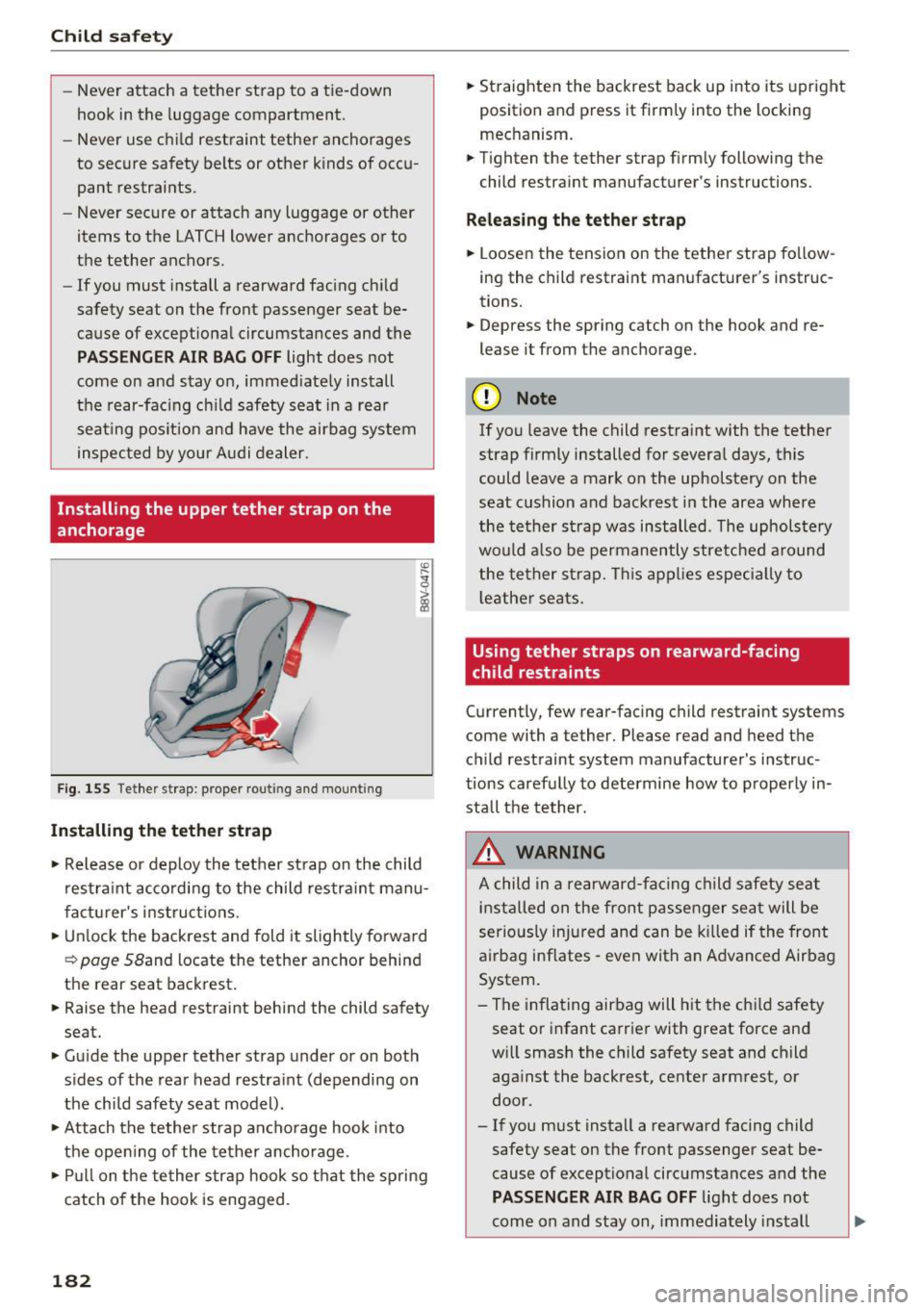
Fig. 155 Tet her strap: proper routing and mounting
Installing th e teth er strap
.,. Release or deploy the tether strap on the child
restra int acco rding to the child restra int manu
fac ture r's instruct ions.
.,. Un lock the backrest and fold it slightly forward
¢ page 58and locate the tether anchor behind
the rear seat backrest.
.,. Raise the head restraint behind the child safety
seat.
.,. Gu ide the upper tether strap under or on both
s ides of the rea r head restra int (depending on
the child safety seat model) .
.,. Attach the tether strap ancho rage hook into
the open ing of the tether anchorage.
.,. Pull on the tether strap hook so that the spring
catch of the hook is engaged.
182
.,. Straighten the backrest back up into its upright
position and press it firmly into the locking
mechanism.
.,. Tighten the tether strap firmly following the
child restraint manufacturer's instructions.
Releasi ng th e tet her strap
.,. Loosen the tension on the tethe r strap fo llow
ing the child restraint manufacturer's instruc
tions.
.,. Depress the spring catch on the hook and re
lease it from the anchorage.
(D Note
If you leave the child restraint with the tether
strap firmly installed for several days, this
could leave a mark on the upholstery on the
seat cushion and backrest in the area where
the tether strap was installed. The upholstery
would also be permanently stretched a round
the tether s trap. This applies especially to
l eather seats.
Using tether straps on rearward-facing
child restraints
Currently, few rear-facing child restraint systems
come with a tether. Please read and heed the
ch ild restraint system manufacturer's i nstruc
tions carefully to determine how to properly in
stall the tether.
&_ WARNING
A child in a rearward-facing child safety seat installed on the front passenger seat will be
seriously inju red and can be k illed if the front
airbag inf lates -even with an Advanced Airbag
System.
- The inflating airbag will h it the child safety
seat or infant carrier with great force and
will smash the child safety seat and child aga inst the backrest, center armrest, or
door.
- If you m ust install a rearward facing child
safety seat on the front passenger seat be
cause of exceptional circumstances and the
PA SSENGER A IR BA G OFF light does not
come on and stay on, immediately install
Page 184 of 272
Check ing and F illing
Checking and Filling
Gasoline fuel
Gasoline grade
A pp lies to: ve hicles w ith gaso li ne engines
The correct gasoline grade is stated on the inside
of the fuel filler door .
The vehicle is equipped with a catalytic converter
and must only be driven w ith
unlead ed ga soli ne.
Aud i recommends using TOP TIER Detergent Gas
oline. Additional information on TOP TIER Deter
gent Gasoline can be found on the official web
site (www .toptiergas.com) .
The individua l gasoline grades are differentiated
by
oct ane rating s. This value is given with (R +M)/
2 equating to AK I or in RON.
The fo llowing headings match the corresponding
sticker in the fuel fi ller door .
UNLEADED FUEL ONLY MIN. (R+M) /2 87
R egula r/ MIN. RON
91 Regular
Use regu lar gasoline with minim um 87 AKI/
9 1 RON ~@ .
The max imum engine power is only reached if
p rem ium gasol ine 91 AKI/ 95 RON is used.
UNLEADED FUEL ONLY PREMIUM MIN . (R
+M )/2
91 / SUPER MIN. RON 95
Using premium gasoline with m inim um 91 AKI/
95 RON is recommended.
If premium gasoline is not available, you can also
use regula r gasoline 87 AKI/ 91 RON . However
this does reduce the engine powe r slight ly.
CD Note
- Fil li ng the tank just one time with leaded
fuel or other meta llic additives will cause
permanent deteriorat ion to the cata lyt ic
conve rter func tion.
- When gasoline with an octane rati ng that is
too low is used , h igh speeds o r heavy engine
l oad can lead to engi ne dam age.
184
(D Tips
The vehicle can be fi lled with fue l that has a
h igher octane rating than what is requi red by
the eng ine.
Blended gasoline
App lies to : vehicles wit h gasol ine engi ne
U se of g asoline cont aining alcohol or MTBE
(m ethyl tertiary butyl ether )
You may use unleaded gasoline blended with al
cohol o r M TBE (commonly referred to as oxygen
ates) if the blended m ixt ure meets the fo llow ing
c rit eria:
Blend of ga soline methanol (wood alcohol or
methyl alcohol)
- Anti-knock index must be 87 AKI or h igher.
- Blend must contain no more than 3% metha-
nol.
- Blend must contain more than 2% co-solvents.
Blend of ga soline and ethanol (grain alcoh ol or
ethyl alcohol)
- Anti-knoc k index must be 87 A KI or h igher.
- Blend must not conta in more than 15% etha-
nol.
Blend of gasoline and MTBE
- Anti -knock index must be 87 AKI or higher.
- Blend mus t contain no t more than 15% MTBE .
Seasonall y adjusted ga soline
Many gasoline grades are blended to perform es
pecially well for winter or summer dr iv ing . Du r
i ng seasonal change-over, we suggest that you
fill up at busy gas stat ions where the seaso nal
adjustment is mo re l ikely to be made in t ime .
CD Note
-Methanol fuels which do not meet these re
quirements may cause corrosion and dam
age to plasti c and rubber components in the
fue l system.
- Do not use fue ls that fa il to meet the speci
fied cr iteria in th is chapter.
...
Page 190 of 272

Checking and Filling
Opening the hood
The hood is released from the interior.
M ~
-...::;:;======== -d ~
Fi g. 159 Sect ion from th e driver's side footwell: release
l ever
F ig. 160 Rocker switc h under the hood
Read and foll ow the WARNING S before check
ing anything in the engine compartment
r::;, page 188, Working in the engine comport
ment .
m
Make sure the wiper arms are not raised up from
the w indshield . Otherwise the paint could be
damaged .
.,. With the driver's door open, pull the lever be
low the instrument panel in the direct ion of the
arrow
r::;, fig. 159 .
190
.,. Raise the hood slightly r::;, .&, .
.,. Press the rocker switch under the hood upward
r::;, fig. 160. This releases the catch .
.,. Open the hood .
A WARNING
Never open the hood when you see that steam
or coolant drips from the engine compart ment- there is a danger of bu rns! Wait unt il
no steam or coolant flows out.
Closing the hood
.,. Push the hood down u ntil the fo rce of the strut
is ove rcome .
.,. Let the hood fall lightly into the latch .
Do not
press it in.
r::;, .&, .
A WARNING
If the hood is not latched complete ly, it could
fly up wh ile you are dr iving and obstruct your
vision.
- For safety reasons, the hood must always be
closed securely while driv ing. Because of
this, always check the hood after closing it
to make sure it is latched correctly . The
hood is latched if the front corners cannot
be lifted.
- If you notice that the hood is not latched
while you are driving, stop immed iate ly and
close it, because this increases the risk of an
accident .
Page 192 of 272
Check ing and F illing
Audi oil quality standard
Gas olin e
VW 502 00 or
engi ne vw 50400
A udi reco mmend s
~Castrol I jgl[J,'fE{g ?r,w.:..~J ri, '.IA!,
Audi rec ommends Longlif e high perform ance
engi ne oil from Au di Genuin e Parts
Using the proper engine oil is important for the
functionality and service life of the engine. Your
engine was factory-filled with a h igh-quality oil
which can usually be used throughout the entire
yea r.
(D Note
Your Limited New Vehicle Warranty does not
cover damage or malfunctions due to failure
to follow recommended maintenance and use
requirements as set forth in the Audi Owner's
Manual and Warranty & Maintenance booklet .
- Use only a high qual ity eng ine oil that ex-
pressly complies with the Audi oil quality
standard specified for your vehicle's engine .
Using any other oil can cause serious engine
damage.
- Do not mix any lubricants or other additives into the engine oil. Doing so can cause en
gine damage.
@ Tips
If you need to add oil and there is none availa
ble that meets the Audi oil quality standard
your engine requires, you may add a total of
no more than 0.5 quart/liter of a h igh-quality
"synthet ic"oil that meets the following speci
fications.
- Vehicles w ith gasoline eng ine: ACEA A3 or
API SM with a viscosity grade of SAE OW-30,
SAE 5W-30 or SAE 5W-40.
- For more information about engine o il that
has been approved for your vehicle, please
contact either your authorized Audi dea ler
or Aud i Custome r Relat ions at
1 (800) 822- 2834 or visit ou r web site at
www.audiusa.com or www .aud icanada.ca.
192
· Eng ine oil consumption
The engine in your vehicle depends on an ade
quate amount of oil to lubricate and cool all of
its moving parts.
In order to provide effect ive lubricat ion and cool
i ng of internal engine components, all internal
combust ion eng ines consume a certa in amount
of oil. Oil consumption var ies from engine to en
gine and may change sign ificantly over the life of
the engine . T ypically, engines w ith a specified
break -in period (see¢
page 65) consume more
oi l during the break-in period than they consume
after oil consumption has stabilized.
U nder normal cond itions, the rate of oil con
sumption depends on the quality and viscosity o f
the oil , the RPM (revo lutions per minute) at
which the engine is operated, the ambient tem perature and road conditions. Further factors are
the amount of o il dilution from water condensa
tion or fuel residue and the oxidation level of the
o il. As any engine is subject to wear as mileage
builds up, the o il consumption may increase over
ti me unt il replacement of wo rn compo nents may
become necessary.
With all these variables coming into play, no standard rate of o il consumption can be estab
li shed or spec ified . T he re is no alte rnative to reg
u la r and freq uent checki ng of the oi l level, see
Note.
If the yellow engine oil level warning symbo l II
in the instrument cluster lights up, you sho uld
chec k the o il level as soon as possible
¢
page 193. Top off the o il at your earlies t con
venience
¢ page 193.
A WARNING
Before you check anything in the engine com
partment, always read and heed all WARN
INGS
¢page 188.
(D Note
Driving with an insufficient oil level is likely to
cause severe damage to the engine.
IJII,
Page 195 of 272
<( co ..... N
" N ..... 0 r--. > 00
-Always dispose of used engine oil prope rly .
Do not dump it on garden soi l, wooded
areas, into open streams or down sewage
drains.
- Recycle used engine oil by taking it to a used
engine oil collection facility in your area, or
contact a serv ice stat ion.
Cooling system
Coolant
The engine coo ling system is filled wi th a mixture
of purified water and coolant additive at the fac
tory. This coo lant must not be not changed.
The coolant leve l is moni to red throug h the . in
d icator light
q page 16 . Howeve r, we do recom
mend occasiona lly checking the coo lant level
manually.
If you m ust add coo lant, use a m ix ture of water
an d coolant addit ive. Mixing the coolant additive
with d isti lled water is recommended.
Coolant additive
The coolan t additive is made of anti-freezing and
corros ion pro tection agents. Only use the fol low
in g coolant add it ives. The se addi tives may be
mixed wit h each other.
Coolant additive Specification
G13 TL 7
74)
G12 ++ TL 774 G
T he amount of coo lant additive that needs to be
mixed with water depends on the climate where
the vehicle will be ope rated. If the coolant addi
tive percentage is too low, the coolant can freeze
and damage the eng ine.
Coolant Freeze protec-
additive tion
Warm reg ions min . 40% m in. -13 °F
max. 45% (-
25
°()
Cold regions min . 50% max . -40 °F
max. 55% (-40
°()
Checking and Filling
(D Note
-
Before the start of w inte r, have you r auth or
ized Aud i dealer or a uthorized Aud i Serv ice
Facility check if the coolant addit ive in your
vehicle matches the pe rcentage appropriate
for the climate. This is especially important
when driving in colder climates .
- If the appropr iate coo lant add itive is not
availab le in an emergency, do not add any
other additive. Yo u could damage the en
gine. If this happens, on ly use water and re
store t he corre ct m ix tu re ratio with the
specified coolant ad ditive as soon as poss i
ble.
- O nly refill w ith new coolant.
- Radiator sea lant must not be mi xed with
the coolant.
Adding coolant
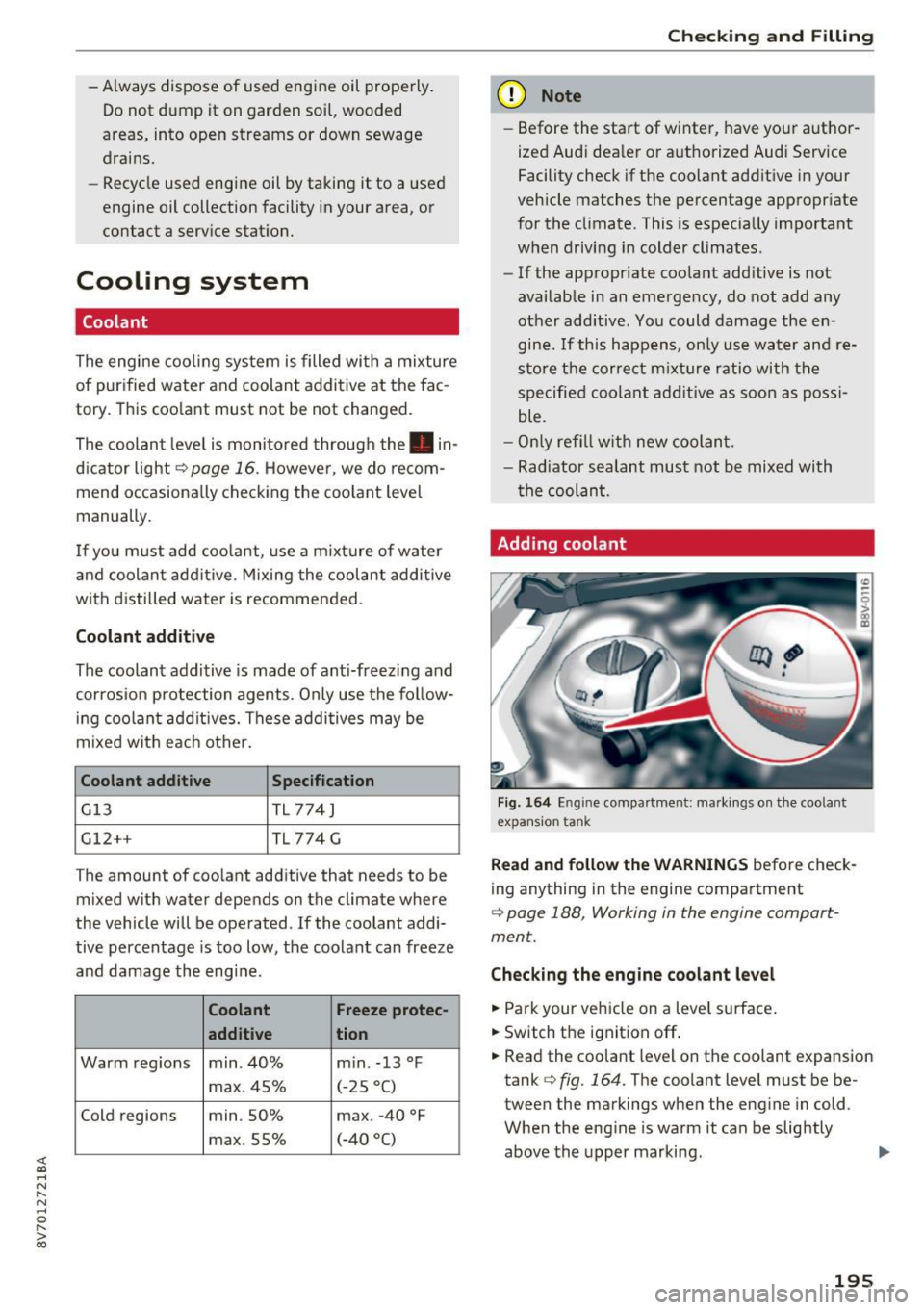
Fig . 1 64 En g in e compa rtment: ma rki ngs o n the coolant
expans ion
t ank
Read and follow the WARNINGS befo re check
ing anything in the engine compartment
i=> page 188, Working in the engine compart
ment.
Che cking the engine coolant level
.. Park your vehicle on a leve l su rface .
.. Switch t he ignition off .
.. Read the coolant level on the coolant expansion
tank ¢
fig. 164. The coolant level must be be
tween the markings when the eng ine in cold .
When the eng ine is warm it can be slig htly
above the upper marking.
195