warning AUDI A3 CABRIOLET 2016 Owners Manual
[x] Cancel search | Manufacturer: AUDI, Model Year: 2016, Model line: A3 CABRIOLET, Model: AUDI A3 CABRIOLET 2016Pages: 272, PDF Size: 67.88 MB
Page 125 of 272
<( co ..... N
" N ..... 0 r--. > 00
.. Make sure that nothing can interfere with the
pedals.
.. Adjust front seat , head restraint and mirrors
correctly for your height.
.. Instruct passengers to adjust the head re
straints accord ing to their height .
.. Make sure to use the right ch ild restraint cor
rectly to protect children
~ page 165, Child
safety .
.,. Sit properly in your seat and make sure that
your passengers do the same
¢page 53, Front
seats .
.. Fasten your safety be lt and wear it properly. Al
so instruct your passengers to fasten their safe
ty belts properly ¢
page 135 .
What impairs driving safety?
Safe driving is directly related to the condition of
the vehicle , the driver as well as the driver's abili
ty to concentrate on the road without being dis
tracted.
The driver is responsible for the safety of the ve
hicle and all of its occupants. If your ability to
drive is impaired, safety risks for everybody in the
veh icle increase and you also become a hazard to
everyone else on the road
¢ ,&. Therefore :
.,. Do not let yourself be distracted by passengers
or by using a cellular telephone.
.. NEVER dr ive when your driv ing ability is im
paired (by medications, alcohol, drugs, etc.) .
.. Observe all traffic laws, rules of the road and
speed limits and plain common sense.
.. ALWAYS adjust your speed to road, traffic and
weathe r conditions.
.. Take frequent breaks on long trips. Do not drive
for more than two hours at a stretch .
.. Do NOT drive when you are tired, under pres
sure or when you are stressed.
A WARNING
Impaired dr iv ing safety increases the risk of
ser ious personal inj ury and death whenever a
vehicle is being used.
Driving safety
Correct passenger
seating positions
Proper seating position for the driver
The proper driver seating position is important
for safe, relaxed driving .
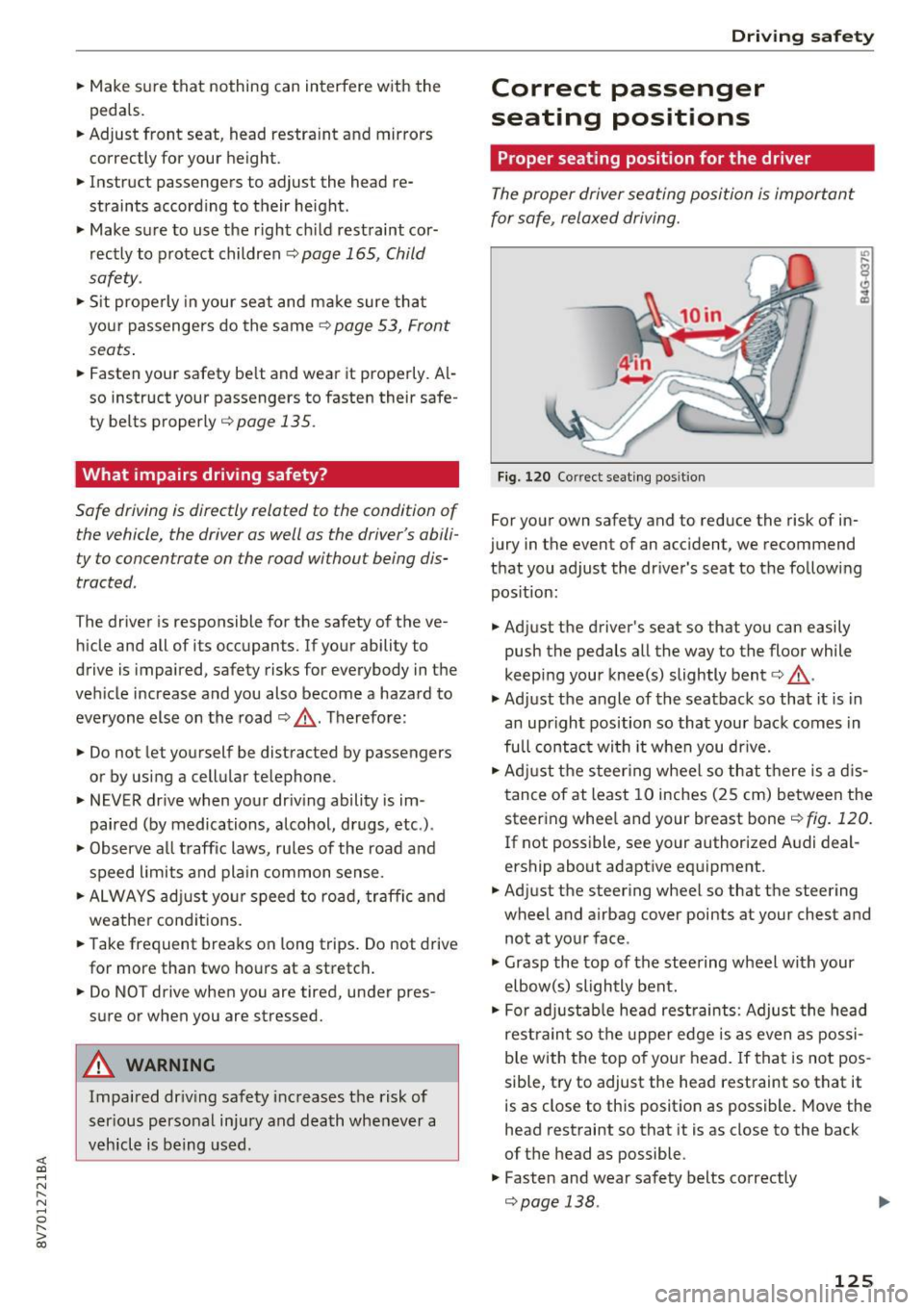
Fig. 120 Correct seating pos it ion
For your own safety and to reduce the risk of in
jury in the event of an accident, we recommend
that you adjust the driver 's seat to the following
position:
.. Adjust the driver's seat so that you can easily
push the pedals all the way to the floor while
keep ing your knee(s) slightly bent¢,& .
.,. Adjust the angle of the seatback so that it is in
an upright position so that your back comes in
full contact wi th it when you dr ive .
.. Adjust the steering wheel so that there is a dis
tance of at least 10 inches (25 cm) between the
steering whee l and your breast bone¢
fig. 120.
If not poss ible, see your author ized A udi deal
ership about adaptive equipment.
.. Adjust the steering wheel so that the steering
wheel and airbag cover points at your chest and
not at your face .
.,. Grasp the top of the steering wheel with your
elbow(s) slightly bent .
.. For adjustable head restraints: Adjust the head
restraint so the upper edge is as even as possi
b le with the top of your head. If that is not pos
sible, try to adjust the head restraint so that it
is as close to this posit ion as possible. Move the
head restraint so that it is as close to the back
of the head as possible.
.. Fasten and wear safety belts correctly
¢page 138. ..,.
125
Page 126 of 272
Driving safety
"' Always keep both feet in the footwell so that
you are in control of the vehicle at all times.
For detailed information on how to adjust the
driver's seat, see
c;, page 53.
A WARNING
Drivers who are unbelted, out of position or
too close to the airbag can be seriously in
jured by an airbag as it unfolds . To help re
duce the risk of serious personal injury:
- Always adjust the driver's seat and the
steering wheel so that there are at least
10 inches (25 cm) between your breastbone
and the steering wheel.
- Always adjust the driver's seat and the
steering wheel so that there are at least
4 inches (10 cm) between the knees and the
lower part of the instrument panel.
- Always hold the steering wheel on the out
side of the steering wheel rim with your
hands at the 9 o'clock and 3 o'clock posi
tions to help reduce the risk of personal in
jury if the driver's airbag inflates.
- Never hold the steering wheel at the
12 o'clock position or with your hands at
other positions inside the steering wheel
rim or on the steering wheel hub. Holding
the steering wheel the wrong way can cause
serious injuries to the hands, arms and head if the driver's airbag inflates.
- Pointing the steering wheel toward your
face decreases the ability of the su pplemen
tal driver's airbag to protect you in a colli
sion.
- Always sit in an upright position and never lean against or place any part of your body
too close to the area where the airbags are
located .
- Before driving, always adjust the front seats
properly and make sure that all passengers
are properly restrained .
- For adjustable head restraints: before driv
ing, always also adjust the head restraints
properly .
- Never adjust the seats while the vehicle is
moving. Your seat may move unexpectedly
and you could lose control of the vehicle.
126
-
-Never drive with the backrest reclined or
tilted far back! The farther the backrests are
tilted back, the greater the risk of injury due
to incorrect positioning of the safety belt
and improper seating position .
- Children must always ride in child seats
c:;, page 165 . Special precautions apply
when installing a child seat on the front
passenger seat
c:;, page 143.
Proper seating position for the front
passenger
The proper front passenger seating position is
important for safe, relaxed driving.
For your own safety and to reduce the risk of in
jury in the event of an accident , we recommend
that you adjust the seat for the front passenger
to the following position:
"'Adjust the angle of the seatback so that it is in
an upright position and your back comes in full
contact with it whenever the vehicle is moving.
"'For adjustable head restraints: adjust the head
restraint so the upper edge is as even as possi
ble with the top of your head. If that is not pos
sible, try to adjust the head restraint so that it
is as close to this position as possible
c:;, page 12 7 . Move the head restraint so that it
is as close to the back of the head as possible.
"' Keep both feet flat on the floor in front of the
front passenger seat .
"' Fasten and wear safety belts correctly
c;,page 138.
For detailed information on how to adjust the
front passenger's seat, see
c:;, page 53 .
A WARNING
Front seat passengers who are unbelted, out
of position or too close to the airbag can be
seriously injured or killed by the airbag as it
unfolds. To help reduce the risk of serious
personal injury:
- Passengers must always sit in an upright po
sition and never lean against or place any part of their body too close to the area
where the airbags are located.
Ill-
Page 127 of 272
-Passengers who are unbelted, out of posi
tion or too close to the airbag can be seri
ously injured by an airbag as it unfolds with
great force in the blink of an eye.
- Always make sure that there are at least
10 inches (25 cm) between the front pas
senger's breastbone and the instrument
panel.
- Always make sure that there are at least
4 inches (10 cm) between the front passen ger's knees and the lower part of the instru
ment panel.
- Each passenger must always sit on a seat of
their own and properly fasten and wear the safety belt belonging to that seat.
- Before driving, always adjust the front pas
senger seat properly.
- For adjustable head restraints: before driv
ing, always also adjust the head restraints
properly.
-Always keep your feet on the floor in front
of the seat. Never rest them on the seat, in
strument panel, out of the window, etc. The
airbag system and safety belt will not be
able to protect you properly and can even in
crease the risk of injury in a crash.
- Never drive with the backrest reclined or
tilted far back! The farther the backrests are
tilted back, the greater the risk of injury due
to incorrect positioning of the safety belt and improper seating position.
- Children must always ride in child seats
c> page 165. Special precautions apply
when installing a child seat on the front
passenger seat
c> page 143.
Proper seating positions for passengers in
rear seats
Rear seat passengers must sit upright with both
feet on the floor consistent with their physical
size and be properly restrained whenever the ve
hicle is in use.
To reduce the risk of injury caused by an incorrect
;;§ seating position in the event of a sudden braking
..... N
" N ..... 0 r--. > 00
maneuver or an accident, your passengers on the
rear bench seat must always observe the follow
ing:
Driving safety
.,. For adjustable head restraints: adjust the head
restraint so the upper edge is as even as possi
ble with the top of your head. If that is not pos
sible, try to adjust the head restraint so that it
is as close to this position as possible
c>page 127.
.,. Keep both feet flat in the footwell in front of
the rear seat.
.,. Fasten and wear safety belts properly
c> page 138.
.,. Make sure that children are always properly re
strained in a child restraint that is appropriate
for their size and ager:!;>
page 165.
A WARNING
-
Passengers who are improperly seated on the
rear seat can be seriously injured in a crash.
- Each passenger must always sit on a seat of
their own and properly fasten and wear the
safety belt belonging to that seat.
- Safety belts only offer maximum protection
when the safety belts are properly posi
tioned on the body and securely latched. By not sitting upright, a rear seat passenger in
creases the risk of personal injury from im
properly positioned safety belts!
- For adjustable head restraints: always ad
just the head restraint properly so that it
can give maximum protection.
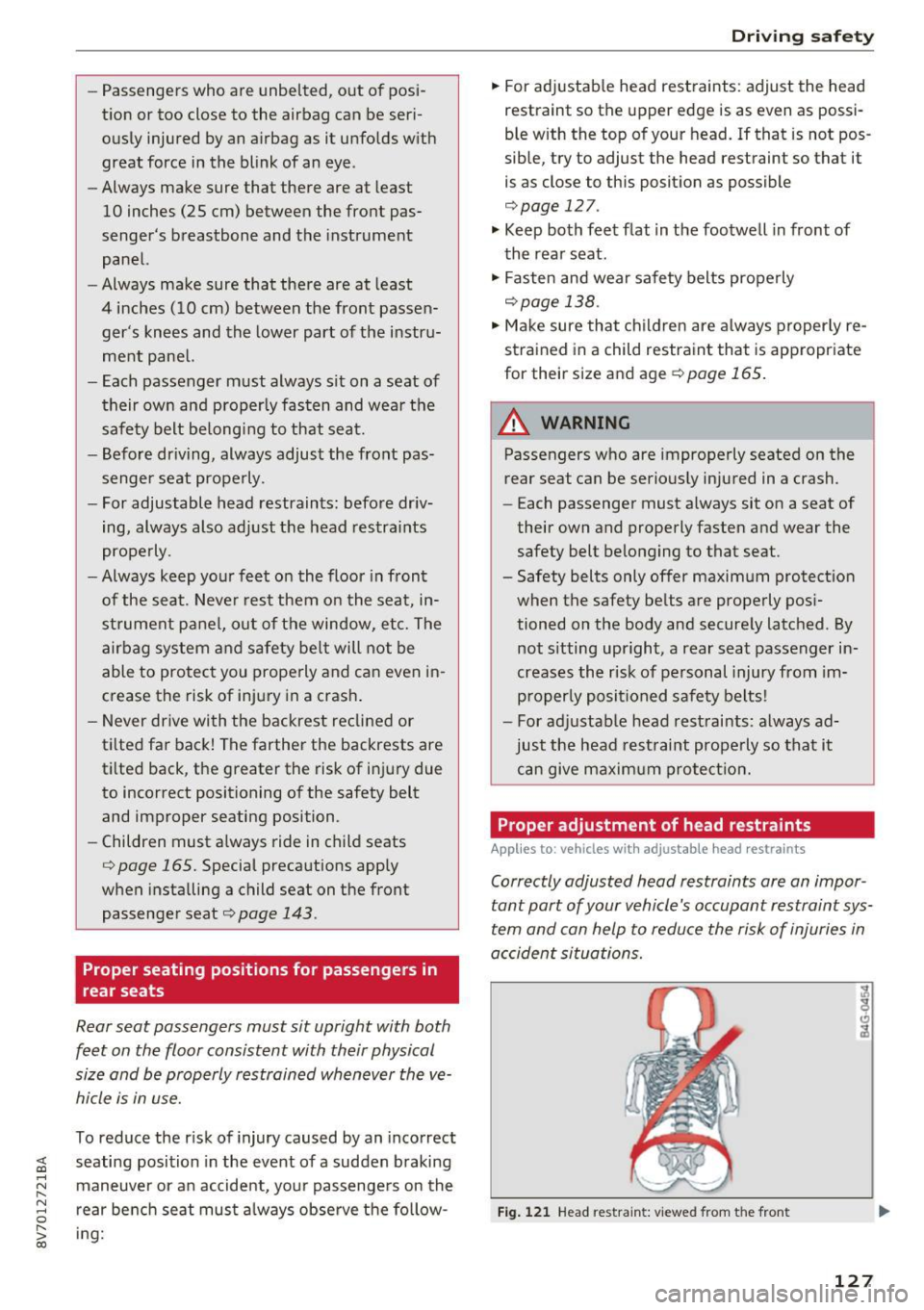
Proper adjustment of head restraints
App lies to: vehicles with adjusta ble head restraints
Correctly adjusted head restraints are an impor
tant part of your vehicle's occupant restraint sys
tem and can help to reduce the risk of injuries in
accident situations.
Fig. 121 Head restraint: viewed from the front
127
Page 128 of 272
Driving sa fe ty
The head restraints must be correc tly adjusted to
achieve the best protection .
.,. Adjust the head restraint so the upper edge is
as even as poss ible with the top of your head.
If
that is not possible, try to adjust the head re
straint so that it is as close to this position as
poss ib le
~ fig . 121.
.,. If there is a passenger on the rear center seat
ing pos it ion, slide the center head restra int up
ward at least to the next notch.
Adjusting head restraints
c::> page 55.
A WARNING
All seats are equipped with head restraints.
Dr iv ing without head restraints or with head
restraints that are not proper ly adjusted in
creases the risk of ser ious or fatal neck injury
dramatically. To help reduce the r is k of injury:
- Always dr ive with the head restraints in
place and properly ad justed .
- Every person in the vehicle must have a properly adjusted head restra int.
- Always make sure each person in the vehicle
prope rly adjusts their head restraint. Adjust
the head restra int so the uppe r edge is as
even as possib le w ith the top of you r head.
If that is no t possib le, t ry to adjust the head
restra int so th at it is as close to th is position
as possib le. Move the head restraint so that
it is as close to the back of the hea d as pos
sible.
- Never attempt to adjust head restraint
whi le driving. If you have dr iven off and
must adjust the driver headrest for any rea
son, first stop the vehicle safely before at
tempting to ad just the head restra int.
- Children must always be properly restrained
in a chi ld restraint that is appropriate for
their age and size
c::> page 165.
128
Examples of improper seating positions
The occupant restraint system can only reduce
the risk of injury if vehicle occupants are properly
seated .
Improper seating positions can cause ser ious in
jury or death . Safety be lts ca n only work when
they are properly positioned on t he body . Im
prope r seat ing pos itions red uce the effectiveness
of safety bel ts a nd will even increase t he risk of
i njury and deat h by mov ing the safety bel t to cr it
ic al areas of the body. Improper seating positions
a lso increase the risk of se rio us in jury and death
when an airbag deploys and strikes an occ upant
who is not in the proper seating posit ion. A dr iver
i s responsible for the safety of all vehicle occu
pants and espec ially for children. Therefore :
.,. Never allow anyone to assume an incor rect
seating position when the vehicle is being used
Q A .
The following bulletins list on ly some samp le po
s itions that will increase the r isk of serious injury
and death . Our hope is that these examples will
make you more aware of seating positions that
a re dangerous .
Therefore, whene ver the vehicl e is m oving:
-never stand up in the vehicle
- neve r stand on the seats
- neve r kneel on the seats
- neve r ride w it h the seatback recl ined
- never l ie down on the rear seat
- never lean up against the instrument panel
- never s it on the edge of the seat
- never sit sideways
- never lean out the window
- neve r put your feet o ut the window
- neve r put your feet on the instr ument panel
- neve r res t your feet on the seat c ushion or back
of the seat
- never ride in the footwell
- never ride in the cargo area
Page 129 of 272
<( co .... N ,.__
N .... 0 ,.__
> co
A WARNING
Improper seating positions increase the risk
of serious personal injury and death whenever
a vehicle is being used.
- Always make sure that all vehicle occupants
stay in a proper seating position and are
properly restrained whenever the vehicle is
being used.
Driver's and front
passenger's footwell
Important safety instructions
Applies to: veh icles with knee airbags
A WARNING
Always make sure that the knee airbag can in
flate without interference. Objects between
yourself and the airbag can increase the risk
of injury in an accident by interfering with the
way the airbag deploys or by being pushed in
to you as the airbag deploys.
- No persons (children) or animals should ride in the footwell in front of the passenger
seat. If the airbag deploys, this can result in
serious or fatal injuries .
- No objects of any kind should be carried in
the footwell area in front of the driver's or passenger's seat. Bulky objects (shopping
bags, for example) can hamper or prevent
proper deployment of the airbag. Small ob
jects can be thrown through the vehicle if
the airbag deploys and injure you or your
passengers.
Pedal area
Pedals
The pedals must always be free to move and
must never be interfered with by a floor mat or
any other object.
Make sure that all pedals move freely without in
terference and that nothing prevents them from
returning to their original positions.
Only use floor mats that leave the pedal area free
and can be secured with floor mat fasteners.
Driving safety
If a brake circuit fails, increased brake pedal trav
el is required to bring the vehicle to a full stop.
A WARNING
-Pedals that cannot move freely can cause loss
of vehicle control and increase the risk of seri
ous injury.
- Never place any objects in the driver's foot well. An object could get into the pedal area
and interfere with pedal function. In case of
sudden braking or an accident, you would
not be able to brake or accelerate!
- Always make sure that nothing can fall or
move into the driver's footwell.
Floor mats on the driver side
Always use floor mats that can be securely at tached to the floor mat fasteners and do not in
terfere with the free movement of the pedals.
.. Make sure that the floor mats are properly se
cured and cannot move and interfere with the
pedals¢ .&,.
Use only floor mats that leave the pedal area un
obstructed and that are firmly secured so that
they cannot slip out of position. You can obtain
suitable floor mats from your authorized Audi Dealer.
Floor mat fasteners are installed in your Audi.
Floor mats used in your vehicle must be attached
to these fasteners. Properly securing the floor mats will prevent them from sliding into posi
tions that could interfere with the pedals or im
pair safe operation of your vehicle in other ways.
A WARNING ~
Pedals that cannot move freely can result in a
loss of vehicle control and increase the risk of
serious personal injury.
-Always make sure that floor mats are prop
erly secured.
- Never place or install floor mats or other floor coverings in the vehicle that cannot be
properly secured in place to prevent them
from slipping and interfering with the ped-
als or the ability to control the vehicle.
Ill>
129
Page 130 of 272
Driving safety
-Never place or install floor mats or other
floor coverings on top of already installed
floor mats. Additional floor mats and other
coverings will reduce the size of the pedal
area and interfere with the pedals .
- Always properly reinstall and secure floor
mats that have been taken out for cleaning.
- Always make sure that objects cannot fall
into the driver footwell while the vehicle is
moving . Objects can become trapped under
the brake pedal and accelerator pedal caus ing a loss of veh icle control.
Storing cargo correctly
Loading the luggage compartment
All luggage and other objects must be properly
stowed and secured in the luggage compart
ment.
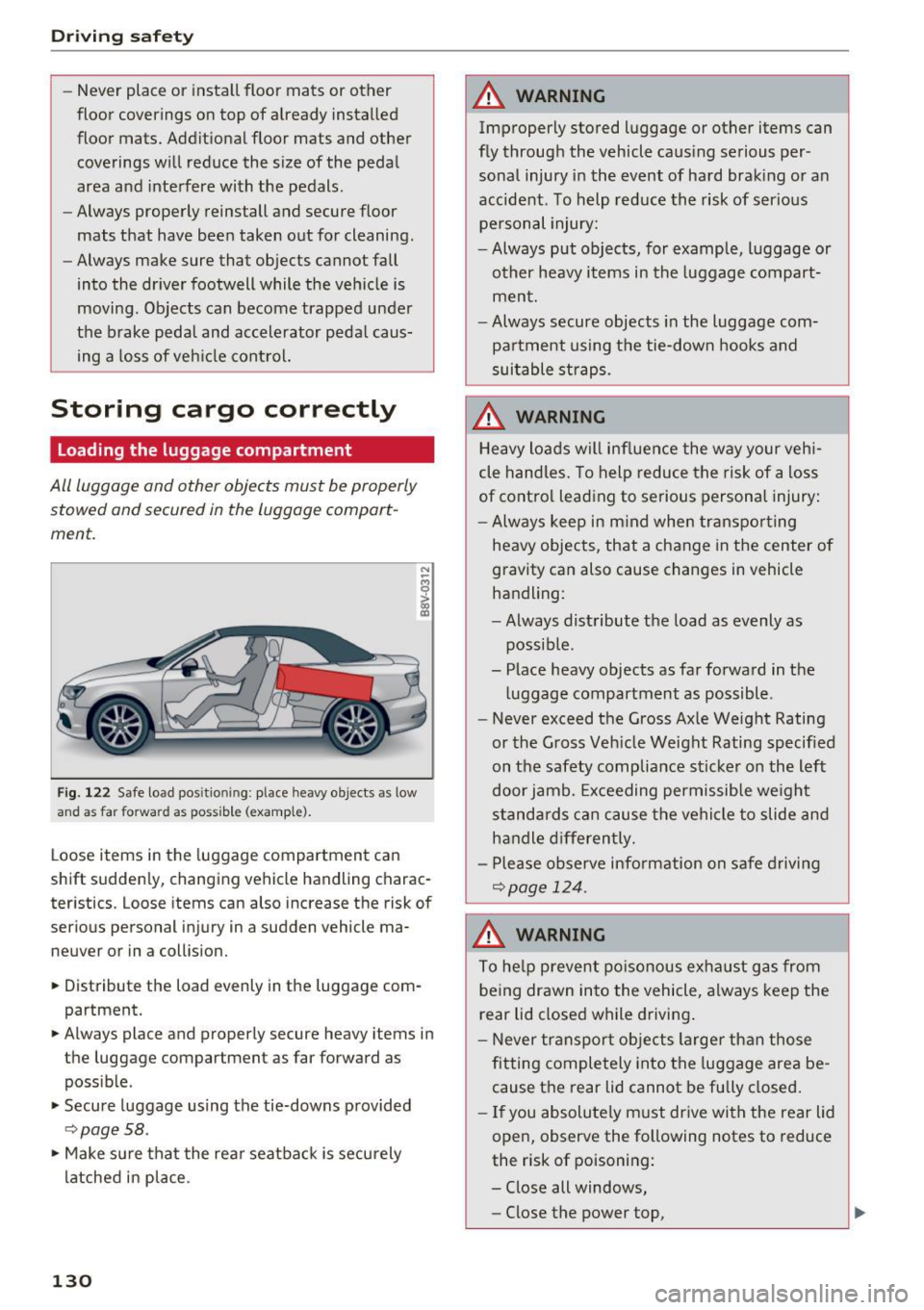
Fig. 122 Safe load positio nin g: place heavy objects as low
and as far forward as possible (example).
N ;;:; 0
> ill
Loose items in the luggage compartment can
shift suddenly, changing vehicle handling charac
teristics . Loose items can also increase the risk of
serious personal injury in a sudden vehicle ma
neuver or in a collision.
.,. Distribute the load evenly in the luggage com
partment .
.,. Always place and properly secure heavy items in
the luggage compartment as far forward as
possible .
.,. Secure luggage using the tie-downs provided
~ page 58.
.,. Make sure that the rear seatback is securely
latched in place .
130
A WARNING
Improperly stored luggage or other items can
fly through the vehicle caus ing serious per
sonal injury in the event of hard braking or an
accident. To help reduce the risk of serious
personal injury:
- Always put objects, for example, luggage or
other heavy items in the luggage compart
ment.
-Always secure objects in the luggage com
partment using the tie-down hooks and
suitable straps .
A WARNING
Heavy loads will influence the way your vehi
cle handles. To help reduce the risk of a loss
of control leading to serious personal injury:
- Always keep in m ind when transporting
heavy objects, that a change in the center of
gravity can also cause changes in vehicle
handling:
- Always distribute the load as evenly as
possible.
- Place heavy objects as far forward in the
luggage compartment as possible .
- Never exceed the Gross Axle Weight Rating
or the Gross Veh icle Weight Rating specified
on the safety compliance sticker on the left
door jamb. Exceeding permissible we ight
standards can cause the vehicle to slide and
handle differently.
- Please observe information on safe driving
~page 124.
A WARNING
To help prevent poisonous exhaust gas from
being drawn into the vehicle, always keep the
rear lid closed while driving .
- Never transport objects larger than those
fitting completely into the luggage area be
cause the rear lid cannot be fully closed.
- If you absolutely must dr ive with the rear lid
open, observe the following notes to reduce
the risk of poisoning:
- Close all windows,
- Close the power top,
Page 131 of 272
<( co .... N ,.__
N .... 0 ,.__
> co
-Open all air outlets in the instrument pan
el,
- Switch off the air recirculation,
- Set the fresh air fan to the highest speed.
& WARNING -
Always make sure that the doors, all win
dows, the power top and the rear lid are se
curely closed and locked to reduce the risk of
injury when the vehicle is not being used.
- After closing the rear lid, always make sure
that it is properly closed and locked.
- Never leave your vehicle unattended espe
cially with the rear lid left open. A child
could crawl into the vehicle through the lug
gage compartment and close the rear lid be
coming trapped and unable to get out. Be
ing trapped in a veh icle can lead to serious
personal injury.
- Never let children play in or around the vehi
cle.
- Never let passengers r ide in the luggage
compartment. Vehicle occupants must al
ways be properly restrained in one of the ve
hicle's seating positions.
(!) Tips
- Air c irculation helps to reduce window fog
ging . Stale air escapes to the outside
through vents in the trim panel. Be sure to
keep these slots free and open.
- The t ire pressure must correspond to the
l oad. The tire pressure is shown on the tire
pressure label. The tire pressure label is lo
cated on the driver's side B-pillar. The tire
pressure label lists the recommended cold
tire inflation pressures for the vehicle at its
maximum capacity weight and the tires that
were on your vehicle at the t ime it was man
ufactured. For recommended tire pressures
for normal load conditions, please see chap
ter
c> page 214.
Driving safety
Tie-downs
The luggage compartment is equipped with four
tie-downs to secure luggage and other items .
Use the tie-downs to secure your cargo properly
c> page 130, Loading the luggage compartment.
In a collision, the laws of physics mean that even
smaller items that are loose in the veh icle will
become heavy missiles th at can cause serious in
jury. Items in the vehicle possess energy which
vary w ith vehicle speed and the we ight of the
item . Vehicle speed is the most significant factor.
For example, in a frontal collision at a speed of
30 mph (48 km/h), the forces acting on a 10-lb
(4 .5 kg) object are about 20 times the normal
we ight of the item. This means that the we ight
of the item would sudden ly be about
200 lbs. (90 kg). You can imagine the injuries
that a 200 lbs. (90 kg) item flying freely through
the passenger compartment cou ld cause in a col
lision like this .
& WARNING
----
Weak, damaged or improper straps used to
secure items to tie-downs can fail during hard
braking or in a collision and cause serious per
sonal injury.
- Always use suitable mounting straps and
properly secure items to the tie-downs in
the luggage compartment to help prevent
items from shifting or flying forward as dan
gerous missiles.
- When the rear seat backrest is folded down,
always use suitable mounting straps and properly secure items to the tie-downs in
the luggage compartment to help prevent
items from flying forward as dangerous
missi les into the passenger compartment.
- Never attach a child safety seat tether strap
to a tie-down.
131
Page 133 of 272

Transport Canada M otor Vehicle Safety Investig a
tions Laboratory
80 Noel Street
Gatin eau, QC
J8Z OAl
For additional road safety infor
mation, please visit the Road
Safety website at:
http:/ /www.tc.gc.ca/eng/
road safety/menu. htm
Active rollover
protection system
Function
The rollover protection system protects vehicle
occupants in the event of a rollover.
----Fig. 123 Rear seats: rollbar dep loy men t range
S: -two rollbars 00
Driving safety
-the safety belts with belt tensioners
- the windshield frame
- the rollover sensors
The active rollover protection system provides
additional safety in the event of a rollover. With
in milliseco nds, sensors dep loy two rollbars lo
cated beh ind the head restraints in the rear seats
Qfig . 124.
The rollbars, reinforced windshield frame and
belt tensioners help protect front and rear pas
sengers in the event of a rollover.
The rollover protection system functions when
the power top is both open and closed .
A WARNING
Do not use the area behi nd the rear seat head
r estraints
Q fig. 123 as a storage area. T h is is
the area where the rollbars deploy. If the roll
over protection system is triggered, objects
place there can be propelled through the ve
hicle and make it more difficult for the roll
bars to deploy. This increases the risk for seri
ous or life-threatening in juries.
When is rollover protection deployed?
Rollover protection deploys in a collision or roll
over.
Depending on the collision, sensors throughout
the vehicle and the control modu le trigger the
rollover system to deploy.
For safety reasons, rollover protection also de
ploys during front, side and rear collisions above
a certain level of severity.
133
Page 134 of 272
Driving safety
Retracting rollover protection
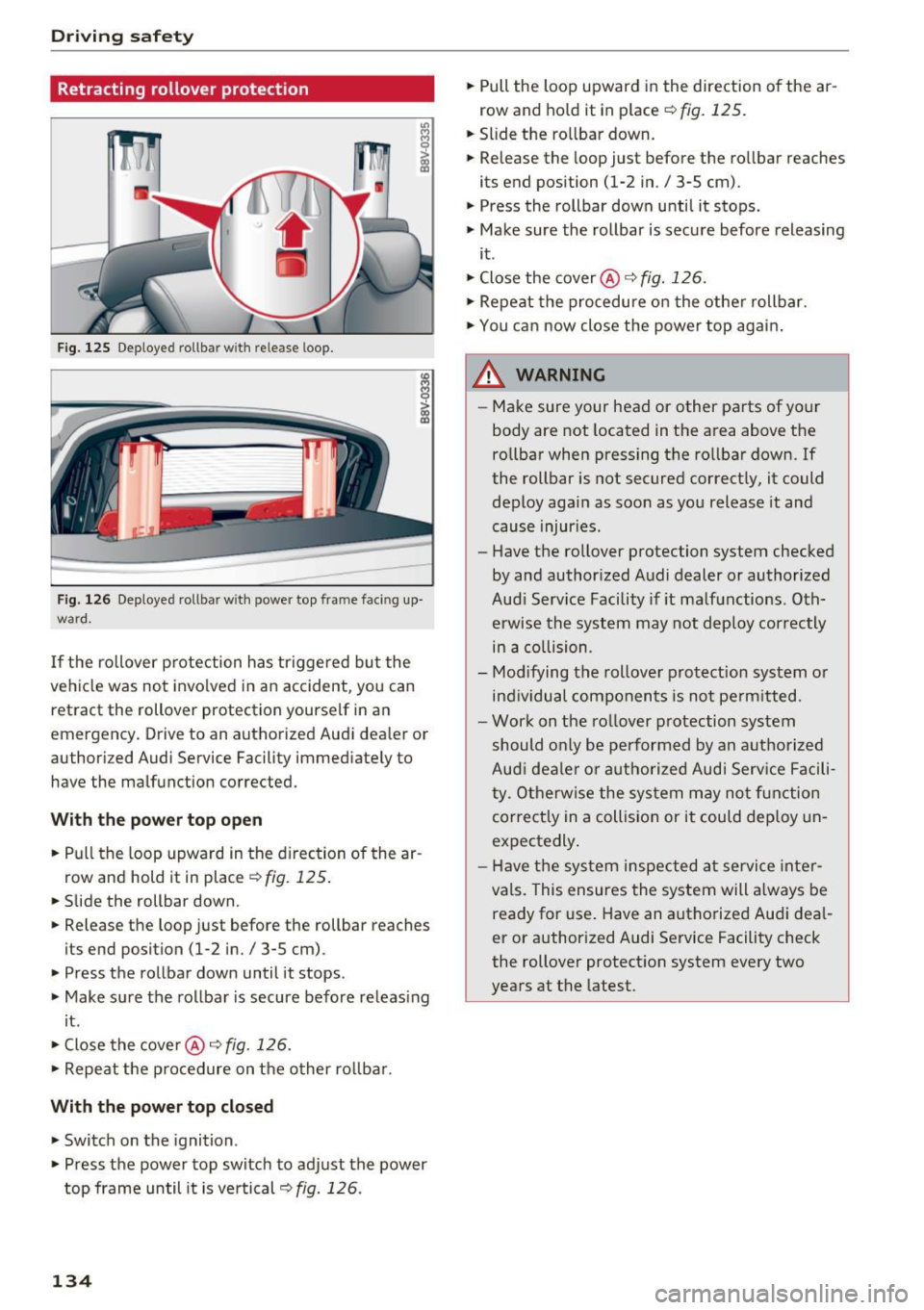
Fig. 12 5 Deployed rollbar w ith re lease loop.
--------
F ig. 126 Deployed rollbar w ith power top frame facing up
ward.
If the ro llover p rotection h as triggered bu t the
ve hicle was no t invo lved in an accident, you can
retract the rollover protection yourself in an
emergency . Drive to an authorized Aud i dea ler or
author ized Audi Service Facility immediately to
have the malfunction corrected.
With the power top open
• Pull the loop upward in the d irection of the ar
row and hold it in place~
fig. 125 .
• Slide the rollbar down.
• Release the loop just before the rollbar reaches
its end position (1-2 in./ 3-5 cm).
• Press the ro llbar down until it stops .
• Make su re the rollbar is secure before re leas ing
it.
• Close the cover@ 9
fig. 126.
• Repe at the p rocedure on t he other ro llba r.
With the power top closed
• Switch on the ignition .
• Press the power top switch to adjust the power
top frame until it is ve rtical 9
fig. 126 .
134
• Pull the loop upward in the direction o f the ar
row and ho ld it in p lace
9fig. 125.
• Slide the ro llbar down.
• Release the loop just before the ro llbar reaches
its end position (1-2 in./ 3-5 cm).
• Press the rollbar down until it stops.
• Make sure the rollbar is secure before releasing
it .
• Close the cover @'*
fig. 126.
• Repeat the procedu re on the othe r rollbar.
• You can now close the powe r top agai n.
A WARNING
-
-Make sure your head or other parts of yo ur
body are not located in the a rea above the
rollbar when pressing the ro llbar down. If
the rollbar is not secured correct ly, it could
deploy again as soon as you release it and
cause injur ies.
- Have the rollover protection system checked
by and author ized Audi dealer or authorized
Aud i Serv ice Facility if it malfunctions. O th
erwis e the syst em may not deploy correctly
in a collision.
- Mod ifying the rollover pro tection system or
in dividual componen ts is not pe rm itted.
- Work on the ro llover p rotection system
should only be performed by an a uthorized
Aud i dea le r o r auth o riz e d Audi Serv ice Facili
ty. Otherwise the system m ay no t fu n ction
correctly in a collision or it could deploy un
expectedly .
- H ave t he sys tem inspected a t service inte r
vals. This ensures the system will always be ready for use . Have an autho rized Aud i dea l
er or author ized Audi Service Facility check
the rollover protect ion system every two
years at the latest.
Page 135 of 272
<( co .... N r--N .... 0 ,.__
> co
Safety belts
General notes
Always wear safety belts!
Wearing safety belts correctly saves lives!
This chapter explains why safety belts are neces
sary, how they work and how to adjust and wear
them correctly.
~ Read all the information that follows and heed
all of the instructions and WARNINGS.
A WARNING
Not wearing safety belts or wearing them im
properly increases the risk of serious personal
injury and death .
- Safety belts are the single most effective
means available to reduce the risk of serious
injury and death in automobile accidents.
For your protection and that of your passen
gers, always correctly wear safety belts
when the vehicle is moving.
- Pregnant women, injured, or physically im
paired persons must also use safety belts.
Like all vehicle occupants, they are more
likely to be seriously injured if they do not
wear safety belts. The best way to protect a
fetus is to protect the mother -throughout
the entire pregnancy.
Number of seats
Your Audi has a total of four seating positions:
two in the front and two in the rear. Each seating position has a safety belt .
A WARNING
Not wearing safety belts or wearing them im
properly increases the risk of serious personal
injury and death.
- Never strap more than one person, includ
ing small children, into any belt.
It is espe
cially dangerous to place a safety belt over a
child sitting on your lap.
- Never let more people ride in the vehicle
than there are safety belts available.
Safety belts
-Be sure everyone riding in the vehicle is
properly restrained with a separate safety
belt or child restraint.
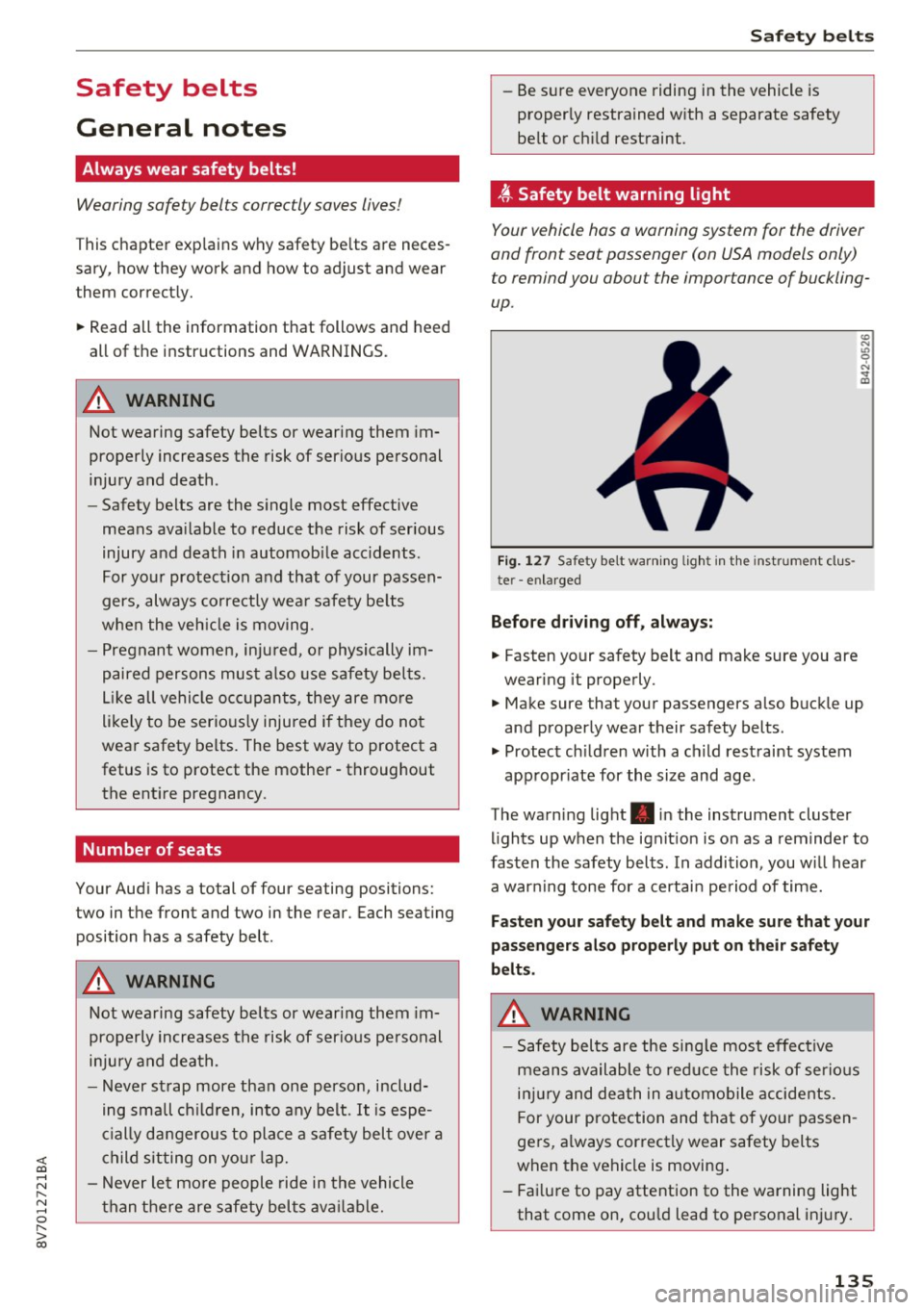
~ Safety belt warning light
Your vehicle hos o warning system for the driver
and front seat passenger (on USA models only)
to remind you about the importance of buckling
up .
Fig. 127 Safety belt warn ing light in the instrument clus
te r -enlarged
Before driving off, always:
.. Fasten your safety belt and make sure you are
wearing it properly.
.,, N
"' 0 ..:, ., m
~ Make sure that your passengers also buckle up
and properly wear their safety belts .
~ Protect children w ith a ch ild restraint system
appropr iate for the size and age .
The warning light . in the instrument cluster
lights up when the ignit ion is on as a reminder to
fasten the safety belts. In addition, you wil l hear
a warning tone for a certain period of time.
Fasten your safety belt and make sure that your
passengers also properly put on their safety
belts.
A WARNING
-
- Safety belts are the sing le most effective
means available to reduce the risk of serious
injury and death in automobile accidents.
F or your protection and that of your passen
gers, a lways correctly wear safety belts
when the vehicle is moving .
- Failure to pay attention to the warning light
that come on, could lead to personal injury.
135