battery AUDI A3 CABRIOLET 2016 Owner's Manual
[x] Cancel search | Manufacturer: AUDI, Model Year: 2016, Model line: A3 CABRIOLET, Model: AUDI A3 CABRIOLET 2016Pages: 272, PDF Size: 67.88 MB
Page 198 of 272
Check ing and F illing
@ For the sake of the environment
Because of the prob lem of proper disposal of
brake fluid as we ll as the special tools re
quired and the necessary expertise, we rec
ommend that you have the b rake fluid
changed by your author ized Audi dealer .
Battery ( 12 V)
General information
All work on the battery requires expert knowl
edge .
Read and follow the WARNINGS
before check
i n g a nyth ing in the engine compartment
c::> page 188, Working in the engine compart
ment.
The batte ry in you r Aud i does not need any main
tena nce unde r
normal operating cond itions. A udi
re commends hav ing the e lectro lyte level check
by an au thor ized A udi dealer or au thori ze d Audi
Serv ice Facility when there a re
high outs ide tem
peratures or when driving a ll day. The elect rolyte
level sho uld a lso be checked each time the bat
tery is charged
c::> page 200.
Have the battery checked when you bring your ve
hicle in for an inspection. It is a good idea to re
p lace the battery if it is more than 5 years old .
T he batte ry is located in the eng ine compar tment
and is practically
maintenance-free .
Disconnecting the battery terminals
The battery shou ld not be d isconnected. Severa l
veh icle functions (power w indows, for example)
w ill be lost w hen the b attery is disconne cted. The
f u nctions mus t be reprog rammed after connect
in g the battery. To avo id th is, the battery shou ld
only be disconn ecte d from the vehicle e lectrica l
system when it is abso lutely necessary.
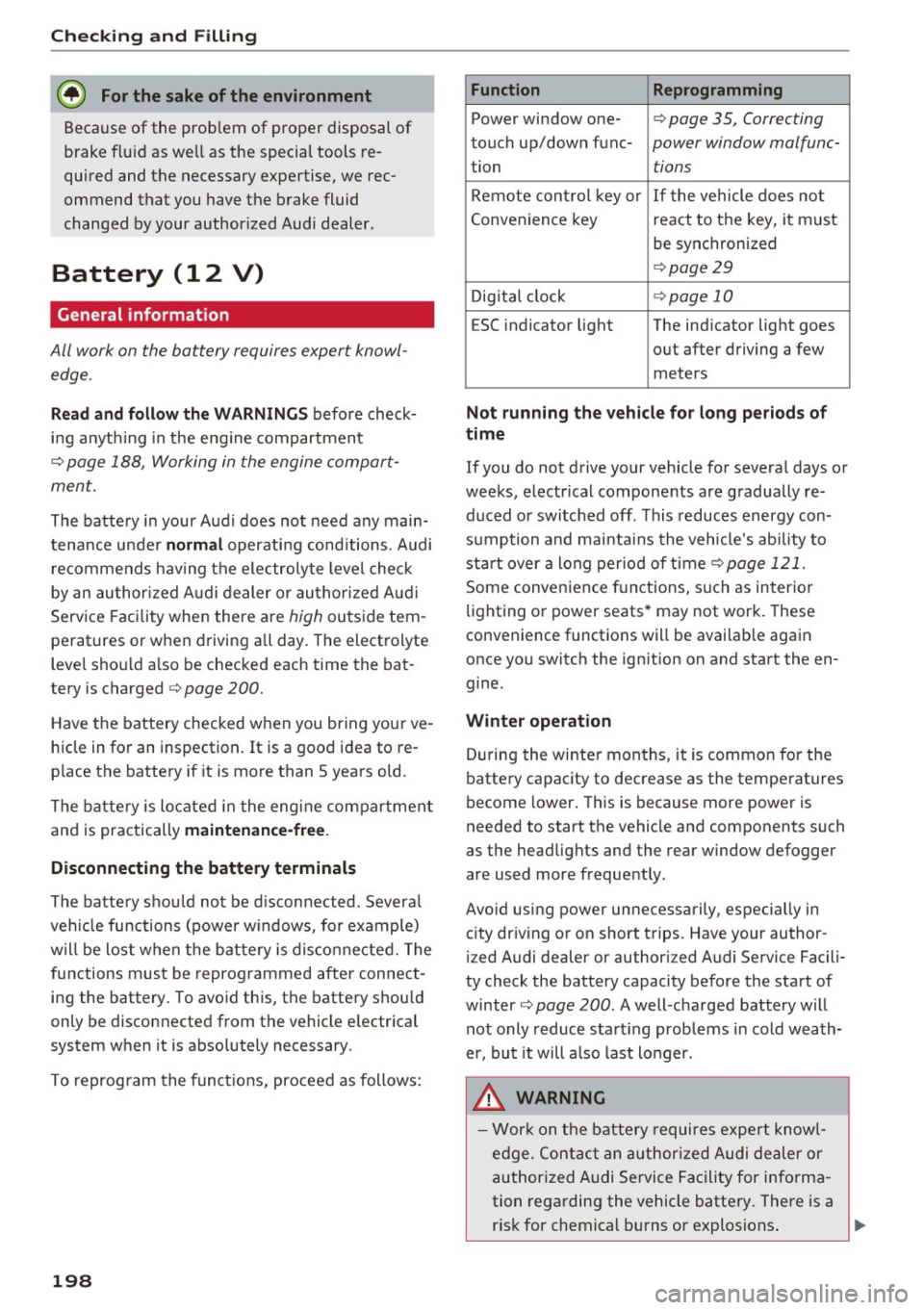
T o reprogram the func tions, proceed as follows:
198
Function Reprogramming
Power window one-c::> page 35, Correcting
touch up/down func-power window malfunc-
tion tions
Remote control key o r If the vehicle does no t
Convenience key react to the key, it must
be synchronized
c::> page29
Dig ita l cl ock c::>page 10
ESC indicator light The ind icator light goes
o ut after driving a few
meters
Not running the vehicle for long period s of
time
If you do not drive your vehicle for severa l days o r
weeks, electrical components are gradually re d u ced or switched off . This reduces energy con
s u mp tion and mai ntain s the vehicle's ability to
st art over a long perio d of time
c::> page 1 21.
Some conven ien ce f unctions, such as inter ior
li ght ing o r power seats* may not wor k. T hese
convenience functions will be availab le aga in
once you sw itch the ignition on and start the en
gine.
Winter operation
D ur ing the winte r mon ths, it is common for the
batte ry capac ity to decrease as the temperatures
become lower . This is because more power is
needed to start the vehicle and components such
as the headlights and the rear window defogger
a re used more freque ntly .
Avoid using power unnecessa rily, espec ia lly in
c ity dr iving o r on short t rips. Have your author
i z ed Audi dealer or author iz ed Audi Se rvice Facili
ty check the battery capacity be fore the start of
winter
c::> page 200 . A well -cha rged battery will
not only reduce sta rting prob lems in cold wea th
e r, bu t it will a lso l ast longer.
.&_ WARNING
- W ork on the b attery requires e xper t knowl
e d ge. Con tact an a uthor ized Audi dealer or
author ized Audi Se rvice Facility for info rma
tion rega rding the vehicle batte ry. There is a
-
ris k for chemical burns or e xplosions . ..,.
Page 199 of 272
<( co .... N ,.__
N .... 0 ,.__
> co
-Never open the vehicle battery. Do not try to
change the battery electro lyte level. Other
wise explosive gas will escape from the bat
tery and increase the r isk of an explos ion .
(D Tips
If your vehicle is not driven for several weeks
in very cold temperatures, remove the battery
and store it in a place where it will not freeze.
This prevents the battery from being dam
aged and needing to be replaced .
Working on the battery
Be especially careful when working on or near
the battery .
The battery (12 V) is located in the engine com
partment.
Always heed the
safety warnings, when working
on the vehicle battery or the vehicle electrical
system to prevent injury.
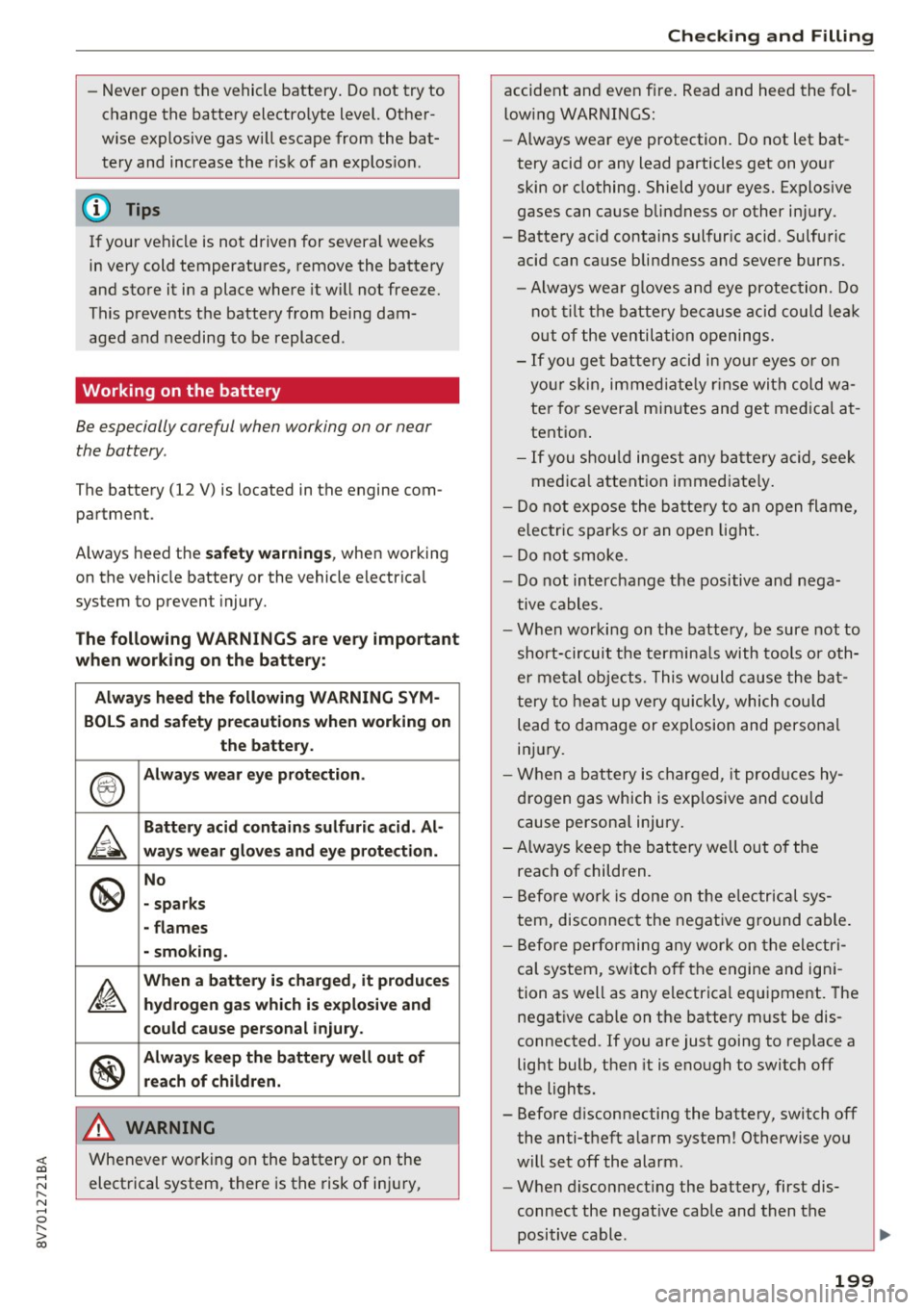
The following WARNINGS are very important
when working on the battery:
Always heed the following WARNING SYM-
BOLS and safety precautions when working on
the battery.
®
Always wear eye protection.
&
Battery acid contains sulfuric acid. Al-
ways wear gloves and eye protection.
@
No
- sparks
- flames
- smoking.
A
When a battery is charged, it produces
hydrogen gas which is explosive and
.
could cause personal injury .
®
Always keep the battery well out of
reach of children.
A WARNING
Whenever working on the battery or on the
electrical system, there is the risk of injury,
-
Checking and Filling
accident and even fire . Read and heed the fol
low ing WARNINGS:
- Always wear eye protection. Do not let bat
tery acid or any lead particles get on your
skin or clothing. Shield your eyes. Explosive
gases can cause blindness or other injury.
- Battery acid contains sulfur ic acid. Sulfuric
acid can cause blindness and severe burns.
- Always wea r gloves and eye protection. Do
not tilt the battery because acid could lea k
out of the ventilation openings.
- If you get battery acid in yo ur eyes or on
you r skin, immed iate ly r inse with cold wa
ter for severa l min utes and get medical at
tent ion .
- If you shou ld ingest any battery acid, seek
medica l attention immediate ly.
- Do not expose the battery to an open flame,
electric sparks or an open light.
- Do not smoke.
- Do not interchange the positive and nega-
tive cables.
- When working on the battery, be sure not to
short-circuit the termina ls with tools or oth
er metal objects. This would cause the bat
tery to heat up very quickly, which could
lead to damage or exp losion and personal
inj ury.
- When a battery is charged, it produces hy
drogen gas which is explosive and could
cause persona l injury.
- Always keep the battery well out of the
reach of children.
- Before work is done on the e lectrical sys
tem, disconnect the negative ground cable.
- Before performing any work on the electri
cal system, switch off the engine and igni
tion as well as any electrical equipment. The
negat ive cab le on the battery must be dis
connected. If you are just going to replace a
light bulb, then it is enough to switch off
the lights.
- Before disconnecting the battery, switch off
the anti-theft a larm system! Otherwise you
will set off the alarm .
- When disconnecting the battery, first dis
connect the negat ive cable and then the
positive cable.
199
Page 200 of 272
Checking and Filling
-Before reconnecting the battery, make sure
all electrical consumers are switched off.
Reconnect the posit ive cab le first and then
the negative cable. Never interchange the cables -th is could start a fire!
- Never charge a frozen or a thawed-out bat
tery. It could explode! If a battery has fro
zen, then it must be rep laced . A discharged
batte ry can freeze over at 32 °F (0 °C).
- Make sure the vent hose is always attached
to the opening on the side of the battery.
- Never use batteries which are damaged.
The re is the danger of an explos ion! Always
r e place a damaged batte ry .
A WARNING
California Proposit ion 65 Wa rning:
- Battery posts, termina ls and re lated acces
sories contai n lead and lead compounds,
c hem icals known to the State of Califo rnia
to ca use c ancer and rep rodu ctive p roblems.
Wash hands after h andling.
(D Note
- Do no t disconnect the veh icle bat tery when
the ig nition is o n or when the engine is run
n ing, othe rw ise, you will damage elec tronic
componen ts in the ele ct ric al sys tem.
- If you r vehicle is goi ng to stand for a l ong
period of time wi thout be ing driven, p rotect
the battery from "freezing", otherwise it
will be damaged and will then have to be re placed .
200
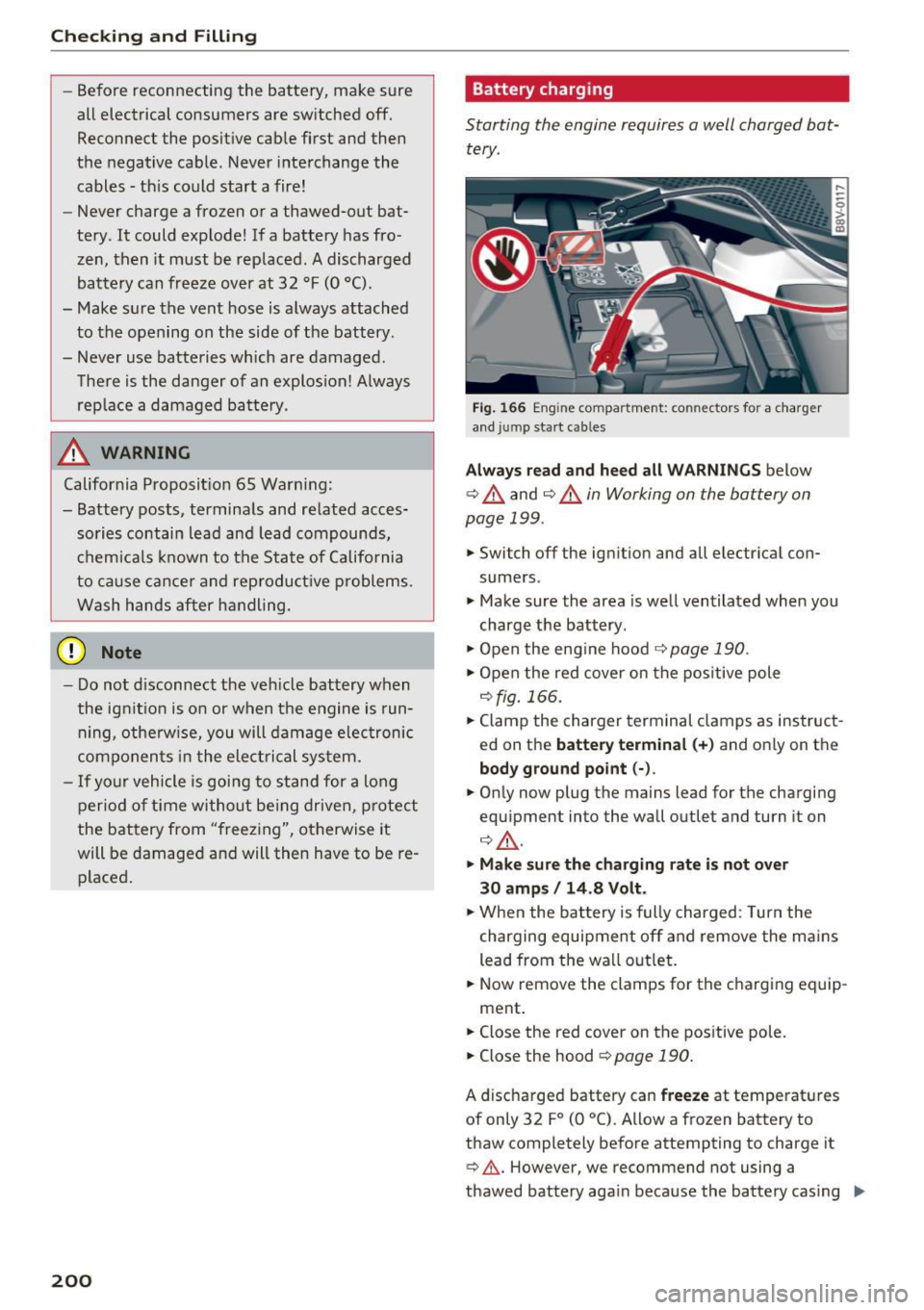
Battery charging
Starting the engine requires a well charged bat
tery .
Fig. 166 Eng ine compartment: connectors for a c harge r
a n d jum p start cab les
Alway s re ad and h eed a ll WARN IN GS below
c:> ,& and c:> .& in Working on the battery on
page 199 .
.,. Switch off the ignit ion and all electrical con
sumers .
.,. Make sure the area is we ll ventilated when you
charge the battery .
.,. Open the eng ine hood
i=!.) page 190 .
.,. Open the red cover on the pos itive pole
i=!,) fig. 166.
.,. Clamp the charger terminal clamps as instruct
ed on the
battery terminal (+ ) and only on the
body ground point (· ).
.,. On ly now plug the mains lead for the charging
equipment into the wall outlet and turn it on
i=!,) ,& .
.,. M ake sure th e charg ing rate i s not o ver
30 amp s/ 14.8 V olt .
.,. When the bat tery is fully charged : Turn the
charging equipment off and remove the mains
lead from the wall outlet .
.,. Now remove the clamps for the charging equip -
ment .
.,. Close the red cover on the positive pole .
.,. Close the hood
q page 190.
A discharged battery can freeze at temperatures
of only 32 F
0 (0 °C). Allow a frozen battery to
thaw completely before attempting to charge it
c:> .&.. However, we recommend not using a
thawed battery aga in because the battery casing .,..
Page 201 of 272

<( co .... N ,.__
N .... 0 ,.__
> co
can be cracked due to ice format ion and can leak
battery acid.
Battery charging (Maximum charging rate of
30 amps/ 14.8 Volt)
When charging at
low voltages (e.g. with a trick
le charger), the battery cables do not have to be
d isconnected first. The battery caps should
not
be opened when charging a battery.
It is not necessary to remove the battery from
the luggage compartment, and it is also not nec
essary to disconnect the cables.
Fast charging the battery (charging rate
above 14.8 Volts)
F or technical reasons do not use a battery charg
er that uses voltage greater than 14.8 Volts to
charge your vehicle's battery.
A WARNING
Charging a battery can be dangerous.
- Always follow the operating instructions
provided by the battery charger manufactur
er when charging your battery.
-Never charge a frozen battery. It may ex
plode because of gas trapped in the ice. Al
low a frozen battery to thaw out first.
- Do not reuse batteries which were frozen.
The battery housing may have cracked and
weakened when the battery froze .
- Charge the battery in a well ventilated area.
Keep away from open flame or electrical
spark. Do not smoke . Hydrogen gas generat
ed by the battery is exp losive.
- To reduce the danger of explosion, never
connect or disconnect charger cables wh ile
the charger is operat ing.
- Fast charging a battery is dangerous and
should only be attempted by a competent
technician with the proper equipment.
- Battery acid that may spill during charging
should be washed off with a solution of
warm water and baking soda to neutralize
the acid.
Checking and Filling
(D Note
Never use a fast charger as a booster to start
the engine. This will seriously damage sensi
tive electronic components, such as control units, relays, radio, etc., as well as the battery
charger.
Battery replacement
The new battery must hove the some specifica
tions and dimensions as the original equipment
battery.
Intelligent energy management in your vehicle is
responsible for distribut ing the e lectrical energy
throughout your vehicle
c;, page 121 . The intelli
gent energy management system will keep the
engine battery charged better than vehicles with
out this system. To make sure the additional
electrical energy is available once again after you
have changed the battery, we recommend that
you install batteries of the same type and manu
facture only (the same as those installed at the
t ime your vehicle was delivered). Specifications
are listed on the battery housing . Your author
ized dealer must code the battery in the energy
management system to enable you to use the en
ergy management functions correctly after re
plac ing the battery.
The new battery must have the same capacity,
voltage (12-volts), amperage, construction and plug seal ing.
When install ing the battery, make sure the ign i
t ion and all electr ical consumers are switched
off .
(D Note
Make sure the venti lation hose on the s ide of
the battery is connected, otherwise fumes or battery acid can leak out .
@ For the sake of the environment
Because of the problem of proper d isposal of
a battery, we recommend your authorized
Audi dealer change the battery for you. Bat
teries contain sulfur ic acid and lead and must
always be disposed of properly in compliance .,.
201
Page 202 of 272
Check ing and F illing
with all environmental regulations. D isposing
of vehicle batteries improperly is very danger
ous to the env ironment .
Windshield washer
system
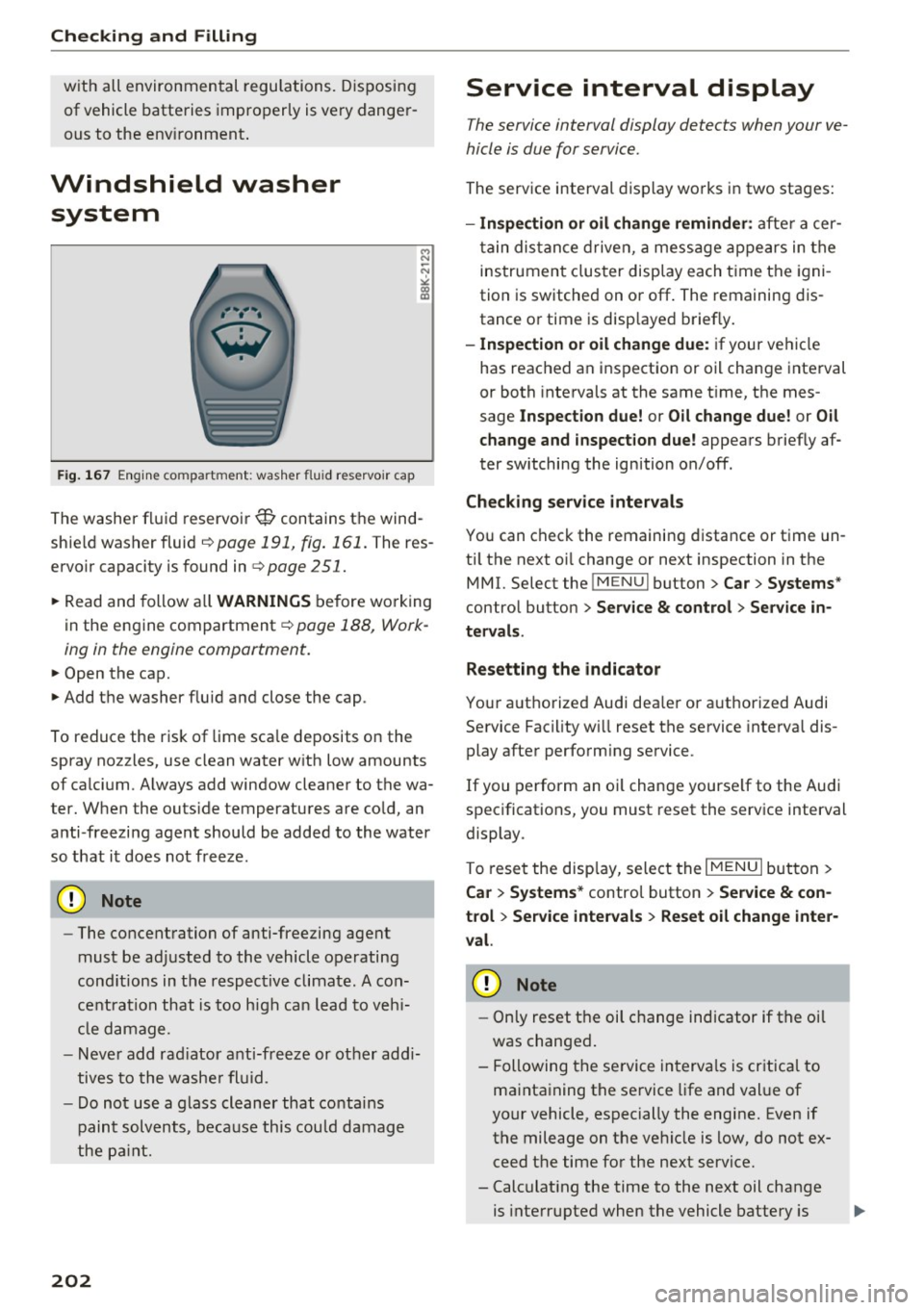
F ig. 16 7 Engin e co mpartment : washer fluid reservoir cap
"' N
-N
" 0:, lD
The washer flu id reservoir§ contains the wind
shie ld wash er fluid
¢ page 191, fig. 161. The res
ervoir capacity is found in
9 page 251.
.. Read and follow a ll WARNINGS before wo rking
in the engine compartment ¢
page 188, Work
ing in the engine compartment.
.. Open the cap .
.. Add the washer fluid and close the cap .
To reduce the risk of lime sca le deposits on the
spray nozzles, use clean water w ith low amounts
of calc ium . A lways add window cleaner to the wa
t er. When the outs ide temperatures are co ld, an
anti-freezing agent should be added to the water
so that it does not freeze .
(D Note
-The concentration of anti-freezing agent
must be ad justed to the vehicle operating
cond itions in the respect ive climate . A con
ce ntration that is too high can lead to veh i
cle damage.
- Neve r add rad iator ant i-freeze or ot her addi
tives to the washe r fl uid .
- Do not use a glass cleaner that conta ins
paint solvents, beca use this cou ld damage
the pa int.
202
Service interval display
T he service interval display detects when your ve
hicle is due for service.
The service interval display works in two stages :
-Inspe cti on or oil change reminder: afte r a cer-
tain dis tan ce dr ive n, a message appears in the
instrument cluster display each t ime the igni
tion is switched on or off . The remaining dis
tance or tim e is disp layed briefly.
- Inspection or oil change due : if your vehicl e
has reached an inspection or oil change inte rval
or both intervals at the same t ime, the mes
sage
Inspection due! or Oil change due! or Oil
change and inspection d ue!
appears briefly af
ter switching the ignition on/off.
Check ing ser vice inter vals
You can check the remaining d istance or t ime un
ti l the next oi l change or next inspection in the
MMI. Select the
i MENU I button> Car> Systems *
control button > Ser vice & control > Service in
tervals .
Resetting the indic ator
Your a uthorized Audi dea ler or authorized Audi
Service Facility w ill reset the service interva l dis
play after perform ing service .
If you perform an o il change yourse lf to the Audi
specifications, you must reset the service interval
display .
To rese t the disp lay, select the
I MENU I but ton>
Car > Systems * control button > Service & con
t rol > Service inter vals > Re set oil change inter ·
val.
(D Note
- Only reset the oil c hange indicator if the oi l
was changed .
- Following the service in terva ls is cr itica l to
mainta ining the se rvice life and val ue of
your vehicle, especially the engine. Even if
the mileage on the ve hicle is low, do not ex
ceed the time for the next service.
- Calculat ing the time to the next oil change
is inte rrupted when the vehicle battery is
Page 229 of 272

<( co .... N ,.__
N .... 0 ,.__
> co
corrosion protection, maintenance and storage procedures . Also follow the information about
the battery
~ page 198.
Care and cleaning
229
Page 241 of 272
<( co ..... N
" N ..... 0 r--. > 00
-Some of the equipment listed in the follow
ing tables applies only to certain model ver
s ions or certain optional equipment .
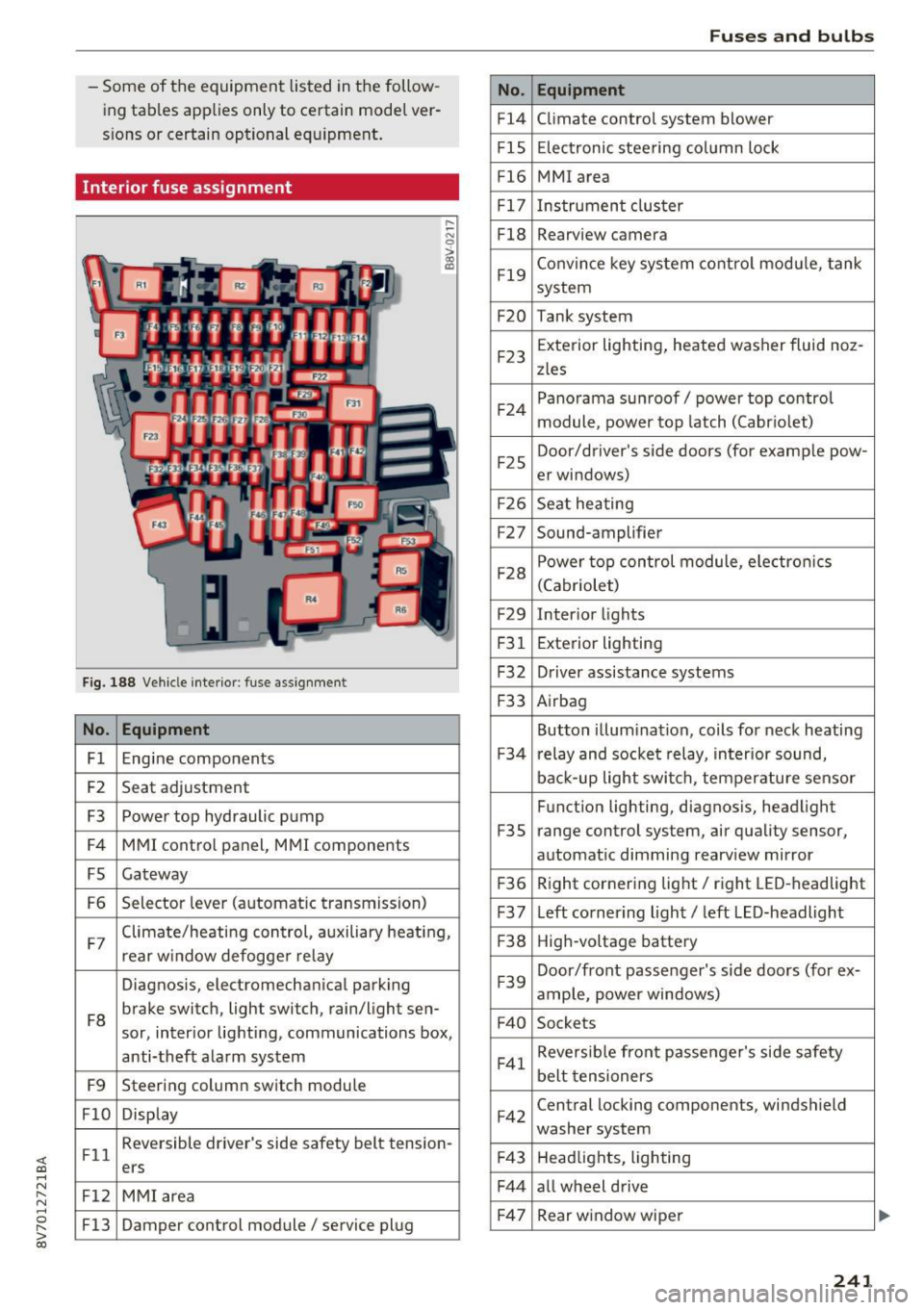
Interior fuse assignment
Fig. 188 Vehicle interior: fuse assignment
No. Equipment
Fl Engine components
F2 Seat
adjustment
F3 Power top hydraulic pump
F4 MMI control panel, MMI components
FS Gateway
F6 Selector
lever (automatic transmission)
.... ~ N
0
>
"' (0
F7 Climate/heating control, auxiliary heating,
rear w
indow defogger relay
Diagnosis, electromechanical parking
FB brake switch, light switch
, rain/light sen-
sor, inter ior lighting, communications box,
anti-theft alarm system
F9 Steering column switch module
FlO Display
Fll Reversible driver's side safety belt tension
-
ers
F12 MMI area
F13 Damper control module/ service plug
No.
Fl4
FlS
Fl6
F 17
FlB
F19
F20
F23
F 24
F2 5
F2 6
F27
F28
F29
F 31
F32
F 33
F 34
F35
F 36
F37
F38
F39
F40
F41
F42
F4 3
F44
F 47
Fuses and bulbs
Equipment
Climate control system blower
Electronic steering column lock
MMI area
Instrument cluster
Rearview camera
Convince key system control module, tank
system
Tank system
Exterior lighting, heated washer fluid noz -
zles
Panorama sunroof/ power top control
module, power top latch (Cabriolet)
Door/driver's side doors (for examp le pow-
er windows)
Seat heating
Sound-amplifier
Power top control module, electro nics
(Cabriolet)
Inter ior lights
Exterior lighting
Driver assistance systems
Airbag
Button illumination, coils for neck heating
r elay and socket relay, interior sound,
back-up light switch, temperature sensor
Function lighting, diagnosis, headlight
range control system, air quality sensor,
automat ic dimming rearview mirror
R ight cornering light/ right LED-headlight
Left cornering light/ left LED-headlight
High-voltage battery
Door/front passenger's side doors (for ex-
ample, power windows)
Sockets
Reversible front passenger's side safety
belt tensioners
Central locking components, windshield
washer system
Headlights, lighting
all wheel drive Rear w indow wiper
241
Page 242 of 272
Fuses and bulbs
No . Equipment
F48 Exterior sound actuator
F49 Starter, clutch sensor, headlight relay coil,
high-voltage
battery
FS3 Rear window defogger
The power seats* are protected via
circuit break
ers
that automatically switch on after a few sec
onds after the overload has been reduced.
(D Tips
Note that the following table was accurate at
the time of printing and is subject to change.
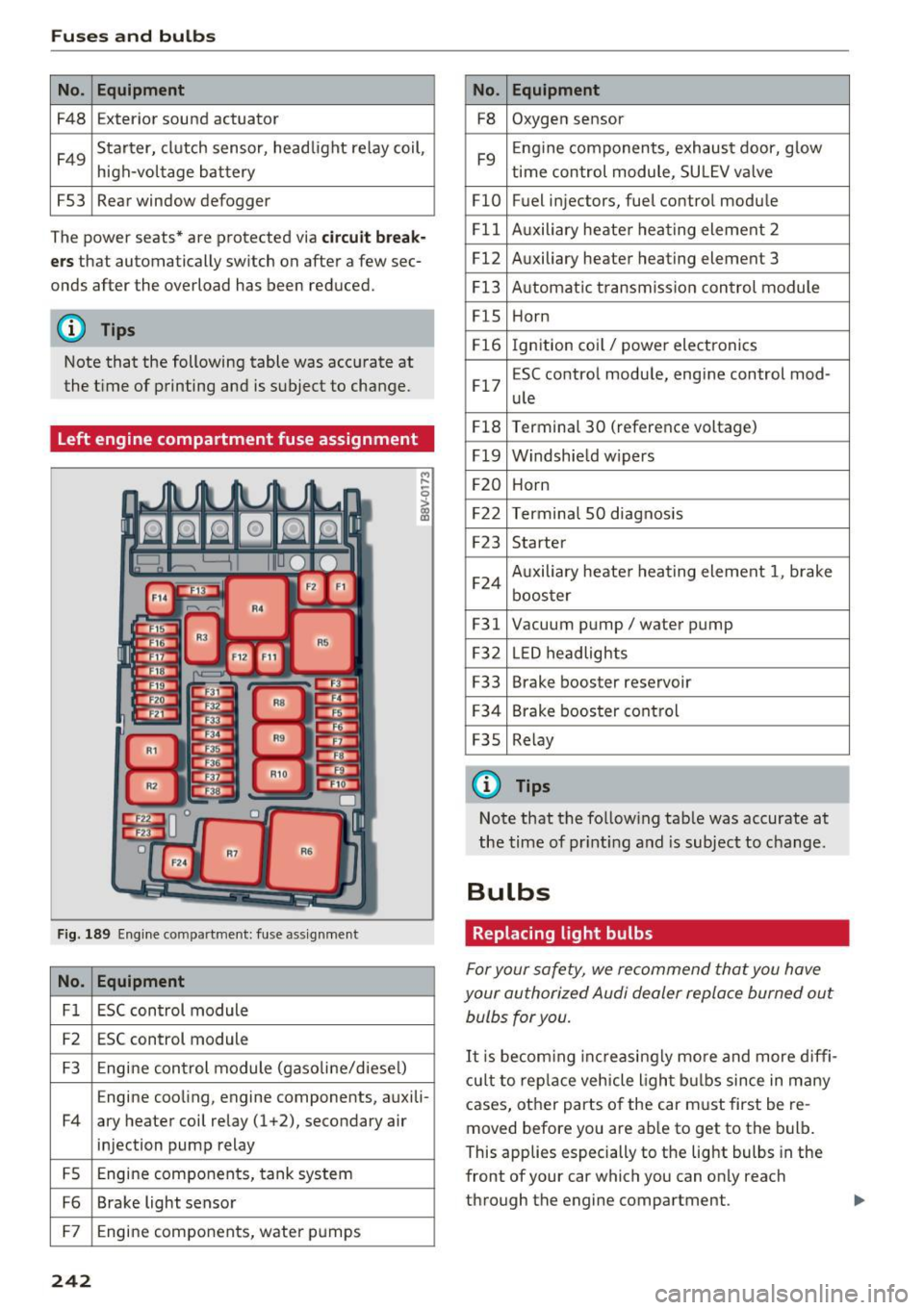
Left engine compartment fuse assignment
Fig . 189 Engine compartment: fuse assignment
No. Equipment
Fl ESC control module
F2 ESC control module
F3 Engine control module (gaso line/diesel)
Engine cooling, engine components, auxili-
F4 ary heater coil relay (1+2), secondary air injection pump relay
FS Engine components,
tank system
F6 Brake light sensor
F7 Engine components, water
pumps
242
No. Equipment
F8 Oxygen sensor
F9 Engine
components, exhaust door, glow
time control module, SU LEV valve
FlO Fuel injectors, fuel control module
Fll Auxiliary heater heat ing element 2
F12 Auxiliary heater heating element 3
F13 Automatic transmiss ion control module
FlS Horn
F16 Ignition coil/ power electronics
F17 ESC control module, engine control mod-
ule
F18 Terminal 30 (reference voltage)
F19 Windshie ld w ipers
F20 Horn
F22 Terminal SO diagnosis
F23 Starter
F24 Auxiliary heater heating element
1, brake
booster
F31 Vacuum pump/ water pump
F32 LED headlights
F33 Brake booster reservoir
F34 Brake booster control
F3S Relay
@ Tips
Note that the following tab le was accurate at
the time of printin g and is subject to change.
Bulbs
Replacing light bulbs
For your safety, we recommend that you have
your authorized Audi dealer replace burned out bulbs for you.
It i s becom ing increasingly more and more diffi
cult to replace vehicle light bulbs since in many
cases, other parts of the car must first be re
moved before you are ab le to get to the bulb.
This applies especially to the light bulbs in the
front of your car which you can only reach
through the engine compartment .
Page 244 of 272

Emergency situations
Emergency situations
General
This chapter is intended for trained emergency crews and working personnel who have the nec
essary tools and equipment to perform these
operations.
Starting by pushing or
towing
CD Note
Vehicles with an automatic transmission can
not be started by pushing or towing.
Starting with jumper
cables
If necessary, the engine con be started by con
necting it to the battery of another vehicle .
If the engine should fail to start because of a dis
charged or weak battery, the battery can be con
nected to the battery of
another vehicle, using a
pair of jumper cables to start the engine.
Jumper cables
Use only jumper cables of sufficiently large cross
section
to carry the starter current safely. Refer
to the manufacturer's specifications.
Use only jumper cables with
insulated terminal
clamps which are distinctly marked :
plus(+) cable in most cases colored red
minus(-) cable
in most cases colored black .
A WARNING
Batteries contain electricity, acid, and gas.
Any of these can cause very serious or fatal in
jury. Follow the instructions below for safe hand Ling of your vehicle's battery .
-Always shield your eyes and avoid leaning
over the battery whenever possible.
-A discharged battery can freeze at tempera
tures just below 32 °F (0 °C). Before con
necting a jumper cable, you must thaw the
244
frozen battery completely, otherwise it could explode .
- Do not allow battery acid to contact eyes or
skin. Flush any contacted area with water immediately.
- Improper use of a booster battery to start a
vehicle may cause an explosion.
- Vehicle batteries generate explosive gases.
Keep sparks, flame and lighted cigarettes
away from batteries.
- Do not try to jump start any vehicle with a
low acid level in the battery .
- The voltage of the booster battery must also
have a 12-volt rating. The capacity (Ah) of
the booster battery should not be lower
than that of the discharged battery. Use of
batteries of different voltage or substantial
ly different "Ah" rating may cause an explo
sion and personal injury .
- Never charge a frozen battery. Gas trapped in the ice may cause an explosion .
- Never charge or use a battery that has been
frozen . The battery case may have be weak
ened .
- Use of batteries of different voltage or sub stantially different capacity (Ah) rating may
cause an explosion and injury. The capacity
(Ah) of the booster battery should not be
lower than that of the discharged battery.
- Before you check anything in the engine
compartment, always read and heed all
WARNINGS
~page 188.
CD Note
-Applying a higher voltage booster battery
will cause expensive damage to sensitive
electronic components, such as control
units, relays, radio, etc.
- There must be no electrical contact between
the vehicles as otherwise current could al
ready start to flow as soon as the positive
(+) terminals are connected.
@ Tips
The discharged battery must be properly con-
nected to the vehicle's electrical system. .,..
Page 245 of 272

<( co ..... N
" N ..... 0
" > 00
When jump starting or charging the battery,
never connect the negative ground cable to
the battery negative post because the battery
manager system must be able to detect the
battery's state of charge . Always connect the
negative ground cable to the negat ive ground
post of the battery manager control unit .
Using jump start cables
Connect the jump start cables in the exact order
described below.
Fig . 190 Engine compa rtment: connec tor s for ju mp start
cab les and a charger
Fig. 191 Jump start ing th e battery w ith another vehicle:
@ -dra ined bat tery, @-sta rter battery
m ~ 0 :> m
m
The battery is located to the left in the engine
compartment.
Do not jump start a frozen or
thawed battery
c> A in Starting with jumper ca
bles on page
244! Replace the battery. The pro
cedure for connecting jump start cables that is
described next is designed to help jump start
your veh icle.
Vehicle with drained battery:
.. Read the following carefully
c> page 244
.. Set the parking brake and place the selector
lever in the P position .
Emergency situations
.. Turn the ignition and electrica l equipment off
in both vehicles .
Connecting the negative terminal(-) to the
negative terminal(-) (black)
.. To reach the battery terminals, flip the battery
cover cap to the side
c> fig. 190.
1. Clamp the end of the red jump start cable to
the terminal
(D c> fig. 191 on the dead bat
tery @
c> CD in Starting with jumper cables
on page 244 .
2. Clamp the other end of the red jump start ca
ble to the terminal @on the charging bat
tery @.
Connect NEGATIVE (-) to NEGATIVE (-)
(black)
3. Clamp the black end of the jump start cable
preferably at the ground point, or on the
negative term inal @ on the charging battery
®·
4. Clamp the other end of the black jump start
cable
only to the ground point© on your
vehicle @Q(D.
5. Route the jump start cables so they cannot
get caught in the moving parts in the engine
compartment.
Starting the engine
6. Start the engine in the vehicle giving the charge and let it run at idle.
7. Start the engine in the vehicle with the dead battery and wait two to three minutes until it
"runs smoothly" .
8.
If the engine does not start, stop the start ing
procedure after 10 seconds and then repeat
it after approx imately 30 seconds.
9. In the vehicle that is being jump started,
switch the heate r fan and rear window de
froster on to red uce any voltage peaks that
may occur when disconnecting the jumper
cables. The headlights must be switched off.
10. With the engines running, remove the cables in
reverse order of the way they were instal
led . Make sure the cables do not get caught
in moving eng ine components .
11. Switch the heater fan and rear window de
froster off.
12 . Close the battery cover.
245