fuel AUDI A3 CABRIOLET 2016 Owner's Manual
[x] Cancel search | Manufacturer: AUDI, Model Year: 2016, Model line: A3 CABRIOLET, Model: AUDI A3 CABRIOLET 2016Pages: 272, PDF Size: 67.88 MB
Page 189 of 272
<( co .... N ,.__
N .... 0 ,.__
> co
-Keep children away from the engine com
partment.
- Never spill fluids on a hot engine. These flu
ids (such as the freeze protection contained
in the coolant) can catch fire .
- Avoid short circuits in the e lectrical system,
especially the battery.
- When working in the engine compartment,
remember that the radiator fan can switch
on even if the ignition is switched off, which
increases the risk of personal injury.
- Never open the cap on the coolant expan
sion tank when the engine is warm. The
cooling system is under pressure.
- To protect your face, hands, and arms from
hot steam or coolant, cover the cap with a
large cloth when opening.
- Do not remove the engine cover under any
circumstances . This increases the risk of
burns.
- If tests need to be performed w ith the en
gine running, there is additional danger due
to moving components (such as the ribbed
belt, alternator and radiator fan) and from
t he high vo ltage ig nition system.
- Never reach into the radiator fan . The e lec
t ric a uxiliary fan is cont rolled by tempera
t ur e and can switch on sudde nly.
- Pay atte ntion to the fo llow ing warnings list
ed when wo rk on the fuel system or on t he
ele ct rical eq uipment is requ ired.
- Always d isconnect the ve hicle battery
from the vehicle electrical system
- Do not smoke
- Never work near open flames
- Always have a working fire ex tinguisher
nearby
- T o red uce the risk of e lec tric shoc k and in
jury, neve r touch the followi ng components
when the eng ine is r unning or is being star t
ed :
- Ignition cable
- Other components in the electronic high
voltage ignition system
- If you must check or perform work on the
engine while it is runn ing:
Ch eck ing and Filling
-Set the parking brake and place the selec
tor lever in the P (park) posit ion first.
- Always proceed with extreme caution so
that clothing, jewelry or long hair do not become caught in the radiator fan, fan
belt or other moving components or do
not come into con tact with ho t compo
nen ts . Tie bac k long hair befo re beginn ing
work and do not wea r clothing that can
hang down into t he engine.
- Lim it yo ur exposure to exhaust and chemi
cals to as short a time as possible
~ .&. .
&_ WARNING
Ca lifo rnia Proposition 65 Warning:
- E ngine exhaust, some of its const ituents,
and certa in vehicle components conta in or
emit chemi cals know n to the State of Cali
forni a to ca use cance r and birth defects and
reproductive harm. In add ition, cert ain flu
ids contained in vehicles and certain prod
ucts of component wea r contain or em it
chemicals known to the State o f Californ ia
to cause cancer and birth defects or other reproductive harm .
- Battery posts, term inals and related acces
sories contain lead and lead compounds,
chemicals know n to the State of Californ ia
to cause cancer and reproductive harms .
Wash hands afte r handling .
(D Note
When filling fluids, be sure not to m ix the f lu
i ds up. Otherwise severe malfunctions and en
gine damage will occur .
@) For the sake of the environment
You should regularly check the ground under
your vehicle i n order to detect leaks quic kly. If
the re are visible spots from o il or other fluids,
bring your veh icle to an authorized Audi deal
er o r autho rize d Aud i Serv ice Facility to be
chec ke d .
189
Page 192 of 272
Check ing and F illing
Audi oil quality standard
Gas olin e
VW 502 00 or
engi ne vw 50400
A udi reco mmend s
~Castrol I jgl[J,'fE{g ?r,w.:..~J ri, '.IA!,
Audi rec ommends Longlif e high perform ance
engi ne oil from Au di Genuin e Parts
Using the proper engine oil is important for the
functionality and service life of the engine. Your
engine was factory-filled with a h igh-quality oil
which can usually be used throughout the entire
yea r.
(D Note
Your Limited New Vehicle Warranty does not
cover damage or malfunctions due to failure
to follow recommended maintenance and use
requirements as set forth in the Audi Owner's
Manual and Warranty & Maintenance booklet .
- Use only a high qual ity eng ine oil that ex-
pressly complies with the Audi oil quality
standard specified for your vehicle's engine .
Using any other oil can cause serious engine
damage.
- Do not mix any lubricants or other additives into the engine oil. Doing so can cause en
gine damage.
@ Tips
If you need to add oil and there is none availa
ble that meets the Audi oil quality standard
your engine requires, you may add a total of
no more than 0.5 quart/liter of a h igh-quality
"synthet ic"oil that meets the following speci
fications.
- Vehicles w ith gasoline eng ine: ACEA A3 or
API SM with a viscosity grade of SAE OW-30,
SAE 5W-30 or SAE 5W-40.
- For more information about engine o il that
has been approved for your vehicle, please
contact either your authorized Audi dea ler
or Aud i Custome r Relat ions at
1 (800) 822- 2834 or visit ou r web site at
www.audiusa.com or www .aud icanada.ca.
192
· Eng ine oil consumption
The engine in your vehicle depends on an ade
quate amount of oil to lubricate and cool all of
its moving parts.
In order to provide effect ive lubricat ion and cool
i ng of internal engine components, all internal
combust ion eng ines consume a certa in amount
of oil. Oil consumption var ies from engine to en
gine and may change sign ificantly over the life of
the engine . T ypically, engines w ith a specified
break -in period (see¢
page 65) consume more
oi l during the break-in period than they consume
after oil consumption has stabilized.
U nder normal cond itions, the rate of oil con
sumption depends on the quality and viscosity o f
the oil , the RPM (revo lutions per minute) at
which the engine is operated, the ambient tem perature and road conditions. Further factors are
the amount of o il dilution from water condensa
tion or fuel residue and the oxidation level of the
o il. As any engine is subject to wear as mileage
builds up, the o il consumption may increase over
ti me unt il replacement of wo rn compo nents may
become necessary.
With all these variables coming into play, no standard rate of o il consumption can be estab
li shed or spec ified . T he re is no alte rnative to reg
u la r and freq uent checki ng of the oi l level, see
Note.
If the yellow engine oil level warning symbo l II
in the instrument cluster lights up, you sho uld
chec k the o il level as soon as possible
¢
page 193. Top off the o il at your earlies t con
venience
¢ page 193.
A WARNING
Before you check anything in the engine com
partment, always read and heed all WARN
INGS
¢page 188.
(D Note
Driving with an insufficient oil level is likely to
cause severe damage to the engine.
IJII,
Page 193 of 272
<( co ..... N
" N ..... 0
" > 00
(D Tips
- The oil pre ssure w arning display. i s not
an indicator of the oil level. Do not rel y on
it. Instead , check the oil level in your en
gine at regular inte rval s, preferably each
t ime you refuel , and alway s befo re going
on a long trip.
- If y ou have the impressio n your engine con
sumes excessive amounts of oil, we recom
mend that you cons ult an autho rized Aud i
dealer to have the cause of your concern
properly d iagnosed . Keep in mind that the
accurate measurement of oil consump tion
requi res great care and may take some
time. An a uthorized Audi dea ler has instruc
tions about how to measure oil consump
tion accurately .
Checking the engine oil level and adding oil
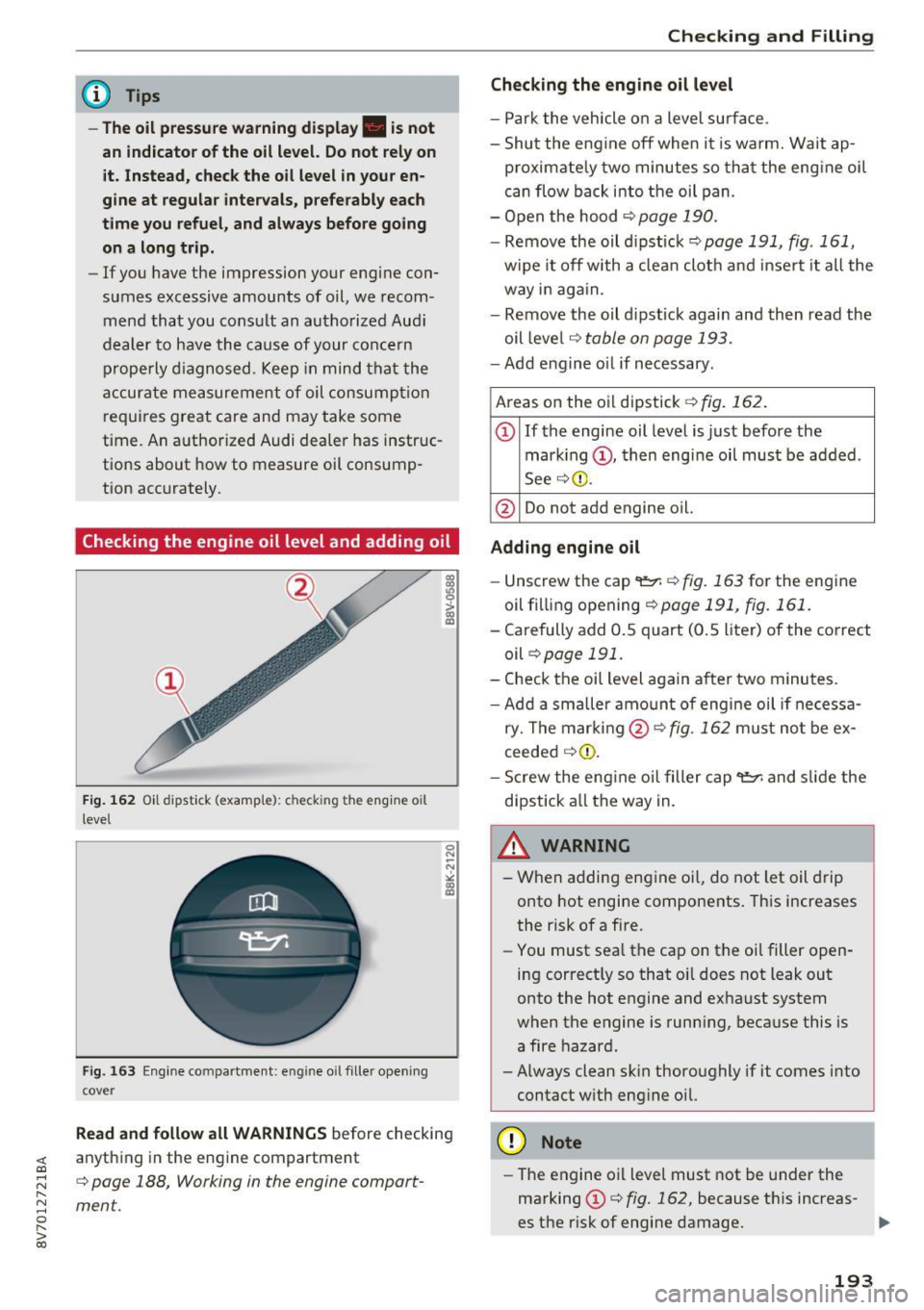
Fig. 16 2 O il dip stick (example) : ch ec king th e eng in e oil
l evel
Fi g. 1 63 Engine co mpartme nt: e ngin e oil f ille r ope ning
c ov er
0
N
-N
"' ::l
Read and follow all WARNINGS before checking
anyth ing in the engine compartment
c:> page 188, Working in the engine comport
men t .
Checking and Filling
Checking the engin e oil level
- Park the vehicle o n a level su rface .
- Shut the eng ine off when it is wa rm. Wait ap-
proximate ly two minutes so that the eng ine oil
can flow back i nto the oil pan .
- Open the hood
c:> page 190.
- Remove the oil d ipstick <=:> page 191, fig . 161 ,
wipe it off w ith a clea n clot h and inse rt it all the
way in aga in .
- Remove the oil d ipstick again and then read the
oil leve l
c:> table on page 193.
-Add engine o il if necessary .
Areas on the oi l dipstick
c:> fig . 162 .
CD If the engine oil level is just before the
mark ing
CD , then eng ine oil must be added .
See
c:> (D .
@ Do not add eng
ine oil.
Adding engine oil
- Unscrew the cap 'l=:7: c:> fig. 163 for the engine
oil filling opening
c:> poge 191, fig. 161.
- Carefully add 0.5 quart (0 .5 liter) of the correct
oil
c:> poge 191.
-Check the oi l level aga in after two minu tes.
- Add a smaller amo unt of engine oil if necessa -
ry. The marking @ <=:>
fig. 162 must no t be ex
ceeded
c:> (!) .
-Scr ew the eng ine oil filler cap 'l=:7: and slide the
dipstick a ll the way in.
.&_ WARNING
=
- When adding engine o il, do not let oil drip
onto hot engine components. This increases
the risk of a fire.
- You must sea l the cap on the oil filler open
ing correct ly so that oil does not leak out
onto the hot engine and ex haust system
when the engine is runn ing , because this is
a fire hazard.
- Always clean sk in thoroughly if it comes into
contact w ith eng ine o il.
(D Note
- The engine o il leve l must not be under the
marking
CD c:> fig. 162, because t his increas-
es the r isk of engine damage.
111>
193
Page 204 of 272
Tires and wheels
Tires and wheels
Wheels
General information
~check your tires regularly for
damage (punctures, cuts, cracks
and bulges). Remove foreign ob
jects from the tire tread.
~ If driving over curbs or similar
obstacles, drive slowly and ap
proach the curb at an angle.
~ Have faulty tires or rims re
placed immediately.
~ Protect your tires from oil,
grease and fuel.
~ Mark tires before removing
them so that the same running direction can be maintained if
they are reinstalled .
~ Lay tires flat when storing and
store them in a cool, dry location
with as little exposure to light as possible.
(i}) Note
-Please note that summer and winter tires are designed for
the conditions that are typical i n those seasons. Audi recom
mends using winter tires dur
i ng the winter months. Low
temperatures significantly de crease the elasticity of summ
er tires, which affects traction
204
and braking ability. If summer
tires are used in very cold
temperatures, cracks can form on the tread bars, resulting in
permanent tire damage that
can cause loud driving noise
and unbalanced tires.
-Burnished, polished or chromed rims must not be used in winter driving condi
tions. The surface of the r ims
does not have sufficient corro
sion protection for th is and
could be permanently dam
aged by road salt or similar
substances.
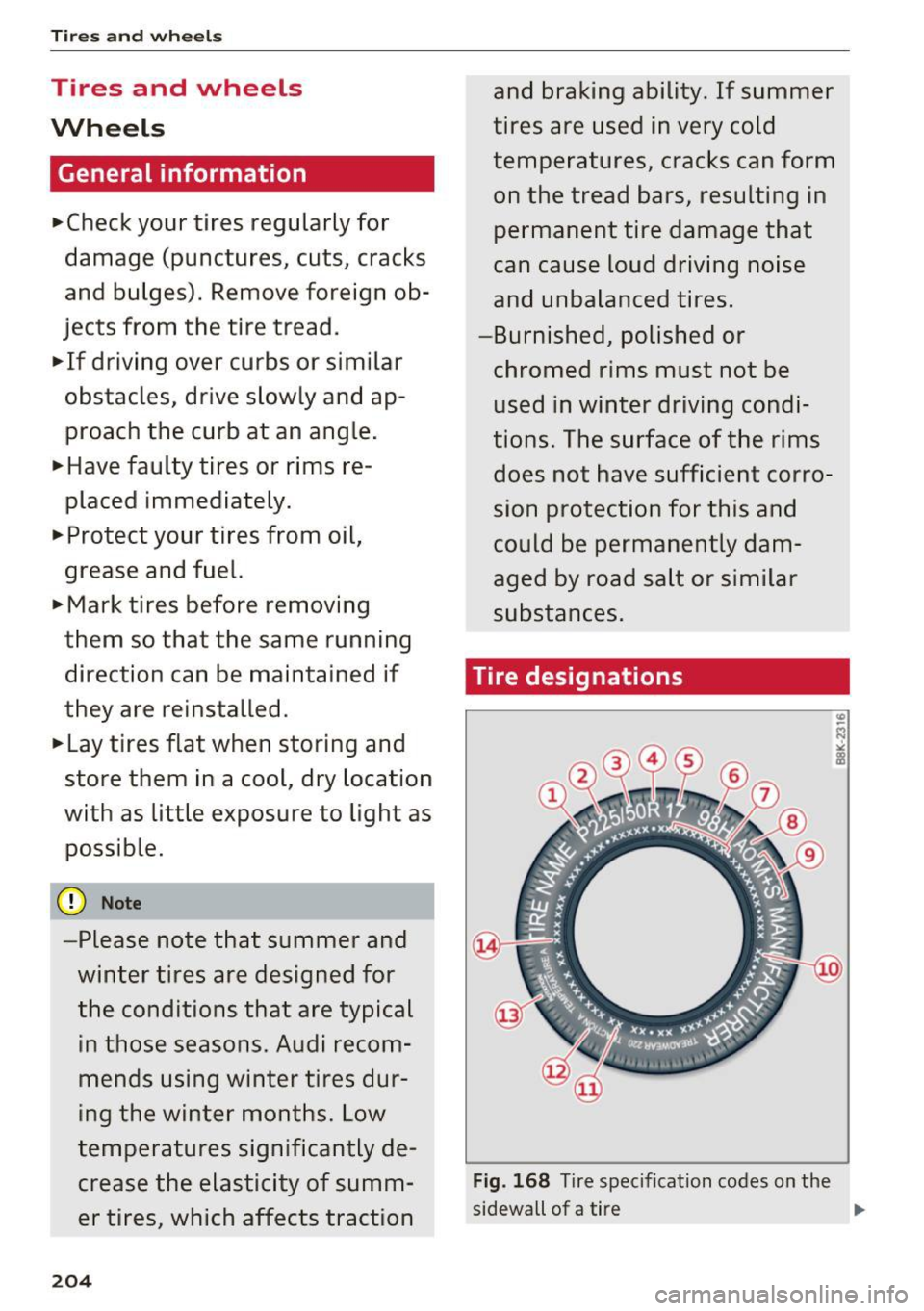
Tire designations
Fig. 168 Tire specifi cation codes on the
sidewall of a tire .,._
Page 207 of 272
Bead
means the part of the tire that is
made of steel wires, wrapped or
reinforced by ply cords and that is
shaped to fit the rim.
Bead separation
means a breakdown of the bond
between components in the bead.
Cord
means the strands forming the
plies in the tire.
Cold tire inflation pressure
means the tire pressure recom
mended by the vehicle manufac
turer for a tire of a designated size that has not been driven for
more than a couple of miles (kilo
meters) at low speeds in the
three hour period before the tire pressure is measured or adjusted .
Curb weight
means the weight of a motor ve
hicle with standard equipment in
c luding the maximum capacity of
fuel, oi l, and coolant, air condi
tioning and add itional weight of
optional equipment.
E xtra load ti re
<( a:,
~ means a tire designed to operate
N
~ at higher loads and at higher in
s: a:,
Tires and wheels
flation pressures than the corre
sponding standard tire . Extra load
tires may be identified as "XL",
" xl", "EXTRA LOAD", or "RF" on
the sidewall.
Gross Axle Weight Rating ( " GAWR")
means the load -carrying capacity
of a single axle system, measured
at the tire-ground interfaces .
Gross Vehicle Weight Rating
("GVWR ")
means the max imum total loaded
weight of the vehicle.
Groove
means the space between two ad
jacent tread ribs .
Load rating (code)
means the maximum load tha t a
tire is rated to carry for a given in
flat ion pressure . You may not find
this informat ion on all tires be
cause it is not requ ired by law.
Maximum load rating
means the load rating for a tire at
the maximum permissible infla
tion pressure for that tire.
Maximum loaded vehicle
weight
means the sum of:
2 0 7
..
Page 215 of 272
<( a:, ... N .... N ... 0
s: a:,
A WARNING
Always adapt the tire pressure
to your driving style and vehicle load.
-Overloading can lead to loss of
vehicle control and increase the risk of an accident. Read
and follow the important safe
ty precautions in¢
page 216,
Tires and vehicle load limits.
-The tire must flex more if the
tire pressure is too low or if
the vehicle speed or load are
too high. This heats the tire up
too much. This increases the risk of an accident because it
can cause the tire to burst and result in loss of vehicle con
trol.
-Incorrect tire pressure in creases tire wear and has a
Tire pressure table
Please note that the information
contained in the following table
was correct at the time of print
ing, and the information is sub
ject to change. If there are differ
ences between this information
and the tire pressures specified
on the label on the driver's side B pillar, always follow the specifica-
Tires and wheels
negative effect on driving and
braking behavior, which in
creases the risk of an accident.
Replace lost valve caps to re
duce the risk of damage to the
tire valves.
@ For the sake of the environment
Tire pressure that is too low in
creases fuel consumption.
(1) Tips
Audi recommends using the
tire pressure specified for a normal load ¢
table on
page 216
or for a full load
when the vehicle is partially
loaded.
tion on the B-pillar label
¢ page 214, fig. 170.
Make sure that the tire designa
tion on your tire matches the des ignation on the tire pressure label
and the tire pressure table.
The following table lists recom mended tire pressures in cold
215
Page 217 of 272
Your safety and that of your passengers also depends on making
sure that load limits are not ex
ceeded. Vehicle load includes ev
erybody and everything in and on
the vehicle. These load limits are
technically referred to as the vehi
cle's
Gross Vehicle Weight Rat
ing
("GVWR").
The "GVWR" includes the weight
of the basic vehicle, all factory in
stalled accessories, a full tank of
fuel, oil, coolant and other fluids
plus maximum load. The maxi
mum load includes the number of
passengers that the vehicle is in
tended to carry ("seating capaci
ty") with an assumed weight of
150 lbs. (68 kg) for each passen
ger at a designated seating posi
tion and the total weight of any luggage in the vehicle. If you tow
a trailer, the weight of the trailer
hitch and the tongue weight of
the loaded trailer must be includ
ed as part of the vehicle load.
The
Gross Axle Weight Rating
("GAWR") is the maximum load
that can be applied at each of the
vehicle's two axles .
; The fact that there is an upper
N
~ limit to your vehicle's Gross Vehi-
o
s: a:,
Tires and wheels
cle Weight Rating means that the
total weight of whatever is being
carried in the vehicle (including
the weight of a trailer hitch and
the tongue weight of the loaded
trailer) is limited. The more pas
sengers in the vehicle or passen
gers who are heavier than the
standard weights assumed mean
that less weight can be carried as
luggage.
The Gross Vehicle Weight Rating
and the Gross Axle Weight Rating
are listed on the safety compli
ance sticker label located on the driver's side B-pillar
9page 214,
fig. 170.
A WARNING
Overloading a vehicle can cause
loss of vehicle control, a crash
or other accident, serious per
sonal injury, and even death.
-Carrying more weight than your vehicle was designed to carry will prevent the vehicle
from handling properly and increase the risk of the loss of
vehicle control.
-The brakes on a vehicle that
has been overloaded may not
be able to stop the vehicle
within a safe distance.
217
Page 222 of 272

Tires and wheels
Tire pressure monitoring
indicator
CD General notes
Applies to: ve hicles w ith tire p ressu re monitoring system
Each tire, including the spare (if provided),
should be checked monthly when cold and inflat
ed to the inflation pressure recommended by the
vehicle manufacturer on the vehicle placard or tire inflation pressure label. (If your vehicle has
tires of a different size than the size indicated on
the vehicle placard or tire inflation pressure la
bel, you should determine the proper tire infla
tion pressure for those tires) .
As an added safety feature, your vehicle has been
equipped w ith a tire pressure monitoring system
(TPMS) that illuminates a low tire pressure tell
tale when one or more of your t ires is significant
ly under-inflated. Accordingly, when the low tire
pressure telltale illuminates, you should stop and
check your tires as soon as possible , and inflate
them to the proper pressure. Driving on a signifi
cantly under-inflated tire causes the tire to over
heat and can lead to tire failure. Under-inflation
also reduces fuel efficiency and tire tread life,
and may affect the vehicle's handling and stop
ping ability .
Please note that the TPMS is not a substitute for
proper tire maintenance, and it is the driver's re
sponsib ility to ma intain correct tire pressure,
even if under-inflation has not reached the level
to tr igger illum inat ion of the TPMS low tire pres
sure telltale.
Your veh icle has also been equipped w ith a TPMS
malfunct ion indicator to indicate when the sys
tem is not operat ing properly. The TPMS mal
function indicator is combined w ith the low tire
pressure telltale. When the system detects a
malfunction, the telltale will flash for approxi
mately one minute and then remain continuous ly
illuminated. This sequence will continue upon
subsequent vehicle start-ups as long as the mal
function exists .
When the malfunction indicator is illuminated,
the system may not be able to detect or signal low tire pressure as intended . TPMS malfunctions
222
may occur for a variety of reasons, including the
installation of replacement or alternate tires or
wheels on the veh icle that prevent the TPMS
from functioning properly. Always check the
TPMS malfunction telltale after replacing one or more tires or wheels on your vehicle to ensure
that the replacement or alternate tires and
whee ls allow the TPMS to continue to function
properly.
If the Tire Pressure Monitoring System
indicator appears
Appl ies to: vehicles wit h Tire Pressure Mo nito rin g System in
dica tor
The tire pressure indicator in the instrument
cluster informs you if the tire pressure is too low
or if there is a system malfunction.
Using the ABS sensors, the tire pressure monitor
i ng system compares the tire tread c ircumfer
ence and vibration characteristics of the individu
al tires. If the pressure changes in one or more
tires , this is indicated in the instrument cluster
display with an
Ii] indicator light and a message.
If only one tire is affected, the location of that
tire will be indicated. The message turns
off after
a few minutes. You can display the message
again
,=;, page 25.
The tire pressures must be stored in the menu
display again each time the pressures change
(switching between partial and full load pres
sure) or after changing or replacing a tire on your
vehicle
c;, page 223. The tire pressure mon itor
ing system on ly monitors the tire pressure you
have stored . You can find the recommended tire
pressures for your vehicle on the label on the
driver's door pillar
q page 214 .
Tire tread circumference and vibrat ion character
i stics can change and cause a tire pressure warn
i ng if:
-If the tire pressure in one or more t ires is too
low,
- the tire has structural damage,
- The tire was replaced or the tire pressure
changed and it was not stored again
,=;, page 223.
- the spare tire is installed.
Page 226 of 272
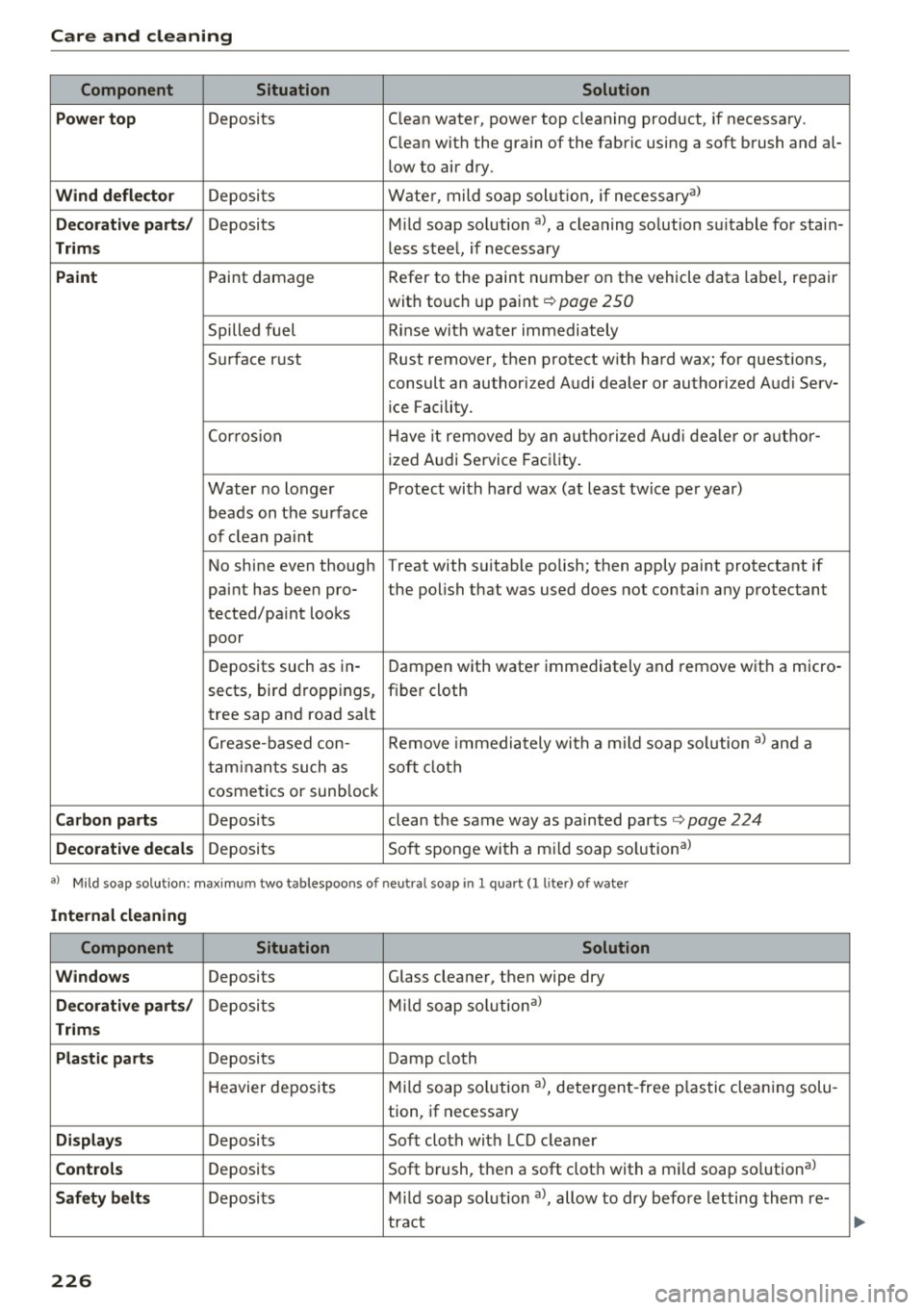
Care and cleaning
Component Situation Solution
Power top
Deposits Clean water, power top cleaning product , if necessary.
Clean with the grain of the fabric using a soft brush and al- low to air dry.
Wind deflector Deposits Water, mild soap solution,
if necessaryal
Decorative parts/ Deposits Mild soap solution a>, a cleaning solution suitable for stain-
Trims less steel, if necessary
Paint Paint damage Refer to the paint number on the vehicle data label, repair
with touch up paint
r:!) page 250
Spilled fuel Rinse with water immediately
Surface r ust Rust remover, then protect with hard wax; for questions,
consult an authorized Audi dealer or authorized Audi Serv-
ice Facility.
Corrosion H
ave it removed by an authorized Aud i dealer or author-
ized Audi Service Facility.
Water no longer Protect with hard wax (at least twice per year)
beads on the surface
of clean paint
No shine even though Treat with suitable polish; then apply paint protectant if
paint has been pro- the polish that was used does not contain any protectant
tected/pa int looks
poor
Deposits such as in- Dampen with water immediately and remove with a micro-
sects, bird droppings,
fiber cloth
tree sap and road salt
Grease-based con- Remove
immediately with a mild soap solution a) and a
taminants such as soft cloth
cosmetics or sunblock
Carbon parts Deposits clean the same way as painted parts ~ page 224
Decorative decals Deposits Soft
sponge with a mild soap solution al
a) Mild soap so lution: maxim um two tablespoons of neutral soap in l quar t (l lite r) of water
Internal cleaning
Component Situation Solution
Windows
Deposits Glass cleaner, then wipe dry
Decorative parts/ Deposits Mild
soap solutiona )
Trims
Plastic parts
Deposits Damp cloth
Heavier deposits Mild soap so lution a>, detergent-free p lastic clean ing solu -
tion, if necessary
Displays Deposits Soft cloth with LCD cleaner
Controls Deposits Soft
brush, then a soft cloth with a mild soap so lutional
Safety belts Deposits Mild soap so lution a>, allow to dry before letting them re-
tract
226
Page 242 of 272
Fuses and bulbs
No . Equipment
F48 Exterior sound actuator
F49 Starter, clutch sensor, headlight relay coil,
high-voltage
battery
FS3 Rear window defogger
The power seats* are protected via
circuit break
ers
that automatically switch on after a few sec
onds after the overload has been reduced.
(D Tips
Note that the following table was accurate at
the time of printing and is subject to change.
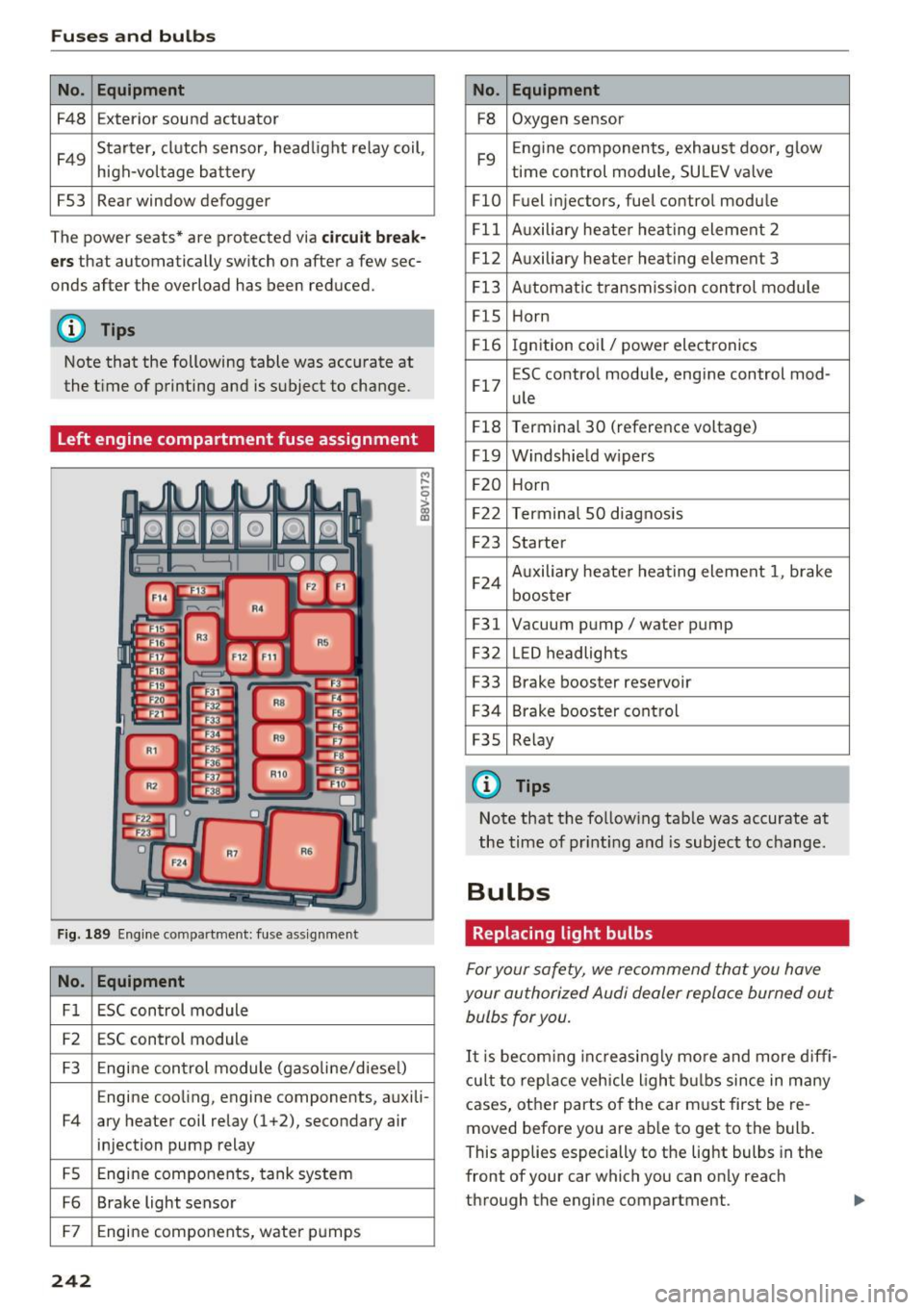
Left engine compartment fuse assignment
Fig . 189 Engine compartment: fuse assignment
No. Equipment
Fl ESC control module
F2 ESC control module
F3 Engine control module (gaso line/diesel)
Engine cooling, engine components, auxili-
F4 ary heater coil relay (1+2), secondary air injection pump relay
FS Engine components,
tank system
F6 Brake light sensor
F7 Engine components, water
pumps
242
No. Equipment
F8 Oxygen sensor
F9 Engine
components, exhaust door, glow
time control module, SU LEV valve
FlO Fuel injectors, fuel control module
Fll Auxiliary heater heat ing element 2
F12 Auxiliary heater heating element 3
F13 Automatic transmiss ion control module
FlS Horn
F16 Ignition coil/ power electronics
F17 ESC control module, engine control mod-
ule
F18 Terminal 30 (reference voltage)
F19 Windshie ld w ipers
F20 Horn
F22 Terminal SO diagnosis
F23 Starter
F24 Auxiliary heater heating element
1, brake
booster
F31 Vacuum pump/ water pump
F32 LED headlights
F33 Brake booster reservoir
F34 Brake booster control
F3S Relay
@ Tips
Note that the following tab le was accurate at
the time of printin g and is subject to change.
Bulbs
Replacing light bulbs
For your safety, we recommend that you have
your authorized Audi dealer replace burned out bulbs for you.
It i s becom ing increasingly more and more diffi
cult to replace vehicle light bulbs since in many
cases, other parts of the car must first be re
moved before you are ab le to get to the bulb.
This applies especially to the light bulbs in the
front of your car which you can only reach
through the engine compartment .