weight AUDI A3 CABRIOLET 2016 Owner's Manual
[x] Cancel search | Manufacturer: AUDI, Model Year: 2016, Model line: A3 CABRIOLET, Model: AUDI A3 CABRIOLET 2016Pages: 272, PDF Size: 67.88 MB
Page 210 of 272
Tires and wheels
Uniform Tire Qu ality Gr ading
is a tire information system devel
oped by the United States Nation
al Highway Traffic Safety Admin
istration (NHTSA) that is designed
to help buyers make relative com parisons among tires. The UTQG
is not a safety rating and not a
guarantee that a tire will last for
a prescr ibed number of miles
(kilometers) or perform in acer
tain way. It simply gives tire buy
ers additional information to
combine with other considera
tions, such as price, brand loya lty
and dealer recommendations. Un
der UTQG, t ires are graded by the
tire manufacturers in three areas:
treadwear, traction, and tempera
ture resistance . The UTQG infor
mation on the tires, molded into
the sidewalls.
U.S. DOT Tire Identification
Number (TIN)
This is the tire's "serial number" .
It begins with the letters "DOT"
and indicates that the tire meets
all federal standards. The next
two numbers or letters indicate
the plant where it was manufac
tured, and the last four numbers represent the
week and year of
manufacture . For example,
210
DOT ... 2215 ...
means that the tire was produced
in the 22nd week of 2015. The
other numbers are marketing co
des that may or may not be used by the tire manufacturer . This in
formation is used to contact con sumers if a tire defect requires a
recall.
Veh icle capacity weight
means the rated cargo and lug
gage load plus 150 lbs . (68 k ilo
grams) times the vehicle's desig
nated seating capacity .
Vehicle maximum load on the
tire
means that load on an ind ividual
tire that is determined by distrib
uting to each axle its sha re of the
maximum loaded veh ic le weight
and dividing by two.
Vehicle normal load on the tire
means that load on an individual
tire that is determined by distrib
uting to each axle its sha re of the
curb weight, accessory weight,
and normal occupan t weight (dis
tributed in accordance with
c:::> ta
ble on page 216) and dividing by
two .
~
Page 216 of 272
Tires and wheels
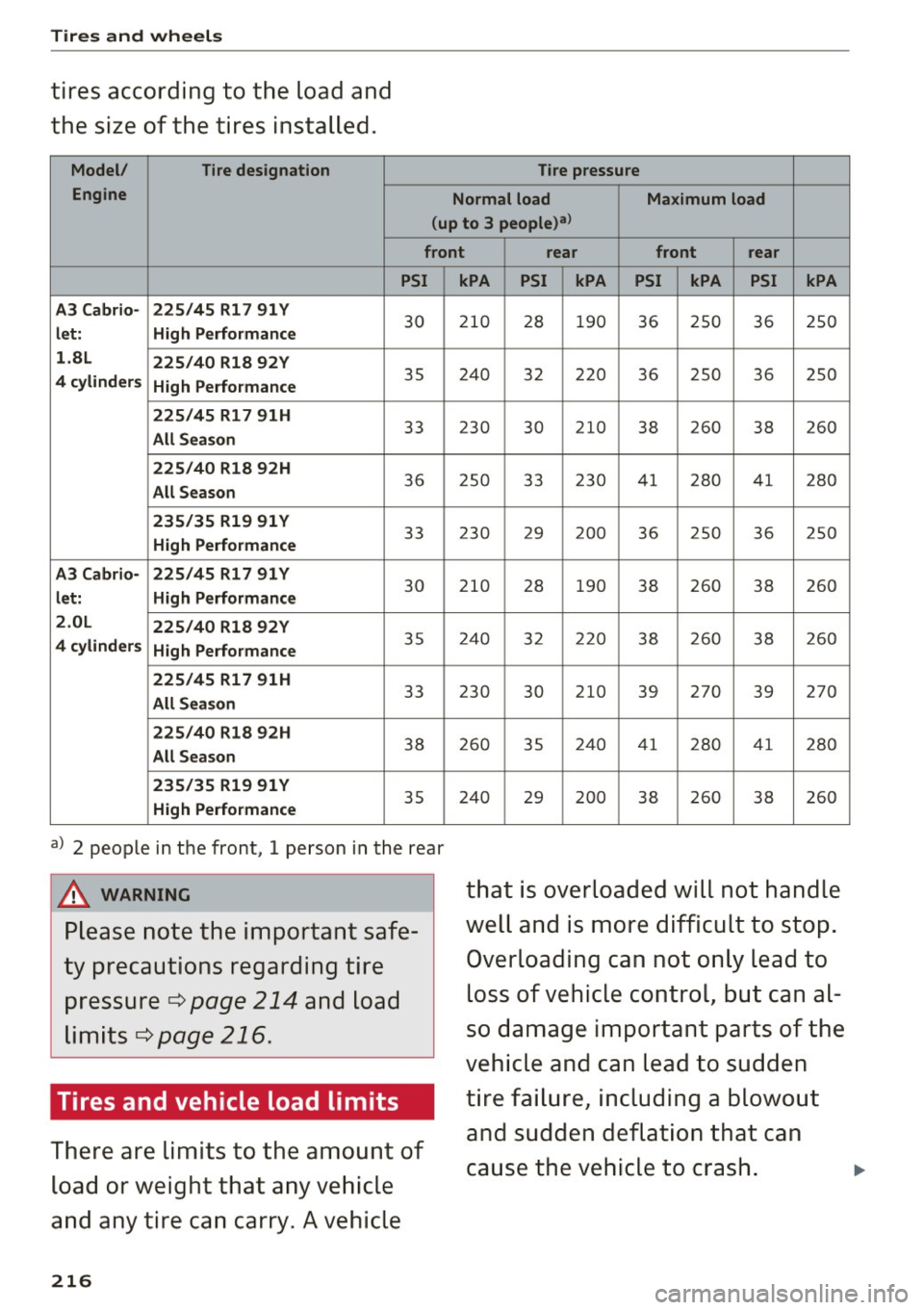
tires according to the load and
the size of the tires installed.
Model/ Tire designation
Engine Tire pressure
Normal load Maximum load
(up to 3 people)
3>
front rear front rear
PSI
A3 Cabrio- 225/45 Rl7 91Y let: High Performance
30
l.8L
225/40 Rl8 92Y
4 cylinders High Performance
35
225/45 Rl 7 91H
All Season
33
225/40 Rl8 92H
All Season
36
235/35 Rl9 91 Y
High Performance
33
A3 Cabrio- 225/45 Rl 7 91 Y
let: High Performance
30
2.0L 225/40 Rl8 92Y
4 cylinders High Performance
35
225/45 Rl 7 91H
All Season
33
225/40 Rl8 92H
All Season
38
235/35 Rl9 91 Y
High Performance
35
a) 2 people in the front , 1 perso n in the rear
.&, WARNING
Please note the important safe
ty precautions regarding tire
pressure
¢ page 214 and load
limits
¢page 216.
Tires and vehicle load limits
There are limits to the amount of
load or weight that any vehicle
and any tire can carry. A vehicle
216
kPA PSI kPA PSI kPA PSI kPA
210 28 190 36 250 36 250
240 3 2 220 36 2 50 36 250
2 30 30 210 38 260 38 260
250 33 230 41 280 41 280
2 30 29 200
36 25
0
36 25
0
210 28 190 38 260 38 260
240 32 220 38 260 38 260
230 30 2 10 39 270
39 270
260 35 240 41 280 41 280
240 29 200 38 260
38 260
that is
overloaded will not handle
well and is more difficult to stop.
Overloading can not only lead to
loss of vehicle control, but can al
so damage important parts of the
vehicle and can lead to sudden
tire failure, including a blowout
and sudden deflation that can
cause the vehicle to crash.
Page 217 of 272
Your safety and that of your passengers also depends on making
sure that load limits are not ex
ceeded. Vehicle load includes ev
erybody and everything in and on
the vehicle. These load limits are
technically referred to as the vehi
cle's
Gross Vehicle Weight Rat
ing
("GVWR").
The "GVWR" includes the weight
of the basic vehicle, all factory in
stalled accessories, a full tank of
fuel, oil, coolant and other fluids
plus maximum load. The maxi
mum load includes the number of
passengers that the vehicle is in
tended to carry ("seating capaci
ty") with an assumed weight of
150 lbs. (68 kg) for each passen
ger at a designated seating posi
tion and the total weight of any luggage in the vehicle. If you tow
a trailer, the weight of the trailer
hitch and the tongue weight of
the loaded trailer must be includ
ed as part of the vehicle load.
The
Gross Axle Weight Rating
("GAWR") is the maximum load
that can be applied at each of the
vehicle's two axles .
; The fact that there is an upper
N
~ limit to your vehicle's Gross Vehi-
o
s: a:,
Tires and wheels
cle Weight Rating means that the
total weight of whatever is being
carried in the vehicle (including
the weight of a trailer hitch and
the tongue weight of the loaded
trailer) is limited. The more pas
sengers in the vehicle or passen
gers who are heavier than the
standard weights assumed mean
that less weight can be carried as
luggage.
The Gross Vehicle Weight Rating
and the Gross Axle Weight Rating
are listed on the safety compli
ance sticker label located on the driver's side B-pillar
9page 214,
fig. 170.
A WARNING
Overloading a vehicle can cause
loss of vehicle control, a crash
or other accident, serious per
sonal injury, and even death.
-Carrying more weight than your vehicle was designed to carry will prevent the vehicle
from handling properly and increase the risk of the loss of
vehicle control.
-The brakes on a vehicle that
has been overloaded may not
be able to stop the vehicle
within a safe distance.
217
Page 218 of 272
Tires and wheels
-Tires on a vehicle that has been overloaded can fail sud
denly, including a blowout and
sudden deflation, causing loss of control and a crash .
-Always make sure that the to tal load being transported -
including the weight of a trail
er hitch and the tongue
weight of a loaded trailer does not make the vehicle
heavier than the vehicle's
Gross Vehicle Weight Rating.
Determining correct load
limit
Use the example below to calcu
late the total weight of the pas
sengers and luggage or other
things that you plan to transport
so that you can make sure that
your vehicle will not be overload ed .
Steps for Determining Correct
Load Limit
1 . Locate the statement "THE
COMBINED WEIGHT OF OCCU
PANTS AND CARGO SHOULD
NEVER EXCEED XXX KG OR XXX
LBS"on your vehicle's placard
(tire inflation pressure label)
¢page 214, fig.170.
218
2. Determine the combined
weight of the driver and passengers that will be riding in
your vehicle.
3. Subtract the combined weight
of the driver and passengers
from
"XXX" kilograms or "XXX"
pounds shown on the sticker
¢page 214, fig. 170.
4. The resulting figure equals the
available amount of cargo and
luggage load capacity. For ex
ample, if the "XXX" amount
equals
1400 lbs . and there will
be five
150 lbs. passengers in
your vehicle, the amount of
available cargo and luggage
load capacity is 650 lbs.
(1400-750 (5 X 150) = 650
lbs.)
5. Determine the combined
weight of luggage and cargo being loaded on the vehicle.
That weight may not safely ex ceed the available cargo and luggage load capacity calculat
ed in Step 4.
6. If your vehicle will be towing a trailer, load from your trailer
will be transferred to your ve
hicle. Consult this manual to
determine how this reduces ...
Page 248 of 272
Emergency situations
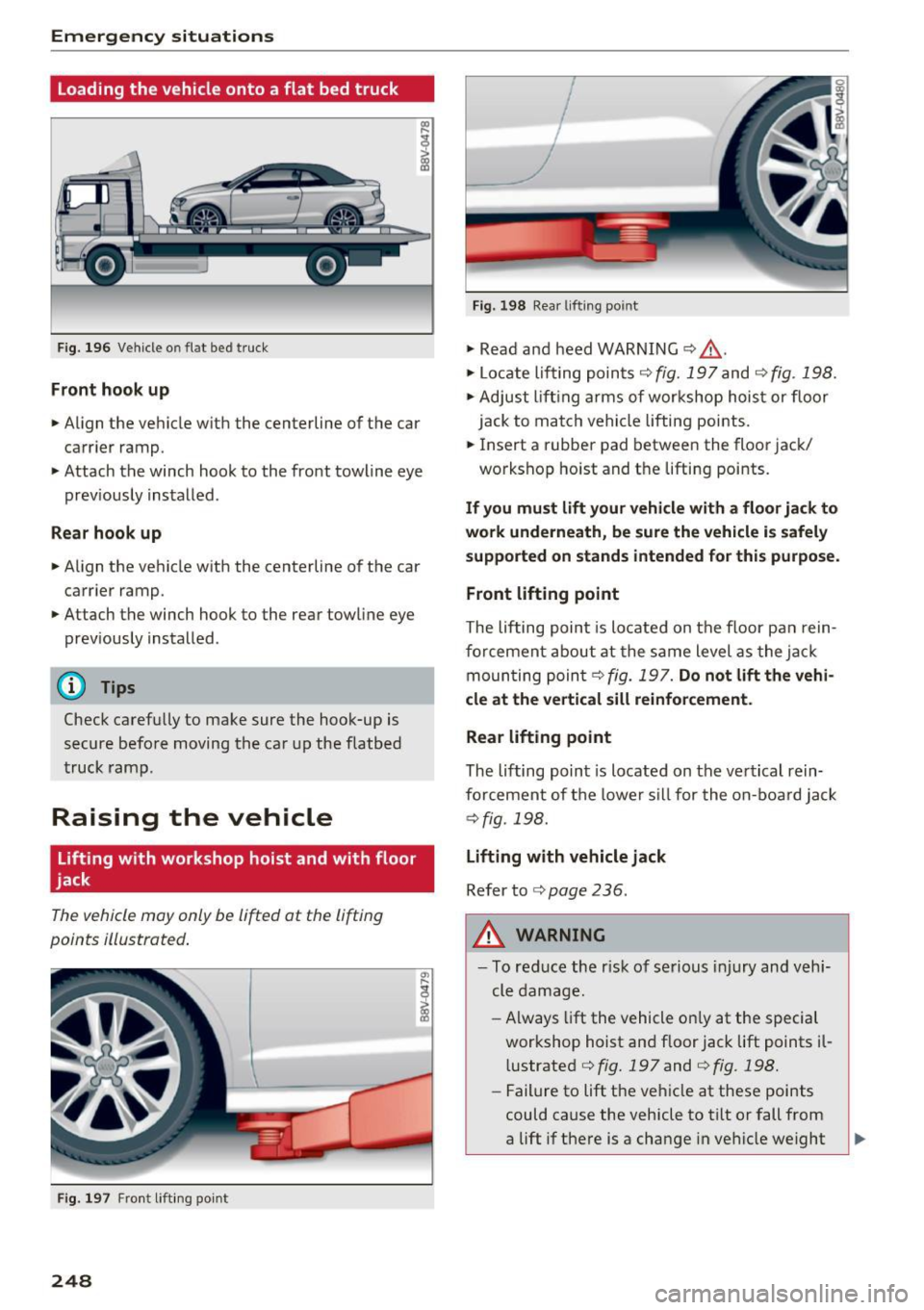
Loading the vehicle onto a flat bed truck
Fig. 196 Vehicle o n flat bed truck
Front hook up
.. Align the vehicle with the centerline of the car
carrier ramp.
.. Attach the winch hook to the front towline eye
prev iously installed.
Rear hook up
.. Align the vehicle with the centerline of the car
carrier ramp.
.. Attach the winch hook to the rear towline eye
previously installed .
@ Tips
Check carefully to make sure the hook-up is
secure before moving the car up the flatbed
truck ramp.
Raising the vehicle
Lifting with workshop hoist and with floor
jack
The vehicle may only be lifted at the lifting
points illustrated.
Fig. 197 Front lifting point
248
Fig. 198 Rear lifting point
.. Read and heed WARNING ¢ f1..
.. Locate lifting points <;!) fig. 197 and <;!)fig . 198.
.. Adjust lifting arms of workshop hoist or floor
jack to match vehicle lifting points .
.. Insert a rubber pad between the floor jack/
workshop hoist and the lifting points .
If you must lift your vehicle with a floor jack to
work underneath, be sure the vehicle is safely
supported on stands intended for this purpose .
Front lifting point
The lifting point is located on the floor pan rein
forcement about at the same level as the jack
moun ting poin t¢
fig. 197. Do not lift the vehi
cle at the vertical sill reinforcement.
Rear lifting point
The lifting point is located on the vertical rein
forcement of the lower sill for the on-board jack
¢fig. 198.
Lifting with vehicle jack
Refer to<=> page 236.
,&. WARNING
-To reduce the r isk of serious injury and vehi
cle damage.
- Always lift the vehicle on ly at the special
workshop hoist and floor jack lift points il
l ustrated
<=>fig.197and <=>fig.198.
-Failure to lift the vehicle at these points
could cause the vehicle to tilt or fall from
a lift if there is a change in vehicle weight
Page 249 of 272
<( co .... N ,.__
N .... 0 ,.__
> co
distr ibut ion an d ba lance . This might hap
pen, for exam ple, when heavy compo
nents such as the engine b lock or trans
miss io n are removed.
- When removing heavy components like
th ese, anc hor vehicle t o hoist o r add corr e
sponding weights to maintain the center of
grav ity. Oth erwise, the ve hicle might ti lt or
s li p off the hois t, causing s eriou s perso na l
lnJUry.
(D Note
- Be awar e of the fo llowing poi nts before lift
i ng t he vehicle:
- The vehicle should never be lifted or
jacked up from underneath the engine oil pan , the transmission housing, the front
or rear axle or the body side members .
This could lead to serious damage.
- To avoid damage to the unde rbody or
chassis frame, a rubber pad must be in
serted between the floor jack and the lift
points.
- Before driv ing over a workshop hoist,
check that the vehicle weight does not
exceed the permissible lifting capacity of
the hoist .
- Before driving over a workshop hoist, en
sure that there is sufficient clearance be
tween the hoist and low parts of the ve
hicle.
Emergency situations
249
Page 250 of 272
Technical data
Technical data
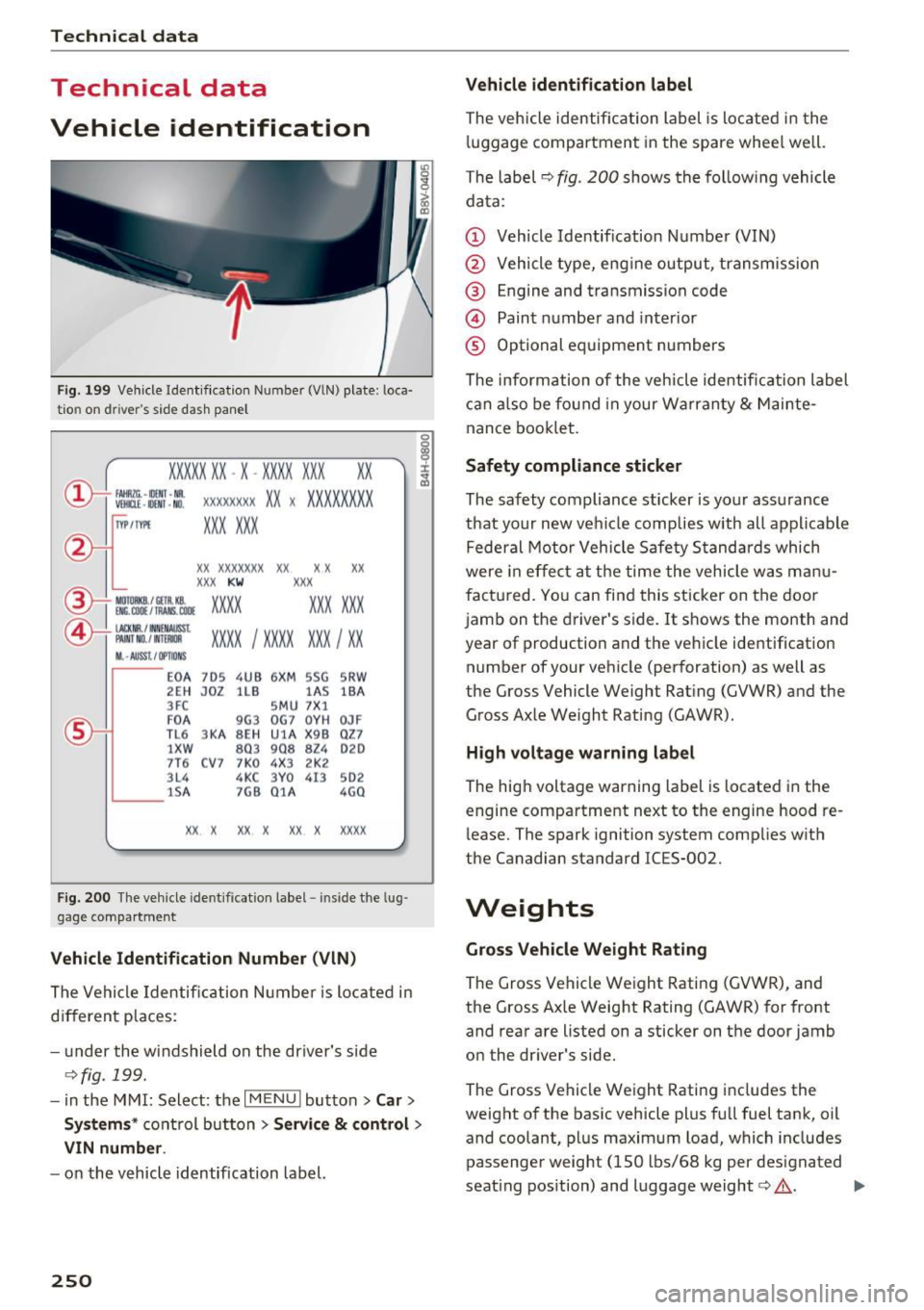
Vehicle identification
Fig. 199 Vehicle Ident if ication Numbe r (VlN) plate : loca·
tio n on d river 's side dash panel
XXXXX XX -X -XX XX XXX XX
@-+ ~J:~t::1 ::: xxxxxxxx xx x xxxx xxx x
IYP lf'VPE XXX X XX
XX XXXXXXX XX X X XX
XXX KW XXX
\YT IM:.COll/fAANS ,COOE XXX XXX 15\_L I MOIOlll
@-+ ~~
1
:tr:~i XXXX I XXXX XXX I XX
II. -AUSST . / OPTIO NS
E0 A 7D5 4UB 6X
M SSG SR W
2EH JOZ lLB lAS
lBA
3FC SM U 7 X1
F0 A
9G3 0
G7 0Y H
0JF
TL 6 3 KA 8EH UlA X 9B Q
Z7
1 XW
803 908
824 020
7T6 C V7 7 K0 4X3 2K2
3L4 4KC 3Y0 413
502
lS A 7GB 01A
4G0
XX X XX X
XX X xxxx
Fig. 200 The vehicle ide ntifi cat ion l abel - inside t he lug ·
gage compartment
Vehicle Identification Number (VlN)
The Vehicle Identification Number is located in
different places :
- under the windshield on the driver's side
¢fig . 199.
- in the MMI: Select: the I MENU I button> Car>
Systems*
control button > Service & control >
VIN number .
-on the vehicle identification label.
250 Vehicle
identification label
The vehicle identification label is located in the
luggage compartment in the spare wheel well.
The label
9 fig. 200 shows the follow ing vehicle
data:
(D Vehicle Identif ication Number (VIN)
@ Vehicle type, engine output, transmission
@ Engine and transmission code
@ Paint number and interior
® Optional equipment numbers
The information of the vehicle identification label
can also be found in your Warranty
& Mainte ·
nance booklet.
Safety compliance sticker
The safety compliance sticker is your assurance
that your new veh icle complies with all applicable
Federal Motor Vehicle Safety Standards which
were in effect at the time the vehicle was manu
factured. Yo u can find this sticker on the door
jamb on the driver's side. It shows the month and
year of production and the vehicle identification
number of your vehicle (perforation) as well as
the Gross Vehicle Weight Rating (GVWR) and the Gross Axle We ight Rating (GAWR).
High voltage warning label
The high voltage warning label is located in the
engine compartment next to the engine hood re
lease. The spark ignition system complies w ith
the Canadian standard ICES-002.
Weights
Gross Vehicle Weight Rating
The Gross Vehicle Weight Rating (GVWR), and
the Gross Axle Weight Rating (GAWR) for front
and rear are listed on a sticker on the door jamb
on the driver 's side.
The Gross Vehicle Weight Rating includes the
weight of the basic vehicle plus full fuel tank, oil
and coolant, plus maximum load, which includes
passenger weight (150 lbs/68 kg per designated
seat ing position) and luggage weight¢,&. . .,.
Page 251 of 272

<( co .... N ,.__
N .... 0 ,.__
> co
Gross Axle Weight Rating
The G ross Axle We igh t Rating is the max imum
l oad that can be applied at each axle of the vehi
cle ~.& .
Vehicle capacity weight
The vehicle capac ity we ight (max. load) is listed
e ithe r o n the dr iver's side B-pillar o r inside the
f u el fi ller flap.
& WARNING
- The actual Gross Ax le Weight Rating at the
front and rear axles sho uld not exceed the
permissible weights, and their comb inat ion
must not exceed the Gross Vehicle We ight
Rat ing.
Dimensions
The dimens io ns can vary depending on the model
a nd equipment.
Length
Width
Width across the m irrors
He igh t at c urb we ightal
a ) T he he ight of the veh icle depen ds on the tire s a nd su sp en sio n.
W hen driv ing on poor roads, by cu rbs and on
steep ramps, make s ure that low-lying compo-
n ents such as the spo ile r and ex haust system do
Capacities
Fuel ta nk
Front wheel drive
all wheel drive
Windsh ield washer system
Techn ical data
- Exceeding permissible weight ratings can
res ult in vehicle damage, accidents and per
sonal injury.
(D Note
- The vehi cle capacity weig ht figu res apply
when the load is d istributed evenly in the
vehicle (passengers and luggage) . When
transport ing a heavy load in the luggage
compartment, ca rry the load as near to the
rear axle as possib le so that t he veh icle's
hand ling is no t impaired .
- Do not exceed the maximum perm iss ible
ax le loads or the maximum gross vehicle
we igh t. Always remember that the veh icle's
han dling will be affe cted by the extra load.
Th erefore, adjust your spee d accordingly.
- Always observe local regulations.
in (mm) 175.3 (4,456)
i n (mm)
70.5 (1,793)
in (mm) 77 .1 (1,960)
i n (mm) 55.4 (1,409)
not come into contact w ith th ese o r they could be
damaged . This applies especially when the vehi
cl e is fully loaded.
gal ( l)
approximately 13.2
gal ( l) (50.0)
app roxima tely 1 4.5
(55.0)
qt (l) approximately 3. 2 (3 .1)
251
Page 262 of 272
Index
Front ai rbags
Description . . . . . . . . . . . . . . . . . . . . . . . . .
147
H ow they wo rk . . . . . . . . . . . . . . . . . . . . . . 153
Fr onta l co llisions and the laws of p hys ics . . 136
Front armrest . . . . . . . . . . . . . . . . . . . . . . . . . 55
Fr ont seats
Adjusti ng . . . . . . . . . . . . . . . . . . . . . . . . . .
126
Ch ild restraints in the front seat . . . . . . . . 144
also refer to Seats . . . . . . . . . . . . . . . . . 53, 58
Fue l
Additives . . . . . . . . . . . . . . . . . . . . . . . . . . .
184
Blende d gasoline . . . . . . . . . . . . . . . . . . . . 184
Current cons umption . . . . . . . . . . . . . . . . . . 24
Fue l filler neck . . . . . . . . . . . . . . . . . . . . . . 185
Fue l gauge . .. ... ............ .... . 10, 11
Fuel tank capac ity . . . . . . . . . . . . . . . . . . . 251
Gasoline . . . . . . . . . . . . . . . . . . . . . . . . . . . 184
Gasolin e additives . . . . . . . . . . . . . . . . . . . 185
Indicato r ligh t . . . . . . . . . . . . . . . . . . . . . . . 20
S aving fue l . . . . . . . . . . . . . . . . . . . . . . 6 5, 1 06
Fue l economy messages (eff ic iency p rogram) .26
F ueling
Fue l filler door emergency release . . . . . .
187
Fue l gauge . . . . . . . . . . . . . . . . . . . . . . . . . . 11
Fue l tank capac ity . . . . . . . . . . . . . . . . . . . 251
Opening the fuel filler door . . . . . . . . . . . . 186
Fuses
Assignment . . . . . . . . . . . . . . . . . . . . . . . .
2 4 1
Interior . . . . . . . . . . . . . . . . . . . . . . . . . . . . 240
replacing . . . . . . . . . . . . . . . . . . . . . . . . . . 240
G
Garment hooks . . . . . . . . . . . . . . . . . . . . . . . . 57
Gas dis charge lamps . . . . . . . . . . . . . . . . . . . 24 2
Gasoline . . . . . . . . . . . . . . . . . . . . . . . . . . . . 184
Octane rating . . . . . . . . . . . . . . . . . . . . . . . 184
Recommendation .. ........ ...... ... . 184
Glossa ry of tire and loading terminology . . 206
Glove compartment . . . . . . . . . . . . . . . . . . . . 57
C D c hanger . . . . . . . . . . . . . . . . . . . . . . . . . . 5 7
Gross Vehicle Weight Ra ting (GVWR) . . . . . 250
H
H eadlight range control system . . . . . . . . . . 43
Indicator l ight . . . . . . . . . . . . . . . . . . . . . . . 21
262
Head lights . . . . . . . . . . . . . . . . . . . . . . . . 43, 45
Cleaning . . . . . . . . . . . . . . . . . . . . . . . . . . . 225
Head light range contro l system . . . . . . . . . 43
Left hand drive, right hand drive . . . . . . . . . 46
Travel mode . . . . . . . . . . . . . . . . . . . . . . . . . 46
Head restraints . . . . . . . . . . . . . . . . . . . . . . . 127
adJust 1ng . . . . . . . . . . . . . . . . . . . . . . . . . . . 55
Adjusting . . . . . . . . . . . . . . . . . . . . . . . . . . 127
remov ing and installing . . . . . . . . . . . . . . . . 55
He ated
ex ter ior mir rors . . . . . . . . . . . . . . . . . . . . . .
4 7
Rear window . . . . . . . . . . . . . . . . . . . . . . . . . 64
Seats . . . . . . . . . . . . . . . . . . . . . . . . . . . . . . . 64
Washer nozz les . . . . . . . . . . . . . . . . . . . . . . 49
He avy cloth ing and s afety be lts . . . . . . . . . .
13 7
Hex w rench . . . . . . . . . . . . . . . . . . . . . . . . . . 230
Hig h voltage warning label . . . . . . . . . . . . . 250
Hig hway ligh t . . . . . . . . . . . . . . . . . . . . . . . . . 44
Hill descent cont rol . . . . . . . . . . . . . . . . . . . .
80
Hill hold . . . . . . . . . . . . . . . . . . . . . . . . . . . . . 75
Hill ho ld assist
refer to H ill hold . . . . . . . . . . . . . . . . . . . . . 75
Horn . . . . . . . . . . . . . . . . . . . . . . . . . . . . . . . . . 8
How are ch ild restraint system anchors relat-
ed to chi ld safety . . . . . . . . . . . . . . . . . . . . .
179
How many a irbags does my vehicle have? . . 150
How safety belt pretensioners work 141
I
Ignition
Ind icator lig ht . . . . . . . . . . . . . . . . . . . . . . .
18
Switching on/off (w ith button) . . . . . . . . . . 70
Ig ni tion key s afety inte rlo ck . . . . . . . . . . . . . 68
Ignition lock
mecha nica l . . . . . . . . . . . . . . . . . . . . . . . . . .
68
Imbalance (whee ls) . . . . . . . . . . . . . . . . . . . 212
Immobilize r . . . . . . . . . . . . . . . . . . . . . . . . . . 2 7
Impo rtant th ings to do before dr ivi ng . . . . 124
Imprope rly worn safety belts . . . . . . . . . . . 140
Ind icator lig hts . . . . . . . . . . . . . . . . . . . . . . . . 12
Infant seats . . . . . . . . . . . . . . . . . . . . . . . . . 171
Infl ation press ure (t ires) . . . . . . . . . . . . . . . 2 14
Inspection in terva l
with dr ive r informa tion system . . . . . . . . .
202
Installing child safety seats
Safety be lts . . . . . . . . . . . . . . . . . . . . . . . .
176
Page 268 of 272
Index
Trailer towing Op erating instructions . . . . . . . . . . . . . . . . . 85
Technical requirements . . . . . . . . . . . . . 85, 86
Transmission malfunction (indicator light) . . 82
Transport Canada . . . . . . . . . . . . . . . . . . . . . 132
Travel mode . . . . . . . . . . . . . . . . . . . . . . . . . . 46
Trunk
refer to Luggage compartment . . . . . . . . . . 58
Trunk lid Trunk escape latch . . . . . . . . . . . . . . . . . . . 230
Turning light . . . . . . . . . . . . . . . . . . . . . . . . . . 43
Turn signa ls . . . . . . . . . . . . . . . . . . . . . . . . . . 45
I ndicator l ight . . . . . . . . . . . . . . . . . . . . . . . 21
u
Unfastening safety belts
Uniform tire quality grading
Unlock ing/ locking 140
221
by remote control . . . . . . . . . . . . . . . . . . . . 29
On the lock cylinder . . . . . . . . . . . . . . . . . . . 32
Using the lock cylinder. . . . . . . . . . . . . . . . . 32
with the central locking switch . . . . . . . . . . 31
with the convenience key . . . . . . . . . . . . . . . 30
Unlocking/ Locking
At the lock cylinder . . . . . . . . . . . . . . . . . . . 32
V
Vanity m irror. . . . . . . . . . . . . . . . . . . . . . . . . . 49
Vehicle Care/cleaning . . . . . . . . . . . . . . . . . . . . . . . 224
Dimensions. .. .. ............. .... .. . 251
Out of service . . . . . . . . . . . . . . . . . . . . . . . 228
Vehicle control modules. . . . . . . . . . . . . . . . 122
Vehicle identification label . . . . . . . . . . . . . 250
Vehicle Identification Number (VIN) . . . . . . 250
Vehicle jack . . . . . . . . . . . . . . . . . . . . . . 230, 236
Veh icle key . . . . . . . . . . . . . . . . . . . . . . . . . . . 27
Vehicle tool kit . . . . . . . . . . . . . . . . . . . . . . . 230
vv
Warning/indicator lights
System indicator light (MIL) . . . . . . . . . . . . 19
Warning/Indicator lights
Airbag system . . . . . . . . . . . . . . . . . . . . . . 155
PASS ENGER AIR BAG OFF . . . . . . . . . . . . . 155
268
Warning lights
refer to Indicator lights . . . . . . . . . . . . . . . . 12
Warranty coverages . . . . . . . . . . . . . . . . . . . 253
Washer fluid level (indicator light) . . . . . . . . 20
Washing matte finish paint . . . . . . . . . . . . . 224
Weights . . . . . . . . . . . . . . . . . . . . . . . . . . . . . 250
What happens if you wear your safety belt too
loose? . . . . . . . . . . . . . . . . . . . . . . . . . . . . . . 139
What happens to unbelted occupants? . . . . 136
What impairs driving safety? . . . . . . . . . . . . 125
Wheel bolts . . . . . . . . . . . . . . . . . . . . . . . . . 219
Wheels .... .. .. .. .. .. ............. .. 204
All wheel drive . . . . . . . . . . . . . . . . . . . . . . 120
Cleaning . . . . . . . . . . . . . . . . . . . . . . . . . . . 225
Glossary of tire and loading terminology . 206
Replacing . . . . . . . . . . . . . . . . . . . . . . . . . . 234
Tires and vehicle load limits ......... .. 216
Wheel wrench . . . . . . . . . . . . . . . . . . . . . . . . 230
When must a safety belt be replaced? . . . . 137
When must the airbag system be inspected? lSS
Where are lower anchorages located? . . . . 180
Wind deflector . . . . . . . . . . . . . . . . . . . . . . . . 39
Window regulators . . . . . . . . . . . . . . . . . . . . . 34
Windows Cleaning/removing ice . . . . . . . . . . . . . . . . 226
Windshie ld
cleaning . . . . . . . . . . . . . . . . . . . . . . . . . . . . 49
defrosting (automatic climate control sys-
tem) . . . . . . . . . . . . . . . . . . . . . . . . . . . . . . . 63
also refer to Windshield . . . . . . . . . . . . . . . 49
Windshie ld washer system . . . . . . . . . . 49, 202
Reservoir capacity . . . . . . . . . . . . . . . . . . . 251
Windshie ld wipers
Cleaning wiper blades . . . . . . . . . . . . . . . . . 50
Fo lding up . . . . . . . . . . . . . . . . . . . . . . . . . . 50
Indicator light . . . . . . . . . . . . . . . . . . . . . . . 20
Replacing windshield wiper blades . . . . . . . 50
Switching on and
off . . . . . . . . . . . . . . . . . . 49
Winter driving Snow chains . . . . . . . . . . . . . . . . . . . . . . . . 219
Tires . . . . . . . . . . . . . . . . . . . . . . . . . . . . . . 219
Winter operat ion
Battery . . . . . . . . . . . . . . . . . . . . . . . . . . . . 198
Cooling system . . . . . . . . . . . . . . . . . . . . . . 195
Windshie ld washer system . . . . . . . . . . . . 202
Winter tires... .. .. .. .. ... ............ 219