ABS AUDI A3 SEDAN 2017 User Guide
[x] Cancel search | Manufacturer: AUDI, Model Year: 2017, Model line: A3 SEDAN, Model: AUDI A3 SEDAN 2017Pages: 400, PDF Size: 67.32 MB
Page 122 of 400
Trailer towing
Trailer towing
Driving with a trailer
General information
Your Audi was designed primarily for passenger
transportation.
If you plan to tow a trailer, please remember that
the additional load will affect durability, econo
my and performance.
Trailer towing not on ly places more stress on the
ve hicle, it also ca lls for more concentration from
the dr iver.
F or this reason, always follow the operating and
driving instructions provided and use common
sense.
Technical requirements
Trailer hitch
Use a weight-carrying hitch conforming to the
gross tra iler weight. The hitch must be suitab le
for your veh icle and tra iler and must be mounted
securely on the vehicle's chassis at a technically
sound
locat ion . Use on ly a trailer hitch with a re
movable ba ll mount . Always che ck with the t rail
er hitch man ufac tur er to make s ure t hat you are
using the co rrect hi tc h.
Do not use a bumper hitch.
The hitch must be installed in such a way that it
does not interfere with the impact -absorbing
bumper system. No mod ificat ions should be
made to the vehicle exhaust and b rake systems .
Fr om t ime to t ime, che ck tha t all hitch mo unti ng
bol ts rem ain securely f aste ned.
W hen you are not tow ing a tra iler, remove the
tra ile r hitc h ba ll mount . This prevents the hit ch
from caus ing damage s hou ld your veh icle be
s truck from be hind
c> ,&. .
Trailer brakes
If your trailer is equipped with a brak ing system,
check to be su re that it conforms to all regula
tions .
120
The t rai ler hydraulic bra ke system must not be
directly connected to the vehicle's hydraulic
bra ke system.
Safety chains
A lways use s afety chains between you r vehi cle
and t he tra ile r.
Trailer lights
Traile r lights must meet all regula tions . B e s ure
to check w ith your Aud i dea le r fo r cor rect wir ing,
switches and relays .
Mirrors
If you are unable to see t he traffic behind you us
i ng t he regular outs ide mir rors, then yo u
must in
stall extended mirro rs . It is impo rtant that you
always have clear vision to the rear.
&, WARNING
Afte r remov ing the tr ailer hi tch, do not s to re
i t i n yo ur vehicle. In case o f su d den braking,
the hitch could fly fo rwa rd and injure you or
your passengers .
Operating instructions
Maximum trailer weight
A tra iler f or yo ur vehicle is lim ite d to a typical
class 1 or class 2 trailer.
Trailer load distribution
Be sure the load in the t rai le r i s he ld se curely in
pla ce to p revent i t from shi fting forward, bac k
ward or si deways.
Never allow a passenger to ride in a trailer c> &.
in Driving instructions on page 121.
Engine cooling system
Towing a tra iler makes the engine work harder. It
is important that the cooling system's perform
ance is up to the additional load . Make sure tha t
the coo ling system has enoug h flu id.
Tire pressure
When towing a trailer, inf late the tires of your
vehicle to the tire pressure listed under "Full load" on the label
c> page 336. Inflate trailer
Page 124 of 400
Trailer towing
room to stop . To compensate fo r the trai ler, you
will need a larger than normal turning radius.
When pass ing, remembe r that you cannot accel
erate as fast as you norma lly would because of
the added load. Make s ure yo u have eno ugh room
to pass . After passing, allow plenty of room for
your tra ile r before chang ing lanes again.
Avoid jer ky s tar ts, sharp turns or rap id lane
changes .
{D) Tips
- Do not tow a trailer during t he b reak-in per i
od of yo ur vehicle.
- If you tow a trailer, your Aud i may require
more frequent m ain tenance d ue to the ex
tra load
r:!) page 3 78.
Parking on a slope
Do not park on a slope with a trailer. If it cannot
be avoided, do so only
a~er doing the following:
When parking:
.,. Apply the foot b rake .
.. Have someone place chocks under both t he ve
hicle and the trai le r wheels .
.. With chocks i n place, slowly release the brakes
u nt il the whee l cho cks absorb the load .
.. T urn the wheels towards the curb .
.. Apply the parking brake .
.. Select the P selector lever position.
When restarting after parking:
.,. Apply the foo t bra ke .
.. Start the engi ne .
.. Se lect the D/S selector lever position .
.. Release the parking brake and slowly pull out
and away from the wheel chocks .
.. Stop and have someone retrieve the wheel
chocks.
(D Tips
If you move the se lector lever of the a utomat
ic transm ission to P before apply ing t he park
ing brake and before block ing the wheels, you
may have to use more fo rce later to move the
lever ou t of the P position .
122
Page 153 of 400
CXl CXl .... N ,.__
N .... 0 N > 00
Intelligent Technology Electronic Stabilization
Control (ESC)
Description
Electronic Stabilization Control ( ESC) supports
driver safety . It reduces the risk of slipping and
improves dr iving stability. ESC detects critica l sit
uations such as the vehicle oversteering and un
dersteer ing or the wheels are spinning. The vehi
cle is stabilized by apply ing the brakes or reduc
ing engine torque . When the ESC engages, the
G1 indicato r light b links in the instrume nt clus
ter.
The follow ing systems are integrated in the ESC:
Anti-loc k bra king system (ABS)
ABS prevents the whee ls from locking when brak
ing. The vehicle can still be steered even during
hard brak ing. Apply steady pressure to the brake
pedal. Do not pump the pedal. A pulsing in the
b rake pedal indicates that the system is act ing to
stabilize the vehicle .
Brake a ssist system
The brake assist system can decrease braking dis
tance. It increases brak ing power when the driver
presses the brake pedal quick ly in emergency sit
uations . You must press and hold the brake pedal
u nti l the dangerous sit uat io n is ove r. In veh icles
with adaptive cr uise contro l*, the bra ke assist
s ys tem is more sensitive if t he d istance detec ted
to the veh icle dr iv ing ahe ad is too small.
Anti -slip regulation (ASR)
ASR reduces eng ine power when the drive wheels
begin spinning and adapts the force to the road
conditions . This makes i t eas ie r to sta rt, acceler
ate and dr ive up hill s.
Electronic differential lock (EDL )
The EDL applies the brakes to a wheel that starts
spinning and transfers t he drive power to the
other driving wheel or wheels ( if the veh icle is
eq uipped w ith all whee l dr ive*) . T his function is
n o t available at higher speeds.
Intellig ent Technology
In extreme cases, ED L automat ica lly switches off
to keep the brake o n the braked whee l from over
heating. The veh icle is still working correct ly. EDL
will switch on again automatically when condi
t ions have returned to normal.
Ste ering recommendation
The ESC he lps to s tabilize the vehicle by changing
the steering torque.
Select ive wheel torque control
Se lective wheel to rque cont rol is used w hen driv
i ng on curves. The fron t whee l on the inside of
the curve or bo th wheels on the i nside of the
c u rve are braked se lective ly as needed . This al
l ows more precise driving in c urves.
Automatic post-collision braking system
T he "automat ic pos t-collision braking system"
c an help to reduce the risk of sliding an d of addi
tiona l co llisions a fter an acciden t. If the ai rbag
contro l modu le detects a co llision above a certain
vehicle speed, the veh icle is bra ked by the ESC.
T he vehicle does not bra ke autorn,;1tically if;
- t he dr ive r presses the acce le rator pedal, or
- the ESC, the brake system or the veh icle elect ri-
cal system are not functioning .
A WARNING
-The ESC and its integ rated systems cannot
overcome the lim its imposed by natura l
phys ic al laws. This is especially important
on sli ppery or wet roads . If the sy stems be
gin acting to stabilize your vehicle, you
should immediately alter your speed to
match the road and traffic conditions. Do
not let the inc reased safety provided tempt
you into taking risks. This could increase
your r isk of a coll is ion.
- Please n ote the r isk of a coll is ion increases
when dr iv ing fast, especially t hrough curves
a nd on slippery or wet roads, and when dr iv
ing too close to objects ahead. The ESC and
its integrated systems ca nnot always pre
vent collisions
-there is st ill a ris k of ac ci-
dents!
..,.
151
Page 154 of 400
Intelligent Technology
- Press the accelerator pedal carefully when
acce le rating on even, slippery surfaces such
as ice and snow. The drive wheels can spin
even when these control systems are instal
led and th is can affect driving stability and
increase the risk of a co llision . condition
. Different tire sizes can lead to a
reduction in engine power.
- You may hear noises when the systems de
scribed are working .
@ Tips
-The ABS and ASR only function correctly
when all four whee ls have a s imilar wear
Switching on/off
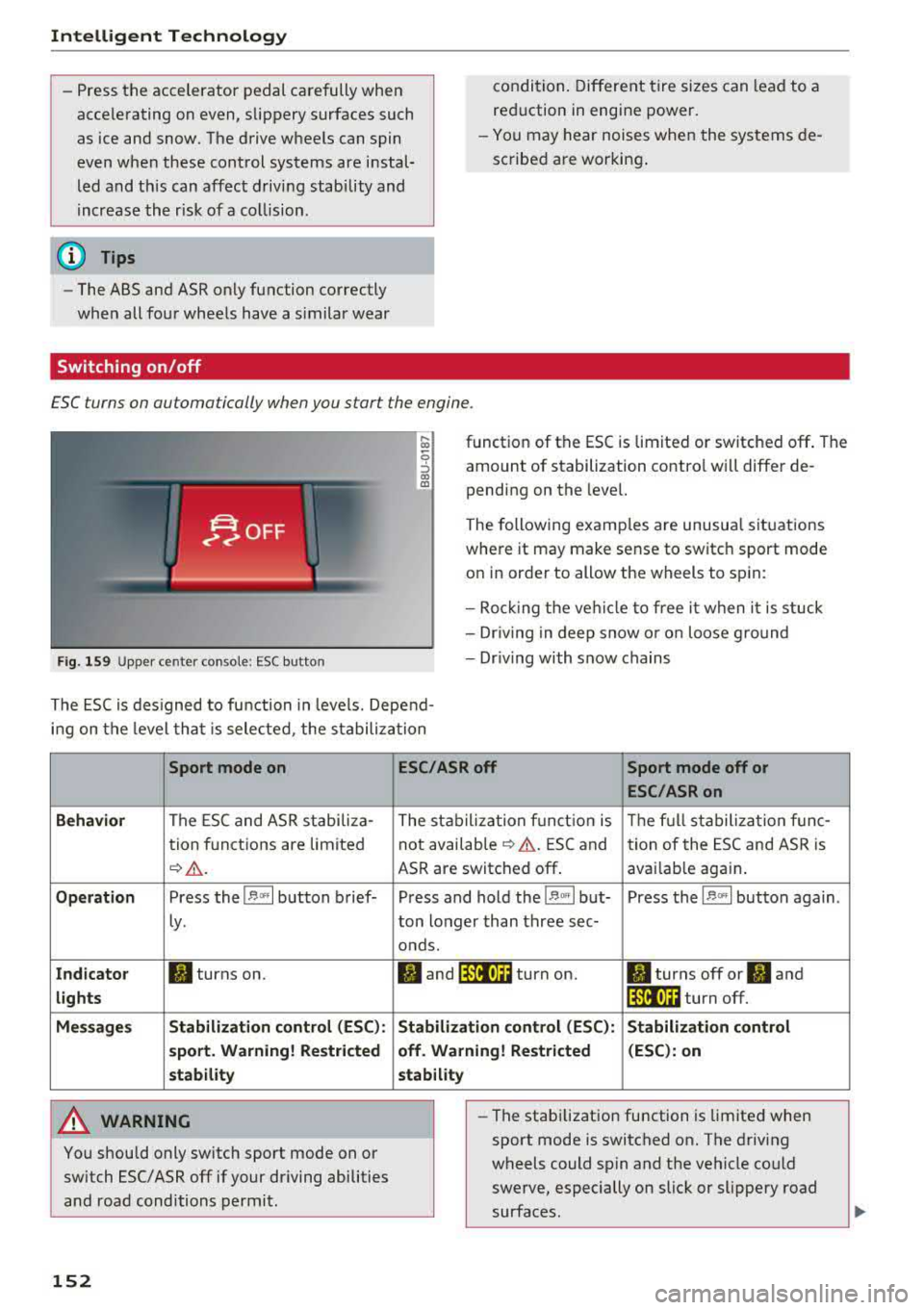
ESC turns on automatically when you start the engine .
Fig . 1 59 Upper ce nter console: ESC butto n
function of the ESC is limited or switched off . The
amount of stabilization contro l will differ de
pending on the level.
The following examp les are unusua l situations
where it may make sense to switch sport mode
on in order to allow the wheels to sp in:
- Roc king the ve hicle to free it when it is stuck
- Dr iv ing in deep snow o r o n loose g round
- Dr iv ing with snow chains
The ESC is des igned to fu nction in levels. Depend
i n g on the level tha t is sele cted , the stabilization
Sport mode on
Behavior
The ESC and ASR stabiliza-
tion f unctions are limited
¢ .&. .
Op eration Press the l.$ ,., I button brief-
Ly .
Ind icator II turns on.
lights
Me ssage s Stabilizati
on cont rol (ESC ):
s port . Warning! Re st ric ted
s tability
A WARNING
You should only switch sport mode on or
switch ESC/ ASR
off if your driving abilities
and road conditions permit.
152
ESC /ASR off Sport mode off or
ESC /ASRon
The stabiliza tion f unct ion is The f ull stabiliza tion f unc-
not availab le
¢ .&. . ESC and
tion of the ESC and ASR is
ASR are switched
off . avai lab le again .
Press and hold the
1 .$ .. , I but- Press the l.$ ,., I button again .
ton longer than three sec-
onds.
fl and 14il•U~ turn on. II turns off or II and
1 4il•U~ turn off.
Stabi lization control (ESC): S tabilization control
off. Warning! Re stricted (
ESC ): on
stability
-
- The stabi lization function is limited when
sport mode is switched on. The driving
wheels could spin and the vehicle could
swerve, especially on slick or slippery road
surfaces.
Page 231 of 400
a, a, ..... N
" N ..... 0 N > 00
Audi music interface
Connect your mobile devices to the Audi music
interface in order to operate them through the
MMI and charge the battery.
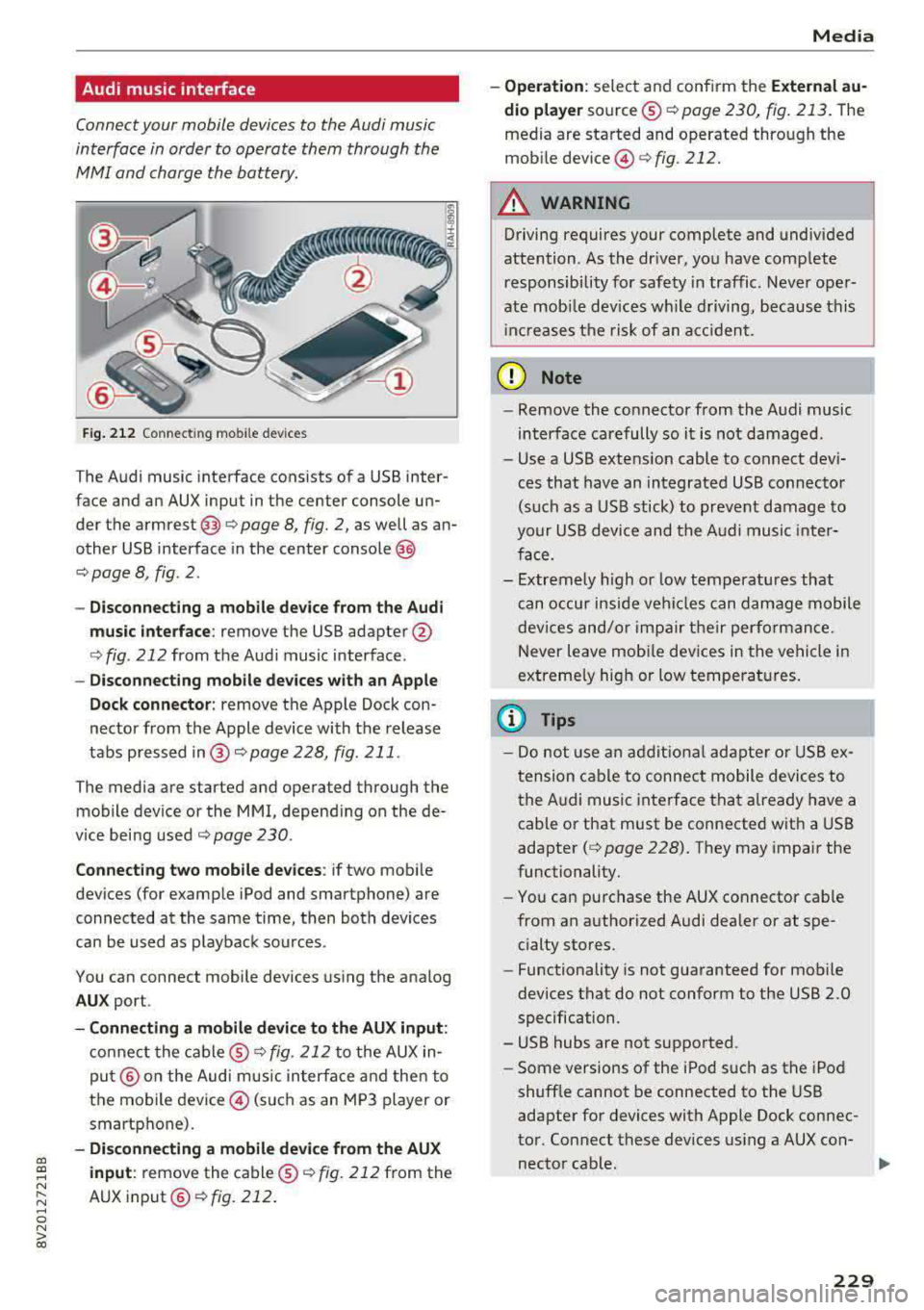
Fig. 212 Connecting mo bile dev ices
T he Audi music interface consists of a USB inter
face and an AUX input in the center console un
der the
armrest @Q page 8, fig. 2, as well as an
other USB interface in the center
console @
Q page 8, fig . 2 .
- Disconnecting a mobile device from the Audi
music interface:
remove the USB adapter @
Qfig . 212 from the Audi music interface .
-Disconnecting mobile devices with an Apple
Dock connector:
remove the Apple Dock con
nector from the Apple device with the release
tabs pressed in@ c:>page228, fig . 211.
The media are started and operated through the mobile device or the MMI, depending on the de
vice being used
c:> page 230 .
Connecting two mobile devices : if two mobi le
devices (for example iPod and smartphone) are
connected at the same time, then both devices
can be used as playback sources .
You can connect mobile devices using the analog
AUX port.
-Connecting a mobile device to the AUX input:
connect the cable ® Q fig. 212 to the AUX in
put@ on the Audi mus ic interface and then to
the mobile device© (such as an MP3 player or
smartphone).
- Disconnecting a mobile device from the AUX
input :
remove the cable ® c:> fig. 212 from the
AUX
input @Qfig. 212.
Media
-Operation : select and confirm the External au
dio player
source ® c:>page 230, fig. 213. The
media are started and operated through the
mobi le
dev ice @ c:>fig . 212.
A WARNING
Driving requires your complete and undivided
attention . As the dr iver, you have complete
re sponsibility for safety in traffic . Never oper
ate mob ile dev ices while driving, because this
i nc reases the risk of an accident.
(D Note
-Remove the connector from the Audi music
interface carefully so it is not damaged.
- Use a USB extens ion cable to connect dev i
ces that have an integrated USB connector
(such as a USB stick) to prevent damage to
your USB device and the Audi music inter
face .
- Extremely high or low temperatures that
can occur inside vehi cles can damage mobile
devices and/or impair the ir performance.
N ever leave mob ile devices in the vehicle in
extreme ly high or low temperat ures.
(D Tips
-Do not use an additional adapter or USB ex
tension cable to connect mobile devices to
the Audi music interface that already have a
cable or that must be connected w ith a USB
adapter
( c:> page 228). They may impair the
functionality.
- You can purchase the AUX connector cab le
from an authorized Audi dealer or at spe
cialty sto res.
- Functionality is not guaranteed for mobile
devices that do not conform to the USB 2.0
specification .
- USB hubs are not supported.
- Some versions of the iPod such as the iPod
shuff le cannot be connected to the USB
adapter for devices with Apple Dock connec
tor . Connect these devices using a AUX con-
nector cable .
liJ,,
229
Page 255 of 400
a, a, .... N
" N ..... 0 N > 00
-Never place or install floor mats or other
floor coverings on top of already installed
floor mats. Additional floor mats and other
coverings w ill reduce the size of the pedal
area and inte rfere with the pedals.
- Always properly reinstall and secure floor
mats that have been taken out for cleaning.
- Always make sure that objects cannot fall
into the driver footwell while the veh icle is
moving . Objects can become trapped under
the brake peda l and accelerator pedal caus
ing a loss of veh icle control.
Storing cargo correctly
Loading the luggage compartment
All luggage and other objects must be properly
stowed and secured in the luggage compart
ment.
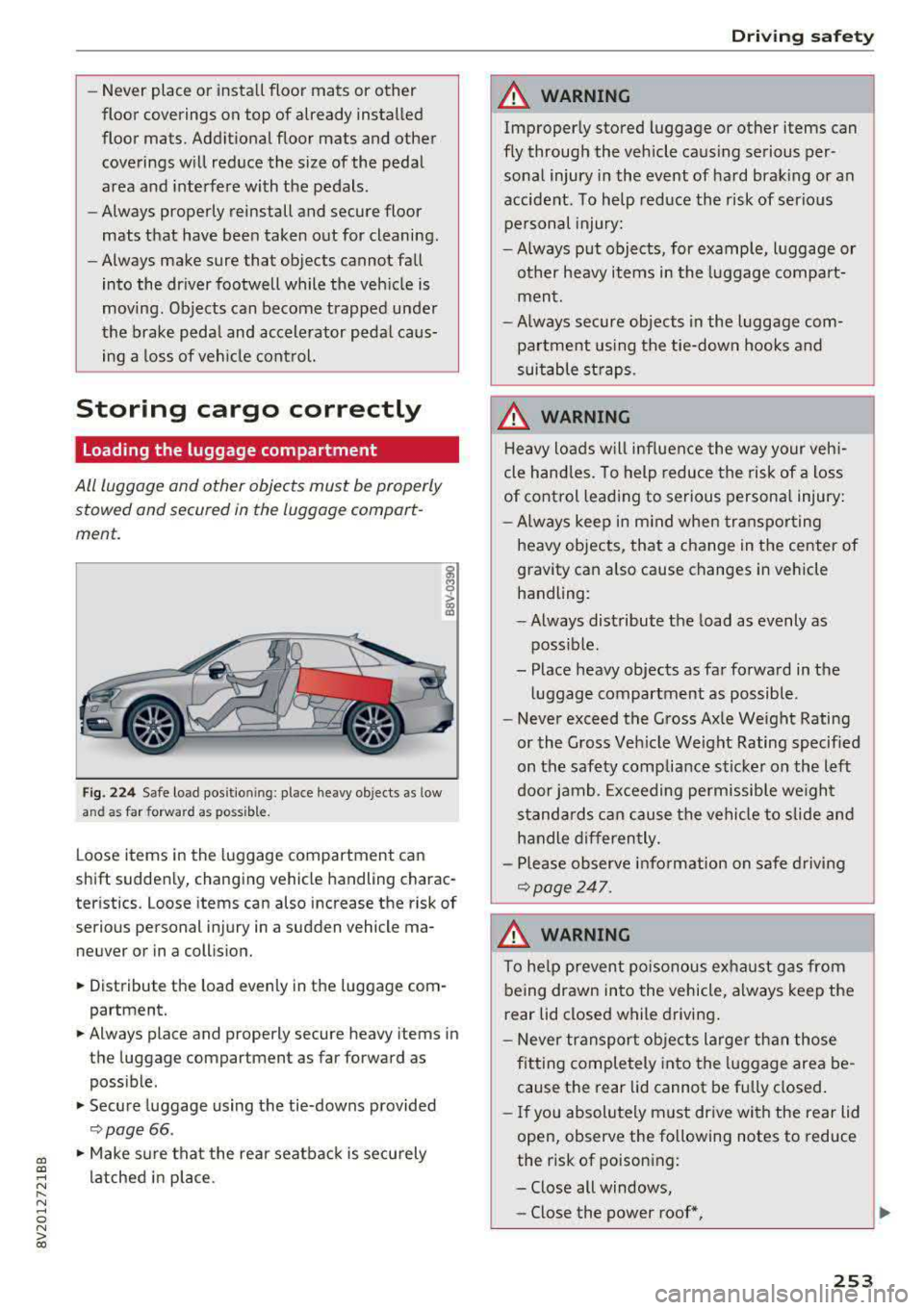
F ig. 22 4 Safe load position ing: place heavy objects as low
and as
far forward as possible.
L oose items in the luggage compartment can
shift sudden ly, changing vehicle handling charac
teristics. Loose items can also increase the risk of
serious personal injury in a sudden vehicle ma
neuver or in a coll ision.
• Distribute the load evenly in the luggage com
partment.
• Always place and properly secure heavy items in
the luggage compartment as far forward as
poss ib le.
• Secure luggage using the tie-downs provided
<:;> page 66 .
• Make sure that the rear seatbac k is securely
latched in place.
Dr iving safety
A WARNING
-
Improperly stored luggage or other items can
fly through the vehicle caus ing serious per
sonal injury in the event of hard brak ing or an
accident. To help reduce the risk of serio us
pe rsonal injury:
- Always put objects, for example, l uggage or
other heavy items in the luggage compa rt
men t.
- Always secure objects in the luggage com
partment using the tie-down hooks and
suitable st raps.
A WARNING
H eavy loads will influen ce the way your veh i
cle hand les. To help reduce the risk of a loss
of cont rol leading to serious personal injury:
- Always keep in m ind when transpo rting
heavy objects, that a change in the center of
gravity can also cause changes in vehicle
handling:
- Always distribute the load as evenly as
poss ible.
- Place heavy objects as far fo rwa rd in the
lu ggage compartment as possible.
- Never exceed the Gross Ax le Weight Rating
or the Gross Ve hicle Weight Rating specified
on the safety compliance s ticker on the left
door jamb. Exceeding permissible we ight
s tanda rds can cause the vehicle to slide and
h a ndle differen tly.
- Pl ease observe info rmat ion on safe driv ing
¢page 247.
A WARNING
To he lp prevent poiso nous ex ha ust gas from
being drawn into the vehicle, always keep the
r ear lid closed while driving .
- Never transport ob jects larger t han those
f itting completely into the luggage area be
cause the rear lid cannot be f ully closed .
- If you absolutely m ust dr ive wi th the rear lid
open, observe the following notes to reduce
the risk of poisoning:
- Close all windows,
- Close the power roof*,
253
Page 261 of 400
injury and death in automobile accidents.
For your protection and that of your passen
gers, always correctly wear safety belts
when the vehicle is moving .
- Failure to pay attention to the warn ing light
that come on, could lead to personal injury.
Why use safety belts?
Frontal collisions and the law of physics
Frontal crashes create very strong forces for peo
ple riding in vehicles .
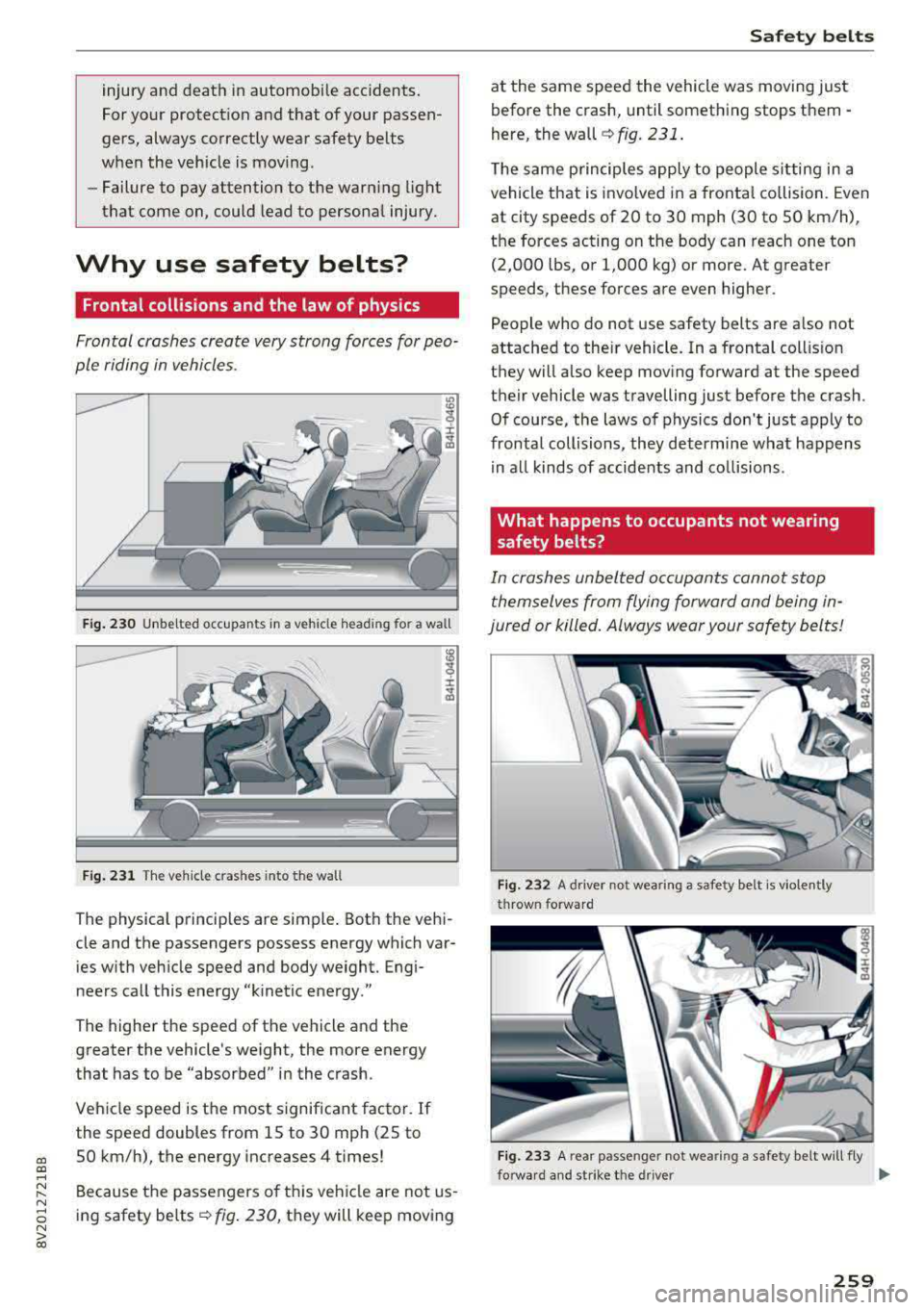
Fig . 230 Unbe lted occupants in a veh icle head ing fo r a wall
Fig . 23 1 The ve hicle c rashes into the wa ll
The physical principles are simple . Both the vehi
cle and the passengers possess energy which var
ies with vehicle speed and body we ight. Engi
neers call this energy "k inetic energy ."
The higher the speed of the vehicle and the
greater the vehicle's weight, the more energy
that has to be "absorbed" in the crash.
Vehicle speed is the most significant facto r. If
the speed doubles from 15 to 30 mph (25 to
a, 50 km/h), the energy increases 4 times! a, .....
~ Because the passengers of t his veh icle are not us-
"' 8 ing safety belts ~ fig. 230, they will keep mov ing N > 00
Safet y bel ts
at the same speed the vehicle was moving just
before the crash, until something stops them -
here, the wall
~ fig. 231 .
The same p rinciples apply to people s itting in a
vehicle that is invo lved in a fronta l co llision. Even
at city speeds of 20 to 30 mph (30 to SO km/h),
the forces acting on the body can reach one ton (2,000 lbs, or 1,000 kg) or more. At greater
speeds, these forces are even higher.
People who do not use safety belts are a lso not
attached to the ir vehicle . In a frontal coll is ion
they will also keep mov ing forward at the speed
their vehicle was travelling just before the crash .
Of course, the laws of physics don't just apply to
frontal collisions , they determine wha t happens
in a ll kinds of accidents and co llisions .
What happens to occupants not wearing
safety belts?
In crashes unbelted oc cupants cannot stop
themselves from flying forward and being in
jured or killed. Always wear your safety belts!
Fi g. 232 A driver not wear ing a safe ty belt is violen tly
throw n forward
F ig. 233 A re ar passe nge r not we aring a safety be lt w ill fly
forward and strike t he driver
Ill-
259
Page 262 of 400
Safe ty belts
Unbelted occupants are not able to resist the tre
mendous fo rces of impact by holding tight or
bracing themselves. Without the benefit of safe
ty restra int systems, the unrestrained occupant
will slam violently into the steering whee l, in
strument panel, windsh ield, or whatever else is
i n the way
¢ fig . 232. This impact with t he ve hi
cle interior has all the ene rgy they had just be
fore the crash.
Never rely on airbags alone for protection . Even
when they deploy, airbags provide only add itional
protection . Airbags are not supposed to dep loy in
all kinds of accidents. A lthough your Audi is
eq uipped w ith airbags, all veh icle occupants, in
cluding the dr iver, must wear safety belts cor
rectly in order to minimize the risk of severe in
jury or death in a crash.
Remember too, that ai rbags will deploy on ly
once and that your safety belts are a lways there
to offer protection in those accidents in which
airbags are not supposed to deploy or when they
have a lready deployed. Unbelted occupants can
also be thrown out of the ve hicle where eve n
more severe or fatal injuries can occur.
It is also important for the rear passengers to
wear safety belts correctly . U nbelted passengers
in the rear seats endanger not only themselves
but also the driver and other passengers
¢ fig . 233 . In a frontal collision they will be
thrown fo rward violently, where they can hit a nd
inj ure the driver and/or front seat passenge r.
260
Safety belts protect
People think it 's possible to use the hands to
brace the body in a minor collision . It's simply
not true!
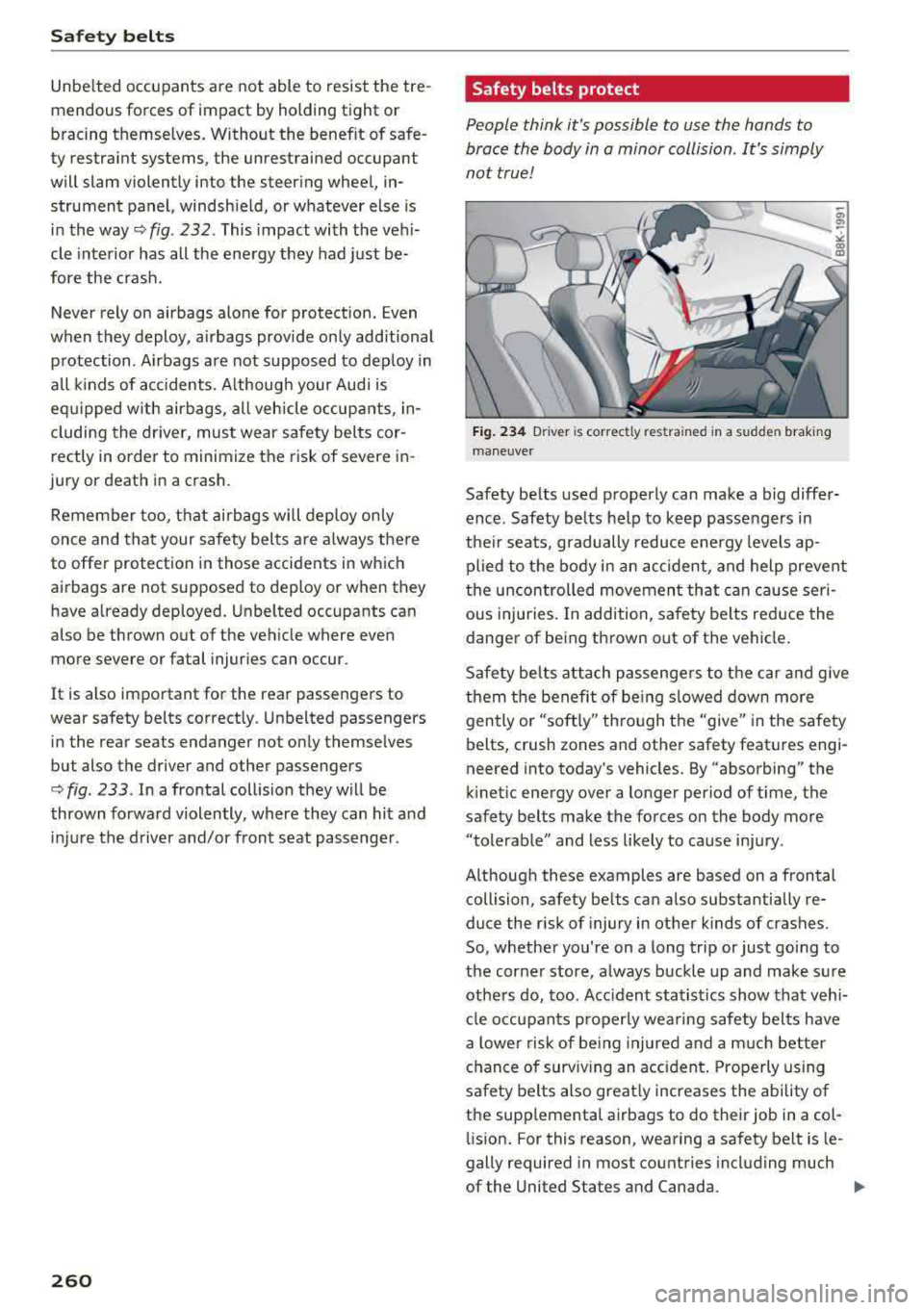
Fi g. 234 D river is corre ctly res trained in a sudde n brak ing
maneuver
Safety belts used properly can make a big differ
ence . Safety belts help to keep passengers in
thei r seats, gradually reduce energy levels ap
plied to the body in an accident, and help prevent
the u ncon trolled movemen t that can cause ser i
ous injuries. In add ition, sa fe ty belts reduce the
danger of being thrown out of the vehicle .
Safety be lts attach passenge rs to the car a nd g ive
them the benefit of be ing s lowed down more
gently or "soft ly" th rough the "give" in the safety
belts, crush zones and other safety features engi
neered into today's vehicles. By "absorbing" the
k inet ic energy over a longer per iod of t ime, the
safety belts make the forces on the body more
"tole rab le" and less likely to cause injury .
Although these examples are based on a frontal collision, safety be lts can also substantially re
duce the r isk of injury in other kinds of crashes.
So, whether you're on a long trip or just going to
the cor ner store, a lways buckle up and make s ure
others do, too . Acc ident sta tist ics show that veh i
cle occupants properly wea ring safety bel ts have
a lowe r risk of be ing injured and a m uch better
c h ance of surviv ing an accident . Properly us ing
safety belts also great ly increases the ability of
the supp lemental airbags to do their job in a col
li sion. For this reason, wearing a safety belt is
le
gally required in most countries including much
of the United States and Canada.
liJI,
Page 274 of 400
Airbag system
-Therefore, always wear your safety belts and
make sure that everybody in your vehicle is
properly restrained.
- Always hold the steering wheel with both
hands on the outside of the steering wheel
rim at the 9:00 o 'clock and 3 :00 o'clock po
sitions to help reduce the risk of personal in
jury if the driver's airbag inflates .
- Never hold the steering wheel at the 12
o'clock position or with your hands any
where inside the steering wheel or on the steering wheel hub. Holding the steering
wheel the wrong way increases the risk of
severe injury to the arms, hands, and head if
the driver airbag deploys.
A WARNING
Objects between you and the airbag will in
crease the risk of injury in a crash by interfer
ing with the way the airbag unfolds and/or by
being pushed into you as the airbag inflates.
- Always make sure nothing is in the front air-
-
bag deployment zone that could be struck
by the airbag when it inflates.
- Objects in the zone of a deploying airbag
can become projectiles when the airbag de
ploys and cause serious personal injury.
- Never hold things in your hands or on your lap when the vehicle is in use .
- Never place accessories or other objects
(such as cup holders, telephone brackets,
note pads, navigation systems, or things
that are large, heavy, or bulky) on the doors;
never attach then to the doors or the wind
shield; never place them over or near or at
tach them to the area marked
,.AIRBAG" on
the steering wheel, instrument panel or the
seat backrests; never place them between
these areas and you or any other person in
the vehicle.
- Never attach objects to the windshield
above the passenger front airbag, such as
accessory GPS navigation units or music players. Such objects could cause serious in
jury in a collision, especially when the air bags inflate .
272
-Never recline the front passenger seat to
transport objects. Items can also move into
the deployment area of the side airbags or
the front airbag during breaking or in a sud
den maneuver . Objects near the airbags can
fly dangerously through the passenger com
partment and cause injury, particularly
when the seat is reclined and the airbags in
flate.
A WARNING
A person on the front passenger seat, espe
cially infants and small children, will receive
serious injuries and can even be killed by be ing too close to the airbag when it inflates .
- Although the Advanced Airbag System in
-
your vehicle is designed to turn off the front
passenger airbag if an infant or a small child
is on the front passenger seat, nobody can
absolutely guarantee that deployment un
der these special conditions is impossible in
all conceivable situations that may happen
during the useful life of your vehicle.
-The Advanced Airbag System can deploy in
accordance with the .,low
risk" option for 3-
and 6-year-old children under the U.S . Fed
eral Standard if a child with electrical capac
itance greater than the combined capaci
tance of a typical one-year old infant re
strained in one of the forward facing or rear
facing child safety seats with which your ve
hicle was certified is on the front passenger
seat and the other conditions for airbag de
ployment are met.
- Accident statistics have shown that children
are generally safer in the rear seat area than
in the front seating position.
- For their own safety, all children, especially
12 years and younger, should always ride in
the back properly restrained for their age and size.
Advanced front airbag system
Your vehicle is equipped with a front Advanced
Airbag System in compliance with United States
Federal Motor Vehicle Safety Standard 208, as
well as Canada Motor Vehicle Safety Standard
..,.
Page 276 of 400
Airbag syste m
seat. Please be sure to read the important infor
mation in the sections that follow and be sure to
heed all of the WARNINGS.
A WARNING
To reduce the risk of injury when an airbag in
flates, always wear safety belts properly.
- If you are unrestrained, leaning forward, sit ting s ideways or out of position in any way,
your risk of injury is much h igher.
- You will also receive serious injuries and could even be killed if you are up aga inst the
airbag or too close to it when it inflates -
even with an Advanced Airbag
c::> page 267 .
A WARNING
A child in a rearward-facing chi ld safety seat
installed on the front passenge r seat w ill be
ser iously injured and can be killed i f the front
airbag inflates
-even w ith an Advanced Ai rbag
System.
-Although the Advanced A irbag System in
yo ur vehicle is designed to tu rn off the front
airbag when a rearwa rd -facing child re
straint has been insta lled on the front pas
senger seat, nobody can absolutely guaran
tee that deployment is impossible in all con
ceivable s ituations that may happen during
the useful life of your vehicle .
- The inflating a irbag w ill hit the child safety
seat or infant carrier with great force and
will smash the chi ld safety seat and child
against the backrest, center armrest , door,
o r roof .
- Always install rearward -facing ch ild re
straints on the rear seat .
- If you must install a rearward fac ing ch ild
safety seat on the front passenger seat be
cause of exceptiona l circumstances and the
PASSENGER AIR BAG OFF light does not
come on and s tay on, immed iate ly install
the rear-fac ing ch ild safety seat in a rear
seating position and have the airbag system
inspected by your Audi dealer.
274
A WARNING ,_
If, in exceptional circumstances, you must in
stall a forward-facing child restraint on the
front passenger's seat:
- Always make sure the forward-facing seat
has been des igned and certified by its man
ufacturer for use on a front seat with a pas
senger front and side airbag.
- Never put the forwa rd-facing child restraint
up against or very nea r the instrument pan
el.
- Always move the front passenge r seat to
the highest posit ion in the up and down ad
justmen t range and move it back to the
rearmost posit io n in the seat's fo re and aft
adjustment range, as far away from the a ir
bag as poss ible, before install ing the for
ward-facing chi ld restraint.
- Always make sure that the safety be lt upper
anchorage is behind the chi ld rest raint and
not next to o r in front of the c hild restraint
so that the safety be lt will be p roper ly posi
tioned.
- Always make sure that there is noth ing on
the front passenger seat that will cause the
capacitive passenger detection system in
the seat to signal to the Airbag System that
the seat is occup ied by a person when it is
no t, or to signal that it is occupied by some
one who is heavier than the person ac tually
si tting on the sea t. T he presence of addi
tional objects could cause the passenger
front airbag to be turned on when it should
be
off, or could cause the airbag to work in a
way that is d ifferent from the way it wou ld
have worked without the object on the seat.
- Make sure that the
PASSENGER AIR BAG
OFF
li ght comes on and stays on all the time
whenever the ign it ion is switched on.
Advanced Airbag System components
T he front passenger seat in your veh icle has a lot
of ve ry important parts of the Advanced A irbag
System i n it. These parts incl ude the capacitive
passenger detection system, wir ing , b rackets,
and more. The control uni t moni tors the system
on the front passenge r seat when t he ignit ion is
..,.