ESP AUDI A3 SEDAN 2017 Manual PDF
[x] Cancel search | Manufacturer: AUDI, Model Year: 2017, Model line: A3 SEDAN, Model: AUDI A3 SEDAN 2017Pages: 400, PDF Size: 67.32 MB
Page 292 of 400
Airbag syste m
How side curtain airbags work
Applies to: ve hicles w ith s ide curta in a irbags
Side curtain airbags con work together with side
airbags to help reduce the risk of head and upper
torso injuries for occupants who ore properly re
strained.
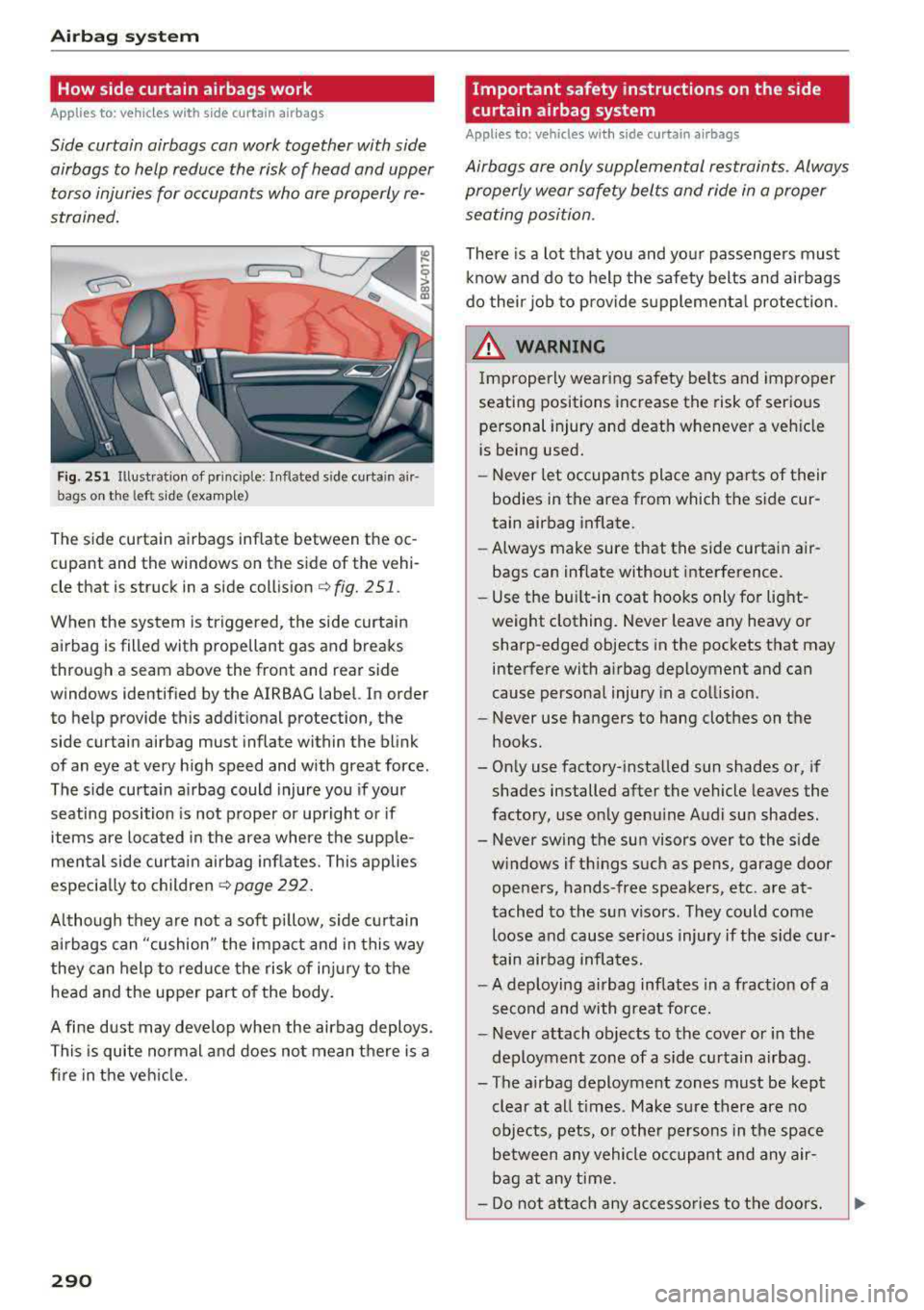
F ig. 251 Illustration of principle: Inflated side curta in air
bags on the left s ide (examp le}
The side curtain airbags inflate between the oc
cupant and the windows on the side of the vehi
cle that is struck in a side collision
c::;, fig. 251.
When the system is triggered, the side curtain
airbag is filled with propellant gas and breaks
through a seam above the front and rear side
windows identified by the AIRBAG label. In order
to help provide this additional protection, the
side curtain airbag must inflate within the blink
of an eye at very high speed and with great force.
The side curta in a irbag could injure you if your
seating position is not proper or upright or if
items are located in the area where the supp le
mental side curtain a irbag inflates. This applies
especially to children
c::;, page 292.
Although they are not a soft pi llow, side curtain
ai rbags can "cushion" the impact and in this way
they can help to red uce the risk of injury to the
head and the upper part of the body.
A fine dust may develop when the airbag deploys.
This is quite normal and does not mean there is a
fire in the veh icle.
290
Important safety instructions on the side
curtain airbag system
Appl ies to : vehicles wi th side curtain airbags
Airbags ore only supplemental restraints . Always
properly wear safety belts and ride in a proper seating position .
There is a lot that you and your passengers must
know and do to help the safety belts and airbags
do their job to p rovide supplementa l protection .
A WARNING
-Improperly wearing safety be lts and improper
seating positions increase the risk of serious personal injury and death whenever a vehicle
is being used.
- Never let occupants place any parts of their
bodies in the area from which the side cur
tain airbag inflate.
- Always make sure that the side curtain air
bags can inflate without interference.
- Use the bu ilt-in coat hooks only for light
weight clothing. Never leave any heavy or
sharp-edged objects in the pockets that may
interfere with a irbag deployment and can
cause personal injury in a collision.
- Never use hangers to hang clothes on the
hooks.
- On ly use factory-insta lled sun shades or, if
shades installed after the vehicle leaves the
factory, use on ly genu ine Audi su n shades.
- Never swing the sun visors over to the side
w indows if things such as pens, garage door
openers, hands-free speakers, etc. are at
tached to the sun v isors. They could come
loose and cause serious injury if the side cu r
tain airbag infla tes.
- A deploying airbag inflates in a fract ion of a
second and with great force.
- Never attach objects to the cover or in the
deployment zone of a s ide curtain airbag .
- The airbag deployment zones must be kept
clear at al l t imes. Make sure there are no
objects, pets, o r othe r persons in the space
between any vehicle occupant and any air
bag at any time.
- Do not attach any accesso ries to the doors.
Page 294 of 400
Child safety
Child safety
Important information
Introduction
The rear seat is generally the safest place in a
collision .
The physical principles of what happens when
your vehicle is in a crash apply also to children
¢ page 259, What happens to occupants not
wearing safety belts? .
But unlike adults and
teenagers, their muscles and bones are not fully
developed. In many respects children are at
g reater r isk of serious injury in crashes than
adults .
Because children's bodies are not fully devel
oped, they require restraint systems especially
des igned for their size, weight, and body struc
ture. Many countries and all states of the United
States and provinces of Canada have laws requir
ing the use of approved child restraint systems
for infants and small children .
In a frontal crash at a speed of 20-35 mph
(30-56 km/h) the forces acting on a 13 -pound
(6 kg) infant will be more than 20 times the
weight of the child. This means the weight of the child would suddenly be more than 260 pounds
(120 kg) . Under these conditions, only an appro
priate child restraint properly used can reduce
the risk of serious injury . Child restra ints, like
adu lt safety belts, must be used properly to be
effect ive. Used improperly, they can increase the
risk of serious injury in an acc ident.
All ch ildren, especially those 12 years and young
er must always ride in the back seat properly re
stra ined for their age and size. If you must insta ll
a child restraint on the front passenger seat in
exceptional circumstances, be sure to read and
heed the important information and warnings
¢ page 268. Infants and other children who are
properly restrained in an appropriate child re
straint that is for their si ze and age can benefit
from the protection that supplemental side air
bags provide in some kinds of crashes .
For more information please see information
provided by the:
292
-National Highway Traffic Safety Administration
(NHTSA), currently at: http :/ /www.safe
rcar.gov (for the USA)
-Transport Canada Information Centre, current-
ly at: http://www.tc.gc.ca (for Canada)
Consult the child safety seat manufacturer's in
structions in order to be sure the seat is right fo r
your chi ld's
size ¢ page 296, Important safety
instructions for using child safety seats .
Please
be sure to read and heed all of the important in
formation and WARNINGS about child safety,
Advanced Airbags, and the installation of child
restra ints in this chapter .
There is a lot you need to know about the Ad
vanced Airbags in your vehicle and how they work
when infants and children in child restraints are
on the front passenger seat . Because of the large
amount of important informat ion , we cannot re
peat it all here. We urge you to read the detailed
i nformation in this owner's manual about airbags
and the Advanced Airbag System in your vehicle
and the very important information about trans
porting children on the front passenger seat.
Please be sure to heed the WARNINGS -they are
extremely important for your safety and the safe
ty of your passengers, especially infants and
small children .
A WARNING
-Accident statistics have shown that children
are generally safer in the rear seat area than
in the front seat ing pos ition. Always restrain
any child age 12 and under in the rear.
-All vehicle occupants and especially children
must be restra ined prope rly whenever rid ing
in a vehicle. An un restrained or improperly
restrained child could be injured by striking
the interior or by being ejected from the ve
hicle during a sudden maneuver or impact.
An unrestrained or improperly restrained
child is a lso at greater risk of injury or death
through contact w ith an inflating airbag.
-A suitable ch ild restraint properly installed
and used at one of the rear seating positions
provides the highest degree of protect ion
for infants and small children in most acc i
dent situat ions.
Page 296 of 400
Child safety
-Always make sure that the PASSENGER
AIR BAG OFF
light comes on and stays on
all the time whenever the ignition is
switched on .
-If the PASSENGER AIR BAG OFF light
does not come on and stay on, immediate
ly install the forward-facing child safety
seat in a rear seating position and have
the airbag system inspected by your au
thorized Audi dealer.
- Always buckle the child safety seat firmly
in place even if a child is not sitting in it. A
loose child safety seat can fly around dur
ing a sudden stop or in a collision .
-Always read and heed all WARNINGS
whenever using a child restraint in a vehi
cle ¢
page 258, Safety belts,~ page 267,
Airbag system and ~ page 292, Impor
tant information.
(D Tips
Always replace child restraints that were in
stalled in a vehicle during a crash. Damage to
a child restraint that is not visible could cause
it to fail in another collision situation.
Advanced front airbag system and children
Your vehicle is equipped with a front "Advanced
Airbag System" in compliance with United States Federal Motor Vehicle Safety Standard (FMVSS)
208, as well as Canada Motor Vehicle Safety
Standard (CMVSS) 208 as applicable at the time
your vehicle was manufactured.
The Advanced Airbag system in your vehicle has
been certified to meet the "low-risk " require
ments for 3- and 6-year old children on the pas
senger side and small adults on the driver side.
The low risk deployment criteria are intended to
reduce the risk of injury through interaction with
the airbag that can occur, for example, by being
too close to the steering wheel and instrument
panel when the airbag inflates. In addition, the
system has been certified to comply with the
"suppression" requirements of the Safety Stand
ard, to turn off the front airbag for infants up to 12 months who are restrained on the front pas-
294
senger seat in child restraints that are listed in
the Standard.
Even though your vehicle is equipped with an Ad
vanced Airbag system, all children, especially
those 12 years and younger, should always ride
in the back seat properly restrained for their age
and size. The airbag on the passenger side makes
the front seat a potentially dangerous place for a child to ride. The front seat is not the safest place
for a child in a forward-facing child safety seat. It
can be a very dangerous place for an infant or a
larger child in a rearward-facing seat.
The vehicle's Advanced Airbag System has a ca pacitive passenger detection system in the front
passenger seat cushion that can detect the pres
ence of a baby or a child in a child restraint sys
tem on this seat.
The capacitive passenger detection system regis
ters the changes that result in an electrical field
when a child, a child restraint , and a baby blanket
are on the front passenger seat. The change in
the measured capacitance due to the presence of
a child, a child restraint, and a baby blanket on
the front passenger seat is related to the child
restraint system resting on the seat. The meas
ured capacitance of a child restraint system var
ies depending on the type of system and specific
make and model.
The electrical capacitance of the various types, makes, and models of child restraints specified
by the U.S.National Highway Traffic Safety Ad
ministration (NHTSA) in the relevant safety
standard are stored in the Advanced Airbag Sys
tem control unit together with the capacitances
typical of infants and a 1-year old child. When a
child restraint is used on the front passenger
seat with a typical 1 year-old infant, the Ad
vanced Airbag System compares the capacitance
measured by the capacitive passenger detection
system with the data stored in the electronic con
trol unit .
Page 298 of 400
Child safety
-Take the child restraint off the front passen
ger seat and install it properly at one of the
rear seat positions if the
PASSENGER AIR
BAG OFF
light does not stay on.
- Have the airbag system inspected by your
authorized Audi dealer immediately.
(D Tips
The child safety seats listed in categories A to
C have been statically tested by Audi only for
the Advanced Airbag function.
Important safety instructions for using
child safety seats
Correct use of child safety seats substantially re
duces the risk of injury in an accident!
As the driver, you are responsible for the safety
of everybody in the vehicle, especially children:
.,. Always use the right child safety seat for each
child and always use it properly
c::> page 298.
.,. Always carefully follow the child safety seat
manufacturer's instructions on how to route
the safety belt properly through the child safe
ty seat .
.,. When using the vehicle safety belt to install a
child safety seat , you must first activate the
convertible locking retractor on the safety belt
to prevent the child safety seat from moving
c::> page 303.
.,. Push the child safety seat down with your full
weight to get the safety belt really tight so that
the seat cannot move forward or sideways
more than one inch (2.5 cm).
.,. Secure unused safety belts on the rear seat
c::> page 298 .
Always remember: Even though your vehicle is
equipped with an Advanced Airbag system, all
children, especially those 12 years and younger,
should always ride in the back seat properly re
strained for their age and size.
.&, WARNING
Not using a child safety seat, using the wrong
child safety seat or improperly installing a
296
child restraint increases the risk of serious
personal injury and death.
- All vehicle occupants and especially children
must be restrained properly whenever riding
in a vehicle. An unrestrained or improperly
restrained child could be injured by striking
the interior or by being ejected from the ve
hicle during a sudden maneuver or impact .
An unrestrained or improperly restrained
child is also at greater risk of injury or death
through contact with an inflating airbag.
- Commercially available child safety seats
are required to comply with U.S. Federal
Motor Vehicle Safety Standard (FMVSS) 213
(in Canada CMVSS 213).
- When buying a child restraint, select one
that fits your child and the vehicle .
- Only use child restraint systems that fully
contact the flat portion of the seat cush ion. The child restraint must not tip or
lean to either side. Audi does not recom
mend using child safety seats that rest on
legs or tube-like frames. They do not pro
vide adequate contact with the seat.
- Always heed all legal requirements per
taining to the installation and use of child
safety seats and carefully follow the in
structions provided by the manufacturer
of the seat you are using.
- Never allow children under 57 inches
(1.45 meters) to wear a normal safety belt .
They must always be restrained by a proper
child restraint system. Otherwise, they
could sustain injuries to the abdomen and
neck areas during sudden braking maneu
vers or accidents .
- Never let more than one child occupy a child
safety seat.
- Never let babies or older children ride in a
vehicle while sitting on the lap of another
passenger .
- Holding a child in your arms is never a sub
stitute for a child restraint system .
- The strongest person could not hold the
child with the forces that exist in an acci
dent. The child will strike the interior of
the vehicle and can also be struck by the
passenger.
Page 300 of 400
Child safety
-Take the child restraint off the front passenger seat and install it proper ly at one of the
rear seat positions if the
PASSEN GER AIR
BA G OF F
light does not stay on.
-Have the airbag system inspected by your
authorized Aud i dealer immediately.
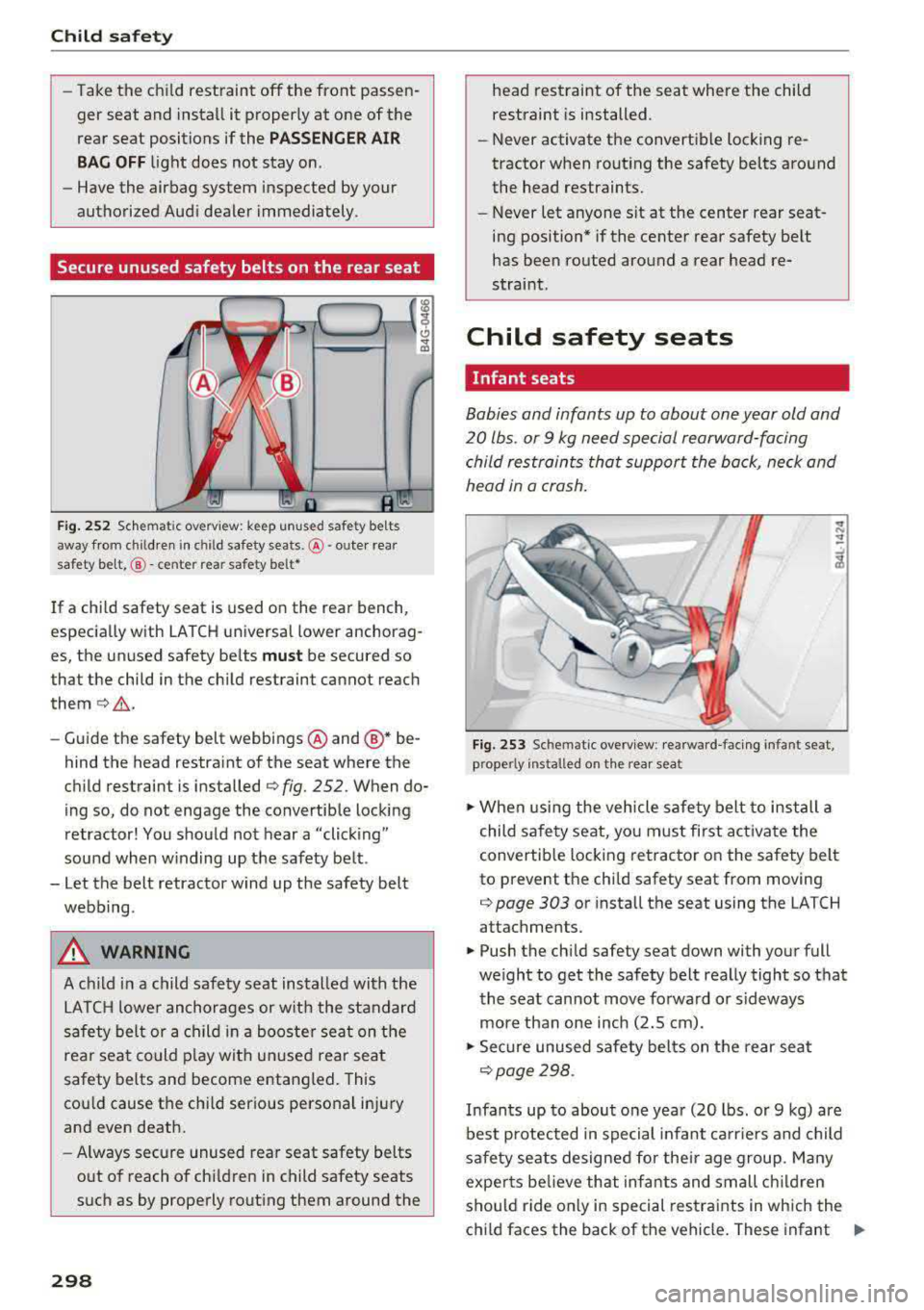
Secure unused safety belts on the rear seat
l8
,h- --lJ ;g
---0
Fig . 252 Schematic overv iew: keep unused safety be lts
away from chi ld ren i n chil d safety seats. @-oute r rear
safety belt, @ - center rear safety be lt*
~
If a chi ld safety seat is used on the rear bench,
especially with LA TCH universal lower anchorag
es, the unused safety be lts
mu st be secured so
that the child in the child restraint cannot reach
them¢,& .
-Gu ide the safety belt webbings @and ®* be
hind the head restraint of the seat where the
child restraint is installed
¢fig. 252. When do
ing so, do not engage the convertible locking
retractor! You should not hear a "clicking"
sound when w inding up the safety be lt .
-Let the belt retractor wind up the safety belt
webb ing .
_& WARNING
A ch ild in a child safety seat installed with the
LATC H lower anchorages or w ith the standard
safety belt or a child in a booste r seat on the
rear seat could p lay with unused rear seat
safety belts and become entangled. This
cou ld cause t he chi ld ser ious personal injury
and even death.
-Always sec ure unused rear seat safety belts
o ut of reach of ch ild ren in child safety seats
s u ch as by properly routing them around the
298
head restraint of the seat where the child
restraint is installed .
-Never activate the convertible locking re
tractor when routing the safety belts around
the head restraints.
-Never let anyone s it at the center rear seat
ing position * if the center rear safety be lt
has been routed around a rear head re
straint.
Child safety seats
Infant seats
Babies and infants up to about one year old and
20 lbs . or
9 kg need special rearward-facing
child restraints that support the back, neck and
head in a crash.
Fig. 253 Sc hema tic ove rv iew : rearward -facing in fant seat ,
prope rly installed on th e rea r seat
.,. When usi ng the vehicle safety belt to install a
child safety seat, yo u must first act ivate the
convertib le locking retractor on the safety belt
to prevent the child safety seat from moving
¢page 303 or install the seat using the LA TCH
attachments.
.,. Push the child safety seat down with your full
weight to get the safety belt really tight so that
the seat cannot move fo rward or sideways
more than one inch (2.5 cm) .
.,. Secu re unused safety belts on the rear seat
¢ page 298 .
Infants up to about one yea r (20 lbs. or 9 kg) are
best protected in special infant carr iers and c hild
safety se ats designed for the ir age group . Many
expe rts be lieve that infants and small c hildren
shou ld r ide on ly in special restraints in which the
ch ild faces the back of the vehicle . These infant
.,.
Page 304 of 400

Child safety
Booster seats and safety belts
Properly used booster seats can help protect
children weighing between about 40 lbs . and 80
lbs. (18 kg and 36 kg) who are less than 4
ft. 9
in. (57 inches/1.45 meters) tall .
Fig. 256 Rear seat: child properly restrained in a booster
seat
The vehicle's safety belts alone will not fit most
children until they are at least 4
ft. 9 in. (57 in
ches/1.45 meters) tall and weigh about 80 lbs.
(36 kg). Booster seats raise these children up so
that the safety belt will pass properly
over the
stronger parts of their bodies and the safety belt
can help protect them in a crash.
• Do not use the convertible locking retractor
when using the vehicle's safety belt to restrain
a child on a booster seat.
• The shoulder belt must lie as close to the cen
ter of the child's collar bone as possible and
must lie flat and snug on the upper body. It
must never lie across the throat or neck. The
lap belt must lie across the pelvis and never
across the stomach or abdomen . Make sure the
belt lies flat and snug. Pull on the belt to tight
en if necessary .
• Applies to: vehicles with safety be lt height ad
justment: If you must transport an older child
in a booster seat on the front passenger seat,
you can use the safety belt height adjustment
to help adjust the shoulder portion properly.
• Secure unused safety belts on the rear seat
qpage298 .
Children up to at least 8 years old (over 40 lbs or
18 kg) are best protected in child safety seats de
signed for their age and weight. Experts say that
the skeletal structure, particularly the pelvis, of
302
these children is not fully developed, and they
must not use the vehicle safety belts without a
suitable child restraint.
It is usually best to put these children in appro
priate booster seats. Be sure the booster seat
meets all applicable safety standards.
Booster seats raise the seating position of the
child and reposition both the lap and shoulder
parts of the safety belt so that they pass across
the child 's body in the right places. The routing of
the belt over the child's body is very important
for the child's protection, whether or not a boos
ter seat is used. Children age 12 and under must
always ride in the rear seat .
Children who are at least 4 ft. 9 in. (57 inches/
1.45 meters) tall can generally use the vehicle's
three point lap and shoulder belts. Never use the
lap belt portion of the vehicle's safety belt alone
to restrain any child, regardless of how big the
child is. Always remember that children do not
have the pronounced pelvic structure required for
the proper function of lap belt portion of the
ve
hicle's three point lap and shoulder belts. The
child's safety absolutely requires that a lap belt
portion of the safety belt be fastened snugly and
as low as possible around the pelvis. Never let
the lap belt portion of the safety belt pass
over
the child's stomach or abdomen.
In a crash, airbags must inflate within a blink of
an eye and with considerable force. In order to do its job , the airbag needs room to inflate so that it
will be there to protect the occupant as the occu pant moves forward into the airbag.
A vehicle occupant who is out of position and too
close to the airbag gets in the way of an inflating
airbag. When an occupant is too close, he or she
will be struck violently and will receive serious or
possibly even fatal injury.
In order for the airbag to offer protection, it is
important that all vehicle occupants, especially
any children, who must be in the front seat be
cause of exceptional circumstances, be properly
restrained and as far away from the airbag as
possible. By keeping room between the child's
body and the front of the passenger compart-
ment, the airbag can inflate completely and
..,.
Page 305 of 400
CXl CXl .... N ,.__
N .... 0 N > 00
provide supplemental protection in certain fron
tal collisions.
A WARNING
Not using a booster seat, using the booster
seat improperly, incorrectly installing a boos
ter seat or using the vehicle safety belt im
properly increases the risk of serious personal
injury and death in a collision or other emer
gency situat ion. To help reduce the risk of se
r ious personal injury and/or death:
- The shoulder belt must lie as close to the
center of the child 's collar bone as possible
and must lie flat and snug on the upper
body .
It must never l ie across the throat or
neck . The lap belt must lie across the pelvis
and never across the stomach or abdomen.
Make sure that the belt lies flat and snug .
Pull on the belt to tighten if necessary.
- Failure to proper ly route safety belts over a
child's body will cause severe injuries in an
accident or other emergency situation
¢page 258.
- The rear side of the child safety seat should
be pos itioned as close as possible to the
backrest on the vehicle seat.
- For adjustable head restraints: adjust or re
move the rear seat head restraint if it is d if
ficult to install the child safety seat with the head restraint in place
¢page 63. Install
the head restra int aga in immediately once
the ch ild safety seat is removed. D riving
without head restra ints or with head re
straints that are not properly adjusted in
creases the risk of serious or fatal neck in
jury dramatically .
- Never let a child put the shoulder belt under the arm or behind the back, because it cou ld
cause severe injuries in a crash.
- Children on the front seat of any car, even with Advanced Airbags, can be seriously in
jured or even killed when an airbag inflates.
- Never let a child stand or knee l on any seat,
for example the front seat.
- Never let a child ride in the cargo area of
your vehicle .
- Always remember that a child leaning for
ward, sitting sideways or out of position in
Ch ild safety
any way during an accident can be struck by
a dep loying airbag. Th is will result in serious
personal injury or death.
- If you must install a booster seat on the
front passenger seat because of exceptional
circumstances the
PA SSENGER AIR B AG
OFF
light must come on and stay on, when
ever the ignit ion is switched on.
- If the
PA SSEN GER AIR BA G OFF light does
not come on and stay on, perform the
checks described
r=;,page 279, Monitoring
the Advanced Airbag System.
- Take the child restra int off the front passen
ger seat and install it prope rly at one of the
rear seat positions if the
PASSENGER AIR
BAG OFF
light does not stay on whenever
the ignition is switched on .
- Always read and heed all WARNINGS when
eve r using a child restrained in a vehicle is
being used
¢ page 258, Safety belts,
¢ page 267, Airbag system and
c::> page 292, Important information.
Securing child safety
seats
Securing a child safety seat using a safety
belt
Safety belts for the rear seats and the front pas
senger can be locked with the convertible locking
retractor to properly secure child safety seats .
The safety belts emergency lo cking retractors for
the rear seats safety be lts and for the front pas
senger's seat safety be lt have a convertible lock
ing retractor for child restraints. The safety be lt
must be locked so that belt webbing cannot un
reel. The retractor can be activated to lock the
safety belt and prevent the safety belt webbing
from loosening up dur ing normal driving . A ch ild
safety seat can on ly be properly instal led when
the safety be lt is locked so that the c hild and
child safety seat will stay in place.
Always remember : Even though your veh icle is
equipped with an Advanced Airbag system, all
children, especia lly those
1 2 yea rs and younger,
sho uld always ride in the back sea t properly re-
strained for their age and size.
IJJ,,
30 3
Page 307 of 400
CXl CXl .... N r--N .... 0 N > 00
-Never put the forward-facing child restraint
up, against or very near the instrument pan
el.
-Always move the front passenger seat to
the highest position in the up and down
ad
justment range and move it back to the
rearmost position in the seat's fore and aft
adjustment range, as far away from the air
bag as possib le, before insta lling the
for
ward-facing child restra int.
- Always make sure that the safety belt upper
anchorage is beh ind the child restraint and
not next to or in front of the chi ld restraint
so that the safety belt will be properly pos i
tioned.
-Make sure that the PASSENGER AIR BAG
OFF
light comes on and stays on all the time
whenever the ignition is switched on .
,&. WARNING t-==
Rearward-facing child restraints:
-A child in a rearward-facing child safety seat
installed on the front passenger seat wi ll be
seriously injured and can be killed if the
front airbag inflates
-even with an Ad
vanced Airbag System.
-The inflating airbag will hit the child safety
seat or infant carrier with great force and
will smash the chi ld safety seat and child
against the backrest, center armrest, door
or roof .
-Always be especially careful if you must in
stall a rearward facing child safety seat on
the front passenger seat in exceptional c ir
cumstances .
-Make sure that the PASSENGER AIR BAG
OFF
light comes on and stays on all the time
whenever the ignition is switched on.
-If the PASSENGE R AIR BAG OFF light does
not come on and stay on, immediately in
sta ll the rear-fac ing ch ild safety sea t in a
rea r seat ing pos ition and have the airbag
system inspected by your Aud i dealer.
Ch ild safety
Activating the convertible locking retractor
Use the convertible locking retractor to secure a
child restraint .
Always heed the ch ild safety seat manufacturer's
instruct ions when installing a child restraint in
your vehicle. To activate the convertible locking retractor:
.. Place the child restraint on a seat, preferably
on the rear seat .
.. Slowly pull the belt all the w ay out .
.. Route it around or through the child restra int
be lt
path ¢&. -
.. Push the ch ild safety seat down with you r full
weight to get the safety belt really tight.
.. Insert the belt tongue into the buckle for that
seating position.
.. Guide the safety belt back into the retractor un
til the belt lies flat and snug on the child safety
seat .
.. You should hear a ''cl icking" noise as the belt
w inds back into the inertia reel. Test the con
vert ible lock ing retractor by pull ing on the belt .
You shou ld no longer be able to pull the belt
out of the retractor. The convertib le loc kin g re
t ractor is now activated.
.. Make sure that the red release button is facing
away from the c hild restraint so that it can be
unbuckled quickly .
.. Pull on the belt to make sure the safety belt is
properly tight and fastened so that the seat
cannot move forward or sideways more than
one inch (2 .5 cm) .
,&. WARNING
Using the wrong ch ild rest raint o r an improp
e rly inst alled child restra int can cause se rious
personal injury or death in a crash.
-Always make sure that the safety be lt re
tr actor is locked when installing a child
safety seat . An un locked safety be lt retrac
tor cannot hold the ch ild safety seat in p lace
during normal driving or in a crash.
-Always buckle the child safety seat firm ly in
p lace even if a child is not sitting in it. A
loose child safety seat can fly a round during
a sudden stop or in a crash.
.,.
305
Page 314 of 400
Check ing and F illing
Checking and Filling
Fuel
Gasoline grade
A pp lies to: ve hicles w ith gaso li ne engines
The correct gasoline grade is stated on the inside
of the fuel filler door .
The vehicle is equipped with a catalytic converter
and must only be driven w ith
unleaded ga soli ne.
Aud i recommends using TOP TIER Detergent Gas
oline. Additional information on TOP TIER Deter
gent Gaso line can be found on the offic ial web
site (www .toptiergas.com) .
The individua l gasoline grades are differentiated
by
octane ratings . This value is given with (R +M)/
2 equating to AK I or in RON.
The fo llow ing headings match the co rrespon ding
sticker in the fue l fi ller door .
UNLEADED FUEL ONLY MIN . (R+M) /2 87
Regular/ MIN. RON 91 Regular
Use regu lar gaso line with minim um 87 AKI/
9 1 RON ~@ .
The max imum engine power is only reached if
p rem ium gasol ine 91 A KI/ 95 R ON is used.
UNLEADED FUEL ONLY PREMIUM MIN. (R
+M) /2 91 / SUPER MIN. RON 95
Using premium gasoli ne with m inim um 91 AKI/
9 5 RON is recommended.
If premium gasoline is not available, yo u can also
use reg ula r gasoline 87 AKI/ 91 RON . However
this does reduce t he engine powe r slight ly.
CD Note
- Fil li ng the tank just one ti me with leaded
f u el or other meta llic additives will caus e
p ermanent deteriorat io n to the cata lyt ic
conve rter func tion.
- When gasoline with an octane rati ng that is
too low is used , h igh speeds o r heavy engi ne
l o ad can lead to engi ne d am age.
312
(D Tips
The vehicle may be filled with fuel that has a
h igher octane rating than what is requi red by
the eng ine.
Blended gasoline
App lies to : vehicles wit h gasol ine engi ne
U se of g asoline conta ining alcohol or MTBE
(methyl tertiary butyl ether)
You may use unleaded gasoline blended with al
cohol o r MTBE (commonly referred to as oxygen
ates) if the blended m ixt ure meets the fo llow ing
c rit er ia:
Blend of gasoline methanol (wood alcohol or
methyl alcohol)
- Anti-knock index must be 87 AKI or h igher.
-Blend must contain no more than 3% metha-
nol.
-Blend must contain more than 2% co-solvents.
Blend of ga soline and ethanol (grain alcoh ol or
ethyl alcohol)
- Anti-knoc k index must be 87 A KI or h igher.
- Blend must not conta in more t han 15% etha-
nol.
Blend of gasoline and MTBE
- Anti -knock index must be 87 AKI or higher.
-Blend mus t contain no t more t han 15% M TBE.
Seasonally adjusted gasoline
Many gasoline grades are blended to perform es
pecially well for winter or s umme r dr iv ing . D ur
i ng seasonal change-ove r, we s ugges t that you
fill up a t busy gas stat io ns where the seaso nal
adjustment is mo re l ikely to be made in t ime .
CD Note
-Methanol fuels which do not meet these re
quireme nts may cause cor rosion and dam
age to plas tic and rubber componen ts i n t he
fue l system.
- Do not use f ue ls that fa il to meet t he speci
fie d cr iteria in th is ch ap ter.
...
Page 315 of 400
CXl CXl .... N r--N .... 0 N > 00
-If you are unable to determine whether or
not a particular fuel blend meets the speci
ficat ions, ask your service station or its fuel
supplier.
-Do not use fuel for which the contents can
not be identified.
-Fuel system damage and performance prob
l ems resulting from the use of fue ls diffe r
ent from those specified are not the respon
s ibility of Audi and are not covered under
the New Veh icle or the Emiss ion Control
System Warrant ies .
-If you experience a loss of fue l economy or
driveability and pe rformance problems due
to the use of one of these fuel blends, we r ecommend that you switch to unblended
fuel.
Gasoline additives
A ma jor concern among many auto manufactur
ers is carbon deposit build-up ca used by the type
of gasoline yo u use.
A lt hough gasoline grades d iffer from one manu
facturer to another, they have cer tain things in
common . A ll gasoline grades contain substances
that can cause deposits to collect on vita l engine
parts, such as fue l injectors and intake valves.
Al
though most gasoline brands include additives to
keep engine and fuel systems clean, they are not
equally effective .
Aud i recommends using TOP TIER Detergent Gas
oline. For more informat ion on TOP TIER Dete r
gent Gasoline, please go to the official website
(www.toptiergas .com) .
After an extended period of using inadequate
fuels, carbon deposit build-ups can rob your
en
g ine of peak performance.
CD Note
Damage or malfunction due to poor fuel q ual
ity is not covered by the Aud i New Vehicle
Limited Warranty.
Ch eck ing and Filling
Refueling
Fuel filler neck
The fue l filler neck is located on the rig ht rea r
s ide panel behind the fuel fille r flap .
If the power lock ing system shou ld fail, yo u can
st ill open the flap manually
-fo r detailed instruc
tio ns see
9 page 315.
You can find the fuel tank capacity of your vehicle
i n
c::;, page 375 .
The label on the inside of the f uel fi ller flap tells
you the correct fuel for your vehicle. For more in
f ormat ion about fuel spec ificat ions, see
9 page 312.
Your vehicle fuel tank has an onboard refue lling
vapor recovery system. This feature helps to pre
vent fuel vapors from escaping from the tank and polluting the environme nt wh ile you refue l yo ur
vehicle . In order to fill the tank p roper ly w hile
pro tect ing t he e nvir onment, p lease follow t his
r efue ling p rocedure ca refully.
_& WARNING
Un der normal opera ting co nd it io ns, neve r car
ry additional f uel con tainers in your car. Gas
canisters and other containers used to trans
port fue l can be dange rous. Such containe rs,
f ull or empty, may leak and could cause a fire
i n a co llision. If you must transpo rt fuel to
use for your lawn mower, snow blower, etc .,
be ve ry careful and always observe local and
sta te laws rega rding the use, transportation
and storage of su ch f uel con tainers. Make cer
t ai n t he co ntain er meets industry standards
(ANSI/AS TM F8S2
-86).
CD Note
Never drive your veh icle until the fue l tank is
complete ly empty. The irreg ular s upply of
f u el can cause misfiring. Gaso lin e c ould enter
the e xhaust sys tem an d damage the cat aly tic
conve rter.
313