heater AUDI A3 SEDAN 2018 User Guide
[x] Cancel search | Manufacturer: AUDI, Model Year: 2018, Model line: A3 SEDAN, Model: AUDI A3 SEDAN 2018Pages: 404, PDF Size: 62.3 MB
Page 375 of 404
LL co .... N
" N .... 0 N > co
No. Equipment
F49 Clutch sensor (relay 1+2),
high-voltage
battery, power electronics
F52 Control module for suspension control
F53 Rear window defogger
The power seats* are protected via
circuit break
ers
that automatically switch on after a few sec
onds after the overload has been reduced.
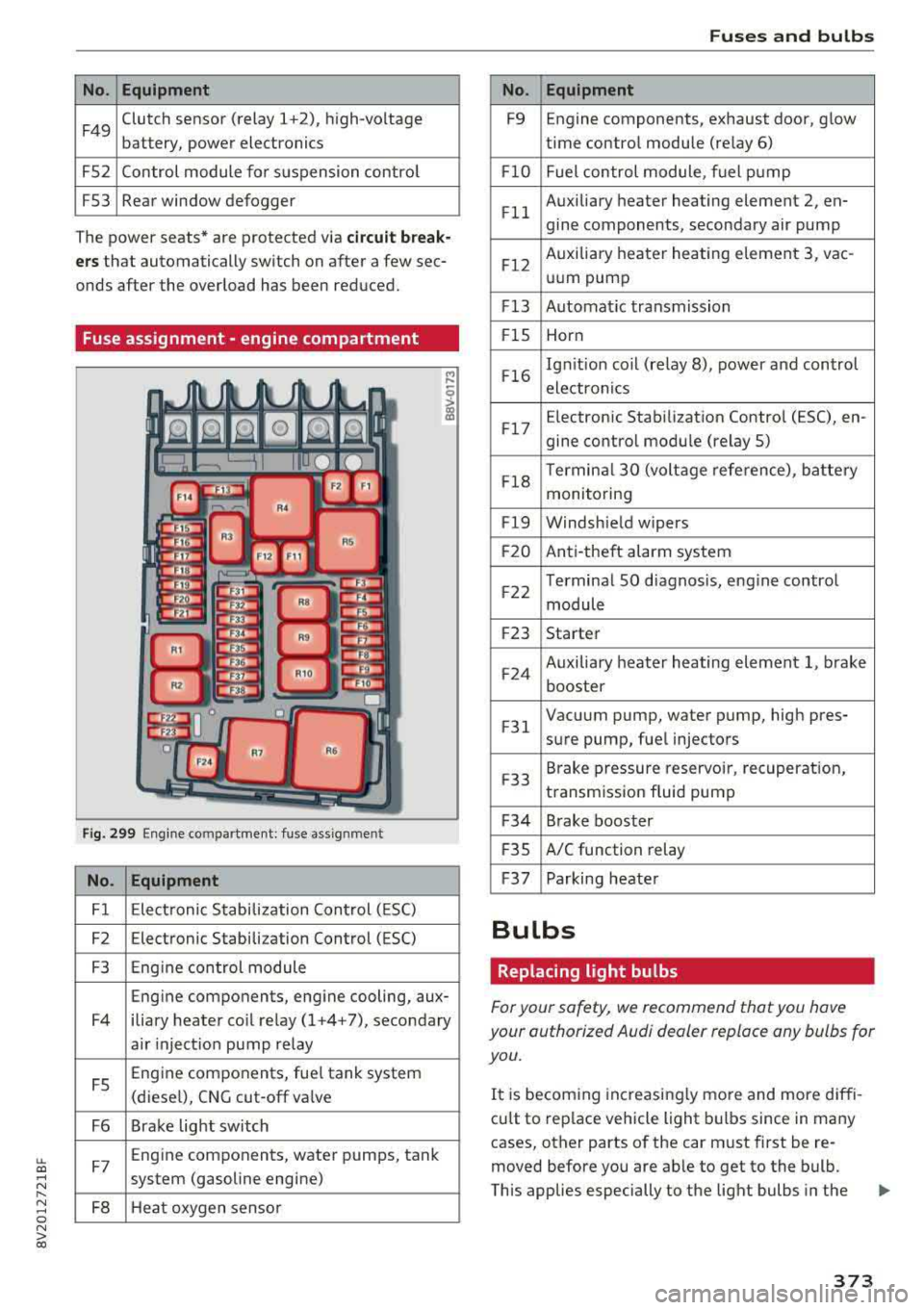
Fuse assignment -engine compartment
Fig. 299 Engine compartme nt: fuse assignment
No. Equipment
Fl Electronic Stabilization Control (ESC)
F2 Electronic Stabilization Control (ESC)
F3 Engine control module
Eng ine components, engine cooling, aux-
F4 iliary heater co il relay (1+4+7), secondary
air inject ion pump relay
FS Engine components, fue
l tank system
(diesel), CNG cut-off va lve
F6 Brake light switch
F7 Eng
ine components, water pumps, tank
system (gasoline engine)
FB Heat oxygen sensor
Fuses and bulbs
No. Equipment
F9 Engine
components, exhaust door, glow
time control module (relay 6)
F lO Fuel control module, fuel pump
F ll Auxiliary
heater heating element 2, en-
gine components, secondary air pump
F12 Auxiliary
heater heating element 3, vac-
uum pump
F13 Automat ic transmission
F lS Horn
F16 Ign
it ion coil (relay 8), power and control
electronics
F17 E
lectroni c Stabilization Control (ESC), en-
gine control module (relay S)
F18 Terminal
30 (voltage reference), battery
monitoring
Fl9 Windshield wipers
F20 Anti-theft alarm system
F22 Terminal
SO diagnos is, engine control
module
F23 Starter
F24 Auxiliary
heater heating element 1, brake
booster
F 31 Vacuum pump, water pump, high pres-
sure pump, fuel injectors
F33 Brake
pressure reservoir, recuperation,
transmission fluid pump
F34 Brake booster
F 35 A/C function
relay
F37 Parking heater
Bulbs
Replacing light bulbs
For your safety, we recommend that you have
your authorized Audi dealer replace any bulbs for
you.
It is becom ing increasingly more and more diffi
cu lt to replace vehicle light bulbs since in many
cases, other parts of the car must first be re
moved before you are ab le to get to the bulb.
This applies especially to the light bulbs in the
373
Page 378 of 404
Emergency situations
flowing when connecting the positive termi
nals and the vehicle battery in the vehicle
providing the jump start cou ld be drained.
- Jump start cables can cause considerab le
damage to the vehicle electrical system if
they are connected incorrectly.
- The drained vehicle battery must be con
nected correctly to the electrical system.
- P lease note that the connecting process de
scribed below for the jump start cables is in
tended for when your vehicle is being jump
started. If you are jump starting another ve
hicle, do not connect the negative cable to
the negat ive terminal( -) on the drained ve
hicle battery, but rather connect it to a large
metal component that is bolted securely to
the engine block, or to the engine block it
se lf. If the vehicle battery in the vehicle be
ing jump started is not vented to the out
side, there is a risk of explosion due to hy
drogen gas.
@ Tips
If a car phone is installed, switch it off or
check the operating guide for what to do in
this situation.
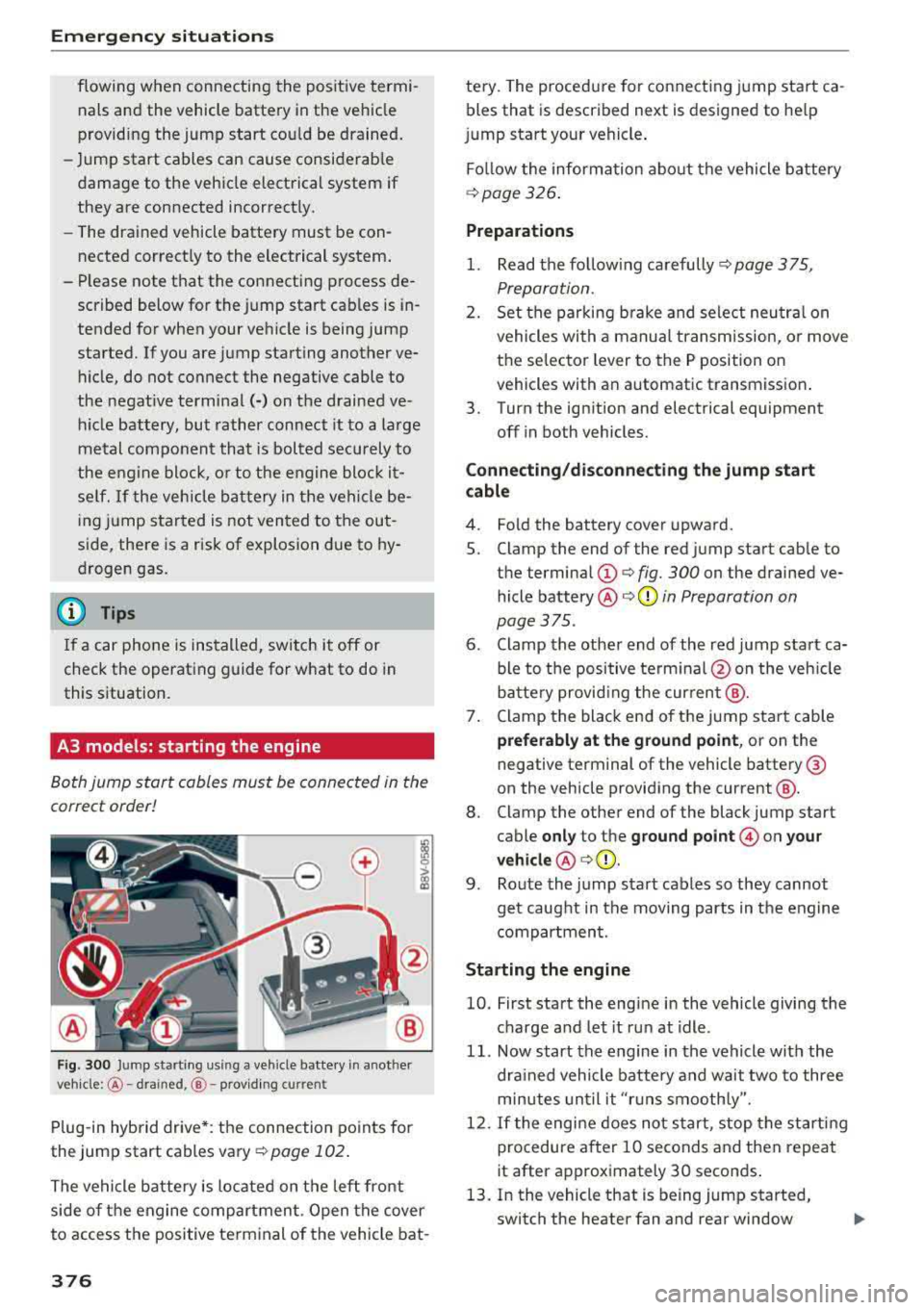
A3 models: starting the engine
Both jump start cables must be connected in the
correct order!
F ig. 300 Ju mp starting using a vehicle batte ry in anot her
vehicle :@ - dra ined, @- providing cu rrent
Plug-in hybrid drive *: the connection points for
the jump start cables vary Q
page 102.
The vehicle battery is located on the left front
side of the engine compartment . Open the cover
to access the positive terminal of the vehicle bat-
376
tery. The procedure for connecting jump start ca
bles that is described next is designed to help
j ump start your vehicle .
Follow the information about the vehicle battery
Qpage 326 .
Preparations
1. Read the following carefully ¢ page 375,
Preparation.
2. Set the parking brake and select neutral on
vehicles with a manual transmission, or move
the selector lever to the P position on
vehicles with an automatic transmission .
3. Turn the ignition and electrical equipment
off in both vehicles.
Connecting/disconnecting the jump start
cable
4. Fold the battery cover upward.
5. Clamp the end of the red jump start cable to
the termina l
(D ¢ fig. 300 on the drained ve
hicle
battery @Q(D in Preparation on
page
375 .
6. Clamp the other end of the red jump start ca
ble to the positive terminal @on the vehicle
battery providing the current @.
7. Clamp the black end of the jump start cab le
preferably at the ground point, or on the
negative terminal of the vehicle battery@
on the vehicle providing the current @.
8. Clamp the other end of the black jump start
cable
only to the ground point © on your
vehicle @Q(D .
9. Route the jump start cables so they cannot
get caught in the moving parts in the engine
compartment.
Starting the engine
10. First start the engine in the vehicle giving the
charge and let it run at idle.
11. Now start the engine in the vehicle with the
dra ined vehicle battery and wait two to three
minutes until it "r uns smoothly".
12. If the engi ne does not start, stop the starting
procedure after 10 seconds and then repeat
it after approximately 30 seconds .
13. In the vehicle that is being jump started, switch the heater fan and rear window
..,,
Page 379 of 404
LL co ..... N
" N ..... 0 N > co
defroster on to reduce any voltage peaks that may occur when disconnecting the jumper
cables. The headlights must be switched
off.
14. While the engines are running , remove the
cables in
reverse order from the way they
were installed, as described in ¢
page 3 76.
Make sure the cables do not get caught in
moving engine components .
15. Fold the cover back on the battery correct ly .
16. Sw itch the heater fan and rear w indow de
froster
off.
Read and fo llow: ¢.&. in Preparation on
page 375
and ¢ (j) in Preparation on page 375.
(D Note
Do not use the negat ive termina l on the veh i
cle battery for jump star ting. A malfunction
could occ ur in the vehicle electrical system.
@ Tips
- Make sure that the connected positive ter
mina l clamps have sufficient contact with
metal.
- The vehicle battery in your vehicle vents to the outs ide so the battery gases d rain out of
the veh icle.
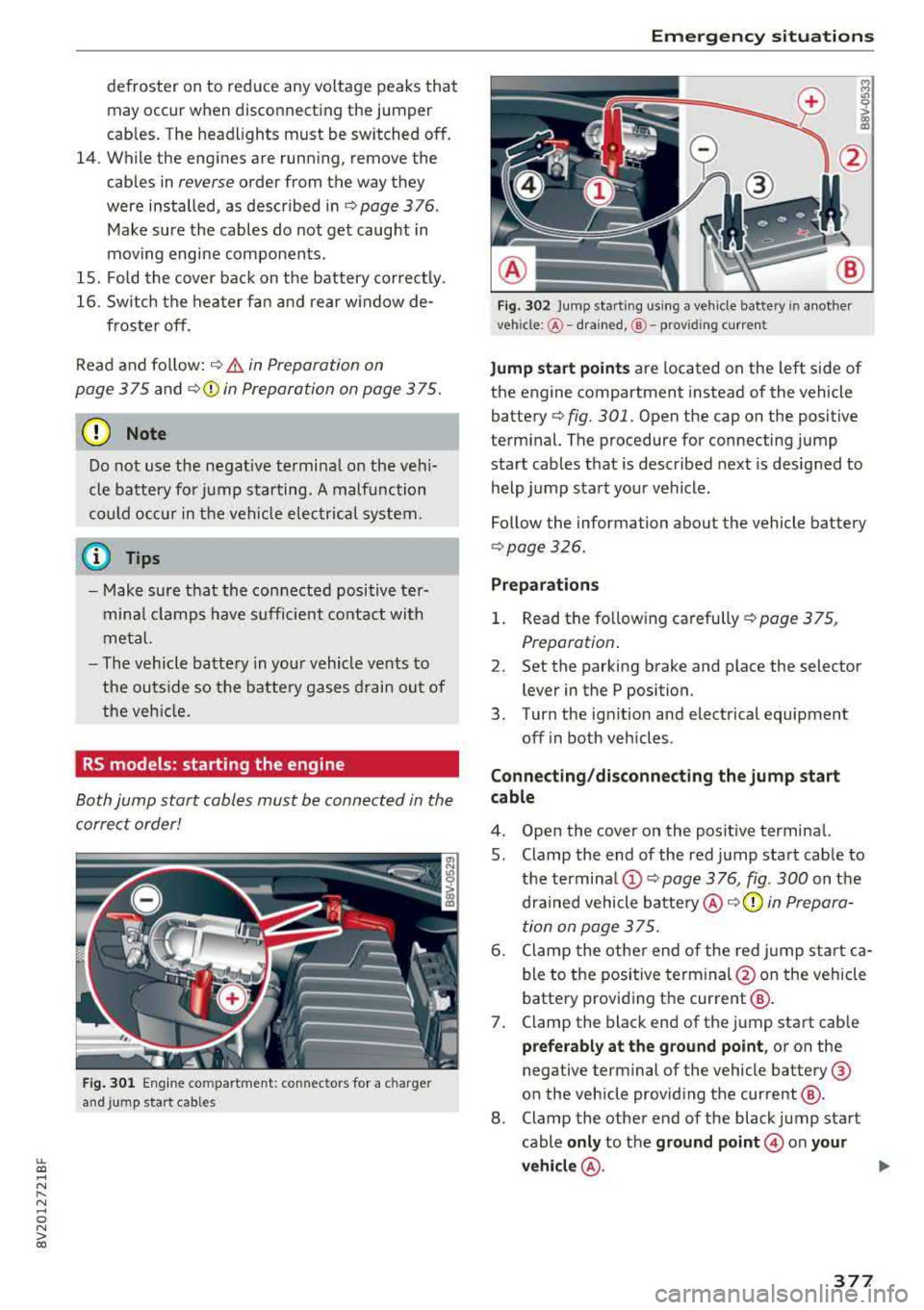
RS model s: starting the engine
Both jump start cables must be connected in the
correct order!
F ig . 301 Engine co mpartment : connector s for a c ha rge r
and jump star t cables
Em erge ncy s itua tions
Fig. 302 Jump star ting using a ve hicle bat tery in anothe r
ve hicl e:@ -drained, @- prov id in g curren t
M
lri 0 > (X) m
Jump sta rt p oin ts are located on the left side of
the engine compartment instead of the vehicle
battery ¢
fig. 301. Open the cap on the positive
terminal. The procedure for connecting jump start cables that is described next is designed to
help jump start your vehicle .
Follow the information about the vehicle battery
¢ page 326.
Pr eparation s
1. Read the follow ing carefully ¢ page 375,
Preparation .
2. Set the parking brake and place the selector
lever in the P position.
3. Turn the ign ition and electrical equipment
off i n both vehicles .
Conn ecting /d is conn ect ing the jum p sta rt
cable
4. Open the cover on the posit ive terminal.
5. Clamp the end of the red jump start cable to the
termina l(!) ¢ page 3 76, fig. 300 on the
drained vehicle
battery @c:;>(Q) in Prepara
tion on page 375.
6. Clamp the other end of the red jump sta rt ca
ble to the positive terminal @on the veh icle
battery providing the current @.
7. Clamp the black end of the jump start cab le
prefer ably at the grou nd point , or on the
negative terminal of the vehicle battery @
on the vehicle providing the current @.
8 . Clamp the other end of the black jump start
cable
only to the gr ound point @ on you r
v e hicl e@ .
.,..
377
Page 380 of 404
Emergency situations
9. Route the jump sta rt cables so they cannot
get caught in the moving parts in the engine
compartment.
Starting the engine
10. First start the engine in the vehicle g iving the
charge and let it run at idle.
11. Now start the engine in the vehicle with the
drained vehicle battery and wait two to three
minutes until it "runs smoothly" .
12.
If the engine does not start, stop the starting
procedure after 10 seconds and then repeat
it after approximately 30 seconds .
13 . In the vehicle that is being jump started,
switch the heater fan and rear w indow de
froster on to reduce any voltage peaks that may occur when disconnecting the jumper
cab les. The headlights must be switched
off.
14. While the engines a re running, remove the
cables in
reverse order from the way they
were installed, as described in ¢
page 3 76.
Make sure the cables do not get caught in
moving engine components.
15 . Close the cap on the positive term inal.
16 . Sw itch the heater fan and rear w indow de
froster
off.
Read and follow: ¢ .&. in Preparation on
page 375
and ¢ (D in Preparation on page 375 .
@ Tips
-Make sure that the connected positive ter
minal clamps have sufficient contact with
metal.
- The vehicle battery in your vehicle vents to
the outs ide so the battery gases drain out of
the veh icle .
Towing with a tow truck
General hint s
Your Audi requires special handling for towing.
The follow ing information is to be used by com
mercial tow truck operators who know how to op
erate the ir equipment safely.
-Never tow your Audi. Towing will cause dam
age to the engine and transmission .
378
-Never wrap the safety chains or winch cables
around the brake lines .
- To prevent unnecessary damage , your Audi
must be transported with a flatbed truck.
- To load the vehicle on to the flatbed, use the
towing loop found in the vehicle tools and at
tach to the front or rear anchorage
¢page 378 and ¢page 379.
A WARNING
A vehicle being towed is not safe for passen
gers . Never allow anyone to ride in a vehicle
being towed, for any reason.
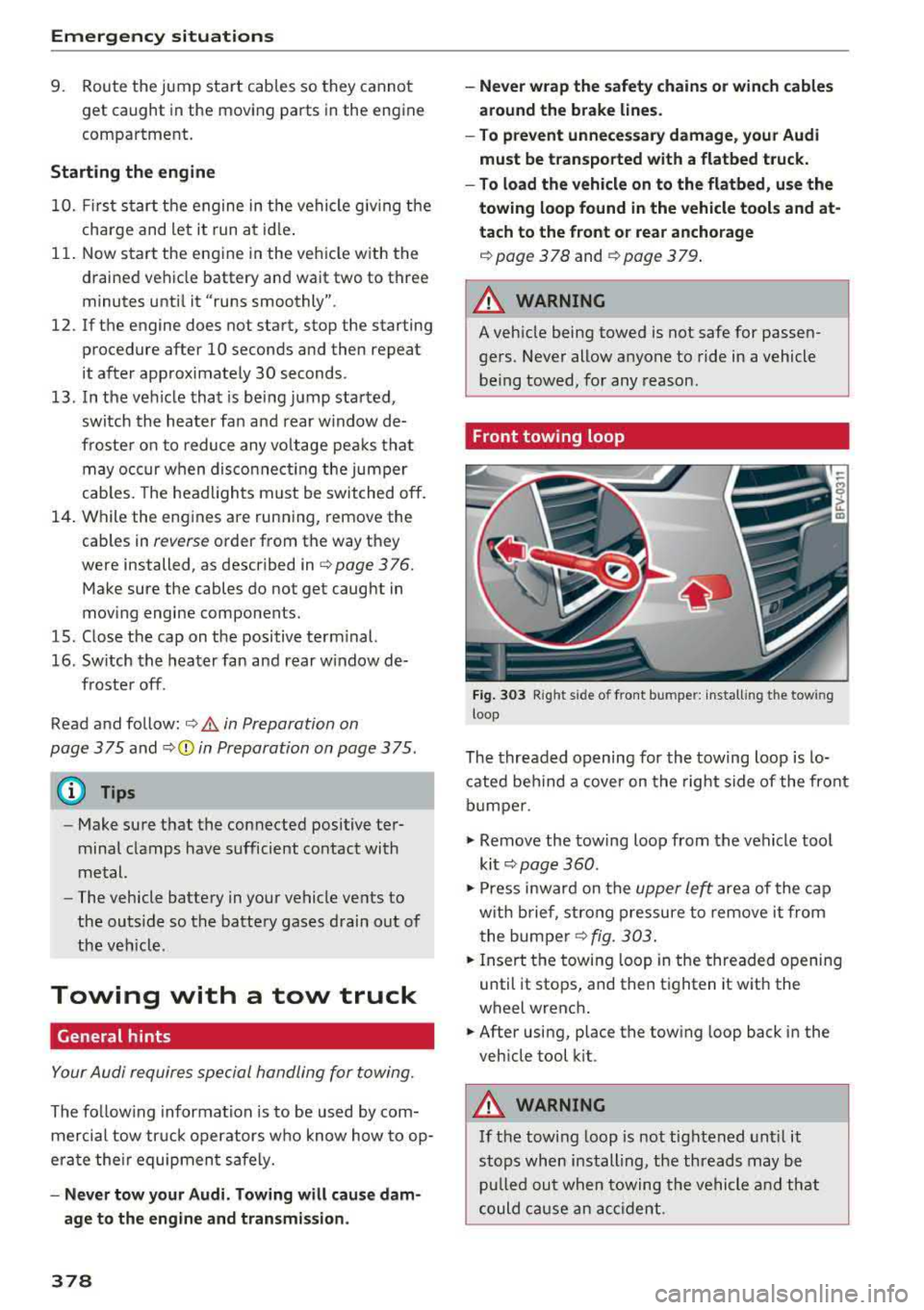
Front towing loop
Fig. 303 Rig ht s ide o f front b umper: install ing the tow ing
loop
The threaded opening for the towing loop is lo
cated behind a
cover on the right side of the front
bumper .
.,,. Remove the towing loop from the vehicle tool
kit ¢
page 360 .
.,,. Press inward on the upper le~ area of the cap
with brief, strong pressure to remove it from
the bumper
¢fig. 303 .
.,,. Insert the towing loop in the threaded opening
until it stops, and then tighten it with the
wheel wrench .
.,,. After using, place the towing loop back in the
vehicle tool kit .
A WARNING
If the towing loop is not tightened until it
stops when installing, the threads may be pulled out when towing the vehicle and that
could cause an accident .
-