manual transmission AUDI A4 2013 User Guide
[x] Cancel search | Manufacturer: AUDI, Model Year: 2013, Model line: A4, Model: AUDI A4 2013Pages: 302, PDF Size: 75.61 MB
Page 96 of 302
94 Transmission Starting the engine
.. The selec to r l eve r must be in P or N.
Starting off
.. Press and hold the brake pedal.
.. Press and hold the release button in these
lector lever handle, select t he des ired selec
tor lever position such as D/S and release
the b utton .
.. Wait briefly until the transmission has shift
ed (you will feel a slight movement) .
.. Remove your foot from the brake pedal and
acce lerate.
Stopping temporarily
.. Keep the vehicle stationary using the b rak
ing peda l, for examp le at traffic lights .
.. Do not press the accelerator pedal when do
ing this.
.. To prevent the vehicle from rolling when
you start dr iving, set the parking brake
when stopping on steep inclines ¢&_ .
.. The parking brake will release automatically
and the vehicle w ill start moving once you
press the accelerator peda l.
Stopping/parking
If the selector lever is not in the P position
when you open the dr iver's door, the vehicle
could roll. The message
Transmission: Car
may roll! Shift to park!
appears.
.. Press and hold the brake pedal unt il the ve
hicle has come to a complete stop .
.. Apply the parking brake¢
page 86, Park-
ing .
.. Se lect the P selector lever position ¢ &.-
Stopping on an incline
.. Always press the brake pedal to hold the ve
hicle in place and prevent it from "rolling
back"
¢ &_ . Do not try to prevent the vehi
cle from "rolling back" when a gear is en
gaged by increasing the engine speed ¢Q).
Starting on an incline
.. Activate the parking brake.
.. With the driving gear selected, press the ac
celerator pedal carefully . The parking brake will release automatically if your seat
belt is
fastened .
Under certain circumstances, such as driving
in the mountains, it may be usefu l to switch
temporarily to the manual shift program in or
der to adjust the gears to the driving condi
tions by hand ¢
page 96.
On s lopes, activate the parking brake first and
then move the selector lever to the P position .
This prevents too much stress from being
placed on the locking mechanism .
Vehicles with multitronic transmission: Your
vehicle is equipped with
hill hold assist allow
ing yo u to start while on an incline. The sys
tem is activated when the brake pedal is
pressed down and he ld
for a few seconds . The
brake pressure will hold for
a moment after
the brake pedal loosens to prevent the vehicle
from roll ing backwards w hile starting up .
A WARNING
-The vehicle can also roll when the engine
is stopped.
-Unintended vehicle movement can cause
serious injury.
- Never leave your vehicle with the engine
r un ning while in gear. If you must leave
your veh icle when the engine is running,
activate the parking brake and move the
selector lever to P.
- Power is still transmitted to the wheels
when the engine is runn ing at idle. To
prevent the vehicle from "creeping", you
must keep your foot on the brake when
the engine is running and the selector
lever is in 0/5 or R or "t iptronic" mode is
selected .
- Do not press the accelerator pedal when changing the selector lever position
while the veh icle is stationary and the
engine is running.
- Never shift into R or P while driving.
- Before driving down a steep s lope, re-
duce your speed and shift into a lower
gear with "tiptronic" .
Page 98 of 302
96 Transmission
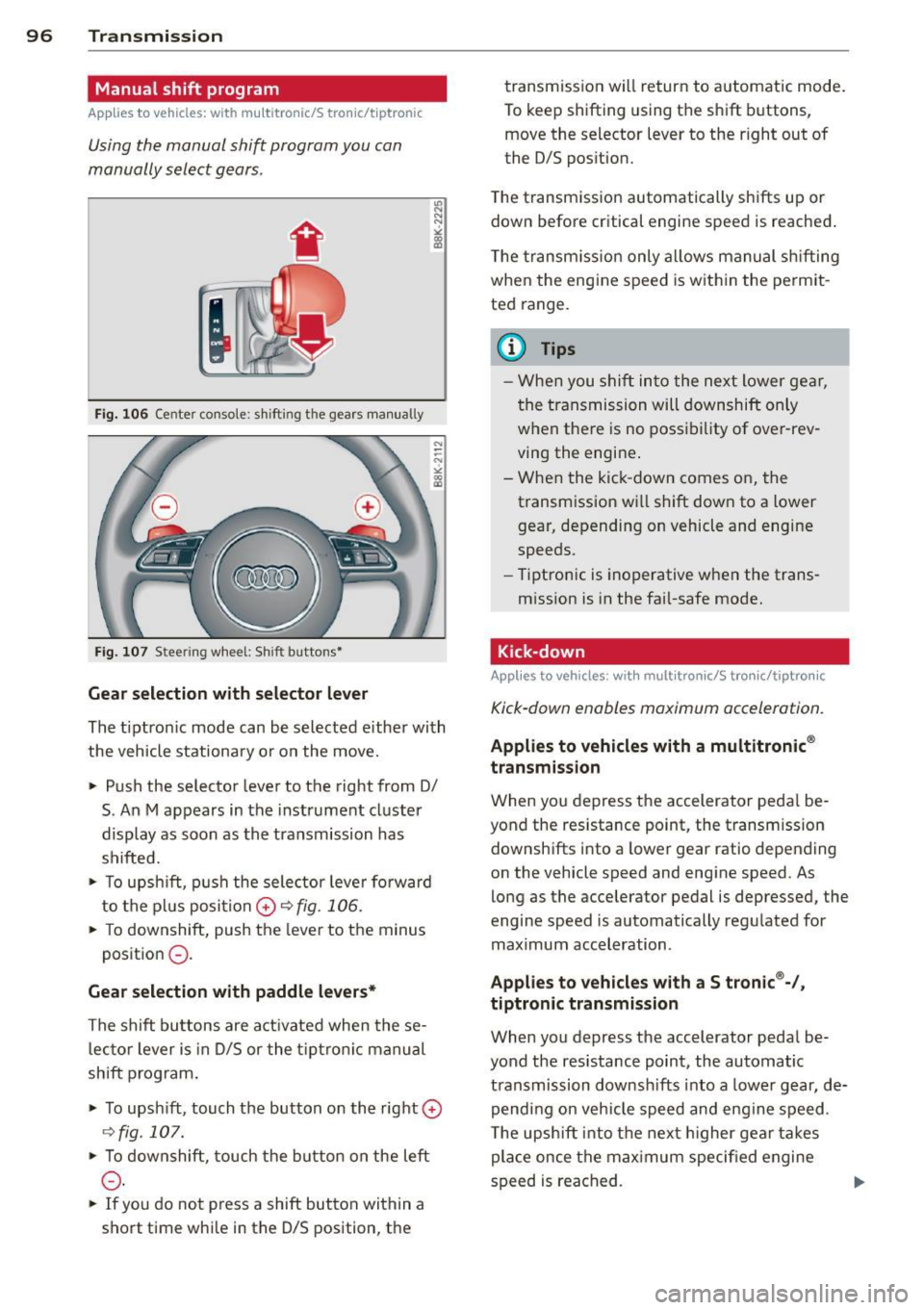
Manual shift program
Appl ies to vehicles: with multitronic/S tronic/t iptronic
Using the manual shift program you can
manually select gears .
Fig . 10 6 Center co nsole: s hifting the gears manu ally
Fig . 10 7 Steer ing w heel: Shift buttons•
Gear selection with selector lever
"' N
N
~
" a> CD
The tiptron ic mode can be selected e ither with
the vehicle stationa ry or on the move.
• Push the selector lever to the right from 0/
S. An M appears in the instrument cl uster
display as soon as the transmission has
shifted.
• To upsh ift, p ush the sele ctor leve r fo rw ard
to the pl us posi tion
0 r:::,fig . 106.
• To downshift , push the lever to the minus
position
0 -
Gear selection with paddle levers*
The s hift bu ttons are act ivated when the se
l ec to r lever is in D/S or the t ip tr on ic manu al
shift program .
• To upsh ift, touch the button on th e right
0
C:, fig . 107.
• To downshift, touch the bu tton on the left
0 -
• If you do not press a shift button wi thin a
s h ort time whi le in the D/S position, t he transmission will return to a
utomatic mode .
To keep shifting using t he sh ift bu ttons,
move the selector lever to the r ight out of
the 0/S pos ition.
T he t ransm iss io n automatically sh ifts up or
down before critical engine speed is reached .
T he transm iss io n only a llows manual sh ifting
when the engine speed is w it hi n the pe rmit
ted range .
@ Tips
-Whe n you s hift into the ne xt l ower ge ar,
the transmission will downshift only
w hen the re is no poss ib ility of ove r-rev
ving the engine .
- W hen the kic k-down comes on, the
transm ission w ill shift d ow n to a lower
gear, depending on vehicle and engine
speeds.
- Tiptro nic is inoperative when the trans
m ission is in the fai l-safe mode.
Kick-down
Applies to vehicles : wit h mult itronic/S t ro ni c/tip tro nic
Kick-down enables maximum acceleration.
Applies to vehicles with a multitronic ®
transmission
W hen you depress the accelerator peda l be
yond the res istance point, the transm ission
downsh ifts into a lower gear ratio depend ing
on the vehicle speed and engine speed. As
lo ng as the acce lerator pedal is depressed, the
engine speed is automatically regu lated for
maximum acceleration .
Applies to vehicles with a S tronic ®-/,
tiptronic transmission
When you depress the accelerator peda l be
yond the resistance point, the automatic t ra nsmission downsh ifts into a lowe r gear, de
pend ing on veh icle s peed an d eng ine speed .
T he upsh ift int o th e nex t higher gea r takes
place once the max imum speci fied engine
s p eed is reached .
Page 103 of 302

Audi adaptive cru ise control and brakin g guar d 101
Vehicles with manual transmission
App lies to vehicles: with Audi adaptive cruise control
The adaptive c ruise control is avai lab le from
the 2nd gear through the 6th gea r in the cus
tomary RPM.
When the adapt ive cruise control is turned on,
you must p ress the clutch to shift gears (as
usual) . When sh ifting normally or when press
ing the cl utch, the adap tive c ruise control re
mains turned on.
Afte r you have engaged the gear, you do
not
need to press the gas peda l. The adaptive
cru ise control accelerates automat ica lly if nec
essary.
I f you press dow n on the clutch fo r too long or
shift/coup le improperly, the adaptive cruise
control may turn off automat ically.
{D) Tips
You cannot tu rn on the adapt ive cru ise
contro l during a sh ifting operation.
Audi adaptive cruise
control
Description
App lies to vehicles: with Audi adaptive cruise control
Fig . 11 3 Detect ion range
What c an Audi adapt ive crui se cont rol d o?
The adaptive cruise control works in conjunc
tion with a radar sensor installed in the front
of the vehicle
¢page 99, fig. 110, which is
subject to desig nated system limits
<=:> page 101 . Stationary objects are disregard
ed . On open
roads with no traffic, adaptive cr uise
control works like a regular cruise contro l sys
tem. The stored speed is maintained . When
approaching a moving vehicle detected up
ahead, the adaptive cruise control system au
tomat ica lly slows down to match that vehi
cle's speed and then maintains the distance
that the dr iver previously stored . As soon as
the sys tem does not detec t a vehicle up
ahead, adaptive cruise cont ro l ac celerates
back up to the stored speed .
Which functions can be controlled?
When you switch adapt ive cruise control on,
you can set the cu rrent speed as the "contro l
speed "
¢ page 102, Switching on and off.
When dr iving, you can stop cru ise contro l
¢page 103 or change the speed ¢page 103
at any time.
You can also set the distance to t he object
ahead and set the adapt ive cru ise control driv
ing program
¢ page 104 .
Page 109 of 302
Audi adaptive cru ise control and brakin g guar d 107
-Sedan: I f you switch the A SR/ESC off,
braking guard switches off automatically
¢ page 187 .
-allroad : If you switch the offroad mode
on, braking g uard switches off automati
cally
¢ page 188.
-Switch braking guard off when you are
l oading the veh icle onto a vehicle carr ier,
tra in, sh ip or other type of transporta
tion. This can prevent undesired warn i ngs from the braking guard system .
Messages
Applies to vehicles: with Audi adaptive cruise co ntrol
B rak ing guard: Off
This driver message appears if the system is
turned off via the radio/MM I*. Otherwise, if
the system is turned off, the information ap
pears every time shortly after the start of the
tr ip.
B ra king gua rd: Act ivated
This drive r message appe ars if sharp brake
pressu re was applied due to an acute warning.
•••
Three white dots appear if a setting cannot be
selected with the operat ing lever . For exam
p le, this happens if you want to raise/lowe r
the speed even though there was no p revious
l y saved speed.
AC C: D eactiv ation
The driver message appears in vehicles with
manual transmission . If the clutch pedal was
pressed down for too long, the adaptive cruise
control turns off. A chime sounds as a rem ind
er.
ACC : Sensor blocked
This message appears if the sensor view is ob
structed, for example by leaves, snow, heavy
spray or dirt. C lean the sensor ¢
page 99,
fig. 110.
ACC: not available
The drive r message appears if there is a ma l
f u nction. The adap tive cruise cont rol tu rns off. A chime sounds as a
reminder. Have the sys
tem checked by an authorized Audi dea ler or
authorized Aud i Service Fac ility.
ACC: unavailable
The driver message appears if, for example,
t h e b ra ke tempe ratu re is too hig h. T he adap
tive cru ise con trol is temporarily u nav ail able.
A ch ime sounds as a remin der .
Engine sp eed !
This dr iver message appears in vehicles with
manua l transm ission if the drive r had not up
shifted or dow nsh ifted in t ime w hile using
adaptive c ruise contro l braking or accelerat
ing, caus ing the veh icle to exceed or not reach
the pe rm itted lim it speed. The adap tive cruise
control turns off. A chime sounds as a remind
er.
Shift lev er po sition!
Vehicles with an automat ic t ransm iss ion: the
drive r message appears if the se lecto r lever is
sh ifted to the N position. The adapt ive cruise
c o ntrol is not ava ilable while in th is posit ion.
Vehicles with manua l transm ission: the driver
message appears for vehicles with manua l
transmission if there is no forward gea r en
gaged, meaning if the reverse gea r or the 1st
ge ar is engaged o r if the sele ctor leve r is i n
the ne utra l posi tion. The ad apt ive cr uise con
tro l is not available while in th is posi tion.
Stabilization control (ESC )
This message appears if the e lectronic stab ili
zation control (ESC) is taking action to stab i
liz e the veh icle. The adaptive c ruise co ntrol
turns off. A chime sounds as a reminder .
Speed too low
This message appears if the current speed is
too low
to set or to maintain the desired
speed.
T he speed being saved must be at least
20 mp h (30 km/h). The cru ise contro l is
turned off for speeds lowe r than 12 mph
(20 km/h). The adaptive cruise control re
mains turned on for speeds above 95 mph
Page 203 of 302
Trailer towing tips
Important to know
Your vehicle hand les different ly when tow ing
a trailer because o f the addit ional weight and
d iffe ren t weight distribution . Safety, pe rform
ance and economy w ill greatly depend on how
caref ully you load your trailer and operate
your rig.
B efore you actua lly tow your trailer, pr actice
turning, stopp ing and bac king up in an area
away from traffic. Keep practicing until you have become comp lete ly fam iliar with the way
your veh icle-trailer comb ination behaves and
responds.
Backing up is d ifficu lt a nd requires practice .
Backing up with a tra iler genera lly requires
steer ing action opposite to that when backing
up your vehicle without a trailer.
M aintain a g reater distance betwee n your ve
h icle and the one in front o f you . You will need
mo re room to stop. To compensate for the
trailer, you will need a larger than normal
turning radius .
W hen pass ing, remember that yo u cannot ac
celerate as fast as yo u normally wo uld be
cause of the added load. Ma ke s ure you have
e nough room to pass . After passing , allow
p lenty o f room fo r your tra iler before chang
in g la nes aga in .
Avoid jerky starts, sharp turns or rap id lane
changes.
(D Tips
- Do not tow a tra iler during the break-in
period of you r vehicle.
- If you tow a trailer, your A udi may re
quire more frequent maintenance due to
the extra load
o page 280.
Trailer towin g 201
Parking on a slope
Do not park on a slope with a trailer . If it can
not be avoided, do so only after doing the fol lowing:
When parking:
.. App ly the foot brake.
.. Have someone p lace chocks under both the
veh icle and the tra iler wheels .
.,. With chocks in place, slowly release t he
bra kes unt il t he whee l choc ks absorb the
load .
.. Tur n the whee ls towa rds t he curb .
.,. App ly the parking brake.
.. Place an a utomat ic t ransm ission* in P, re
spectively a manual transmission in first or
reverse gear.
When restarting after parking:
.. App ly the foot br ake .
.. Sta rt t he engine.
.. Move the se lector lever to D/S, respectively
a man ual transmiss ion in first gear .
.. Release the parking brake and s low ly pull
out and away from the wheel chocks .
.. Stop and have someone retr ieve the wheel
chocks.
@ Tips
If you move the selector leve r of the auto
matic transmissio n* to P before applying
the pa rking brake and befor e bloc king the
whee ls, you may hav e to use mor e forc e
la ter to m ove the lever out of the P p osi
tion.
•
•
Page 222 of 302
220 Checking and filling
-To reduce the risk of being burned, never
open the hood if you see or hear steam
or coolant escaping from the engine
compartment . Wait until no steam or
coolant can be seen or heard before care
fully opening the hood .
- Keep children away from the engine com
partment .
- Never spill fluids on hot engine compo
nents. They can cause a fire.
- Never touch the radiator fan. The auxili
ary electric fan is temperature controlled
and can switch on suddenly.
- Never open the coolant reservoir cap
when the engine is still warm. The cool
ant system is pressurized and hot cool
ant could spray out.
- Protect your face, hands and arm from
steam or hot engine coolant by placing a
thick rag over the cap when you open the
coolant reservoir .
- Do not remove the engine cover under
any circumstances. This increases the
risk of burns.
- If work on the fuel system or the electri
cal system is necessary:
- Always disconnect the battery.
- Never smoke or work near heaters or
open flames. Fluids in the engine com partment could start a fire.
- Keep an approved fire extinguisher im
mediately available.
- To avoid electrical shock and personal in
jury while the engine is running or being
started, never touch:
- Ignition cables
- Other components of the high voltage
electronic ignition system.
- If you must perform a check or repair
with the engine running:
- First, fully apply the parking brake,
move selector lever of automatic trans- mission to
"P" (Park); put manual
transmission in Neutral.
- Always use extreme caution to prevent
clothing, jewelry, or long hair from get
ting caught in the radiator fan, V-belts
or other moving parts, or from contact ing hot parts . Tie back hair before
starting, and do not wear clothing that
will hang or droop into the engine .
- Minimize exposure to emission and
chemical hazards
~ /1. .
A WARNING
=
California Proposition 65 Warning:
- Engine exhaust, some of its constituents,
and certain vehicle components contain
or emit chemicals known to the State of
California to cause cancer and birth de
fects and reproductive harm. In addition,
certain fluids contained in vehicles and
certain products of component wear con
tain or emit chemicals known to the
State of California to cause cancer and
birth defects or other reproductive harm.
- Battery posts, terminals and related ac
cessories contain lead and lead com
pounds, chemicals known to the State of
California to cause cancer and reproduc
tive harms. Wash hands after handling.
(D Note
When adding fluids, always make sure that
they are poured into the proper container
or filler opening, otherwise serious dam
age to vehicle systems will occur.
@) For the sake of the environment
To detect leaks in time, inspect the vehicle
floor pan from underneath regularly. If
you see spots from oil or other vehicle flu ids, have your vehicle inspected by an au
thorized Audi dealer.
Page 261 of 302
~ Unscrew the valve stem from the spare tire.
~ Screw the tire filler hose from the compres
sor firmly onto the valve of the spare tire.
~ Insert the plug from the compressor into a
socket of the vehicle¢
page 64.
~ Switch the compressor on .
~ Let the compressor run until the value
specified on the tire pressure label is
reached
¢ page 238, fig. 192. Switch the
compressor off after running for 12 minutes
at the most -danger of overheating!
A WARNING
The compressor and the tire filler hose can
become extremely hot while they are run
ning -danger of burns!
(D Note
Switch the compressor off after running
for 12 minutes at the most -danger of
overheating! Allow the compressor to cool
down for a few minutes before you use it
again.
Changing a wheel
Before changing a wheel
Observe the following precautions for your
own and your passenger's safety when chang
ing a wheel .
~ After you experience a tire failure, pull the
car well away from moving traffic and try to
reach
level ground before you stop¢ L!)..
~ All passengers should leave the car and
move to a safe location (for instance, behind
the guardrail) ¢
A.
~ Engage the parking brake to prevent your
vehicle from rolling unintentionally ¢
A.
~ Shift into 1st gear on vehicles with manual
transmission, or move the
selector lever to
the P position
on vehicles with automatic
transmission .
~ If you are towing a trailer: unhitch the trail
er from your vehicle.
~ Take the jack¢ page 256 and the spare tire
¢ page 257 out of the luggage compart
ment.
What do I do now? 259
A WARNING
You or your passengers could be injured
while changing a wheel if you do not fol
low these safety precautions:
- If you have a flat tire, move a safe dis
tance off the road. Turn off the engine,
turn the emergency flashers on and use
other warning devices to alert other mo
torists.
- Make sure that passengers wait in a safe
place away from the vehicle and well
away from the road and traffic.
- To help prevent the vehicle from moving
suddenly and possibly slipping off the
jack, always fully set the parking brake
and block the wheel diagonally opposite
the wheel being changed with the fold
ing chocks or other objects. When one
front wheel is lifted off the ground, plac ing the Automatic Transmission in "P"
(Park) will
not prevent the vehicle from
moving .
- Before you change a wheel, be sure the
ground is level and firm. If necessary,
use a sturdy board under the jack.
- Always store the vehicle tool kit, the
jack* and the replaced tire in the luggage compartment
¢page 133.
(D Note
If you are changing the wheel on a steep
incline, use a rock or similar object to
block the opposite wheel to prevent the
vehicle from moving.
(D Tips
Obey all laws.
Changing a wheel
When you change a wheel , follow these
quence described below step-by-step and in
exactly that order.
l. Remove the decorative wheel cover* or
-
the wheel bolt caps*. For more details see..,.
•
•
Page 284 of 302
28 2 Con sum er Inf ormation
-Always make sure the transmission se
lector lever (automatic transmiss ion) is
in "P" (Park position) or Neutral (manual
transmission) and the park brake is firm
ly applied.
@) For the s ake of the environment
-Changing the engine settings will ad
versely affect emission levels. This is det
rimental to the environment and increas
es fuel consumption .
- Always observe environmental regula
tions when disposing of old engine oil,
used brake fluid, dirty engine coolant,
spent batteries or worn out tires.
- Undeployed airbag modules and preten
s ioners might be classified as Perchlo
rate Material -spec ial handling may ap
ply, see www.dtsc.ca .gov/hazardous
waste/perch lorate. When the veh icle or
parts of the restraint system including
airbag modules safety belts with preten
sioners are scrapped, all app licable laws
and regulations must be observed . Your
authorized Audi dealer is familiar with
these requirements and we recommend
that you have your dealer perform this
serv ice for you .
Additional accessories,
modifications and
parts replacement
Additional accessories and parts
replacement
Always consult on authorized Audi dealer be
fore purchasing accessories.
Your veh icle inco rporates the latest safety de
sign featu res ensuring a high standard of ac
tive and passive safety.
This safety could be compromised by non-ap
proved changes to the veh icle. For this reason ,
if pa rts have to be replaced , please observe
the following points when installing addition
a l accessories: Approved Audi accessories and genuine Audi
parts are available from authorized Audi deal
ers.
T hese dea lers a lso have the necessary facili
ties, tools and trained specialists to install the parts and acc essories proper ly.
A WARNING
-Using the wrong spare parts or using non-
approved accessories can cause damage to
the veh icle and ser ious personal injury.
- Use on ly accessories expressly approved
by Audi and genuine Audi spare parts
- These parts and accessories have been
specially designed to be used on your ve
h icle .
- Never install accessories such as tele
phone crad les or beverage ho lders on a ir
bag covers or within the airbag deploy
ment zones . Do ing so will increase the
risk of injury if a irbags are triggered in an
accident!
- Before you check anything in the engine
compa rtment, always read and heed a ll
WARNINGS
9 page 213 .
(D Note
-If items other than genu ine Audi spare
parts, add-on equipment and accessory
items are used or if repair work is not
performed accord ing to specified meth
ods, this can resu lt in seve re damage to
your vehicle's eng ine and body (such as
corrosion) and adversely affect yo ur vehi
cle's warranty .
- If emergency repairs must be performed
elsewhere, have the vehicle examined by
an authorized Audi dealer as soon as
possible .
- The manufacturer cannot be held liable
for damage wh ich occ urs due to failure
to comply with these stipu lations.
Page 287 of 302

A
Accessories . . . . . . . . . . . . . . . . . . . . 64, 282
AC (automatic climate control) ... .. .. .. 77
adaptive cruise control
Vehicles with manual transmission .. .
101
Adaptive cruise control ...... .. .. .. .. .. 99
C leaning sensors/camera ... ... .. .. . 205
Messages .. ................ ... ... 107
Request for driver intervention . . . . . . . 105
Setting the driving program .. .. .. .. . 104
Adaptive dampers .......... .. .. .. .. . 113
Adaptive light ................ ... ... . 47
Adaptive Light (defective) ......... .. .. 22
Adding
Engine coolant ........... .. .. .. ...
227
Engine oil .. ................ ... ... 224
Windshield washer fluid ......... .. . 233
Additional accessories
Additives 282
Engine oil .. ............. .... .. .. . 224
Adjustable steering column ... ... .. .. .. 80
Adjusting
Air distribution (automatic climate con-
trol) . . . . . . . . . . . . . . . . . . . . . . . . . . . . . .
78
Instrument illumination ... .. .. .. .. .. 50
Steering column .................... 80
Temperature (automatic climate control) 78
Airbag
Warning/indicator lights ... .. .. .. .. ..
20
Airbag system . . . . . . . . . . . . . . . . . 145, 162
Advanced Airbag System ....... ... .. 149
Advanced Airbag System components . 152
Care ... ... . .... ... ..... ..... .. ... 158
Children . .. ............. .... .. .. . 167
Child restraints ........... .. .. .. ... 168
Components (front airbags) . ... .. .. . 152
Danger of fitting a child safety seat on
the front passenger seat . . . . . . . . . . . .
146
Disposal . .. .. ........... .. .. .. ... 158
Front airbags . . . . . . . . . . . . . . . . 149, 150
How do the front airbags work? . . . . . . 154
How many airbags does my vehicle
have? ... ... ............. ...... ..
152
How the Advanced Airbag System com-
ponents work together .... .. .. .. .. .
153
Important things to know .. .. .. .. .. . 145 Index 285
Indicator light
..... ............... 156
Monitoring . ... .... ............... 156
PASSENGER AIR BAG OFF light ....... 156
Repairs ... .. .. .. ................. 158
Safety instructions ................. 158
Side airbags ..... .. ............... 160
Side curtain airbags .. .... .. .... .... 163
Weight-sensing mat ............... 167
When must the system be inspected? . 156
all-wheel drive .. .. ................. 191
Alloy wheels .. .... .. ............... 208
All wheel drive
Winter tires . .. .. .... ........... ..
250
Alternator
refer to Generator . . . . . . . . . . . . . . . . . . 17
Anti-freeze
refer to Engine coolant system ....... 226
Anti-lock braking system ............. 185
Warning/ind icator lights ........ .. .. . 19
Anti-slip regulation .. ... ....... .... . 185
Anti-theft alarm warning system ........ 32
Anti-theft systems
Electronic immobilizer .............. .
38
Armrest ...... .. .. ................. . 60
Ashtray . . . . . . . . . . . . . . . . . . . . . . . . . . . .
63
Asterisk
What does it mean when something is marked with an asterisk? . . . . . . . . . . . . . .
6
Audi braking guard
refer to braking guard ............. .. 99
Audi drive select ..... ............... 113
Adaptive dampers ................. 113
Description .. .. ...... ............. 113
Dynamic steering . ... ... .... ... .. .. 113
Setting the driving mode ............ 114
Sport differential . .. .. .. ...... .... . 113
Audi Service Repair Manuals and Litera-
ture
280
AUTO Automatic climate control .......... ..
78
Automatic headlights ............... 47
Auto Lock . . . . . . . . . . . . . . . . . . . . . . . . . . 32
Automatic belt retractor ......... .... 140
Automatic car wash
refer to Washing ... .............. . 203
•
•
Page 292 of 302
290 Index
Floor mats ........ ......... ... .... . 132
Fog lights/rear fog light(s) ..... .. .. .. . . 47
Folding the rear seats . . . . . . . . . . . . . . . . . 69
F oot pedals ....................... . 132
For the sake of the environment Gasoline fumes and the environment .. 217
L ett ing the engine warm up . . . . . . 80, 83
Refueling ............... .. .. .... . 217
Saving fue l by early upshift ing .. ...... 11
Front airbags Descr ipt ion .... .... ...... .. .. .. .. . 149
H ow they work . . . . . . . . . . . . . . . . . . . . 154
Frontal collisions and the laws of physics 138
Fr ont passenger's door emergency locking 38
Front seats Adjusting .. ..... ........... ... .. . 129
Ch ild restraints in the front seat . .. .. . 146
Fuel Additives . ... ............ .. .. .. .. . 214
Blended gasoline ............. .. ... 214
Consumpt ion . . . . . . . . . . . . . . . . . . . . . . 25
Filler neck .. ... . ...... ... .. .. .. .. . 216
Fu el gauge ... ........... .. .. .... .. 12
Gasoline . ... ............ .. .. .. .. . 214
Gasoline additives ................ . 216
Low fuel level symbol . . . . . . . . . . . . . . . 21
Octane rating .................... . 214
Recommendation ........... .. .... . 214
Refuelling .... ........... .. .. .... . 217
Reserve .. ... ... .... ..... .. .. .. .. .. 12
Tank capacity ............. ... .. ... 277
Tank system .......... .... ... .. .. .. 21
Un lock ing the fuel fi ller flap by hand .. 218
Fuel economy messages (efficiency pro-
gram) . .. .. .. ... .. ..... ... .... .. .. .. 29
Fuel filler flap
Unlocking the fuel filler flap by hand .. 218
Fuses Assignment . . . . . . . . . . . . . 265, 266, 267
Replacing . ................. ..... . 265
G
Garage door opener (HomeL ink) .. .. ... 123
Garment hooks . . . . . . . . . . . . . . . . . . . . . . 66
Gas discharge lamps ......... ... .... . 268 Gauges
Engine coolant temperature . . . . . . . . . . 10
Fuel gauge . . . . . . . . . . . . . . . . . . . . . . . . 12
Tachometer . . . . . . . . . . . . . . . . . . . . . . . 11
Gear recommendation . . . . . . . . . . . . . . . . 28
Gearshift indicator ...... ........... .. 27
Gearshift lever
6-speed manual transmission .... .... . 91
General illustration
Instruments and controls ....... .... .. 8
Generator Warning/ind icator lights ........... .. 17
G lossary of tire and loading terminology 235
G love compartment . . . . . . . . . . . . . . . . . . 65
Valet parking .... ................ .. 45
GPS controlled clock ................ .. 12
Gross Vehicle Weight Rating (GVWR) . .. 275
Ground clearance .. ... .......... .... 198
H
Headlights
Cleaning system . . . . . . . . . . . . . . . . . . . . 53
Defective . . . . . . . . . . . . . . . . . . . . . . . . . 21
Headlight range control ............. 22
Left hand drive, right hand drive .. .. .. . 49
Travel mode . . . . . . . . . . . . . . . . . . . . . . . 49
Headlight washer reservoir ..... .. .... 233
Head restraints .. .. ............. .... 131
Adjusting . . . . . . . . . . . . . . . . . . . . 61, 131
Removing/installing .............. .. 61
Heated exterior mirrors . . . . . . . . . . . . . . . . . . . . SO
rear window . . . . . . . . . . . . . . . . . . . . . . . 78
seats .... ... .. .. .. ...... ....... .. . 78
windshield washer spray nozzles . . . . . . 53
Heating ... ..... .. .. .............. .. 76
Heavy clothing and safety be lts ...... .. 140
High beam .. .... ... ................ . 48
High voltage warning label ........ ... 275
Hill descent control ................ .. 95
Homelink (remote control)
Hood 123
Opening . ..... .. ................ . 219
Re lease lever .... ............. .... 219
Hooks ... .. .. .. .. ............... .. . 72
Horn ...... .. .. .. .. ............... .. 8