ESP AUDI A4 2013 Workshop Manual
[x] Cancel search | Manufacturer: AUDI, Model Year: 2013, Model line: A4, Model: AUDI A4 2013Pages: 302, PDF Size: 75.61 MB
Page 168 of 302
166 Child Saf ety
Child Safety
Important things to
know
Introduction
The rear seat is generally the safest place in a
collision .
The physical principles of what happens when
your veh icle is in a crash app ly also to chi ldren
q page 138, What happens to occupants not
wearing safety belts? .
But unlike adults their
muscles and bones are not fully developed. In
many respects children are at greater risk of
serious injury in crashes than adults.
Because children's bodies are not fully deve l
oped, they require restra int systems especial
l y designed for their size , weight, and body
structure. Many countries and all states of the United States and p rovinces of Canada have
laws requiring the use of approved child re
straint systems for infants and small children .
In a frontal crash at a speed of 20 -35 mph
(30-56 km/h) the forces acting on a 13-pound
(6 kg) infant will be more than 20 times the
weight of the child . This means the weight of
the child would suddenly be more than
260 pounds (120 kg). Under these conditions,
only an appropriate ch ild restraint properly
used can reduce the risk of serious injury.
Ch ild restra ints must be used properly to be
effective. Used improperly, they can increase
the risk of serious injury in an accident .
Consult the child safety seat manufactu rer's
instructions to be sure the seat is right for
your chi ld's size
q page 169, Important safe
ty instructions for using child safety seats .
Please be sure to read and heed all of the im
portant information and WARNINGS about
child safety, Advanced Airbags, and the instal lation of child restraints in this chapter .
There is a lot you need to know about the Ad
vanced Airbags in your vehicle and how they
work when infants and children in child re
straints are on the front passenger seat . Be
cause of the large amount of important infor- mation, we cannot repeat it all here
. We urge
you to read the detailed information in this
owner's manua l about airbags and the Ad
vanced Airbag System in your vehicle and the
very important information about transport
ing children on the front passenger seat .
Please be sure to heed the WARNINGS - they
are extremely important for your safety and
the safety of your passengers, especially in
fants and small children.
A WARNING
- Accident statistics have shown that chil
dren are generally safer in the rear seat
area than in the front seating position.
Always restrain any child age 12 and un
der in the rear.
- All vehicle occupants and especially chil
dren must be restrained properly when
ever riding in a vehicle. An unrestrained
or improperly restrained chi ld could be
injured by str ik ing the interior or by be
ing ejected from the vehicle dur ing a
sudden maneuver or impact. An unre
strained or improperly restrained ch ild is
also at greater risk of injury or death
through contact with an inflating airbag.
- A suitable child restraint properly instal
led and used at one of the rear seating
positions provides the highest degree of
protection for infants and small children
in most accident situations.
A WARNING
Children on the front seat of any car even
with Advanced Airbags can be seriously in
jured or even killed when an airbag in
flates . A child in a rearward-facing child
safety seat installed on the front passen
ger seat w ill be ser iously injured and can
be killed if the front airbag inflates.
- The inflating airbag will h it the child
safety seat or infant carrier with great
force and will smash the child safety seat
and child against the back rest, center
armrest or door .
- Always install rearward-facing child safe-
ty seats on the rear seat.
IJi,,,
Page 169 of 302
-If you must install a rearward facing
child safety seat on the front passenger
seat in exceptional circumstances and
the
PASSENGER AIR BAG OFF light does
not come on and stay on, immediately
install the rearward-facing child safety
seat in a rear seating position and have
the airbag system inspected immediately by your authorized Audi dealer.
,& WARNING
If, in exceptional circumstances, you must
install a forward-facing child restraint on
the front passenger's seat:
- Always make sure the forward-facing
seat has been designed and certified by
its manufacturer for use on a front seat
with a passenger front and side airbag.
- Always follow the manufacturer's in
structions provided with the child safety
seat or carrier.
- Always move the passenger seat into its
rearmost position in the seat's fore and
aft adjustment range, as far away from
the airbag as possible before installing
the child restraint. The backrest must be adjusted to an upright position .
- Always make sure that the
PASSENGER
AIR BAG OFF
light comes on and stays
on all the time whenever the ignition is
switched on.
@ Tips
Always replace child restraints that were
installed in a vehicle during a crash. Dam
age to a child restraint that is not visible
could cause it to fail in another collision
situation.
Advanced front airbag system and children
Your vehicle is equipped with a front "Ad
vanced Airbag System" in compliance with
United States Federal Motor Vehicle Safety
Standard (FMVSS) 208 as applicable at the
time your vehicle was manufactured .
Child Safety 167
The Advanced Airbag system in your vehicle
has been certified to meet the "low-risk" re
quirements for 3- and 6-year old children on
the passenger side and small adults on the driver side. The low risk deployment criteria
are intended to reduce the risk of injury
through interaction with the airbag that can
occur, for example, by being too close to the
steering wheel and instrument panel when
the airbag inflates. In addition, the system
has been certified to comply with the "sup
pression" requirements of the Safety Stand
ard, to turn off the front airbag for infants up
to 12 months who are restrained on the front passenger seat in child restraints that are list
ed in the Standard.
Even though your vehicle is equipped with an
Advanced Airbag system, all children, espe
cially those 12 years and younger, should al
ways ride in the back seat properly restrained
for their age and size . The airbag on the pas
senger side makes the front seat a potentially
dangerous place for a child to ride . The front
seat is not the safest place for a child in a for
ward-facing child safety seat. It can be a very
dangerous place for an infant or a larger child
in a rearward-facing seat.
Advanced Airbags and the weight
sensing mat in the front seat
The Advanced Airbag System in your vehicle
detects the presence of an infant or child in a
child restraint on the front passenger seat us
ing the weight-sensing mat in the seat cush
ion and the sensor below the safety belt latch
on the front passenger seat that measures the
tension on the safety belt.
The weight-sensing mat measures total
weight of the child and the child safety seat
and a child blanket on the front passenger
seat. The weight on the front passenger seat
is related to the design of the child restraint
and its "footprint", the size and shape of the
bottom of the child restraint as it sits on the
seat. The weight of a child restraint and its "footprint" vary for different kinds of child re -
straints and for the different models of the ..,. •
•
Page 171 of 302
-Model Manufactured on or
after
Graco Snugride September 25, 2007
Peg Perego Primo V i- September 25, 200 7
aggio SIP I MUN00US
Subpart C -Forward-facing and
con vertible child r estra ints
Model Manufactured on or
after
Britax Roundabout September 25, 2007
E9L02xx
Cosco Touriva 02519 December 1, 1999
Cosco Summit Deluxe September 25, 2007
High Back Booster
22-262
Cosco High Back September 25, 2007
Booster 22-209
Evenflo Tribute V September 25, 2007
379xxxx
Evenflo Medallion December 1, 1999
254
Evenflo Generations September 25, 200 7
352xxxx
Graco ComfortSport September 25, 2007
Graco Toddler Safety September 25, 2007
Seat Step 2
Graco Platinum Cargo September 25, 2007
A WARNING
T o reduce the risk of serious injury, make
sure that the
PASSENGER AIR BAG O FF
light comes on and stays on whenever a
child restraint is installed on the front pas
senger seat and the ignition is switched
on.
- Take the child restraint off the fro nt pas
senger seat and install it properly at one of the rea r seat positions if the
PASSEN
GER AIR BAG OFF
light does not stay on.
- Have the airbag system inspected by
your authorized Aud i dealer immediate
ly.
Child Sa fet y 169
'
(D Tips
The child seats listed in categories A to C
have been statically tested by A udi on ly for
the Advanced A irbag function.
Important safety instructions for using
child safety seats
Correct use of child safety seats substantially
reduces the risk of injury in an accident!
As the dr iver, you are responsib le for the safe
ty of everybody in the vehicle, especially ch il
dren:
... Always use the right chi ld safety seat for
each child and always use it properly
¢page 172 .
... Always carefully fo llow the child safety seat
manufacturer's instruct ions on how to route
the safety belt properly through the child
safety seat.
... When usi ng the veh icle safety belt to ins tall
a child safety se at, you m ust first activate
the convertib le locking retractor on the
safety belt to prevent the child safety seat
from moving
¢ page 176.
... Push the ch ild safety seat down with your
full weight to get the safety be lt really tight
so that the seat cannot move forwa rd or
sideways mo re than one inch (2 .5 cm) .
... If a strap o r tethe r is be ing used to tie the
child safety seat to the fron t passenger
s eat , make sure tha t it is not so tight that it
causes the weight-sensing mat to measure
more weight than is act ually on the seat.
... Sec ure unused safety belts on the rear seat
¢ page 171.
Always remember : Even tho ugh yo ur vehicle is
equipped with an Advanced Airbag system, all c h il dren, especially those 12 years and young
er, shou ld always r ide in the back seat proper -
ly restra ined for the ir age and size. .,_ •
•
Page 172 of 302
1 70 Child Safety
&_ WARNING
Not using a child safety seat, using the
wrong child safety seat or improperly in
stalling a child restraint increases the risk
of serious personal injury and death .
-All vehicle occupants and especially chil
dren must always be restrained properly
whenever riding in a vehicle.
-
- An unrestrained or improperly restrain
ed child can be injured or killed by be
ing thrown against the inside of the ve
hicle or by being ejected from it during
a sudden maneuver or impact .
- An unrestrained or improperly restrain
ed child is at much greater risk of injury
or death by being struck by an inflating
airbag.
- Commercially available child safety seats
are required to comply with U.S. Federal
Motor Vehicle Safety Standard (FMVSS)
213 (in Canada CMVSS 213).
- When buying a child restraint, select
one that fits your child and the vehicle.
- Only use child restraint systems that
fully contact the flat portion of the
seat cushion. The child restraint must not tip or lean to either side. Audi does
not recommend using child safety
seats that rest on legs or tube -like
frames . They do not provide adequate
contact with the seat.
-Always heed all legal requirements per
taining to the installation and use of
child safety seats and carefully follow
the instructions provided by the manu
facturer of the seat you are using.
- Never allow children under 57 inches
(1.45 meters) to wear a normal safety
belt. They must always be restrained by a
proper child restraint system. Otherwise,
they could sustain injuries to the abdo
men and neck areas during sudden brak
ing maneuvers or accidents.
- Never let more than one child occupy a
child safety seat . -
Never let babies or older children ride in
a vehicle while sitting on the lap of an
other passenger .
- Holding a child in your arms is never a
substitute for a child restraint system.
- The strongest person could not hold
the child with the forces that exist in
an accident. The child will strike the in
terior of the vehicle and can also be
struck by the passenger.
- The child and the passenger can also
injure each other in an accident.
- Never install rearward-facing child safety
seats or infant carriers on the front pas
senger seat. A child will be seriously in
jured and can be killed when the passen
ger airbag inflates -even with an Ad
vanced Airbag System .
- The inflating airbag will hit the child
safety seat or infant carrier with great
force and will smash the child safety
seat and child against the backrest,
center arm rest, door or roof.
= Always install rearward-facing child
safety seats or infant carriers on the
rear seat.
- Forward-facing child safety seats instal
led on the front passenger's seat can in
terfere with the airbag when it inflates and cause serious injury to the child. Al
ways install forward-facing child safety seats on the rear seat .
- If exceptional circumstances require the
use of a forward-facing child restraint on
the front passenger's seat, the child's
safety and well-being require that the
following special precautions be taken:
- Make sure the forward-facing seat has
been designed and certified by its man
ufacturer for use on a front seat with a
passenger front and side airbag.
- Always carefully follow the manufac
turer's instructions provided with the
child safety seat or carrier.
- Always move the front passenger seat
into the rearmost position of the pas-
senger seat's fore and aft adjustment
~
Page 173 of 302
range, and as far away from the a irbag
as poss ible before instal ling the child
restraint.
- Always make sure that nothing pre
vents the front passenger's seat from be ing moved to the rearmost position
i n its fore and aft adjustment range.
- Always make sure that the backrest is
in the upr ight position.
- Always buckle the child safety seat firmly
in place even if a child is not sitting in it.
A loose ch ild safety seat can fly around
dur ing a sudden stop or in a coll is ion .
- Always read and heed all WARNINGS
whenever using a child restrained in ave
hicle is being used
c:::;,page 137, Safety
belts,
c:::;, page 145, Airbag system and
¢ page 166, Child Safety.
.8, WARNING
To reduce the risk of serious injury, make
sure tha t the
PASSENGER AIR BAG OFF
light comes on and stays on whenever a
child rest raint is installed on the front pas
senger seat and the ignition is switched
on.
- Take the child restraint off the front pas
senger seat and install it proper ly at one
of the rear seat positions if the
PASSEN
GER AIR BAG OFF
light does not stay on.
- Have the airbag system inspected by
your authorized Aud i dealer immediate
ly.
Secure unused safety belts on the rear
seat
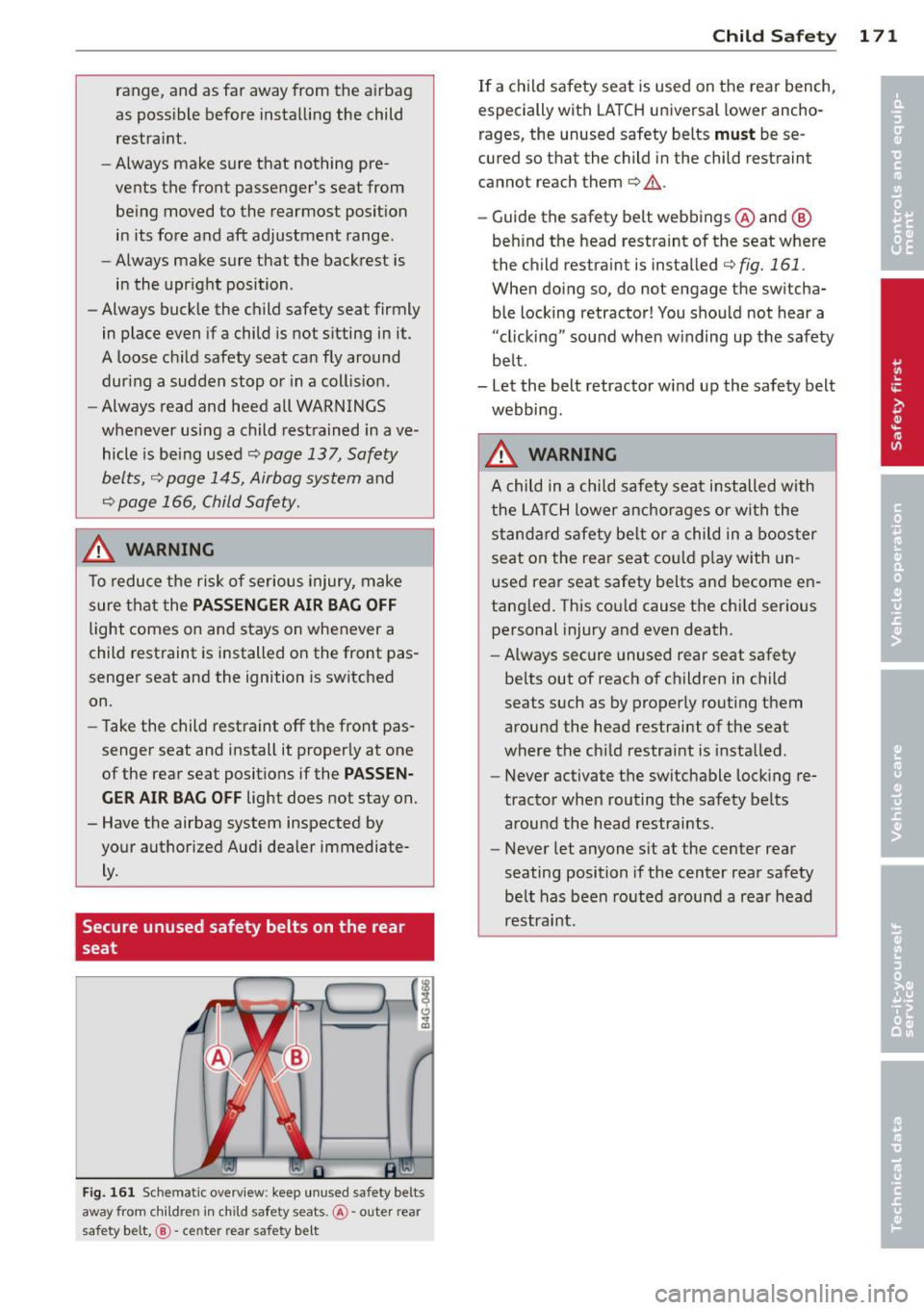
F ig. 161 Schematic overview: kee p un used safety be lts
away from chil dren in child safe ty seats. @-oute r rear
safety be lt,
@ -center rear safety belt
.
Child S afety 1 71
If a child safety seat is used on the rea r bench,
especially with LATCH universal lower ancho
rages, the unused safety belts
must be se
cured so that the child in the child restraint
cannot reach them
c:::;, &,.
- Guide the safety belt webbings @and @
beh ind the head restraint of the seat where
the child restra int is insta lled
c:::;, fig. 161.
When doing so, do not engage the switcha
ble locking retractor! You shou ld not hear a
"cl icking" sound when w inding up the safety
be lt .
- Let the belt retractor wind up the safety belt
webbing.
.8, WARNING
A child in a chi ld safety seat i nstalled with
the LA TCH lower ancho rages or with the
standard s afety be lt or a child in a boos ter
seat on the rea r seat co uld p lay with un
use d rea r seat safety belts and become en
tang led . This could cause t he chi ld ser ious
personal injury and even death.
- Always secure unused rear seat safety
be lts out of reach of children in child
seats such as by proper ly rout ing t hem
around the head restrai nt of the seat
where the ch ild restraint is installed.
- Never activate t he switchable l ock ing re
tracto r when routing the safety be lts
arou nd the head restraints.
- Never let anyone s it at the center rear
seating position if the center rea r safety
be lt has been routed around a rear head
restraint.
Page 177 of 302
~ Secure unused safety belts on the rear seat
¢ page 171 .
Children up to about 40 lbs. (18 kg) are bes t
protected in child safety seats designed for
their age and weight . Expe rts say that the
skeleta l structure, particularly the pelvis, of
these children is not fully developed, and they must not use the vehicle safety belts without
a suitable ch ild restra int.
It is usually best to put these children in ap
propriate booster seats. Be sure the booster
seat meets all applicable safety standards .
Booster seats raise the seating position of the
chi ld and reposition both the lap and shou lder
parts of the safety belt so that they pass
across the child's body in the right places. The
routing of the be lt over the child's body is very
important for the ch ild's protection, whether
or not a booste r seat is used . Children age 12
and under must always ride in the rear seat.
C hi ldren who are at least 4
ft. 9 in. (57 in
ches/1.45 meters) tall can generally use the
vehicle's th ree po int lap and shoulder belts .
Never use the lap belt portion of the veh icle's
safety be lt a lone to restrain any child, regard
l ess of how b ig the child is. Always remembe r
that children do not have the pronounced pe l
vic structure required for the proper function
of lap belt portion of the vehicle's three point
l ap and shoulder be lts. The child's safety ab
solutely requ ires that a lap be lt portion of the
safety belt be fastened snugly and as low as
possible around the pelvis. Never let the lap
be lt portion of the safety belt pass over the
chi ld's stomach or abdomen.
In a cras h, airbags must i nflate within a blink
of an eye and with cons iderable force. In orde r
to do its job, the airbag needs room to inflate
so that it will be there to protect the occupant
as the occupant moves forward into the air bag.
A vehicle occupant who is out of pos ition and
too close to the airbag gets i n the way of an
inflat ing a irbag. When an occupant is too
close, he or she w ill be str uck violen tly and
Child Sa fet y 175
will receive serious or possib ly even fatal in
jury .
In orde r fo r the airbag to offer pro te ction, i t is
important tha t all veh icle occupants, espec ial
ly any children, who m ust be in the front seat
because of exceptiona l circumstances, be
properly restrained and as far away from the
airbag as possible. By keeping room between
the child's body and the front of the passen
ger compartment, the a irbag can inflate com
pletely and provide supplemental protection
in certain frontal collisions .
_&. WARNING
Not using a booste r seat, using the boos
ter seat imp roperly, in correc tly installing a
boos ter sea t or using the vehicle sa fe ty
belt imp roperly increases the risk of seri
ous persona l injury and death in a collision
or other emergency situat ion. To he lp re
d uce the risk of serio us personal injury
and/or death:
- The shou lder belt must lie as close to the
center of the ch ild's collar bone as possi
ble and must lie f lat and snug on the up
per body. It must never lie across the
throat or neck. The lap belt must lie
across the pelvis and neve r across t he
s tomach o r abdomen. Make s ure the belt
lies fla t and snug. Pull on the belt to
tighten if necessary.
- Failure to p roperly ro ute safety belts
over a child's body will ca use seve re inj u
ries in an accident or othe r emergency
situation
¢page 137 .
-The rear side o f the child sa fety seat
should be pos itioned as close as possib le
to the backrest on the vehicle seat. Ad
just or remove the rear seat head re straint if it is diffic ult to install the ch ild
seat with the head restraint in p lace
¢ page 61. Install the head restraint
aga in immediately once the ch ild seat is
removed . D rivi ng without head restraints
or w ith head restra in ts tha t are not prop
erly ad justed increases the risk of serious
.
or fatal neck inj ury drama tically . ~
•
•
Page 178 of 302
176 Child Safety
-Children on the front seat of any car,
even with Advanced Airbags, can be seri
ously injured or even killed when an air
bag inflates .
- Never let a child stand or kneel on any
seat.
- Never let a child ride in the cargo area of your vehicle .
- Always remember that a child leaning
forward, sitting sideways or out of posi
tion in any way during an accident can be
struck by a deploying airbag . This will re
sult in serious personal injury or death .
- If you must install a rearward facing
child safety seat on the front passenger
seat because of exceptional circumstan
ces the
PASSENGER AIR BAG OFF light
must come on and stay on, whenever the
ignition is switched on.
- If you must install a booster seat on the
front passenger seat because of excep
tional circumstances the
PASSENGER
AIR BAG OFF
light must come on and
stay on, whenever the ignition is switch
ed on.
- Take the child restraint
off the front pas
senger seat and install it properly at one
of the rear seat positions if the
PASSEN
GER AIR BAG OFF
light does not stay on
whenever the ignition is switched on .
- Always read and heed all WARNINGS
whenever using a child restrained in ave
hicle is being used
¢page 137, Safety
belts,
c::> page 145, Airbag system and
c::> page 166, Important things to know .
Installing a child safety
seat
Securing a child safety seat using a
safety belt
Safety belts for the rear seats and the front
passenger's seat can be locked with the con
vertible locking retractor to properly secure
child safety seats.
The safety belts emergency locking retractors
for the rear seats safety belts and for the front
passenger's seat safety belt have a con
vertible locking retractor for child restraints.
The safety belt must be locked so that belt
webbing cannot unreel. The retractor can be activated to lock the safety belt and prevent
the safety belt webbing from loosening up
during normal driving. A child safety seat can
only be properly installed when the safety belt
is locked so that the child and child safety
seat will stay in place .
Always remember: Even though your vehicle is
equipped with an Advanced Airbag system, all
children, especially those 12 years and young
er, should always ride in the back seat proper
ly restrained for their age and weight.
& WARNING
=
Improperly installed child safety seats in
crease the risk of serious personal injury
and death in a collision.
-
-Always make sure that the safety belt re
tractor is locked when installing a child
safety seat. An unlocked safety belt re
tractor cannot hold the child safety seat
in place during normal driving or in a
crash .
- Always buckle the child safety seat firmly
in place even if a child is not sitting in it.
A loose child safety seat can fly around
during a sudden stop or in a collision.
-Always make sure that the rear seat
backrest to which the center rear safety
belt is attached is securely latched when
ever the rear center safety belt is being
used to secure a child restraint.
-If the backrest is not securely latched,
the child and the child restraint will be
thrown forward together with the back
rest and will strike parts of the vehicle
interior. The child can be seriously in
jured or killed.
- Never install rearward-facing child safety
seats or infant carriers on the front pas
senger seat. A child will be seriously in
jured and can be killed when the passen- ger airbag inflates.
~
Page 180 of 302
178 Child Safety
-Always be especially careful if you must
install a rearward facing child safety seat
on the front passenger seat in exception
al circumstances.
- A tight tether strap on a rearward-facing
child restraint attached to the front pas
senger seat can put too much pressure
on the weight-mat in the seat and regis
ter a heavier weight in the Advanced Air
bag System. The heavier weight regis
tered can make the system work as
though an adult were on the seat and de
ploy the Advanced Airbag when it must
be suppressed causing serious or even
fatal injury to the child .
- Make sure that the
PASSENGER AIR BAG
OFF
light comes on and stays on all the
time whenever the ignition is switched
on.
- If the
PASSENGER AIR BAG OFF light
does not come on and stay on, immedi
ately install the rearward-facing child
safety seat in a rear seating position and
have the airbag system inspected by your
authorized Audi dealer .
Activating the convertible locking
retractor
Use the convertible locking retractor to se
cure a child restraint.
Always heed the child safety seat manufactur
er's instructions when installing a child re
straint in your vehicle. To activate the conver
tible locking retractor :
.., Place the child restraint on a seat, prefera
bly on the rear seat.
.., Slowly pull the belt
all the way out.
.., Route it around or through the child re
straint belt path¢,&. .
.., Push the child safety seat down with your
full weight to get the safety belt really tight.
.., Insert the belt tongue into the buckle for
that sea ting position .
.., Guide the safety belt back into the retrac tor
until the belt lies flat and snug on the child
safety seat . ..,
You should hear a "clicking" noise as the
belt winds back into the inertia reel. Test the
convertible locking retractor by pulling on
the belt. You should no longer be able to pull the belt out o f the retractor. The con
vertible locking retractor is now activated .
"" Make sure that the red release button is fac
ing away from the child restraint so that it
can be unbuckled quickly.
.., Pull on the belt to make sure the safety belt
is properly tight and fastened so that the
seat cannot move forward or sideways more
than one inch (2.5 cm).
A WARNING ~
Using the wrong child restraint or an im
properly installed child restraint can cause
serious personal injury or death in a crash .
- Always make sure that the safety belt re-
tractor is locked when installing a child
safety seat. An unlocked safety belt re
tractor cannot hold the child safety seat
in place during normal driving or in a
cra:;;h.
- Always buckle the child safety seat firmly
in place even if a child is not sitting in it.
A loose child safety seat can fly around
during a sudden stop or in a crash.
- Always make sure the seat backrest to
which the child restraint is installed is in
an upright position and securely latched
into place and cannot fold forward. Oth
erwise, the seatback with the child safety
seat attached to it could fly forward in
the event of an accident or other emer
gency situation .
- Always read and heed all WARNINGS
whenever using a child restrained in ave
hicle is being used
¢ page 166. Special
precautions apply when installing a child
safety seat on the front passenger seat
¢ page 146, Child restraints on the front
seat -some important things to know .
-
Page 186 of 302
184 Child Saf ety
• Depress the spring catch on the hook and
release it from the anchorage .
(D Note
If you leave the child restraint with the
tether strap firmly insta lled for several
days, this cou ld leave a mark on the up
holstery on the seat c ushion and backrest
in the area where the tether strap was in
stalled. The upholstery would a lso be per
manently stretched around the tether
strap. Th is applies especially to leather
seats.
Using tether straps on rea rward-facing
child restraints
Currently, few rearward-facing child rest raint
systems come with a tether . P lease read and
heed the child restraint system manufactur
er's instructions carefully to determine how to properly instal l the tether.
A WARNING
-
A child in a rea rward-facing child sa fety
s e at insta lled on the front passenger seat
w ill be seriously injured and can be killed if
t he fron t air bag infl ates -even wit h an Ad
vanced Airbag System.
- T he inflati ng a irbag wi ll hit the child
sa fety sea t or infan t carrier w it h grea t
f orce and w ill smash the c hild safety sea t
and child against the backrest, cente r
armrest, or door.
- A tight tet her or ot her st rap on a rear
wa rd-facing child restra int attached to
the front passenger seat can put too much pressure on the weight-mat i n the
seat and register a heavier weight in the
Advanced Airbag System. The heav ie r
we ight registe red can make the system
wor k as though a n adu lt were on the seat
and dep loy the A dvan ced Airbag when i t
mus t be suppres sed c ausing seriou s or
eve n fa tal injury to the child.
- If you mus t install a rea rw ard fa ci ng
ch ild s afety se at on the front passenge r
sea t beca use of excep tional circ ums tan - ces and t
he
PASSENGER AIR BAG OFF
light does not come on and stay on, im
mediately install the rearward-fac ing
child safety seat in a rear seating posi·
tion and have t he ai rbag system inspec t
e d by your authorized A udi dealer .
Additional Information
'
Sources of information about child
restraints and their use
There are a number of sources of add itiona l
information about child restra int selection, in
sta llation and use:
NHTSA advises that the best ch ild safety seat
is the one that fits your ch ild and fits in your
vehicle, and that you will use correct ly and
cons istently .
Try before yo u buy!
U .S National Highway Traffi c Safet y Admin
istration
Tel.: 1 -888-327- 4236 (TIY: 1-800-424-9153)
www.n htsa.gov
National SAFE KIDS Campaign
Tel.: (202) 662 -0600
www.safek ids.org
Safet y BeltSafe U.S.A
Tel.: (800) 7 45-SAFE (English)
T el.: (800) 7 47-SANO (Spanis h)
www.carseat.org
Transport Canada Information Centre
T el.: 1 -800 -33 3-0371 o r ca ll
1-6 13-998-86 16 if yo u are i n the Ottawa area
http://www.tc.gc.ca/eng/roadsafety/
menu. htm
Audi Cu stomer Relation s
Tel.: (800) 822 -2834
Page 188 of 302
186 Intelligent technology
ESC includes and/or works together with the
anti-lock brake system (ABS), brake assist sys
tem, anti-slip regulation (ASR) , e lectronic dif
ferential lock (EDL), dynamic steering" and
e lectronic interaxle differentia l lock* /selective
wheel torque control* . ESC is switched on all
the t ime. I n certa in s ituations whe n you need
l ess t raction, you can switch
off ASR by p ress
i ng the bu tto n
[ru ¢ page 188, fig. 176 or
¢ page 188, fig. 177. Be sure to sw itch ASR
on aga in when yo u no longer need less t rac
tion .
Anti -lock braking system (ABS)
ABS prevents the wheels from locking up
when braki ng. The veh icle can still be steered
even d uring h ard br aking. Apply ste ady p res
sure to the brake pedal. Do no t pump the ped
a l. A pulsing in the brake peda l indicates t hat
the system is he lping yo u to b rake the vehicle .
Brake assist system
The brake assis t system can decrease b ra ki ng
d ista nce. It increases braking power w hen the
d river p resses the brake pedal quic kly in eme r
gency situations . You must p ress and hold the
brake peda l until the situation is over. In
vehicles w ith adapt ive cru ise contro l", the
brake assist system is more sensit ive if the
d ista nce detected to t he vehicle a head is too
small.
Anti-slip regulation (ASR)
ASR reduces engine power when the drive
wheels begin to spin and adapts the fo rce to
the road condit ions. This makes it eas ier to
start , accelerate and drive up hills.
Electronic differenti al lock (EDL )
The ED L brakes wheels that are spinn ing and
transfers the drive power to the other drive
wheel or whee ls if t he vehicle is equipped with
all-w heel drive*. This function is available up
to about 60 mph (100 km/h).
In extreme cases, EDL automat ica lly switches
off to help keep the bra ke on the braked whee l
from overheating. EDL wi ll switch on again au-tomat
ica lly when conditions have ret urned to
no rma l.
Dynamic steering*
On vehicles wi th dynam ic steering*, ESC he lps
st abi liz e the steer ing in cr itical situ ations.
Electronic interaxle differential lock* /
selective wheel torque control*
T he elec troni c int eraxle differentia l lock (front
whee l dr ive) o r th e se lec tive whee l torque
control (all-whee l dr ive) oper ates when dr iv
ing t hro ugh curves. The front wheel on the in
side of the c urve or both whee ls on the inside
of the c urve are b raked se lectively as needed.
This m inimizes sliding in the front wheels and
allows for more precise driving through
curves . The applicable system may not acti
vate when dr iving in wet o r snowy cond itions.
A WARNING
- ESC, ABS, ASR, EDL dynam ic steering*
a nd the ele ct roni c interaxle d ifferential
lo ck* /se lective whee l torque con trol *
cannot ove rcome the laws of physics .
This is especially important on sli ppery
or wet roads.
If the systems beg in acting
to stabilize your veh icle, yo u should im
mediately change your speed to match
the road and traffic conditions . Do not
let the increased safety prov ided by
these systems tempt you to take r isks.
Doing so will increase the risk of a loss of
veh icle cont ro l, col lision and ser ious pe r
sonal injur ies.
- Always ada pt your speed to road, traffi c
a nd wea ther conditions. The r isk of los-
ing con trol of the vehicle i ncreases when
d riving too fast, es pec ia lly through
curves and o n slippe ry or wet roads, an d
when dr iv ing too close to vehicles up
ahead. ESC, ABS, the brake ass ist sys
tem, ASR, EDL dynam ic steer ing* and the
e lectronic inte raxle differentia l lock*/se
lec tive whee l to rque control* cannot p re-
-
vent co llisi ons. ~