tire pressure AUDI A4 2015 Owner's Manual
[x] Cancel search | Manufacturer: AUDI, Model Year: 2015, Model line: A4, Model: AUDI A4 2015Pages: 304, PDF Size: 74.86 MB
Page 246 of 304
244 Tires and whee ls
occupants and luggage or other
cargo that the vehicle can carry .
For the location of the label
¢ page 234, fig . 189 .
A WARNI NG
-~
Overload ing a vehicle can
cause loss of vehicle control,
a crash or other accident, se
rious personal injury, and
even death.
- Carrying more weight than
your vehicle was designed to carry will prevent the vehicle from handling properly
and increase the risk of the
loss of vehicle control.
- The brakes on a vehicle that
has been overloaded may
not be able to stop the vehi
cle within a safe distance.
- Tires on a veh icle that has
been overloaded can fail
suddenly, including a blow
out and sudden deflation,
causing loss of control and a
crash.
- Always make sure that the
total load be ing transported
- including the weight of a
traile r hitch and the tongue
weight of a loaded traile r -
does not make the vehicle heavier than the vehicle's
Gross Vehicle Weight Rat
ing.
Determining correct load
limit
Use the example below to cal
culate the total weigh t of the
passengers and luggage or oth
er th ings that you p lan to trans
port so that you can make sure
that your vehicle w ill not be
overloaded .
Steps for Determining
Correct Load Limit
1. Locate the statement "THE
COMBI NED WEIGH T OF OC
CUPANTS AND CARGO
SHOULD N EVER EXCE ED XXX
KG OR XXX LBS"on your vehi
c le's placard (tire inflation
pressure label)
¢ page 234,
fig . 189 .
2. Determine the combined
weight of the driver and pas
sengers that will be riding in
your vehicle .
3 . Subtract the combined
weight of the driver and pas
sengers from
"XXX" k ilo
grams or
"XXX" pounds
Page 247 of 304
M N
~ co
rl I.O
"' rl
"' rl
shown on the sticker
c=> page 234, fig. 189.
4. The resulting figure equals
the available amount of car go and luggage load capaci
ty. For example, if the
"XXX"
amount equals 1400 lbs.
and there will be five
150
lbs . passengers in your vehi
cle, the amount of available
cargo and luggage load ca
pacity is
650 lbs. (1400-750
(5
X 150) = 650 lbs.)
5. Determine the combined
weight of luggage and cargo being loaded on the vehicle.
That weight may not safely
exceed the available cargo
and luggage load capacity
calculated in Step
4.
6. If your vehicle will be towing
a trailer, load from your trail
er will be transferred to your
vehicle . Consult this manual
to determine how this re
duces the available cargo
and luggage load capacity of
your vehicle .
.,.Check the tire sidewall
{c:> page 248, fig. 193) to de
termine the designated load
rating for a specific tire.
Tires and wheels 245
Tire service life
The service life of tires depends
on a lot of different things in
cluding proper installation and
balancing, correct tire pressure
and driving style.
Fig. 191 Tire tread : tread wear indi
cators (TWI)
Fig. 192 Rotating tires for more even
wear
Tread Wear Indicator (TWI)
The original tires on your vehi
cle have
1/16 inch (1.6 mm)
high "wear indicators"
c=> fig. 191 running across the
tread. Depending on the make,
there will be six to eight of
them evenly placed around the
tire. Marks on the tire sidewall (for example "TWI" or other
Page 248 of 304
246 Tires and whee ls
symbols) indicate the positions
of the tread wear indicators .
Worn tires must be replaced. Different figures may apply in
other countries
s> .1:. .
Tire pressure
Incorrect tire pressure causes
premature wear and can cause
sudden tire blow-out. For this
reason, tire pressure must be
checked at least once a month
r::::>page239 .
Driving style
Driving fast around curves,
heavy acceleration and hard
b raking increase tire wear .
Rotating tires for more even
wear
For all four tires on your vehic le
to have the same service life,
we recommend that the front and rear tires are rota ted ac
cord ing to the tire man ufactur
er's s uggested tire rotat ion in
tervals. Please remember the
following:
-Tire rotation intervals may dif fer from the vehicle service in
tervals outlined in your Main
tenance and Warranty Book let . -
The longer one tire is used in
o ne location on the ve hicle,
the more it wears at certain points; therefore, we recom
mend tha t you follow the tire
manufact ure r's suggested tire
rotat ion interva ls .
- Vehicles with front -wheel
drive expe rience more tread
wear on the front whee ls com
p ared to all wheel drive (q uat
tro).
-Please rota te t ires as shown
r::::> fig . 192 .
-Extra care must be taken when
rotat ing direction-speci fic
tires c:> page 26 7.
Wheel balancing
The wheels on new vehicles are
balanced . Howeve r, various sit
uations d uring everyday drivi ng
can cause them to become un
balanced , resulting in vibra
tions you can usu ally feel
through the s teering wheel.
Unbalanced wheels must be re
ba lanced to avoid excessive
wea r on steering, suspension
and tires. A wheel must also be
rebalanced when a new tire is
insta lled .
Page 250 of 304
248 Tires and wheels
New tires and replacing
tires and wheels
New tires and wheels have to
be broken in.
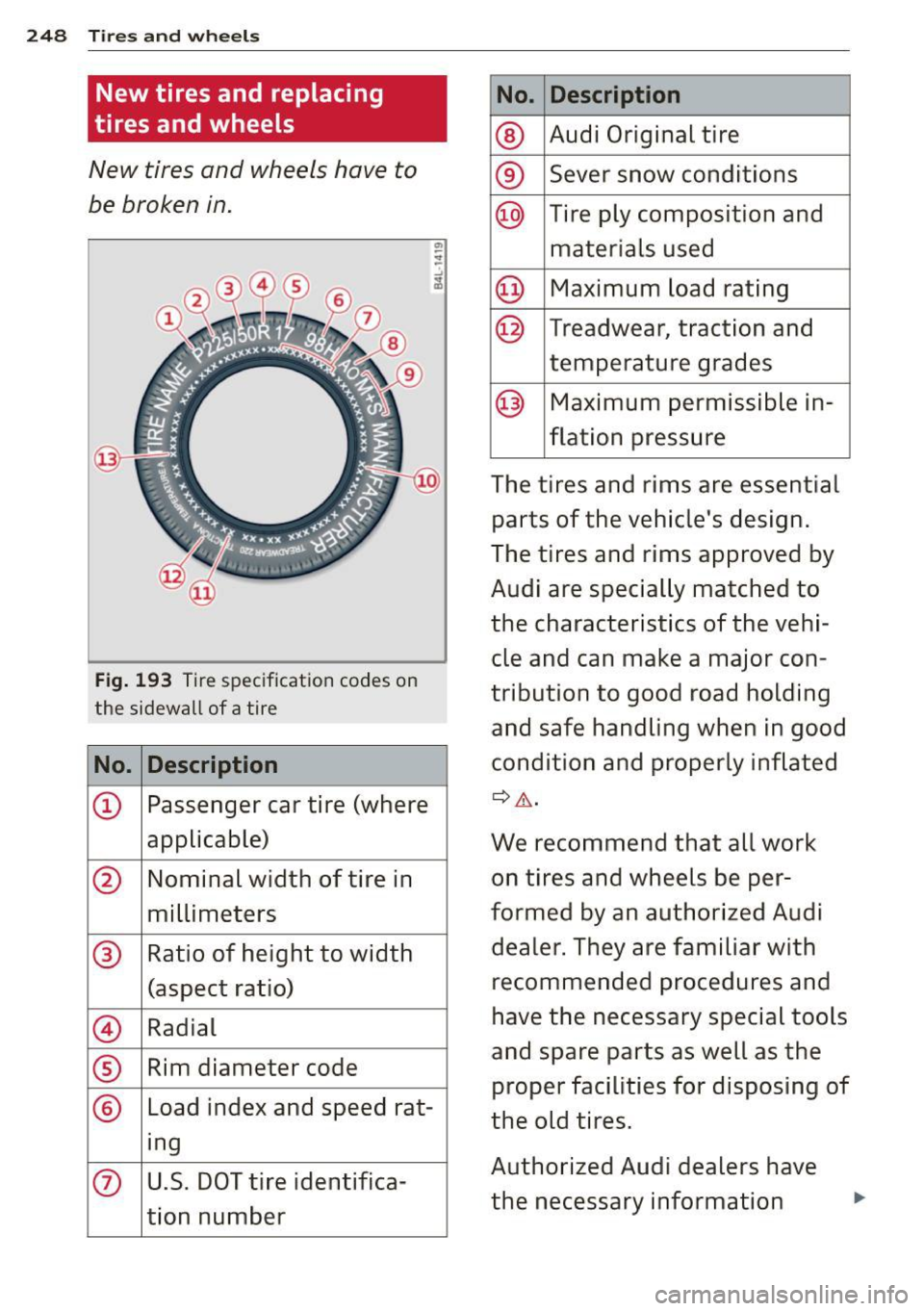
Fig. 193 Tire specification codes on
the sidewall of a tire
No. Description
CD Passenger car tire (where
applicable)
@ Nominal width of tire in
millimeters
@ Ratio of height to width
(aspect ratio)
© Radial
® Rim diameter code
® Load index and speed rat-
1ng
(j) U.S. DOT tire identifica -
tion number
No. Description
® Audi Original tire
® Sever snow conditions
@ Tire ply composition and
materials used
@ Maximum load rating
@ Treadwear, traction and
temperature grades
@ Maximum permissible in-
flation pressure
The tires and rims are essential
parts of the vehicle's design.
The tires and rims approved by
Audi are specially matched to
the characteristics of the vehi
cle and can make a major con
tribution to good road holding and safe handling when in good
condition and properly inflated
¢ A .
We recommend that all work
on tires and wheels be per
formed by an authorized Audi
dealer. They are familiar with recommended procedures and
have the necessary special tools
and spare parts as well as the
proper facilities for disposing of
the old tires.
Authorized Audi dealers have
the necessary information
Page 251 of 304
about technical requirements
for installing or changing t ires
and rims.
Replacing tires and wheels
Tires should be replaced at least in pairs and not individu
ally (for example both front
tires or both rear tires togeth er) .
Be sure to read and heed the in
formation to the tire pressure monitoring system*
¢ page 257.
Always buy replacement radial
tires that have the same specifi
cations as the tires approved
for your vehicle by Audi. Re
placement tires must always
have the same load rating spec
ification as the original equip
ment or approved optional tires
listed in the table¢
page 234.
Audi-approved specification
tires are specially matched to
your vehicle and its load limits and can contribute to the im
portant roadholding, driving
characteristics, and safety of
the vehicle. The table ( ¢
page 234) lists specifica
tions of the tires approved for
I
Tires and wheels 249
the Audi models covered by
your Owner's Literature.
The tire pressure label located on driver's side B-pillar
( c::> page 234J fig. 190) lists the
specifications of the original
equipment tires installed on
your vehicle at the time it was
manufactured.
Federal law requires tire manu
facturers to place standardized information on the sidewall of
all tires
¢fig. 193. This infor
mation identifies and describes
the fundamental characteris
tics, the quality grade of the
tire and also provides a tire identification number for safety
standard certification and in
case of a recall.
Tire specifications
Knowledge of tire specifications
makes it easier to choose the
correct tires. Radial tires have
the tire specifications marked on the sidewall , for example:
P255 / 35 R19 96V XL
This contains the following in-
formation: ..,..
•
•
'
Page 254 of 304
252 Tires and wheels
Maximum Permissible
Inflation Pressure
This number is the greatest
amount of air pressure that
should ever be put in the tire
under normal driving condi
tions.
.&_ WARNING
-Using incorrect or unmatch ed tires and/ or wheels or improper tire and wheel
combinations can lead to loss of control, collision and
serious personal injury.
-Always use tires, rims and wheel bolts that meet the
specifications of original
factory-installed tires or
other combinations that have been specifically ap
proved by the vehicle manu
facturer.
-Tires age even if they are
not being used and can fail
suddenly, especially at high
speeds. Tires that are more
than 6 years old can only be used in an emergency and
then with special care and
at lower speeds.
-Never mount used tires on your vehicle if you are not sure of their "previous
histo
ry." Old used tires may have
been damaged even though
the damage cannot be seen
that can lead to sudden tire
failure and loss of vehicle
control.
-All four wheels must be fit ted with radial tires of the
same type, size (rolling cir
cumference) and the same
tread pattern. Driving with different tires reduces vehi
cle handling and can lead to
a loss of control.
-If the spare tire is not the
same as the tires that are
mounted on the vehicle -for
example with winter tires -
only use the spare tire for a
short period of time and
drive with extra care. Refit
the normal road wheel as soon as safely possible.
-Never drive faster than the maximum speed for which
the tires on your vehicle are
rated because tires that are
driven faster than their rat
ed speed can fail suddenly.
-Overloading tires cause heat build-up, sudden tire fail
ure, including a blowout
..
Page 255 of 304
and sudden deflation and loss of control.
-Temperature grades apply to tires that are properly in
flated and not over or un
derinflated.
-For technical reasons it is not always possible to use
wheels from other vehicles_ 1n some cases not even
wheels from the same vehi
cle model.
-If you install wheel trim discs on the vehicle wheels
I
make sure that the air flow
to the brakes is not blocked.
Reduced airflow to the
brakes can them to over
heat, increasing stopping
distances and causing a col lision.
-Run flat tires may only be used on vehicles that were
equipped with them at the
factory. The vehicle must have a chassis designed for
run flat tires and a factory
installed tire pressure moni
toring system* that indi cates a loss of tire pressure.
Incorrect use of run flat
tires can lead to vehicle damage or accidents. Check
Tires and wheels 253
with an authorized Audi dealer or tire specialist to
see if your vehicle can be
equipped with run flat tires.
If run flat tires are used
I
they must be installed on all
four wheels. Mixing tire types is not permitted.
(D Note
-For technical reasons, it is not generally possible to
use the wheel rims from
other vehicles. This can hold
true for wheels of the same
vehicle type.
-If the spare tire is different from the tires that you have mounted on your vehicle
(for example winter tires or
wide profile tires), then use
the spare tire for a short pe riod of time only and drive
with extra care. Replace the
flat tire with the tire match ing the others on your vehi
cle as soon as possible.
-Never drive without the valve stem cap. The valves could get damaged.
I),
•
•
'
Page 259 of 304
'"" N
0 ::.,: co ,...., \!) 1.1'1 ,...., 1.1'1 ,....,
and handling under a variety of driving condi
tions . Ask your authorized Audi dealer for
more details.
The low aspect ratio of these tires is indicated
by a numeral of
55 or less in the tire's size
designation. The numeral represents the ratio
of the tire's sidewa ll height in relation to its
tread width expressed in percentage . Conven
tional tires have a height/width ratio of 60 or
more .
The performance of low-aspect-ratio tires is
particularly sensitive to improper inflation
pressure. It is therefore important that low
aspect ratio tires are inflated to the specified
pressure and that the inflation pressure is
regularly checked and maintained. Tire pres
sures should be checked at least once a
month and always before a long trip
¢ page 239, Checking tire pressure.
What you can do to avoid tire and rim
damage
Low aspect ratio tires can be damaged more
easily by impact with potho les, curbs, gullies
or ridges on the road, particularly if the tire is
underinflated .
In order to minimize the occurrence of impa ct
damage to the tires of your vehicle, we recom
mend that you observe the following precau
tions:
- Always maintain recommended inflation
pressures. Check your tire pressure every
2,000 miles (3,000 km) and add air if neces
sary .
- Drive carefully on roads with potholes, deep
gullies or ridges. The impact from driving
t hr ough or over such obstacles can damage
your tires. Impact with a curb may also cause damage to your tires.
- After any impact, immediately inspect your
t ir es or have them inspected by the nearest
authorized Aud i dealer. Replace a damaged
t ir e as soo n as possible .
- Inspect your t ires every 2,000 miles (3,000
km) for damage and wear . Damage is not al
ways easy to see . Damage can lead to loss of
air and underinflation, wh ich could eventu-
Tires and wheels 257
ally cause tire failure. If you believe that a
tire may have been damaged, rep lace the
tire as soon as possib le.
- These tires may wear more quickly than oth
ers.
- Please also remembe r that, while these tires
deliver responsive handling, they may ride
less comfortably and make more noise than
other choices.
Reduced performance in winter/cold
season conditions
All tires are designed for certain purposes.
The low aspect ratio, ultra high performance
tires or iginally installed on your vehicle are in
tended for maximum dry and wet road per
formance and handling. They are not suitable
for cold, snowy o r icy weather conditions. If
you drive under those circumstances, you
should equip your vehi cle w ith all-season or
winter tires, which offer better traction under
those conditions. We suggest you use the rec
ommended snow or a ll-season tires specified
for your vehicle, or their equivalent .
Refer to¢
page 254 for more detailed infor
mation regarding winter tires.
Ti re pressure
monitoring system
ill General notes
Applies to vehicles: with tire pressure monitoring system
Each tire, including the spare (if provided),
sho uld be checked monthly when cold and in
flated to the inflation pressure recommended by the veh icle manufacturer on the veh icle
placard or tire inflation pressure label. (If your
vehicle has tires of a d ifferent size than the
s ize indicated on the vehicle placard or tire in
flat io n pressure label, you should determine
the proper t ire inflation pressu re for those
tires).
As an added safety feature , your veh icle has
been equipped with a tire pressure mon itoring
system (TPMS) that illum inates a low ti re
pressure te llt ale when one or more of your
tires is significantly under-inflated. .,.
•
•
Page 260 of 304
258 Tires and wheels
Accordingly, when the low tire pressure tell
tale illuminates, you should stop and check
your tires as soon as possible, and inf late
them to the proper pressure. Driving on a sig nificantly under-inflated tire causes the tire to
overheat and can lead to tire failure. Under-in
flation also reduces fuel efficiency and tire
tread life, and may affect the vehicle's han
dling and stopp ing ability.
Please note that the TPMS is not a subst itute
for proper tire maintenance, and it is the driv
er's responsib ility to ma inta in correct tire
pressu re, even if under- inflation has not
reached the level to trigger illumination of the
TPMS low tire pressure telltale.
Your veh icle has also been equ ipped with a
TPMS malfunction indicator to indicate when
the system is not operating properly. The
TPMS malfunction indicator is combined with
the low tire pressure telltale . When the sys
tem detects a malfunction, the te lltale will
f lash for approximately one minute and then
remain cont inuous ly illuminated. This se
quence will continue upon subsequent vehicle
start-ups as long as the ma lfunction ex ists .
When the malfunct ion indicator is illuminat
ed, the system may not be able to detect or
signal low t ire pressure as intended. TPMS
malfunctions may occur for a variety of rea
sons, includ ing the installat ion of replace
ment or a lternate tires or whee ls on the veh i
cle that prevent the TPMS from functioning
p rop erly. Always check the TPM S malf unct ion
tellta le after replacing one o r more t ires or
wheels on your vehicle to ensure that the re p lacement or a lternate tires and wheels allow
the TPMS to continue to function properly. Tire pressure indicator appears
App lies to vehicles : wi th tire p ress ure mo nito rin g system
The tire pressure indicator in the instrument
cluster informs you if the tire pressure is too
low or if there is a system malfunction .
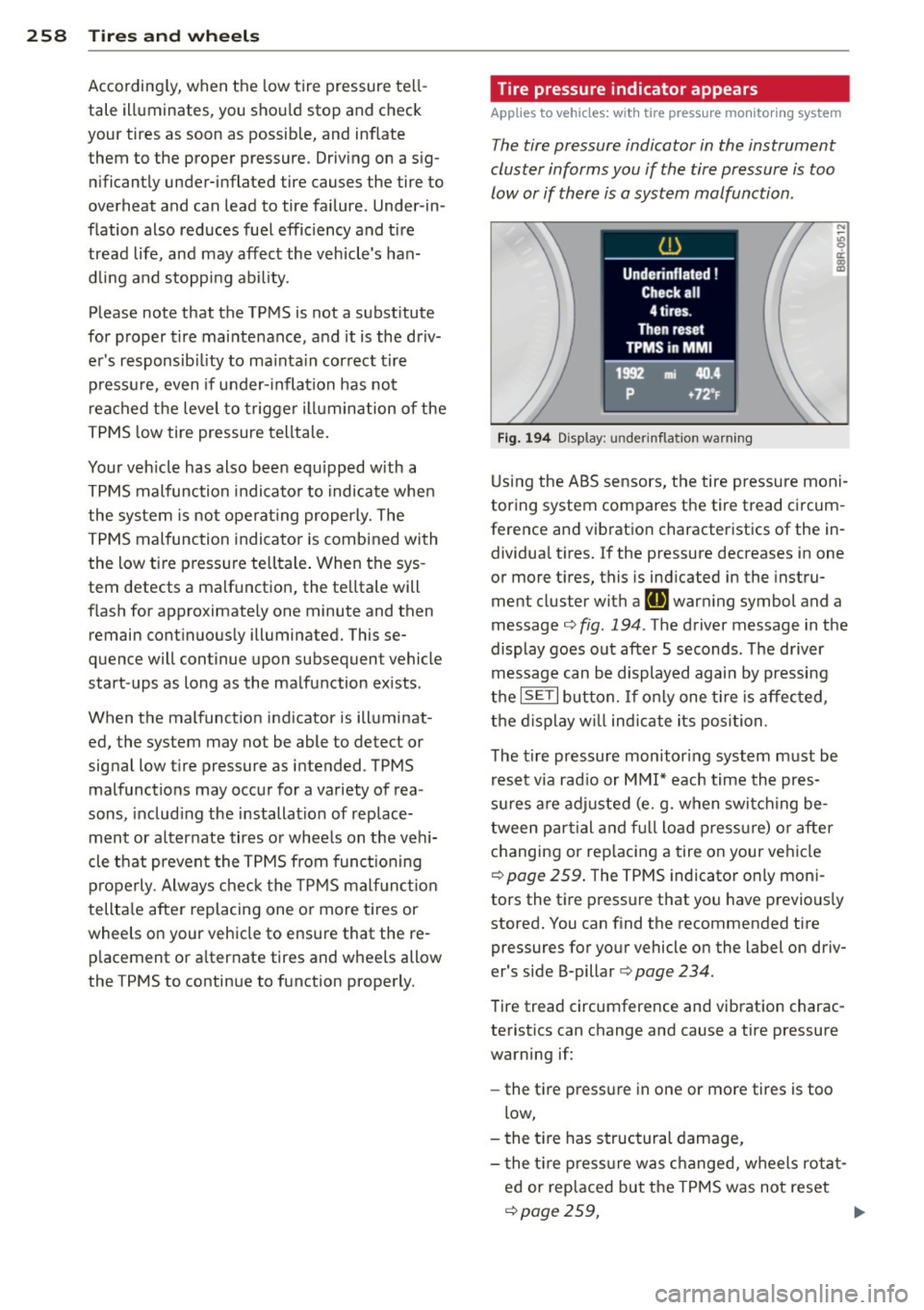
Fig. 194 Display: u nde rinfla tion warning
Using the ABS sensors, the tire pressure moni
toring system compares the tire tread circum
ference and vibration characteristics of the in
dividua l tires.
If the pressure decreases in one
or more t ires, this is indicated in the instru
ment cluster with a
RI] war ning symbol and a
message¢
fig . 194 . The driver message in the
display goes out afte r 5 seconds . The driver
message can be displayed again by pressing
the
ISETI button. If o nly one tire is affec ted,
the display will ind icate its position.
The tire pressure monitoring system must be
reset via rad io or MMI* each time the pres
sures are adjusted (e.g. when switching be
tween partial and full load pressure) or after
changing or replacing a tire on your ve hicle
¢
page 259. The TPMS indicator only moni
tors the tire pressure that you have previous ly
stored. You can find the recommended tire
pressures for your vehicle on the label on driv
er's side 8-pillar ¢
page 234.
Tire tread circumference and vibration charac
teristics can change and cause a tire pressure
warning if:
- the tire pressure in one or more tires is too
low,
- the tir e has structural damage,
- the tir e pressure was changed, wheels rotat-
ed or rep laced but the TPMS was not reset
¢page 259, ..,_
Page 261 of 304
'"" N
0 ::.,: co ,...., \!) ..,.,
,...., ..,., ,....,
-the spa re tire* /inflatable spare tire* is
mounted.
Warning symbols
[IJ Loss of pressure in at least one tire¢,&. .
Check the tire or tires and replace or repair if necessa ry. The indicator light
[IJ in the instru
ment cluster also illuminates
¢page 13.
Check/correct the pressures of all four tires
and resetTPMS via radio or MMI*.
mm (T ire Pressure Monitoring System) Ti re
pre ssure: S ystem m alfuncti on!.
1tE appea rs after sw itching the ign it ion on
or while d rivi ng and the ind icator light
[IJ in
the instrument cluster blinks for approxi mately one minute and then stays on, there is
a system malfunction. Attempt to store the
correct t ire pressure ¢
page 259. If the indi
cator light does not turn off or if it turns on
shortly thereafter, immediately drive your ve
h icle to an authorized Audi dealer or author
ized repair facility to have the malfunction
corrected.
.&, WARNING
- If the t ire pressure indicator appears in
the instrument cl uster d isplay, one or
more o f your tires is significantly under
inflated. Reduce your speed immediately
and avoid any hard steering or braking
maneuvers. Stop as soon as possible and
check the t ires and the ir pressures. In
flate the tire pressure to the proper pres
sure as indicated on the vehicle 's t ire
pressure label~
page 234 . Driving on a
significantly under-inflated tire ca uses
the tire to overhea t and can lead to tire
failure. Under-inflation also is likely to impair the vehicle 's handling and stop
ping ability.
- The driver is responsible for mainta ining
the correct tire pressures. You must check the tire pressures regularly .
- Under certain cond itions (such as a spor
ty driving style, winter conditions or un paved roads), the pressure monitor indi
cator may be de layed .
Tire s an d wheel s 259
-Ask your a uthorized Audi dea ler if run
flat tires may be used on your vehicle.
(D Tips
- The tire pressure mon itoring system may
stop working when there is an ESC ma l
function.
- Using snow chains may res ult in a system
ma lfunction.
- The tire pressure mon itor ing system on
your Audi was deve loped using tires with
the "AO" or "RO" identification on the
tire s idewall
~ page 248. We recom
mend us ing these tires.
Reset tire pressure monitoring system
App lies to vehicles: with tire pressure mon itor ing system
If the tire pressure is adjusted, wheels ore ro
tated or changed, the TPMS must be reset via
radio or MMI*.
... Before storing the new tire pressures, check
that the current pressures on all four tires
correspond to the specified va lues and
adapt the pressures to the current load
¢ page 234.
.,. Switch on the ignition.
.,. Select: the
I CARI funct io n button > Tir e pre s
s ure mon itoring
> Store now . Or
.,. Select: the
I CARI fu nct ion button > Car sy s
tem s*
contro l button > S erv icing & che cks >
Tire pres sure mon itor in g > Store tire pre s
s ures
> Yes, sto re now .
(D Tips
Do not store the tire pressure if there are
snow chains on the tire . Otherwise, a sys
tem mal function may occur.
•
•