tow AUDI A4 2016 Owner's Manual
[x] Cancel search | Manufacturer: AUDI, Model Year: 2016, Model line: A4, Model: AUDI A4 2016Pages: 278, PDF Size: 70.26 MB
Page 128 of 278
Driving safety
_& WARNING
Pedals that cannot move freely can cause loss
of vehicle control and increase the risk of seri·
ous injury .
- Never place any objects in the driver's foot
well. An object could get into the pedal area
and interfere with pedal function . In case of
sudden braking or an accident, you would
not be able to brake or accelerate!
-Always make sure that nothing can fall or
move into the driver 's footwell.
Floor mats on the driver side
Always use floor mats that can be securely at
tached to the floor mat fasteners and do not in
terfere wi th the free movement of the pedals .
.,. Make sure that the floor mats are properly se
cured and cannot
mov e and interfere with th e
pedals
c:> ,& .
Use only floor mats that leave the pedal area un
obstructed and that are firmly secured so that
they cannot slip out of position. You can obtain
suitable floor mats from your authori zed Audi
dealer .
Floor mat fasteners are installed in your Audi.
Floor mats used in your vehicle must be attached
to these fasteners. Properly securing the floor
mats will prevent them from sliding into posi
tions that could interfere with the pedals or im
pair safe operation of your vehicle in other ways.
A WARNING
Pedals that cannot move freely can result in a
loss of vehicle control and increase the risk of
serious personal injury .
- Always make sure that floor mats are prop
erly secured.
- Never place or install floor mats or other
floor coverings in the vehicle that cannot be
properly secured in place to prevent them
from slipping and interfering with the ped als or the ability to control the vehicle.
- Never place or install floor mats or other
floor coverings on top of already installed
126
floor mats. Additional floor mats and other
coverings will reduce the size of the pedal
area and interfere with the pedals.
- Always properly reinstall and secure floor
mats that have been taken out for cleaning .
- Always make sure that objects cannot fall
into the driver footwell while the vehicle is
moving. Objects can become trapped under
the brake pedal and accelerator pedal caus ing a loss of vehicle control.
Storing cargo correctly
Loading the luggage compartment
All luggage and other objects must be properly stowed ond secured in the luggage compart
ment .
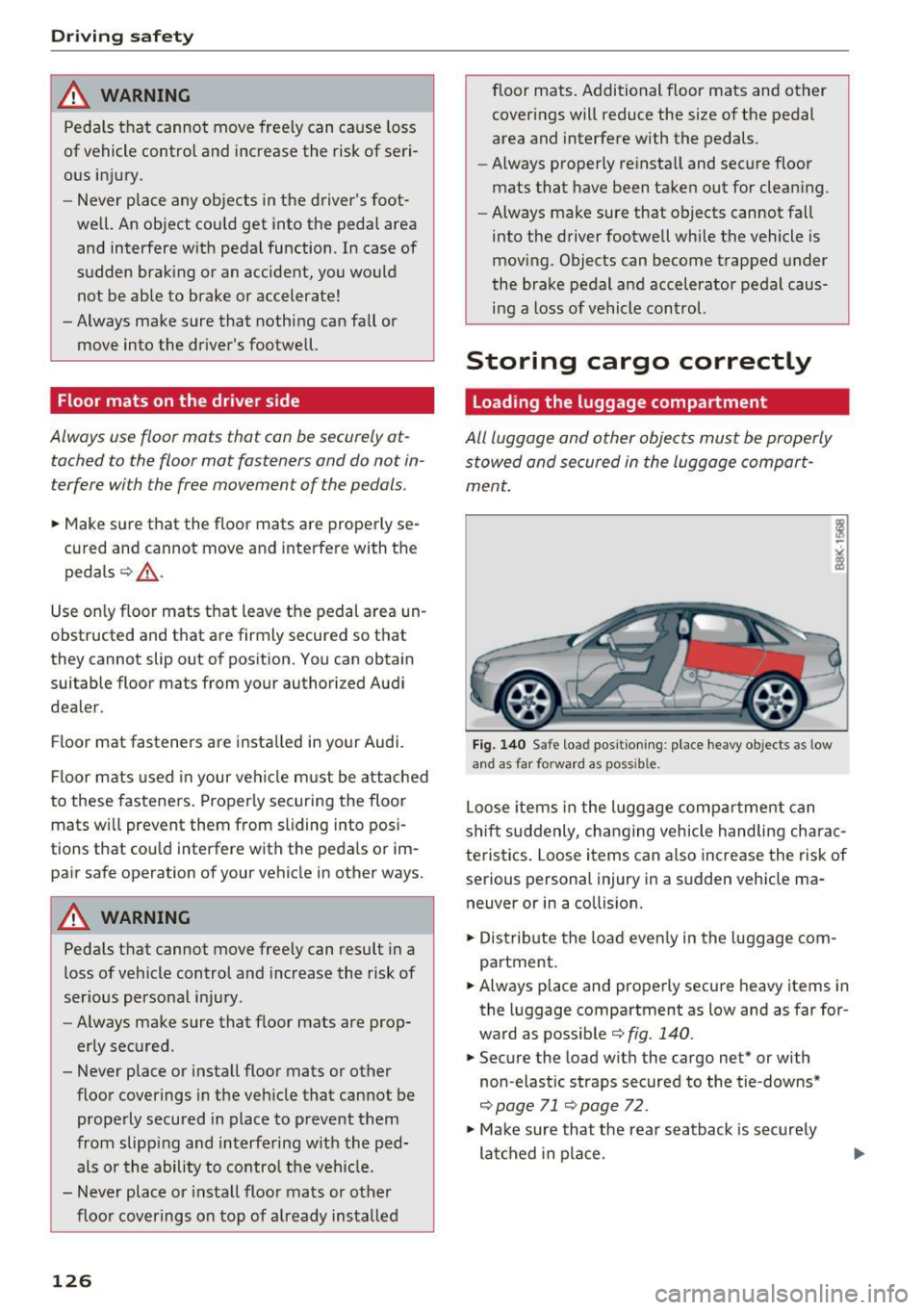
Fig. 140 Safe load positioning : place heavy ob jects as low
and as far forward as poss ib le.
Loose items in the luggage compartment can
shift suddenly, changing vehicle handling charac
teristics. Loose items can also increase the risk of
serious personal injury in a sudden vehicle ma
neuver or in a collision .
.,. Distribute the load evenly in the luggage com
partment.
.,. Always place and properly secure heavy items in
the luggage compartment as low and as far for
ward as possible
c:> fig. 140 .
.,. Secure the load with the cargo net* or with
non-elastic straps secured to the tie -downs*
c:> page 71 c:>page 72.
.,. Make sure that the rear seatback is securely
latched in place.
Page 137 of 278
,....,
N
0
""' CX) ,....,
I.Cl U"I ,....,
I.Cl ,....,
-A loose-fitting safety be lt can cause serious
injuries by shifting its pos ition on your body
from the strong bones to more vulnerable,
soft tissue and cause serious injury .
- Always read and heed all WARNINGS and
other important information
c!) page 132.
Pregnant women must also be correctly
restrained
The bes t way to pro tec t the fe tus is to make sure
that expectant mothers always wear safety belts
correctly -throughout the pregnancy .
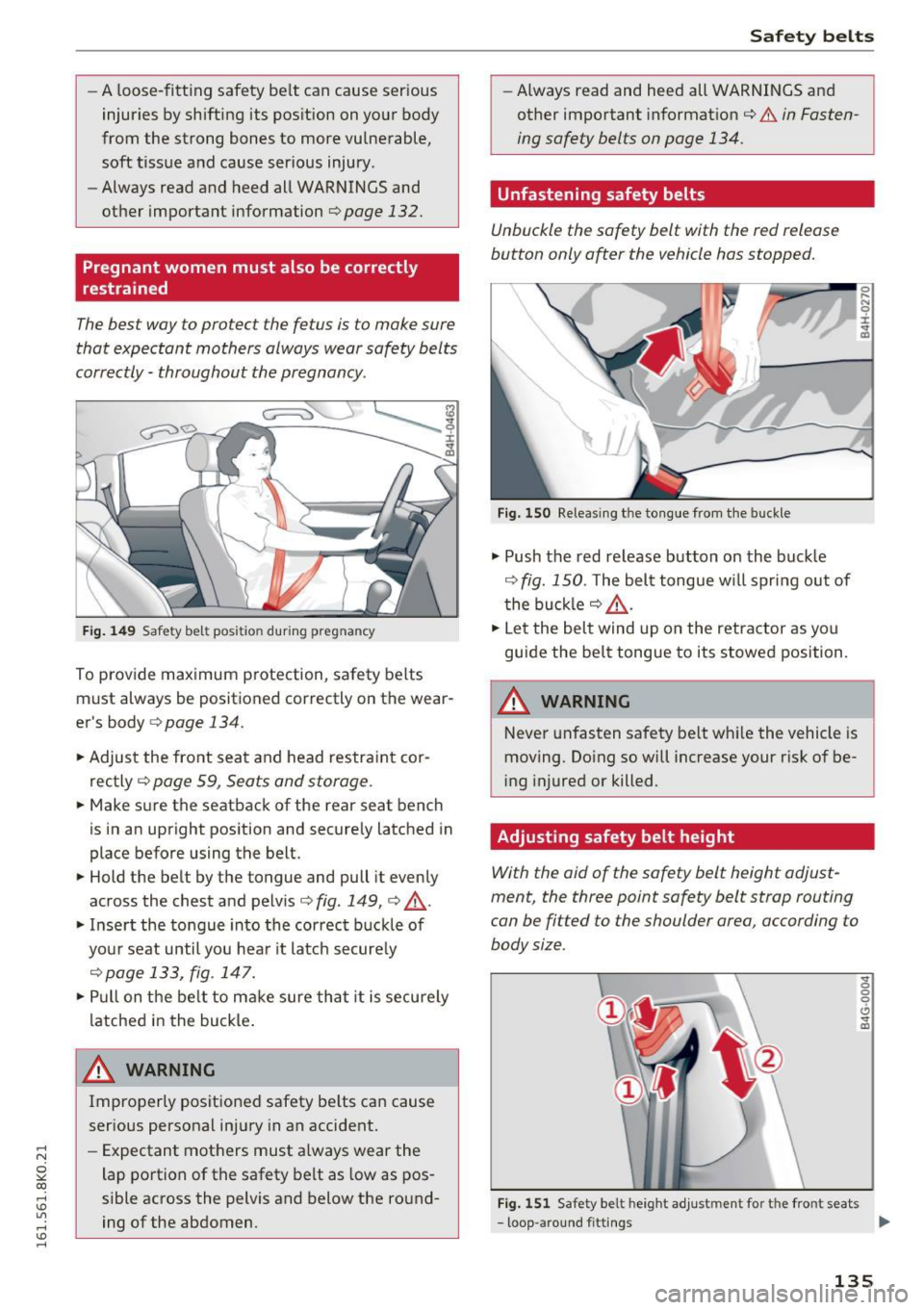
Fig . 14 9 Safe ty belt pos itio n dur ing pregn an cy
To provide max imum p rotection, safety belts
must always be positioned correctly on the wear
er's body
c:> page 134.
.,. Adjust the front seat and head restraint cor
rectly ¢
page 59 , Seats and storage .
.,. Make su re th e seatback of the rear seat bench
is in an upright position and secure ly latched in
place before using the belt.
.,. Hold the belt by the tongue and pull it even ly
across the chest and pelv is
c:> fig. 149, c:> ,& .
.,. Inse rt the tongue into the cor rec t buckle of
you r seat until you hea r it latch securely
,:!)page 133, fig . 147.
.,. Pull on the be lt to m ake sure that it is securely
latched in the bu ck le .
& WARNING
Improperly positioned safety be lts can cause
ser ious personal inj ury in an accident.
- Expectant mothers must a lways wear the
lap portion of the safety belt as low as pos
sible across the pelvis and below the round ing of the abdomen .
Safety bel ts
-Always read and heed all WARNINGS and
other important informat ion ¢
A in Fasten
ing safety belts on page 134.
Unfastening safety belts
Unbuckle the safety belt with the red release
button only o~er the vehicle has stopped.
.,
JJ
Fig. 150 Releasi ng t he to ngue from the buckle
.,. Push the red re lease but ton on the buck le
r:!) fig. 150 . The belt tongue w ill spr ing out of
t he buck le
c:> ,& .
.,. Let the belt wind up on the retra ctor as yo u
guide the belt tongue to its stowed posit ion.
& WARNING
Never unfasten safety belt whi le the vehicle is
moving . Do ing so will increase your r isk of be
i ng injured or killed .
Adjusting safety belt height
With the aid of the safety belt height adjust
ment, the three point safety belt strap rout ing
can be fi tted to the shoulder area, according to
body size .
Fig. 1 51 Safety belt height a dju stm ent fo r th e fro nt seat s
0 .... N 0
:i: .., co
... 0 0
0
6 ... co
-loop -a round fittings Ill>
135
Page 148 of 278
Airbag syste m
restraints or occupants on the front passen
ger seat and prevent the side airbag in the
seat backrest from deploying properly.
- Never use cushions, pillows, blankets or
similar items on the front passenger seat.
The additional padding will prevent the
weight-sens ing mat in the seat from accu
rately reg istering the ch ild restraint or per
son on the seat and prevent the Advanced
Airbag System from funct ioning prope rly.
- If you must use a child restraint on the front
passenge r seat and the child restraint man
ufact urer's instructions require the use of a
towel, foam cushion or something else to properly position the chi ld restraint, make
certain that the
PASSENGER AIR BAG O FF
light comes on and stays on whenever the
child restraint is installed on the front pas
senger seat.
- If the
PASSENGER AIR BAG O FF light does
not come on and stay on, immediately in
stall child restrai nt in a rear seating position
and have the airbag system inspected by
you r authorized Aud i deale r.
How the Advanced Airbag System
components work together
The front Advanced Airbag System and the side
ai rbags supplement the protection offered by the
front three-point safety belts with pretensioners and load limiters and the adjustable head re
stra ints to help reduce the r isk of injury in a wide
range of accident and crash situations. Be sure to
read the important information about safety and heed the WARNINGS in th is chapter .
Dep loyment of the Advanced Airbag System and
the activation of the safety belt pretensioners de
pend on the deceleration measured by the crash
sensors and registered by the electronic control
unit . Crash severity depends on speed and decel
era tion as we ll as the mass and stiffness of the
vehicle or object invo lved in the crash.
On the passenger s ide, regardless of safety belt
use, the a irbag will be t urned off if the weight on
the passenge r seat is less than the amount p ro
g rammed in the e lectron ic cont rol unit . T he front
146
airbag on the passenger side will also be turned
off if one of the child safety seats that has been
certified under Federal Motor Vehicle Safety
Standard 208 has been recogn ized on the seat.
The
PAS SEN GER AI R BA G OFF light comes on
and stays on to te ll you when the front Advanced
Airbag on the passenger side has been turned off
¢ page 139, Child restraints on the front seat
some important things to know .
.&_ WARNING
To reduce the risk of injury when an airbag in
f lates, always wear safety belts properly.
- I f you are un restrained, leaning forward, sit
ting sideways or ou t of position i n any way,
your ris k of injury is much highe r.
- You will a lso receive ser ious injuries and
could even be killed if yo u are up against the
airbag or too close to i t when it inflates -
even with an Advanced Airbag
r::!;>page 138.
More important things to know about front
airbags
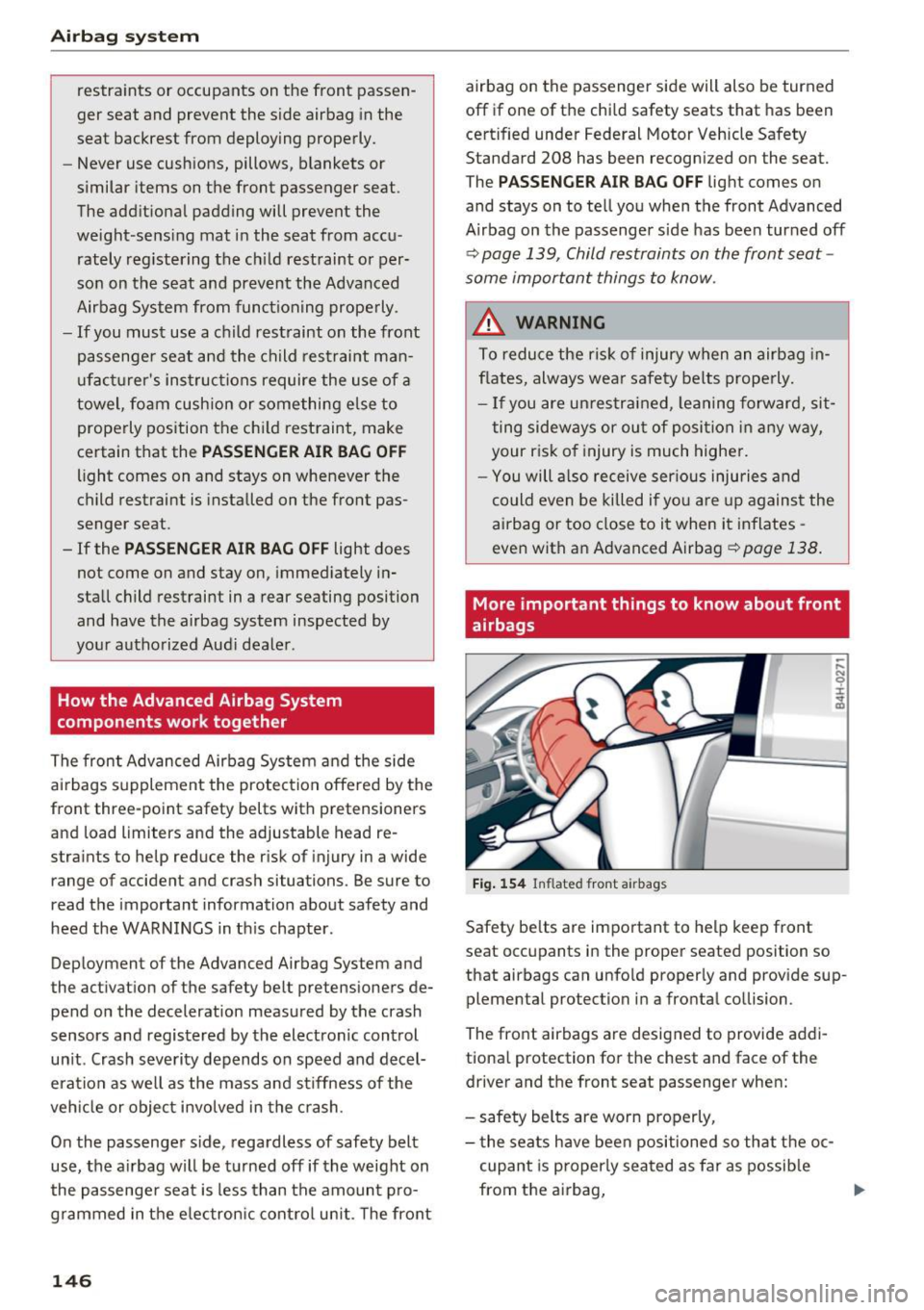
Fig. 154 Inflated front a irbags
-,... N 0 :i: ;;i;
Safety be lts are important to help keep front
seat occupants in the proper seated position so
that airbags can unfo ld properly and prov ide sup
plemental protection in a fronta l co llision.
The front airbags a re designed to provide addi
tional protection for the chest and face of the driver and the front seat passenger when:
- safety belts are worn properly,
- t he seats have been positioned so that t he oc-
cupant is properly seated as far as possib le
from the airbag,
Ill-
Page 172 of 278
Child safety
-Always make sure the seat backrest to which
the child restraint is installed is in an up
right position and securely latched into
place and cannot fold forward. Otherwise,
the seatback with the child safety seat at
tached to it could fly forward in the event of
an accident or other emergency situation.
- Always read and heed all WARNINGS when
ever using a child restrained in a vehicle is
being used¢
page 158 . Special precautions
apply when installing a child safety seat on
the front passenger seat¢
page 139, Child
restraints on the front seat -some impor
tant things to know.
Deactivating the convertible locking
retractor
The convertible Locking retractor for child re
straints will be deactivated automatically when
the belt is wound all the way bock into the re
tractor .
~ Press the red button on the safety belt buckle.
Th@ belt tongue will pop out of the buckle.
~ Guide the safety belt all the way back into its
stowed position .
Always let the safety belt retract completely into
its stowed position . The safety belt can now be
used as an ordinary safety belt without the con
vertible locking retractor for child restraints.
If the convertible locking retractor should be ac
tivated inadvertently, the safety belt must be un
fastened and guided completely back into its
stowed position to deactivate this feature. If the
convertible locking retractor is not deactivated,
the safety belt will gradually become tighter and
uncomfortable to wear.
A WARNING
-
Improperly installed child safety seats in
crease the risk of serious personal injury and
death in a collision.
- Never unfasten the safety belt to deactivate
the convertible locking retractor for child re straints while the vehicle is moving. You
170
would not be restrained and could be seriously injured in an accident.
- Always read and heed all WARNINGS when
ever using a child restrained in a vehicle is
being used¢
page 158. Special precautions
apply when installing a child safety seat on
the front passenger seat<=:>
page 139, Child
restraints on the front seat -some impor
tant things to know.
Page 179 of 278
..... N
0 ::..:: co .....
wireless telecommunications provider and the
"About Aud i connect" tab in your vehicle's
MMI*:
IMENU I button> Audi connect > About
Audi conn ect.
Electronic Stabilization
Control (ESC)
Description
ESC helps to improve road ho ld ing and vehicle
dynamics to help reduce the probability of skid
d ing and loss of veh icle control. It works only
when the engine is runn ing . E SC detects certain
d ifficult dr iving sit uat ions, including when t he
ve hicl e is begin ning to spin (yaw) out of co ntro l
a nd helps you to ge t the veh icle back under con
tro l by se lective ly bra king the wheels, and/or re
d ucing engine powe r and provid ing steering as
sistance to help hold the vehicle on the dr iver's
intended course. The indicator light
GJ in the in
strument cluster blinks when ESC is taking action
to help you co ntro l the vehicle.
ESC has limitations. It is important to remember
that ESC cannot overcome the laws of physics. It
will not a lways be able to help out under all con
d itions you may come up aga inst. For example,
ESC may not always be able to help you master
situations where there is a sudde n change in the
coeff icient of friction of the road surface. When
there is a section of dry road that is sudde nly cov
e red with wate r, slush o r snow, ESC cannot pe r
form the same way i t wo uld on the dry s urface . If
the vehicle hydrop lanes (rides on a cushion of wa
ter i nstead of t he road su rface), ESC wi ll not be
ab le to he lp you steer the ve hicle because contact
with the pavement has been interrupted and the
ve hicle cannot be b raked or steered. Dur ing fast
cornering, pa rticula rly on w inding roads, ESC
cannot always deal as effect ively w it h difficult
d riving si tuations tha n at lowe r speeds. When
tow ing a t raile r, ESC is no t able to help you re
g ai n con trol as it would if you we re not towing a
tra iler .
A lways adjust yo ur speed and driving sty le to
road, traffic and weathe r co nd itions. ESC canno t
override the vehicle's physical lim its, increase the
Intellig ent Technology
available t ract ion, or keep a vehicle on the road if
road depart ure is a resu lt of driver inattention .
Instead, ESC improves the possib ility o f keeping
the vehicle under contro l and on the road d uring
extreme maneuvers by us ing the driver's steer ing
i nputs to help keep the veh icle go ing in the in
tended direction.
If you are traveling at a speed
that causes you to run off the road before ESC
c an p rovide any assistan ce, you may not exper i
en ce the benefi ts of ESC.
ESC is swi tched o n all the time . In certa in s itua
t ions when you need less tract ion, you can sw itch
off AS R by press ing the button
11) c:> page 178,
fig. 173 o r c:> page 178, fig . 174. Be s ure to
swi tch ASR on again w hen you no longe r need
l ess trac tion.
T he following systems are integ ra ted in the ESC:
Anti-lock brak ing system (ABS)
ABS prevents the wheels from locking up w hen
braking. The vehicle can still be steered even d ur
i ng hard braking. Apply steady p ressure to the
brake pedal. Do not pump the peda l. A p uls ing in
t h e br ake peda l indicates that the system is help
i ng yo u to b rake the vehi cle.
Brake assist system
T he brake assist system can decrease braking dis
tance . It increases b raking powe r when the dr iver
presses the b rake peda l quickly in emergency sit
u at io ns. You mus t press and ho ld the br ake pedal
u nt il t he s ituat ion is ove r. In vehicles wi th adap
tive cru ise control *, the brake assist system is
more sensitive if the distance detected to the ve
hicle ahead is too sma ll.
Anti-slip regulation (ASR )
ASR reduces engine powe r whe n the dr ive whee ls
begi n to spin and adapts the fo rce to the road
co ndit ions . Thi s makes it easier to start, acce ler
ate and d rive up hills .
Electronic differential lock (EDL)
T he ED L brakes wheels t hat are spi nning and
transfe rs the dr ive power to the o ther dr ive
whee l or wheels if the vehicle is equ ip p ed with
all -wheel drive*. This function is not ava ilab le at
higher speeds. .,.
177
Page 183 of 278
..... N
0 ::..:: co .....
the p urpose of clean ing the brake system
only if road conditions permit. Other road
users must not be put at risk - you may
cause an accident!
- Before descend ing a steep grade, reduce
speed and shift transm iss io n into a lower
gear or lowe r d riv ing range. Do not ride the
bra kes or hold the pedal down too long or
t oo often. This could ca use the bra kes to get
hot an d diminish brak ing efficiency.
- Do not "r ide t he b rakes" by resting your foot
on the pe dal when yo u do not inten d to
br ak e. This may cause the br akes to over
heat, p remat ure wea r and increased stop
ping distance.
- Under certa in climatic and operating condi
tions such as passing thro ugh water, driving
in heavy ra in or after washing the vehicle,
the effectiveness of the brakes can be re
duced. In w inte r, ice can acc umulate on the
brake pads, linings, discs and drums. Care
fully apply brakes for a test. Brakes will dry and ice coatings w ill be cleaned off after a
few careful b rake applica tions.
- Driv ing for an ex tended period of time on
salt-covered roads witho ut using your
bra kes can also affe ct bra king efficie ncy .
C le an off a ccumula ted s alt co ating from
bra ke discs and pads with a few caref ul
bra ke app lications.
- If you dam age the fro nt sp oiler, or if yo u in
st all a diff erent spoi le r, be sure the ai r flow
to the front brakes is not obstr ucte d. Othe r
wise the bra ke system could overheat reduc
ing the e ffectiveness of the entire b rake sys
tem.
- Failure of one brake circuit will impair the
brak ing capability resulting in an increased
stopp ing distance. Avoid driving the vehicle
and have it towed to the nearest authorized
Audi dealer or qualif ied workshop.
- Never let the veh icle roll to a stop w ith the
engi ne shut off .
-If the brake booster is not working, the
bra ke pedal m ust be pressed conside rably
harder to make up for the lac k of booster
assista nee .
Intellig ent Technology
Electro-mechanical
power assist, dynamic
steering
The ele ctro-mechanical power a ssist helps the
driver when steering .
P ower s teer ing adapts electronically based on
t h e veh icle spee d.
Indicator lights and messages
• Steering defective! Do not drive vehicle!
If this indicator light turns on and stays on and
t hi s message appears, the power steering may
have failed.
Do
not continue driving. See your author ized
Audi dealer or a qualified repair facility for assis
tance.
' :r, y Dynamic steering: System fault! You can
continue d riving
If the indic ator l igh t turns on and the message
appe ars, the steering may be more diffic ult to
move o r more sensitive than usu a l. T he steering
whee l may a lso be at an angle w hen d riving
straight .
Drive slowly to you r autho rized Audi dea le r or
qualified wo rks hop to have the malfunction cor
rected .
,T u Dynamic steering: initializing
If this drive r message appea rs and t he indicator
li ght is flashing on t he instrument pane l, dynam
ic s teer ing* is being re ini tialized. After s tarting
t h e engine, t he steer ing w heel w ill move sligh tly.
Re- ini tializa tion might be necessary if the s teer
ing wheel was moved hard to the left a nd right
whi le the vehicle was not moving . The display
goes out as soon as initialization is comp lete.
A WARNING ~
Have the dynam ic steeri ng* system malfunc -
tion repaired as soon as poss ible by an au
thor ized Audi dealer or qualified workshop -
r isk of acc ident!
181
Page 188 of 278
Driving and th e en vironm ent
(D Tips
- Check the depth of the water before driving
through it .
- Do not stop the veh icle, drive in reverse or
switch the engine
off when driving through
water.
- Keep in mind that oncoming vehicles may
create waves that raise the water level and
make it too deep for your veh icle to drive
through safely.
- Avoid driving through salt water because it
can cause corrosion .
Catalytic converter
It is very impor tant tha t your emission con trol
system (ca talytic converter) is functioning prop
erly to ensure that your vehicle is running in an
environmentally sound manner .
~ Always use lead-free gasoline ¢ page 198,
Fuel supply .
~ Never run the tank down a ll the way to empty .
~ Never put too much motor oil in your engine
¢ page 20 7, 9::?l Adding engine oil .
~ Never try to push- or tow-start you r vehicle.
The cata lytic converter is an efficient "clean-up"
dev ice bu ilt into the exha ust system of the vehi
cle. The cata lytic conve rter burns many of the
pollutants in the exhaust gas before they are re
leased into the atmosphere.
The exclusive use of unleaded fue l is critica lly im
portant for the life of the catalytic conve rter and
p roper functioning of the engine.
A WARNING ,..____ -
- The temperature of the exhaust system is
high, both when driving and after stopping
the engine.
- Never touch the exha ust tail pipes once they
have become hot. This could result in burns.
- Do not park or ope rate t he vehicle in areas
where t he hot exha ust system may come in
contact with dry grass, br ush, fue l spill or
other mater ial which can cause a fire.
- Do not apply additional undercoating or
rustproofing on or near the exhaust mani-
186
fold, exha ust pipes, cata lytic conve rter or
heat shields . D uring driving, the substance
used for undercoat ing could overheat and
cause a f ire .
Cl) Note
-Be aware that just one tank f illing wit h
leaded fu e l w ill already seriously degrade
the performance of the catalytic converter.
- Do not exceed the correct engine oil leve l
¢page 207.
-Do not drive until the fue l tank becomes
completely empty . The engine could mis
fire. Unbu rned fue l cou ld also get into the
exhaust system and this could cause the
catalytic converter to overheat.
- Do not turn off the ign ition while the vehicle
is moving .
- Do not continue to operate your vehicle un
der these conditions, as otherw ise fuel can
reac h the catalytic converter . T hi s could re
sult in overheat ing of the converter, requir
ing its replacement.
- T o ass ure eff icient ope rat ion of the Emis
sion Contro l System:
- Have you r vehicle maintained properly and
i n accordance wit h the service recommen
dations in your Warranty & Ma intenance
booklet.
- Lack of proper ma intenance as well as im
p roper use of the veh icle will impa ir the
function of the emission control system
and could lead to damage .
(® For the sake of the environment
Even when the Emission Control System is op
erating properly, t he exhaust gas can have a
sulfur-like exhaust gas smell under some op
erating states. Th is depends on the sulfur
con tent of the fuel being used . Us ing a d iffer
ent brand of fuel may help , or fi lli ng the tank
wi th lead-free super g rade g asoline.
Shutting down vehicle
If you wo uld like yo ur vehicle to remain inopera
tive for a longer pe riod of time, con tact an Audi
o r other spec ia liz ed dealer. They can adv ise you ..,.
Page 192 of 278
Trailer mod e
Trailer mode
Driving with a trailer
General information
Your Audi was designed primarily for passenger
transportation.
If you plan to tow a trailer, please remember that
the additional load will affect durability, econo
my and performance.
Trailer towing not only places more stress on the
vehicle, it also calls for more concentration from
the driver.
F or this reason, always follow the operating and
driving instructions provided and use common
sense.
Technical requirements
Tr aile r hitch
Use a weight-carrying hitch conforming to the
gross trailer weight. The hitch must be suitable
for your veh icle and trailer and must be mounted
securely on the vehicle's chassis at a technically
sound
location . Use only a trailer hitch with a re
movable ball mount . Always check w ith the t rail
er hitch man ufact urer to make su re that you are
using the co rrect hitch .
Do not use a bump er hit ch .
The hitch must be installed in such a way that it
does not interfere with the impact -absorbing
bumper system. No mod ificat ions should be
made to the vehicle exhaust and brake systems .
From t ime to t ime, check that a ll hitch mount ing
bolts rema in securely fastened.
When you are not tow ing a tra iler, remove the
tra iler hitch ba ll mount . This prevents the hitch
from caus ing damage shou ld your veh icle be
s truck from be hind ¢
,&..
Trailer brakes
If your trailer is equipped with a brak ing system,
check to be sure that it conforms to all regula
tions .
190
The trailer hydraulic brake system must not be
directly connected to the vehicle's hydraulic
brake system ¢&. .
Safety chains
Always use safety chains between you r vehicle
and the trailer.
Trailer lights
Traile r lights must meet all regulations . Be sure
to check w ith your author ized Audi dealer for cor
r ec t wiring , switches, and relays.
M irrors
If you are unable to see the traffic behind you us
ing the regular outs ide mirrors, then you
must in
stall extended mirrors . It is important that you
always have clear vision to the rear.
.&_ WARNING
- If a tra ile r has e lectr ica l brakes p lease no te
t hat these brakes are not activated by the
factory-fit ted contro l unit -risk of accident!
'
- After removing the trai ler hitch, do not
store it in your vehicle. In case of sudden
braking, the hitch co uld fly forward and in
jure you or yo ur passengers.
Operating instructions
Ma ximum traile r we ight
A trailer for your vehicle is limited to a typical
class 1 or class 2 trailer.
Trailer load distribution
Be sure the load in the trai ler is held securely in
place to p revent i t from shifting forward, back
ward or sideways.
Nev er allow a pa ssen ger to rid e in a trailer ¢ &.
in Driving instructions on page 191.
Engine cooling system
Towing a tra iler makes the engine work harder . It
i s important that the cooling system's perform
ance is up to the additional load. Make sure that
the cool ing system has enoug h fluid.
Page 193 of 278
..... N
0 ::..:: co ..... oJ) Lil
..... oJ) .....
Tire pressure
When tow ing a tra ile r, infl ate the tires of yo ur
ve hicl e to the co ld tire press ure listed under "Fu ll
l oad" on the label located on the driver's side B
pi llar (visib le when th e door is open). Inflate
tra ile r tir es to t railer and tire manufacture rs'
specifications.
Light s
The headlight settings should be checked wi th
the trai ler attached before driv ing
off . Check to
make sure both veh icle and trai ler lights are
wo rking prope rly .
Safety chains
Be s ure trai ler s afety chains are p ro p erly conne ct
ed from the trailer to the hitc h on the vehicle .
L eave enough slack in the chains to permit turn
ing corners . When you install safety cha ins, make
sure they w ill not drag on the road when yo u are
driving.
The chains s hou ld cross under the t railer tongue
to p revent it from dropp ing in case of separat ion
from t he hitc h.
Driving instructions
Driving with a trailer always requires extra core
and consideration.
To ob tain the best possible handling of vehicle
and trailer, please note the fo llowing :
.,. Do no t tow a lo ad ed t railer w hen yo ur car i tse lf
i s not lo ad ed.
.,. Be especia lly caref ul when passing ot he r
vehicles .
.,. Observe speed limits.
.,. Do not d rive at the maximum permissible
speed .
.,. Always apply brakes early .
.,. Moni to r th e temperature gauge .
Weight distribution
T owing a loaded trailer w ith an empty car res ults
in a high ly unstable distribution of weight . If this
cannot be avo ided, drive at very low speeds o nly
to avoid the risk of losing steering control.
Trailer mode
A "ba lanced" rig is easier to opera te and co ntrol.
This means that the tow vehicle sho uld be loaded
to the extent possib le and permissib le, w hile
keeping the trailer as light as possible under the
cir cumstances . Wheneve r poss ib le, transfer
some cargo to the luggage compartment of the
tow ve hicle while observing tongue load require
ments and vehicle loa ding consi de rations .
Speed
The higher the speed, the mo re diff icult it be
comes for the driver to control the r ig. Do not
drive at t he max imum permissib le speed. Reduce
you r sp eed even more if load, weathe r or wind
cond it ions are u nfavo rab le -pa rticularly when
go ing down hill.
Reduce vehicle speed
immediately if the trailer
shows the slightes t sign of sway ing .
Do not try
to stop the swaying by accelerating .
Observe speed limits . In some a reas, speeds fo r
vehicles towing trailers are lower tha n for regular
vehicles .
Always apply bra kes early . When d riving down
hill, shift into a lower gear to use the e ngine
braki ng effect to slow the vehicle . Use of the
brakes alone can cause them to overhea t and fa il.
Coolant temperature
The coo lant tempe rature gauge c:> page 10 m ust
be obse rved caref ully. If the needle moves close
to the upper end of the scale, reduce speed im
me diate ly and/or t urn
off th e a ir cond it io ne r .
If the coolant temperat ure warning light . in
t h e instr ument cluster starts flashing, pull
off
the road, stop and let the engine idle for about
two m inu tes to pre vent heat build -u p .
A WARNING ,.__ -
A nyone not prope rly restr ained in a moving
ve hicl e is at a m uch grea te r risk in an a cci
d ent. Never le t anyon e ride in your car w ho is
n o t pr ope rly we arin g th e res tra ints p ro vid ed
by Au di .
191
Page 194 of 278
Trailer mode
Trailer mode notes
Important to know
Your vehicle handles different ly when tow ing a
tra iler because of the additional weight and dif
ferent weight distr ibution. Safety, performance
and economy w ill great ly depend on how careful
ly you load your trailer and operate your rig.
Before you actua lly tow your trailer, practice
turning, stopping and backing up in an area away
from traffic . Keep practicing until you have be
come completely familiar with the way your vehi
cle-trailer combination behaves and responds.
Backing up is d ifficult and requires practice.
Backing up with a trailer generally requires steer
ing action opposite to that when backing up your
vehicle without a trailer.
Maintain a greater distance between your vehicle
and the one in front of you. You w ill need more
room to stop . To compensate for the trai ler, you
will need a larger than norma l turning radius.
When passing, remembe r that you cannot accel
erate as fast as you normally would because of
the added load. Make sure you have enough room
to pass. After passing, allow plenty of room for
your trai ler before chang ing lanes again.
Avoid jerky starts, sharp turns or rapid lane
changes.
(D Tips
- Do not tow a trailer during the break-in peri
od of you r vehicle.
- If you tow a trailer, your Audi may require
more frequent maintenance due to the ex
tra load~
page 258.
Parking on a slope
Do not pork on a slope with a trailer. If it cannot
be avoided, do so only ofter doing the following:
When parking:
.,. Apply t he foot brake .
.,. Have someone place chocks under both the ve
hicle and the trailer wheels.
192
.. With chocks in place, slowly release the brakes
until the wheel chocks absorb the load.
.. Turn the whee ls towards the curb .
.. App ly the parking brake .
.. Place an automat ic transmission* in P, respec
tively a manual transmission in first or reverse
gear .
When restarting after parking:
.. App ly the foot brake.
.. Start the engine.
.. Move the selector lever to 0/5, respectively a
manual transmission in first gear.
.. Release the parking brake and slowly pull out
and away from the whee l chocks.
.,. Stop and have someone ret rieve the wheel
chocks.
(D Tips
If you move the selector lever of the automat
ic transmission* to P before applying the
parking brake and before blocking the wheels,
you may have to use more force later to move
the lever out of the P position.