tow AUDI A4 2016 Owner's Guide
[x] Cancel search | Manufacturer: AUDI, Model Year: 2016, Model line: A4, Model: AUDI A4 2016Pages: 278, PDF Size: 70.26 MB
Page 232 of 278
Wheels
loss of vehicle control, but can al
so damage important parts of the
vehicle and can lead to sudden tire failure, including a blowout
and sudden deflation that can
cause the vehicle to crash.
Your safety and that of your pas
sengers also depends on making
sure that load limits are not ex
ceeded. Vehicle load includes ev
erybody and everything in and on
the vehicle. These load limits are
technically referred to as the vehi
cle's
Gross Vehicle Weight Rat
ing
("GVWR ") .
The "GVWR" includes the weight
of the basic vehicle, all factory in
stalled accessories, a full tank of
fuel, oil, coolant and other fluids plus maximum load. The maxi
mum load includes the number of
passengers that the vehicle is in
tended to carry ("seating capaci
ty") with an assumed weight of 150 lbs. (68 kg) for each passen
ger at a designated seating posi
tion and the total weight of any
luggage in the vehicle. If you tow
a trailer, the weight of the trailer
hitch and the tongue weight of
the loaded trailer must be includ
ed as part of the vehicle load.
230
The Gross Axle Weight Rating
("GAWR") is the maximum load
that can be applied at each of the
vehicle's two axles.
The fact that there is an upper
limit to your vehicle's Gross Vehi
cle Weight Rating means that the
total weight of whatever is being
carried in the vehicle (including
the weight of a trailer hitch and
the tongue weight of the loaded
trailer) is limited. The more pas
sengers in the vehicle or passen
gers who are heavier than the
standard weights assumed mean
that less weight can be carried as
luggage.
The Gross Vehicle Weight Rating and the Gross Axle Weight Rating
are listed on the safety compli
ance sticker label located on the
driver's side B-pillar
¢ page 22 7,
fig. 190.
! WARNING
Overloading a vehicle can cause
loss of vehicle control, a crash
or other accident, serious per
sonal injury, and even death.
-Carrying more weight than your vehicle was designed to carry will prevent the vehicle
from handling properly and
Page 239 of 278
,....,
N
0
""' CX) ,....,
I.Cl U"I ,....,
I.Cl ,....,
Emergency assistance
Vehicle tool kit
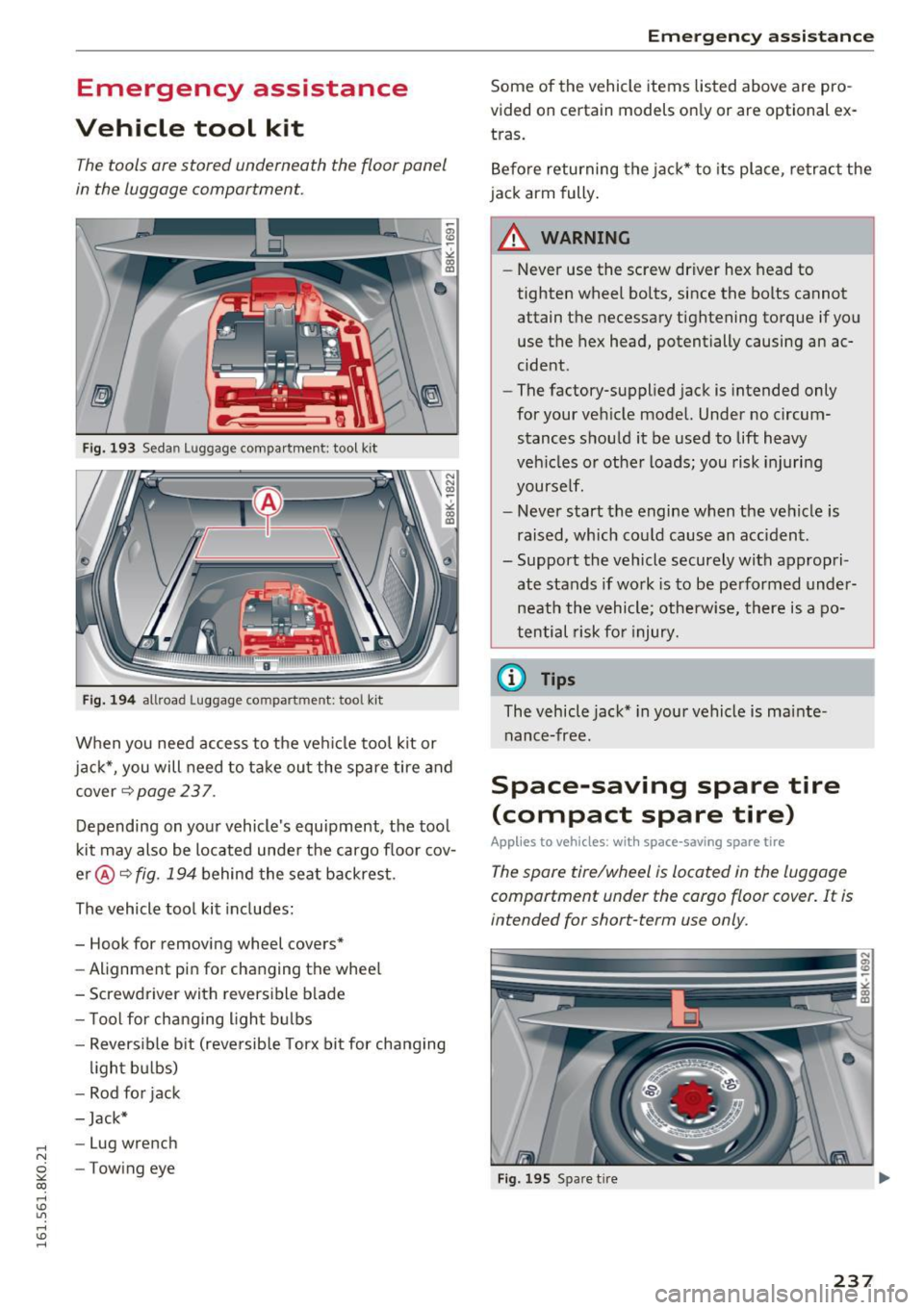
The tools ore stored underneath the floor panel
in the luggage comportment.
Fig. 193 Sedan Luggage compartment: tool kit
Fig. 194 all road Luggage compartment: tool kit
When you need access to the veh icle tool kit or
jack*, you will need to take out the spare tire and
cover
c:::> page 237.
Depending on your vehicle's equipment, the too l
kit may also be located unde r the cargo floor cov
e r@
c:::> fig. 194 behind the seat backrest.
The vehicle tool kit includes:
- Hook for removing wheel covers*
- Alignment pin for changing the wheel
- Screwdriver with reversible b lade
- Tool for changing l ight b ulbs
- Revers ible b it (reve rsible Torx bit for changing
l igh t bu lbs)
- Rod for jack
- Jack*
- Lug wrench
- Towing eye
Emergen cy a ssis tanc e
Some of the vehicle items listed above are pro
vided on certain models on ly or are optional ex
tras.
Be fore returning the jack* to its place, retract the
jack arm fully .
A WARNING
-Never use the screw driver hex head to
tighten wheel bolts, since the bolts cannot
attain the necessary tightening torque if you
use the hex head, potentially causing an ac
cident.
- The factory-supplied jack is intended only
for your veh icle model. Under no circum
stances should it be used to lift heavy
veh icles or othe r loads; you risk injuring
yourse lf.
- Never start the engine when the vehicle is
raised, which cou ld cause an accident.
- Support the vehicle securely with appropri ate stands if wo rk is to be pe rformed under
neath the vehicle; otherwise, there is a po
tential risk fo r injury.
(0 Tips
The vehicle jack* in your vehicle is mainte
nance-free .
Space-saving spare tire
(compact spare tire)
App lies to vehicles: wi th space -saving spare tire
The spore tire/wheel is located in the luggage
comportment under the cargo floor cover. It is
intended for short-term use only.
Fig . 195 Spare tire
237
Page 241 of 278
,....,
N
0
""' CX) ,....,
I.Cl U"I ,....,
I.Cl ,....,
.,. Always store the vehicle tool kit, the jack* and
the replaced tire in the luggage compartment
e::> page 126 .
Stowing the inflatable spare tire
.,. Release the air by unscrewing the valve stem .
.,. Screw the valve stem back in afterwards.
.. Wait a few hours before placing the whee l in
the spare wheel well
e::> .&_.
.. Secure the wheel with the large screw.
.,. Fold the cargo floor back down.
After using the infl atabl e spare w hee l
The inflatable spare tire can be re-used as long as
it is not damaged and is not worn down to the
tread wear indicators~ .&..
When you le t the air out of the infla table spare
tire, it does not assume its folded shape again for
several hours. Until then, it cannot be placed
back in the spare wheel well and stowed securely .
A WARNING
-Never use the spare tire if it is damaged or if
it is worn down to the tread wear indicators.
- If the inflatable spare tire is more than 6
years old, use it on ly in an emergency and
with extreme caut ion and careful driving.
- The inflatab le spare tire is intended only for
temporary and short-term use. It shou ld be
replaced as soon as poss ible with the nor
mal wheel and tire.
- The tire pressure value for the inflatable
spare tire is located on the driver's s ide B
pillar
e::> page 227, fig. 190.
- Maximum perm iss ible speed is 50 mph
(80 km/h).
- Avoid full-throttle accelerat io n, heavy brak
ing, and fast corneri ng.
- When the air is let out of the inflatable
spare wheel, it does not assume its folded
shape for several hours. Until then, it can not be placed back in the spare wheel well
and stowed secu rely .
- Never drive with more than one inflatable
spare tire .
- For technical reasons ., the use of tire chains
on the inf latab le spare tire is not perm itted.
Em ergen cy a ssis tanc e
If it is necessary to drive with tire chains,
the inflatable spare wheel must be mounted
on the rear a xle in the event of a flat in a
front tire. The newly available rear whee l
must then be installed in place of the front
wheel wi th the flat t ire. Installing the t ire
chai n befo re mounting the whee l and tire is
re comme nded.
- L oose items in the passenger compartment
can cause se rious personal injury during
ha rd br aking or i n an accident . Never store
the inflatable spare tire or jack * and too ls in
the passenge r compartment .
(D Note
- The inflatable spa re t ire has been deve loped
specifically fo r thi s ve hicle mode l.
It must
not be exchanged or used for other vehicle
mode ls. S imilar ly, inf latab le tires from oth
er veh icle mode ls must not be used.
- Normal summer or w inte r tires must not be
installed on the inflatable t ire rim.
Inflating inflatable spare
tire
Applies to vehicles: wit h inflatable s pare tir e
Fig. 19 7 Luggage compartm ent: compressor
.. Remove the cover for the vehicle tools and re
move the compressor . For some vehicle mod
els, the compressor is located in a holder under
the spare tire.
.. Unscrew the valve stem from the spare tire.
.,. Screw the t ire filler hose from the compressor
fi rmly onto the valve of the spare tire .
.,. Insert the p lug from t he comp ressor into a
soc ket of the veh icle
e:> page 64 .
.,. Sw itch t he comp ressor on. .,,.
239
Page 242 of 278
Emergency assistance
"'Let the compressor run until the va lue specified
on the tire pressure label is reach ed
¢ page 227, fig. 191 . Switch the compressor
off after running for 12 minutes at the mos t -
danger of overheating!
A WARNING
The compressor and the tire filler hose can become extremely hot while they are running
- danger of burns!
CD Note
Switch the compressor off after running for
12 minutes at the most -danger of overheat
ing! Allow the compressor to cool down for a
few minutes before you use it again.
Replacing wheels
Before changing a wheel
Observe the following precaut ions for your own
and your passenger's safety when changing a
wheel.
"' After you experience a tire failure, pull the car
well away from moving traffic and try to reach
level ground before you stop ¢.&_ .
"' All passengers shou ld
leave the car and move
to a safe location (for instance, behind the
guardrail) ¢.&_ .
"' Engage the
parking brake to prevent your vehi
cle from rolling unintentionally ¢&_ .
"' Sh ift into
1st gear on vehicles w ith manual
transmission, or move the
selector lever to the
P position
on vehicles with automatic transmis
sion .
"' If you are towing a trailer: unhitch the trailer
from your vehicle.
"' Take the
jack¢ page 237 and the spare tire
¢ page 238 out of the luggage compartment .
A WARNING
You or your passengers could be injured wh ile
chang ing a wheel if you do not follow these
safety precautions :
- If you have a flat tire, move a safe distance
off the road . Turn off the engine, turn the
240
emergency flashers on and use other warn
ing devices to alert other motorists.
- Make sure that passengers wait in a safe
place away from the vehicle and well away
from the road and traffic.
- To help prevent the vehicle from moving
suddenly and possibly slipping off the jack,
always fully set the parking brake and block
the wheel diagonally opposite the wheel be ing changed with the folding chocks or oth
er objects . When one front whee l is lifted
off the ground, placing the Automat ic
T ransmission in "P" (Par k) w ill
not prevent
the vehicle from moving.
- Before you change a wheel, be sure the
ground is level and firm . If necessary, use a
sturdy board under the jack.
- Always store the vehicle tool kit, the jack*
and the replaced tire in the luggage com
partment
¢ page 126.
CD Note
If you a re changing the wheel on a steep in
cline, use a rock or similar object to block the
opposite wheel to prevent the vehicle from
moving.
(D Tips
Obey all laws.
Changing a wheel
When you change a wheel, follow the sequence
described below step-by-step and in exactly that
order .
1. Remove the decorative wheel cover* or the
wheel bolt caps* . For more details see also
¢ page 241, Decorative wheel covers or
¢ page 241, Wheels with wheel bolt cops.
2. Loosen the wheel bolts ¢page 242.
3. Locate the proper mounting point for the
jack and align the jack below that point
¢ page 242.
4. Lift the car with the jack¢ page 242.
5. Remove the wheel with the flat tire and then
install the
spare tire ¢page 243.
6. Tighten all whee l bolts lightly .
Page 252 of 278
Emergency situations
Emergency situations
General
This chapter is intended for trained emergency crews and working personnel who have the nec
essary tools and equipment to perform these
operations.
Starting by pushing or
towing
CD Note
Vehicles with an automatic transmission
cannot be started by pushing or towing.
Starting with jumper
cables
If necessary, the engine con be started by con
necting it to the battery of another vehicle.
If the engine should fail to start because of a dis
charged or weak battery, the battery can be con
nected to the battery of
another vehicle, using a
pair of jumper cables to start the engine.
Jumper cables
Use only jumper cables of sufficiently largecross
section
to carry the starter current safely. Refer
to the manufacturer's specifications.
Use only jumper cables with
insulated terminal
clamps which are distinctly marked :
plus(+) cable in most cases colored red
minus(-) cable
in most cases colored black.
A WARNING
Batteries contain electricity, acid, and gas.
Any of these can cause very serious or fatal in
jury. Follow the instructions below for
safe
handling of your vehicle's battery.
-Always shield your eyes and avoid leaning
over the battery whenever possible.
-A discharged battery can freeze at tempera
tures just below 32 °F (0 °C). Before con
necting a jumper cable, you must thaw the
250
frozen battery completely, otherwise it could explode.
- Do not allow battery acid to contact eyes or
skin. Flush any contacted area with water immediately.
- Improper use of a booster battery to start a
vehicle may cause an explosion.
- Vehicle batteries generate explosive gases.
Keep sparks, flame and lighted cigarettes
away from batteries.
- Do not try to jump start any vehicle with a
low acid level in the battery.
- The voltage of the booster battery must also
have a 12-Volt rating. The capacity (Ah) of
the booster battery should not be lower
than that of the discharged battery. Use of
batteries of different voltage or substantial
ly different "Ah" rating may cause an explo
sion and personal injury.
- Never charge a frozen battery. Gas trapped in the ice may cause an explosion.
- Never charge or use a battery that has been
frozen . The battery
case may have be weak
ened .
- Use of batteries of different voltage or sub
stantially different capacity (Ah) rating may
cause an explosion and injury. The capacity
(Ah) of the booster battery should not be
lower than that of the discharged battery.
- Before you check anything in the engine
compartment, always read and heed all
WARNINGS
~page 203.
CD Note
-Applying a higher voltage booster battery
will cause expensive damage to sensitive
electronic components, such as control
units, relays, radio, etc.
- There must be no electrical contact between
the vehicles as otherwise current could al
ready start to flow as soon as the positive
(+) terminals are connected.
@ Tips
The discharged battery must be properly con-
nected to the vehicle's electrical system. .,..
Page 254 of 278
Emergency situations
-The battery cell locking screws must be
tightened securely.
- Before you check anything in the engine
compartment, always read and heed all
WARNINGS
c:> page 203.
(D Note
Improper hook-up of jumper cables can ruin
the generator.
- A lways connect POSITIVE(+) to POSITIVE
(+), and NEGATIVE(-) to NEGATIVE(-)
ground post of the battery manager control
unit.
- Check that a ll screw plugs on the battery
cells are screwed in firmly. If not, tighten
plugs prior to connecting clamp on negative
battery terminal.
- Please note that the procedure for connect
ing a jumper cable as described above ap
plies specif ically to the case of your vehicle
being jump started. When you are giv ing a
jump start to another vehicle, do
not con
nect the negative(-) cable to the negative
(-) terminal on the discharged battery @
c:> fig. 210. Instead, securely connect the
negative (-) cab le to either a solid metal
component that is firm ly bolted to the en
gine block or to the engine block itself. If
the battery that is being charged does not
vent to the outside , escap ing battery gas
could ignite and explode!
Towing with a tow truck
General hint s
Your Audi requires special handling for towing.
The following information is to be used by com
mercial tow truck operators who know how to op
erate the ir equipment safely.
-Never tow your Audi, towing will cause dam
age to the engine and transmission.
- Never wrap the safety chains or winch cables
around the brake lines .
- To prevent unnecessary damage, your Audi
must be transported with a flat bed truck.
252
-To load the vehicle on to the flat bed, use the
towing loop found in the vehicle tools and at
tach to the front or rear anchorage
c:> page 252 and c:> page 253.
A WARNING
A veh icle being towed is not safe for passen
gers . Never allow anyone to ride in a vehicle
being towed, for any reason .
Front towing loop
Do not install the front towing loop until it is
needed .
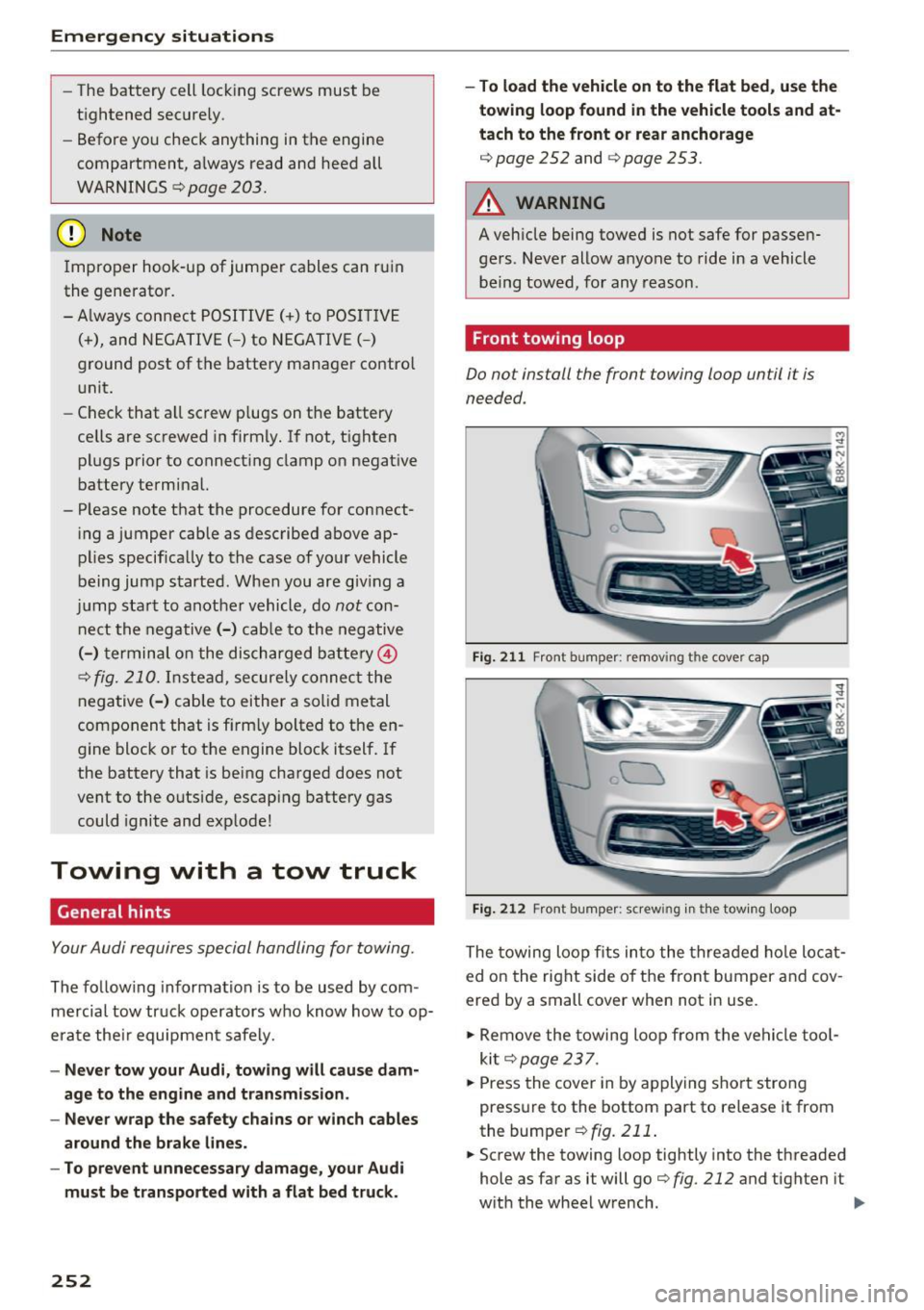
Fig. 211 Front bumper: removing th e cover cap
Fig. 212 Front bumper: s crew ing in t he towing loop
The towing loop fits into the threaded hole locat
ed on the right side of the front bumper and cov
ered by a small cover when not in use .
.,. Remove the towing loop from the vehicle tool
ki t
c:> page 23 7.
... Press the cover in by applying short strong
pressure to the bottom part to release it from
the bumper
c:> fig. 211.
... Screw the towing loop tightly into the threaded
hole as far as it will go
c:> fig. 212 and tighten it
with the wheel wrench. ..,.
Page 255 of 278
,....,
N
0
""' CX) ,....,
I.Cl U"I ,....,
I.Cl ,....,
When it is no longer needed, unscrew the towing
loop and put it back into the vehicle toolkit. Be
sure to have the towing loop stored in the vehicle
at all times.
A WARNING
If the towing loop is not screwed in as far as it
w ill go, the thread can pull out when the vehi
cle is towed -potential risk of an accident .
Rear towing loop
Do not install the rear towing loop until it is
needed.
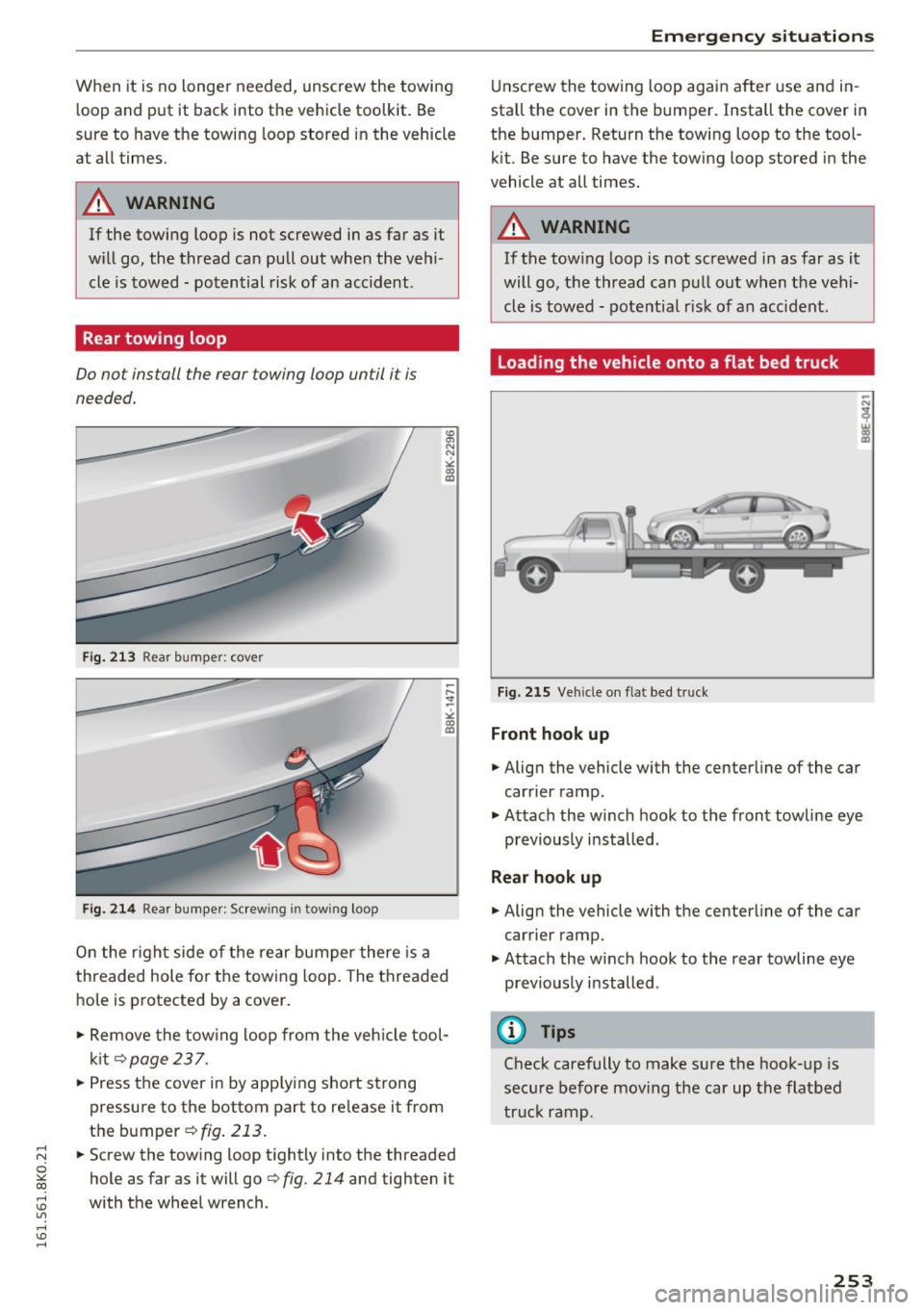
Fig. 213 Rear bumper: cover
Fig. 214 Rear bumper: Screwing i n tow ing loop
ID
"' N N ~ 0) IX)
On the right side of the rear bumper there is a
threaded hole for the towing loop. The threaded
hole is protected by a cover.
~ Remove the towing loop from the vehicle tool
kit
r::!;> page 237.
~ Press the cover in by applying short strong
pressure to the bottom part to re lease it from
the bumper
¢fig. 213.
~ Screw the towing loop tightly into the threaded
hole as far as it will go
r::!;> fig. 214 and tighten it
with the wheel wrench .
Emergency situations
Unscrew the towing loop again after use and in
stall the cover in the bumper. Install the cover in
the bumper. Return the towing loop to the tool kit. Be sure to have the towing loop stored in the
vehicle at all times.
A WARNING
-If the tow ing loop is not screwed in as far as it
will go, the thread can pull out when the vehi
cle is towed -potential risk of an accident.
Loading the vehicle onto a flat bed truck
Fig. 215 Veh icle on flat bed truck
Front hook up
~ Align the vehicle with the centerline of the car
carrier ramp.
~ Attach the w inch hook to the front towline eye
previously installed.
Rear hook up
~ Align the vehicle with the centerline of the car
carrier ramp.
~ Attach the w inch hook to the rear towline eye
previously installed .
@ Tips
Check carefully to make sure the hook-up is
secure before moving the car up the flatbed
truck ramp.
253
Page 260 of 278
Consumer information
Consumer information
Warranty coverages
Your Audi is covered by the following warran
ties:
- New Vehicle Limited Warranty
- Limited Warranty Against Corrosion Perfora-
tion
- Emissions Control System Warranty
- Emissions Performance Warranty
- California Emissions Control Warranty (USA
vehicles only)
- California Emissions Performance Warranty
(USA vehicles only)
Detailed information regarding your warranties
can be found in your
Warranty & Maintenance
booklet .
Operating your vehicle
outside the U.S.A. or
Canada
Government regulati ons in the United States and
Canada require that automobi les meet specific
emission regulations and safety standards.
Therefore, vehicles built for the U.S.A. and Cana
da differ from vehicles sold in other countries.
If you plan to take your vehicle outside the conti
nenta l limits of the United States or Canada,
there is the poss ibility that:
- un leaded fue ls for vehicles with catalytic con
verter may not be available;
- fuel may have a considerably lower octane rat
ing . Improper fuel may cause engine damage;
- service may be inadequate due to lack of proper
service facilities, tools or testing equipment;
- r eplacement parts may not be readily available.
- Nav igation systems for veh icles built for the
U.S .A . and Canada will not necessarily work in
Europe, and may not work in other countries
outside of North America.
258
(D Note
Audi cannot be responsib le for mechanical
damage that could result from inadequate
fuel, service or parts ava ilability.
Audi Service Repair
Manuals and Literature
Audi Official Factory Service Manuals and Litera
ture are published as soon as poss ible after mod
el introduction . Service manuals and literature
are available to order from the Audi Technical Lit
erature Ordering Center at :
www.audi.techliterature .com
Maintenance
General '
Your vehicle has been designed to help keep
maintenance requirements to a minimum. How
ever, a certain amount of regular maintenance is
still necessary to assure your vehicle's safety,
economy and reliability . For detailed vehicle
maintenance consult your Warranty & Mainte
nance booklet .
Under difficult operating conditions, for exam
ple at extremely low outside temperatures, in
very dusty regions, when towing a trailer very fre
quently, etc., some service work should be per
formed between the intervals specified. This ap
plies particularly to:
- oil changes, and
- cleaning or replac ing the a ir filter .
'
@) For the sake of the environment
By regularly maintain ing your vehicle, you
help make sure that em iss ion standards are
maintained, thus minimizing adverse effects
on the environment .
Important considerations for you and your
vehicle
The increasing use of electronics, sophisticated
fuel injection and emission control systems, and
the generally increas ing technica l complexity of ..,_
Page 274 of 278
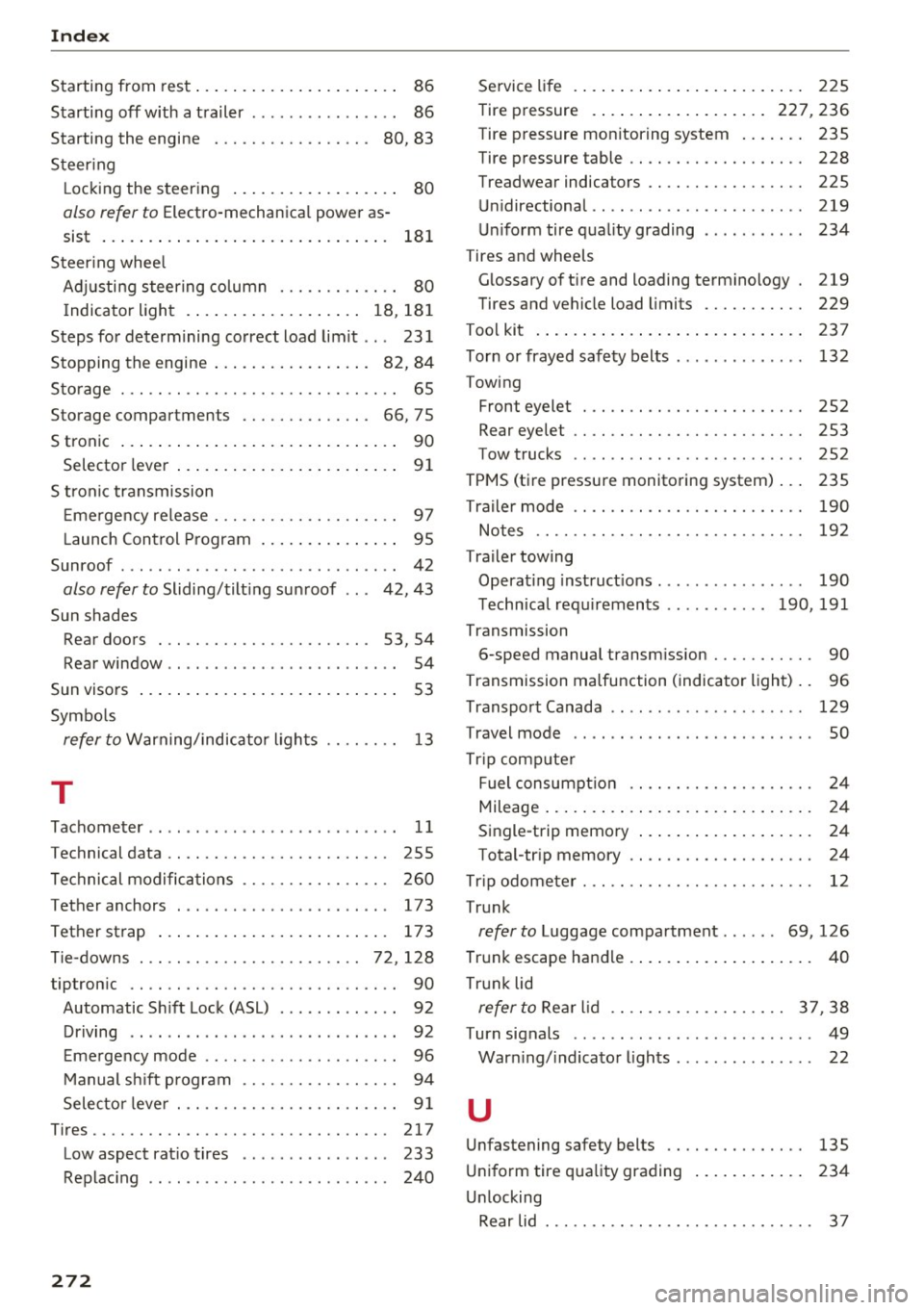
Index
Starting from rest . . . . . . . . . . . . . . . . . . . . . . 86
Starting off with a trailer . . . . . . . . . . . . . . . . 86
Starting the engine . . . . . . . . . . . . . . . . . 80, 83
Steer ing
L ocking the steering . . . . . . . . . . . . . . . . . . 80
also refer to Electro-mechanical power as-
sist . . . . . . . . . . . . . . . . . . . . . . . . . . . . . . . 181
Steering wheel
Adjusting steering column . . . . . . . . . . . . . 80
Indicator light . . . . . . . . . . . . . . . . . . . 18, 181
Steps for determining correct load limit . . . 231
St . th ·
opping e engine . . . . . . . . . . . . . . . . . 82, 84
Storage . . . . . . . . . . . . . . . . . . . . . . . . . . . . . . 65
Storage compartments . . . . . . . . . . . . . . 66, 75
S tronic . . . . . . . . . . . . . . . . . . . . . . . . . . . . . . 90
Selector lever . . . . . . . . . . . . . . . . . . . . . . . . 91
S tronic transmission
Emergency release . . . . . . . . . . . . . . . . . . . . 97
La unch Control Program . . . . . . . . . . . . . . . 95
Sunroof . . . . . . . . . . . . . . . . . . . . . . . . . . . . . . 42
also refer to Sliding/tilting sunroof 42, 43
Sun shades Rear doors 53,54
Rear window . . . . . . . . . . . . . . . . . . . . . . . . . 54
Sun visors . . . . . . . . . . . . . . . . . . . . . . . . . . . . 53
Symbo ls
refer to Warning/indicator lights . . . . . . . . 13
T
Tachometer . . . . . . . . . . . . . . . . . . . . . . . . . . . 11
Technical data . . . . . . . . . . . . . . . . . . . . . . . . 255
Technical modifications . . . . . . . . . . . . . . . . 260
Tether anchors . . . . . . . . . . . . . . . . . . . . . . . 173
Tether strap ..... ................ .... 173
Tie-downs . . . . . . . . . . . . . . . . . . . . . . . . 72, 128
tiptronic . . . . . . . . . . . . . . . . . . . . . . . . . . . . . 90
Automatic Shift Lock (ASL) . . . . . . . . . . . . . 92
Driving . . . . . . . . . . . . . . . . . . . . . . . . . . . . . 92
Emergency mode . . . . . . . . . . . . . . . . . . . . . 96
Manual shift program . . . . . . . . . . . . . . . . . 94
Selector lever . . . . . . . . . . . . . . . . . . . . . . . . 91
Tires .. ...... .. .. .................... 217
Low aspect ratio tires . . . . . . . . . . . . . . . . 233
Replacing . . . . . . . . . . . . . . . . . . . . . . . . . . 240
272
Service life . . . . . . . . . . . . . . . . . . . . . . . . . 225
Tire pressure . . . . . . . . . . . . . . . . . . . 227, 236
Tire pressure monitoring system . . . . . . . 235
Tire pressure table . . . . . . . . . . . . . . . . . . . 228
Treadwear indicators . . . . . . . . . . . . . . . . . 22S
Unidirectional .. ... ... ..... .......... 219
Uniform tire quality grading . . . . . . . . . . . 234
Tires and wheels Glossary of tire and loading terminology . 219
Tires and vehicle load limits . . . . . . . . . . . 229
Tool kit . . . . . . . . . . . . . . . . . . . . . . . . . . . . . 237
Torn or frayed safety belts . . . . . . . . . . . . . . 132
Towing Front eyelet . . . . . . . . . . . . . . . . . . . . . . . . 252
Rear eyelet . . . . . . . . . . . . . . . . . . . . . . . . . 253
Tow trucks . . . . . . . . . . . . . . . . . . . . . . . . . 252
TPMS (tire pressure monitoring system) . . . 235
Trailer mode . . . . . . . . . . . . . . . . . . . . . . . . . 190
Notes . . . . . . . . . . . . . . . . . . . . . . . . . . . . . 192
Trailer towing Operating instructions. ..... ....... ... 190
Technical requirements ........... 190, 191
Transmission 6-speed manual transmission . . . . . . . . . . . 90
Transmission ma lfunction (indicator light) . . 96
Transport Canada . . . . . . . . . . . . . . . . . . . . . 129
Travel mode . . . . . . . . . . . . . . . . . . . . . . . . . . SO
Tr ip computer
Fuel consumption . . . . . . . . . . . . . . . . . . . . 24
Mileage...... ... .. .. ................ 24
s· 1 t · 1ng e-rip memory . . . . . . . . . . . . . . . . . . . 24
Total-trip memory . . . . . . . . . . . . . . . . . . . . 24
Tr ip odometer . . . . . . . . . . . . . . . . . . . . . . . . . 12
Trunk
refer to Luggage compartment . . . . . . 69, 126
Trunk escape handle . . . . . . . . . . . . . . . . . . . . 40
Trunk lid
refer to Rear lid .. .. .... ........... 37 ,38
Turn signals . . . . . . . . . . . . . . . . . . . . . . . . . . 49
Warning/indicator lights . . . . . . . . . . . . . . . 22
u
Unfastening safety belts
13S
Uniform tire quality grading . . . . . . . . . . . . 234
Unlocking Rear lid . . . . . . . . . . . . . . . . . . . . . . . . . . . . . 37