light AUDI A4 2017 Owners Manual
[x] Cancel search | Manufacturer: AUDI, Model Year: 2017, Model line: A4, Model: AUDI A4 2017Pages: 386, PDF Size: 96.32 MB
Page 297 of 386

Using tether straps on rearward-facing
child restraints
Currently, few rear-facing chi ld restraint systems
come with a tether. Please read and heed the
child restraint system manufacturer's instruc
tions carefully to determine how to properly in
stall the tether.
A WARNING
A child in a rearward-facing child safety seat
installed on the front passenger seat will be
ser iously injured and can be killed if the front
airbag inflates -even w ith an Advanced A irbag
System.
- T he inflating a irbag w ill hit the child safety
seat or infant carrier with great force and
will smash the child safety seat and child
against the backrest, center armrest, or
door.
- If you must install a rearward facing child
safety seat on the front passenger seat be
cause of exceptiona l circumstances and the
PASSENGER AIR BAG OFF,;; light does not
come on and stay on, immed iate ly install
the rear-facing child safety seat in a rear
seat ing pos ition and have the airbag system
inspected by your Audi dealer.
Additional information
Sources of information about child
restraints and their use
There are a number of sources of additional in
formation about child restraint selection, instal
lation and use:
NHTSA advises that the best child safety seat is
the one that fits your child and fits in your vehi
cle, and that you will use correctly and consis
tently .
Try before you buy!
U .S National Highway Traffic Safety Administra
tion
;;!; Tel.: 1-888-327-4236 (TTY: 1-800-424-9153) ....
~ http://www.nhtsa.gov
N 8 http ://www.safercar.gov
0
3
Tel.: (202) 662-0600
http:/ /www.safekids .org
Safety BeltSafe U .S.A
Tel.: (800) 745-SAFE (English)
Tel.: (800) 747-SANO (Spanish) http://www. ca rseat. org
Child safety
Transport Canada Information Centre
Tel.: 1-800-333-0371 or ca ll 1-613-998-8616 if
you are in the Ottawa area
http://www.tc.gc.ca/ eng/roadsafety/menu. htm
Audi Customer Relations
Tel.: (800) 822-2834
295
Page 298 of 386

Check ing and F illing
Checking and Filling
Gasoline
Fuel supply
Applies to: vehicles with gaso line engine
Using the right fuel helps keep the environment
clean and prevents engine damage.
F u el r eco mmend ati on
The fuel recommended for your vehicle is unle ad
e d pr em ium
grade gasoline . Audi recommends
using TOP TIER Detergent Gasoline with a mini
mum octane rating of 91 AKI (95 RON). For more
information on TOP TIER Detergent Gasoline,
p lease go to the offic ial website
(www.toptiergas .com).
The recommended gasoline octane rating for
your engine can also be found on a label located on the ins ide of the fuel filler flap . This rating
may be specified as AK I or RON .
Your veh icle may also be operated using unlead
ed regular gasoline with a minimum octane rat
ing of 87 AKl/91 RON. However, using 87 AKI/91
RON octane fuel w il l slightly reduce engine pe r
forma nce.
Us e un leade d gaso lin e onl y. Unleaded gasoline
is availab le throughout the USA , Canada, and in
most European countries . We recommend that
you do not ta ke your vehicle to areas or co unt ries
where un leaded gaso line may not be availab le.
For more information on refueling your vehicle,
see
¢ page 298 .
Octane rating
Octane rating indicates a gasoline's ability to re
sist engine damaging "knock" caused by prema
ture ignit ion and detonation . Therefore, buy ing
the correct grade of gasoline is very important to
he lp prevent poss ible engine damage and a loss
of eng ine performance.
Gasoline most commonly used in the Un ited
States and Canada has the following octane rat
i n gs that ca n usually be found on the filler pump:
- Premium Grade: 91 - 96 AKI
296
- Regu la r Grade: 87 - 90 AK I
Explanation of the abbreviations:
AKI = Anti Knock Index = (R +M)/2 = (RON +MON)/
2
RON = Research Octane Number
MON = Motor Octane Number.
{[) Note
-Do not use a ny fue l w ith o ctane ratings low
er than 87 AKI or 91 RON othe rw ise expen
sive engine damage wi ll occur .
- Do
not use leaded gasoline. The use of lead
ed gasoline will severely damage your vehi
cle's catalyt ic converter and its ability to
control exhaust emissions .
Blended gasoline
Applies to: vehicles with gasoline engine
Use of gaso lin e conta ining alcoho l or MTBE
(meth yl tertia ry butyl ether )
You may use unleaded gasoline blended with al
cohol or MTB E (commonly referred to as oxygen
ates) if the blended m ixture meets the follow ing
criteria:
Blend of g asoline methanol (wood alcohol o r
m eth yl alcoho l)
-Anti -knock index must be 87 AKI or h igher.
- Blend must contain no more than 3% metha-
nol.
- Blend must contain more than 2% co -solvents.
Blend of ga soline and ethanol (grain alcohol or
ethyl alc ohol )
- Anti-knock index must be 87 AKI or h igher .
- Blend must not conta in more than 15% etha-
nol.
Blend of gas oline and M TBE
- Anti-knock index must be 87 AK I or h igher .
- Blend must contain not mo re than 1S% MTB E.
S easonall y adjusted gasoline
Many gasoline grades are blended to perform es
pecially well for winter or summer dr iv ing . Dur-
i ng seasonal change-over, we suggest that you .,..
Page 304 of 386

Checking and Filling
the engine. See an authorized Audi dealer or
authorized Audi Service Facility for assis
tance.
- Ad Blue attacks surfaces such as painted ve
hicle components, plastic and carpet. Re
move the fluid as quickly as possible with a
damp cloth and plenty of cold water. If the
Ad Blue has already crystallized, use warm
water and a sponge . Ad Blue residue that is
not removed will crystallize and can damage
the affected surface.
- Do not store refill bottles or canisters per
manently in the vehicle. If the container
leaks, the escaping AdBlue could damage
the vehicle interior.
- Do not allow Ad Blue to come into contact
with clothing.
If there is contact with the
fluid , flush immediately with plenty of wa
ter.
(D Tips
Follow the Ad Blue manufacturer 's instruc
tions for use and storage.
Refilling AdBlue using the bottle
Applies to: veh icles with selective catalyt ic reduction
.. Remove the cap from the refill bottle¢ A in
Preparation on page 301,
~ CD in Preparation
on page 301.
.. Position the bottle on the filler tube and turn
the bottle clockwise until it stops turning.
.. Press lightly against the bottom of the bottle
to empty it. Continue pressing the bottom of
the bottle until it is empty or until fluid stops
flowing into the tank.
.,. Remove the bottle and seal the filler neck
¢ page 303, Completing AdBlue refill.
(D Note
Only use refill bottles that are approved for
your vehicle. Using other systems can cause
Ad Blue to leak.
(j) Tips
- You can obtain refill bottles from an author
ized Audi dealer or authorized Audi Service
Facility.
302
- A permitted refill bottle contains approxi
mately 0.5 gallon (1.9 liters) of AdBlue.
Refilling AdBlue using a canister
Applies to: vehicles with selective catalyt ic reduct ion
@
+®
Fig. 244 Canis te r w ith attachable hose
.,. Remove the cover from the refill canister ¢ A
in Preparation on page 301, ¢(Din Prepara
tion on page 301 .
.. Secure the end of the hose (Don the opening in
the canister @by turning the hose to the right .
.. Remove the cap @from the other end of the
hose @ .
.. Position the end of the hose@on the filler
neck in the vehicle and turn the hose to the
right to tighten it .
.,. Lift the canister up and then tip it. Continue
holding the canister in a tipped position until it
is empty or until no more fluid flows into the
tank .
.. Remove the canister and close the filler tube
¢ page 303, Completing AdBlue refill .
([) Note
Only use refill canisters that are approved for
your vehicle. Using other systems can cause
AdBlue to leak.
(D Tips
- An authorized Audi dealer or authorized
Audi repair facility can tell you which refill
canisters are approved for your vehicle .
- A permitted refill canister contains approxi
mately 1.3 gallons (5 liters) of Ad Blue.
Page 307 of 386

reproductive harm. In addition, certain flu
ids contained in vehicles and certain prod
ucts of component wear contain or emit
chemicals known to the State of California
to cause cancer and birth defects or other
reproduct ive harm.
- Battery posts, terminals and related acces
sories contain lead and lead compounds,
chem icals known to the State of California
to cause cance r and rep roductive harms.
Wash hands after handling.
(D Note
When filling flu ids, be sure not to mix the flu
ids up . Otherwise severe ma lfunctions and en
gine damage w ill occur.
@ For the sake of the environment
You should regularly check the grou nd under
your veh icle in order to detect Leaks qu ickly . If
there are v isible spots from oil or other fluids,
bring your vehicle to an authorized Aud i dea l
er or authorized Audi Service Facility to be
checked.
Opening the hood
The hood is released from the interior.
F ig. 2 45 Dri ver fo otw ell : rele ase leve r
Checki ng an d Fill in g
Fig. 246 Unlocke d hood: lever
Make sure the wiper arms are not raised up from
the windshield. Otherwise the paint could be
damaged .
.,. With the driver's door open, pull the lever be
low the instrument pane l in the direction of the
arrow
c;> fig. 245 .
.,. Raise the hood slightly c;> ,&. .
.,. Press the lever c;> fig. 246 in the direct ion of the
arrow. This releases the hooks .
.. Open the hood .
A WARNING
-
Never open the hood if you can see steam or
coolant escaping from the engine compart ment, because this increases the risk of
burns. Wait until no steam or coolant is es
cap ing .
Closing the hood
.,. Push the hood down until you override the
force of the str uts .
.,. Let the hood fall lightly into the latch .
Do not
press it in.
c;> &_ .
A WARNING
-===
If the hood is not latched complete ly, it could
fly up wh ile you are driving and obstruct your
vis ion.
- For safety reasons, the hood must always be
closed securely while driv ing. Because of
this, always check the hood after closing it
to make sure it is latched correctly . The
hood is latched if the front corners cannot
be lifted.
~
305
Page 309 of 386
<( a, .... N ,....
N .... 0 0
3 a,
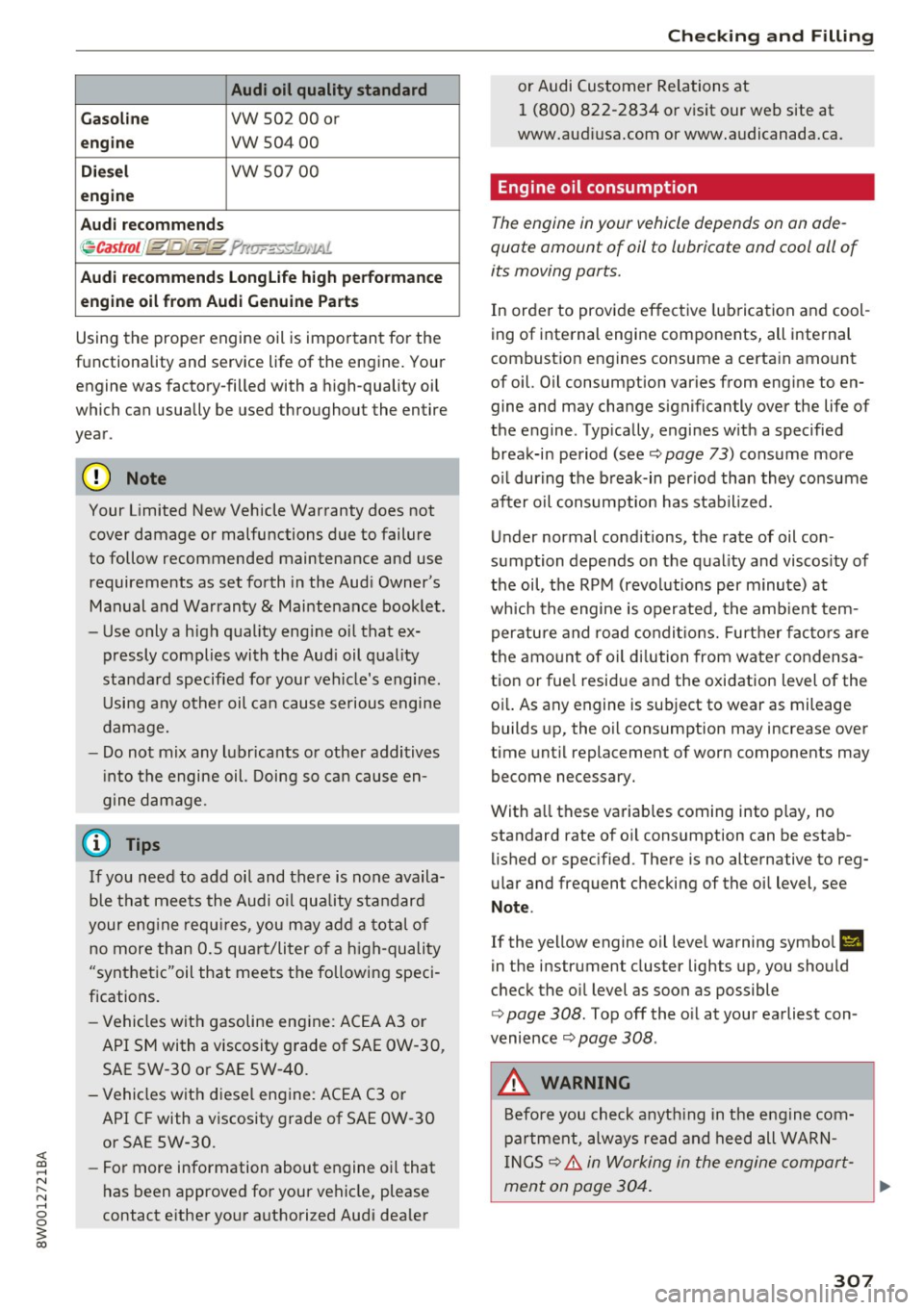
Audi oil quality standard
Gas oline
VW 502 00 or
engi ne vw 504 00
Diesel vw 507 00
eng ine
A udi recomm ends
~ Castrot /jglQ,Y j;-11Jt ?rtwF«J.o,.11-J.
Audi recomm ends Longlife high perf orma nce
engine oil from Aud i Genuine Parts
Using the proper engine oil is important for the
functionality and service life of the eng ine. Your
engine was factory-filled with a high-quality oil
which can usually be used throughout the entire
year.
(D Note
Your Limited New Vehicle Warranty does not
cover damage or malfunctions due to failure
to follow recommended maintenance and use
requirements as set forth in the Aud i Owner's
Manual and Warranty
& Maintenance booklet .
- Use only a high quality eng ine oil that ex-
pressly complies with the Aud i oil quality
standard specified for your vehicle's engine .
U si ng a ny other oil can cause serious engine
damage.
- Do not mix any lubr icants or othe r additives
i nto the engine oil. Doing so can cause en
gine damage.
If you need to add oil and there is none availa
ble that meets the Audi o il quality standard
your eng ine requ ires, you may add a tota l of
no more than 0 .5 qua rt/liter of a h igh-quality
"synthetic"oil that meets the following speci
fications.
- Vehicles with gasoline engine: AC EA A3 or
API SM with a viscosity grade of SAE OW-30,
SAE SW-30 or SAE 5W-40.
- Vehicles with diesel engine: ACEA C3 or API CF with a viscosity grade of SAE OW-30
or SAE 5W-30.
- For more information about engine oil that
has been approved for your vehicle, please
contact either your authorized Audi dea ler
Ch eck ing and Filling
or Audi Customer Relations at
1 (800) 822-2834 or visit our web site at
www.aud iusa .com or www .a udicanada .ca.
Engine oil consumption
The engine in your vehicle depends on on ade
quate amount of oil to lubricate and cool all of
its moving ports.
In order to provide effective lubrication and cool
ing of internal engine components, all internal
combust ion eng ines consume a certa in amount
of oil. Oil consumption varies from eng ine to en
gine and may change s ignificantly over the life of
the engine. Typ ically, engines w ith a specified
break-in period (see
c::> page 73) consume more
o il during the break-in per iod than they consume
after oil consumpt ion has stabil ized.
Under normal cond itions, the rate of oil con
sumption depends on the quality and viscos ity of
the oil, the RPM (revolutions per minute) at
which the engine is operated, the amb ient tem
peratu re and road co ndit ions. Furt her fac to rs a re
the amo unt of oil di lution from wate r condensa
tion or fuel residue and the oxidation level of the oi l. As any engine is subject to wear as mileage
builds up, the oil consumption may increase over
time unt il replacement of worn components may
become necessary.
With a ll these variab les coming into play, no
standard rate of oil consumption can be estab
lished or spec ified . There is no alternative to reg
ular and frequent checking of the oi l level, see
Not e.
If the yellow engine oil level warning symbo l El
in the instrument cluster lights up, you should
check the oil level as soon as possible
c::> page 308 . Top off the o il at your earliest con
venience
c::> page 308 .
A WARNING
Before you check anyt hing in the engine com
partment, always read and heed all WARN
IN GS
c::> .&. in Working in the engine compart-
ment on page 304. ..,_
307
Page 312 of 386
Checking and Filling
Cooling system
Coolant
The engine coo ling system is filled with a mixture
of pur ified water and coolan t addit ive at the fa c
tory. This coo lant must not be not changed.
The coolant leve l is monito red throug h the . in
dicator light~
page 31. Howeve r, we do recom
mend occasionally check ing the coo lan t level
manually.
I f you must add coolant, use a m ixture of water
and coolant additive. M ixing the coolant additive
with d istilled wate r is recommended.
Coolant additive
The coolant additive is made of anti-freezing a nd
corros ion protection agents. Only use the fo llow
ing coo lant add it ives. These additives may be
m ixed w ith each other.
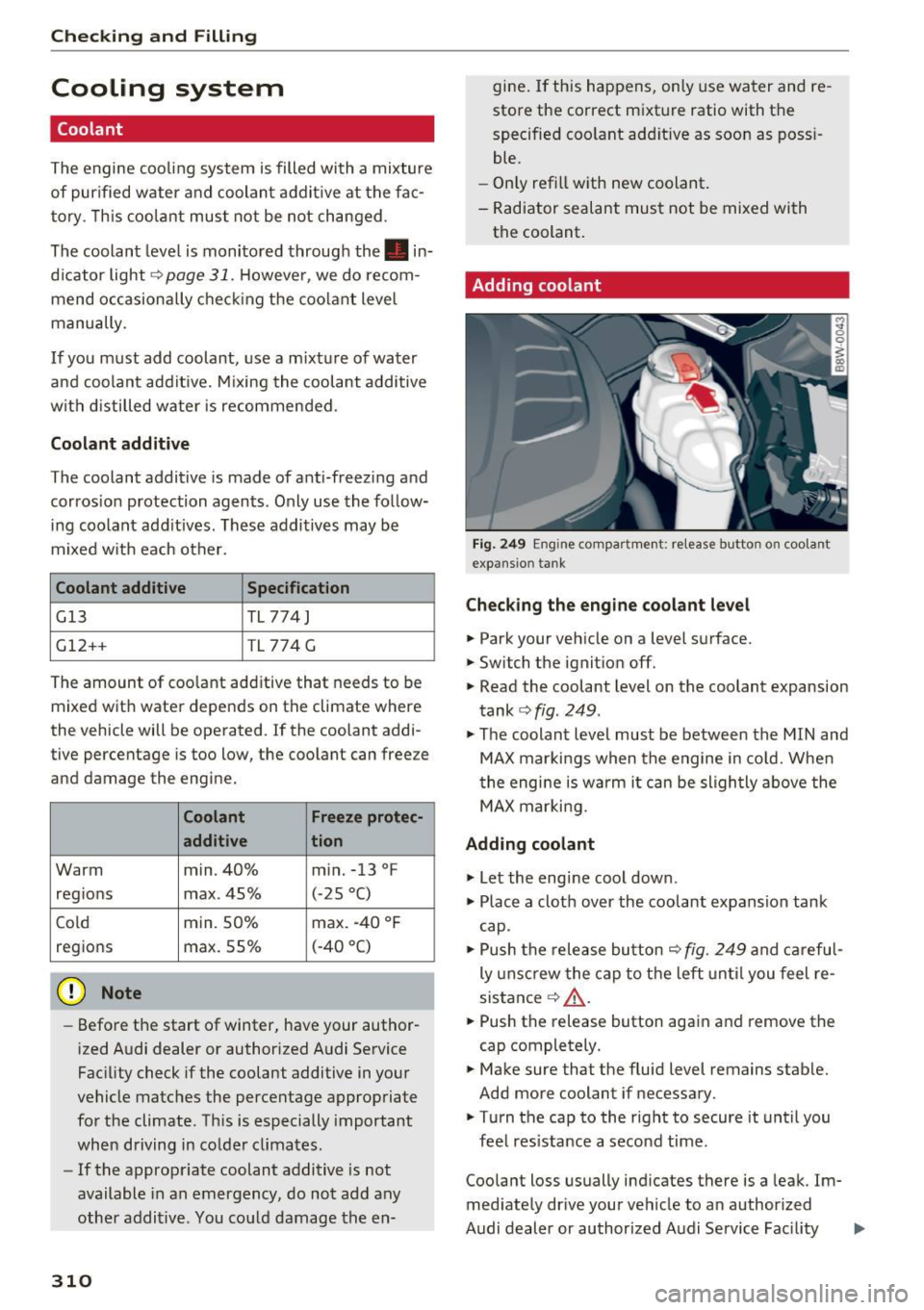
Coolant additive Specification
G13
TL 774)
G12++ TL 774 G
The amount of coo lant add itive that needs to be
mixed w it h water depends on the climate where
the vehicle will be operated. If the coolant addi
tive percentage is too low, the coolant can freeze
and damage the engine.
Coolant Freeze protec-
additive tion
Warm min. 40% m in. -13 °F
reg ions max. 45% (-25 °C)
Cold min. 50% max. -40 °F
reg ions max. 55% (-40 °C)
(D Note
- Befo re the start of winter, have your author
i zed Audi dealer or authorized A udi Service
Fac ility check if the coolant additive in yo ur
vehicle matc hes the percentage approp riate
fo r the climate. Th is is especially important
when driving in co lde r climates.
- If the appropriate coolant additive is not
available in an emergency, do not add any
other additive. You cou ld damage the en-
310
gine . If this happens, only use water and re
store the correct m ixt ure ratio with the
specified coo lant add itive as soon as poss i
ble.
- On ly ref ill with new coolant .
- Rad iator sealant mus t not be mixed wi th
the coolant.
Adding coolant
Fig. 24 9 Eng ine co mpart m ent: re lease button on coolant
expansio n tank
Check ing the engine coolant level
.,. Park your veh icle on a level surface.
.,. Switch the ignit ion off.
.,. Read the coolant level on the coolant expansion
tank
c:> fig . 249 .
.,. The coolant leve l mus t be between the MIN and
MAX mar kings when the engine in co ld. Whe n
t he engi ne is warm i t ca n be sligh tly above the
MAX mar kin g.
Adding coolant
.,. Let the engi ne cool down.
.,. Place a cloth over the coo lant expansion tank
cap.
.,. Push the rele ase button¢
fig. 249 and carefu l
ly unsc rew the cap to the left un til you feel re
sis tance ¢,&. .
.,. Push the release button again and remove the
cap completely.
.,. Make sure that the fluid level remains stab le.
Add more coolant if necessary .
.,. Turn the cap to the right to secure it until you
feel res istance a second time.
Coolant loss usually ind icates there is a leak. Im
med iate ly dr ive your vehicle to an author ized
Audi dealer or authorized A udi Service Fac ility ..,.
Page 313 of 386
and have the cooling system inspected. If the
cooling system is not leaking, a loss can come
from the coolant boiling through overheating and being pushed out of the cooling system.
A WARNING
- The cooling system is under pressure. Do
not open the coolant expansion tank cap
when the engine is hot. This increases the
risk of burns .
- The coolant add itive and the coolant can be
dangerous to your health. For this reason,
keep the coolant in the original container
and away from children. There is a risk of
poisoning.
- When working in the engine compartment,
remember that the radiator fan can switch
on even if the ignition is switched off, which
increases the risk of injury.
(D Note
Do not add coolant if the expansion tank is
empty. There may be a ir in the cooling sys
tem, which increases the risk of engine dam
age . If this is the case, do not continue driv
ing . See an authorized Audi dealer or author
ized Audi Service Facility for assistance.
Brake fluid
Checking brake fluid level
The brake fluid level can be checked with a quick
glance .
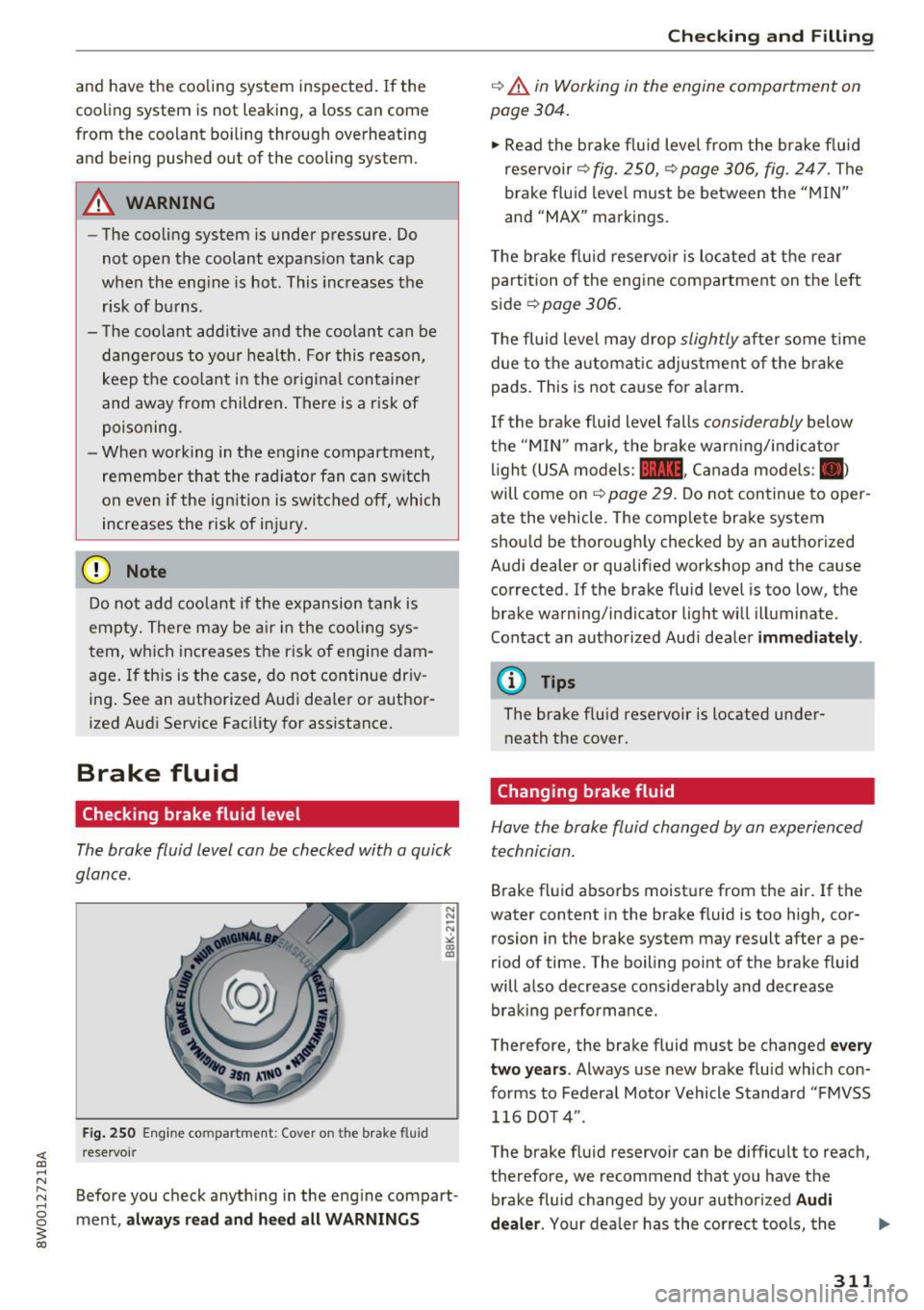
Fig. 250 Engine compa rtment: Cover o n the brake fluid
rese rvoir
Before you check anything in the eng ine compart
ment,
always read and heed all WARNINGS
Checking and Filling
c::> .&. in Working in the engine compartment on
page 304.
" Read the brake fluid level from the brake fluid
reservoir
c::> fig. 250, c::> page 306, fig. 247. The
brake fluid level must be between the "MIN"
and "MAX" markings.
The brake flu id reservoir is located at the rear
partition of the engine compartment on the left
side
~ page 306 .
The fluid level may drop slightly after some time
due to the automatic adjustment of the brake
pads . This is not cause for alarm.
If the brake fluid level falls considerably below
the "MIN" mark, the brake warning/indicato r
light (USA models:
11111 , Canada models : II>
will come on c::> page 29. Do not continue to oper
ate the vehicle. The complete brake system
should be thoroughly checked by an authorized
Audi dealer or qualified workshop and the cause
corrected . If the brake fluid level is too low, the
brake warning/indicator light will illuminate .
Contact an authorized Audi dealer
immediately .
@ Tips
The brake fluid reservoir is located under
neath the cover.
Changing brake fluid
Hove the broke fluid changed by on experienced
technician.
Brake fluid absorbs moisture from the air. If the
water content in the brake fluid is too high, cor
rosion in the brake system may result after ape
riod of time. The boiling point of the brake fluid
will also decrease considerably and decrease braking performance .
Therefore, the brake fluid must be changed
every
two years .
Always use new brake fluid which con
forms to Federal Motor Vehicle Standard "FMVSS
116 DOT 4" .
The brake fluid reservoir can be difficult to reach,
therefore, we recommend that you have the brake fluid changed by your authorized
Audi
dealer.
Your dealer has the correct tools, the
311
Page 314 of 386

Check ing and F illing
right brake fluid and the know -how to do this for
you.
A WARNING
- Brake fluid is poisonous. It must be stored
only in the closed orig inal container out of
the reach of chi ldren!
- B rake failure can resu lt from old or inappro
pr iate brake flu id. Observe these precau
t ions:
- Use on ly brake fluid that mee ts SA E speci
fi cation) 17 0 3 and confo rms to Fede ral
Motor Ve hicle Standard 116. Always check
wit h your authorized Audi dealer to make
sure you are using the correct brake fluid.
The cor rect type o f brake fluid is a lso indi
cated on the brake fluid reservoir.
- The brake fluid must be new. Heavy use of
the brakes can cause a vapor lock if the
brake flu id is left in the system too long.
This ca n ser iously affect t he efficiency of
the bra kes as well as your safety. This
could result in an acc ident.
{U) Note
Brake fluid w ill damage the pa int of yo ur vehi
cle.
@ For the sake of the environment
Because of the prob lem of proper disposal of
brake flu id as we ll as the special tools re
quired and the necessary expertise, we rec
ommend tha t you have the brake fluid
changed by your author ized Audi d ealer.
Battery
General information
Unde r normal operating conditions, the battery
i n your Audi does not need any maintenance.
W ith
high outs ide temperat ures o r long da ily
d rives we recommend that you have the electro
lyte leve l checked by an a uth orized Audi dea le r or
qua lified wor kshop. The e lectroly te leve l should
a lso be checked each time the batte ry is ch a rged
¢ page 314.
312
Have t he battery chec ke d when yo u take yo ur ve
hicle in for service . You are we ll advised to re
place a battery that is o lder than 5 yea rs .
With ce rta in types o f airbag deployment, t he
b atte ry is disconnected from the veh icle elect ri
ca l system for safety reasons ¢.&
in Repair, care
and disposal of the airbags on page 268.
Disconnecting the battery terminals
Some ve hicl e fu nctions (power window regula
tors, for examp le) are lost if the batte ry te rm i
nals a re disconnected . These f unc tions have to be
relearned after the battery term inals are con
nected again . To p revent this, the battery should
o nl y be disconnected from the vehicle electrical
system when absolute ly necessary for repairs.
Vehicles not driven for long periods
If you do not d rive yo ur vehicle ove r a period of
severa l days o r weeks, electr ica l components are
grad ua lly cut back or switched of f. T his reduces
energy consumpt ion and maintains start ing ca
pability over a longer period ¢
page 138.
Some of the convenience functions may not oper
ate, such as the inter ior lights or the power seat
adjustment . The convenience functions will be
available again w hen you turn on the ignit io n and
start the eng ine .
Winter operation
Dur ing the winte r months, battery capacity tends
to decrease as tempe ratures drop. This is be
ca use more power is also consumed while start
i ng, and t he headlights, rear w indow defogger,
etc ., are used more often.
Avo id unnecessary powe r consumption, partic u
l a rly in city traffic or when traveling o nly short
distances . Let your author ized Audi dealer check
the capacity of the vehicle battery before win ter
sets in ¢
page 314 . A well charged battery will
n ot only p reve nt sta rting prob lems when the
we ather is co ld , but will also last longer.
@ Tips
I f yo ur vehicle is left sta nding for several
weeks at extreme ly low te mpera tures, th e ve-
h icl e b att ery should be re mo ved and store d
II>-
Page 315 of 386

<( a, .... N ,....
N .... 0 0
3 a,
where it will not freeze. This will prevent it
from being damaged and having to be re
placed.
Working on the battery
Be especially careful when working on or near the battery.
The battery is located in the engine compart
ment. Before you check anything in the engine
compartment,
read and heed all WARNINGS
c::>& .
Always heed the safety warnings, when wo rking
on the vehicle battery or the vehicle electrical
system to prevent injury.
The following WARNINGS are very important
when working on the battery:
Always heed the following WARNING SYM -
BOLS and safety precautions when working on
the battery.
®
Always wear eye protection.
&
Battery acid contains sulfuric acid. Al-
ways wear glov es and eye protection .
@
No
-sparks
- flames
- smoking.
~
When a battery i s charged, it produces
hydrogen gas which is explosive and
could cause personal injury.
®
Always keep the battery well out of reach
of children.
A WARNING
Whenever working on the battery or on the
electrical system, there is the risk of injury,
accident and even fire . Read and heed the fol
lowing WARNINGS:
-Always wear eye protection. Do not let bat
tery acid or any lead particles get on your
skin or clothing. Shield your eyes. Exp losive
gases can cause blindness or other injury .
- Battery acid contains su lfuric acid. Sulfuric
acid can cause blindness and severe burns.
-
Checking and Filling
-Always wear gloves and eye protection. Do
not tilt the battery because acid could leak
out of the ventilation openings.
- If you get battery acid in your eyes or on
your skin, immed iate ly r inse with cold wa
ter for several minutes and get med ical at
tent ion.
- If you shou ld ingest any battery acid, seek
med ica l attent ion immed iate ly.
- Do not expose the battery to an open flame,
electric sparks or an open light.
- Do not smoke.
- Do not interchange the positive and nega -
tive cables.
- When working on the battery, be sure not to
short-circuit the termina ls with tools or oth
er metal objects. This would cause the bat
tery to heat up very quickly, which cou ld
lead to damage or explosion and personal
injury .
- When a battery is charged, it produces hy
drogen gas which is explosive and could
cause personal injury.
- Always keep the battery well out of the
reach of children .
- Before work is done on the e lectrical sys
tem, disconnect the negat ive ground cable.
- Before performing any work on the electri
cal system, sw itch off the engine and ign i
tion as well as any electrical equipment. The
negat ive cable on the battery must be dis
connected. If you are just going to replace a light bulb, then it is enough to swi tch off
the lights.
- Before disconnecting the battery, switch off
the anti-theft alarm system! Otherwise you
will set off the alarm.
- When disconnecting the battery, first dis
connect the negative cable and then the
positive cable.
- Before reconnecting the battery, make sure
all electrical consumers are switched off.
Reconnect the positive cable first and then
the negative cable. Never interchange the
cables -this could start a fire!
313
Page 318 of 386
Check ing and F illing
Windshield washer
system
.........
w •
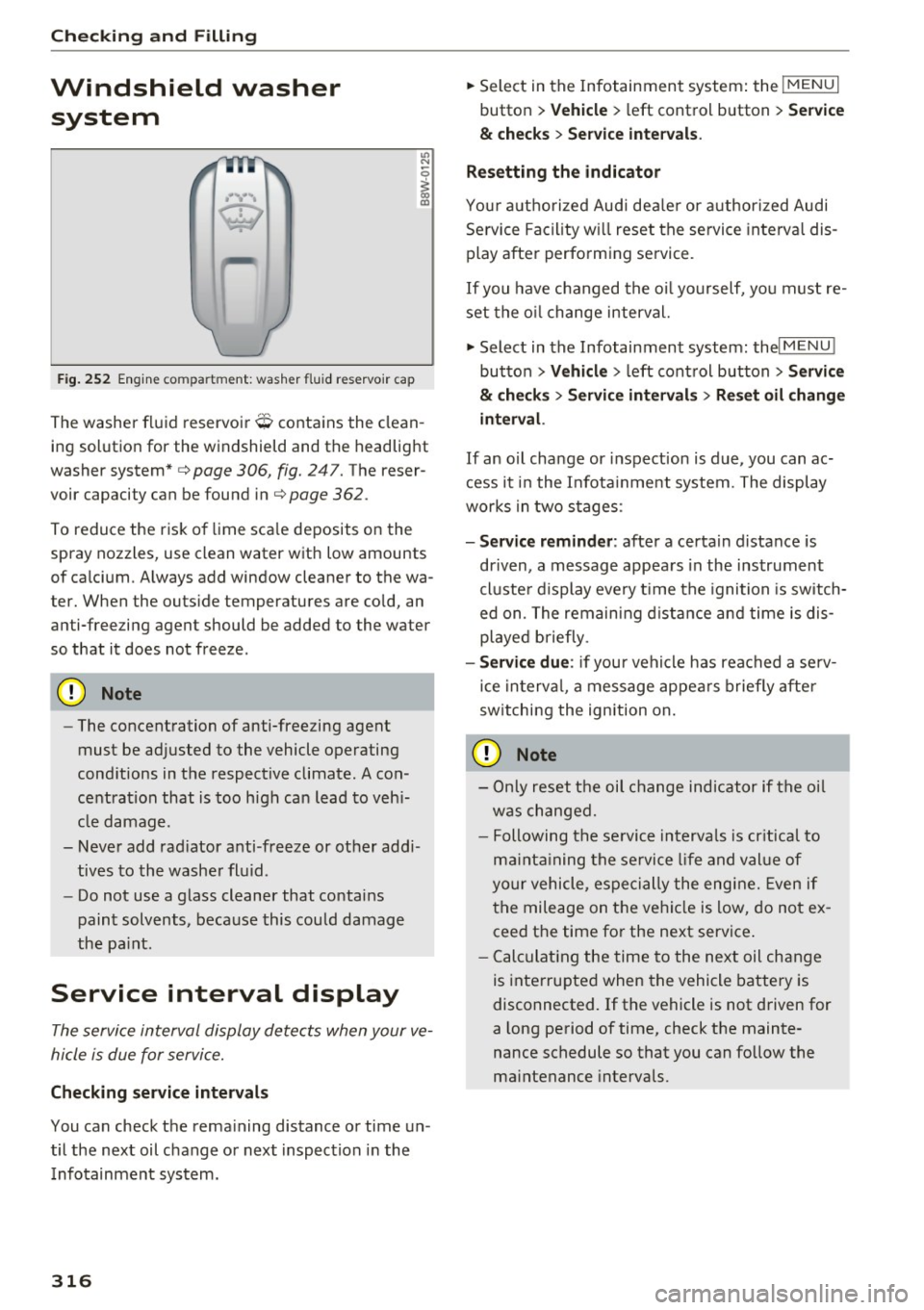
F ig. 252 Engin e comp artm ent : wash er fluid r ese rvoir cap
"' N
0
~ 00 m
The washer fluid reservoir O contains the clean
ing solution for the windshield and the headlight
washer system* c>
page 306, fig. 24 7. The reser
voir capacity can be found inc>
page 362 .
To reduce the risk of lime sca le deposits on the
spray nozzles, use clean water with low amounts
of calci um. Always add window cleaner to the wa
t er. When the outside temper atures are co ld, an
anti-free zing agent should be added to the water
so that it does not freeze .
Cl) Note
-The concentration of anti-free zing agent
must be adjusted to the vehicle operating
conditions in the respective climate. A con
centration that is too high can lead to veh i
cle damage .
- Never add rad iator anti -freeze or other addi
tives to the washer fluid .
- Do not use a glass cleaner that contains
paint solvents, beca use this could damage
the pa int.
Service interval display
The service interval display detects when your ve
hicle is due for service.
Checking se rv ice intervals
You can check the rema ining distance or time un
til the next oil change or next inspection i n the
I nfotainment system .
316
.. Select in the Infotainment system : the !MENUI
button > V ehicle > left control button > Se rvice
& che cks > Ser vice inte rvals .
Resettin g the indicator
You r authorized Audi dea le r or authorized Audi
Se rvice Facility w ill reset the se rvice interval dis
play after performing service.
If you have changed the oi l yourself, yo u must re
set the o il change interval.
.. Select in the Infotainment system: thel
M ENU !
button > Vehicle > left control button > Ser vic e
& check s > Service int erv al s > Re set oil chang e
int erva l.
If an o il cha nge or inspection is due, you can ac
cess it i n the Infota inment system. The display
works in two stages :
-Se rv ice re mind er: after a certain distance is
dr iven, a message appears in the instrument
cluste r display eve ry t ime the ignition is switch
ed on. The remaining d istance and time is dis
played briefly .
-Serv ic e due : if your vehicle has reached a se rv
ice in terva l, a message appears briefly after
sw itching the ignition on.
(D Note
- Only reset the oil change indicator if the oi l
was changed.
- Following the se rvice interva ls is cr itical to
ma inta ining the se rvice l ife and val ue of
yo ur vehicle, especially the engine. Even if
the mileage on the vehi cle is low, do not ex
ceed the time for the next service .
- Calc ulat ing the time to the next oil change
is interrupted when the vehicle battery is
disconnected.
If the vehicle is not driven for
a long period of time, check the mainte
nance schedule so that you can fo llow the
maintenance intervals .