battery AUDI A4 2017 Owner's Manual
[x] Cancel search | Manufacturer: AUDI, Model Year: 2017, Model line: A4, Model: AUDI A4 2017Pages: 386, PDF Size: 96.32 MB
Page 306 of 386

Check ing and F illing
Engine compartment
Working in the engine compartment
Special care is required if you are working in the
engine compartment
Fo r wo rk in th e engine compa rtmen t, s uch as
c h ec kin g and filli ng flu id s, th ere is a risk of in
j u ry, sc aldin g, ac cide nts, a nd b urn s. For this
rea son, foll ow all the warning s and gener al
s a fe ty p recaution s pr ov ided in the f ollow ing in·
f o rm ation . Th e en gine c omp artmen t is a dan
ger ous are a.
¢ ,&.
_& WARNING
- T urn the engine off.
- Switch the ign ition off .
- Set the parking brake .
- Select the P selector lever pos ition .
- let the engine cool down.
- Never open the hood if you can see steam or coolant escaping from the engine compart
ment, because th is increases the r isk of
burns . Wait until no steam or coolant is es
caping .
- Keep ch ildren away from the engine com
partment .
- Never spill flu ids on a hot engine. These flu
ids (such as the anti -freezing agent con
ta ined in the coolant) can ignite .
- Avoid short circu its in the electrical system,
especially to the battery .
- When working in the engine compartment,
remember that the rad iator fan can sw itch
on even if the ign ition is switched off, which
increases the risk of injury .
- Never open the cap on the coolant expan sion tank when the eng ine is warm. The
cooling system is under pressu re .
- To protect your face, hands, and arms from
hot steam or coolant, cover the cap with a
large cloth when opening.
- Do not remove the engine cover under any
circumstances. This increases the risk of
burns.
- If tests need to be performed w ith the en
gine running, there is additional danger d ue
304
to moving components (such as the ribbed
be lt, alternator and rad iator fan) and from
the high-voltage ignition system.
- Do not under any circumstances activate the
throttle inadvertently (for example, by hand
from the engine compartment) if the vehi
cle is stat ionary but the eng ine is running
and a gear is engaged . Otherwise, the veh i
cle will start to move immediately and this
could result in an acc ident.
- Pay attent ion to the following warnings list
ed when wor k on the fue l system o r on the
electrical equipment is req uired.
- Always disconnect the vehicle battery
from the vehicle electrical system.
- Do not smoke .
- Never work near open flames.
- Always have a working fire extinguisher
nearby
- To reduce the r isk of e lectr ic shock and in
jury, never touch the follow ing components
when the engine is running or is being start
ed:
- Ign ition cable
- Other components in the electronic high-
voltage ign ition system
- If you must check or perform work on the engine whi le it is running:
- Set the parking brake and place the selec
tor lever in the P (park) pos ition first.
- Always proceed w ith extreme cau tion so
that clothing, jewelry or long hair do not become ca ught in the rad iator fan, fan
belt or other moving components or do
not come into contact with hot compo
nents. Tie back long hair before beginning
work and do not wear clothing that can hang down into the engine .
- Limit your exposure to exhaust and chemi
cals to as short a time as possible¢.&. .
_& WARNING
California Proposition 65 Warning :
- Engine exhaust, some of its constituents,
and certa in vehicle components conta in or
emit chemicals known to the State of Cali-
fornia to cause cancer and birth defects and ..,
Page 307 of 386

reproductive harm. In addition, certain flu
ids contained in vehicles and certain prod
ucts of component wear contain or emit
chemicals known to the State of California
to cause cancer and birth defects or other
reproduct ive harm.
- Battery posts, terminals and related acces
sories contain lead and lead compounds,
chem icals known to the State of California
to cause cance r and rep roductive harms.
Wash hands after handling.
(D Note
When filling flu ids, be sure not to mix the flu
ids up . Otherwise severe ma lfunctions and en
gine damage w ill occur.
@ For the sake of the environment
You should regularly check the grou nd under
your veh icle in order to detect Leaks qu ickly . If
there are v isible spots from oil or other fluids,
bring your vehicle to an authorized Aud i dea l
er or authorized Audi Service Facility to be
checked.
Opening the hood
The hood is released from the interior.
F ig. 2 45 Dri ver fo otw ell : rele ase leve r
Checki ng an d Fill in g
Fig. 246 Unlocke d hood: lever
Make sure the wiper arms are not raised up from
the windshield. Otherwise the paint could be
damaged .
.,. With the driver's door open, pull the lever be
low the instrument pane l in the direction of the
arrow
c;> fig. 245 .
.,. Raise the hood slightly c;> ,&. .
.,. Press the lever c;> fig. 246 in the direct ion of the
arrow. This releases the hooks .
.. Open the hood .
A WARNING
-
Never open the hood if you can see steam or
coolant escaping from the engine compart ment, because this increases the risk of
burns. Wait until no steam or coolant is es
cap ing .
Closing the hood
.,. Push the hood down until you override the
force of the str uts .
.,. Let the hood fall lightly into the latch .
Do not
press it in.
c;> &_ .
A WARNING
-===
If the hood is not latched complete ly, it could
fly up wh ile you are driving and obstruct your
vis ion.
- For safety reasons, the hood must always be
closed securely while driv ing. Because of
this, always check the hood after closing it
to make sure it is latched correctly . The
hood is latched if the front corners cannot
be lifted.
~
305
Page 314 of 386

Check ing and F illing
right brake fluid and the know -how to do this for
you.
A WARNING
- Brake fluid is poisonous. It must be stored
only in the closed orig inal container out of
the reach of chi ldren!
- B rake failure can resu lt from old or inappro
pr iate brake flu id. Observe these precau
t ions:
- Use on ly brake fluid that mee ts SA E speci
fi cation) 17 0 3 and confo rms to Fede ral
Motor Ve hicle Standard 116. Always check
wit h your authorized Audi dealer to make
sure you are using the correct brake fluid.
The cor rect type o f brake fluid is a lso indi
cated on the brake fluid reservoir.
- The brake fluid must be new. Heavy use of
the brakes can cause a vapor lock if the
brake flu id is left in the system too long.
This ca n ser iously affect t he efficiency of
the bra kes as well as your safety. This
could result in an acc ident.
{U) Note
Brake fluid w ill damage the pa int of yo ur vehi
cle.
@ For the sake of the environment
Because of the prob lem of proper disposal of
brake flu id as we ll as the special tools re
quired and the necessary expertise, we rec
ommend tha t you have the brake fluid
changed by your author ized Audi d ealer.
Battery
General information
Unde r normal operating conditions, the battery
i n your Audi does not need any maintenance.
W ith
high outs ide temperat ures o r long da ily
d rives we recommend that you have the electro
lyte leve l checked by an a uth orized Audi dea le r or
qua lified wor kshop. The e lectroly te leve l should
a lso be checked each time the batte ry is ch a rged
¢ page 314.
312
Have t he battery chec ke d when yo u take yo ur ve
hicle in for service . You are we ll advised to re
place a battery that is o lder than 5 yea rs .
With ce rta in types o f airbag deployment, t he
b atte ry is disconnected from the veh icle elect ri
ca l system for safety reasons ¢.&
in Repair, care
and disposal of the airbags on page 268.
Disconnecting the battery terminals
Some ve hicl e fu nctions (power window regula
tors, for examp le) are lost if the batte ry te rm i
nals a re disconnected . These f unc tions have to be
relearned after the battery term inals are con
nected again . To p revent this, the battery should
o nl y be disconnected from the vehicle electrical
system when absolute ly necessary for repairs.
Vehicles not driven for long periods
If you do not d rive yo ur vehicle ove r a period of
severa l days o r weeks, electr ica l components are
grad ua lly cut back or switched of f. T his reduces
energy consumpt ion and maintains start ing ca
pability over a longer period ¢
page 138.
Some of the convenience functions may not oper
ate, such as the inter ior lights or the power seat
adjustment . The convenience functions will be
available again w hen you turn on the ignit io n and
start the eng ine .
Winter operation
Dur ing the winte r months, battery capacity tends
to decrease as tempe ratures drop. This is be
ca use more power is also consumed while start
i ng, and t he headlights, rear w indow defogger,
etc ., are used more often.
Avo id unnecessary powe r consumption, partic u
l a rly in city traffic or when traveling o nly short
distances . Let your author ized Audi dealer check
the capacity of the vehicle battery before win ter
sets in ¢
page 314 . A well charged battery will
n ot only p reve nt sta rting prob lems when the
we ather is co ld , but will also last longer.
@ Tips
I f yo ur vehicle is left sta nding for several
weeks at extreme ly low te mpera tures, th e ve-
h icl e b att ery should be re mo ved and store d
II>-
Page 315 of 386

<( a, .... N ,....
N .... 0 0
3 a,
where it will not freeze. This will prevent it
from being damaged and having to be re
placed.
Working on the battery
Be especially careful when working on or near the battery.
The battery is located in the engine compart
ment. Before you check anything in the engine
compartment,
read and heed all WARNINGS
c::>& .
Always heed the safety warnings, when wo rking
on the vehicle battery or the vehicle electrical
system to prevent injury.
The following WARNINGS are very important
when working on the battery:
Always heed the following WARNING SYM -
BOLS and safety precautions when working on
the battery.
®
Always wear eye protection.
&
Battery acid contains sulfuric acid. Al-
ways wear glov es and eye protection .
@
No
-sparks
- flames
- smoking.
~
When a battery i s charged, it produces
hydrogen gas which is explosive and
could cause personal injury.
®
Always keep the battery well out of reach
of children.
A WARNING
Whenever working on the battery or on the
electrical system, there is the risk of injury,
accident and even fire . Read and heed the fol
lowing WARNINGS:
-Always wear eye protection. Do not let bat
tery acid or any lead particles get on your
skin or clothing. Shield your eyes. Exp losive
gases can cause blindness or other injury .
- Battery acid contains su lfuric acid. Sulfuric
acid can cause blindness and severe burns.
-
Checking and Filling
-Always wear gloves and eye protection. Do
not tilt the battery because acid could leak
out of the ventilation openings.
- If you get battery acid in your eyes or on
your skin, immed iate ly r inse with cold wa
ter for several minutes and get med ical at
tent ion.
- If you shou ld ingest any battery acid, seek
med ica l attent ion immed iate ly.
- Do not expose the battery to an open flame,
electric sparks or an open light.
- Do not smoke.
- Do not interchange the positive and nega -
tive cables.
- When working on the battery, be sure not to
short-circuit the termina ls with tools or oth
er metal objects. This would cause the bat
tery to heat up very quickly, which cou ld
lead to damage or explosion and personal
injury .
- When a battery is charged, it produces hy
drogen gas which is explosive and could
cause personal injury.
- Always keep the battery well out of the
reach of children .
- Before work is done on the e lectrical sys
tem, disconnect the negat ive ground cable.
- Before performing any work on the electri
cal system, sw itch off the engine and ign i
tion as well as any electrical equipment. The
negat ive cable on the battery must be dis
connected. If you are just going to replace a light bulb, then it is enough to swi tch off
the lights.
- Before disconnecting the battery, switch off
the anti-theft alarm system! Otherwise you
will set off the alarm.
- When disconnecting the battery, first dis
connect the negative cable and then the
positive cable.
- Before reconnecting the battery, make sure
all electrical consumers are switched off.
Reconnect the positive cable first and then
the negative cable. Never interchange the
cables -this could start a fire!
313
Page 316 of 386

Checking and Filling
-Never charge a frozen or a thawed-out bat
tery. It could explode! If a battery has fro
zen, then it must be rep laced. A discharged
battery can freeze over at 32°F (0°C).
- Make sure the vent hose is always attached
to the opening on the side of the battery.
- Never use batteries which are damaged.
There is the danger of an explos ion! A lways
rep lace a damaged battery .
A WARNING
California Propositio n 65 Warning:
- Battery posts, terminals and re lated acces
sories contain lead and lead compounds,
chemicals known to the State of California
to cause cance r and rep roduct ive p roblems.
Wash hands after handling.
(D Note
- Do not d isconnect the vehicle battery when
the ig nitio n is switched on or when the en
g ine is r unning, o therwise, you w ill damage
electron ic compone nts in t he e lectr ica l sys
t em.
- If your vehicle is going to stan d for a long
period of t ime without be ing dr iven, p rotect
the b attery from "free zing", o therwise it
will be d am age d and will then h ave to be re
placed .
Battery charging
Starting the engine requires a well charged ba t
tery.
F ig . 2 5 1 Eng ine compartmen t: Co nnectors for charger and
jump er cables
314
Alway s read and heed all WARNINGS below
¢ A and c:> A in Working on the battery on
page 313.
.. Tur n off the ign ition and all ele ctrica l consum
ers .
.. Make sure the area is well ventilated when you
charge the battery .
.. Open the engine hood
c:> page 305 .
.. Open the cover on the positive pole c:> fig. 251 .
.. Connect the charger connectors according to
the instruct ions to the
jump start bolts. (Bo lts
unde r the cover= "positive", Bolts with hex
head= "n ega tive").
.. Onl y now plug the m ain s lead fo r the ch arging
equ ipment in to the wall o utlet and tu rn it on
¢ _A .
.. Make sure the charging rate is not over
30 amps /14.8 Volt.
.. When the battery is fully charged: Turn the
charging equipment off and remove the mains
lead from the wa ll out let .
.. Now remove the clamps for the c harg ing equip-
ment.
.. Close the cover on the posi tive pole.
.. Close the hood
¢ page 305.
A d ischa rged battery can freeze at temperat ures
of only 32 °F (0 °C). Allow a fro zen ba ttery to
thaw completely befo re a ttemp ting to ch arge it
¢ &. . However, we recommend not u sing a
thawed battery aga in beca use the ba tte ry casing
can be cracke d due to ice formation a nd can leak
battery acid.
Battery charging (Maximum charging rate of
30 amps/14.8 Volt)
When charging at low voltages (e .g . with a trick·
le charger ),
the battery cables do not have to be
disconnected fir st. The batte ry caps should
not
be opened when charging a battery.
It is not necessary to remove the battery from
the luggage compartment .
Fast charging the battery (charging rate
above 14 .8 Volts)
For technica l reasons do not use a battery cha rg
er that uses voltage greater than 14.8 Vo lts to
c h arge your veh icle's battery.
Page 317 of 386

<( a, .... N ,....
N .... 0 0
3 a,
& WARNING
Charging a battery can be dangerous.
- Always follow the operat ing instruct ions
provided by the battery charger manufactur
er when charging your battery .
- Never charge a frozen ba ttery . It may ex
plode because of gas trapped in the ice. A l
low a frozen battery to thaw out first .
- Do not reuse batteries wh ich were frozen.
The battery housing may have cracked and
weakened when the battery froze .
- Charge the battery in a we ll ventilated area.
Keep away from open flame or electrical
spark. Do not smoke . Hydrogen gas generat
ed by the battery is exp losive.
- To reduce the danger of explosion, never
connect or disconnect charger cables whi le
the charger is operat ing.
- Fast charging a battery is dangerous and
should only be attempted by a competent
technician with the proper equipment.
- Battery acid that may spill during charging
should be washed off with a solution of
warm water and baking soda to neutralize
the acid .
(D Note
Never use a fast charger as a booster to start
the engine. This will serious ly damage sensi
tive electronic components, such as control
units, relays, radio, etc ., as well as the battery
charger .
Replacing the battery
Your veh icle is equipped with an inte llige nt ene r
gy management system for d istr ibut ing elect rici
ty ¢
page 138. The battery cha rges better in
vehicles with the en ergy management system
than in vehicles without the system. To ensure
that th e additional pow er is availabl e after re
p lac ing the battery, rep lacing w ith the same type
of b attery from the s ame manufac turer ( like the
battery that was delivered with the veh icle) is
recommended . Yo ur authorized deale r must code
the battery in the energy management system to
Ch eck ing and Filling
enable you to use the energy management func
tions corr ectly aft er replacing the batt ery .
If it is no t possib le to use a battery of this type,
the new battery mus t have the same capacity,
vo ltage ( 12-volts), amperage, construction and
plug sealing.
When install ing the battery, make sure the ig ni
t ion and all electr ica l cons umers are tu rned off.
Q) Note
- Vehicles, fo r example with a Start-Stop sys
t em*, a re equipped with a specia l cycle
proof bat tery (such as an AGM battery). In
sta lling a different type of battery can cause
prob lems in the veh icle elect rical system .
When replacing the vehicle battery, always
install one w ith the same specifications as
the origina l battery.
- Make sure that the gas venting hose is al
ways connected to the original opening on the battery s ide . Otherw ise gasses or bat
tery acid could leak out .
- Battery mounts and clamps must always be
secured correct ly .
- Read and follow the warn ings under
¢
page 313, Working on the battery before
performing any work on the battery.
® For the sake of the environment
Because of the problem of proper d isposa l of
a battery, we recommend your authori zed
Audi dealer change the battery for you. Bat
teries contain sulfur ic acid and lead and must
always be disposed of properly in compliance
wi th a ll envi ronmenta l reg ulat ions. Dispos ing
of veh icle bat teries improperly is very da nger
ous to the environment.
315
Page 318 of 386
Check ing and F illing
Windshield washer
system
.........
w •
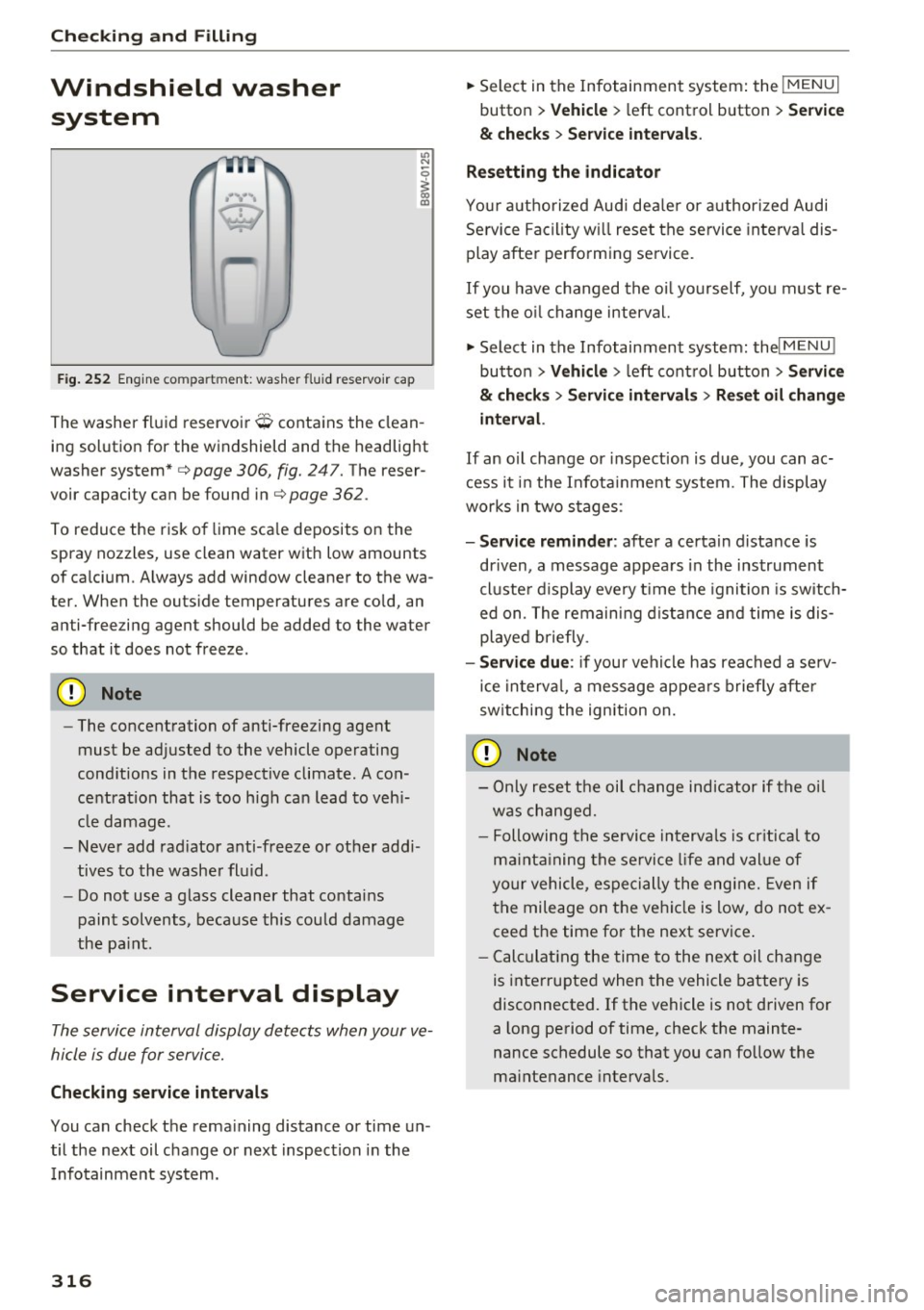
F ig. 252 Engin e comp artm ent : wash er fluid r ese rvoir cap
"' N
0
~ 00 m
The washer fluid reservoir O contains the clean
ing solution for the windshield and the headlight
washer system* c>
page 306, fig. 24 7. The reser
voir capacity can be found inc>
page 362 .
To reduce the risk of lime sca le deposits on the
spray nozzles, use clean water with low amounts
of calci um. Always add window cleaner to the wa
t er. When the outside temper atures are co ld, an
anti-free zing agent should be added to the water
so that it does not freeze .
Cl) Note
-The concentration of anti-free zing agent
must be adjusted to the vehicle operating
conditions in the respective climate. A con
centration that is too high can lead to veh i
cle damage .
- Never add rad iator anti -freeze or other addi
tives to the washer fluid .
- Do not use a glass cleaner that contains
paint solvents, beca use this could damage
the pa int.
Service interval display
The service interval display detects when your ve
hicle is due for service.
Checking se rv ice intervals
You can check the rema ining distance or time un
til the next oil change or next inspection i n the
I nfotainment system .
316
.. Select in the Infotainment system : the !MENUI
button > V ehicle > left control button > Se rvice
& che cks > Ser vice inte rvals .
Resettin g the indicator
You r authorized Audi dea le r or authorized Audi
Se rvice Facility w ill reset the se rvice interval dis
play after performing service.
If you have changed the oi l yourself, yo u must re
set the o il change interval.
.. Select in the Infotainment system: thel
M ENU !
button > Vehicle > left control button > Ser vic e
& check s > Service int erv al s > Re set oil chang e
int erva l.
If an o il cha nge or inspection is due, you can ac
cess it i n the Infota inment system. The display
works in two stages :
-Se rv ice re mind er: after a certain distance is
dr iven, a message appears in the instrument
cluste r display eve ry t ime the ignition is switch
ed on. The remaining d istance and time is dis
played briefly .
-Serv ic e due : if your vehicle has reached a se rv
ice in terva l, a message appears briefly after
sw itching the ignition on.
(D Note
- Only reset the oil change indicator if the oi l
was changed.
- Following the se rvice interva ls is cr itical to
ma inta ining the se rvice l ife and val ue of
yo ur vehicle, especially the engine. Even if
the mileage on the vehi cle is low, do not ex
ceed the time for the next service .
- Calc ulat ing the time to the next oil change
is interrupted when the vehicle battery is
disconnected.
If the vehicle is not driven for
a long period of time, check the mainte
nance schedule so that you can fo llow the
maintenance intervals .
Page 344 of 386
Care and cleaning
Placing your vehicle out
of service
If you would like to take your vehicle out of serv
ice for a longer t ime, contact your authorized
Aud i dealer or a uthorized Aud i Serv ice Facility .
They will advise you of important measu res, such
as co rrosion protectio n, main tenance and sto r
age p rocedures. Also follow the i nfo rmation
about the battery
~ page 312.
342
Page 358 of 386
Emergency situations
Emergency situations
General
This chapter is intended for trained emergency crews and working personnel who have the nec
essary tools and equipment to perform these
operations.
Starting by pushing or
towing
CD Note
Vehicles with an automatic transmission
cannot be started by pushing or towing.
Starting with jumper
cables
If necessary, the engin e con be started by con
necting it to the battery of another vehicle.
If the engine should fail to start because of a dis
charged or weak battery, the battery can be con
nected to the battery of
another vehicle, using a
pair of jumper cables to start the engine.
Jumper cables
Use only jumper cables of sufficiently large cross
section
to carry the starter current safely. Refer
to the manufacturer's specifications.
Use only jumper cables with
insulated terminal
clamps which are distinctly marked :
plus(+) cable in most cases colored red
minus(-) cable
in most cases colored black.
A WARNING
Batteries contain electricity, acid, and gas.
Any of these can cause very serious or fatal in
jury. Follow the instructions below for
safe
handling of your vehicle's battery.
-Always shield your eyes and avoid leaning
over the battery whenever possible.
-A discharged battery can freeze at tempera
tures just below 32 °F (0 °C). Before con
necting a jumper cable, you must thaw the
356
frozen battery completely, otherwise it could explode.
- Do not allow battery acid to contact eyes or
skin. Flush any contacted area with water immediately.
- Improper use of a booster battery to start a
vehicle may cause an explosion.
- Vehicle batteries generate explosive gases.
Keep sparks, flame and lighted cigarettes
away from batteries.
- Do not try to jump start any vehicle with a
low acid level in the battery.
- The voltage of the booster battery must also
have a 12-Volt rating. The capacity (Ah) of
the booster battery should not be lower
than that of the discharged battery. Use of
batteries of different voltage or substantial
ly different "Ah" rating may cause an explo
sion and personal injury.
- Never charge a frozen battery. Gas trapped in the ice may cause an explosion.
- Never charge or use a battery that has been
frozen . The battery
case may have be weak
ened .
- Use of batteries of different voltage or sub
stantially different capacity (Ah) rating may
cause an explosion and injury. The capacity
(Ah) of the booster battery should not be
lower than that of the discharged battery.
- Before you check anything in the engine
compartment, always read and heed all
WARNINGS
~page 304.
CD Note
-Applying a higher voltage booster battery
will cause expensive damage to sensitive
electronic components, such as control
units, relays, radio, etc.
- There must be no electrical contact between
the vehicles as otherwise current could al
ready start to flow as soon as the positive
(+) terminals are connected.
@ Tips
The discharged battery must be properly con-
nected to the vehicle's electrical system. .,..
Page 359 of 386
When jump starting or charging the battery,
never connect the negative ground cable to
the battery negative post because the battery
manager system must be able to detect the
battery's state of charge . Always connect the
negative ground cable to the negat ive ground
post of the battery manager control unit .
Using the jump start
cable
Both jump start cables must be connected in the
correct order!
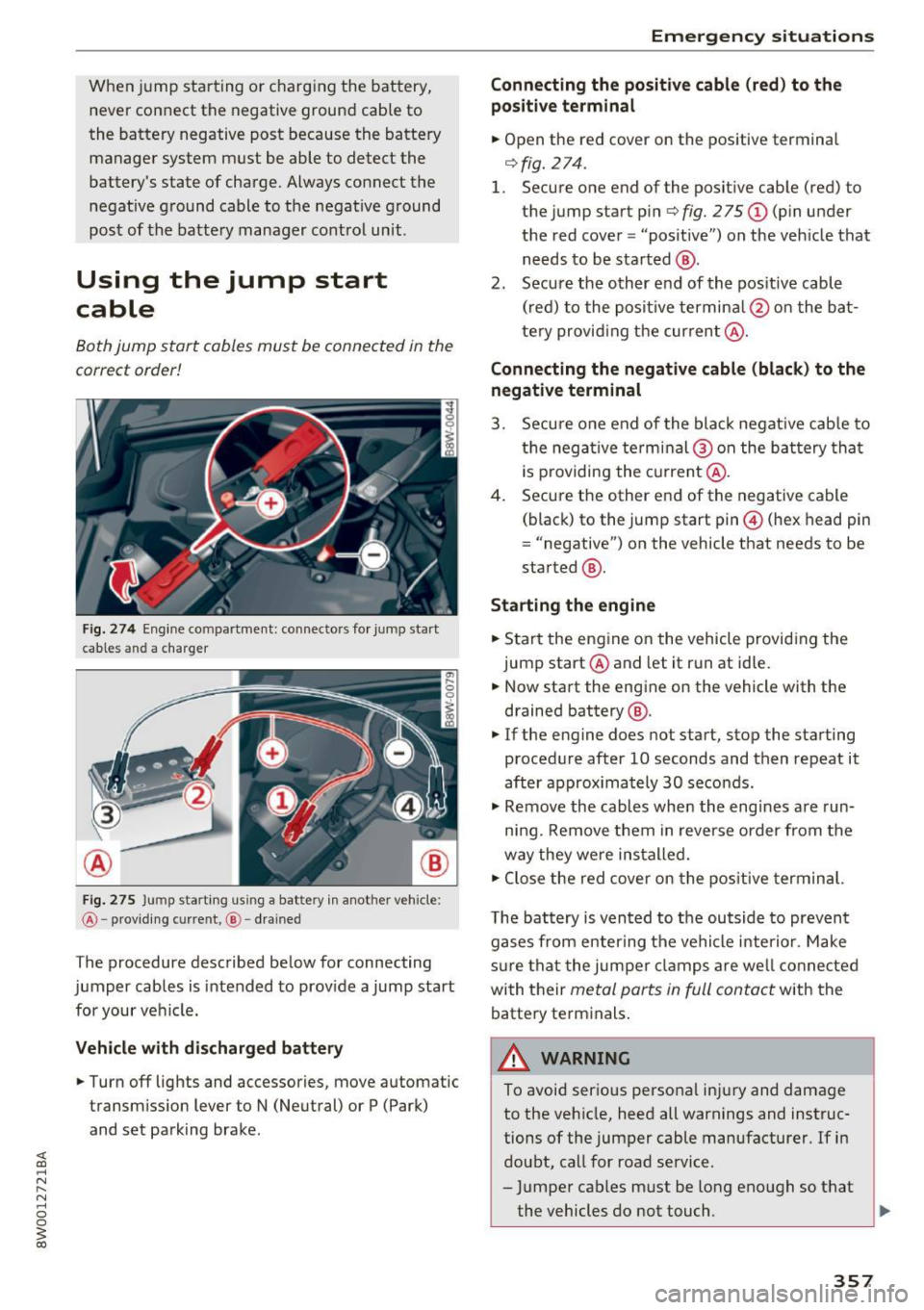
Fig. 274 Engine co mpa rtment: connecto rs for jump start
cables and a charger
@
Fig. 275 Ju mp sta rting us ing a battery in another vehicle:
@ -providing cu rre nt, @ - drained
The procedure described below for connecting
jumper cables is intended to provide a jump start
for your vehicle.
Vehicle with discharged battery
.. Turn off lights and accessories, move automatic
transmission lever to N (Neutral) or P (Park)
and set parking brake .
Emergency situations
Connecting the positive cable (red) to the
po sitive terminal
.. Open the red cover on the positive terminal
r=>fig.274 .
1. Secure one end of the positive cable (red) to
the jump start pin
r=> fig. 275 (D (pin under
the red cover = "posit ive") on the vehicle that
needs to be started @.
2. Secure the other end of the pos itive cable
(red) to the positive termina l@ on the bat
tery provid ing the current @.
Connecting the negative cable (black) to the
negative terminal
3. Secure one end of the black negat ive cab le to
the negative terminal @on the battery that
i s p roviding the current@.
4. Secure the other end of the negative cable
(black) to the jump start pin@ (hex head pin
= "negative") on the vehicle that needs to be
started @.
Starting the engine
.. Start the engine on the vehicle providing the
jump start @and let it run at idle .
.. Now start the engine on the vehicle with the
drained battery @ .
.. If the engine does not start, stop the starting
procedure after 10 seconds and then repeat it
after approx imately 30 seconds .
.. Remove the cables when the engines are run
ning. Remove them in reverse order from the
way they were installed.
.. Close the red cover on the positive terminal.
T he battery is vented to the outside to prevent
gases from enter ing the vehicle interior . Make
s ur e that the jumper clamps are well connected
with their
metal ports in full contact with the
battery terminals.
_& WARNING
-To avoid serious personal injury and damage to the vehicle, heed all warnings and instruc
tions of the jumper cable manufacturer. If in
doubt, call for road service.
- Jumper cables must be long enough so that
the vehicles do not touch . ..,_
357