tow AUDI A4 2017 Workshop Manual
[x] Cancel search | Manufacturer: AUDI, Model Year: 2017, Model line: A4, Model: AUDI A4 2017Pages: 386, PDF Size: 96.32 MB
Page 333 of 386
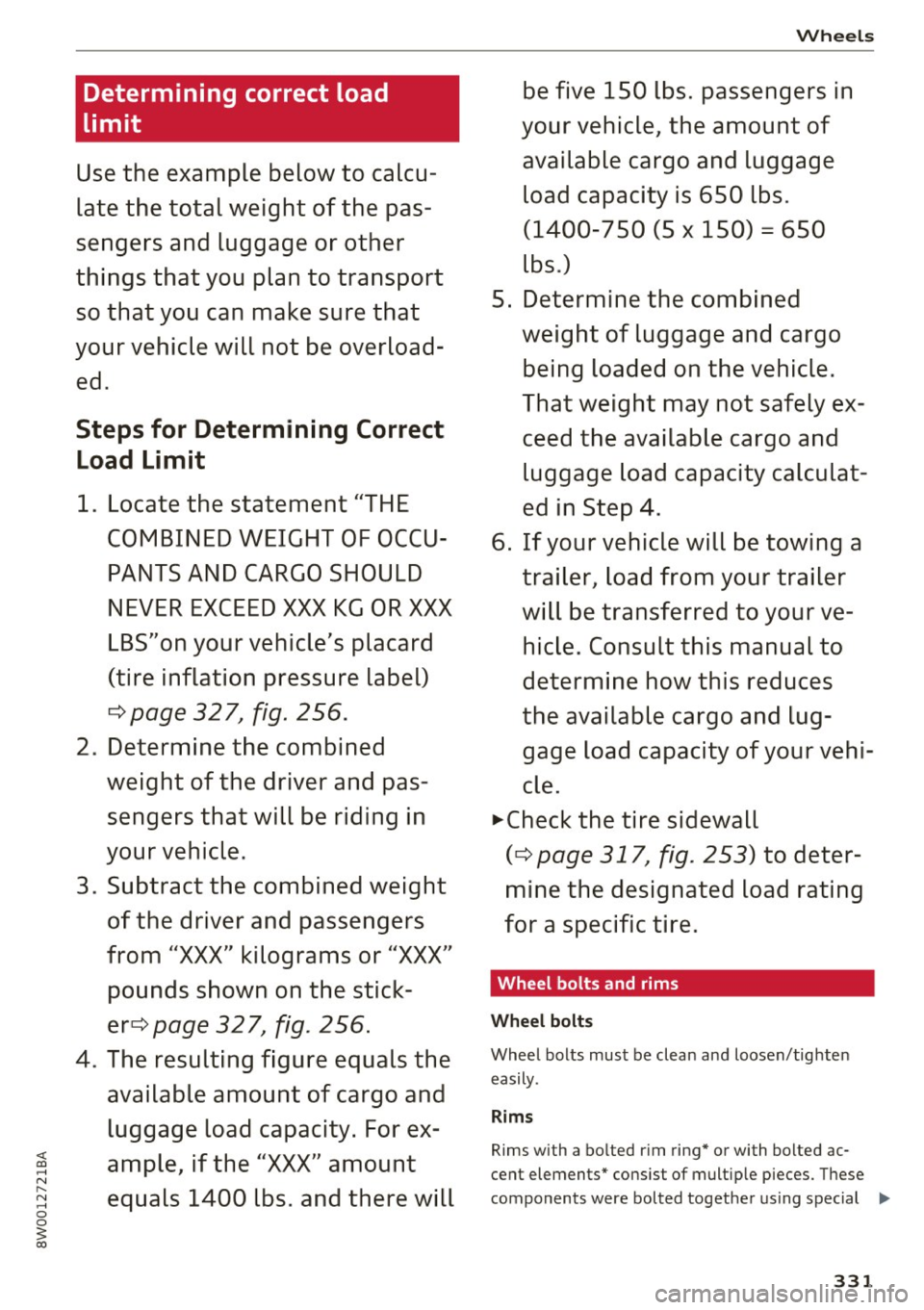
Determining correct load
limit
Use the example below to calcu
late the total weight of the pas
sengers and luggage or other
things that you plan to transport
so that you can ma ke sure that
your vehicle will not be overload ed .
Steps for Determining Correct
Load Limit
1 . Locate the statement "THE
COMBINED WEIGHT OF OCCU PANTS AND CARGO SHOULD
NEVER EXCEED XXX KG OR XXX
LBS"on your vehicle 's pla card
(tire inflation pre ssure l abel)
¢ page 327, fig. 256.
2 . Determine the combined
weight of the drive r and pas
s engers that will be riding in
your vehicle.
3 . Subtra ct the combined weight
of the driver and passengers
from
" XXX" kilograms or "XXX"
pounds shown on the stick
er ¢
page 32 7, fig . 256.
4. The re sulting figure equals the
available amount of cargo and
luggage load capacity. For ex-
; ample, if the
"XXX" amount
N
~ equals 1400 lbs. and there will 0 0
3
be five 1 SO lbs. pa ssengers in
your vehicle, the amount of available cargo and luggage load capacity i s 650 lb s.
(1400-750 (5 X 150) = 650
lbs.)
5. Determin e the combined
weight of luggage and cargo
being loaded on the vehicle.
That weight may not safely ex
ceed the available cargo and luggage load capa city cal culat
ed in Step
4 .
6.
If your vehi cle will be towing a
trailer, load from your trailer
will be transferred to your ve
hicle. Con sult thi s manual to
determine how this reduces
the available cargo and lug gage load capacity of your vehi
cle.
..,.Check the tire sidewall
(¢ page 317 , fig. 253) to deter
mine the designated load rating
for a specific tire.
Wheel bolts and rims
Wheel bolts
Wheel bolts mus t be clean and loosen/tig hte n
easily .
Rims
Rims with a bo lted r im ring * or with bo lted ac-
cent elements" co nsist of multip le pieces. These
components were bolted togethe r using s pec ial ..,.
331
Page 342 of 386
Care and cleaning
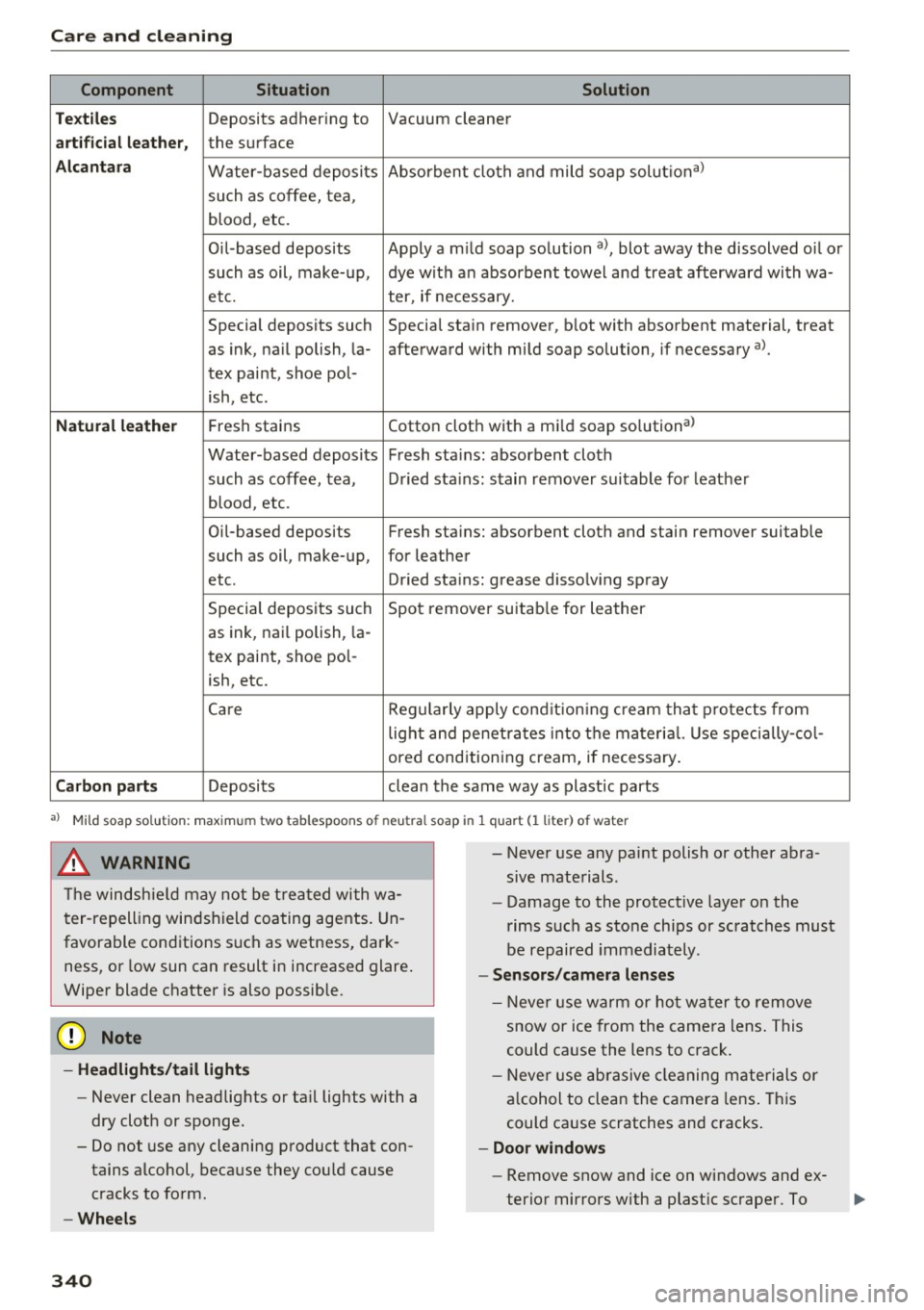
Component Situation Solution
Te xtil es
Deposits adhering to Vacuum cleaner
a rt ifici al le ather , the surface
Alcant ara Water-based deposits Absorben
t cloth and mild soap solutiona>
such as coffee, tea,
blood, etc.
O il-based deposits Apply a m ild soap solution a), blot away the dissolved oil or
such as oil, make-up, dye with an absorbent towel and treat afterward with wa-
etc. ter, if necessary.
Special deposits such Special stain remover, b lot with absorbent material, treat
as ink, na il polish, la- afterward with mild soap solution, if necessary a).
tex paint, shoe pol-
ish, etc.
Natural leather Fresh stains Cotton cloth with a mi
ld soap solutiona>
Water-based deposits Fresh sta ins : absorbent cloth
such as coffee, tea, Dried sta ins: stain remover suitable fo r leather
blood, etc.
Oil-based deposits Fresh stains: absorbent cloth and stain remover suitable
such as oil, make-up, for leather
etc. Dried sta ins : grease dissolv ing spray
Special deposits such Spot remover suitab le for leather
as ink, nai l polish, la -
tex paint, shoe pol-
ish, etc.
Ca re Regularly apply cond ition ing cream that protects from
light and penet rates into the materia l. Use specia lly-co l-
ored conditioning cream, if necessary.
Carbon parts Deposits clean the same way as plastic parts
a) Mild soap solution: maximum two tablespoons of neutral soap in 1 quart (l liter) of water
_& WARNING
The windshie ld may not be trea ted with wa
ter-repelling windshield coating agents. Un
favorable conditions s uch as wetness, dark
ness, or low sun can result in increased glare .
Wiper blade chatter is also possible.
(D Note
- Headlights/tail light s
-Never clean headlights or tail lights with a
dry cloth or sponge.
- Do not use any cleaning product that con
tains alcohol, because they could cause
cracks to form.
- Wheels
340
-
- Never use any paint polish or other abra
sive materials.
- Damage to the protect ive layer on the
rims such as stone chips or scratches must
be repaired immediately.
- Sensors /camera lenses
- Neve r use wa rm or ho t wa ter to remove
snow or ice from the camera lens . This
could cause the lens to crack .
- Neve r use ab rasive cleaning materials or
a lcohol to clea n the camera lens . This
could cause scratches and cracks .
-Doo r window s
-Remove snow and ice on windows and ex-
terior mirrors with a plast ic scraper. To
Page 347 of 386
<( a, .... N ,....
N .... 0 0
3 a,
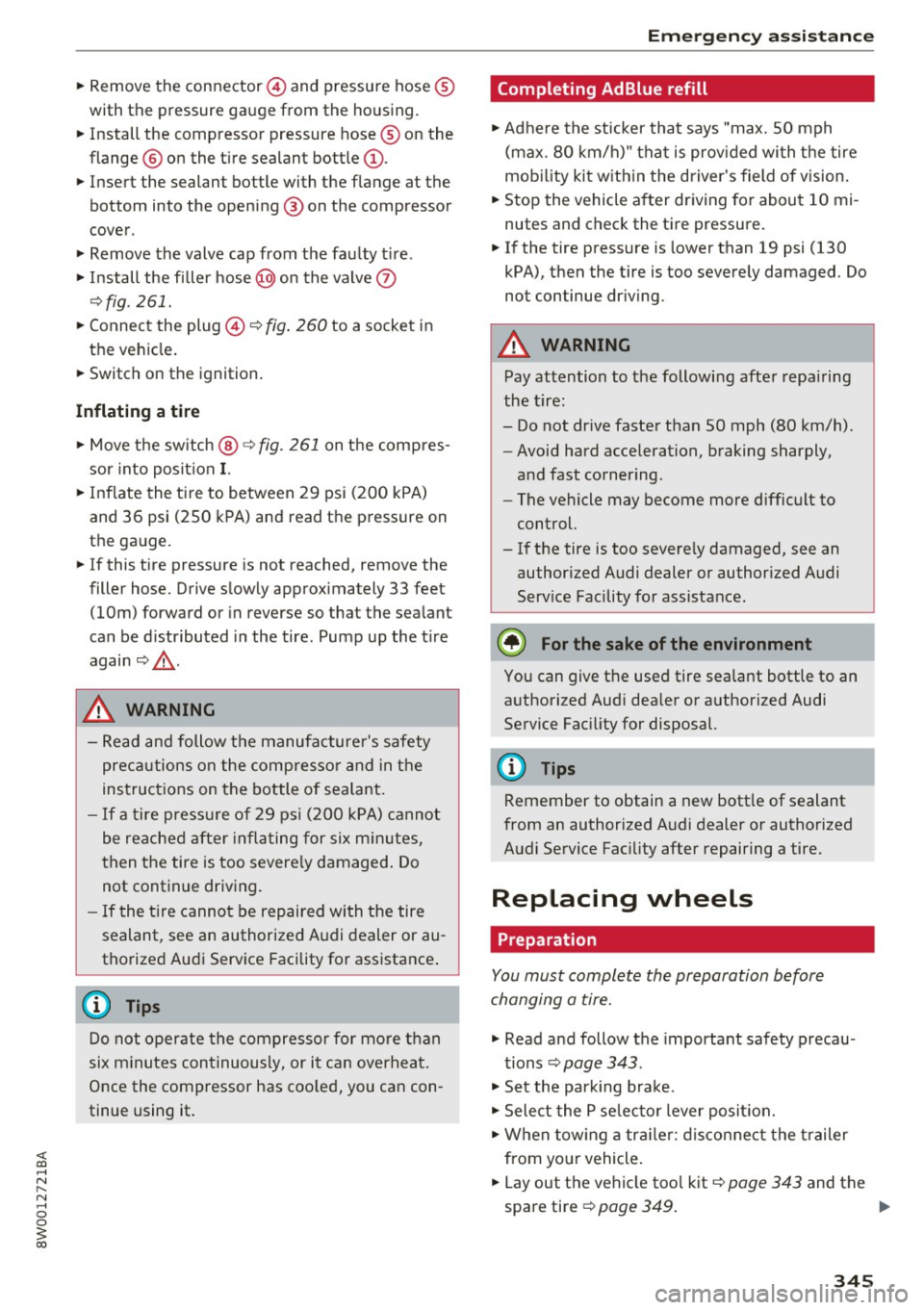
• Remove the connector@) and pressure hose ®
with the pressure gauge from the housing.
• Install the compressor pressure hose ® on the
flange @ on the tire sealant bottle@.
• Insert the sealant bottle with the flange at the
bottom into the opening @ on the compressor
cover .
• Remove the valve cap from the fau lty t ire .
• Install the fi ller hose @on the valve(!)
r::!vfig. 261.
• Connect the plug@¢ fig. 260 to a socket in
the vehicle .
• Switch on the ignition.
Inflating a tire
• Move the sw itch @ r::?v fig. 261 on the comp res
sor into posit ion
I.
• Inflate the tire to between 29 psi (200 kPA)
and 36 psi (2SO kPA) and read the pressure on
the gauge.
• If this tire pressure is not reached, remove the
filler hose. Drive slowly approximately 33 feet (10m) forward or in reverse so that the sea lant
can be d istributed in the tire . Pump up the t ire
again
~ A .
A WARNING
-Read and follow the manufacture r's safety
precautions on the compresso r and in the
ins tructions on the bottle of sealant.
- If a tire press ure of 29 ps i (200 kPA) cannot
be reached afte r inflating for six m in utes,
then the tire is too severe ly damaged . Do
not continue driving.
- If the t ire cannot be repaired with the tire
sealant, see an authorized A udi dealer or au
thorized Audi Serv ice Facility for assistance .
@ Tips
Do not operate the compressor for mo re than
six m inutes continuously, or i t can overheat .
Once the compressor has coo led, you can con
tinue using it .
Emergenc y ass is tanc e
Completing AdBlue refill
• Ad here the sticker that says "max. SO mph
(max . 8 0 km/h) " that is provided wi th t he tire
mob ility kit w it hi n the driver's field of vision.
• Stop the vehicle a fter driving for abou t 10 mi
nutes and check the tire pressure.
• If the tire pressure is lower than 19 psi (130
kPA), then the tire is too severely damaged. Do not continue dr iving.
A WARNING
Pay attention to the following afte r repa iring
the tire:
- Do not dr ive faste r than SO mph (80 km/h) .
- Avoid hard acce leration, braking sharply,
and fast cornering .
- The vehicle may become more difficult to
control.
- If the tire is too severe ly damaged, see an
authorized Audi dealer or authorized Audi
Serv ice Facility for assistance.
(® For the sake of the environment
You can give the used tire sealant bottle to an
a uthorized Audi dea ler or authorized Audi
Service Fac ility for disposal.
(D Tips
Remember to obtain a new bott le of sealant
from an authorized A udi dealer or authorized
A udi Service Fac ility after repairing a tire.
Replacing wheels
Preparation
You must complete the preparation before
changing a tire.
• Read and follow the important safety precau-
tions
~ page 343 .
• Set the par king brake.
• Sele ct the P selec to r lever posit ion.
• W hen tow ing a tr ailer: d isconne ct the trailer
from your vehicle .
• Lay out the vehicle too l kit ~
page 343 and the
spare tire
¢ pag e 349 . .,,.
345
Page 358 of 386
Emergency situations
Emergency situations
General
This chapter is intended for trained emergency crews and working personnel who have the nec
essary tools and equipment to perform these
operations.
Starting by pushing or
towing
CD Note
Vehicles with an automatic transmission
cannot be started by pushing or towing.
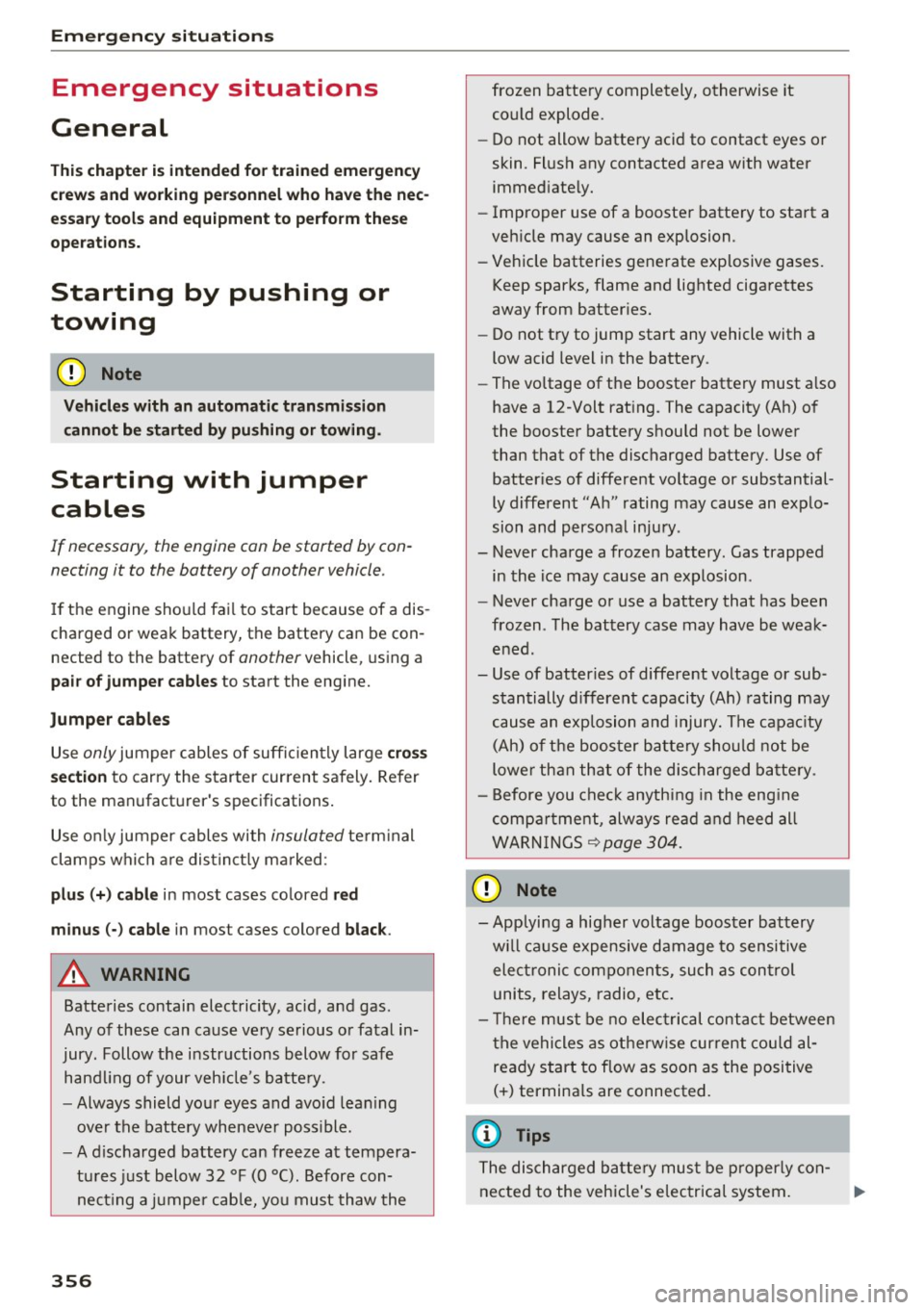
Starting with jumper
cables
If necessary, the engin e con be started by con
necting it to the battery of another vehicle.
If the engine should fail to start because of a dis
charged or weak battery, the battery can be con
nected to the battery of
another vehicle, using a
pair of jumper cables to start the engine.
Jumper cables
Use only jumper cables of sufficiently large cross
section
to carry the starter current safely. Refer
to the manufacturer's specifications.
Use only jumper cables with
insulated terminal
clamps which are distinctly marked :
plus(+) cable in most cases colored red
minus(-) cable
in most cases colored black.
A WARNING
Batteries contain electricity, acid, and gas.
Any of these can cause very serious or fatal in
jury. Follow the instructions below for
safe
handling of your vehicle's battery.
-Always shield your eyes and avoid leaning
over the battery whenever possible.
-A discharged battery can freeze at tempera
tures just below 32 °F (0 °C). Before con
necting a jumper cable, you must thaw the
356
frozen battery completely, otherwise it could explode.
- Do not allow battery acid to contact eyes or
skin. Flush any contacted area with water immediately.
- Improper use of a booster battery to start a
vehicle may cause an explosion.
- Vehicle batteries generate explosive gases.
Keep sparks, flame and lighted cigarettes
away from batteries.
- Do not try to jump start any vehicle with a
low acid level in the battery.
- The voltage of the booster battery must also
have a 12-Volt rating. The capacity (Ah) of
the booster battery should not be lower
than that of the discharged battery. Use of
batteries of different voltage or substantial
ly different "Ah" rating may cause an explo
sion and personal injury.
- Never charge a frozen battery. Gas trapped in the ice may cause an explosion.
- Never charge or use a battery that has been
frozen . The battery
case may have be weak
ened .
- Use of batteries of different voltage or sub
stantially different capacity (Ah) rating may
cause an explosion and injury. The capacity
(Ah) of the booster battery should not be
lower than that of the discharged battery.
- Before you check anything in the engine
compartment, always read and heed all
WARNINGS
~page 304.
CD Note
-Applying a higher voltage booster battery
will cause expensive damage to sensitive
electronic components, such as control
units, relays, radio, etc.
- There must be no electrical contact between
the vehicles as otherwise current could al
ready start to flow as soon as the positive
(+) terminals are connected.
@ Tips
The discharged battery must be properly con-
nected to the vehicle's electrical system. .,..
Page 360 of 386
Emergency situations
-When connecting jumper cables, make sure
that they cannot get caught in any moving
parts in the engine compartment.
- Do not bend over the batteries -danger of
chemical burns!
- The battery cell locking screws must be
tightened securely.
- Before you check anything in the engine
compartment, always read and heed all
WARNINGS
c> page 304.
(D Note
Improper hook-up of jumper cables can ruin
the generator.
- Always connect POSITIVE(+) to POSITIVE
(+), and NEGATIVE(-) to NEGATIVE(-)
ground post of the battery manager control
unit.
- Check that all screw p lugs on the battery
cells are screwed in firmly. If not, tighten
plugs prior to connect ing clamp on negative
battery terminal.
- Please note that the procedure for connect
i ng a jumper cable as described above ap
plies specifically to the case of your vehicle
being jump started . When you are giving a
ju mp start to another vehicle, do
not con
nect the negative (-) cable to the negative
(-) terminal on the discharged batte ry @
c> fig. 2 75. Instead, securely connect the
negative( -) cab le to either a solid metal
component that is firm ly bolted to the en
gine block or to the engine block itself. If
the battery that is being charged does not
vent to the outside, escap ing battery gas
could ignite and explode!
Towing with a tow truck
General hints
Your Audi requires special handling for towing.
The following information is to be used by com
mercial tow truck operators who know how to op
erate the ir equipment safely.
-Never tow your Audi, towing will cause dam
age to the engine and transmission.
358
-Never wrap the safety chains or winch cables
around the brake lines .
- To prevent unnecessary damage, your Audi
must be transported with a flat bed truck .
- To load the vehicle on to the flat bed, use the
towing loop found in the vehicle tools and at
tach to the front or rear anchorage
i:> page 358 and c> page 359 .
A WARNING
A vehicle being towed is not safe for passen
gers. Never allow anyone to ride in a vehicle
being towed, for any reason.
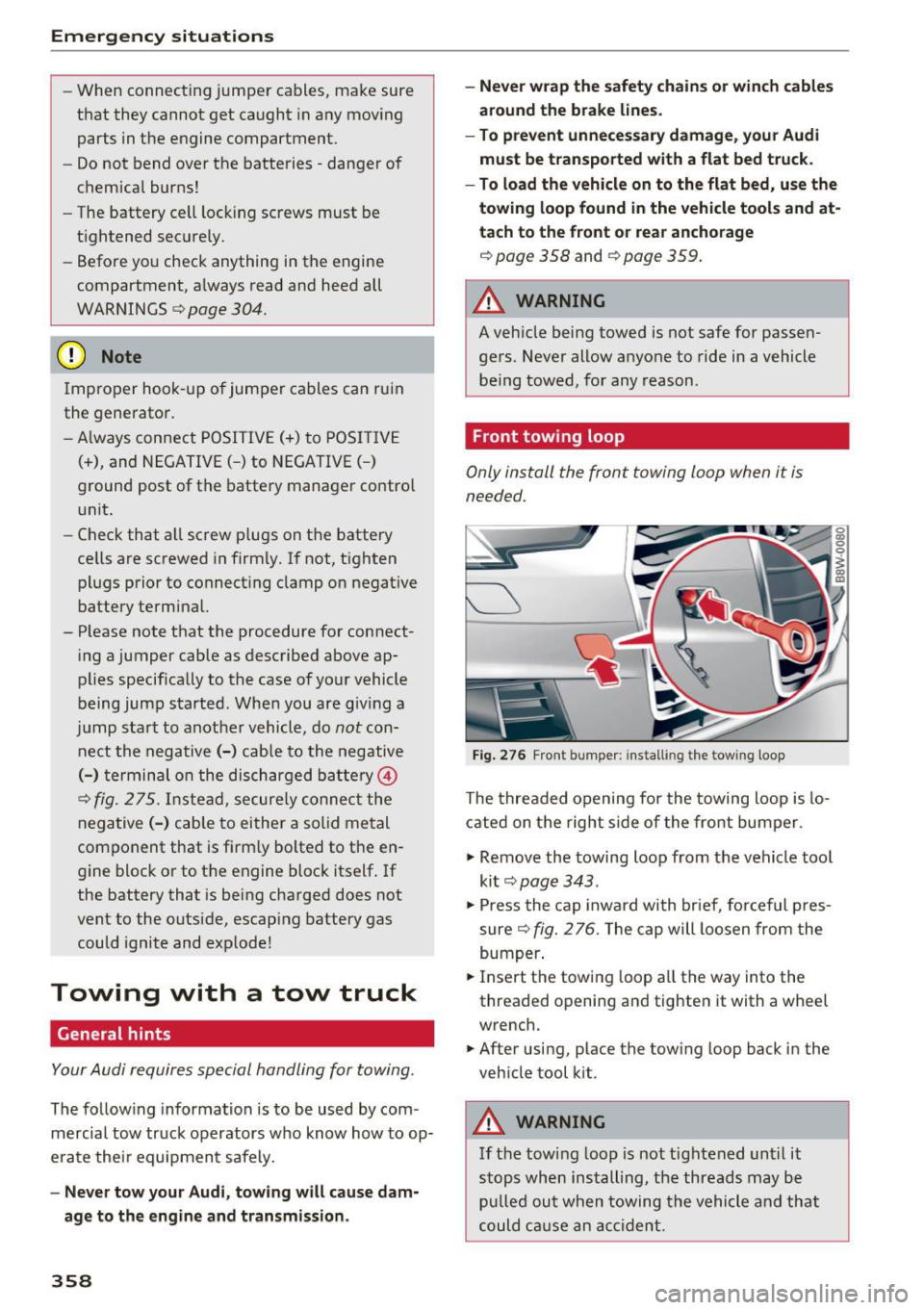
Front towing loop
Only install the front towing loop when it is
needed.
Fig. 276 Front bumper: installing the towing loop
The threaded opening for the towing loop is lo
cated on the right s ide of the front bumper.
.,. Remove the towing loop from the vehicle too l
ki t
c> page 343 .
.,. Press the cap inward with brief, forceful p res
sure
c> fig. 2 76. The cap will loosen from the
bumper .
.,. Insert the towi ng loop all the way into the
threaded opening and tighten it with a wheel
wrench.
.,. After using, place the towing loop back in the
vehicle tool kit .
A WARNING
If the towing loop is not tightened until it
stops when installing, the threads may be
pulled out when towing the vehicle and that
could cause an accident.
-
Page 361 of 386
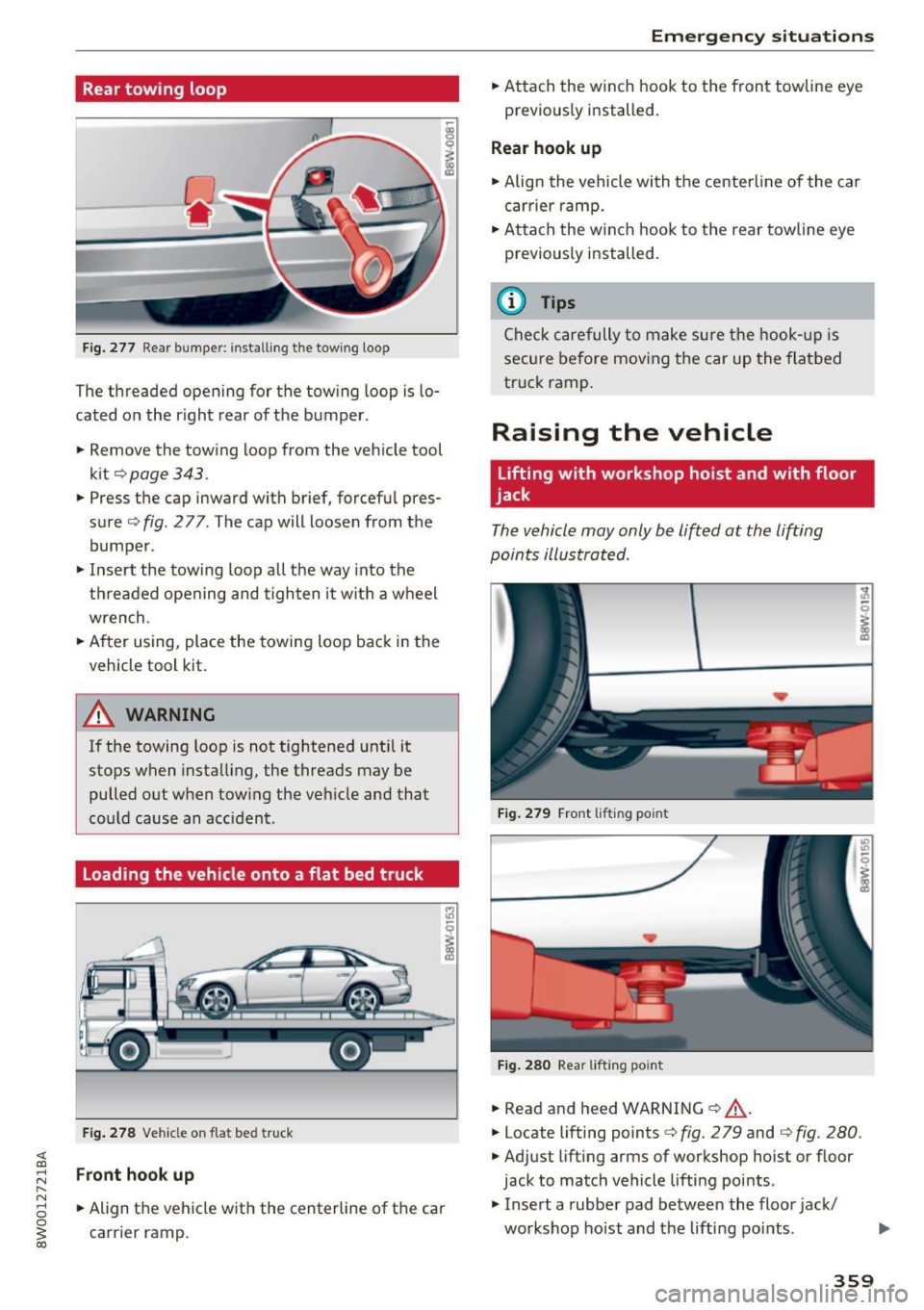
Rear towing loop
Fig. 277 Rea r bumper: install ing the tow ing loop
The threaded opening for the towing loop is lo
cated on the r ight rear of the bumper.
.. Remove the towing loop from the vehicle tool
kit
¢page 343.
.. Press the cap inward with brief, forcefu l pres
sure ¢
fig. 277. The cap will loosen from the
bumper .
.,. Insert the towing loop all the way into the
threaded opening and tighten it w ith a wheel
wrench .
.. After using, place the towing loop back in the
vehicle tool kit.
A WARNING
If the towing loop is not tightened until it
stops when installing, the threads may be
pulled out when tow ing the vehicle and that
cou ld cause an accident .
Loading the vehicle onto a flat bed truck
Fig. 278 Vehicle on flat bed truck
Front hook up
-
.. Align the vehicle with the centerline of the car
carrier ramp.
Emergency situations
.. Attach the winch hook to the front towline eye
previously installed.
Rear hook up
.. Align the vehicle with the centerline of the car
carrier ramp .
.. Attach the w inch hook to the rear towline eye
previously installed.
(D Tips
Check carefully to make sure the hook-up is
secure before moving the car up the flatbed
truck ramp.
Raising the vehicle
Lifting with workshop hoist and with floor
jack
The vehicle may only be lifted at the lifting
points illustrated .
Fig. 279 Front lifting point
Fig. 280 Rear lif tin g po int
.. Read and heed WARNING ¢&, .
.. Locate lifting points¢
fig. 279 and¢ fig. 280.
.,. Adjust lifting arms of workshop hoist or floor
jack to match vehicle lifting points .
.. Insert a rubber pad between the floor jack/
workshop hoist and the lifting points . .,.
359
Page 365 of 386
<( a, .... N ,....
N .... 0 0
3 a,
Consumer information
Warranty coverages
Y our Audi is co vered b y the foll owing war ran
tie s:
- New Vehicle Limited Warranty
- Limited Warranty Against Corrosion Perfora-
tion
- Emissions Control System Warranty
- Emissions Performance Warranty
- California Emissions Control Warranty (USA
vehicles only)
- California Emissions Performance Warranty
(USA vehicles only)
Detailed information regard ing your warranties
can be found in yo ur
W arranty & M ainten ance
bookl et.
Operating your vehicle
outside the U.S.A. or
Canada
Government reg ulations in the Un ited States and
Canada require that automobiles meet specific
emission regulations and safety standards.
Therefore, vehicles built for the U .S.A. and Cana
da differ from vehicles sold in other countries.
I f you p lan to take your vehicle outside the conti
nenta l limits of the United States or Canada,
there is the poss ibility that:
- u nleaded fue ls for vehicles with cata lytic con
verter may not be available;
- fuel may have a considerably lower octane rat
i ng. Imprope r fuel may ca use engine damage;
- service may be inadequate due to lack of p roper
service facilities, tools or testing eq uipment;
- r eplacement parts may not be readily ava ilable.
- Navigation systems for veh icles built for the
U .S .A . and Canada will not necessa rily work in
E urope, and may not wo rk in other countries
outside of North Amer ica.
Con sumer inf ormation
(D Note
Audi cannot be respons ible for mechanical
damage that could resu lt from inadequate
fuel, service or parts ava ilability.
Audi Service Repair
Manuals and Literature
Audi Official Factory Service Manuals and L itera
ture are published as soon as poss ible after mod
el introduction. Service Ma nua ls and literature
are avai lab le to order from the Audi Tec hni cal Lit
erature Ordering Center at:
www .audi .t e chlit eratur e.com
Maintenance
General
Your vehicle has been designed to he lp keep
maintenance requirements to a min imum. How
ever, a certain amount of regular maintenance is
still necessary to assure your veh icle's safety,
economy and reliab ility . For detailed vehicle
maintenance consult your Wa rranty
& Mainte
nance book let .
Und er diff icult op erating condition s, for exam
ple at extremely low outside temperatures, in
very dusty regions, when towing a trai le r very fre
quently, etc., some service work shou ld be per
fo rmed between the in terv als specified. This ap
plies particularly to:
- oil changes, and
- cleaning or replacing the a ir filter .
(® For the sake of the environment
By regularly maintain ing your vehicle, you
help make sure that emiss ion standards are
maintai ned, thus min imizing adverse effects
on the environment .
Important considerations for you and your
vehicle
The increasing use of electronics, sophisticated
fuel injection and emission control systems, and
the generally increas ing technica l complexity of ""'
363
Page 382 of 386
Index
Tires.... .. .... ... .. .. ..... ... .. .. ... 317
All whee l drive . . . . . . . . . . . . . . . . . . . . . . 13 7
L ow aspect rat io tires . . . . . . . . . . . . . . . . 333
Repair set . . . . . . . . . . . . . . . . . . . . . . . . . . 343
Replac ing . . . . . . . . . . . . . . . . . . . . . . . . . . 345
Service life . . . . . . . . . . . . . . . . . . . . . . . . . 325
T ire pressu re . . . . . . . . . . . . . . . . . . . . . . . 327
Tire pressu re monitoring system . . . . . . . 334
Tire Pressu re Monito ring System . . . . . . . 335
Ti re press ure table . . . . . . . . . . . . . . . . . . . 328
Tire press ure (t railer towing) . . . . . . . . . . . 90
Treadwear indicators . . . . . . . . . . . . . . . . . 325
unidirectional . . . . . . . . . . . . . . . . . . . . . . . 348
Unid irectional . ................... ... 319
Uniform t ire quality grad ing . . . . . . . . . . . 333
T ires and w heels
Glossary of tire and loading termi nology . 319
Tires and vehicle load limits . . . . . . . . . . . 329
T MC
refer to T raff ic informa tion . . . . . . . . . . . . 20 1
Tone (sound)
refer to Adjus ting the sound . . . . . . . . . . . 233
Tool . . . . . . . . . . . . . . . . . . . . . . . . . . . . . . . . 343
T o rn o r frayed s afety be lts . . . . . . . . . . . . . . 2 47
touch
refer to MMI touch
Towing Tow trucks
T owing loo p
TPMS 144
358
3S8,3 59
Tire Pressu re Monitoring System . . . . . . . 335
Traffic information . . . . . . . . . . . . . . . . 20 1, 202
T raff ic messages . . . . . . . . . . . . . . . . . . . . . . 197
Traffic sign recognit ion . . . . . . . . . . . . . . . . . 24
T railer mode (navigation) . . . . . . . . . . . . . . . 195
Trai ler tow ing . . . . . . . . . . . . . . . . . . . . . . . . . 90
I nformation . . . . . . . . . . . . . . . . . . . . . . . . . 9 1
P a rk ing syste m . . . . . . . . . . . . . . . . . . . . . . 132
T echnical requi rements . . . . . . . . . . . . . . . . 90
Towing capaci ty . . . . . . . . . . . . . . . . . . . . . . 90
T ransmiss ion malfunction (i ndicator light) . . 87
Transport Canada . . . . . . . . . . . . . . . . . . . . . 244
Tr ave l guide
referto Travel(travelg uide) . ... .. .. ... 175
Trave l (travel guide) . . . . . . . . . . . . . . . . . . . 17 5
Treb le (so und) . . . . . . . . . . . . . . . . . . . . . . . 233
380
Trunk lid
Tr unk escape latch . . . . . . . . . . . . . . . . . . . 343
Turn assist. . . . . . . . . . . . . . . . . . . . . . . . . . . 108
Turn signal Ind icator light . . . . . . . . . . . . . . . . . . . . . . . 36
Turn signals . . . . . . . . . . . . . . . . . . . . . . . . . . 51
u
UL SD No. 2 (Diesel fuel) . . . . . . . . . . . . . . . . 29 7
Un fastening safety belts . . . . . . . . . . . . . . . 250
U niform tire qua lity grading . . . . . . . . . . . . 333
Unl ocking/locking
On t he loc k cylinde r . . . . . . . . . . . . . . . . . . . 42
Wi th the cen tra l locking sw itch . . . . . . . . . 41
With the convenience key . . . . . . . . . . . . . . 40
With the remote control . . . . . . . . . . . . . . . 40
U pdat ing statio ns ( rad io) . . . . . . . . . . . . . . . 204
USB stick
refer to Aud i m usic interface.. ....... .. 21S
V
Va let park ing funct ion . . . . . . . . . . . . . . . . . . 47
Vani ty m irro r . . . . . . . . . . . . . . . . . . . . . . . . . . 56
Vehicle Care/cleaning .. .. .. .. ........ ..... .. 337
Dime nsions . . . . . . . . . . . . . . . . . . . . . . . . . 362
Ident ific at ion number . . . . . . . . . . . . . . . . 361
L ift ing . . . . . . . . . . . . . . . . . . . . . . . . . . . . . 34 7
Ou t of service . . . . . . . . . . . . . . . . . . . . . . . 3 42
Specifications . . . . . . . . . . . . . . . . . . . . . . . 361
Vehicle identification labe l . . . . . . . . . . . . 361
Vehicle con trol modules. . . . . . . . . . . . . . . . 139
Vehicle jack . . . . . . . . . . . . . . . . . . . . . . . . . . 343
Lifting po ints . . . . . . . . . . . . . . . . . . . . . . . 347
Vehicle key . . . . . . . . . . . . . . . . . . . . . . . . . . . 38
Vehicle sta tus report
A udi con nect vehicle co ntro l . . . . . . . . . . . 182
Vehicle too l kit . . . . . . . . . . . . . . . . . . . . . . . 343
Vent ilation . . . . . . . . . . . . . . . . . . . . . . . . . . . 68
Version informa tion . . . . . . . . . . . . . . . . . . . 232
VIEW button . . . . . . . . . . . . . . . . . . . . . . . . . . 12
VI N . . . . . . . . . . . . . . . . . . . . . . . . . . . . . . . . 3 61
Vo ice guidance
refer to Mul tifunction
stee ring wheel . . . . . . . . . . . . . . . . . 12 , 14 , 15