lock AUDI A4 AVANT 2008 Owners Manual
[x] Cancel search | Manufacturer: AUDI, Model Year: 2008, Model line: A4 AVANT, Model: AUDI A4 AVANT 2008Pages: 368, PDF Size: 46.19 MB
Page 310 of 368
___ T_ ir_e _ s_ a_ n
_ d_ w_ h_ e_ e_ls _________________________________________________ _
& WARNING
• Using incorrect or unmatched tires and / or wheels or improper
tire and wheel combinations can lead to loss of control , collision
and serious personal injury .
• Always u se tires , rims and wheel bolts that meet the specifica
tions of original factory -installed tires or other combinations that
have been specifically approved by the vehicle manufacturer.
• Tires age even if they are not being used and can fail suddenly ,
especially at high speeds . Tires that are more than 6 years old can
only be used in an emergen cy and then with special care and at
lower speed s.
• Never mount used tires on your vehi cle if you are not sure of
their "previous history." Old used tires may have been damaged
even though the damage cannot be seen that can lead to sudden
tire failure and loss of vehicle control.
• All four wheels must be fitted with radial tires of the same type ,
size (rolling circumference ) and the same tread pattern. Driving
with different tires reduces vehi cle handling and can lead to a loss
of control.
• If the spare t ire is not the same as the tires that are mounted
on the vehicle -for example with winter tires -only use the spare
tire for a short period of time and drive with extra care . Refit the
normal road wheel as soon as safely possible.
• Never drive faster than the ma ximum speed for wh ich the tires
on your vehicle are rated because tires that are driven faster than
their rated speed can fail suddenly .
• Overloading tire s cause heat build -up , sudden tire failure ,
including a blowout and sudden deflation and loss of control.
• Temperature grades apply to tires that are properly inflated and
not over or underinflated .
• For technical reasons it is not always possible to use wheel s
from other vehicles - in some cases not even wheels from the
same vehicle model.
& WARNING (continued )
• If you install wheel trim discs on the vehicle wheels, make sure
that the air flow to the brakes is not blocked . Reduced airflow to
the brakes can them to overheat , increasing stopping distances
and causing a collision .
• Run flat tires may only be used on vehicles that were equipped
with them at the factory. The vehicle must have a chassis designed
for run flat tires and a factory-installed tire pressure monitoring
s ystem that indicate s a loss of tire pressure . Incorrect use of run
flat tires can lead to vehicle damage or ac cidents . Check with an
authorized Audi dealer or tire specialist to see if your vehicle can
be equ ipped with run flat tires . If run flat tires are used , they must
be installed on all four wheels . Mixing tire types is not permitted.
0 Note
• For tec hnical r eas ons, it is no t gene rally possible to use the
whee l rims from other vehicles . ihis can hold true for wheels of the
same ve hicle type.
• I f the spare tire is different from the tires that you have mounted
on y our ve hicle (f or exampl e wi nter t ires or wide p ro fi le tir es), then
use the spa re tire fo r a short per iod of time on ly and d rive with extra
c a re . Rep lace the flat t ire wi th the ti re m atc h ing t he oth ers o n you r
vehic le as soon as possib le .
• If yo u should put diff eren t w heels a nd tires on yo ur vehi cle (e. g.
winter wheels and tires), you must be certa in that the wheels and
t ires a re co mpatibl e w ith the tire press ur e m onit orin g sys te m.
Otherwise the system will regist er a ma lfunction and a fau lt
mes sage wil l be d isp layed . Fo r mo re info rmation, contact yo ur Audi
dea ler .
0 Note
• When i nsta lling new ti res, be care fu l n ot to damage t he va lves o r
tire press ure mon itoring system* sensors . .,_
Page 313 of 368
Tires and wheels 1111
----------------
W For the sake of the environment
Use summer tires when weather conditions permit. They are
quieter, do not wear as quickly and reduce fuel consumption. •
Snow chains
Snow chains may be fitted only to the front wheels, and only to
certain tire sizes. Ask your authorized Audi dealer on which tire
sizes snow chains can be used.
If you are going to use snow chains, then you must install them on
the front wheels at least.
The snow chains must have low-profile links and must not be thicker
than 0.53 inch (13.5 mm), including the lock.
Remove wheel center covers and trim discs before putting snow
chains on your
vehicle => 0. For safety reasons cover caps must
then be fitted over the wheel bolts. These are available from autho
rized Audi dealers.
& WARNING
Using the wrong snow chains for your vehicle or installing them
incorrectly can increase the risk of loss of control leading to
serious personal injury.
• Snow chains are available in different sizes. Always make sure
to follow the instructions provided by the snow chain manufac
turer.
• When driving with snow chains never drive faster than the
speed permitted for your specific snow chains.
• Always observe local regulations .
0 Note
• Remove snow chains before driving on roads not covered with
snow to avoid damaging tires and wearing the snow chains down
u n necessarily.
• Snow chains, which come into direct contact with the wheel rim,
can scratch or damage it . Therefore, make sure that the snow chains
are suitably covered.
[ i] Tips
Where snow chains are mandatory on certain roads, this normally
also applies to vehicles with All Wheel Drive. •
Wheel bolts
Wheel bolts must always be tightened to the correct
torque.
The design of wheel bolts is matched to the factory installed rims. If
different rims are fitted, the correct wheel bolts with the right length
and correctly shaped bolt heads must be used. This ensures that
wheels are fitted securely and that the brake system functions
correctly.
In certain circumstances, you may not use wheel bolts from a
different vehicle -even if it is the same
model => page 348.
& WARNING
Improperly tightened or maintained wheel bolts can become loose
causing loss of control, a collision and serious personal injury.
• Always keep the wheel bolts and the threads in the wheel hubs
clean so the wheel bolts can turn easily and be properly tightened .
• Never grease or oil the wheel bolts and the threads in the wheel
hubs. They can become loose while driving if greased or oiled,
even if tightened to the specified torque.
.,_
Vehicle care
Page 319 of 368
_____________________________________________ W_ h_ a_t _d_ o_l
_ d_o _ n_o_ w_ ? _ __,_
/b, WARNING (continued)
• Using a bumper jack to raise the vehicle will damage the
bumper system. The jack may slip, causing injury.
• Never support your vehicle on cinder blocks, bricks or other
objects. These may not be able to support the load and could
cause injury when they fail.
• Never start or run the engine while the vehicle is supported by
the jack.
• If you must work under the vehicle, always use safety stands
specifically designed for this purpose.
• Never try and use the hexagonal socket
in the handle of the
screwdriver to loosen or tighten the wheel bolts.
• Always make sure the spare tire and even a flat tire are secured
in place and not loose, otherwise they could fly forward, causing
personal injury to passengers in the vehicle in an accident or
sudden maneuver.
• Never use the jack supplied with your Audi on another vehicle,
particularly on a heavier one. The jack is only suitable for use on
the vehicle it came with.
•
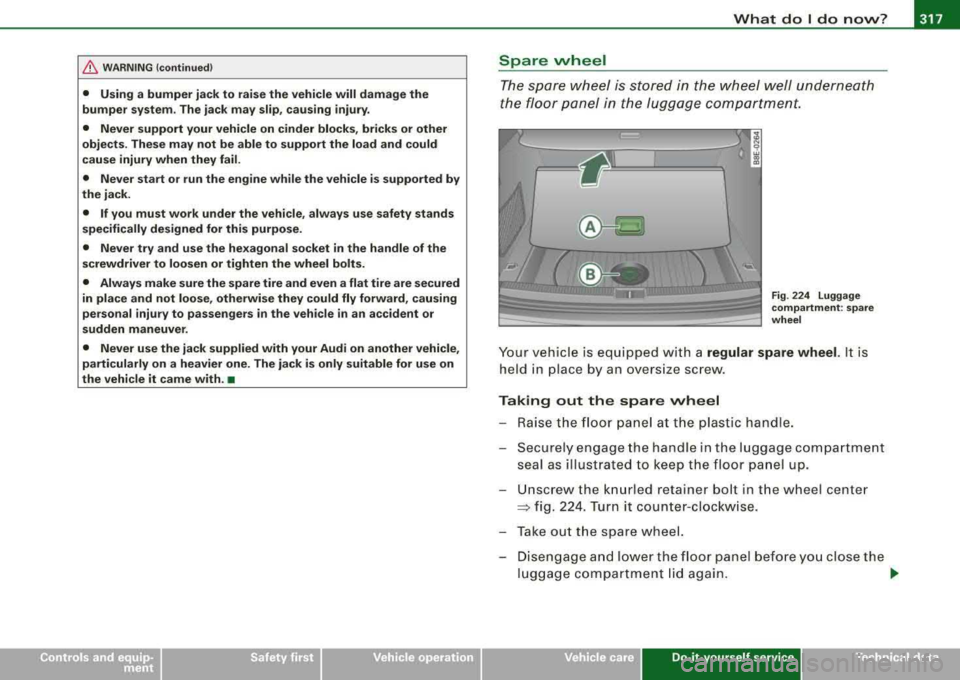
Spare wheel
The spare wheel is stored in the wheel well underneath
the floor panel in the luggage compartment.
Fig. 224 Luggage
compartment : spare
wheel
Your vehicle is equipped with a regular spare wheel. It is
held in place by an oversize screw.
Taking out the spare wheel
- Raise the floor panel at the plastic handle.
- Securely engage the handle in the luggage compartment
seal as illustrated to keep the floor panel up.
- Unscrew the knurled retainer bolt in the wheel center
=> fig. 224. Turn it counter -clockwise .
- Take out the spare wheel.
- Disengage and lower the floor panel before you close the
luggage compartment lid again.
..,.
Do-it-yourse lf service irechnical data
Page 320 of 368

___ w_ h_ a_t _ d_ o_ l_d _ o_ n_ o_w _ ? ______________________________________________ _
Storing the replaced wheel
- Place the replaced wheel inside the spare wheel well in
the luggage compartment.
- Tighten the knurled retaining screw clockwise to secure
the wheel in place.
- Disengage and lower the floor panel before you close the
luggage compartment lid again.
& WARNING
Loose items in the passenger compartment can cause serious
personal injury during hard braking or in an accident.
• Never store the spare wheel or jack and tools
in the passenger
compartment.
• Always store all jacking equipment, tools, and the spare wheel
in the luggage compartment.
• Tighten the knurled retaining screw for the spare wheel
securely.
[ i] Tips
Check the inflation pressure of the spare tire periodically to keep the
tire ready for use. •
Wheel change
Before changing a wheel
Follow these points for your own and your passenger's
safety when replacing a wheel.
After you experience a tire failure, pull the car well away
from moving traffic and try to reach
level ground before
you
stop ~& .
-All passengers should leave the car and move to a safe
location (for instance, behind the
guardrail) ~& .
-Apply the parking brake firmly ~& .
-Move selector lever to position P on an automatic trans-
mission; put manual transmission in
first gear~& .
-If you are towing a trailer: unhitch the trailer from your
vehicle.
- Take the
tool case and the spare tire ~ page 316 out of
the luggage compartment.
& WARNING
You or your passengers could be injured while changing a wheel if
you do not follow these safety precautions:
• If you have a flat tire, move a safe distance off the road. Turn off
the engine, turn the emergency flasher on and use other warning
devices to alert other motorists.
• Make sure that passengers wait
in a safe place away from the
vehicle and well away from the roadway and traffic.
• To help prevent the vehicle from moving suddenly and possibly
slipping off the jack, always fully set the parking brake and block
the wheel diagonally opposite the wheel being changed . When one
front wheel is lifted off the ground, placing the Automatic Trans-
~
Page 323 of 368
What do I do now ? -
------------------'
Loosening and tightening the wheel bolts
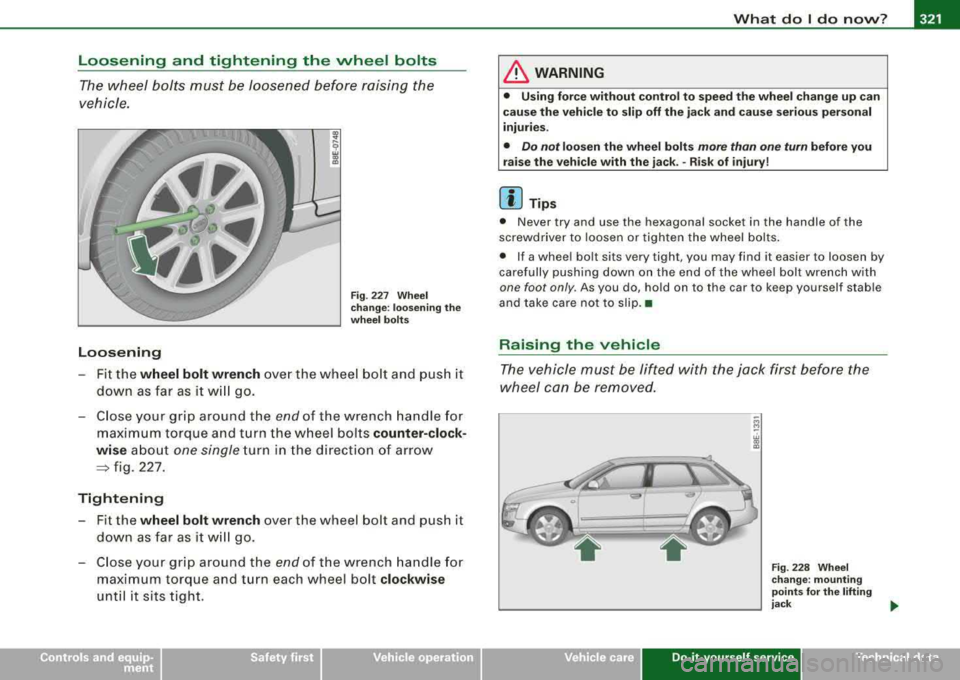
The wheel bolts must be loosened before raising the
vehicle .
Loosening
Fig . 227 Wheel
c h an ge : loose ning t he
w heel b olts
- Fit the wheel bolt wrench over the whee l bo lt and push it
down as far as it w ill go.
- C lose your grip around the
e n d of the wrench ha n dle for
maximum torque and t urn the wheel bolts counter-clock
wi se abo ut
one single turn in the direction of ar ro w
=> fig. 227.
Tight ening
Fit the wheel bolt wrench over the wheel bolt and push it
down as far as it w ill go .
- C lose your grip around the
end of the wrench handle for
maximum torque and turn each wheel bolt clockwise
until it sits tight.
LJ}. WARNING
• Using f orc e without control t o speed t he wh eel ch a nge up can
c au se th e vehicle t o slip off the jack and cau se seriou s per son al
injurie s.
• Do n ot lo osen the wheel b olt s more than one turn before y ou
r a is e th e vehi cle with the jack .
-Ris k of inju ry!
[ i] Tip s
• Never try and use the hexagonal socket in the handle of the
screwdriver to loosen or tighten the wheel bolts .
• If a whee l bolt sits very tight, you may find it easier to loosen by
carefully pushing down on the end of the whee l bolt wrench w ith
one foot only . As you do, ho ld on to the car to keep yourself stab le
and take care not to slip. •
Raising the vehicle
The vehicle must be lifted with the jack first before the
wheel can be removed.
F ig . 228 W hee l
c ha nge : m ount ing
po ints
for th e li fting
j ack _,.
Do-it-yourself service irechnical data
Page 325 of 368
What do I do now? -
------------------'
Taking the wheel off /putting the spare on
Follow these instructions step-by-step for changing the
wheel
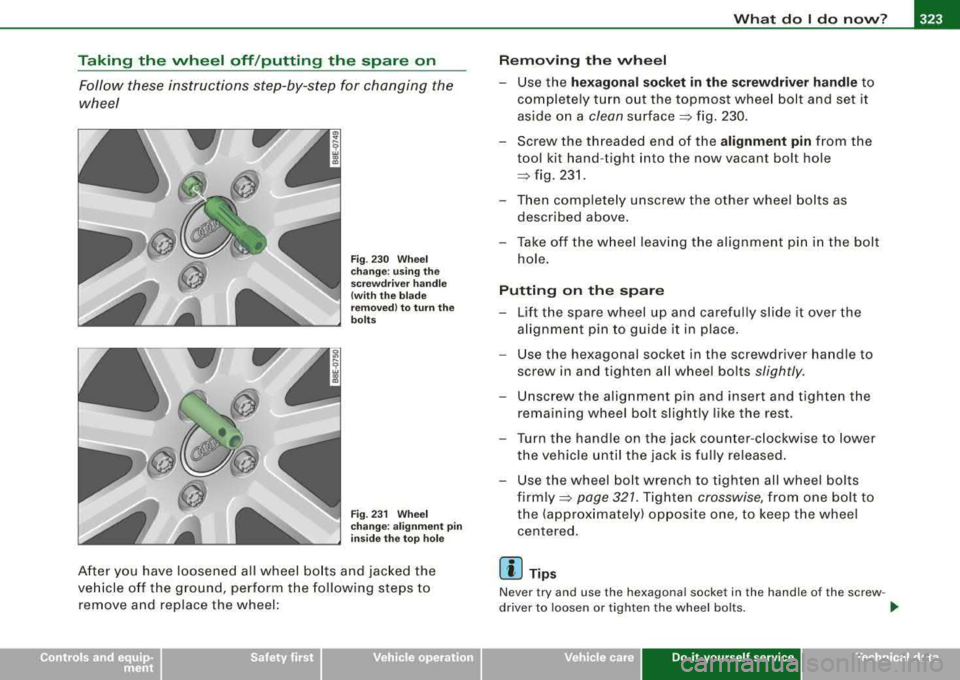
Fig . 230 Wheel
change : using the
screwdriver handle
(with the blade
removed) to turn the
bolts
Fig . 231 Wheel
change : alignment pin
inside the top hole
After you have loosened all wheel bolts and jacked the
vehicle off the ground, perform the following steps to
remove and replace the wheel:
Removing the wheel
-Use the hexagonal socket in the screwdriver handle to
completely turn out the topmost wheel bolt and set it
aside on a
clean surface => fig. 230.
-Screw the threaded end of the alignment pin from the
tool kit hand -tight into the now vacant bolt hole
=> fig. 231 .
-Then completely unscrew the other wheel bolts as
described above.
-Take off the wheel leaving the alignment pin in t he bolt
hole.
Putting on the spare
-Lift the spare wheel up and carefully slide it over the
alignment pin to guide it in place.
-Use the hexagonal socket in the screwdriver handle to
screw in and t ighten all wheel bolts
slightly .
-Unscrew the alignment pin and insert and tighten the
remaining wheel bo lt slightly like the rest.
-Turn the handle on the jack counter-clockwise to lower
the vehicle until the jack is fully released.
-Use the wheel bolt wrench to tighten all wheel bolts
firmly =>
page 327. Tighten crosswise, from one bolt to
the (approximately) opposite one, to keep the wheel
centered.
[ i] Tips
Never try and use the h exagonal socket in the handle of the screw -
driver to loosen or tighten the wheel bolts.
.,
Do-it-yourse lf service irechnical data
Page 334 of 368
-Emergency situations PW--------=----=---------------
4. Connect clamp on opposite end of negative cable to the
negative(-) terminal© of the discharged vehicle battery
@.
- Check that all screw plugs on the battery cells are
screwed in firmly. If not, tighten plugs prior to
connecting clamp on negative battery terminal.
Starting the engine
-Start the engine of the vehicle with the booster battery.
Run the engine at a moderate speed.
- Start engine with discharged vehicle battery in the usual
manner .
- If the engine fails to start: do not keep the starter
cranking for longer than 10 seconds. Wait for about 30
seconds and then try again.
- With engine running, remove jumper cables from both
vehicles in exact
reverse order.
The battery is vented to the outside to prevent gases from entering
the vehicle interior.
Make sure that the jumper clamps are well connected with their
metal parts in full contact with the battery terminals .
& WARNING
To avoid serious personal injury and damage to the vehicle, heed
all warnings and instructions of the jumper cable manufacturer. If
in doubt, call for road service.
• Jumper cables must be long enough so that the vehicles do not
touch.
• When connecting jumper cables, make sure that they cannot
get caught in any moving parts in the engine compartment.
& WARNING (continued)
• Before you check anything in the engine compartment, always
read and heed all
WARNINGS:::::, page 265, "Engine compartment".
0 Note
Improperly connected jumper cables can damage or destroy the
generator .
• Always connect POSITIVE (+l to POSITIVE(+), and NEGATIVE (-l to
NEGATIVE (- l terminal.
• Check that all screw plugs on the battery cells are screwed in
firmly. If not, tighten plugs prior to connecting clamp on negative
battery terminal.
• Please note that the procedure for connecting a jumper cable as
described above applies specifically to the case of your vehicle
being jump started. When you are giving a jump start to another
vehicle, do not connect the minus 1-1 cable to the minus (-1 terminal
on the discharged battery @::::, page 331, fig. 234. Instead, securely
connect the minus (-l cable to either a massive metal component
that is firmly bolted to the engine block or to the engine block itself .
If the battery that is being charged does not vent to the outside,
escaping battery gas could ignite and explode! •
Emergency towing with commercial
tow truck
General hints
Your Audi requires special handling for towing.
The following information is to be used by commercial tow truck
operators who know how to operate their equipment safely.
• Never tow your Audi, towing will cause damage to the engine
and transmission. .,_
Page 337 of 368

Emergency situations -
----------------=-=---
Rear hook up
These s te p s app ly fo r w in chi ng the vehi cle on to a car
c arr ier w ith the re a r f ir st.
- Have the vehic le ali gne d cent ered wi th the ca r carr ier
r a mp.
- Attach the win ch hook to t he
rear to wline eye
=> pa ge 334, fig. 237 .
- On ce th e ca r is po sit io ned on t he car ca rrie r, ha ve safety
c hain (s ) a ttach ed t o the
fron t towline eye => pag e 333an d
ti ghte ned .
[ i] Tips
Chec k carefu lly to ma ke sure the veh icle is hoo ked up securel y
b ef ore mov ing the ca r up the ca r ca rrier r amp. •
Lifting the vehicle
Important safety precautions
Be aware of the following hazards before l ift ing the vehic le w ith a
w ork sho p ho is t or f lo or jack :
• The vehicle should never be lifted or jacked up from underneath
the engine oil pan, the transmission housing , the front or rear axle
or the body side members . This could lead to serious damage.
• Use lifting equipment with padded contact surfaces to avoid
damage to the underbody or chassis frame.
• Alternatively, cover the contact surfaces on workshop hoist or
floor ja ck with rubber pads before lifting.
• Before driving over a workshop hoist , check that the vehicle
weight does not exceed the permissible lifting capacity of the hoist. •
Before driving over a workshop hoist , ensure that there is suffi
cient clearance between the hoist and low parts of the vehicle .
& WARNING
To reduce the risk of serious injury and vehicle damage:
• Always lift the vehicle only at the special workshop hoist and
floor jack lift points illustrated
=> fig . 239 and => fig . 240 .
• Failure to lift the vehicle at these points could cause the vehicle
to tilt or fall from a lift if there is a change in vehicle weight distri
bution and balance . This might happen, for example, when heavy
components such as the engine block or transmission are
removed .
• When removing such heavy components, anchor vehicle to
hoist or add corresponding weights to maintain the center of
gravity . Otherwise , the vehicle might tilt or slip off the hoist ,
causing serious personal injury .
•
Do-it -yourself service
Page 343 of 368

_________________________________________________ G_ e_ n_ e_r _a _l_ i_n _f_o _ r_ m_ a_ t
_ i
_ o _ n
__ __
T he sa fe ty co mplia nce s ticke r
is your assurance t hat your new vehicle complies with a ll applicable
Federa l Motor Vehic le Safety Standards which were in effect at the
t ime the veh ic le was manufactured . You can find t his st icker on the
left door jamb. It shows the mon th and year of production and the
vehic le identification number of your vehic le (perforation) as well as
the Gross Veh icle Weight Rating (GVWR) and the Gross Axle Weight
Rating (GAWRl.
Th e high volt ag e wa rning la bel
is located on the lock carrier .
The spark ignition syste m mee ts all requirement s of the Canadi an
Interf ere nc e-C au si ng Equipm ent Regulati ons. •
Weights
Gross Veh icle Weight R ating
The G ross Veh ic le Weight Rat ing (GVWR), and the Gross Ax le Weight
Rating (GAWR) for front and rear are listed on a sticker on the left
door jamb .
The Gross Vehicle Weight Rating includes the we ight of the basic
vehic le plus fu ll fuel tank, oil and coolant, plus maximum load,
whic h inc ludes passenger weight ( 150 lbs/68 kg per designated
seating position) and luggage weight.
Gr oss Axle Weight Ra ting
The Gross Ax le Weight Rating is the maximum load that can be
app lied at each axle of the
veh ic le =:> & .
Vehicl e cap acit y w eight
The vehicle capacity weight (max. load) is listed either on the
driver's side 8 -pillar or inside the fuel fi ller f lap .
Controls and equip
ment Safety first Vehicle operation
Roof
weight
The maximum permissible roof we ight is
165 lb (75 kg ). The roof
weight is made up of the weight of the roof rack system and the
weight of the object being
transported =:> page 117, "L oading the
roof rack".
LJ}. WARNING
• The actual Gr oss Axle Weight R atin g at the front and re ar ax les
s hould not ex ceed the permi ssible w eight s, and th eir combination
mu st not e xceed the Gr oss Vehicle Weight R atin g.
• Exceeding pe rmi ssible weight ratin gs can re sult in vehicle
d am age , acc ident s and per son al inju ry.
0 Note
• The vehicle capacity weight figures apply when the load is
distr ibuted even ly in t he ve hicle (passengers and l uggage). When
transporting a heavy load in the luggage compartment, carry the
load as near to the rear axle as possib le so that the vehic le's
handling is not impaired .
• Do not exceed the maxim um permissib le axle loads or the
maximum gross vehic le weight. Always remember that the vehic le's
handling wi ll be affected by the extra load . Therefore, adjust your
speed according ly.
• Always observe local reg ulations. •
Dimensions
The specifications refer to the basic mode l. Differences may occur
depending on the mode l type and options ordered, for example, tire
sizes.
..,
Vehicle care Do-it-yourself service Technical data
Page 350 of 368

llffl _ __::C:::.::: o:.:.n.:.: s:::.::: u:.:.m .:.:.: e:.: r~ I n:..:.:. f.::
o :.:.r .:.m :.:.:: a:.: t:.:. i.::o :.:.n.:.... _____________________________________________ _
&, W ARNING (continued )
• Always support your vehicle with safety stands if it i s neces
sary to work underneath the vehicle. The jack supplied with the
vehicle is not adequate for this purpose and could collapse
causing serious personal injury .
• If you must work underneath the vehicle with the wheels on
the ground , always make sure the vehicle is on level ground , that
the wheels are always securely blocked and that the engine
cannot be started .
• Always make sure the transmission selector lever (automatic
transmission) is in
" P " (Park position) and the park brake is firmly
applied.
ffi For the sake of the environment
• Changing the engine settings wi ll adverse ly affect emission
l eve ls . T hi s is detri menta l to th e envi ro nm ent and increas es fu el
consumption .
• Always observ e env ironmenta l re gulations w hen disposing of
old e ngine oil, used brake f luid, dirty engine coo lant, spent batteries
or worn out tires .•
Additional accessories,
modifications and parts replacement
Additional accessories and parts
replacement
Alway s co nsult an autho rized Audi de aler before
pu rchasing acc essories .
Your vehicle incorporates t he latest safety d esig n f eatures ensuring
a high standa rd of active and pas sive safety . Th
is saf ety could be compromised by non -approved changes to the
v ehi cle . F or thi s re aso n, if par ts have to be re pla ced , pl ease obs erve
th e fo llow ing points when insta lling add itional acc essories :
A pproved Aud i accesso ries and gen uine Audi pa rts a re avai la bl e
fr om authori zed Aud i dea lers .
Th ese dealers also have the necessary faci lities, tools and tra ined
spec ia li sts to in sta ll th e parts an d acce ssor ies pr op erly .
& WARNING
Using the wrong spare parts or using non -approved accessories
can cause serious personal injury .
• Use only accessories expressly approved by Audi and genuine
Audi spare parts .
• These parts and accessories have been specially designed to
be used on your vehicle .
• Never install accessories such as telephone cradles or
beverage holders on airbag covers or within the airbag deploy
ment zones . Doing so will increase the risk of injury if airbags are
triggered in an accident!
• Before you check anything in the engine compartment , always
read and heed all WARNINGS
=> page 265.
0 Note
• I f item s ot her than ge nuin e Audi s pa re pa rts, add- on eq uipment
and accessory items are us ed or if r epair wor k is not performed
according to s pecified methods, thi s can re sult in severe damage to
your v ehicle's eng ine and body (suc h as c orros io n) a nd advers ely
affect yo ur vehic le 's wa rranty.
• Th e manufacturer cannot be held liable for damage w hich occurs
d ue t o fa ilur e to comply w it h these stipu lation s.•