lock AUDI A4 AVANT 2008 Manual Online
[x] Cancel search | Manufacturer: AUDI, Model Year: 2008, Model line: A4 AVANT, Model: AUDI A4 AVANT 2008Pages: 368, PDF Size: 46.19 MB
Page 270 of 368
Fue l su pply and fillin g yo ur fu el tank
Ble nd of g aso line and ethanol (grain alco hol or ethyl alco ho l!
• Anti-knock index must be 87 AKI or higher.
• Blend must not contain more than 10% ethanol.
Blend of ga solin e and MTBE
• Anti-knock index must be 87 AKI or higher.
• Blend must contain not more than 15% MTBE.
Sea sonall y adj usted ga soline
Many gasoline grades are blended to perform especia lly we ll for
winter or summer drivi ng . Dur ing seasona l change -over, we suggest
that you fil l up at busy gas stations where the seasonal adjustment
is more likely to be made in time .
0 Note
• Methanol fuels which do not meet these requirements may
cause corrosion and damage to plastic and rubber components in
the fue l system.
• Do not use fuels that fail to meet the specified criteria in this
chapter .
• If you are unable to determine whether or not a particu lar fuel
b lend meets the specifications, ask your service station or its fuel
supplier.
• Do not use fuel for w hich the contents ca nnot be identified.
• Fue l system damage and performance problems resulting from
t he use of fuels different fro m those specified are no t the responsi
bility of Audi and are not covered under the New Vehicle or the
Em ission Control System Warranties .
• If you experience a loss of fue l economy or driveabi lity and
performa nce problems due to the use of o ne of these fuel blends,
we recommend that you switch to unblended fuel. •
Gasoline additives
A major concern among many auto manufacturers is carbon
depos it build-up caused by the type of gasoline you use.
A lthough gasoline grades differ from one manufacturer to another,
they have certain things in common. All gaso line grades contain
substances that can cause deposits to co llect on vital engine parts,
such as fue l injectors and intake valves. A lthough most gaso line
brands include additives to keep engine and fue l systems clean,
they are not equal ly effective .
Audi reco mmends using TOP TIER De tergen t Gasoline. For more
information on TOP T IER Detergent Gasoline, please go to the offi
cia l website (www.toptie rgas .com).
After an extended period of using inadequate fuels, built-up carbon
deposits can rob your engine of peak performance .
(D Note
Damage or malfunction due to poor fuel qua lity is not covered by
the Aud i New Veh ic le Limited Warranty. •
Fuel tank
Fuel filler neck
The fue l fi ller neck is located o n the r ight rear side pane l be hin d the
fuel filler flap.
I f the power locking system shou ld fail, you can stil l open the flap
manual ly - for detai led instructions
see=> page 271 .
You can find the fuel tank capacity of your vehicle in Techni cal Dat a
=> page 343. ~
Page 272 of 368
Fuel supply and filling your fuel tank
Taking the fuel cap off
- To open the fuel filler flap, pull the button~ page 269,
fig. 200.
- Unscrew fuel filler cap counter-clockwise and hang it on the fuel filler flap.
Refuelling procedure
- Insert the fuel nozzle from the gasoline pump into the
fuel filler neck as far as it will go.
- Select a medium refuelling rate so that the nozzle
switches off automatically when the tank is full.
Putting the fuel cap back on
- After filling your tank, twist the fuel filler cap clockwise
until you hear a definite click.
- Close the fuel filler flap.
To avoid fuel spilling or evaporating from the fuel tank always close
fuel filler cap properly and completely. An improperly closed fuel
filler cap may also cause the MIL lamp => page 27to come on.
& WARNING
Improper refueling or handling of fuel can cause fire, explosion
and severe burns .
• Fuel is highly flammable and can cause severe burns and other
injuries.
• Failure to shut the engine off while refueling and/or to insert
the pump nozzle fully into the car's filler neck could cause fuel
overflow and fuel spray. Fuel spray and overflowing fuel are
dangerous because they can cause fire or serious injury.
& WARNING (continued)
• Never use a cellular telephone while refueling. The electromag
netic radiation can cause sparks that can ignite fuel vapors and
cause a fire .
• Never get back into your vehicle while refueling. If in excep
tional circumstances you must get back in your vehicle while refu
eling, make certain that you close the door and touch metal to
discharge static electricity before touching the filler nozzle again .
Static electricity can cause sparks that can ignite fuel vapors
released during refueling .
• Never smoke or have an open flame anywhere in or near your
vehicle when refueling or filling a portable fuel container.
• For your safety, we strongly recommend that you do not travel
with a portable fuel container in your vehicle. The container, full or
empty may leak and could cause a fire, especially in a crash.
• If, under exceptional circumstances, you must transport a
portable fuel container, please observe the following:
- Never fill a portable fuel container while it is anywhere in or
on the vehicle (for example, in the luggage compartment, or on
the trunk). Static electricity can build up while filling and can
ignite fuel vapors causing a fire.
- Always place a portable fuel container on the ground before
filling.
- Always keep the filler nozzle completely inside the portable container before and during filling.
- If filling a portable container made of metal, the filler nozzle must always be in contact with the container. This will help
prevent static electricity from discharging and cause a fire.
- Never spill fuel inside the vehicle or luggage compartment .
Fuel vapors are highly flammable.
- Always observe local and state/provincial laws regarding the
use, storage and transportation of fuel containers
~
Page 273 of 368
Fuel supply and filling your fuel tank ------------ -=--=---=-----:::,.......c._ _ __,
/b, WARNING (continued)
-Make certain the fuel container meets industry standards
(ANSI / ASTM F852-861.
0 Note
If any fuel has spilled onto the car, it should be removed immedi
ately to prevent damage to the paint.
ffi For the sake of the environment
As soon as the correctly operated no zzle switches off automatically
for the first time, the tank is full. Do not try to add more fuel because
fu el may spill out . In addition, the expansion space in the fuel tank
will be filled
-causing the fuel to overflow when it becomes warm
and pollute the environment.
[ i] Tips
• Running your engine while refuelling may cause vapors to
escape or even fuel to spill out of the tank. This would then shut off
the fuel nozzle before the tank is full.
• Do not refuel your vehicle with the ignition switched on. The fuel
gauge may o therwise not indicate the correc t fuel level after
refuelling. •
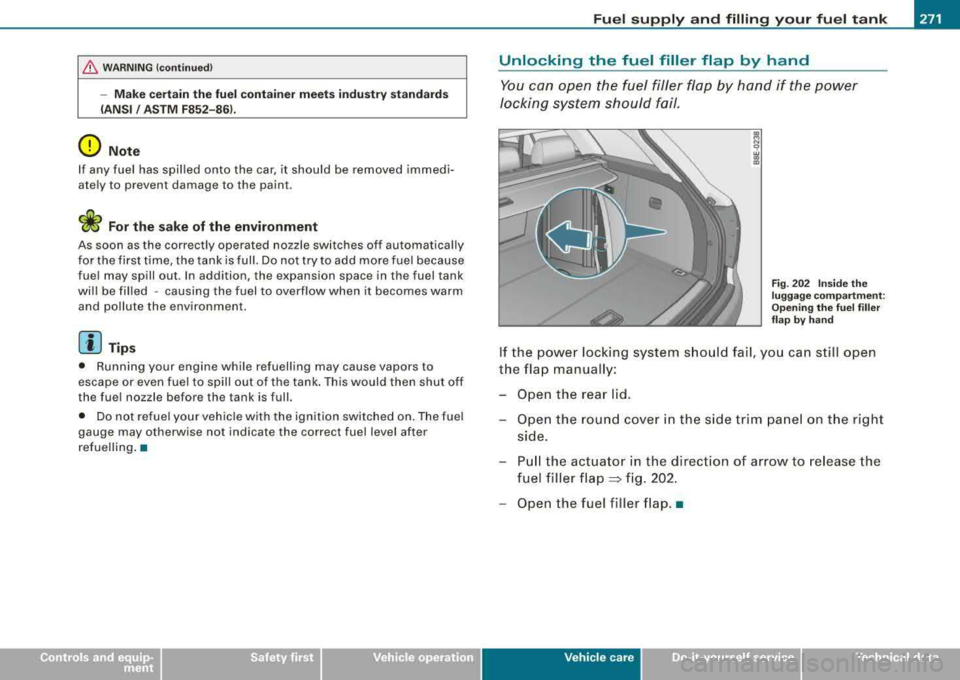
Unlocking the fuel filler f lap by hand
You can open the fuel filler flap by hand if the power
locking system should fail.
Fig . 202 Inside the
luggage compartment:
Opening the fuel filler
flap by hand
If the power locking system should fail, you can still open
the flap manually:
- Open the rear lid.
- Open the round cover in the side trim panel on the right
side.
- Pull the actuator in the direction of arrow to release the
fuel filler flap
=> fig. 202.
- Open the fuel filler flap. •
Vehic le care irechnical data
Page 275 of 368

Checking and filling -
-----------------------------==--------=--
& WARNING (continued)
ment. Wait until no steam or coolant can be seen or heard before
carefully opening the hood.
•
Closing the engine hood
- Pull the hood down until the pressure from the strut is
reduced.
- Let the hood
drop down and latch in place. Do not try to
push
it shut; it may fail to engage =:>& .
& WARNING
A hood that is not completely latched could fly up and block your
view while driving.
• When you close the engine hood, check it to make sure the
safety catch has properly engaged. The hood should be flush with
the surrounding vehicle body parts.
• If you notice while driving that the hood is not secured prop
erly, stop at once and close it. •
Working in the engine compartment
Be especially careful whenever you work in the engine
compartment.
Whenever you must perform any work in the engine compartment,
for example checking and filling different fluids, there is a risk of
injury, burns and accidents. To prevent personal injury always
observe the following WARNINGS . The engine compartment of any
vehicle is a hazardous area
=> & .
• I I • • I
& WARNING
To help avoid injury, before you check anything under the hood:
• Turn off the engine.
• Remove the ignition key .
• Apply the parking brake.
• Move selector lever of automatic transmission to
"P" (Park);
put manual transmission in Neutral.
• Always let the engine cool down. Hot components will burn
skin on contact.
• To reduce the risk of being burned, never open the hood if you
see or hear steam or coolant escaping from the engine compart
ment. Wait until no steam or coolant can be seen or heard before
carefully opening the hood.
• Keep children away from the engine compartment.
• Never spill fluids on hot engine components. They can cause a
fire.
• Never touch the radiator fan. The auxiliary electric fan is
temperature controlled and can switch on suddenly.
• Never open the coolant reservoir cap when the engine is still
warm . The coolant system is pressurized and hot coolant could
spray out.
• Protect your face, hands and arm from steam or hot engine
coolant by placing a thick rag over the cap when you open the
coolant reservoir .
• If work on the fuel system or the electrical system is necessary: -Always disconnect the battery.
- Never smoke or work near heaters or open flames. Fluids in
the engine compartment could start a fire .
- Keep an approved fire extinguisher immediately available.
• To avoid electrical shock and personal injury while the engine
is running or being started, never touch:
- Ignition cables
.,_
Vehicle care
Page 283 of 368

_____________________________________________ C_h_ e_ c
_ k_in -= g_a
_ n_d _ f_il _li _n ..;::g ;;.___..
le as t 50 % but not more th an 60 % to maintain antifreeze protection
and cooling efficiency . If the coolant frost protection is too low, the
coolant could freeze and damage the vehic le heating and engine
cooling system.
For year -round driving, antifreeze is added at the factory for temper
atures down to :
•
-31 °F (- 35 °C) USA
•
-40 °F ( -40 °C) Canada.
You can mix the G12 + coolant additive with other additives (for
examp le G11 or G12) . Always check with your authorized Audi
dea ler.
& WARNING
Bef ore you check anything in the eng ine comp artm ent , a lw ays
re ad and h eed all W ARNING S
=> & in "Worki ng in the engine
c ompartm en t" on
page 273.
0 Note
• Before winter sets in, have the coolant checked to see if the
coolant additive in your vehicle is sufficient to meet the climate
conditions. This is especially important if you live in a region where
the winter is extremely cold. If necessary, increase the proportion of coolant additive to 60%.
• When adding coolant additive to your cooling system,
remember :
-We recommend using only coolant additive G12 + (check the
label) for your vehicle. This coo lant additive is avai lable at autho
rized Audi dealers . Other types of antifreeze can significantly
reduce corrosion protect ion. The resulting corrosion can cause a
loss of coolant and serious engine damage.
• Do no t add any type of radiator leak sealan t to you r vehicle's
engine coolant . Adding radiator repair fluid may adversely affect the function and performance of your cooling system and could result
in damage not covered by yo ur New Vehicle Limited Warranty. •
Checking the engine coolant level
The engine coolant level can be checked with a quick
glance.
F ig . 211 E ngine
co mpa rtm ent: Co olan t
e xp an sion tan k
Before you che ck a ny thing in the e ng ine compar tmen t,
alway s read and heed all
WARNINGS => & in "Working in
t h e engine compartment" on
page 273.
Turn off the ignitio n.
Let the engine cool down.
P lace a t hick rag over the coo lant expans ion tank
=> fig. 211 and carefully twist the cap counter-clockwise
=>& . ...
Ve hic le care irechnical data
Page 284 of 368

___ C_ h_ e_c _k _ i_n ~g _ a_n_ d_ f_il _li _n_ g~--------------------------------------------
-Read the engine coolant level in the open coolant expan
sion
tank => fig. 211. With a cold engine, the coolant level
should be between the "min" and "max" markings. When
the engine is warm, the level may be slightly above the "max" marking.
The location of the coolant expansion tank can be seen in the
engine compartment
illustration=> page 275 .
To obtain an accurate reading, the engine must be sw itched off.
The expansion tank in your vehicle is equipped with an electric
coolant level sensor.
When the coolant level is too low, the warning light in the Auto
Check System
=> page 31 will blink until you add coolant and the
level has been restored to normal. Even though there is an electric
coolant level sensor, we still recommend you check the coolant level
from time to time.
Coolant loss
Coolant loss may indicate a leak in the cooling system . In the event
of coolant loss, the cooling system should be inspected immedi
ately by your authorized Audi dealer . It is not enough merely to add
coolant.
In a
sealed system, losses can occur only if the boiling point of the
coolant is exceeded as a result of overheating.
& WARNING
The cooling system is under pressure and can get very hot. Reduce
the risk of scalding from hot coolant by following these steps.
• Turn off the engine and allow it to cool down.
• Protect your face, hands and arms from escaping fluid and
steam by covering the cap with a large, thick rag.
& WARNING (continued)
• Turn the cap slowly and very carefully in a counter-clockwise
direction while applying light, downward pressure on the top of
the cap.
• To avoid being burned, do not spill antifreeze or coolant on the
exhaust system or hot engine parts. Under certain conditions, the
ethylene glycol in engine coolant can catch fire.
0 Note
Do not add any type of radiator leak sealant to your vehicle's engine
coolant. Adding radiator repair fluid may adversely affect the func
tion and performance of your cooling system and could result in damage not covered by your New Vehicle Limited Warranty. •
Adding coolant
Be very careful when adding engine coolant.
Before you check anything in the engine compartment,
always read and heed all WARNINGS => & in "Working in
the engine compartment" on
page 273.
-Turn off the engine.
-Let the engine cool down.
-Place a thick rag over the coolant expansion tank
=> page 281 , fig. 211 and carefully twist the cap counter
clockwise
=> & .
-Add coolant.
-Twist the cap on again tightly.
Replacement engine coolant must conform to exact spec ifications
=> page 280, "Coolant". If in an emergency coolant additive G12 + is .,,
Page 285 of 368
___________________________________________ C_ h_e _c_ k_ i_n ~g _ a_n _d_ f_il _li _n ~g __ ffllll
not available, do not use a different additive. Use plain water
instead until you can get the correct additive and can restore the
correct ratio. This should be done as soon as possible.
If you have lost a considerable amount of coolant, then you should
add cold antifreeze and cold water only when the engine is cold .
Always use
new engine coolant when refilling.
Do not fill coolant above the "MAX" mark. Excess coolant will be
forced out through the pressure relief valve in the cap when the engine becomes hot.
& WARNING
• The cooling system is under pressure and can get very hot.
Reduce the risk of scalding from hot coolant by following these
steps.
-Turn off the engine and allow it to cool down.
-Protect your face, hands and arms from escaping fluid and
steam by covering the cap with a large, thick rag.
- Turn the cap slowly and very carefully in a counter-clockwise
direction while applying light, downward pressure on the top
of the cap.
- To avoid being burned, do not spill antifreeze or coolant on
the exhaust system or hot engine parts. Under certain condi
tions, the ethylene glycol in engine coolant can catch fire .
• Antifreeze is poisonous. Always store antifreeze in its original
container and well out of the reach of children.
• If you drain the coolant, it must be caught and safely stored in
a proper container clearly marked
"poison".
0 Note
• Coolant pollutes the environment and could cause an engine
fire. Excess coolant will be forced out through the pressure relief
valve in the cap when the engine becomes hot. •
If, in an emergency , only water can be added, the correct ratio
between water and antifreeze=>
page 280 must be restored as soon
as possible.
~ For the sake of the environment
Drained coolant should not be reused . Always dispose of used
coolant while observing all environmental regulations.•
Radiator fan
The radiator fan switches on automatically by itself.
The radiator fan is driven by the engine via the V -belt. The viscous
clutch regulates the speed of the fan according to the temperature
of the coolant.
An auxiliary electric radiator fan* switches on and off depending on
coolant temperature and other vehicle operating conditions .
After you switch the engine off, the auxiliary fan can continue
running for up to 10 minutes -even with the ignition off. It can even
switch on again later by
itself =>& , if
• the temperature of the engine coolant rises due to the heat
build-up from the engine in the engine compartment, or
• the engine compartment heats up because the vehicle is parked
in intense sunlight .
& WARNING
• To reduce the risk of personal injury never touch the radiator
fan.
• The auxiliary electric fan is temperature controlled and can
switch on suddenly even when the engine is not running .
• The auxiliary radiator fan switches on automatically when the
engine coolant reaches a certain temperature and will continue to
run until the coolant temperature drops. •
Vehicle care
Page 287 of 368
___________________________________________ C_ h_e _c_ k_ i_n ~g _ a_n _d_ f_il _li _n ~g __ _
& WARNING (continued)
-The brake fluid must be new. Heavy use of the brakes can
cause a vapor lock if the brake fluid is left in the system too
long. This can seriously affect the efficiency of the brakes as
well as your safety. This could result in an accident.
0 Note
Brake fluid will damage the paint of your vehicle.
W For the sake of the environment
Because of the problem of proper disposal of brake fluid as well as
the special tools required and the necessary expertise, we recom
mend that you have the brake fluid changed by your authorized Audi
dealer. •
Battery
General information
Under normal operating conditions, the battery in your Audi does
not need any maintenance. With
high outside temperatures it is
advisable however to check the fluid level at regular intervals
through the transparent battery housing. Also check the fluid level
each time you charge the battery. After charging the battery
~ page 289, you should likewise check the battery acid level.
Have the battery checked when you take your vehicle in for service.
You are well advised to replace a battery that is older than 5 years.
Preserving battery charge on a vehicle not operated
for a long time
Some components of the electrical equipment (for example, the
electronic immobilizer) will keep drawing a low current even when the car is
not running
. This will eventually drain the battery
completely if your vehicle is left sitting for a long period of time
without being driven . To prevent this, either charge the battery
occasionally or disconnect the battery negative (ground) cable.
Winter operation
During the winter months, battery capacity tends to decrease as
temperatures drop . This is because more power is also consumed
while starting, and the headlights, rear window defogger, etc., are
used more often.
Avoid unnecessary power consumpt ion, particularly in city traff ic or
when traveling only short distances. Let your authorized Audi dealer
check the capacity of the vehicle battery before winter sets in
~ page 289. A well charged battery will not only prevent starting
problems when the weather is cold, but will also last longer.
[ i] Tips
If your vehicle is left standing for several weeks at extremely low
temperatures, the vehicle battery should be removed and stored
where it will not freeze. This will prevent it from being damaged and
having to be replaced. •
Location of the vehicle battery
The vehicle battery is located in the plenum chamber at the back of
the engine
compartment~ page 275.
The positive(+) battery terminal is protected by a plastic cover. This cover must be removed to access to the positive(+) terminal when
connecting jumper cables to start the engine .
& WARNING
Before you check anything in the engine compartment, always
read and heed all WARNINGS
~ & in "Working in the engine
compartment" on
page 273. •
Vehicle care
Page 292 of 368
___ C_ h_ e_c _k_ i_n ~g _ a_n_ d_ f_ il _li_ n~ g~--------------------------------------------
For example, a charging current of 4.5 amps would be used on a
battery rated at 45 Ah. Rated capacity of the battery in your vehicle
is listed on the battery housing .
The battery caps should
not be opened when charging a battery.
& WARNING
Charging a battery can be dangerous.
• Always follow the operating instructions provided by the
battery charger manufacturer when charging your battery.
• Never charge a frozen battery . It may explode because of gas
trapped in the ice. Allow a frozen battery to thaw out first.
• Do not reuse batteries which were frozen. The battery housing
may have cracked and weakened when the battery froze.
• Charge the battery in a well ventilated area. Keep away from
open flame or electrical spark. Do not smoke. Hydrogen gas gener
ated by the battery is explosive.
• To reduce the danger of explosion, never connect or disconnect
charger cables while the charger is operating.
• Fast charging a battery is dangerous and should only be
attempted by a competent technician with the proper equipment.
• Battery acid that may spill during charging should be washed
off with a solution of warm water and baking soda to neutralize
the acid.
0 Note
Never use a fast charger as a booster to start the engine . This will
seriously damage sensitive electronic components, such as control
units, relays, radio, etc ., as well as the battery charger. •
Disconnecting and connecting the battery
When the battery is disconnected some features on the
vehicle will become inoperative and you must reset them
when the battery is reconnected.
When you disconnect the vehicle battery note the following:
• some data stored in the driver information system is erased,
• the clock stops,
• the factory installed radio locks up,
• the engine management system and the one-touch-up and one
touch -down functions of the power windows no longer work .
After you reconnect the battery, you must reset the following
features :
Inoperative because the
battery was discon
nected:
clock
one-touch-up and one-touch
down feature on the power
windows
engine management
seat memory*
radio station coding
Removing battery
To reset after the battery is
reconnected, see:
=> page 14
=> page 67
=> page 135
=> page 100
Sound System Operating Instruc -
tions booklet .
•
Before you check anything in the engine compartment,
always
read and heed all WARNINGS :::> & in "Working in
the engine compartment" on page
273. ~
Page 302 of 368
___ T_ ir_e _ s_ a_ n
_ d_ w_ h_ e_ e_ls _________________________________________________ _
The tire pressure label on your Audi lists the recommended cold tire
inf lation pressures for the new, original equipmen t tires that were
on your vehic le at the time it was manufactured . For the location of
the
labe l=> page 297, fig. 217 .
Most tires lose a ir natural ly over time. They can a lso lose some air if
you drive over a potho le or hit a curb wh ile parking. It is usually not
possible to see whether the radial t ires used today are under inflated
just by looking at them.
Therefore, be su re to check tire pressures at least once a month and
always before going on a long trip . Make sure to take the number of
people and the amount of luggage into account when adjusting tire
pressure for a trip -even one that you wou ld not cons ider to be
" long ."
See => page 301, "Tires and vehicle load limits" for more
important i nformation .
A lways use an accurat e tire pressure gaug e when checking and
adjusting inflat ion pressures. Check a ll of the tires and be sure not
to forget the spare tire . If the pressure in any tire is too high when
the t ire is "cold," let air o ut of the t ire slowly with the edge of the tire
gauge and keep check ing the pressure until you reach the pressure
that is correct for the load (passengers and luggage) and kind of
driving you p lan to do .
I f the pressure in any tire is too low, note the difference between the
pressure in the co ld tire and the pressure you need and add the air
that you need to reach the correct pressure for the vehicle load
(passengers and luggage) fo r the t ires on your veh ic le as listed on
the on your vehicle and in this manual and the kind of driving you pl an to do .
Never exceed the m aximum inflation pressure li sted on the tire
s idewall for an y re ason .
Remem ber that the vehic le manufacturer, not t he tire manufacturer,
determines the correct tire pressure for the tires on your vehicle .
I t is important to check the tire pressure when the tires are cold.
• Read the required tire pressure from the t ire pressure label
located either on driver 's side B -pillar or inside the fuel fi ller flap . •
Turn the va lve stem cap counter -clockwise to remove it from the
t ire valve .
• Place the air pressure gauge on the valve.
• The tire pressures should only be checked and adjusted when
the tires are cold. The s lightly raised pressures of warm tires must
not be reduced.
• Adjust the tire pressure to the load you are carrying.
• Reinstal l the va lve stem cap on the valve .
When should I check the tire pressure?
The correct tire pressure is especially important at high spe eds . The
pressure should the refore be checked at least once a mo nth and
a lways before starting a journey. Do not forget to check the tire pres
sure for the spare whee l
=> page 317.
Wh en should I adjust th e tir e pre ssur es?
Adjust t he tire pressure to the load you are carry ing . After changing
a wheel
o r replacing whee ls you have to ad just the tire pressures on
a ll whee ls . In addition, on vehicles w ith tire pressure monito ring
system* you must then store the new tire pressures in the system
=> page 45.
& WARNING
Incorrect tire pre ssure s and /or underinflation can lead sudden tire
f ai lure , loss of control , collision , seri ous per sonal injury or even
death.
• When the w arning symbol
(l) appe ars in the in strument
clu ster , stop and inspect the tire s.
• Incorrect t ire pres sure and /or underinflat ion can cause
increa sed tire wear and can affect the handling of the vehicle and
s topping ability.
• Incorrect tire pres sures and /or underinflation can also lead to
s udden tire fa ilure , inc luding a blowout and sudden defl ation ,
cau sing los s of vehicle control .
~