light AUDI A4 AVANT 2008 Owners Manual
[x] Cancel search | Manufacturer: AUDI, Model Year: 2008, Model line: A4 AVANT, Model: AUDI A4 AVANT 2008Pages: 368, PDF Size: 46.19 MB
Page 285 of 368
___________________________________________ C_ h_e _c_ k_ i_n ~g _ a_n _d_ f_il _li _n ~g __ ffllll
not available, do not use a different additive. Use plain water
instead until you can get the correct additive and can restore the
correct ratio. This should be done as soon as possible.
If you have lost a considerable amount of coolant, then you should
add cold antifreeze and cold water only when the engine is cold .
Always use
new engine coolant when refilling.
Do not fill coolant above the "MAX" mark. Excess coolant will be
forced out through the pressure relief valve in the cap when the engine becomes hot.
& WARNING
• The cooling system is under pressure and can get very hot.
Reduce the risk of scalding from hot coolant by following these
steps.
-Turn off the engine and allow it to cool down.
-Protect your face, hands and arms from escaping fluid and
steam by covering the cap with a large, thick rag.
- Turn the cap slowly and very carefully in a counter-clockwise
direction while applying light, downward pressure on the top
of the cap.
- To avoid being burned, do not spill antifreeze or coolant on
the exhaust system or hot engine parts. Under certain condi
tions, the ethylene glycol in engine coolant can catch fire .
• Antifreeze is poisonous. Always store antifreeze in its original
container and well out of the reach of children.
• If you drain the coolant, it must be caught and safely stored in
a proper container clearly marked
"poison".
0 Note
• Coolant pollutes the environment and could cause an engine
fire. Excess coolant will be forced out through the pressure relief
valve in the cap when the engine becomes hot. •
If, in an emergency , only water can be added, the correct ratio
between water and antifreeze=>
page 280 must be restored as soon
as possible.
~ For the sake of the environment
Drained coolant should not be reused . Always dispose of used
coolant while observing all environmental regulations.•
Radiator fan
The radiator fan switches on automatically by itself.
The radiator fan is driven by the engine via the V -belt. The viscous
clutch regulates the speed of the fan according to the temperature
of the coolant.
An auxiliary electric radiator fan* switches on and off depending on
coolant temperature and other vehicle operating conditions .
After you switch the engine off, the auxiliary fan can continue
running for up to 10 minutes -even with the ignition off. It can even
switch on again later by
itself =>& , if
• the temperature of the engine coolant rises due to the heat
build-up from the engine in the engine compartment, or
• the engine compartment heats up because the vehicle is parked
in intense sunlight .
& WARNING
• To reduce the risk of personal injury never touch the radiator
fan.
• The auxiliary electric fan is temperature controlled and can
switch on suddenly even when the engine is not running .
• The auxiliary radiator fan switches on automatically when the
engine coolant reaches a certain temperature and will continue to
run until the coolant temperature drops. •
Vehicle care
Page 286 of 368

ffl...__C_ h_ e_c _k_ i_n ..::g a- a_n_ d_ f_ il _li_ n""" g:::a.-___________________________________________ _
Brake f luid
Checking brake fluid level
The brake fluid level c an be checked with a quick glance .
Fig. 212 Engin e
co mp artm ent: B rak e
f lu id rese rvoi r
Before you check a nything in the e ngine compartment,
alway s re ad and he ed all WARNINGS ~ & in "Working in
the engi ne com partment" on
page 273.
- Pull the rubber st rip @ up partially and lift the cover @
slightly~ fig. 212 .
- Read the brake fluid level from the brake fluid reservoi r
@. The brake fluid level must be between the "MIN" and
"MAX" markings.
The brake fluid reservoir is located at the rear partition of the engine
compartment on the le ft side
~ page 275.
The fluid level may drop slightly after some time due to the auto
matic adjustment of the brake pads. This is not cause for alarm.
If the brake fluid level fal ls
considerably below the "MIN" mark, the
brake warning/indicator light (U .S . models :
BRAKE, Canadian models:
0) will come on=> page 23 and~ page 31 . Do not continue to
opera te the vehicle. The complete brake system should be thor
oughly checked by an authorized Audi dealer or qua lified workshop
and the cause corrected. If the brake fluid level is too low, the brake
warning/indicator light will illuminate . Contact an authorized Audi
dea ler
immedi atel y.•
Changing brake fluid
H ave the brake fluid changed by an experienced techni
cian.
Brake fluid absorbs mo isture from the air . If the water content in the
brake fluid is too high, corrosion in the brake system may result
after a period of time. The bo iling point of the brake fluid wil l a lso
decrease considerably and decrease braking performance.
Therefore, the brake fluid must be changed
e ver y tw o year s. Always
use new brake fluid which conforms to Federal Motor Vehic le Stan
dard "FMVSS 116 DOT
4".
The brake fluid rese rvo ir can be difficult to reach, therefore, we
recommend that you have the brake fluid changed by your autho
rized
Audi dealer . Your dealer has the correct tools, the right brake
fl uid and the know-how to do this for you.
& WARNING
• Brake fluid is po is o nou s. It m ust be stored only in the clo se d
orig inal container out of the re ach of children!
• Brake f ailure can resu lt from old o r inapp ropriat e brake fluid .
Ob serve the se precaution s:
- Use only brake fl uid that me ets SAE spe cific atio n
J 1703 and
conform s to F ederal Motor Vehicle Standard 11 6. Alway s check
with y our authorized A ud i dealer t o ma ke sure you are u sing
th e c orrect br ake fluid . The correct type of brake fluid i s al so
i ndicated on the brake flu id re ser voir .
..,_
Page 287 of 368
___________________________________________ C_ h_e _c_ k_ i_n ~g _ a_n _d_ f_il _li _n ~g __ _
& WARNING (continued)
-The brake fluid must be new. Heavy use of the brakes can
cause a vapor lock if the brake fluid is left in the system too
long. This can seriously affect the efficiency of the brakes as
well as your safety. This could result in an accident.
0 Note
Brake fluid will damage the paint of your vehicle.
W For the sake of the environment
Because of the problem of proper disposal of brake fluid as well as
the special tools required and the necessary expertise, we recom
mend that you have the brake fluid changed by your authorized Audi
dealer. •
Battery
General information
Under normal operating conditions, the battery in your Audi does
not need any maintenance. With
high outside temperatures it is
advisable however to check the fluid level at regular intervals
through the transparent battery housing. Also check the fluid level
each time you charge the battery. After charging the battery
~ page 289, you should likewise check the battery acid level.
Have the battery checked when you take your vehicle in for service.
You are well advised to replace a battery that is older than 5 years.
Preserving battery charge on a vehicle not operated
for a long time
Some components of the electrical equipment (for example, the
electronic immobilizer) will keep drawing a low current even when the car is
not running
. This will eventually drain the battery
completely if your vehicle is left sitting for a long period of time
without being driven . To prevent this, either charge the battery
occasionally or disconnect the battery negative (ground) cable.
Winter operation
During the winter months, battery capacity tends to decrease as
temperatures drop . This is because more power is also consumed
while starting, and the headlights, rear window defogger, etc., are
used more often.
Avoid unnecessary power consumpt ion, particularly in city traff ic or
when traveling only short distances. Let your authorized Audi dealer
check the capacity of the vehicle battery before winter sets in
~ page 289. A well charged battery will not only prevent starting
problems when the weather is cold, but will also last longer.
[ i] Tips
If your vehicle is left standing for several weeks at extremely low
temperatures, the vehicle battery should be removed and stored
where it will not freeze. This will prevent it from being damaged and
having to be replaced. •
Location of the vehicle battery
The vehicle battery is located in the plenum chamber at the back of
the engine
compartment~ page 275.
The positive(+) battery terminal is protected by a plastic cover. This cover must be removed to access to the positive(+) terminal when
connecting jumper cables to start the engine .
& WARNING
Before you check anything in the engine compartment, always
read and heed all WARNINGS
~ & in "Working in the engine
compartment" on
page 273. •
Vehicle care
Page 288 of 368
ffl...__C_ h_ e_c _k _ i_n ..::g ,_ a_n_ d_ f_il _li _n....: g==-- --------------------------------------------
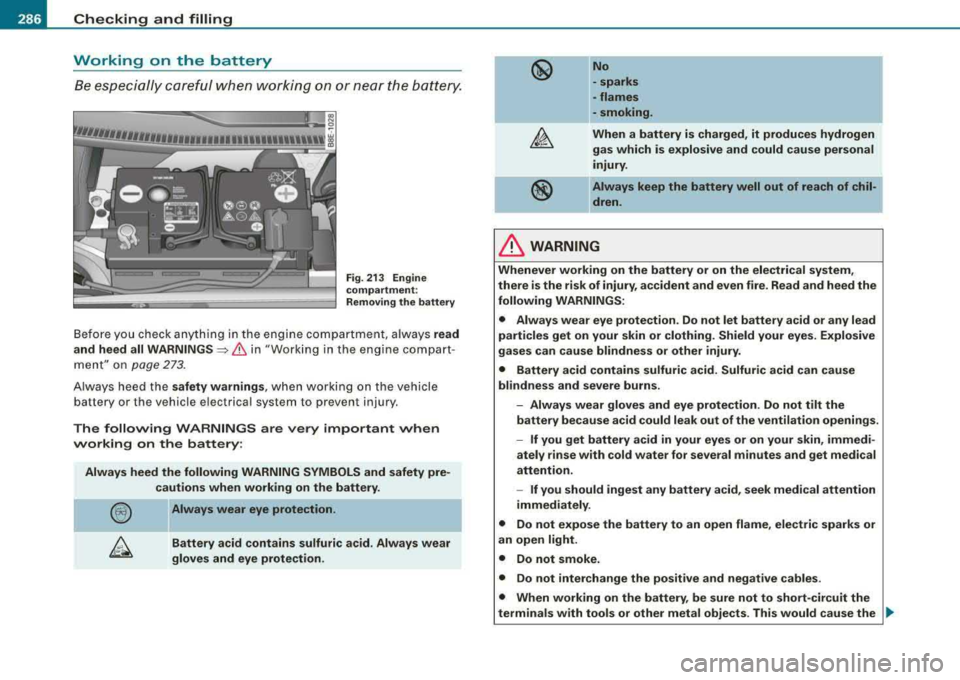
Working on the battery
Be es pecia lly car efu l w he n work ing on or n ear t he battery .
Fig. 213 Engine
compartment :
Removing the battery
Befo re you chec k anythi ng in the e ngine c ompart me nt, al ways read
and heed all
WARNINGS ~ & in " Working in the e ngine compa rt
m ent " o n page
273 .
Alw ays heed the safety warnings , when w orki ng on the v ehicle
batte ry or the vehicle e lectrica l system to preve nt inju ry.
The following WARNINGS are very important when
working on the battery:
Always heed the following WARNING SYMBOLS and safety pre cautions when working on the battery .
Always wear eye protection .
Battery acid contains sulfuric acid . Always wear
gloves and eye protection .
@
No
-sparks
- flames
- smoking .
When a battery is charged , it produces hydrogen
gas which is explosive and could cause personal
injury .
Always keep the ba ttery well ou t of reach of chi l
dren .
& WARNING
Whenever working on the battery or on the electrical system,
there is the risk of injury, accident and even fire . Read and heed the
following WARNINGS:
• Always wear eye protection . Do not let battery acid or any lead
particles get on your skin or clothing. Shield your eyes . Explosive
gases can cause blindness or other injury .
• Battery acid contains sulfuric acid. Sulfuric acid can cause
blindness and severe burns .
- Always wear gloves and eye protection. Do not tilt the battery because acid could leak out of the ventilation openings .
- If you get battery acid in your eyes or on your skin , immedi
ately rinse with cold water for several minutes and get medical
attention.
- If you should ingest any battery acid, seek medical attention
immediately.
• Do not expose the battery to an open flame , electric sparks or
an open light.
• Do not smoke.
• Do not interchange the positive and negative cables .
• When working on the battery , be sure not to short -circuit the
term inals with tools or other metal objects . This would cause the
IJJ>
Page 289 of 368

Checking and filling 111111
--------------------------------------------=-----=--------
& WARNING (continued )
battery to heat up very quickly , whi ch could le ad to damage or
explosion and personal injury .
• When a battery is charged , it produces hydrogen gas whi ch is
explosive and could cause personal injury .
• Always keep the battery well out of the reach of children .
• Before work is done on the electrical system , disconnect the
negative ground cable .
• Before performing any work on the electri cal system , switch off
the engine and ignition as well as any electrical equipment. The negative cable on the battery must be disconnected. If you are just
going to replace a light bulb , then it is enough to switch off the
lights.
• Before disconnecting the battery, switch off the anti -theft
alarm system! Otherwise you will set off the alarm .
• When disconnecting the battery , fir st di sconnect the negative
c able and then the positive cable .
• Before reconnecting the battery, make sure all electrical
consumers are switched off . Reconnect the positive cable first and
then the negative cable. Never interchange the cables -this could
start a fire!
• Never charge a frozen or a thawed -out battery . It could
explode! If a battery has frozen, then it must be replaced . A
discharged battery can freeze over at 32 °F (0 °Cl.
• Make sure the vent hose is always attached to the opening on
the side of the battery.
• Never use batteries which are damaged . There is the danger of
an explosion! Always replace a damaged battery.
in. WARNING
California Proposition 65 Warning :
• I I • • I
& WARNING (continued )
• Battery posts , terminals and related accessories contain lead
and lead compounds , chemicals known to the State of California
to cause cancer and reproductive problems . Wash hands after
handling.
0 Note
• Do not d isconnect th e ve hicle bat tery w hen t he ig ni tio n i s
switched on or when the engine is running , otherwise, you will
da mage e lec troni c c om pon ent s in the e lec trica l syste m.
• When working on the engine, protect t he battery housing from
u ltraviolet (UV) rays by not pa rking the ve hicle i n direct sun lig ht.
• If your vehicle is going to stand fo r a long period of time wit hout
being driven, pro tect the battery from "freezing", ot herwise it w ill
be damaged and wi ll then have to be replaced .•
Vehicle care
Page 293 of 368

_____________________________________________ C_h_ e_ c
_ k_in --= g'--a
_ n_d _ f_il _li _n ..::g ::.-__,-
-Switch off the ignition and all electrical consumers.
First disconnect the minus cab le (usual ly black or brown) and then
the plus cable (usual ly red). Then remove the battery mounting
bracket and remove the battery. •
Replacing battery
The new battery must have the same specifications and
dimensions as the old one.
A replacement battery must have the same spec ifications and
dimensions as the o riginal equipment battery. Specifications are
listed on the battery housing.
When installing the battery, make sure the ignition and all electrical
consumers are switched off.
0 Note
Make sure the ventilation hose on the side of the battery is
connected, otherwise fumes or battery acid can leak out.
~ For th e sake of th e environm ent
Because of the problem of proper disposal of a battery, we recom
mend your authorized Audi dealer change the battery for you.
Batteries contain sulfur ic acid and lead and must always be
disposed of properly in compliance with a ll environmenta l regula
t ions . Dispos ing of vehic le batteries improperly is very dangerous to
the environment. •
Windshield/headlight washer
container
Using plain water is not adequate for filling the wind
shield washer system and the headlight washer system*.
i w a, a,
Fig . 21 6 Engin e
co mp artment : Wind
s hiel d and head ligh t
w as her f luid contain er
~-~ The washer flu id container is marked with the symbol W on
its cap.
-Before you check a nything in the engine compartmen t,
always read and heed all WARNINGS :::::, & in "Working
in t he engine compartment" on
page 273.
-Lift t he fi ller c ap tongu e to add wash er fluid. You can fil l
the container to the top .
-Press the ca p bac k onto the filler neck a fter fi lling the
container.
You can find the reservoir c a pac ity in the tab le in=> page 343.
Use winterized windshield washer solvent during the cold season
even though the ve hic le is equipped with
h eated wash er jets . It _.,
Vehic le care irechnical data
Page 300 of 368
___ T_ ir_e _ s_ a_ n
_ d_ w_ h_ e_ e_ls _________________________________________________ _
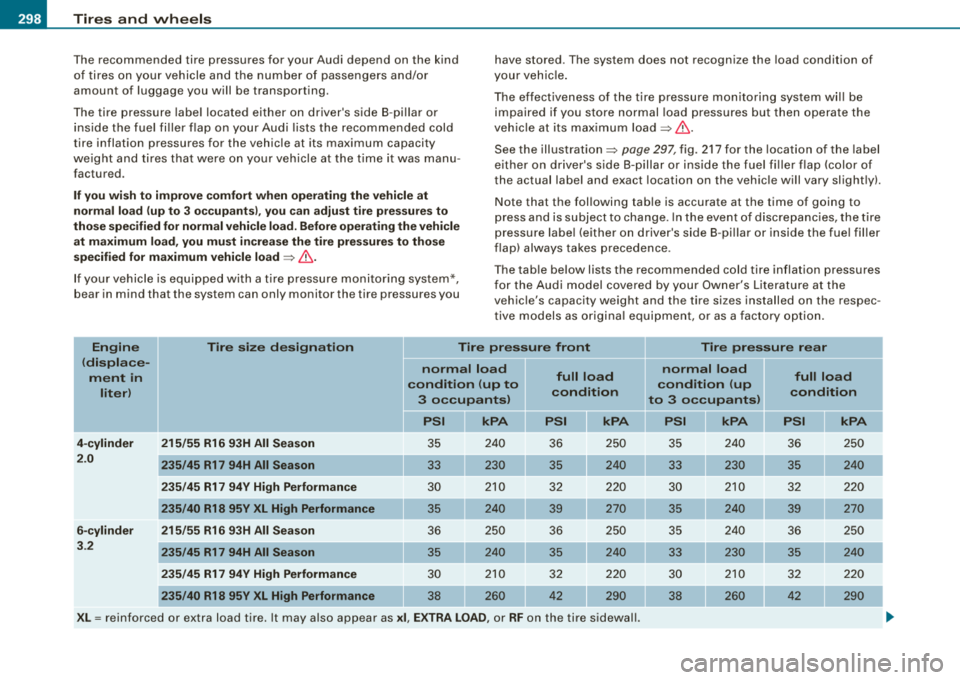
The recommended tire pressures for your Audi depend on the kind
of tires on your vehicle and the number of passengers and/or
amount of luggage you will be transporting.
The tire pressure label located either on driver's side 8-pillar or
inside the fuel filler flap on your Audi lists the recommended cold
tire inflation pressures for the vehicle at its maximum capacity
weight and tires that were on your vehicle at the time it was manu
fac tured .
If you wish to improve comfort when operating the vehicle at
normal load (up to 3 occupants), you can adjust tire pressures to
those specified for normal vehicle load. Before operating the vehicle at maximum load, you must increase the tire pressures to those
specified for maximum vehicle load
~ & .
If your vehicle is equipped with a tire pressure monitoring system*,
bear in mind that the system can only monitor the tire pressures you have stored
. The system does not recognize the load condition of
your vehicle.
The effectiveness of the tire pressure monitoring system will be
impaired if you store normal load pressures but then operate the
vehicle at its maximum
load~& .
See the illustration~ page 297, fig . 217 for the location of the label
either on driver's side 8-pillar or inside the fuel filler flap (color of
the actual label and exact location on the vehicle will vary slightly).
Note that the following table is accurate at the time of going to
press and is subject to change . In the event of discrepancies, the tire
pressure label (e ither on driver's side 8 -pillar or inside the fuel filler
flap) always takes precedence.
The table below lists the recommended cold tire inflation pressures
for the Audi model covered by your Owner's Literature at the
vehicle's capacity weight and the tire si zes installed on the respec
tive models as original equipment, or as a factory option.
Engine Tire size designation Tire pressure front Tire pressure rear
(displace- normal load normal load
ment in condition (up to full load
condition (up full load
liter) condition
condition
3 occupants) to 3 occupants)
PSI kPA PSI kPA PSI kPA PSI kPA
4-cylinder 215/55 R16 93H All Season 35 240
36 250 35 240
36 250
2.0
235/45 R17 94H All Season 33 230 35 240 33 230 35 240
235/45 R17 94V High Performance 30 210
32 220 30 210
32 220
235/40 R18 95V XL High Performance 35 240 39 270 35 240 39 270
6-cylinder 215/55 R16 93H All Season 36 250 36 250 35 240 36 250
3.2
235/45 R17 94H All Season 35 240
35 240
33 230 35 240
235/45 R17 94V High Performance 30
210 32 220 30 210 32 220
235/40 R18 95V XL High Performance 38 260 42 290 38 260 42 290
XL = reinforced or extra load tire. It may also appear as xi, EXTRA LOAID, or RF on the tire sidewall.
Page 302 of 368
___ T_ ir_e _ s_ a_ n
_ d_ w_ h_ e_ e_ls _________________________________________________ _
The tire pressure label on your Audi lists the recommended cold tire
inf lation pressures for the new, original equipmen t tires that were
on your vehic le at the time it was manufactured . For the location of
the
labe l=> page 297, fig. 217 .
Most tires lose a ir natural ly over time. They can a lso lose some air if
you drive over a potho le or hit a curb wh ile parking. It is usually not
possible to see whether the radial t ires used today are under inflated
just by looking at them.
Therefore, be su re to check tire pressures at least once a month and
always before going on a long trip . Make sure to take the number of
people and the amount of luggage into account when adjusting tire
pressure for a trip -even one that you wou ld not cons ider to be
" long ."
See => page 301, "Tires and vehicle load limits" for more
important i nformation .
A lways use an accurat e tire pressure gaug e when checking and
adjusting inflat ion pressures. Check a ll of the tires and be sure not
to forget the spare tire . If the pressure in any tire is too high when
the t ire is "cold," let air o ut of the t ire slowly with the edge of the tire
gauge and keep check ing the pressure until you reach the pressure
that is correct for the load (passengers and luggage) and kind of
driving you p lan to do .
I f the pressure in any tire is too low, note the difference between the
pressure in the co ld tire and the pressure you need and add the air
that you need to reach the correct pressure for the vehicle load
(passengers and luggage) fo r the t ires on your veh ic le as listed on
the on your vehicle and in this manual and the kind of driving you pl an to do .
Never exceed the m aximum inflation pressure li sted on the tire
s idewall for an y re ason .
Remem ber that the vehic le manufacturer, not t he tire manufacturer,
determines the correct tire pressure for the tires on your vehicle .
I t is important to check the tire pressure when the tires are cold.
• Read the required tire pressure from the t ire pressure label
located either on driver 's side B -pillar or inside the fuel fi ller flap . •
Turn the va lve stem cap counter -clockwise to remove it from the
t ire valve .
• Place the air pressure gauge on the valve.
• The tire pressures should only be checked and adjusted when
the tires are cold. The s lightly raised pressures of warm tires must
not be reduced.
• Adjust the tire pressure to the load you are carrying.
• Reinstal l the va lve stem cap on the valve .
When should I check the tire pressure?
The correct tire pressure is especially important at high spe eds . The
pressure should the refore be checked at least once a mo nth and
a lways before starting a journey. Do not forget to check the tire pres
sure for the spare whee l
=> page 317.
Wh en should I adjust th e tir e pre ssur es?
Adjust t he tire pressure to the load you are carry ing . After changing
a wheel
o r replacing whee ls you have to ad just the tire pressures on
a ll whee ls . In addition, on vehicles w ith tire pressure monito ring
system* you must then store the new tire pressures in the system
=> page 45.
& WARNING
Incorrect tire pre ssure s and /or underinflation can lead sudden tire
f ai lure , loss of control , collision , seri ous per sonal injury or even
death.
• When the w arning symbol
(l) appe ars in the in strument
clu ster , stop and inspect the tire s.
• Incorrect t ire pres sure and /or underinflat ion can cause
increa sed tire wear and can affect the handling of the vehicle and
s topping ability.
• Incorrect tire pres sures and /or underinflation can also lead to
s udden tire fa ilure , inc luding a blowout and sudden defl ation ,
cau sing los s of vehicle control .
~
Page 321 of 368
What do I do now? 11111111
-----------------------------------
& WARNING (continued)
mission in "P" (Park), or engaging a gear in a manual transmission
will
not prevent the vehicle from moving.
• Before you change a wheel, be sure the ground is level and firm.
If necessary, use a sturdy board under the jack.
• After installing the spare wheel, make sure that you remount
the flat tire/wheel in its storage area properly and tighten the
knurled retaining screw securely . •
Changing a wheel
When you change a wheel, follow the sequence described
below step-by-step and exactly in that order.
1. Remove the decorative wheel cover*. For more details
see also
=> page 320, "Decorative wheel covers" or
=> page 320, "Wheels with cap -covered wheel bolts".
2. Loosen the wheel bolts => page 321.
3.
Locate the proper mounting point for the jack and align
the jack below that
point=> page 321.
4. Lift the car with the jack => page 321.
5.
Take the flat wheel off and then put the spare on
=> page 323.
6. Tighten all wheel bolts lightly.
7.
Lower the vehicle with the jack.
8. Use the wheel bolt wrench and
firmly tighten all wheel
bolts=> page 321.
9. Put the decorative wheel cover* back on.
LJ}. WARNING
Always read and head all WARNINGS and information :::::> & in
"Raising the vehicle" on
page 321 and :::::, page 324. •
After changing a wheel
A wheel change is not complete without the following
actions.
-Store and secure the replaced wheel in the spare wheel
well.
-Put the tool case and the jack back in place in the luggage
compartment.
-Check the tire pressure on the spare wheel immediately
after mounting it.
- As soon as possible, have the
tightening torques on all
wheel bolts checked with a torque wrench. The correct
tightening torque is
90 ft lb (120 Nml.
- Have the flat tire
replaced as soon as possible.
[ i] Tips
• If you notice while changing a tire that the wheel bolts are
corroded and difficult to turn, then they should be replaced before
you check the tightening torque.
• Drive at reduced speed until you have the tightening torques
checked .•
Do -it -yourself service
Page 325 of 368
What do I do now? -
------------------'
Taking the wheel off /putting the spare on
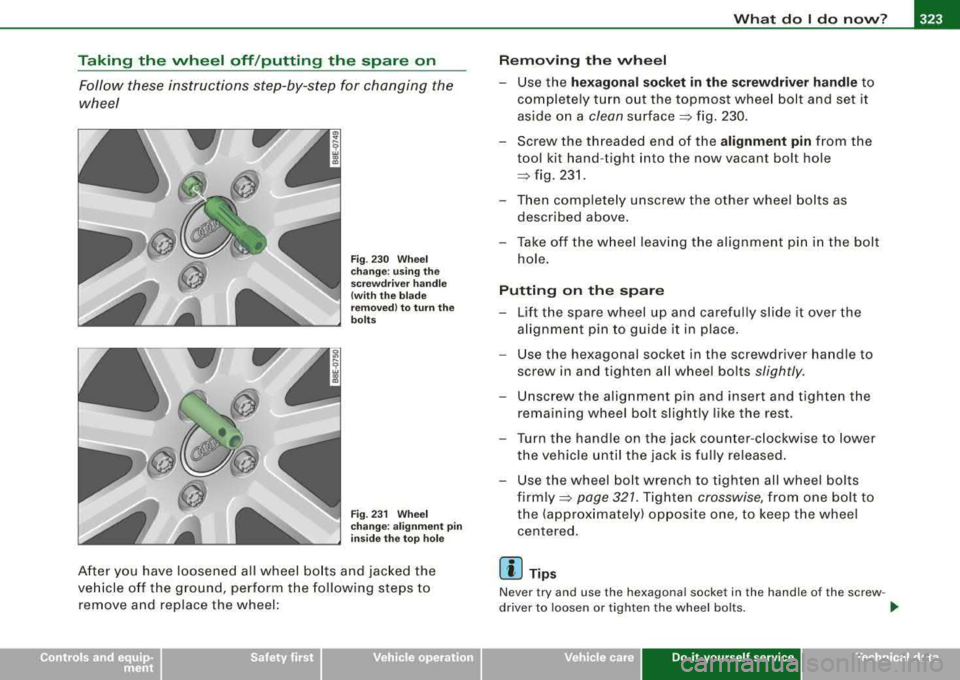
Follow these instructions step-by-step for changing the
wheel
Fig . 230 Wheel
change : using the
screwdriver handle
(with the blade
removed) to turn the
bolts
Fig . 231 Wheel
change : alignment pin
inside the top hole
After you have loosened all wheel bolts and jacked the
vehicle off the ground, perform the following steps to
remove and replace the wheel:
Removing the wheel
-Use the hexagonal socket in the screwdriver handle to
completely turn out the topmost wheel bolt and set it
aside on a
clean surface => fig. 230.
-Screw the threaded end of the alignment pin from the
tool kit hand -tight into the now vacant bolt hole
=> fig. 231 .
-Then completely unscrew the other wheel bolts as
described above.
-Take off the wheel leaving the alignment pin in t he bolt
hole.
Putting on the spare
-Lift the spare wheel up and carefully slide it over the
alignment pin to guide it in place.
-Use the hexagonal socket in the screwdriver handle to
screw in and t ighten all wheel bolts
slightly .
-Unscrew the alignment pin and insert and tighten the
remaining wheel bo lt slightly like the rest.
-Turn the handle on the jack counter-clockwise to lower
the vehicle until the jack is fully released.
-Use the wheel bolt wrench to tighten all wheel bolts
firmly =>
page 327. Tighten crosswise, from one bolt to
the (approximately) opposite one, to keep the wheel
centered.
[ i] Tips
Never try and use the h exagonal socket in the handle of the screw -
driver to loosen or tighten the wheel bolts.
.,
Do-it-yourse lf service irechnical data