fuel cap AUDI A4 AVANT 2008 User Guide
[x] Cancel search | Manufacturer: AUDI, Model Year: 2008, Model line: A4 AVANT, Model: AUDI A4 AVANT 2008Pages: 368, PDF Size: 46.19 MB
Page 298 of 368
___ T_ ir_e _ s_ a_ n
_ d_ w_ h_ e_ e_ls _________________________________________________ _
S idewa ll
means t hat port ion of a tire between the tread and bead.
Speed ra ting
extended periods of time. The ratings range from 93 mph (150 km/h)
to 186 mph (298
km/h) => page 306. You may not f ind this informa
tion on a ll tires because it is not required by law .
The speed rating letter code, whe re applicable, is mo lded on the tire
s idewal l and indicates the maximum perm issible road
speeds => &
in "Winter tires" on page 310.
Tire pr essu re m onitorin g sys tem *
means a system that detects when one or more of a vehicle's tires
are under inflated and i lluminates a low tire pressure warning te ll
tale .
Tread
means that portion of a tire that comes into contact with the road.
Trea d sepa ration
mea ns pu lling away of the tread from the tire carcass.
Tr eadw ear indi cato rs ( TWI)
mea ns the projections with in the pr incipa l grooves designed to give
a visual indication of the degrees of wear of the tread . See
=> page 303, "T read Wear Indicator (TWI)" for m ore information on
measuring tire wear.
Uniform Tire Qualit y Grading
is a tire information system deve loped by the United States National
H ighway Traff ic Safety Admin istration (N HTSA) t hat is designed to
help buyers make relative comparisons among tires. The U TQG is
n ot a safety rating and not a guarantee that a tire will last for a
prescribed number of miles or perform in a certain way . It simply
gives ti re buyers additiona l info rmation to combine with other
considerations, such as price, brand loyalty and dea ler recommen -dations
. Under UTQG, tires are graded by the tire manufacturers in
t hree areas : treadwear, tract ion and tempera ture resista nce. The
U TQG information on the tires, molded into the sidewa lls .
U .S . D OT Tire Identification Number (TIN )
This is the tire's "seria l number" It begins with the letters "DOT" and
indicates that the tire meets a ll federa l standards. The next two
numbers or letters indicate the plant where it was manufactured,
and t he last four numbers represent the wee k and year of manufac
ture. For example,
DOT ... 2205 ...
means t hat the tire was produced in the 22t h week of 2005. The
other numbers are marketing codes that may or may not be used by
t he t ire manufacturer. This informat ion is used to c ontac t
consumers if a tire defect requires a reca ll.
Veh icle capacity we ight
means the rated cargo and luggage load plus 150 lbs . (68 kilograms)
t imes t he vehicle's total seating capaci ty as listed on the la bel
located either on the driver's side 8 -pillar or on the inside of the fuel
fi ller flap .
Vehi cle max imum l oad on th e tir e
means that load on an ind ividual tire that is determ ined by distrib
uting to each axle its share of the maximum loaded vehicle weight
and d ividing by two.
V ehi cle norm al l oa d on th e tir e
means that load on an ind ividual tire that is determ ined by d istrib
uting to each axle its share of the curb weight, accessory weight,
and normal occupant weigh t (distributed in accorda nce w ith tab le
below=> page 297) and dividing by two . _.,
Page 299 of 368
________________________________________________ T_ i_ r _e _s _ a_n_ d_ w_ h_ e_e _l_s _ __._
O cc upant loading and distribution for vehicle no rmal load for various d esignated s eating capa cities
Designated seating capacity , num
ber of occupants
5
Cold tire inflation pressure
Vehicle normal load , number of
occupants
3
Occupant distribution in a normally
loaded vehicle
2 in front, 1 in back seat
T ire pressure affec ts the overall ha ndling, performan ce and safety of a vehicle.
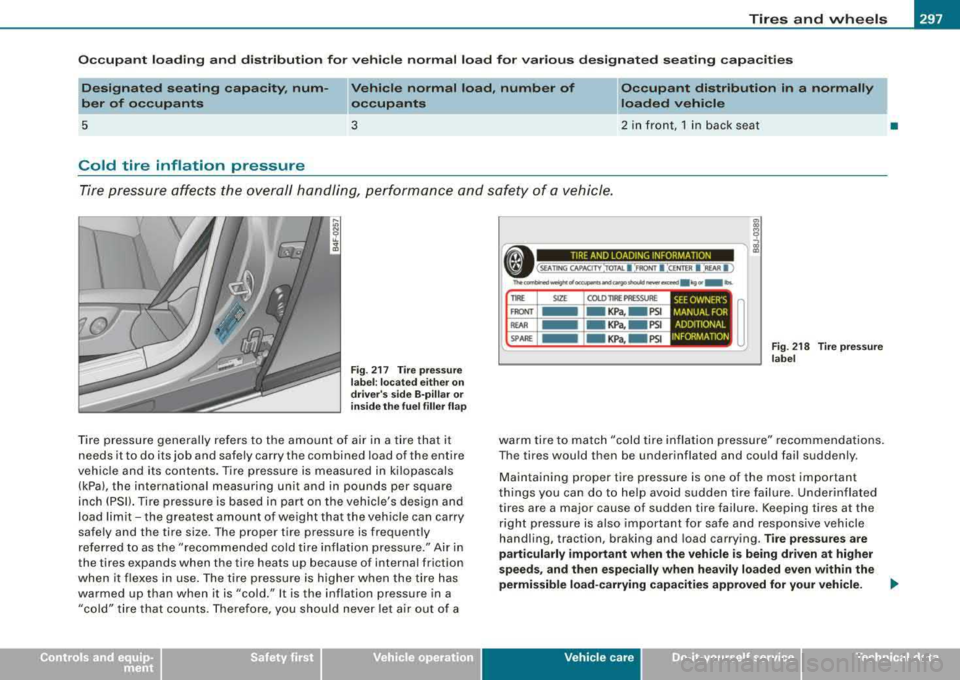
Fig . 21 7 Tire pre ssu re
label : located eit her on
driver's side B-pillar or
in side the fuel filler fl ap
ill
9 ,-, ~ ------------------.. j;l
• (SEATING CAPAQlY :rorAL I :FRONT I : cENTER I :REAR I ) m
Thea,mtwd""'9/Wdoocu,,.....andQ1Vo.....,.....,-,ed .logo, _ .,.
TIRE AND LOAD ING INFORMATION
TIRE SIZE COLO TIRE PRESSURE
FRONT -KPa, -PSI
REAR -KPa, - PSI
SPARE -KPa, -PSI
MANUAL FOR
INFORMATION SEE OWNER'S I
ADDITIONAL
Fig . 218 T ir e pr essu re
label
w arm tir e to matc h "cold t ire in flation press ure" recommenda tions .
The tires wou ld then be underinflated and cou ld fai l suddenly .
M aintaini ng proper t ire pressure is one of the most im po rta nt
thi ngs you ca n do t o help avo id sud den t ire fa ilu re. Underi nflated
tires are a major cause of sudden tire failure. Keeping tires at the
ri ght pressure is also importa nt for safe and r espo nsive ve hicle
handling, traction, braking and load carrying.
Tire pressures are
particularly important when the vehicle is being driven at higher
speed s, and then especially when heavily loaded even within the
•
T ire pressure generally refe rs to the amou nt of air in a t ire that it
needs it to do its job and safely carry the combined load of the entire
veh ic le and i ts c ontents. Tire p ressu re is measu red in kilopascals
(kPa), the international measuring unit and in pounds per square
inch (PSI) . Tir e p res su re is based in part on th e vehic le's design and
load lim it - the greatest amount of weight that the veh ic le can carry
safely and the tire size . The proper tire pressure is frequently
re ferred to as the "recommended cold t ire infla tion pressure." A ir in
the tires expands when the tire heats up because of internal friction
when it fl exe s i n us e. The tir e press ure is high er w he n th e t ire has
warmed up than when it is "cold." It is the inflation pressure in a "c old" tire that c ounts. Theref ore , yo u sho uld never le t air ou t of a
permissible load -carrying capacities approved for your vehicle. ...
Ve hic le care Technical data
Page 300 of 368
___ T_ ir_e _ s_ a_ n
_ d_ w_ h_ e_ e_ls _________________________________________________ _
The recommended tire pressures for your Audi depend on the kind
of tires on your vehicle and the number of passengers and/or
amount of luggage you will be transporting.
The tire pressure label located either on driver's side 8-pillar or
inside the fuel filler flap on your Audi lists the recommended cold
tire inflation pressures for the vehicle at its maximum capacity
weight and tires that were on your vehicle at the time it was manu
fac tured .
If you wish to improve comfort when operating the vehicle at
normal load (up to 3 occupants), you can adjust tire pressures to
those specified for normal vehicle load. Before operating the vehicle at maximum load, you must increase the tire pressures to those
specified for maximum vehicle load
~ & .
If your vehicle is equipped with a tire pressure monitoring system*,
bear in mind that the system can only monitor the tire pressures you have stored
. The system does not recognize the load condition of
your vehicle.
The effectiveness of the tire pressure monitoring system will be
impaired if you store normal load pressures but then operate the
vehicle at its maximum
load~& .
See the illustration~ page 297, fig . 217 for the location of the label
either on driver's side 8-pillar or inside the fuel filler flap (color of
the actual label and exact location on the vehicle will vary slightly).
Note that the following table is accurate at the time of going to
press and is subject to change . In the event of discrepancies, the tire
pressure label (e ither on driver's side 8 -pillar or inside the fuel filler
flap) always takes precedence.
The table below lists the recommended cold tire inflation pressures
for the Audi model covered by your Owner's Literature at the
vehicle's capacity weight and the tire si zes installed on the respec
tive models as original equipment, or as a factory option.
Engine Tire size designation Tire pressure front Tire pressure rear
(displace- normal load normal load
ment in condition (up to full load
condition (up full load
liter) condition
condition
3 occupants) to 3 occupants)
PSI kPA PSI kPA PSI kPA PSI kPA
4-cylinder 215/55 R16 93H All Season 35 240
36 250 35 240
36 250
2.0
235/45 R17 94H All Season 33 230 35 240 33 230 35 240
235/45 R17 94V High Performance 30 210
32 220 30 210
32 220
235/40 R18 95V XL High Performance 35 240 39 270 35 240 39 270
6-cylinder 215/55 R16 93H All Season 36 250 36 250 35 240 36 250
3.2
235/45 R17 94H All Season 35 240
35 240
33 230 35 240
235/45 R17 94V High Performance 30
210 32 220 30 210 32 220
235/40 R18 95V XL High Performance 38 260 42 290 38 260 42 290
XL = reinforced or extra load tire. It may also appear as xi, EXTRA LOAID, or RF on the tire sidewall.
Page 302 of 368
___ T_ ir_e _ s_ a_ n
_ d_ w_ h_ e_ e_ls _________________________________________________ _
The tire pressure label on your Audi lists the recommended cold tire
inf lation pressures for the new, original equipmen t tires that were
on your vehic le at the time it was manufactured . For the location of
the
labe l=> page 297, fig. 217 .
Most tires lose a ir natural ly over time. They can a lso lose some air if
you drive over a potho le or hit a curb wh ile parking. It is usually not
possible to see whether the radial t ires used today are under inflated
just by looking at them.
Therefore, be su re to check tire pressures at least once a month and
always before going on a long trip . Make sure to take the number of
people and the amount of luggage into account when adjusting tire
pressure for a trip -even one that you wou ld not cons ider to be
" long ."
See => page 301, "Tires and vehicle load limits" for more
important i nformation .
A lways use an accurat e tire pressure gaug e when checking and
adjusting inflat ion pressures. Check a ll of the tires and be sure not
to forget the spare tire . If the pressure in any tire is too high when
the t ire is "cold," let air o ut of the t ire slowly with the edge of the tire
gauge and keep check ing the pressure until you reach the pressure
that is correct for the load (passengers and luggage) and kind of
driving you p lan to do .
I f the pressure in any tire is too low, note the difference between the
pressure in the co ld tire and the pressure you need and add the air
that you need to reach the correct pressure for the vehicle load
(passengers and luggage) fo r the t ires on your veh ic le as listed on
the on your vehicle and in this manual and the kind of driving you pl an to do .
Never exceed the m aximum inflation pressure li sted on the tire
s idewall for an y re ason .
Remem ber that the vehic le manufacturer, not t he tire manufacturer,
determines the correct tire pressure for the tires on your vehicle .
I t is important to check the tire pressure when the tires are cold.
• Read the required tire pressure from the t ire pressure label
located either on driver 's side B -pillar or inside the fuel fi ller flap . •
Turn the va lve stem cap counter -clockwise to remove it from the
t ire valve .
• Place the air pressure gauge on the valve.
• The tire pressures should only be checked and adjusted when
the tires are cold. The s lightly raised pressures of warm tires must
not be reduced.
• Adjust the tire pressure to the load you are carrying.
• Reinstal l the va lve stem cap on the valve .
When should I check the tire pressure?
The correct tire pressure is especially important at high spe eds . The
pressure should the refore be checked at least once a mo nth and
a lways before starting a journey. Do not forget to check the tire pres
sure for the spare whee l
=> page 317.
Wh en should I adjust th e tir e pre ssur es?
Adjust t he tire pressure to the load you are carry ing . After changing
a wheel
o r replacing whee ls you have to ad just the tire pressures on
a ll whee ls . In addition, on vehicles w ith tire pressure monito ring
system* you must then store the new tire pressures in the system
=> page 45.
& WARNING
Incorrect tire pre ssure s and /or underinflation can lead sudden tire
f ai lure , loss of control , collision , seri ous per sonal injury or even
death.
• When the w arning symbol
(l) appe ars in the in strument
clu ster , stop and inspect the tire s.
• Incorrect t ire pres sure and /or underinflat ion can cause
increa sed tire wear and can affect the handling of the vehicle and
s topping ability.
• Incorrect tire pres sures and /or underinflation can also lead to
s udden tire fa ilure , inc luding a blowout and sudden defl ation ,
cau sing los s of vehicle control .
~
Page 303 of 368
________________________________________________ T_ i
_ r_e _s_ a_n_ d_ w_ h_ e_e _ l_s __ l'III
& W ARNING (continued )
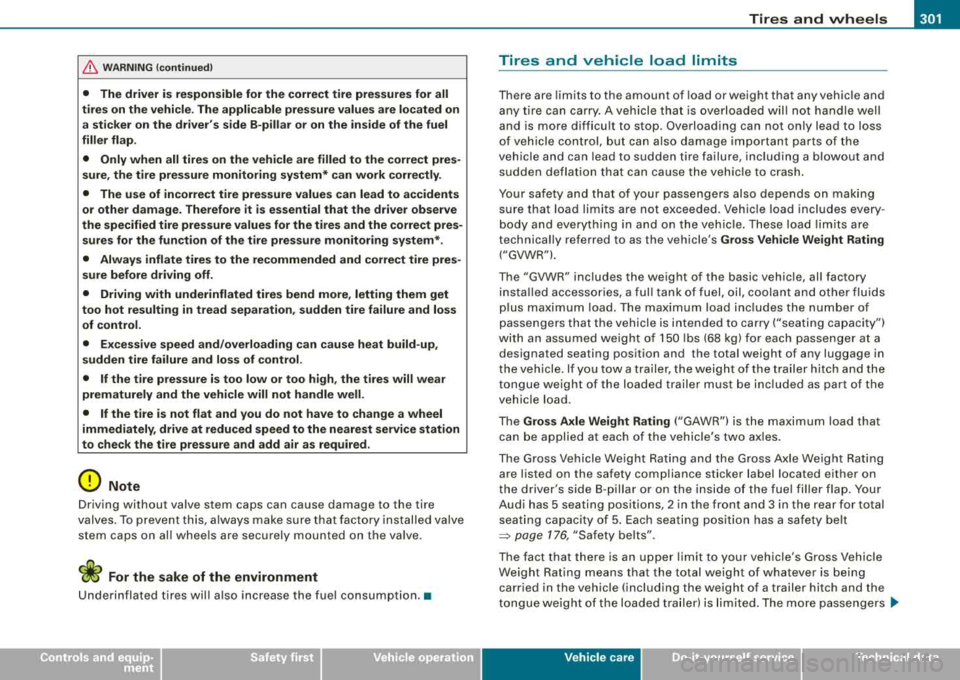
• The driver is respon sible for the correct tire pre ssure s for all
tire s on the vehicle. The applicable pressure values are located on
a st icker on the driver 's side B-pillar or on the inside of the fuel
filler flap.
• Only when all tire s on the vehicle are filled to the correct pres
sure , the tire pressure monitoring system * can work correctly .
• The use of incorrect tire pressure values can lead to accidents
or other damage. Therefore it is essential that the driver observe
the specified tire pressure values for the tires and the correct pres
sures for the function of the tire pressure monitoring system*.
• Always inflate tires to the recommended and correct tire pres
sure before driving off.
• Driving with underinflated tires bend more , letting them get
too hot resulting in tread separation , sudden tire failure and loss
of control.
• Ex cessive speed and /overloading can cause heat build -up ,
sudden tire failure and loss of control .
• If the tire pressure is too low or too high, the tires will wear
prematurely and the vehicle will not handle well.
• If the tire is not flat and you do not have to change a wheel
immediately, drive at reduced speed to the nearest service station
to che ck the tire pressure and add air as required .
0 Note
Driving without valve stem caps can cause damage to the tire
valves. To preve nt th is, a lways make s ure th at f acto ry installed va lve
stem caps on al l whee ls are securely mounted on the va lve .
~ For the sake of the environment
Underinflated tires will a lso increase the fuel consumpt io n. •
Tires and vehicle load limits
There are limits to the amount of load or weight t hat any vehic le and
any tire can carry . A ve hicle that i s ove rloa ded will not handle well
and is more d iff icu lt to stop . Overload ing can not only lead to loss
o f vehi cle control, but can also damag e impor tan t p arts o f the
vehic le and can lead to sudden tire failure, including a blowout and
sudde n defla tion that ca n cause the veh ic le to c ra sh .
Your sa fety a nd t hat o f your passe ngers a lso depe nds o n maki ng
s u re that load li mits are not exceeded. Vehic le load incl udes every
b ody and everythi ng i n and on t he vehicle . T he se l oa d limi ts are
technical ly referred to as the ve hic le's
Gross Vehicle Weight Rating
("GVW R"l.
T he "GVWR" includes the wei ght of the basic vehic le, all factory
in sta lled acces so ries, a full t an k of f uel, o il, c oolant a nd oth e r flu ids
p lus max imum load . T he maximum load inc ludes th e number o f
p asse ngers tha t th e ve hicle i s intended t o carry ("seat ing ca paci ty")
with an assu med weight o f 150 l bs (68 kg) fo r each passe nger at a
designated seating position and the total weight of any luggage in
th e v ehic le. I f you tow a trai ler, the we ig ht o f the tra iler hitch a nd th e
tongue weight of the loaded trailer must be inc luded as part of the
ve hicle lo ad .
The
Gross Axle Weight Rating ("GAWR") is t he maximum load that
ca n b e app lie d at eac h of th e veh icle's two axle s.
T he G ross Ve hicle We ight Rati ng a nd th e G ross A xle Wei ght R ati ng
are listed on the safety comp liance stic ker label located either on
t he driver 's si de B-pi lla r o r on the in sid e of t he fue l fille r fl ap. You r
Aud i has 5 seating posit ions, 2 in the front and 3 in the rear for total
sea ting ca paci ty of 5. Each sea ting p osit ion has a safe ty b elt
=> page 176, "Saf ety be lts" .
The fact that there is an upper limit to your vehicle's Gro ss Vehicle
W eight Rat ing m eans that th e total weight o f whatever is b ein g
carried in the vehic le (including the weight of a traile r hitc h and the
ton gue we ight of the loaded tr aile r) is lim it e d. Th e m or e passe ng ers
~
Vehicle care
Page 308 of 368
___ T_ ir_e_ s_ a_ n
_ d_ w_ h_ e_ e_l_
s _________________________________________________ _
R ep laci ng tires a nd whee ls
T ires shou ld be replaced at least in pairs and not ind ividually (for
examp le bo th front tires or both rear tires together!.
On v ehicles with tire pressure monitoring system *, be sure to read
and heed the informat ion
=> page 307.
A lways buy rep lacement radia l tires that have the same sp ecifica
t ions as the tires approved for your veh ic le by Aud i. Replacement
tires must always have the same load rating specification as the
orig ina l equipment or approved optional t ires listed in the table
=> page 297.
Audi -approved specification tires are specially matched to your
vehic le and its load limits, and can contribute to the important road
holding, driving characteristics, and safety of the vehicle . The table
(=> page 297) lists specifications of the tires approved for the Audi
models covered by your Owner's Literature .
The tire pressure labe l located either on driver 's side 8 -pi llar or
inside the fuel fi ller
flap(=> page 297, fig. 218) lists the specifica
tions of the origina l equipment tires installed on your vehicle at the
time it was manufactured .
Federa l law requires tire manufacturers to place standardized infor
mation on the s idewall of all
tires => page 305, fig. 221 . This informa
tion identifies and describes the fundamental characteristics, the quality grade of the tire and a lso provides a tire identification
number for safety standard certification and in case of a recall.
Tir e specificat ions
Knowledge of tire specifications makes it easier to choose the
correct tires . Ra dial t ires have the tire specifications marked o n the
sidewall, for example :
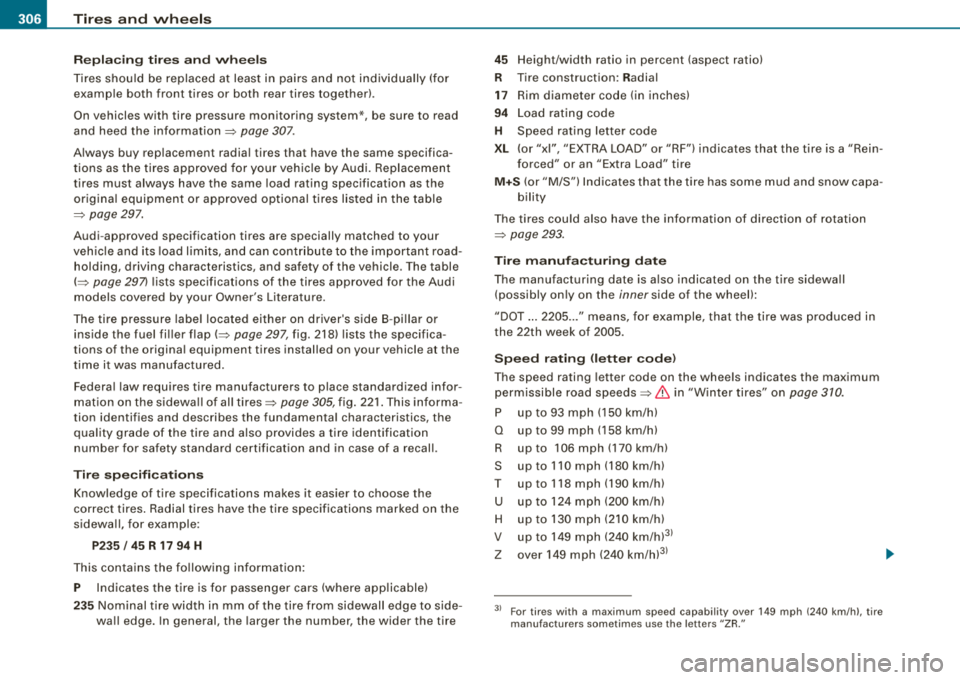
P235 / 45 R 1 7 94 H
This contains the following informat ion:
P Indicates the tire is for passenger cars (where app licable)
2 35 No minal t ire wid th i n mm of the tire fro m sidewall edge to side
wall edge. In general, the larger the number, the wider the tire
45 Height/width ratio in percent (aspect ratio)
R Tire construction: Radial
17 Rim diameter code (in inches)
94 Load rat ing code
H Speed rating letter code
X L (or "xi", "EXTRA LOAD" or "RF") indicates that the t ire is a "Rein
forced" or an "Extra Load" ti re
M +S (or "M/S") Ind icates that the tire has some mud and snow capa -
bility
The tires cou ld also have the information of direction of rotation
=> page 293.
Tire m anuf acturing date
The manufacturing date is a lso indicated on the tire sidewall
(possibly on ly on the
inner side of the wheel):
"DOT ... 2205 . ..
" means, for example, that the tire was produced in
the 22th week of 2005.
S peed r ating (le tt e r code )
The speed rating letter code on the whee ls indicates the maximum
permissible road
speeds => & in "W inter tires" on page 310 .
p up to 93 mph ( 150 km/h)
Q up to 99 mph (158 km/h)
R up to 106 mph (170 km/h)
s up to 110 mph (180 km/h)
T up to 118 mph (190 km/h)
u up to 124 mph (200 km/h)
H up to 130 mph (210 km/
h)
V up to 149 mph (240 km/h)3
l
z over 149 mph (240 km/h)31
3> For tires w ith a maximum speed capabi lity over 149 mph (240 km/h) , tire
manufacturers sometimes use the letters " ZR."
Page 313 of 368
Tires and wheels 1111
----------------
W For the sake of the environment
Use summer tires when weather conditions permit. They are
quieter, do not wear as quickly and reduce fuel consumption. •
Snow chains
Snow chains may be fitted only to the front wheels, and only to
certain tire sizes. Ask your authorized Audi dealer on which tire
sizes snow chains can be used.
If you are going to use snow chains, then you must install them on
the front wheels at least.
The snow chains must have low-profile links and must not be thicker
than 0.53 inch (13.5 mm), including the lock.
Remove wheel center covers and trim discs before putting snow
chains on your
vehicle => 0. For safety reasons cover caps must
then be fitted over the wheel bolts. These are available from autho
rized Audi dealers.
& WARNING
Using the wrong snow chains for your vehicle or installing them
incorrectly can increase the risk of loss of control leading to
serious personal injury.
• Snow chains are available in different sizes. Always make sure
to follow the instructions provided by the snow chain manufac
turer.
• When driving with snow chains never drive faster than the
speed permitted for your specific snow chains.
• Always observe local regulations .
0 Note
• Remove snow chains before driving on roads not covered with
snow to avoid damaging tires and wearing the snow chains down
u n necessarily.
• Snow chains, which come into direct contact with the wheel rim,
can scratch or damage it . Therefore, make sure that the snow chains
are suitably covered.
[ i] Tips
Where snow chains are mandatory on certain roads, this normally
also applies to vehicles with All Wheel Drive. •
Wheel bolts
Wheel bolts must always be tightened to the correct
torque.
The design of wheel bolts is matched to the factory installed rims. If
different rims are fitted, the correct wheel bolts with the right length
and correctly shaped bolt heads must be used. This ensures that
wheels are fitted securely and that the brake system functions
correctly.
In certain circumstances, you may not use wheel bolts from a
different vehicle -even if it is the same
model => page 348.
& WARNING
Improperly tightened or maintained wheel bolts can become loose
causing loss of control, a collision and serious personal injury.
• Always keep the wheel bolts and the threads in the wheel hubs
clean so the wheel bolts can turn easily and be properly tightened .
• Never grease or oil the wheel bolts and the threads in the wheel
hubs. They can become loose while driving if greased or oiled,
even if tightened to the specified torque.
.,_
Vehicle care
Page 343 of 368

_________________________________________________ G_ e_ n_ e_r _a _l_ i_n _f_o _ r_ m_ a_ t
_ i
_ o _ n
__ __
T he sa fe ty co mplia nce s ticke r
is your assurance t hat your new vehicle complies with a ll applicable
Federa l Motor Vehic le Safety Standards which were in effect at the
t ime the veh ic le was manufactured . You can find t his st icker on the
left door jamb. It shows the mon th and year of production and the
vehic le identification number of your vehic le (perforation) as well as
the Gross Veh icle Weight Rating (GVWR) and the Gross Axle Weight
Rating (GAWRl.
Th e high volt ag e wa rning la bel
is located on the lock carrier .
The spark ignition syste m mee ts all requirement s of the Canadi an
Interf ere nc e-C au si ng Equipm ent Regulati ons. •
Weights
Gross Veh icle Weight R ating
The G ross Veh ic le Weight Rat ing (GVWR), and the Gross Ax le Weight
Rating (GAWR) for front and rear are listed on a sticker on the left
door jamb .
The Gross Vehicle Weight Rating includes the we ight of the basic
vehic le plus fu ll fuel tank, oil and coolant, plus maximum load,
whic h inc ludes passenger weight ( 150 lbs/68 kg per designated
seating position) and luggage weight.
Gr oss Axle Weight Ra ting
The Gross Ax le Weight Rating is the maximum load that can be
app lied at each axle of the
veh ic le =:> & .
Vehicl e cap acit y w eight
The vehicle capacity weight (max. load) is listed either on the
driver's side 8 -pillar or inside the fuel fi ller f lap .
Controls and equip
ment Safety first Vehicle operation
Roof
weight
The maximum permissible roof we ight is
165 lb (75 kg ). The roof
weight is made up of the weight of the roof rack system and the
weight of the object being
transported =:> page 117, "L oading the
roof rack".
LJ}. WARNING
• The actual Gr oss Axle Weight R atin g at the front and re ar ax les
s hould not ex ceed the permi ssible w eight s, and th eir combination
mu st not e xceed the Gr oss Vehicle Weight R atin g.
• Exceeding pe rmi ssible weight ratin gs can re sult in vehicle
d am age , acc ident s and per son al inju ry.
0 Note
• The vehicle capacity weight figures apply when the load is
distr ibuted even ly in t he ve hicle (passengers and l uggage). When
transporting a heavy load in the luggage compartment, carry the
load as near to the rear axle as possib le so that the vehic le's
handling is not impaired .
• Do not exceed the maxim um permissib le axle loads or the
maximum gross vehic le weight. Always remember that the vehic le's
handling wi ll be affected by the extra load . Therefore, adjust your
speed according ly.
• Always observe local reg ulations. •
Dimensions
The specifications refer to the basic mode l. Differences may occur
depending on the mode l type and options ordered, for example, tire
sizes.
..,
Vehicle care Do-it-yourself service Technical data
Page 345 of 368
_____________________________________________________ D_a_ t_ a _ ___.11111
Data
Ap plies to vehicles : w ith 2 .0 lite r 4-cyl. engine
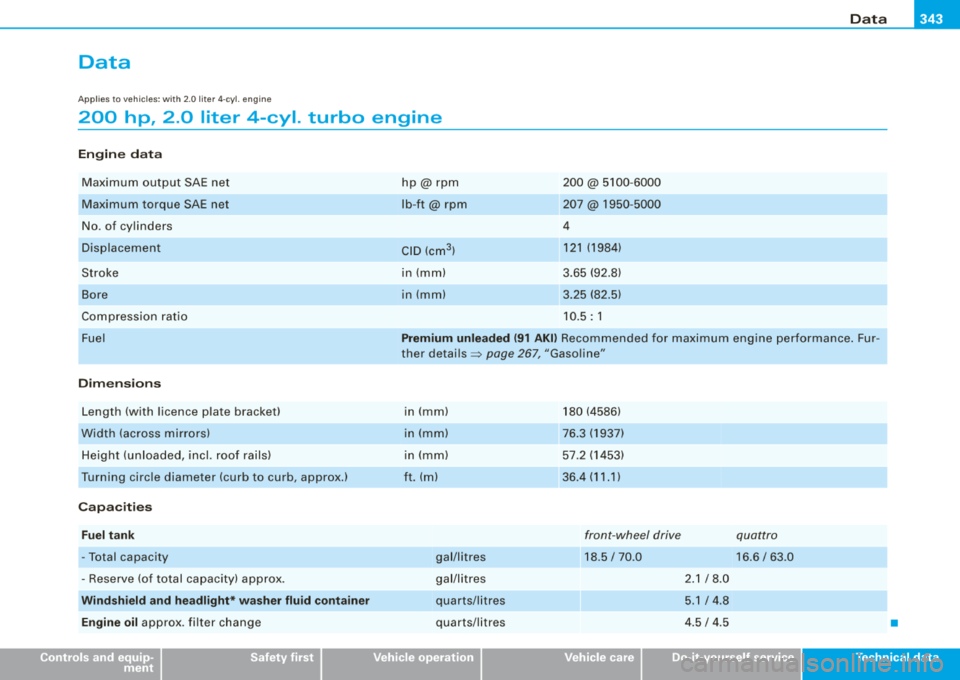
200 hp, 2.0 liter 4-cyl. turbo engine
En gin e da ta
Maximum output SAE net
Maximum torque SAE net
No . of cy linders
Displacement
Stroke Bore
Compression rat io
Fuel
Dim ensio ns
Length (with licence plate bracket)
Width (across mirrors)
Height (unloaded, incl. roof rails)
T urning circle diameter (curb to curb,
approx.!
Ca pac itie s
F u el t ank
-Total capacity
- Reserve (of total capacity) approx.
Wind shield and headlight * w as her fluid contain er
Engine oil
approx. fi lter change
Controls and equip
ment Safety first
hp@ rpm
lb-ft@ rpm
C ID (cm
3l
in (mm)
in (mm)
200 @ 51 00 -6000
207
@ 1950 -5000
4
121 (1984)
3.65 (92.8) 3.25 (82.5) 10.5: 1
Pr emium unle aded (91 AKI) Recommended for maximum engine performance. Fur
ther
details=> page 267, "Gasoline"
in (mm)
in (mm)
i n ( mm)
ft. (ml
gal/litres
ga l/litres
quarts/I it res
quarts/I it res
180 (4586)
76.3 (1937)
57 .2 (1453)
36.4 (11.1
l
front-wheel drive
18.5 / 70.0
2.1 / 8.0
5.1 / 4.8
4.5 / 4.5
quattro
16.6 / 63.0
•
Vehicle operation Vehicle care Do-it-yourself service Technical data
Page 346 of 368
llffl __ D_ a_ ta ______________________________________________________ _
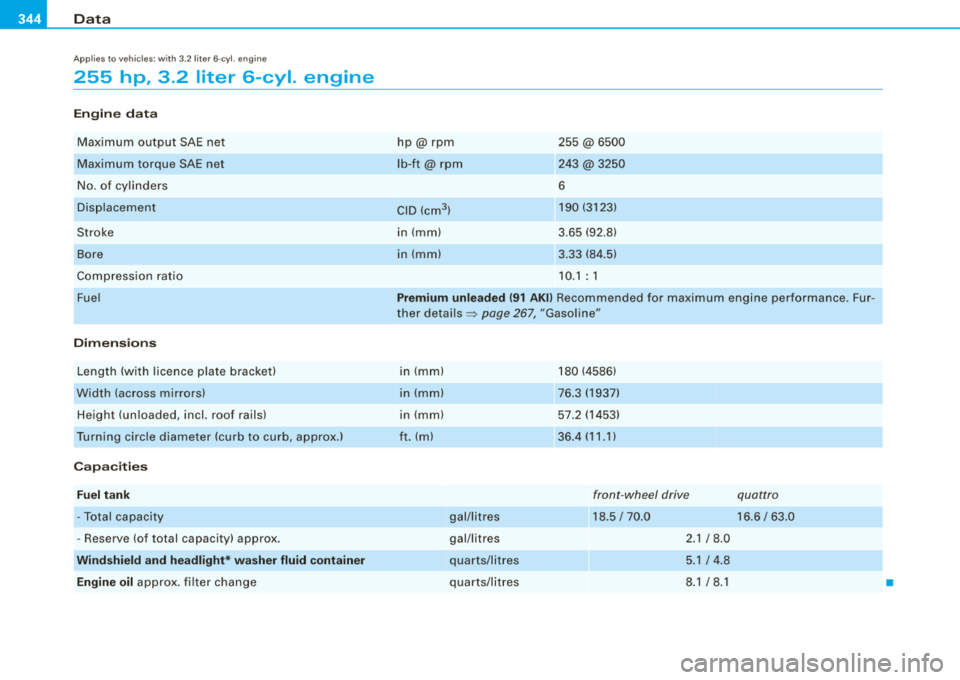
Applies to vehi cles: with 3 .2 liter 6-c yl. engine
255 hp, 3.2 liter 6-cyl. engine
En gin e data
Maximum output SAE net
Maximum torque SAE net
No. of cylinders
Disp lacement
Stroke
Bore
Compress ion ratio
Fuel
Dim ension s
Length (with licence plate bracket)
Width (across mirrors) Height (un loaded, incl. roof rails)
Turning circle diameter (curb to curb, approx .)
Ca pac ities
Fuel tan k
-Total capacity
-Reserve (of total capacity) approx.
Windshield and headlight* wa sher fluid container
Engine oil
approx. fi lter change hp@rpm
lb-ft@ rpm
CID (cm
3l
in (mm)
in (mm) 255@ 6500
243 @3250
6
190 (3123)
3 .65 (92 .8)
3 .33 (84 .5)
10.1 : 1
P remium unle aded (91 AKI) Recommended for maximum engine performance . Fur
t her
details~ page 267, "Gasoline"
in (mm)
in (mm)
in (mm)
ft . (ml
gal/litres
gal/litres
quarts/litres
quarts/litres 1
80 (4586)
76.3 (1937)
57.2 ( 1453)
36 .4 ( 11 .1 l
front -wheel drive
18.5 / 70 .0
2.1 / 8 .0
5 .1 / 4.8
8 .1 / 8 .1 quattro
16.6 / 63 .0
•