tire size AUDI A4 AVANT 2008 User Guide
[x] Cancel search | Manufacturer: AUDI, Model Year: 2008, Model line: A4 AVANT, Model: AUDI A4 AVANT 2008Pages: 368, PDF Size: 46.19 MB
Page 314 of 368
-
Tires and wheels
----------------
&, WARNING (continued )
• Only u se wheel bolts that belong to the rim being installed.
• Never use different wheels bolt s on your vehi cle .
• Alway s maintain the correct tightening torque for the wheel
bolts to reduce the risk of a wheel los s.
If the tightening torque of
the wheel bolts is too low , they can loosen and come out when the
vehi cle is moving. If the tightening torque is too high , the wheel
bolts and threads can be damaged and the wheel can become
loose .
0 Note
The specified torque for the wheel bolts is 90 ft lb (12 0 Nm) with a
tolerance of± 7,4 ft lb(± 10 Nm). Torque whee l bolts diagonally.
After changing a wheel, the torque must be c hecked as soon as
possible with a torque wrench -preferably by an authorized Audi
d ea ler or qua lifi ed works hop.•
Low aspect ratio tires
Your Aud i is factory -equipped with low aspect ratio tires . T hese tires
have been thorough ly tested and been selected specifical ly for your
mod el for t he ir superb perf or mance, r oad feel and ha ndling u nder
a variety of driving conditions . Ask your authorized Audi dealer for
mo re deta ils.
The low aspect ratio of these tires is indicated by a numeral of
55 or
less
i n the ti re's size designatio n. The numeral rep resents the ra tio
of the t ire's sidewa ll height in relation to its tread width expressed
in percentage . Conventiona l tires have a height/width ratio of 60 or
m ore.
The performan ce of low -aspe ct-ratio tires is part icularly sensitive to
improper inflation pressure . It is therefore important that low
aspe ct ratio tires are inflated to the specified pressure and that the
inflation pressure i s regularly checked and maintained. Tire pres- sures should be checked at least once a month and always before a
long
trip => page 299, "C heck ing tire pre ssure" .
What you can do to avoid tire and rim damage
Low as pect r ati o ti res can be da maged more easi ly by impact w ith
potho les, curbs, gullies or ridges on the road, particularly if the tire
i s u nde rinfl ated.
I n order to min imize the occurrence of impact damage to the t ires
of your vehic le, we recommend that you observe the fo llowing
precautions :
• Always maintain recommended inflation pressures . Check your
t ire pr essu re every 2,000 miles (3,000 k m) a nd add air if necessary .
• Drive careful ly on roads with potholes, deep gu llies or ridges.
T he im pac t from driving t hroug h or ov er suc h ob stacl es ca n
damage your tires. Impact with a curb may also cause damage to
yo ur tir es .
• After any impact, immediately inspect your tires or have them
inspec te d by the neares t au thori ze d Aud i dealer. Replac e a
damaged tire as soon as possible.
• I nspect you r ti res eve ry 2,0 00 m iles (3,000 km) for damage and
wear. Damage is not always easy to see. Damage can lead to loss of
a ir a nd und eri nfl ation, whic h cou ld eve ntual ly ca use tire fa ilur e. If
you be lieve that a tire may have been damaged, rep lace the tire as
s o on as p ossi ble.
• T hese tires may wear more quickly than others .
• P lease a lso remember that, whi le these tires de liver respons iv e
handling, they may ride less comfortably and make more noise t han
other choices.
Reduced performance in winter /cold season
c onditions
A ll tir es a re desig ned f or certai n purposes. The low a spect rati o,
u ltra hi gh pe rf ormance t ires or igin a lly ins tal led on your ve hicle are
intended for maximum dry and wet road performance and handling .
Th ey a re not su itab le fo r co ld, snowy or ic y weat her co nd it io ns. If
~
Page 319 of 368
_____________________________________________ W_ h_ a_t _d_ o_l
_ d_o _ n_o_ w_ ? _ __,_
/b, WARNING (continued)
• Using a bumper jack to raise the vehicle will damage the
bumper system. The jack may slip, causing injury.
• Never support your vehicle on cinder blocks, bricks or other
objects. These may not be able to support the load and could
cause injury when they fail.
• Never start or run the engine while the vehicle is supported by
the jack.
• If you must work under the vehicle, always use safety stands
specifically designed for this purpose.
• Never try and use the hexagonal socket
in the handle of the
screwdriver to loosen or tighten the wheel bolts.
• Always make sure the spare tire and even a flat tire are secured
in place and not loose, otherwise they could fly forward, causing
personal injury to passengers in the vehicle in an accident or
sudden maneuver.
• Never use the jack supplied with your Audi on another vehicle,
particularly on a heavier one. The jack is only suitable for use on
the vehicle it came with.
•
Spare wheel
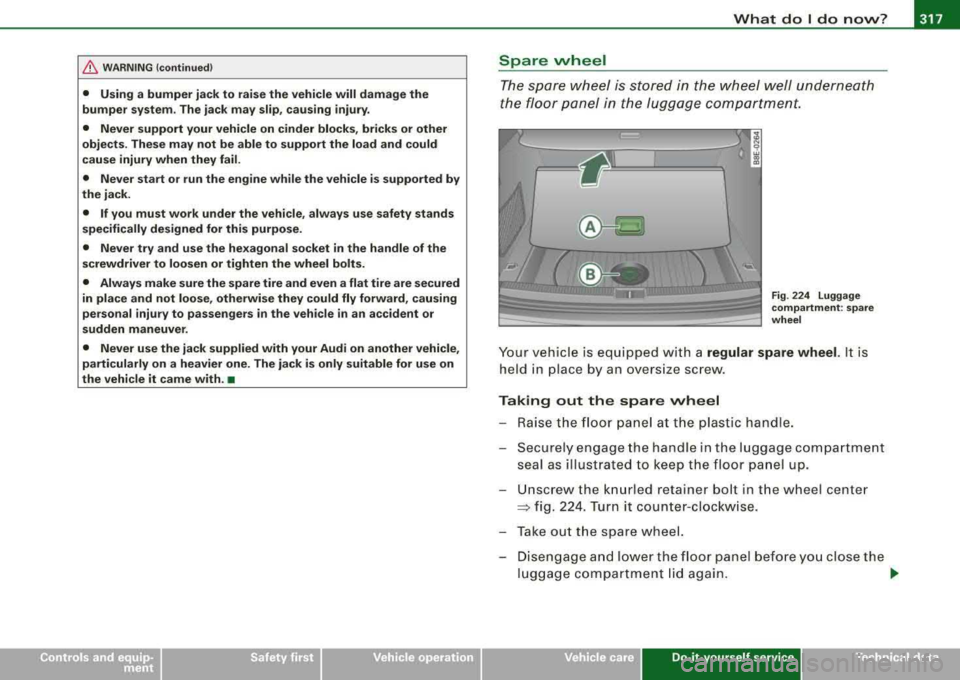
The spare wheel is stored in the wheel well underneath
the floor panel in the luggage compartment.
Fig. 224 Luggage
compartment : spare
wheel
Your vehicle is equipped with a regular spare wheel. It is
held in place by an oversize screw.
Taking out the spare wheel
- Raise the floor panel at the plastic handle.
- Securely engage the handle in the luggage compartment
seal as illustrated to keep the floor panel up.
- Unscrew the knurled retainer bolt in the wheel center
=> fig. 224. Turn it counter -clockwise .
- Take out the spare wheel.
- Disengage and lower the floor panel before you close the
luggage compartment lid again.
..,.
Do-it-yourse lf service irechnical data
Page 343 of 368

_________________________________________________ G_ e_ n_ e_r _a _l_ i_n _f_o _ r_ m_ a_ t
_ i
_ o _ n
__ __
T he sa fe ty co mplia nce s ticke r
is your assurance t hat your new vehicle complies with a ll applicable
Federa l Motor Vehic le Safety Standards which were in effect at the
t ime the veh ic le was manufactured . You can find t his st icker on the
left door jamb. It shows the mon th and year of production and the
vehic le identification number of your vehic le (perforation) as well as
the Gross Veh icle Weight Rating (GVWR) and the Gross Axle Weight
Rating (GAWRl.
Th e high volt ag e wa rning la bel
is located on the lock carrier .
The spark ignition syste m mee ts all requirement s of the Canadi an
Interf ere nc e-C au si ng Equipm ent Regulati ons. •
Weights
Gross Veh icle Weight R ating
The G ross Veh ic le Weight Rat ing (GVWR), and the Gross Ax le Weight
Rating (GAWR) for front and rear are listed on a sticker on the left
door jamb .
The Gross Vehicle Weight Rating includes the we ight of the basic
vehic le plus fu ll fuel tank, oil and coolant, plus maximum load,
whic h inc ludes passenger weight ( 150 lbs/68 kg per designated
seating position) and luggage weight.
Gr oss Axle Weight Ra ting
The Gross Ax le Weight Rating is the maximum load that can be
app lied at each axle of the
veh ic le =:> & .
Vehicl e cap acit y w eight
The vehicle capacity weight (max. load) is listed either on the
driver's side 8 -pillar or inside the fuel fi ller f lap .
Controls and equip
ment Safety first Vehicle operation
Roof
weight
The maximum permissible roof we ight is
165 lb (75 kg ). The roof
weight is made up of the weight of the roof rack system and the
weight of the object being
transported =:> page 117, "L oading the
roof rack".
LJ}. WARNING
• The actual Gr oss Axle Weight R atin g at the front and re ar ax les
s hould not ex ceed the permi ssible w eight s, and th eir combination
mu st not e xceed the Gr oss Vehicle Weight R atin g.
• Exceeding pe rmi ssible weight ratin gs can re sult in vehicle
d am age , acc ident s and per son al inju ry.
0 Note
• The vehicle capacity weight figures apply when the load is
distr ibuted even ly in t he ve hicle (passengers and l uggage). When
transporting a heavy load in the luggage compartment, carry the
load as near to the rear axle as possib le so that the vehic le's
handling is not impaired .
• Do not exceed the maxim um permissib le axle loads or the
maximum gross vehic le weight. Always remember that the vehic le's
handling wi ll be affected by the extra load . Therefore, adjust your
speed according ly.
• Always observe local reg ulations. •
Dimensions
The specifications refer to the basic mode l. Differences may occur
depending on the mode l type and options ordered, for example, tire
sizes.
..,
Vehicle care Do-it-yourself service Technical data