battery AUDI A4 AVANT 2008 Owner's Manual
[x] Cancel search | Manufacturer: AUDI, Model Year: 2008, Model line: A4 AVANT, Model: AUDI A4 AVANT 2008Pages: 368, PDF Size: 46.19 MB
Page 277 of 368
Checking and filling -
------------ ----=---a::;;._...a
©
©
(i)
Coolant expansion tank ( ... L) ...... ... .. ..... .. ... .
Windshield/headlight washer container
( 0 ) ...... . .
Power steering reservoir (green cap)
& WARNING
Before you check anything in the engine compartment, always
read and heed all WARNINGS
=> & in "Working in the engine
compartment" on
page 273. •
Applies to vehicles: with 6 -cy lin d er engine
3.2 liter , 6-cylinder engine (255 hp)
281
291
241
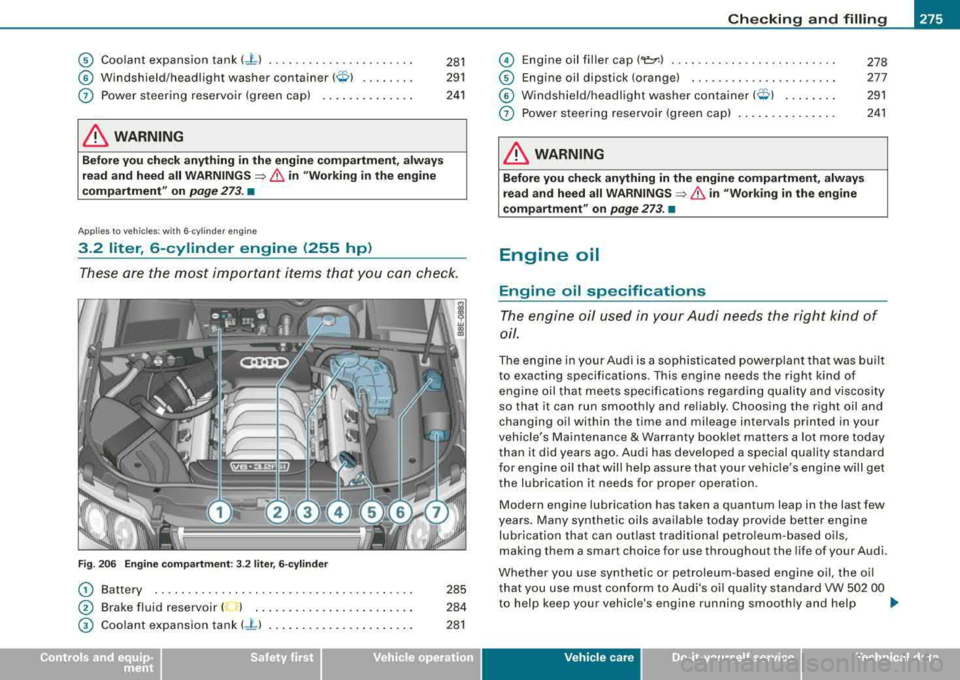
These are the most important items that you can check.
Fig . 206 Engine compartment: 3 .2 liter , 6-cylinder
CD
0
©
Battery .. ............... ... .. ...... .... ...... .
Brake fluid reservoir (
... ) . .. ... ... .... .... ...... .
Coo lant expansion tank
(J _)
285
284
281
©
©
©
(i)
Engine oil filler cap (
Windshield/headlight washer container
( O ) ... .... .
Power steering reservoir (green cap)
& WARNING
Before you check anything in the engine compartment , always
read and heed all WARNINGS
=> & in "Working in the engine
compartment" on
page 273. •
Engine oil
Engine oil specifications
278
277
291
241
The engine oil used in your Audi needs the right kind of
oil.
The engine in your Audi is a sophisticated powerplant that was built
to exacting specifications . This engine needs the right kind of
engine oil that meets specifications regarding quality and viscosity
so that it can run smoothly and re liably . Choosing the right oil and
changing oil within the time and mileage intervals printed in your
vehicle's Maintenance
& Warranty booklet matters a lot more today
than it did years ago. Audi has developed a special quality standard
f or engine oil that wil l help assure that your vehicle's engine wi ll get
the lubrication it needs for proper operation .
Modern engine lubrication has taken a quantum leap in the last few
years. Many synthetic oils available today provide better engine
lubrication that can outlast traditional petroleum-based oils,
making them a smart choice for use throughout the life of your Audi .
Whether you use synthetic or petroleum -based engine oil, the oil
that you use must conform to Audi's oi l quality standard VW 502 00
to help keep your vehicle 's engine running smoothly and help
.,_
Ve hic le care Technical data
Page 287 of 368
___________________________________________ C_ h_e _c_ k_ i_n ~g _ a_n _d_ f_il _li _n ~g __ _
& WARNING (continued)
-The brake fluid must be new. Heavy use of the brakes can
cause a vapor lock if the brake fluid is left in the system too
long. This can seriously affect the efficiency of the brakes as
well as your safety. This could result in an accident.
0 Note
Brake fluid will damage the paint of your vehicle.
W For the sake of the environment
Because of the problem of proper disposal of brake fluid as well as
the special tools required and the necessary expertise, we recom
mend that you have the brake fluid changed by your authorized Audi
dealer. •
Battery
General information
Under normal operating conditions, the battery in your Audi does
not need any maintenance. With
high outside temperatures it is
advisable however to check the fluid level at regular intervals
through the transparent battery housing. Also check the fluid level
each time you charge the battery. After charging the battery
~ page 289, you should likewise check the battery acid level.
Have the battery checked when you take your vehicle in for service.
You are well advised to replace a battery that is older than 5 years.
Preserving battery charge on a vehicle not operated
for a long time
Some components of the electrical equipment (for example, the
electronic immobilizer) will keep drawing a low current even when the car is
not running
. This will eventually drain the battery
completely if your vehicle is left sitting for a long period of time
without being driven . To prevent this, either charge the battery
occasionally or disconnect the battery negative (ground) cable.
Winter operation
During the winter months, battery capacity tends to decrease as
temperatures drop . This is because more power is also consumed
while starting, and the headlights, rear window defogger, etc., are
used more often.
Avoid unnecessary power consumpt ion, particularly in city traff ic or
when traveling only short distances. Let your authorized Audi dealer
check the capacity of the vehicle battery before winter sets in
~ page 289. A well charged battery will not only prevent starting
problems when the weather is cold, but will also last longer.
[ i] Tips
If your vehicle is left standing for several weeks at extremely low
temperatures, the vehicle battery should be removed and stored
where it will not freeze. This will prevent it from being damaged and
having to be replaced. •
Location of the vehicle battery
The vehicle battery is located in the plenum chamber at the back of
the engine
compartment~ page 275.
The positive(+) battery terminal is protected by a plastic cover. This cover must be removed to access to the positive(+) terminal when
connecting jumper cables to start the engine .
& WARNING
Before you check anything in the engine compartment, always
read and heed all WARNINGS
~ & in "Working in the engine
compartment" on
page 273. •
Vehicle care
Page 288 of 368
ffl...__C_ h_ e_c _k _ i_n ..::g ,_ a_n_ d_ f_il _li _n....: g==-- --------------------------------------------
Working on the battery
Be es pecia lly car efu l w he n work ing on or n ear t he battery .
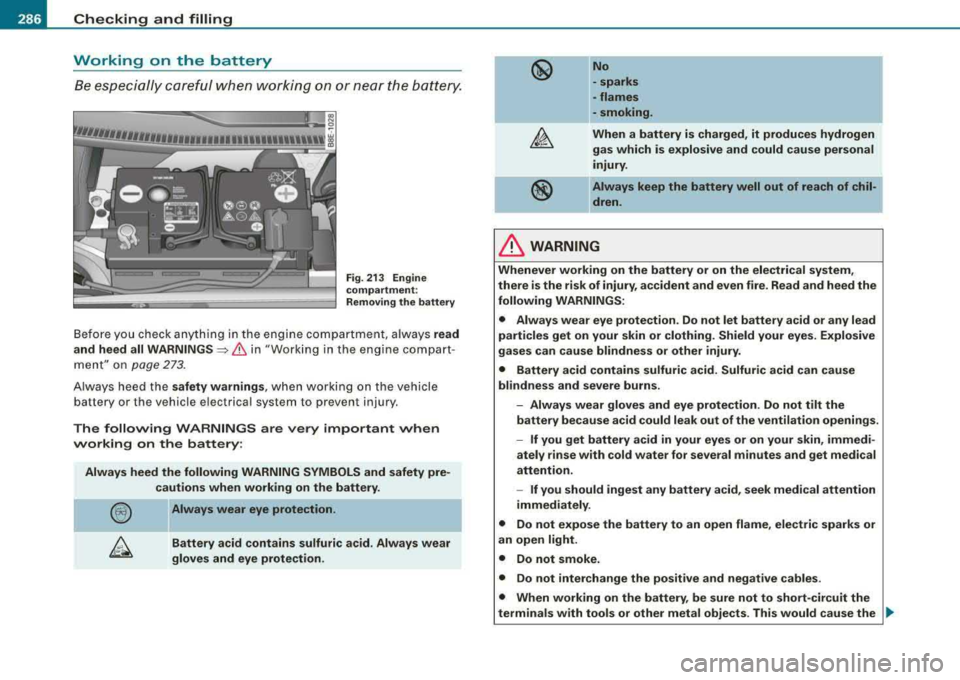
Fig. 213 Engine
compartment :
Removing the battery
Befo re you chec k anythi ng in the e ngine c ompart me nt, al ways read
and heed all
WARNINGS ~ & in " Working in the e ngine compa rt
m ent " o n page
273 .
Alw ays heed the safety warnings , when w orki ng on the v ehicle
batte ry or the vehicle e lectrica l system to preve nt inju ry.
The following WARNINGS are very important when
working on the battery:
Always heed the following WARNING SYMBOLS and safety pre cautions when working on the battery .
Always wear eye protection .
Battery acid contains sulfuric acid . Always wear
gloves and eye protection .
@
No
-sparks
- flames
- smoking .
When a battery is charged , it produces hydrogen
gas which is explosive and could cause personal
injury .
Always keep the ba ttery well ou t of reach of chi l
dren .
& WARNING
Whenever working on the battery or on the electrical system,
there is the risk of injury, accident and even fire . Read and heed the
following WARNINGS:
• Always wear eye protection . Do not let battery acid or any lead
particles get on your skin or clothing. Shield your eyes . Explosive
gases can cause blindness or other injury .
• Battery acid contains sulfuric acid. Sulfuric acid can cause
blindness and severe burns .
- Always wear gloves and eye protection. Do not tilt the battery because acid could leak out of the ventilation openings .
- If you get battery acid in your eyes or on your skin , immedi
ately rinse with cold water for several minutes and get medical
attention.
- If you should ingest any battery acid, seek medical attention
immediately.
• Do not expose the battery to an open flame , electric sparks or
an open light.
• Do not smoke.
• Do not interchange the positive and negative cables .
• When working on the battery , be sure not to short -circuit the
term inals with tools or other metal objects . This would cause the
IJJ>
Page 289 of 368

Checking and filling 111111
--------------------------------------------=-----=--------
& WARNING (continued )
battery to heat up very quickly , whi ch could le ad to damage or
explosion and personal injury .
• When a battery is charged , it produces hydrogen gas whi ch is
explosive and could cause personal injury .
• Always keep the battery well out of the reach of children .
• Before work is done on the electrical system , disconnect the
negative ground cable .
• Before performing any work on the electri cal system , switch off
the engine and ignition as well as any electrical equipment. The negative cable on the battery must be disconnected. If you are just
going to replace a light bulb , then it is enough to switch off the
lights.
• Before disconnecting the battery, switch off the anti -theft
alarm system! Otherwise you will set off the alarm .
• When disconnecting the battery , fir st di sconnect the negative
c able and then the positive cable .
• Before reconnecting the battery, make sure all electrical
consumers are switched off . Reconnect the positive cable first and
then the negative cable. Never interchange the cables -this could
start a fire!
• Never charge a frozen or a thawed -out battery . It could
explode! If a battery has frozen, then it must be replaced . A
discharged battery can freeze over at 32 °F (0 °Cl.
• Make sure the vent hose is always attached to the opening on
the side of the battery.
• Never use batteries which are damaged . There is the danger of
an explosion! Always replace a damaged battery.
in. WARNING
California Proposition 65 Warning :
• I I • • I
& WARNING (continued )
• Battery posts , terminals and related accessories contain lead
and lead compounds , chemicals known to the State of California
to cause cancer and reproductive problems . Wash hands after
handling.
0 Note
• Do not d isconnect th e ve hicle bat tery w hen t he ig ni tio n i s
switched on or when the engine is running , otherwise, you will
da mage e lec troni c c om pon ent s in the e lec trica l syste m.
• When working on the engine, protect t he battery housing from
u ltraviolet (UV) rays by not pa rking the ve hicle i n direct sun lig ht.
• If your vehicle is going to stand fo r a long period of time wit hout
being driven, pro tect the battery from "freezing", ot herwise it w ill
be damaged and wi ll then have to be replaced .•
Vehicle care
Page 290 of 368
IIIII...__C_ h_ e_c _k_ i_n ..::g ,_ a_n_ d_ f_il _li _n....: g==-- --------------------------------------------
Ap plies to vehi cles: with ma gic e ye batte ries
Checking the battery acid level on magic eye
batter ies
The battery acid level in the battery can be checked
through the clear inspection window.
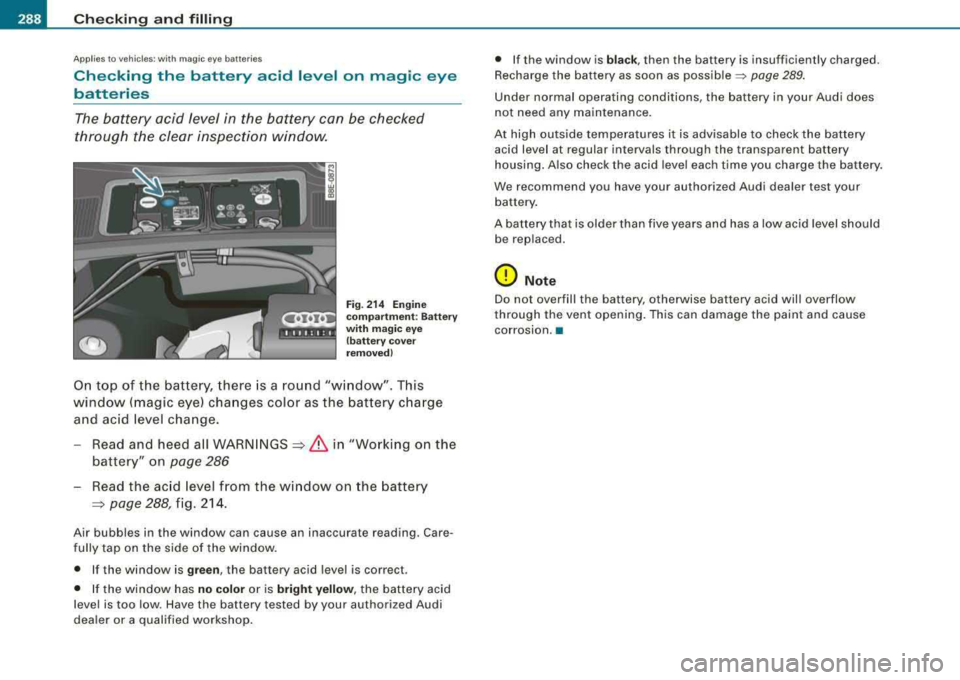
F ig . 2 14 En gin e
co mpa rtme nt: B atte ry
w it h m agic eye
(battery cov er
r e m ove d)
On top of the battery, there is a round "window" . This
window (m agic eye) changes color as the battery cha rge
and acid level change .
- Read and heed all
WARN INGS=> & in "Working on the
battery" on
page 286
- Read the ac id level from the window on the battery
=> page 288, fig. 214.
Air bubbles in the window can cause an inaccurate reading . Care
ful ly tap on the side of the window .
• If the window is
gre e n, the battery acid level is correct .
• I f the window has
no c olor or is bright y ello w, the battery acid
level is too low . Have the battery tested by your authori zed Audi
dea ler or a qualified workshop. •
If the window is
blac k, then the battery is insufficiently charged .
Recharge the battery as soon as possible
=> page 289 .
Under normal opera ting conditions, the battery in your Audi does
not need any maintenance.
At high outside temperatures it is advisable to check the battery acid level at regular intervals through the transparent battery
housing . Also check the acid level each time you charge the battery.
We recommend you have your authorized Audi dea ler test your
battery.
A battery that is older than five years and has a low acid level should
be rep laced.
0 Not e
Do not overfill the battery , otherwise battery acid will overflow
t hrough the vent opening. This can damage the paint and cause
corrosion .•
Page 291 of 368
_____________________________________________ C_h_ e__;_ c_k _in ....::: g:._ a_n _d ;,:_;_ f....;il ....;li .:..n :.::g~--1""
Ap plies to vehi cles: with convent ional batte ries
Checking the battery acid level on
conventional batteries
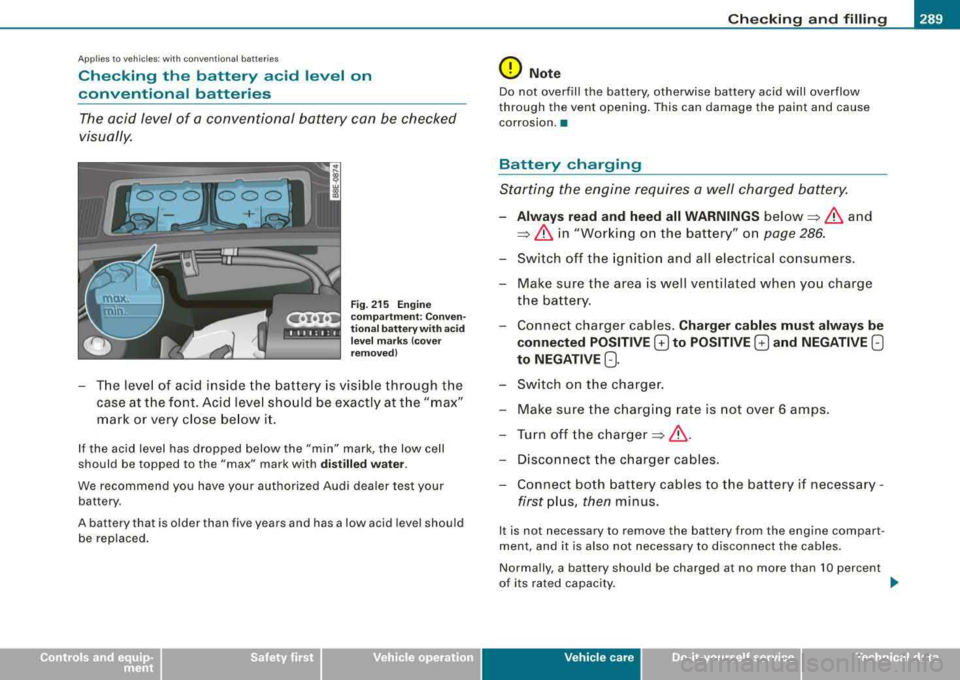
The acid level of a conventional battery can be checked
visually.
Fig . 215 Engin e
co mp artmen t; Co nve n
tio na l battery w ith acid
l eve l mar ks (cover
re m ove d)
-The level of acid inside the battery is visible through the
case at the font . Acid level should be exactly at t he "max"
mark or very close be low i t.
If the acid level has dropped below the "m in" mark, the low cell
should be topped to the
"max" mark with distill ed wa ter.
We recommend you have your authorized Audi dea ler test your
battery.
A battery that is older than five years and has a low acid level should be rep laced.
0 Not e
Do not overfill the battery, otherwise battery acid will overflow
through the vent opening . This can damage the paint and cause
corrosion. •
Battery charging
Starting the engine requires a well charged battery.
Always read and he ed all WARNINGS below => & and
=> & in "Working on the battery" on page 286.
-Switch off the ignition and all e lectrica l co nsumers.
-Make sure the area is well ventilated when you cha rge
t h e battery.
-Connec t charger cables . Charger cable s mu st alw ay s be
c onne cte d POSITIVE
G to POSITIVE G and NEGATIVE 8
to NEGATIVE (:).
-Switch on the charger.
-Make sure the charging rate is not over 6 amps.
-T urn off the charger ::::::,& .
-Disconnect the charger cab les .
-Connect both battery cables to the battery if necessary -
first plus, then minus.
It is not nec essary to remove the battery from th e engine compart
ment, and it is also not necessary to disconnect the cables.
Norma lly, a battery should be charged at no more than 10 percent
of its rated capacity . .,.
Ve hic le care irechnical data
Page 292 of 368
___ C_ h_ e_c _k_ i_n ~g _ a_n_ d_ f_ il _li_ n~ g~--------------------------------------------
For example, a charging current of 4.5 amps would be used on a
battery rated at 45 Ah. Rated capacity of the battery in your vehicle
is listed on the battery housing .
The battery caps should
not be opened when charging a battery.
& WARNING
Charging a battery can be dangerous.
• Always follow the operating instructions provided by the
battery charger manufacturer when charging your battery.
• Never charge a frozen battery . It may explode because of gas
trapped in the ice. Allow a frozen battery to thaw out first.
• Do not reuse batteries which were frozen. The battery housing
may have cracked and weakened when the battery froze.
• Charge the battery in a well ventilated area. Keep away from
open flame or electrical spark. Do not smoke. Hydrogen gas gener
ated by the battery is explosive.
• To reduce the danger of explosion, never connect or disconnect
charger cables while the charger is operating.
• Fast charging a battery is dangerous and should only be
attempted by a competent technician with the proper equipment.
• Battery acid that may spill during charging should be washed
off with a solution of warm water and baking soda to neutralize
the acid.
0 Note
Never use a fast charger as a booster to start the engine . This will
seriously damage sensitive electronic components, such as control
units, relays, radio, etc ., as well as the battery charger. •
Disconnecting and connecting the battery
When the battery is disconnected some features on the
vehicle will become inoperative and you must reset them
when the battery is reconnected.
When you disconnect the vehicle battery note the following:
• some data stored in the driver information system is erased,
• the clock stops,
• the factory installed radio locks up,
• the engine management system and the one-touch-up and one
touch -down functions of the power windows no longer work .
After you reconnect the battery, you must reset the following
features :
Inoperative because the
battery was discon
nected:
clock
one-touch-up and one-touch
down feature on the power
windows
engine management
seat memory*
radio station coding
Removing battery
To reset after the battery is
reconnected, see:
=> page 14
=> page 67
=> page 135
=> page 100
Sound System Operating Instruc -
tions booklet .
•
Before you check anything in the engine compartment,
always
read and heed all WARNINGS :::> & in "Working in
the engine compartment" on page
273. ~
Page 293 of 368

_____________________________________________ C_h_ e_ c
_ k_in --= g'--a
_ n_d _ f_il _li _n ..::g ::.-__,-
-Switch off the ignition and all electrical consumers.
First disconnect the minus cab le (usual ly black or brown) and then
the plus cable (usual ly red). Then remove the battery mounting
bracket and remove the battery. •
Replacing battery
The new battery must have the same specifications and
dimensions as the old one.
A replacement battery must have the same spec ifications and
dimensions as the o riginal equipment battery. Specifications are
listed on the battery housing.
When installing the battery, make sure the ignition and all electrical
consumers are switched off.
0 Note
Make sure the ventilation hose on the side of the battery is
connected, otherwise fumes or battery acid can leak out.
~ For th e sake of th e environm ent
Because of the problem of proper disposal of a battery, we recom
mend your authorized Audi dealer change the battery for you.
Batteries contain sulfur ic acid and lead and must always be
disposed of properly in compliance with a ll environmenta l regula
t ions . Dispos ing of vehic le batteries improperly is very dangerous to
the environment. •
Windshield/headlight washer
container
Using plain water is not adequate for filling the wind
shield washer system and the headlight washer system*.
i w a, a,
Fig . 21 6 Engin e
co mp artment : Wind
s hiel d and head ligh t
w as her f luid contain er
~-~ The washer flu id container is marked with the symbol W on
its cap.
-Before you check a nything in the engine compartmen t,
always read and heed all WARNINGS :::::, & in "Working
in t he engine compartment" on
page 273.
-Lift t he fi ller c ap tongu e to add wash er fluid. You can fil l
the container to the top .
-Press the ca p bac k onto the filler neck a fter fi lling the
container.
You can find the reservoir c a pac ity in the tab le in=> page 343.
Use winterized windshield washer solvent during the cold season
even though the ve hic le is equipped with
h eated wash er jets . It _.,
Vehic le care irechnical data
Page 309 of 368
________________________________________________ T_ i
_ r_e _s_ a_n_ d_ w_ h_ e_e _ l_s __ l!III
W up to 168 mph (270 km/h)3
)
Y up to 186 mph (298 km/h)3
l
Your vehicle is normally factory equipped tires, which possess
excellent driving characteristics and give your Audi optimum
driving comfort. An electronic speed
limiter => page 28will normally
prevent your vehicle from going faster than the tire speed rating
=> & .
U .S. DOT Tire Identification Number (TIN) and tire
manufacture date
This is the tire's "serial number". It begins with the letters "DOT"
and indicates that the tire meets all federal standards. The next two
numbers or letters indicate the plant where it was manufactured,
and the last four numbers represent the week and year of manufac
ture . For example, the numbers 2205 mean that the tire was
produced in the 22th week of 2005. The other numbers are
marketing codes that may or may not be used by the tire manufac
turer. This information is used to contact consumers if a tire defect
requires a recall.
Tire ply composition and materials used
The number of plies indicates the number of layers of rubber-coated
fabric in the tire. In general, the greater the number of plies, the
more weight a tire can support. Tire manufacturers also must indi
cate the materials in the tire, which include steel, nylon, polyester,
and others.
Maximum Load Rating
This number indicates the maximum load in kilograms and pounds
that can be carried by the tire.
Tire quality grading for treadwear, traction, and
temperature resistance
Tread wear, traction and temperature grades=> page 309 . Maximum Permissible Inflation Pressure
This number is
the greatest amount of air pressure that should ever
be put in the tire under normal driving conditions.
Replacing tires or rims on vehicles equipped with tire
pressure monitoring system*
The wheels on your vehicle are equipped with a sensor which
constantly monitors the air pressure inside the tire, and then trans
mits this information to the tire pressure monitoring system*. If you
are going to replace the wheel rims on your vehicle, make sure the
new rims also have these sensors. The sensors must be compatible
with the tire pressure monitoring system* on your vehicle.
If you install rims, which do not have the sensors, or have sensors
which are not compatible, then the tire pressure monitoring
system * will not work properly. In this case, the tire pressure moni
toring system* would not be able to monitor the tire pressure or
warn you if it is necessary .
• The battery inside of the tire pressure sensor has a limited
service life.
• Always drive with the valve stem caps securely mounted. We
recommend using factory installed valve stem caps . Ask your autho
rized Audi dealer to replace lost valve stem caps.
The installation of replacement tires with steel cord body plies in
the tire sidewall may cause malfunction of the tire pressure moni
toring system, and is not recommended (cord material information
in molded on the tire sidewall).
Always check your tire pressure monitoring system* indicator after
replacing one or more tires on your vehicle. If the tire pressure
monitoring system * indicator flashes, or is on, your system is not
working properly. Your replacement tire might be incompatible with
your tire pressure monitoring system*, or some component of the
tire pressure monitoring system* may be damaged.
....
Vehicle care
Page 332 of 368
lllft!l.,___E
_ m_ e_r-=g =-e_ n_c ..:y:- s_ i_ t _u _a_ t_ i_ o _n_ s _______________________________________________ _
Emergency situations
General
This section i s intended for trained emergency crews and working
personnel who have the necessary tools and equipment to perform
these operations.
•
Starting by pushing or towing
0 Note
Vehicles with an automatic transmission cannot be started by
pushing or towing . •
Starting with jumper cables
If n ece ssary, the eng in e can b e star ted by conne cting it to
the battery of another veh ic le .
If th e engin e shou ld fai l to start because of a discharged or weak
b at te ry, the batt ery can be co nnected t o the ba ttery of
another
ve hic le, us ing a pair of jumper cables to start the engine.
Jumper cables
Use
only jumper cables of sufficient ly large cross se ction to safe ly
c a rry the st ar ter curr ent. Refer to th e m anuf actu rer's specific ations.
Us e on ly j um per ca bles with
isolated term ina l clam ps and prop erly
marked for distinction:
plus (+l cable in most c ases c olored red
minus (- l cable in most cases co lored black .
& WARNING
Batteries contain electricity , acid, and gas . Any of these can cause
very serious or fatal injury. Follow the instructions below for safe
handling of your vehicle 's battery.
• Always shield your eyes and avoid leaning over the battery
whenever possible .
• A discharged battery can already freeze at temperatures just
below 32 °F (0 °Cl. Before connecting a jumper cable, the frozen
battery must be thawed completely , otherwise it could explode.
• Do not allow battery acid to contact eyes or skin . Flush any
contacted area with water immediately .
• Improper use of a booster battery to start a vehicle may cause
an explosion.
• Vehicle batteries generate e xplosive gases . Keep sparks, flame
and lighted cigarettes away from batteries.
• Do not try to jump start any vehicle with a low ac id level in the
battery.
• The voltage of the booster battery must also have a 12-Volt
rating . The capacity (Ahl of the booster battery should not be
lower than that of the discharged battery . Use of batteries of
different voltage or substantially different
" Ah " rating may cause
an e xplosion and personal injury .
• Never charge a frozen battery. Gas trapped in the ice may cause
an explosion .
• Never charge or use a battery that has been frozen . The battery
case may have be weakened.
• Use of batteries of different voltage or substantially different
capacity (Ah ) rating may cause an explosion and injury . The
capacity (Ah l of the booster battery should not be lower than that
of the discharged battery . ..,_