battery AUDI A4 AVANT 2008 User Guide
[x] Cancel search | Manufacturer: AUDI, Model Year: 2008, Model line: A4 AVANT, Model: AUDI A4 AVANT 2008Pages: 368, PDF Size: 46.19 MB
Page 80 of 368
![AUDI A4 AVANT 2008 User Guide Clear vision
[ i] Tips
• Do not attach any stickers to the windshield in front of the two
light sensors, as this would interfere with both the automatic oper
ation of t](/img/6/57552/w960_57552-79.png "AUDI A4 AVANT 2008 User Guide Clear vision
[ i] Tips
• Do not attach any stickers to the windshield in front of the two
light sensors, as this would interfere with both the automatic oper
ation of t")
Clear vision
[ i] Tips
• Do not attach any stickers to the windshield in front of the two
light sensors, as this would interfere with both the automatic oper
ation of the headlights and the automatic dimming of the inside
mirror(sl.
• If the vehicle is remotely unlocked and locked
three times in
succession,
leaving home will not turn on the lights a fourth time to
safeguard the battery and lights .
• If you wish to use the coming home/leaving home function regu
larly, you can leave it activated at all times without risking perma
nent strain on the electrical system. As the system is controlled by
light sensors, it wi ll only be energized in darkness.
• Frequent use of the coming home/leaving home function for
approaching and departing a vehicle parked in the dark wil l strain
the battery. This applies particularly if only short distances are
driven between stops . Occas ionally drive longer distances to make
sure the battery is recharged sufficiently.
• If the fog lights have been switched on by the coming
home/leaving home function, they will always be switched off when
you switch on the ignition .•
Instrument panel illumination
The glow of the instruments, displays and the center
console can be adjusted to increase or reduce brightness.
Fig. 76 Instrumen t
panel illumination
Press the"+" button to increase the brightness.
- Press the"-" button to reduce the brightness.
Ignition ON, light switch at @.
With the ignition switched ON, the glow of instrument needles can
be adjusted to appear brighter or dimmer.
Ignition ON, light switch at ;oo~ or io.
With the lights switched on, the brightness of instrument cluster
!i.e . needles, gauges and displays) and center console illumination
can be adjusted.
0 Note
The instrument cluster and center console illumination (gauges and needles) comes on when you switch on the ignition and the vehicle
headlights are off. Be aware of the following difference between
models built to US or Canadian specifications : ..,
Page 83 of 368
Interior lights
Interior lights and glove compartment light The interior lights include the both reading lights for the
driver and the front passenger.
--
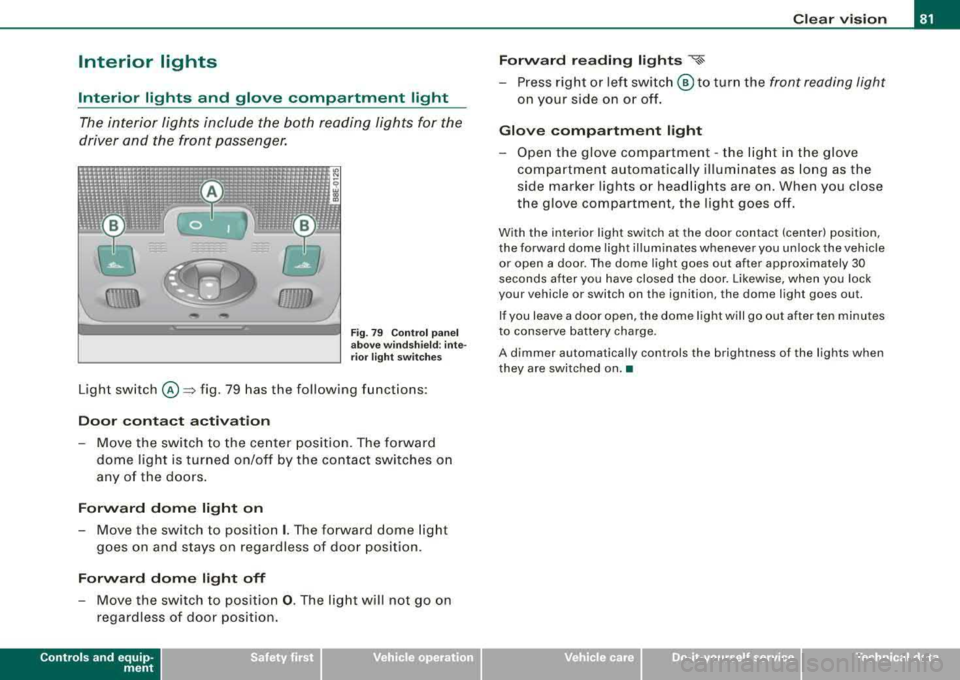
Fi g. 7 9 Control pan el
a bov e wind sh ie ld : int e
r ior ligh t sw itche s
Light sw itch @=> fig. 79 has the following funct ions :
Door contact activation
-Move the switch to the ce nter positi on. The forward
dome light is tur ned on/off by the contact switches o n
any of the doors.
Forward dome light on
- Move the switch to positio n I. The forward dome lig ht
g o es on an d stays on regardless of doo r position .
Forward dome light off
- Move the switch to positio n 0. The lig ht will not go on
regardless of door position.
Controls and equip
ment
Clear v ision
Forw ard reading lights
~
-Press right or left switch @ to turn the front reading light
on your side on or off.
Glove compartment light
-Open the glove com partment -the lig ht in the g love
compartment automatica lly il lum inates as lo ng as the
side marker lights or head lights are on. When you c lose
the glove compartment, the light goes off.
With the interior light switch at the door contact (center) position,
the forward dome light il luminates whenever you unlock the veh icle
or open a door . The dome light goes out after approximately 30
seconds after you have closed the door . Likewise, when you lock
your vehicle or switch on the ignition, the dome light goes out.
If you leave a door open, the d ome light wi ll go out after ten minutes
to conserve battery charge.
A dimmer automatically controls the brightness of the lights when
they are switched on .•
irechnical data
Page 85 of 368
Luggage compartment light
A dome light in the rear roof liner illuminates the luggage compartment. An additional light is provided on the
inside of the rear lid .
8l
9 w CD
"'
L--------,;
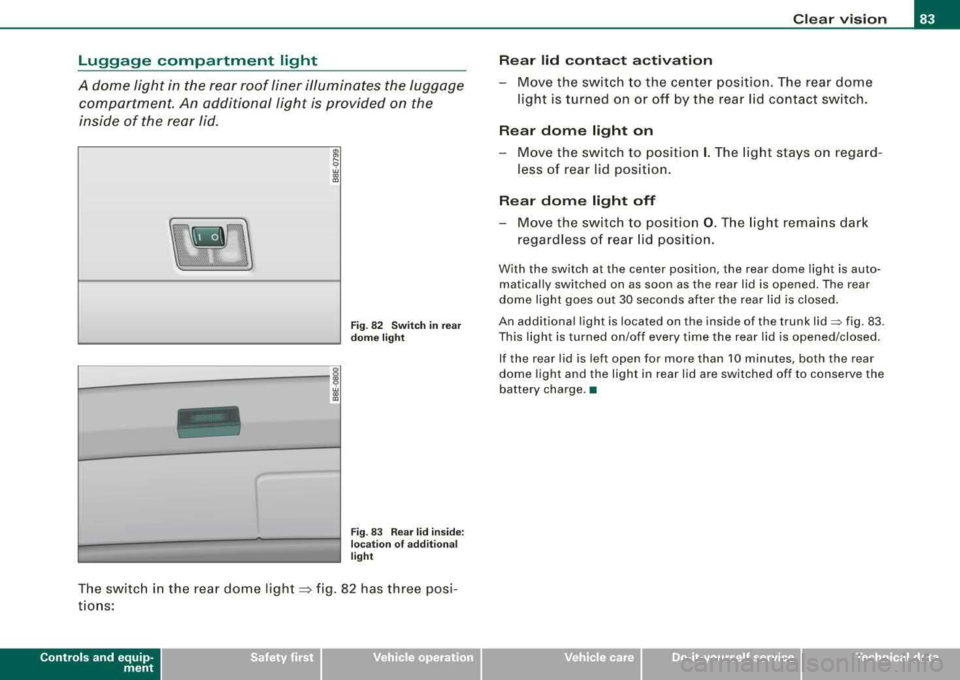
Fig . 8 2 Swi tc h in r ear
d om e light
Fi g. 83 Rear lid in sid e:
l oca tio n of add itio na l
li g ht
The switc h in the rea r dome light => fig. 82 has three posi
t io ns:
Controls and equip
ment
Clear v ision
Re ar lid conta ct ac tivation
-Move the switch to the center position. The rear dome
light is turned on or off by the rear lid contact switch.
Rear dome l ight on
Move the switch to position I. The light stays on regard
less of rear lid posit ion.
Re ar dome light off
-Move the switch to pos ition 0 . The light rema ins dark
regardless o f rear lid posi tion .
With the switch at the center pos ition , the rear dome light is auto
matical ly switched on as soon as the rear lid is opened. The rear
dome light goes out 30 seconds after the rear lid is closed .
An additional light is located on the inside of the trunk
lid=> fig. 83 .
This light is turned on/off every time the rea r lid is opened/closed .
If the rear lid is left open for more than 10 minutes, both the rear
dome light and the light in rear lid are switched off to conserve the
battery charge. •
irechnical data
Page 124 of 368
![AUDI A4 AVANT 2008 User Guide -
Seats and storage
----=---------------
0 Note
To avoid damaging the socket, only use plugs that fit properly.
[ i] Tips
When the engine is off and accessories are still plugg](/img/6/57552/w960_57552-123.png "AUDI A4 AVANT 2008 User Guide -
Seats and storage
----=---------------
0 Note
To avoid damaging the socket, only use plugs that fit properly.
[ i] Tips
When the engine is off and accessories are still plugg")
-
Seats and storage
----=---------------
0 Note
To avoid damaging the socket, only use plugs that fit properly.
[ i] Tips
When the engine is off and accessories are still plugged in and are
on , the vehicl e battery can still be drained .•
Storage
General overview
There are numerous places to store items in your vehicle.
Glove compartment
Center console
Owner's Literature
Compartments in the door trims
Coat hooks
Compartments in the door trims ::, page 122
=:> page 123
=:> page 123
------::, page 124
=:> page 124
=:> page 114
Some of the storage locations are only found on specific vehicle
models or are optional equipment.
& WARNING
• Always remove objects from the instrument panel. Any items
not put away could slide around inside the vehicle while driving or
when accelerating or when applying the brakes or when driving
around a corner.
• When you are driving make sure that anything you may have
placed in the center console or other storage locations cannot fall
& WARNING (continued)
out into the footwells. In case of sudden braking you would not be
able to brake, depress the clutch or accelerate.
• Any pieces of clothing that you have hung up must not interfere
with the driver's view. The coat hooks are designed only for light
weight clothing . Never hang any clothing with hard, pointed or
heavy objects in the pockets on the coat hooks. During sudden
braking or in an accident
-especially if the airbag is deployed -
these objects could injure any passengers inside the vehicle. •
Glove compartment
The glove compartment is illuminated and can be locked .
•
To open glove compartment
Fig. 132 Glove
compartment
- Pull the handle in the direction of the arrow ~ fig. 132
and swing the cover down to open.
_,,,
Page 138 of 368
___ o_ n_ t_h _e _ r_o _a_ d __________________________________________________ _
temporarily interrupted to conserve battery power. After the engine
has started, release the key and it will return to position
0-
Before the starter can be operated again the key must be turned
back to position
G) . The non-repeat lock prevents you from
damaging the starter when the engine is running.
_& WARNING
• Never remove the key from the ignition lock while the vehicle is
moving. The steering wheel will lock causing loss of control.
• If you have to leave your vehicle-even for just a minute- always
remove the ignition key and take it with you. This is especially
important if you are going to leave children behind in the vehicle.
The children could start the engine or use other vehicle controls.
Unsupervised use of vehicle controls (for example, power
windows) can cause serious personal injuries.
[ i] Tips
If the vehicle battery has been disconnected and then reconnected,
then you must leave the key in position
0 for about 5 seconds
before you can start the engine. •
Ignition key safety lock
The ignition key can only be removed when the selector
lever is in the
"P" (Park) position.
After switching off the ignition, the ignition key can only be
removed from the ignition lock when the selector lever is in the
"P"
(Park) position. After you have removed the key, the selector lever is
locked and cannot be moved. •
Starting and stopping the engine
Starting the engine
The engine can only be started with your original Audi
key.
-Set the parking brake.
-Move the selector lever to the neutral position (automatic
transmission: selector lever in P or N)
=> & .
-On vehicles with manual transmission, fully depress the
clutch pedal.
-Turn the ignition key to position 0 => page 135, fig. 143
- do not depress the gas pedal when starting the engine!
-Let go of the key as soon as the engine starts.
A cold engine may at first be loud after it has been started. This is
due to the hydraulic valves building up the oil pressure . This is
normal and no need for concern.
If the engine does not start immediately, stop trying after 10
seconds and then try to restart the engine about 30 seconds later.
What to do if the engine does not start
• ~ page 330
• ~ page 332, "Emergency towing with commercial tow truck"
_& WARNING
Never start or let the engine run in a confined or enclosed area.
Exhaust fumes from the engine contain carbon monoxide, a color
less and odorless gas. Carbon monoxide can be fatal if inhaled.
• Never leave the engine idling unattended. An unattended
vehicle with a running engine poses a danger of personal injury or
theft.
~
Page 159 of 368
________________________________________________ ___:H....:..::: o:..:.m .:....:..:: e::L:.:. i.:....:n :.:..:k :..::® ::__ffllll
Homelink®
Universal radio frequency remote
control
Applies to vehicles: with Homelink® universal radio frequency remote cont ro l
How it works
The HomeLink® universal remote control can be
programmed with the hand held transmitters of the equip
ment you want to activate from inside your car.
The Homelink® system is capable of operating up to three different
remote contro lled devices from inside your vehicle using the
Homelink ® universa l radio frequency remote control.
The system lear ns t he rad io frequency codes of handheld transmit
ters used to operate garage doors, estate gates, home or outdoor
l ighting systems, and other devices 1
l.
The original handhe ld transmitters allocated to the remote
control led devices maintain their ab ility to activate these devices
and can be sti ll be used .
The Homelink® system has a nonvolati le memory, so that all
program ming will be retained after the vehicle battery has
completely discharged or been disconnected .
Before y ou can use the Homelink® universa l remote cont rol to
operate radio -frequency remote controlled devices, you wi ll first
need to program the Ho melink® transmitter.
ll Fo r the sake of readabil ity, a ga rage door opene r is always referred to in this
descr iption.
Controls and equip
ment • I I • • I
& WARNING
• Never use the Homelin kl!!I Universal Tran smitter with any
garage door opener that does have not the s afet y stop and reverse
feature a s required by federal s afety standard s. This include s any
garage door opener m odel manufa ctured before April 1 , 19 82.
• A garage door open er whi ch cannot detect an object , sign aling
the door to stop and rever se does not meet current federal s afet y
s tandard s. Using a garage door opene r without these feature s
in creases r isk of seriou s injury or de ath.
0 Note
When you program the Homelink® system, you are wel l advised to
turn off the garage door opener. A garage door opener whic h is
continuously triggered into action during programming may over
strain and damage its elect ric mot or, -an o verheated motor is a fire
hazard!
[ i ] Tips
• The Homelink® Universa l Remote Control will not affect your
equipment's current safety standard.
• The radio frequencies that are authorized for the country in
which the vehicle was sold are used. These frequencies may differ
in other countries.
• For addi tiona l informat ion cal l to ll-free 1 (800) 355 -3515 or look
up the website on the Internet for detai led instructions:
www .homelink .com •
Page 160 of 368
___ H_ o_ m_ e_L_ i_n _k_ ® __________________________________________________ _
Applies to vehicles: with Home link® univer sal rad io frequency remote contro l
Programming the HomeLink ® Universal
Remote Control
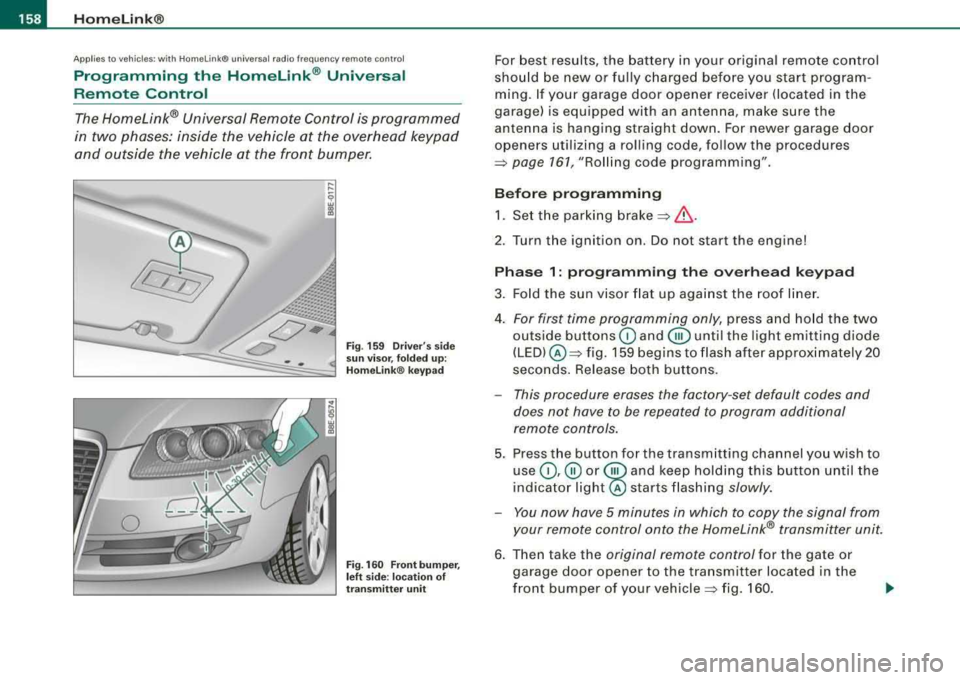
The Homelink® Universal Remote Control is programmed
in two phases: inside the vehicle at the overhead keypad
and outside the vehicle at the front bumper.
Fig . 159 Driver's side
sun visor, folded up:
Homelink ® keypad
Fig. 160 Front bumper,
left side : location of
transmitter unit
For best results, the battery in your original remote control
should be new or fully charged before you start program
ming. If your garage door opener receiver (located in the
garage) is equipped with an antenna, make sure the
antenna is hanging straight down. For newer garage door
openers utilizing a rolling code, follow the procedures
=> page 161, "Rolling code programming" .
Before programming 1. Set the parking
brake =>& .
2. Tur n the ignition on. Do not start the engine!
Phase 1: programming the overhead keypad
3. Fold the sun visor flat up against the roof liner.
4.
For first time programming only, press and hold the two
outside buttons
G) and @until the light emitting diode
(LED) @=> fig. 159 begins to flash after approximately 20
seconds. Release both buttons.
- This procedure erases the factory -set default codes and
does not have to be repeated to program additional
remote controls.
5. Press the button for the transmitting channel you wish to
use
G) ,@ or @ and keep holding this button until the
indica tor
light@ starts flashing slowly.
- You now have 5 minutes in which to copy the signal from
your remote control onto the Homelink® transmitter unit.
6. Then take the original remote control for the gate or
garage door opener to the transmitter located in the
front bumper of your
vehicle => fig. 160.
Page 204 of 368

-Airbag system ---=--.:..,.._ _________________________________ _
&, WARNING (continued )
cellular telephones and CB radios, etc .) must be performed by a
qualified technician who has the training and special equipment
necessary .
• For any work on the airbag system , we strongly recommend
that you see your authorized Audi dealer or qualified workshop .
• Never modify the front bumper or parts of the vehicle body .
• Always make sure that the side airbag can inflate without inter
ference :
- Never install seat covers or replacement upholstery over the
front seatba cks that have not been specifically approved by
Audi.
- Never use additional seat cushions that cover the areas
where the side airbags inflate.
- Damage to the original seat covers or to the seam in the area
of the side airbag module must always be repaired immedi
ately by an authorized Audi dealer .
• The airbag system can be activated only once. After an airbag
has inflated , it must be replaced by an authorized Audi dealer or
qualified technician who has the technical information , training
and special equipment necessary.
• The airbag system can be deployed only once. After an airbag
has been deployed, it must be replaced with new replacement
parts designed and approved especially for your Audi model
version. Replacement of complete airbag systems or airbag
components must be performed by qualified workshops only .
Make sure that any a irbag service action is entered in your Audi
Maintenance
& Warranty booklet under AIRBAG REPLACEMENT
RECORD .
• In accidents when an airbag is deployed, the vehicle battery
separates the alternator and the starter from the vehi cle electrical
system for safety reasons with a pyrotechnic circuit interrupter.
-Work on the pyrotechni c circuit interrupter must only be
performed by a qualified dealer -risk of an accident !
&, WARNING (continued )
-If the vehicle or the circuit interrupter is scrapped, all appli
cable safety precautions must be followed.
•
Other things that can affect Advanced Airbag performance
Changing the vehic le 's suspension system can change the way that
t he A dvance d Ai rbag S ystem p erf o rm s in a c rash. F or example,
using tire -rim combinations not approved by Audi, lowerin g the
ve hicle , ch ang ing the stiff ness of the suspe nsion, includ ing the
springs, suspension struts, shock absorbers etc. can chang e the
fo rces that a re measured by the airbag senso rs and se nt to the elec
tronic control u nit. Some suspension chan ges can, for exampl e,
i n crease the fo rce level s measured by the sen so rs and ma ke the
a irbag s yste m de plo y in cras he s in w hi ch it wou ld not de ploy if th e
changes had not been made. Other kinds of changes may reduce
t h e fo rce lev els measu red by the senso rs a nd p reven t the airb ag
from dep loying when it should.
T he sens ors i n the safe ty belt buckle f or the dri ve r and front
passeng er seat tell t he electronic contro l modu le if the safety belt is
la tched o r not. If t he sa fe ty bel t i s being used, the fro nt ai rbag wi ll
deploy at a s ligh tly high er rate o f veh icle dece lerat io n th an if th e
safety be lt is not being u sed . Th erefo re , in a particula r co llision, it is
poss ib le th at a n airbag will not deplo y at a seat ing po sit io n wh ere
the safety be lt is being used but wi ll inflate at the pos ition where the
safety be lt is not bei ng used . It is im po rta nt tha t noth ing i nte rfere
with the safety belt buc kles so that the sensors can send the correct
i nf orm atio n abou t s afe ty belt use to th e electr onic co ntrol uni t.
~
Page 275 of 368

Checking and filling -
-----------------------------==--------=--
& WARNING (continued)
ment. Wait until no steam or coolant can be seen or heard before
carefully opening the hood.
•
Closing the engine hood
- Pull the hood down until the pressure from the strut is
reduced.
- Let the hood
drop down and latch in place. Do not try to
push
it shut; it may fail to engage =:>& .
& WARNING
A hood that is not completely latched could fly up and block your
view while driving.
• When you close the engine hood, check it to make sure the
safety catch has properly engaged. The hood should be flush with
the surrounding vehicle body parts.
• If you notice while driving that the hood is not secured prop
erly, stop at once and close it. •
Working in the engine compartment
Be especially careful whenever you work in the engine
compartment.
Whenever you must perform any work in the engine compartment,
for example checking and filling different fluids, there is a risk of
injury, burns and accidents. To prevent personal injury always
observe the following WARNINGS . The engine compartment of any
vehicle is a hazardous area
=> & .
• I I • • I
& WARNING
To help avoid injury, before you check anything under the hood:
• Turn off the engine.
• Remove the ignition key .
• Apply the parking brake.
• Move selector lever of automatic transmission to
"P" (Park);
put manual transmission in Neutral.
• Always let the engine cool down. Hot components will burn
skin on contact.
• To reduce the risk of being burned, never open the hood if you
see or hear steam or coolant escaping from the engine compart
ment. Wait until no steam or coolant can be seen or heard before
carefully opening the hood.
• Keep children away from the engine compartment.
• Never spill fluids on hot engine components. They can cause a
fire.
• Never touch the radiator fan. The auxiliary electric fan is
temperature controlled and can switch on suddenly.
• Never open the coolant reservoir cap when the engine is still
warm . The coolant system is pressurized and hot coolant could
spray out.
• Protect your face, hands and arm from steam or hot engine
coolant by placing a thick rag over the cap when you open the
coolant reservoir .
• If work on the fuel system or the electrical system is necessary: -Always disconnect the battery.
- Never smoke or work near heaters or open flames. Fluids in
the engine compartment could start a fire .
- Keep an approved fire extinguisher immediately available.
• To avoid electrical shock and personal injury while the engine
is running or being started, never touch:
- Ignition cables
.,_
Vehicle care
Page 276 of 368

lffll...__C_ h_ e_c _k _ i_n ..::g ,_ a_n_ d_ f_il _li _n....: g==-- --------------------------------------------
& WARNING (continued )
-Other components of the high voltage electronic ignition
system .
• If you must perform a che ck or repair with the engine running:
- Fir st, fully apply the parking brake , move selector lever of
automatic transmission to
" P " (Park ); put manual transmission
in Neutral.
- Alway s use extreme caution to prevent clothing , jewelry , or
long hair from getting caught in the radiator f an, V -belts or
other moving part s, or from contacting hot parts. Tie ba ck hair
before starting , and we ar no clothing that will hang or droop
into the engine.
• Min imize e xposure to emission and chemical hazards
=> & .
& WARNING
California Proposition 65 Warning :
• Engine exhaust , some of its constituents , and certa in vehicle
c omponents contain or emit chemicals known to the State of Cali
fornia to cause cancer and birth defects and reproductive harm . In
addition , certain fluids contained in vehicles and certain products
of component wear contain or emit chemical s known to the State
of California to cause cancer and birth defects or other reprodu c
tive harm.
• Battery posts, terminal s and related accessories contain lead
and lead compounds , chemicals known to the State of California
to cause cancer and reproductive harms . Wash hands after
handling.
0 Note
When a dding f luids, always make sur e tha t they are poured i nto the
prop er container or filler opening, otherwise serious damage to
ve hicle syste ms wi ll occur .
ffi For the sake of the environment
To detect leaks i n time, inspect the veh icle floor pan from unde r
neath regularly. If you see spots from oil or other vehicle fluids, have
your veh ic le i nspected by a n authori zed Audi dealer. •
Engine compartment
Applies to v ehic les: with 2 .0 I tur bo, 4-cy linder -e n gi ne
2 .0 I, 4-cy linder turbo engine (200 hp)
T hese are th e mo st impo rtant items that you ca n check .
Fig . 205 Engine comp artment : 2 .0 I , 4-cylind er turbo
G) Battery ... ..... .. ... .... ... ...... ... .. .. ... .. .
0 Engine oil fil le r cap (
© Engine oil dipstick ( orange) .. .... .. .... .... ... .. .
285
2 78
2 8 4
277 ....