instrument cluster AUDI A4 AVANT 2008 Owner's Manual
[x] Cancel search | Manufacturer: AUDI, Model Year: 2008, Model line: A4 AVANT, Model: AUDI A4 AVANT 2008Pages: 368, PDF Size: 46.19 MB
Page 179 of 368
Before driving off, always:
-Fasten your safety belt and make sure you are wearing it
properly.
- Make sure that your passengers also buckle up and prop erly wear their safety belts.
- Protect your children with a child restraint system appro-
priate for the size and age of the children.
The warning light {} in the instrument cluster lights up when the
ignition is switched on as a reminder to fasten the safety belts . In
addition, you will hear a warning sound.
After the ignition is switched on, the warning tone will come on for about 6 seconds a long with a{} warning light in the instrument
cluster if either the driver or (on USA models only) front seat
passenger has not fastened their safety belt. As soon as the driver
and front seat passenger have fastened the safety belt, the warning
tone will stop and the warning light will go out.
I f both the driver and front seat passenger have not buckled -up
within about 24 seconds after the warning tone has stopped, the
warning tone will sound again for about 6 seconds. The warning
tone will sound repeatedly for about 6 seconds at 24 second inter
vals until both the driver and front passenger have buckled-up. The
safety belt warning system is active for about 5 minutes and during
this time the warning light in the instrument cluster will stay on .
Fasten your safety belt now and make sure that your passengers
also properly put on their safety belts.
•
Safety first
Safety belts
Why safety belts?
Frontal collisions and the law of physics
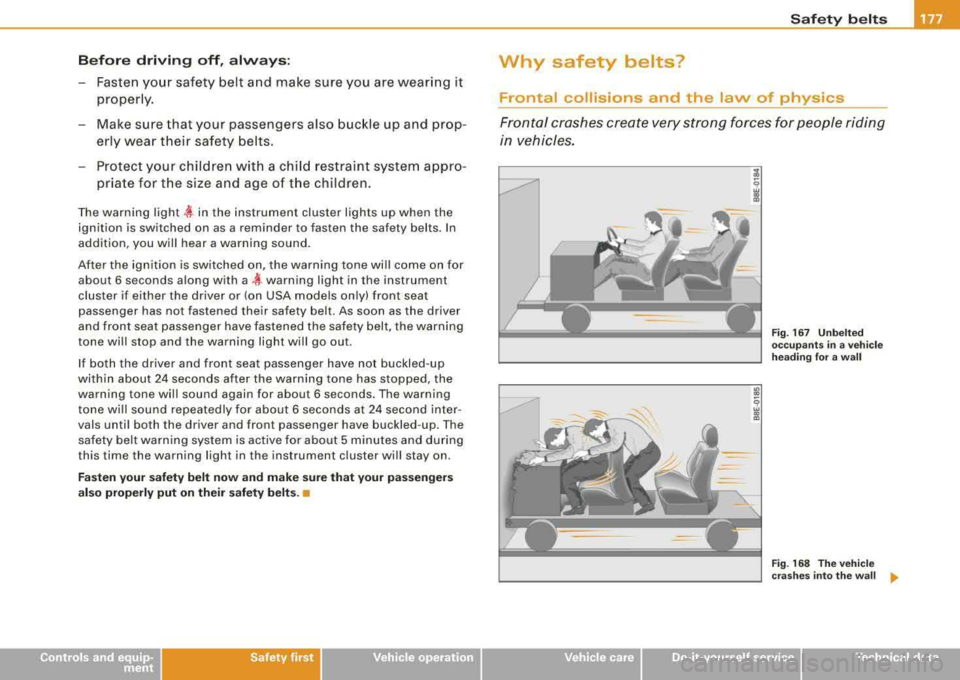
Frontal crashes create very strong forces for people riding
in vehicles.
"' "' 9 w
"' a,
Fig. 167 Unbelted
occupants in a vehicle
heading for a wall
Fig . 168 The vehicle
crashes into the wall
jlJ>
Technical data
Page 191 of 368
__________________________________________________ A_ i_ r _b _a-' g=- s_ y=-- s_t _e _m ______ lfflll
Child restraints on the front seat - some
important things to know
- Be sure to read the important information and head the
WARNINGS for important details about children and
Advanced
Airbags=> page 210.
Even though your vehicle is equipped with an Advanced Airbag
System, make certain that all children, especially those 12 years and
younger, always ride in the back seat properly restrained for their
age and size . The airbag on the passenger side makes the front seat
a potentially dangerous place for a child to ride. The front seat is not
the safest place for a child in a forward -facing child safety seat. It
can be a very dangerous place for an infant or a child in a rearward
facing seat.
The Advanced Airbag System in your vehicle has been certified to comply with the Requirements of United States Federal Motor
Vehicle Safety Standard 208 as applicable at the time your vehicle
was manufactured.
The Standard requires the front airbag on the passenger side to be
turned off ("suppressed") if a child up to about one year of age
restrained in one of the rear-facing or forward-facing infant
restraints listed in Federal Motor Vehicle Safety Standard 208 with
which the Advanced Airbag System in your vehicle was certified has been installed on the front passenger seat. For a listing of the child
restraints that were used to certify compliance with the US Safety
Standard ::::, page 212.
The PASSENGER AIR BAG OFF light in the instrument panel tells you
when the front Advanced Airbag on the passenger side has been
turned off by the electronic control unit.
Each time you turn on the ignition, the
PASSENGER AIR BAG OFF
light will come on for a few seconds and:
• will stay on if the front passenger seat is not occupied,
Controls and equip
ment Safety first
Vehicle operation
• will stay on if there is a small child or child restraint on the front
passenger seat,
• will go off if the front passenger seat is occupied by an adult as
registered by the weight-sensing
mat ::::, page 198, "Monitoring the
Advanced Airbag System" .
The
PASSENGER AIR BAG OFF light comes on when the control unit
detects a total weight on the front passenger seat that requires the
front airbag to be turned off.
If the total weight on the front passenger seat is more than that of
a typical 1 year-old child but less than the weight of a small adult,
the front airbag on the passenger side can deploy (the
PASSENGER
AIR BAG OFF
light does not come on). If the PASSENGER AIR BAG
OFF
light does not come on, the front airbag on the passenger side
has not been turned off by the electronic control unit and can
deploy if the control unit senses an impact that meets the condi
tions stored in its memory.
For example, the airbag may deploy if:
• a small child that is heavier than a typical 1 year-old child is on
the front passenger seat (regardless of whether the child is in one
of the child safety seats
listed ::::, page 212), or
• a child who has outgrown child restraints is on the front
passenger seat.
If the front passenger airbag is turned off, the
PASSENGER AIR BAG
OFF
light comes on in the instrument cluster and stays on.
The front airbag on the passenger side may
not deploy (the
PASSENGER AIR BAG OFF light does not illuminate and stay lit) even
if a small adult or teenager, or a passenger who is not sitting upright
with their back against a non-reclined backrest with their feet on the
vehicle floor in front of the seat is on the front passenger seat
=> page 168, "Proper seating position for the driver".
If the front passenger airbag deploys, the Federal Standard requires
the airbag to meet the "low risk" deployment criteria to reduce the risk of injury through interaction with the airbag . "Low risk" deploy
ment occurs in those crashes that take place at lower decelerations _,,.
Vehicle care Do-it-yourself service Technical data
Page 196 of 368
___ A_ ir_b _ a_ g=- s--=- y_s _t _e _m _________________________________________________ _
&, WARNIN G (continu ed )
• The inflating airbag will hit the child s afety seat or infant
car rier with gre at for ce and will sma sh the child safe ty se at and
c hild agai nst the ba ckre st, center arm re st, door , or roof .
• Alwa ys in sta ll re arw ard -f aci ng child re str aint s in the b ack se at .
• If you mu st in stall a rearw ard facing child safety seat on the
front p assenger se at be cause of e xce pti ona l ci rc um stan ce s a nd
the PASSENGER AIR BAG OFF light doe s not come on and stay on ,
immedi atel y insta ll the re ar-f a cing child s afet y s ea t in a re ar
se ating position and h av e the airb ag sy stem inspe cted by your
Audi dealer .
& WARNING
If, in e xception al c ir cum sta nces, you mu st in sta ll a forward -f ac in g
c hild re straint on the front p assenger 's seat:
• Alway s mak e sure the forward-f acing seat ha s been designed
and certified by it s manufacturer for u se on a front seat with a
p asseng er front and side airb ag .
• Never put the forw ard -fa cing child re straint up again st or very
near the instrument panel.
• Alway s move the p assenger seat into it s re armost position in
the se at's fore and aft adju stment range , as far a way from the
a irbag a s pos sible , before installing the forward -f a cing child
rest raint . The ba ckrest must be ad justed to an upright po sitio n.
• Make sure that the PASSENGER AIR BAG OFF light come s on
a nd stay s on all th e time whenever the ignit ion i s swi tched on .
•
Advanced Airbag System components
The front passenger seat in your vehicle has a lot of very impo rtant
parts of the Advanced A irbag System in it . These parts include the
we ight -sensing mat , sensors, wiring, brackets , and more. The func -tion of the system in the front passenger seat is checked by the e
lec
tronic contro l unit w hen t he ignit ion is on . The co ntrol uni t monitors
the Advanced Airbag System and turns the airbag indicator light on
whe n a malfunction i n the system components is detected. T he
function of the airbag ind icator light is described in greater detai l
below. Because the front passenger seat contains important parts
o f the Advanced Airbag System, you must take care to prevent it
from being damaged . Damage to the seat may prevent the
Advanced Airbag for the front passenger seat from do ing its job in
a crash .
The front Adva nc ed Airbag S ystem consi sts of th e
following :
• Crash sensors in the front of the ve hicle that measure veh ic le
acce leration/deceleration to provide information to the Advanced
A irbag System about t he severity of t he crash .
• An electronic control unit, with integrated crash sensors for front
and side impacts. The control unit "dec ides" whethe r to fire the
front airbags based on the information received from the crash sensors . The control unit also "dec ides" whether the safety be lt
pretensioners should be activated.
• A dual -stage Advanced Airbag with gas generator for the driver
inside the steering wheel hub.
• A dual-stage Advanced A irbag and gas generator inside the
instrument pane l for the front passenger .
• A we ight -sensing mat under the upholstery padding of the front
passenger seat cushion that measures the tota l weight on the seat .
T he information registered is sent continuously to the electronic
control un it to regu late dep loyment of the front Advanced Airbag on
the passenger side .
• An airbag monitor ing system and indicator light in the instru
ment
cluster=> page 198 .
• The PASSENGER AIR BAG OFF light comes on and stays on in t he
center of the instrument panel
=> page 199, fig . 180 and te lls you
when the fron t Advanced Airbag on the passenger side has been
turned off.
~
Page 202 of 368

__ .....;.A..;.;.;. ir.;;b ;..; a;;;. g=.... s;;;..!. y.;;s ;.;;t ..;;e ;.;.m.;..;... ________________________________________________ _
• make sure that the safety belt tension sensor is not blocked.
Shake the safety belt latch on the front passenger seat back and
forth;
• If a strap or tether is being used to tie the child safety seat to the
front passenger seat, make sure that it is not so tight that it causes
the weight -sensing mat to measure more weight than is actually on
the seat.
If the PASSENGER AIR BAG OFF light still does not come on and does
not stay on continuously (when the ignition is switched on),
• take the child restraint off the front passenger seat and install it
properly at one of the rear seat positions. Have the airbag system
inspec ted by your Audi dealer immediately .
• move the child to a rear seat position and make sure that the
child is properly restrained in a child restraint that is appropriate for
its size and age.
The
PASSENGER AIR BAG OFF light should NOT come on when the
ignition is on and an adult is sitting in a proper seating position on
the front passenger seat. If the
PASSENGER AIR BAG OFF light
comes on and stays on or flashes for about 5 seconds while driving,
under these circumstances, make sure that:
• the adult on the front passenger seat is properly seated on the
center of the seat cushion with his or her back up against the back
rest and the backrest is not
reclined~ page 168, "Proper occupant
seating positions",
• the adult is not taking weight off the seat by holding on to the
passenger assist handle above the front passenger door or
supporting their weight on the armrest,
• the safety belt is being properly worn and that there is not a lot
of slack in the safety belt webbing,
• accessory seat covers or cushions or other things that may cause
an incorrect reading or impression on the weight-sensing mat
under the upholstery of the seat have been removed from the front
passenger seat, •
a safety belt extender has not been left in the safety belt latch for
the front passenger seat.
In addition to the
PASSENGER AIR BAG OFF light in the center of the
instrument panel, the message
PASSENGER AIR BAG OFF or
PASSENGER AIR BAG ON will briefly appear in the instrument cluster
display. This is to inform the driver of the current front passenger
airbag status. •
Important safety instructions on monitoring
the Advanced Airbag System
& WARNING
An airbag system that is not functioning properly cannot provide
supplemental protection in a frontal crash.
• If the airbag indicator light comes on, it means that there may
be something wrong with the Advanced Airbag System. It is
possible that the airbag will inflate when it is not supposed to, or
will not inflate when it should.
• Have the airbag system inspected immediately by your Audi
dealer.
& WARNING
If the front airbag inflates, a child without a child restraint, in a
rearward-facing child safety seat or
in a forward-facing child
restraint that has not been properly installed will be seriously
injured and can be killed .
• Even though your vehicle is equipped with an Advanced Airbag
System, make certain that all children, especially 12 years and
younger, always ride on the back seat properly restrained for their age and size .
• Always install forward or rear-facing child safety seats on the
rear seat -even with an Advanced Airbag System.
.,_
Page 205 of 368

& WARNING
Changing the vehicle's suspension including use of unapproved
tire-rim combinations can change Advanced Airbag performance and increase the risk of serious personal injury in a crash.
• Never install suspension components that do not have the
same performance characteristics as the components originally
installed on your vehicle.
• Never use tire-rim combinations that have not been approved
by Audi.
& WARNING
Items stored between the safety belt buckle and the center
console can cause the sensors in the buckle to send the wrong
information to the electronic control module and prevent the
Advanced Airbag System from working properly .
• Always make sure that nothing can interfere with the safety
belt buckles and that they are not obstructed . •
Safety first
Airbag system
Side airbags
Description of side airbags
The airbag system can provide supplemental protection
to properly restrained occupants.
Fig. 181 Side airbag
location in the driver's
seat
The side airbags are located in the sides of the front seat backrests
=> fig. 181 and the rear backrest* facing the doors. They are identi
fied by the word "AIRBAG".
The side airbag system basically consists of: • the electronic control module and external side impact sensors
• the two side airbags located in the sides of the front backrests
• two rear side airbags (as an ordered
option)
• the airbag warning light in the instrument cluster .
Th e airbag system is monitored electronically to make certain that
it is functioning properly at all times. Each time you turn on the igni
tion, the airbag system indicator light will come on for a few
seconds (self diagnostics).
The side airbag system supplements the safety belts and can help
to reduce the risk of injury to the driver's, front and rear*
.,_
irechnical data
Page 252 of 368
III.___T_ r_a _il _e_ r_ t_o _vv_ i_ n """g"'- ---------------------------------------------------
W eig ht d is tri buti on
Towing a loaded tra iler wit h an empty car resu lts in a high ly
unstable distribution of weight . If this cannot be avoided drive at
ve ry low speeds only to avo id the risk of losing steering control.
A "ba lanced" rig is easier to operate and control. This means that
the tow vehicle should be loaded to the extent possible and permis
sib le whi le keeping the trailer as light as possib le under the circum
stances. Whenever possible, transfer some cargo to the luggage
compar tment of the tow veh icle whi le observi ng tongue load
requirements and vehicle loading considerations.
Speed
T he higher the speed, the more difficu lt it becomes for the driver to
contro l the rig . Do not drive at the maximum permissible speed.
Reduce your speed even more under unfavorable load, weather or
wind conditions -part icularly when going dow nh ill.
Reduce vehicle speed
immedi ately if the trailer shows the slightest
sign of swaying.
Do not tr y to stop the s waying by a cceler ating .
Observe speed limits . In some areas speeds for veh ic les towi ng
trai lers are lower than for regular vehicles.
Always app ly brakes early. When driving downhi ll, shift into lower
gear to use the engine braking effect to slow down the vehicle. Use
of the brakes alone can cause them to overheat and fail.
C oo la nt tempe ra tu re
The coola nt temperature gauge => page 13 must be observed care
ful ly. If the needle moves close to the upper end of the scale, reduce
speed immediately and/or switch off the air conditioner.
If the coolant te mperature warning light in the instrument cluster
starts
flashing -~-, pul l off the road, stop and let the engine idle for
about two minutes to prevent heat build -up .
& WARNING
An yone not p rop erl y res trained in a mo ving vehicl e is at a much
gre ate r risk in an accident. Never let an yone rid e in your car who
is not p rop erl y wear ing the re stra int s pro vided b y Aud i. •
Trailer towing tips
Important to know
Your vehicle handles differently when towing a tra iler because of
the additional weight and weight distribution. Safety, performance
and economy wi ll great ly depend on how carefu lly you load your
trai ler and operate your rig.
Before you actual ly tow your tra iler, practice turning, stoppi ng and
backing up in an area away from traffic. Keep practicing unti l you
have comp letely become familiar with the way yo ur vehicle -trailer
combination behaves and responds .
Backing up is difficu lt and requires practice. Backing up with a
trai ler genera lly requ ires steering action oppos ite of that when
backing up your vehic le without a trailer.
Mainta in a greater distance between you r vehic le and the one in
front of you. You will need more room to stop.
To compensate for the trai ler, you wi ll need a larger than normal
t urning radius .
When passing, remember that you cannot accelerate as fast as you nor mally wou ld because of t he added load . Make sure yo u have
enough room to pass. After passing, al low plenty of room for your
trai ler before changing lanes again .
Avo id jerky starts, sharp turns or rapid lane changes.
Page 279 of 368

Checkin g a nd fillin g --------------~~~-
the form of Service or Repair Orders that all scheduled maintenance
was performed in a t ime ly manner .•
Engine oil consumption
The engine in your vehicle depends on an adequate
amount of oil to lubricate and cool all of its moving parts.
In order to prov ide effect ive lubrication and cool ing of in ternal
engine components, all internal combustion engines consume a
certain amount of o il. Oil consumption varies from engine to engine
and may change significantly over the life of the engine . Typically,
eng ines wi th a specified break -in period
(see ~ page 243) consume
more oil during the break -in period than they consume after oi l
consumption has stabi lized .
Under norma l condit ions, the rate of o il consumption depends on
the quality and viscosity of the oil, the RPM (revo lutions per minute)
at whic h the engine is operated, t he amb ient te mperature and road
conditions. Further factors are the amount of oil dilution from water
condensatio n or fuel residue and t he oxidation level of the o il. As
any engine is subject to wear as mileage builds up, the oil consump
t ion may increase over time until rep laceme nt of worn components
may become necessary .
With all these variables coming into play, no standard rate of oil consu mption can be estab lished or specified. T here is no a lternative
to regu lar and frequent checking of the oil level, see
Note .
If the yellow eng ine o il level warni ng symbol in the instrument
cluster ~ lights up, you should check the oil level as soon as
possible
with the oil dipstick ~ page 277 . Top off the o il at your
earl iest
convenience~ page 278.
& WARNING
Bef ore you che ck anything in the eng ine comp artment , alway s
read and heed all WARNINGS
~ & in "Working in the engine
c ompartment " on
page 27 3.
0 Note
Driving with an insuff ic ient oil level is l ikely to cause severe damage
to the engine.
[ i ] Tip s
• The oil pres sure warning displ ay "e:7: is n ot an indi cator of the oil
level . Do not rel y on it. Instead, check the oil level in your engine at
regular inter vals, preferably ea ch time you refuel , and al way s before
going on a long trip.
• If you have the impression your engine consumes excessive
amounts of oi l, we reco mmend that you consult your Audi dealer to
have the cause of your concern properly diagnosed . Keep in mind
that t he accurate measurement of oil consumptio n requ ires great
care and may take some time. Your Audi dealer has instructions
about how t o measure oil cons umpt ion accurately. •
Checking the engine oil level
Vehicle care
Fig. 2 07 Illu strati on of
prin ciple 1: M ark ers on
oil dip sti ck ...
Page 328 of 368

1119....__F_ u_ s_ e_s _ a_n _ d_ b_ u_lb _ s _______________________________________________ _
Fuses and bulbs
Fuses
Repl ac ing a fu se
A problem in the electrical system may be caused by a
blown fuse.
Fig . 232 End face of
instrument panel :
removing cover plate
to access fuses
Fig . 233 Fuse carrier
behind the instrument
panel end face, cover
removed
- Switch off the ignition and the electrical component
affected.
- Carefully pry the face cover off the instrument panel
using the ignition key or a
screwdriver ~ fig. 232.
- Check the fuse listing on the next pages to find out which
fuse belongs to the component which has failed
~ page 327, "Fuse list".
- Remove the blown fuse with the plastic clip provided.
The clip is located on the holder in the fuse box.
- Replace a blown fuse (recognizable by the melted metal
strip inside) with a fuse of the same amperage .
- Firmly snap the cover back onto the instrument panel
face.
The various electrical circuits are protected by fuses. The fuses are
clustered in a centralized unit. The unit is located behind the face
panel at the end of the instrument panel. The crank for operating
the sunroof in case of a power failure is also stored behind the face
panel ~ page 70.
Two spare fuses and a sticker identifying the fuses are located on
the inside of the fuse box cover.
You are well advised to keep a supply of spare fuses in your vehicle.
Fuses with the proper ampere ratings are available at your Audi
d ea le r.
& WARNING
Never replace a fuse with one that has a higher amperage rating.
• A fuse with a too high amperage could damage the electrical
part and cause a fire.
~
Page 329 of 368

Fuses and bulbs -
----------------
0 Note No. Equipment Amps
• On no account should fuses be repaired (e.g. patched up with tin 13 Steering column module 10
foil or wire) as this may cause serious damage elsewhere in the elec -14 Brake lights 10
trical circuit or cause fire.
15 Instrument cluster, Navigation system 10
• If a fuse blows repeatedly, do not keep replacing it. Instead, have
the cause for the repeated short circuit or overload tracked and Garage door opener
5
fixed.
•
Level, tire pressure control, park assist,
17 light/rain sensor 10
Fuse list Automatic headlight range control, left 5
Fuses which can be replaced. 19 Fog lights, rear fog light 15
20
Not used
No. Equipment Amps
21 Not used
1 Air conditioner 10 Front doors 15
2
Footwell illumination 5 23 Rear doors 15
3 Heated washer jets 5 Central convenience electrical system 20
4 Radiator fan 5 25 Heater blower 30
5
Telephone, oil level sensor, multifunction 10 26 Rear window defogger 30
switch, rear heated Seat, shift gate
27 Socket for trailer towing (controller) 30
6
Air conditioner (air quality sensor), air pressure 5 28 Fuel pump 20 sensor
Electronic Stabilization Program (ESP), brake
29 Not used
7 light switch, clutch pedal switch, steering angle 10 Power sunroof 20
sensor Automatic transmission, mirror dimming, diag-
31 15 8 Telephone 5 nosis socket
9 Brake booster (vacuum pump) 15 Towing assembly 15
10
Automatic headlight beam adjustment, auto -5 33 Cigarette
lighter 20
matic headlight range control, right
Electrical socket 20
11
Airbag 5 35 Luggage compartment socket 20
12
Diagnosis socket 10 Windshield wiper system 30
Do -it -yourself service
Page 354 of 368
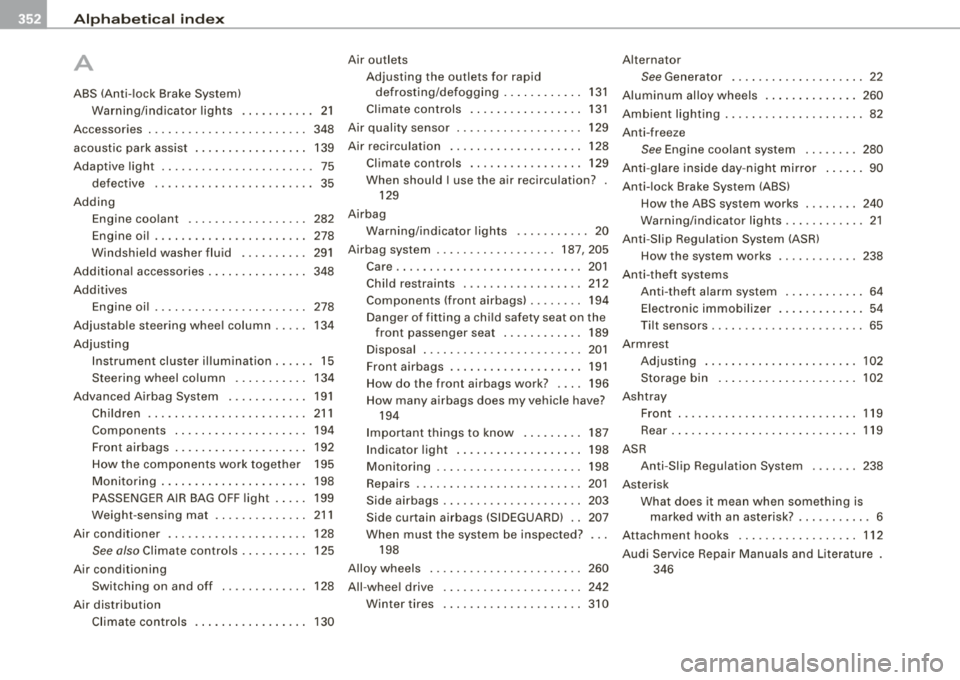
111'1_....::::A::.:l:.!: p :.:h..:.: a:::.:: b:.::e :.:t::i c::.::: a.:..l ..:.: in :..:.:: d:.:e :.:x::..... ___________________________________________ _
A
ABS (Anti- lock Brake System)
Warning/indicator lights ... .... .... 21
Accessories . .... .... .... .... .... ... 348
acoust ic park assist . . . . . . . . . . . . . . . . . 139
Adap tive light .. ... .... ... .. ...... ... 75
defective . . . . . . . . . . . . . . . . . . . . . . . . 35
Adding Engine coo lant
282
Engine oi l ... ... .. .... .... ... .... 278
Windshield washer fluid .... .... .. 291
Additiona l accessories .. ...... ...... . 348
Additives Eng ine oi l .. ....... ....... ....... 278
Adjustable steering whee l column .. ... 134
Adjusting Instrument cluster il lumina tion ... .. . 15
Steering wheel co lumn . ...... .... 134
Advanced A irbag System . .... ... .... 191
Ch ildren ... ........... .... ... ... 211
Components ...... .... ... .... ... 194
Fr ont airbags . . . . . . . . . . . . . . . . . . . . 192
How the c ompone nts wo rk togethe r 195
Monitoring . . . . . . . . . . . . . . . . . . . . . . 198
PASSE NGER AIR BAG O FF light ..... 199
Weight -sensing mat ....... ... .... 211
Air conditioner . . . . . . . . . . . . . . . . . . . . . 128
See also Climate controls . . . . . . . . . . 125
Air conditioning Switching on and off 128
A ir distribution
C limate controls . ...... ... .... ... 130 Air outlets
Adjusting the outlets for rapid defrosting/de fogging .. ...... .... 131
Cl imate con trols ...... .... .... ... 131
Air quality sensor . . . . . . . . . . . . . . . . . . . 129
Air recirculation .. ... .... .... .... ... 128
Clima te controls .. .... ..... .. .... 129
When should I use the air recircu lation?
129
Airbag Warning/indicator lights .... ... .... 20
Airbag system . . . . . . . . . . . . . . . . . . 187 , 205
Car e ...... .... .... .... .... .... .. 201
Child restraints .... .... .... .... .. 212
Componen ts (front airbags) .... ... . 194
Danger of fitting a chi ld safety seat on the
front passenger seat . . . . . . . . . . . . 189
Disposal .. ....... .... .... .... ... 201
Front airbags . .... ... .... .... .... 191
How do the front
ai rbags work? .... 196
How many airbags does my vehicle have? 194
I mportant things to know ....... .. 1 87
I ndicator light ... .. .... .... ... ... 198
Monitoring . . . . . . . . . . . . . . . . . . . . . . 198
Repairs ...... .... ... .... .... .... 201
Side airbags ... ...... .... ... .. ... 203
Side curtain airbags (SIDEGUARD) .. 207
When must the sys tem be inspec ted? ...
198
Alloy w heels . .... .... .... .... .... .. 260
All -wh ee l driv e 242
Winter tir es ..... .... .... ... .. ... 310 A
lternator
See Generator . . . . . . . . . . . . . . . . . . . . 22
Aluminum al loy wheels . ...... .... ... 260
Ambient light ing . ....... .... ... .. .... 82
Anti-free ze
See Engine coolant system ........ 280
Anti -glare inside day -ni ght mi rro r .. ... . 90
An ti- lock B rake System (ABS)
How the ABS system works . ....... 240
Warning/indicator l ights ........... . 21
Anti -Slip R egulation Syst em (ASR)
How the sys tem works .... .... .... 238
An ti- theft systems
Anti -theft ala rm system .. ...... .... 64
Electronic immobilizer .. ... .... ... . 5 4
Tilt sensors . .... .... ... .... .... ... 65
Armrest Adjusting ...... .... ... .... ..... . 102
Storage bi n
Ashtray 1
02
Front . .... .... .... .... ... .... ... 119
Rear ...... .... .... .... ... .... ... 119
ASR Anti- Slip Regulation System .... ... 238
Asterisk What does it mean when something is marked with an asterisk? .. ... .... .. 6
Attachment hooks ... .... .... .... ... 112
Aud i Service Repa ir Manuals and Lite rature
346