steering AUDI A4 AVANT 2008 Owner's Manual
[x] Cancel search | Manufacturer: AUDI, Model Year: 2008, Model line: A4 AVANT, Model: AUDI A4 AVANT 2008Pages: 368, PDF Size: 46.19 MB
Page 193 of 368
/b, WARNING (continued )
• Improper installation of child restraints can reduce their effec
tiveness o r even prevent them from providing any protection .
• An improperly installed child restraint can interfere with the
airbag a s it deploys and ser iously injure or even kill the child -
even with an Advanced Airbag System .
• Alway s carefully follow the manufacturer's instructions
provided with the child safety seat or carrier .
• Never place additional items on the seat that can in crease the
total weight registered by the weight -sensing mat and can cause
injury in a crash. •
Front airbags
Description of front airbags
The air bag sys tem can pr ovi de s upp lem ental pro tecti on
t o p rop erly restr ained front se a t oc cupants.
Safety first
Fig . 177 Location of
driver airb ag : in
s teering wheel
( I p
Airbag system
Fig. 178 Location of
front pa ssen ger 's
airbag : in the instru
ment p anel
Your vehic le is equipped with a dual -stage front "Advanced Airbag
System" in compl ia nce wi th Uni ted Sta tes Federa l Motor Ve hic le
Safety Standard (FMVSSl 208 as applicable at the time your vehicle
w as manufactured . Your vehicle is a lso equipped with side airbags
fo r the driver and front seat passenger . The safety belts for the front
seats have "pretensioners" that he lp to take s lack out of the belt
syste m. The p re te nsioners a re a lso activated by t he elec tronic
control unit for the airbag system.
The front safety belts a ls o have loa d lim iters to help reduce the
forces app lied to the body in a crash .
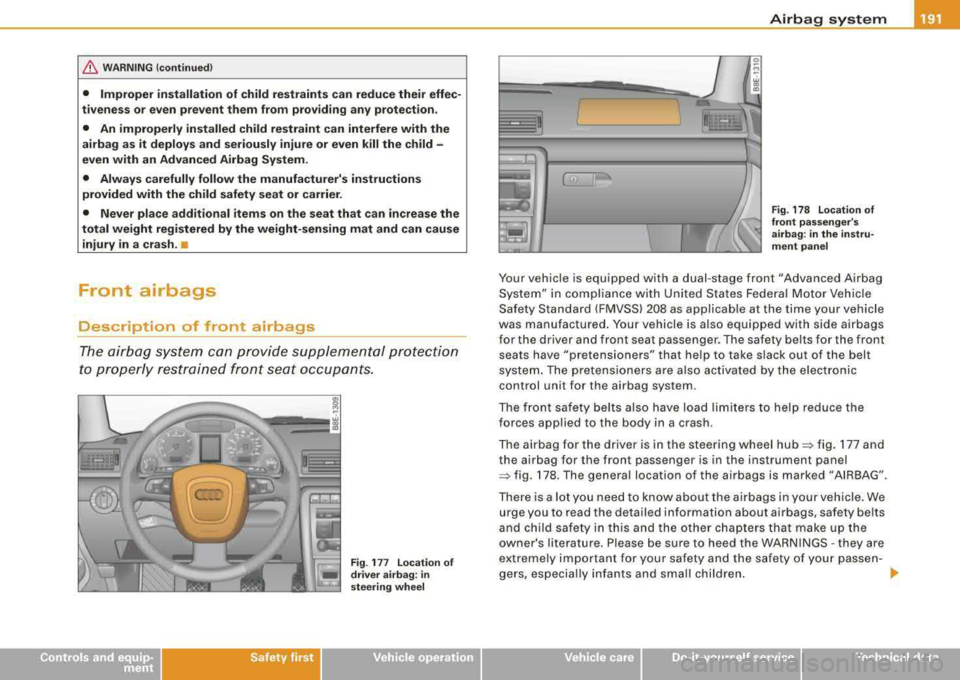
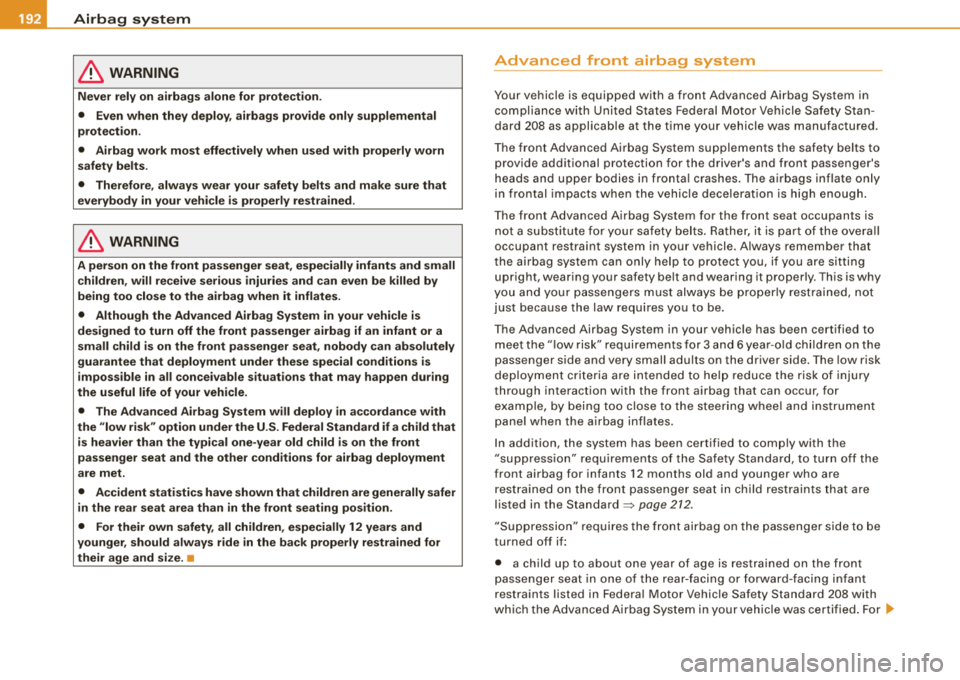
The airbag fo r the driver is in the steering wheel
hub => fig. 177 and
the airbag for t he front passenger is in the instrument pane l
=> fig. 178. The genera l location of the airbags is marked "AIRBAG" .
Th ere is a l ot you nee d t o know abou t the airbags in y our ve hicle. We
urge you to read the detailed information about airbags, safety be lts
and c hild safe ty in this and the ot her c hapt ers that mak e up the
owner 's lit erature. P lease be sure to heed the WARN INGS -they are
extremely importa nt for you r safety a nd the safety of you r passe n-
g ers, especially infants and small children.
..,
irechnical data
Page 194 of 368
-Airbag system
----:=-..:....--------------------------------------------
& WARNING
Never rely on airbags alone for protection.
• Even when they deploy, airbags provide only supplemental
protection .
• Airbag work most effectively when used with properly worn
safety belts.
• Therefore, always wear your safety belts and make sure that
everybody in your vehicle is properly restrained.
& WARNING
A person on the front passenger seat, especially infants and small children, will receive serious injuries and can even be killed by
being too close to the airbag when it inflates.
• Although the Advanced Airbag System in your vehicle is
designed to turn off the front passenger airbag if an infant or a
small child is on the front passenger seat, nobody can absolutely
guarantee that deployment under these special conditions is
impossible in all conceivable situations that may happen during
the useful life of your vehicle.
• The Advanced Airbag System will deploy in accordance with
the
"low risk" option under the U.S. Federal Standard if a child that
is heavier than the typical one-year old child is on the front
passenger seat and the other conditions for airbag deployment
are met.
• Accident statistics have shown that children are generally safer
in the rear seat area than in the front seating position.
• For their own safety, all children, especially 12 years and
younger, should always ride in the back properly restrained for
their age and size.
•
Advanced front airbag system
Your vehicle is equipped with a front Advanced Airbag System in compliance with United States Federal Motor Vehicle Safety Stan
dard 208 as applicable at the time your vehicle was manufactured .
The front Advanced Airbag System supplements the safety belts to
provide additional protection for the driver's and front passenger's
heads and upper bodies in frontal crashes. The airbags inflate only
in frontal impacts when the vehicle deceleration is high enough.
The front Advanced Airbag System for the front seat occupants is
not a substitute for your safety belts. Rather, it is part of the overall
occupant restraint system in your vehicle . Always remember that
the airbag system can only help to protect you, if you are sitting
upright, wearing your safety belt and wearing it properly. This is why
you and your passengers must always be properly restrained, not
just because the law requires you to be.
The Advanced Airbag System in your vehicle has been certified to
meet the "low risk" requirements for 3 and 6 year-old children on the
passenger side and very small adults on the driver side. The low risk
deployment criteria are intended to help reduce the risk of injury
through interaction with the front airbag that can occur, for example, by being too close to the steering wheel and instrument
panel when the airbag inflates .
In addition, the system has been certified to comply with the
"suppression" requirements of the Safety Standard, to turn off the
front airbag for infants 12 months old and younger who are
restrained on the front passenger seat in child restraints that are
listed in the
Standard~ page 272 .
"Suppression" requires the front airbag on the passenger side to be
turned off if:
• a child up to about one year of age is restrained on the front
passenger seat in one of the rear-facing or forward-facing infant
restraints listed in Federal Motor Vehicle Safety Standard 208 with
which the Advanced Airbag System in your vehicle was certified. For
~
Page 196 of 368
___ A_ ir_b _ a_ g=- s--=- y_s _t _e _m _________________________________________________ _
&, WARNIN G (continu ed )
• The inflating airbag will hit the child s afety seat or infant
car rier with gre at for ce and will sma sh the child safe ty se at and
c hild agai nst the ba ckre st, center arm re st, door , or roof .
• Alwa ys in sta ll re arw ard -f aci ng child re str aint s in the b ack se at .
• If you mu st in stall a rearw ard facing child safety seat on the
front p assenger se at be cause of e xce pti ona l ci rc um stan ce s a nd
the PASSENGER AIR BAG OFF light doe s not come on and stay on ,
immedi atel y insta ll the re ar-f a cing child s afet y s ea t in a re ar
se ating position and h av e the airb ag sy stem inspe cted by your
Audi dealer .
& WARNING
If, in e xception al c ir cum sta nces, you mu st in sta ll a forward -f ac in g
c hild re straint on the front p assenger 's seat:
• Alway s mak e sure the forward-f acing seat ha s been designed
and certified by it s manufacturer for u se on a front seat with a
p asseng er front and side airb ag .
• Never put the forw ard -fa cing child re straint up again st or very
near the instrument panel.
• Alway s move the p assenger seat into it s re armost position in
the se at's fore and aft adju stment range , as far a way from the
a irbag a s pos sible , before installing the forward -f a cing child
rest raint . The ba ckrest must be ad justed to an upright po sitio n.
• Make sure that the PASSENGER AIR BAG OFF light come s on
a nd stay s on all th e time whenever the ignit ion i s swi tched on .
•
Advanced Airbag System components
The front passenger seat in your vehicle has a lot of very impo rtant
parts of the Advanced A irbag System in it . These parts include the
we ight -sensing mat , sensors, wiring, brackets , and more. The func -tion of the system in the front passenger seat is checked by the e
lec
tronic contro l unit w hen t he ignit ion is on . The co ntrol uni t monitors
the Advanced Airbag System and turns the airbag indicator light on
whe n a malfunction i n the system components is detected. T he
function of the airbag ind icator light is described in greater detai l
below. Because the front passenger seat contains important parts
o f the Advanced Airbag System, you must take care to prevent it
from being damaged . Damage to the seat may prevent the
Advanced Airbag for the front passenger seat from do ing its job in
a crash .
The front Adva nc ed Airbag S ystem consi sts of th e
following :
• Crash sensors in the front of the ve hicle that measure veh ic le
acce leration/deceleration to provide information to the Advanced
A irbag System about t he severity of t he crash .
• An electronic control unit, with integrated crash sensors for front
and side impacts. The control unit "dec ides" whethe r to fire the
front airbags based on the information received from the crash sensors . The control unit also "dec ides" whether the safety be lt
pretensioners should be activated.
• A dual -stage Advanced Airbag with gas generator for the driver
inside the steering wheel hub.
• A dual-stage Advanced A irbag and gas generator inside the
instrument pane l for the front passenger .
• A we ight -sensing mat under the upholstery padding of the front
passenger seat cushion that measures the tota l weight on the seat .
T he information registered is sent continuously to the electronic
control un it to regu late dep loyment of the front Advanced Airbag on
the passenger side .
• An airbag monitor ing system and indicator light in the instru
ment
cluster=> page 198 .
• The PASSENGER AIR BAG OFF light comes on and stays on in t he
center of the instrument panel
=> page 199, fig . 180 and te lls you
when the fron t Advanced Airbag on the passenger side has been
turned off.
~
Page 199 of 368
Airbag system 111111
-----------------------------=--=-------
It is important to remember that while the supplemental airbag
system is designed to reduce the likelihood of serious injuries, other
injuries, for example swelling, bruising and minor abrasions, can
also happen when airbags inflate. Airbags do not protect the arms
or the lower parts of the body. Front airbags only supplement the
three point safety belts in some frontal collisions in which the
vehicle deceleration is high enough to deploy the airbags.
Front airbags
will not deploy:
• if the ignition is switched off when a crash occurs,
• in side collisions,
• in rear -end collisions,
• in rollovers ,
• when the crash deceleration measured by the airbag system is
less than the minimum threshold needed for airbag deployment as
registered by the electronic control unit.
The front passenger airbag
will also not deploy:
• when the front passenger seat is not occupied,
• when the weight on the front passenger seat as sensed by the
Advanced Airbag System indicates that the front airbag on the
passenger side has to be turned off by the electronic control unit
(the PASSENGER AIR BAG OFF light comes on and stays onl.
& WARNING
Sitting in the wrong position can increase the risk of serious injury
in crashes.
• To reduce the risk of injury when the airbags inflate, the driver
and passengers must always sit in an upright position, must not
lean against or place any part of their body too close to the area
where the airbags are located.
• Occupants who are unbelted, out of position or too close to the
airbag can be seriously injured by an airbag as it unfolds with
great force in the blink of an
eye :::::, page 189.
Controls and equip ment Safety first
Vehicle operation
& WARNING
A child in a rearward-facing child safety seat installed on the front
passenger seat will be seriously injured and can be killed if the
front airbag inflates
-even with an Advanced Airbag System.
• The inflating airbag will hit the child safety seat or infant
carrier with great force and will smash the child safety seat and
child against the backrest, center arm rest, door or roof.
• Always install rear-facing child safety seats on the rear seat.
• If you must install a rearward facing child safety seat on the
front passenger seat because of exceptional circumstances and
the PASSENGER AIR BAG OFF light does not come on and stay on, immediately install the rear-facing child safety seat in a rear
seating position and have the airbag system inspected by your
Audi dealer .
& WARNING
Objects between you and the airbag will increase the risk of injury
in a crash by interfering with the way the airbag unfolds or by
being pushed into you as the airbag inflates .
• Never hold things in your hands or on your lap when the vehicle
is in use.
• Never transport items on or in the area of the front passenger
seat. Objects could move into the area of the front airbags during
braking or other sudden maneuver and become dangerous projec
tiles that can cause serious personal injury if the airbags inflate.
• Never place or attach accessories or other objects (such as cup
holders, telephone brackets, large, heavy or bulky objects) on the
doors, over or near the area marked "AIRBAG" on the steering
wheel, instrument panel, seat backrests or between those areas
and yourself. These objects could cause injury in a crash, espe
cially when the airbags inflate.
• Never recline the front passenger's seat to transport objects.
Items can also move into the area of the side airbag or the front _,,
Vehicle care Do-it-yourself service Technical data
Page 203 of 368
& WARNING (continued)
• If you must install a rearward-facing child safety seat on the
front passenger seat because of exceptional circumstances and
the PASSENGER AIR BAG OFF light does not appear and stay on ,
immediately install the rear -facing child safety seat in a rear
seating posit ion and have the airbag system inspected by your
Audi dealer .
• A tight tether or other strap on a rearward-facing child restraint
attached to the front passenger seat can put too much pressure
on the weight-sensing mat in the seat and register more weight
than is actually on the seat. The heavier weight registered can make the system work as though an adult were on the seat and
deploy the Advanced Airbag when it must be suppressed causing
serious or even fatal injury to the child.
• If , in exceptional circumstances , you must install a forward
facing child restraint on the front passenger seat , always move the
seat into its rearmost position in the seat 's fore and aft adjust
ment range , as far away from the airbag as possible. The backrest
must be adjusted to an upright position . Make sure that the
PASSENGER AIR BAG OFF light comes on and stays on all the time
whenever the ignition is switched on .
& WARNING
• If the PASSENGER AIR BAG OFF light does not go out when an
adult is sitting on the front passenger seat after taking the steps
described above , make sure the adult is properly seated and
restrained at one of the rear seating positions .
• Have the airbag system inspected by your Audi dealer before
transporting anyone on the front passenger seat .
Controls and equip ment Safety first
Vehicle operation
Airbag system
[ i ] Tips
If the w eig ht-sens ing ma t in th e front passe nger seat detects an
e m pty seat , the front airbag on the pa ssenge r side wil l be turned
o ff , a nd PASSENGER AIR BAG OFF will stay o n.
a
Repair, care and disposal of the airbags
Pa rts o f the airba g sy ste m are i nsta lled at many d ifferen t pl aces on
y our Audi. Instal ling, removing , se rvicing or re pairing a pa rt in an
ar ea of th e ve hicle ca n da mage a part of an airbag syst em and
prevent that system from wor king properly in a co llision.
T he re a re so me impo rtant thin gs you have to know t o make sure
that the effectiv eness of the system will not be impaired and that
di scar ded co mpon ents do not ca use inju ry o r po llut e th e env iron
m ent .
& WARNING
Improper care , servicing and repair pro cedures can increase the
risk of personal injury and death by preventing an airbag from
deploying when needed or deploying an airbag unexpectedly :
• Never cover, obstruct, or change the steering wheel horn pad
or airbag cover or the instrument panel or modify them in any way.
• Never attach any objects such as cup holders or telephone
mountings to the surfaces covering the airbag units .
• For cleaning the horn pad or instrument panel , use only a soft ,
dry cloth or one moistened with plain water . Solvents or cleaners
could damage the airbag cover or change the stiffness or strength
of the material so that the airbag cannot deploy and protect prop
erly .
• Never repair , adjust , or change any parts of the airbag system.
• All work on the steering wheel, instrument panel, front seats or
electrical system (including the installation of audio equipment ,
...,
Vehicle care Do-it-yourself service Technical data
Page 213 of 368

& WARNING (conti nued )
• Alw ays install r ear-facing child saf ety s eats on the r ear seat.
• If you mu st in sta ll a re arwa rd f acing child safe ty s eat on the
front pas senger seat in exc eptional cir cum stances and the
PASSENGER AIR BAG OFF light doe s not come on and stay on,
immediat ely install th e rear-fa cing child safety s eat in a rear
s e ating po sit ion and h ave the airb ag sys tem in spe cted immedi
a tel y by y our Audi dealer .
& WARNING
If, in exceptional circum stance s, you must in stall a forward -fac ing
c hild re st ra int on the fr ont p assenge r's s eat:
• Alway s make sure the forward -facing seat ha s been de signed
and cert ified by it s m anuf acturer for u se on a front se at with a
pa ssenger front and side airbag .
• Always follow the m anufacturer's instruct ions provided w ith
the child safet y seat or c arrier.
• Alway s m ov e th e passeng er sea t into it s re arm ost p osit ion in
the seat' s fore and aft adju stment range , as far away from the
a irb ag as possible before installin g the ch ild r estr aint . The b ack
rest must be adjusted to an upright po sition.
• Alway s ma ke sure th at the PASSENGER AIR BAG OFF light
come s on and stay s on all the time wheneve r the ignition i s
s wit ched on . •
Advanced front airbag system and children
Your vehicle is equipped with a dual -stage front "Advanced Airbag
System" in comp liance with United States Federal Motor Vehicle
Safety Standard ( FMVSS) 208 as applicab le at the time your vehic le
was manufactured .
Controls and equip
ment Safety first Vehicle operation
Chi
ld Sa fe ty
The Advanced Airbag system in your vehic le has been certified to
meet the " low -risk" require ments for 3 and 6 yea r- old c hild ren on
the passenger side and small adu lts on the driver side . The low risk
deployment c rite ria are intended to reduce the risk of inju ry th rough
interaction with the airbag that can occur, for example, by being too
close to the steering whee l and instrument panel when the airbag
in flates . In add it ion, the system has been cert ified to comply with
the "suppression" requirements of the Safety Standard, to turn off
the front airbag for in fants up to 12 months who are restrained on
the front passeng er seat in child restraints that are listed in the
Standard.
Even though your vehic le is equipped with an Advanced Airbag
system, all ch ildren, especially those 12 years and younger, sho uld
a lways ride in the back seat proper ly restra ined for the ir age and
size . The airbag on the passenger side makes the front seat a poten
tially dangerous p lace for a chi ld to r ide. The front seat is not the
safest p lace for a chi ld in a forward -facing child safety seat. It can be
a very dangerous place for an infant or a larger chi ld in a rearward
facing seat. •
Advanced Airbags and the weight-sensing
mat in the front seat
The Advanced A irbag System in your ve hicle detects the p resence
of an infant or chi ld in a child restraint on the front passenger seat
using the weight -sensing mat in the seat cushion and the sensor
below the safety belt latch on the front passenger seat that
measures the tension on the safety belt .
The weight -sensing mat meas ures total we ig ht of the ch ild and the
child safety seat and a chi ld blanket on the front passenger seat. The
weight o n the fr ont passenge r seat is related to the desig n of the
child restraint and its "footprint" , the size and shape of the bottom
of the child restraint as it sits on the seat. The weight of a child
restraint and its "footprint" vary for different kinds of chi ld
_..
Vehicle care Do-it-yourself service Technical data
Page 239 of 368
_________________________________________ ___:l:.:.. n !.!t ~e :.:.11 :.!.ig ~e :.:..n !.!t :... t::.: e::.: c~ h:..:.:..,: n~o =.!l~o ~g Lly '.,_ _l!III
speed of the vehicle about its vertica l axis, the lateral acce leration
ac ting on the veh ic le, the brake pressure and the s teering ang le a re
a ll measured .
The direction in which the driver wishes to travel is determined with
the aid of the steering angle and veh icle speed and is continua lly
compared with the actual behavior of the vehicle. If the two do not
match, -for example, when the vehicle starts hydrop la ning on a
wet road -
, ESP will au tomatical ly brake the appropria te wheel to
correct the problem .
The vehicle is then stabi lized by the forces acting on the whee l
during braking . If the vehicle is
oversteering (r ea r tends to skid out
of the turn), t he brakes are main ly app lied on the whee l that is on
the outside of the curve . In the case of a vehicle that is
understeering
(tendency to s lide out of the curve) , the bra kes are applied at the
rear whee l that is on the inside of the curve. An acoustic signal indi
cates when ESP brake appl ication cuts in
=> & .
The system operates across the entire speed range in combination
wi th the ABS system
~ page 240. If the Ant i- Lock Brake Sys te m
(ABS) malfunctions, the ESP wi ll be out of act ion as well.
Ac tivat ion
When you turn on the engine, ESP will automatica lly be activated
and will perfo rm a self -test.
You can activate a deactivated ESP or deact ivated ASR as requ ired
by pressing the
=> page 236, fig. 199 button.
D eac tiva tion
Norma lly, the ESP should always be on .
When necessary, you can deact ivate Anti -Slip Regulat ion (ASR) or
the Electronic Stabilization Program (ESP) by pressing the button
=> page 236, fig. 199 .
• Dea ctivating A SR: Tap briefly on the ESP button . In certain excep
t iona l situations (e .g. driving wit h tire chains or a t a forced pace
around a track), the Anti-S lip Regu lation (ASR) can be deactivated
Controls and equip
ment Safety first Vehicle operation
=> page
238 . The ESP check light flashes . T ap the ESP button again
t o r eact ivate ASR. The ESP check light g oes out .
• Deactiv ating ESP : Press the ESP button for more than 3 seconds .
W ith ESP deactivated, the ESP check ligh t illum inates cons tant ly .
Press the ESP button again to reactivate ESP . The ESP check light
g o es out .
& WARNING
The Electronic Stabilization Program i s neve rthele ss subject to the
laws of physi cs . It is part icularly important to pa y attent ion to thi s
fact on we t and slippery roads . It is therefore important that you
always adapt your driving to the condit ion of the road and traffic
c onditions. Do not allow the inc reased safety provided by the Elec
tronic Stabiliz ation Program sy stem to lull you into a ccepting
additional safety ri sk s.
• Plea se note that when ESP or ASR is dea ctivated , the drive
wheels can spin on icy and slippery roads and the vehicle can
break a way -da nger of skidding! •
Electronic differential lock (EDL)
The elec tr o nic differen tial l ock mon itors t he r ota tion al
speed of the drive wheels .
Gener al not es
The elec tronic d if f erential l ock (EDU helps the ca r to start mov ing,
accelerate and c limb a grad ient on surfaces providing poor or
a lmost n o grip. W ithout EDL, th is w ould be difficult, if no t impos
sib le.
How the system works
The EDL operates automatical ly. It monitors the rotational speed of
the drive whee ls on an ax le with the he lp of t he ABS senso rs
=> page 2 40 . If a noticeable difference in rotational speed between
the drive wheels on one axle is de tected (e .g. on sl ippery grou nd
on .,,.
Vehicle care Do-it-yourself service Technical data
Page 243 of 368

____________________________________________ ln_t_ e_ l_ li _,..g "- e_ n
_ t_t_e _c_ h_ n_o _l_o _....g ,_,y'-----'IJIII
& WARNING
Although the ABS is very effective, always remember that braking
capability is limited by tire traction. Always adjust your driving
speed according to the road and traffic conditions. Do not let the
extra safety afforded by the ABS tempt you into taking extra risks.
The ABS cannot overcome the laws of physics.
[ i] Tips
• If ABS is not functioning properly, a warning light will come on.
See~ page 21.
• If a fault occurs in the ABS , the EDL is also not functioning. This
is indicated by the ABS warning light. •
Brake assistant
The brake assistant is designed to achieve the optimum
braking effect.
The brake assistant helps to increase the effective braking power
and thus to achieve a shorter stopping distance . If the driver
presses the brake pedal very quickly, the brake assistant automati
cally boosts the braking force to the maximum level, up to the point
where the anti-lock brake function (ABS) intervenes to stop the
wheels from locking. You should then keep the brake pedal pressed
until the vehicle has braked to the required speed. The brake assis
tant switches itself off as soon as you release the brake pedal.
The brake assistant will not be operative if there is a malfunction in
the ABS.
Controls and equip
ment Safety first
Vehicle operation
& WARNING
Please remember that the accident risk always increases if you
drive too fast, especially in corners or on a slippery road, or if you
follow the vehicle ahead of you too closely. An increased accident
risk cannot be compensated even by the brake assistant, so
always maintain a safe speed. •
Servotronic® -advanced power
steering system
The power steering systems uses the power of the
running engine to allow precise steering with little effort. Your Audi is equipped with the electronically controlled
Servotronic® advanced power steering system. It adjusts
the degree of steering assistance to the roadspeed.
The advanced Servotronic ® power steering system senses the road
speed and electronically adjusts power assistance to provide
comfortable and safe steering response exactly matched to the
vehicle speed .
Power steering will not work if the engine is off. As a result, the
steering wheel will be hard to turn.
The power steering fluid level is checked during the scheduled
maintenance services.
0 Note
If there is an electronic malfunction, servotronic will still function
like a conventional power steering system, providing a constant
steering support force that is no longer proportionate to the vehicle
speed . This is most noticeable when turning the steering wheel at
low speeds (for example when parking), -more effort will be
required than usual.
.,.
Vehicle care Do-it-yourself service Technical data
Page 244 of 368
llffll.___l_n _t _e _ll _ig =- e_n _ t_ te_ c_h _n_ o_ lo-'g'"'-=- y ___________________________________________ _
• Be aware of the different than usua l steering response and
adjus t you r steer ing forc e acc ordin gly.
• Have the prob lem checked and set right by an Audi dea ler as
s o on as poss ible.
[ i] Tips
• When t he engi ne is running, never ho ld t he steer ing w heel
turned all the way to the right or to the left for longer than 15
seco nds. Th e powe r steering p ump w ill ove rhea t th e hydra ulic flu id
if you keep holding the steer ing whee l turned a ll the way . T his is
l ike ly to d amage t he powe r stee ring sys tem.
• I f the power steering system should fail entirely, or if the engine
i s not r unning ( for e xa mpl e, while being t owed), you will still be able
to steer the vehicle . However,
considerably more effort wil l be
r e q uired to do s o.
• I f the power steering system should have a lea k, or is not func
t ioning pr operly, co nt ac t yo ur auth orize d Audi deale r immedia tely.
• T he power steering system requires a specia lly formu lated
h ydraulic fluid. T he power s teeri ng reserv oir is th e one loca ted m ost
forward on the left side of the engine
compartment=> page 265,
"Engine co mpartme nt". The c orrect f luid level in the reservoir is
important for proper functioning of the power steering .•
Ap plies to veh icl es : w ith A ll Whee l Dr ive
Driving with your quattro®
Wit h All Whe el Dr ive, all fo ur w heel s are d riven .
Gen eral information
With All W heel Dr ive, powe r is d istributed to all four w hee ls . T hi s
happens automatica lly depending on your dr iving style and the
r oa d c ondit ions at th e time. See
also => page 237, "Elec tronic diff er
entia l lock (E DU" .
Winter tires
When driv ing in th e win te r, yo ur ve hicle with All Wheel Drive ha s an
advantage, even with regular t ires. In winter road conditions it may
b e advi sable to m ount win ter tires ( or all -s easo n tires) for impr oved
driveabi lit y and braking : th ese tires mus t be moun ted on
all four
wheels .
See also => page 31 0, "Winter tires".
Snow chains
Whe re snow cha ins a re ma ndato ry on certai n roa ds, th is norma lly
a lso app lies to veh ic les with a ll-wheel
dr ive=> page 311, "Snow
chain s".
Replacing wheels /tires
Ve hicles wit h All Wheel D rive mu st always have t ires of the sa me
size . A lso avo id tires with different tread depths . For details see
page
=> page 305 .
Off-Road dri ving?
Yo ur Au di d oes not have e nough gr ound clea ra nce to be use d as an
off -road vehic le . It is therefore best to avoid rough tracks and
u neven te rr ain as much as poss ible . Also refe r
to => page 2 45.
& WARNING
Alway s adjust your driving to road and traffic condition s. Do not
let the extra safety afforded by the all -wheel drive tempt you into
taking extra risks .
• Although the quattro ®all-wheel drive is very effective, always
remember that braking capacity is limited by tire traction. You
should therefore not drive at e xcessive speeds on icy or slippery
road surfaces.
• On wet road surfaces , be careful not to drive too fast be cause
the front wheels could begin to slide on top of the water (hydro
planing ). If this should occur , you will have no warning from a
sudden increase in engine speed as with a front -wheel drive
vehicle . Always drive at speeds which are adjusted to the road
conditions - risk of crash! •
Page 252 of 368
III.___T_ r_a _il _e_ r_ t_o _vv_ i_ n """g"'- ---------------------------------------------------
W eig ht d is tri buti on
Towing a loaded tra iler wit h an empty car resu lts in a high ly
unstable distribution of weight . If this cannot be avoided drive at
ve ry low speeds only to avo id the risk of losing steering control.
A "ba lanced" rig is easier to operate and control. This means that
the tow vehicle should be loaded to the extent possible and permis
sib le whi le keeping the trailer as light as possib le under the circum
stances. Whenever possible, transfer some cargo to the luggage
compar tment of the tow veh icle whi le observi ng tongue load
requirements and vehicle loading considerations.
Speed
T he higher the speed, the more difficu lt it becomes for the driver to
contro l the rig . Do not drive at the maximum permissible speed.
Reduce your speed even more under unfavorable load, weather or
wind conditions -part icularly when going dow nh ill.
Reduce vehicle speed
immedi ately if the trailer shows the slightest
sign of swaying.
Do not tr y to stop the s waying by a cceler ating .
Observe speed limits . In some areas speeds for veh ic les towi ng
trai lers are lower than for regular vehicles.
Always app ly brakes early. When driving downhi ll, shift into lower
gear to use the engine braking effect to slow down the vehicle. Use
of the brakes alone can cause them to overheat and fail.
C oo la nt tempe ra tu re
The coola nt temperature gauge => page 13 must be observed care
ful ly. If the needle moves close to the upper end of the scale, reduce
speed immediately and/or switch off the air conditioner.
If the coolant te mperature warning light in the instrument cluster
starts
flashing -~-, pul l off the road, stop and let the engine idle for
about two minutes to prevent heat build -up .
& WARNING
An yone not p rop erl y res trained in a mo ving vehicl e is at a much
gre ate r risk in an accident. Never let an yone rid e in your car who
is not p rop erl y wear ing the re stra int s pro vided b y Aud i. •
Trailer towing tips
Important to know
Your vehicle handles differently when towing a tra iler because of
the additional weight and weight distribution. Safety, performance
and economy wi ll great ly depend on how carefu lly you load your
trai ler and operate your rig.
Before you actual ly tow your tra iler, practice turning, stoppi ng and
backing up in an area away from traffic. Keep practicing unti l you
have comp letely become familiar with the way yo ur vehicle -trailer
combination behaves and responds .
Backing up is difficu lt and requires practice. Backing up with a
trai ler genera lly requ ires steering action oppos ite of that when
backing up your vehic le without a trailer.
Mainta in a greater distance between you r vehic le and the one in
front of you. You will need more room to stop.
To compensate for the trai ler, you wi ll need a larger than normal
t urning radius .
When passing, remember that you cannot accelerate as fast as you nor mally wou ld because of t he added load . Make sure yo u have
enough room to pass. After passing, al low plenty of room for your
trai ler before changing lanes again .
Avo id jerky starts, sharp turns or rapid lane changes.