brake light AUDI A4 AVANT 2008 Owner's Guide
[x] Cancel search | Manufacturer: AUDI, Model Year: 2008, Model line: A4 AVANT, Model: AUDI A4 AVANT 2008Pages: 368, PDF Size: 46.19 MB
Page 251 of 368
____________________________________________________ T_r_a _i_le _ r_t_ o _ w_ i
_ n...; g=- ---
Trailer lights
Trailer lights must meet all regulations. Be sure to check with your
authorized Audi dealer for correct wiring, switches and relays .
Mirrors
If you are unable to see the traffic behind you using the regular
outside mirrors, then you
must install extended mirrors. It is impor
tant that you
always have clear vision to the rear .
& WARNING
After removing the trailer hitch, do not store it in your vehicle. In
case of sudden braking, the hitch could fly forward and injure you
or your passengers. •
Operating instructions
Maximum trailer weight
A trailer for your vehicle is limited to a typical class 1 or class 2
trailer .
Trailer load distribution
Be sure the load in the trailer is held securely in place to guard
against shifting, be it forward, backward or sideways.
Never allow a passenger to ride in a trailer~ & in "Driving instruc
tions".
Tire pressure
When towing a trailer, inflate the tires of your vehicle to the cold tire
pressure listed under "Full load" on the sticker on the right door
jamb. Inflate trailer tires to trailer and tire manufacturers' specifica
tions .
Controls and equip
ment Safety first Vehicle operation Lights
The
headlight settings should be checked with the trailer attached
before driving off. Adjust as necessary so that you can see the road
ahead but not blind oncoming traffic.
Check proper working of vehicle and trailer lights .
Power Supply
The power supply to the trailer is disconnected when the ignition
key is removed.
Safety chains
Be sure trailer safety chains are properly connected from the trailer
to the hitch on the vehicle . Leave enough slack in the chains to
permit turning corners. When you install safety chains, make sure
they will not drag on the road when you are driving.
The chains should cross under the trailer tongue to prevent it from
dropping in case of separation from the hitch.•
Driving instructions
Driving with a trailer always requires extra care and
consideration.
To obtain the best possible handling of vehicle and trailer,
please note the following:
- Do not tow a loaded trailer when your car itself is not
loaded.
- Be especially careful when passing other vehicles.
- Observe speed limits.
- Do not drive at the maximum permissible speed.
- Always apply brakes early.
- Monitor the temperature gauge.
Vehicle care Do-it-yourself service Technical data
Page 252 of 368
III.___T_ r_a _il _e_ r_ t_o _vv_ i_ n """g"'- ---------------------------------------------------
W eig ht d is tri buti on
Towing a loaded tra iler wit h an empty car resu lts in a high ly
unstable distribution of weight . If this cannot be avoided drive at
ve ry low speeds only to avo id the risk of losing steering control.
A "ba lanced" rig is easier to operate and control. This means that
the tow vehicle should be loaded to the extent possible and permis
sib le whi le keeping the trailer as light as possib le under the circum
stances. Whenever possible, transfer some cargo to the luggage
compar tment of the tow veh icle whi le observi ng tongue load
requirements and vehicle loading considerations.
Speed
T he higher the speed, the more difficu lt it becomes for the driver to
contro l the rig . Do not drive at the maximum permissible speed.
Reduce your speed even more under unfavorable load, weather or
wind conditions -part icularly when going dow nh ill.
Reduce vehicle speed
immedi ately if the trailer shows the slightest
sign of swaying.
Do not tr y to stop the s waying by a cceler ating .
Observe speed limits . In some areas speeds for veh ic les towi ng
trai lers are lower than for regular vehicles.
Always app ly brakes early. When driving downhi ll, shift into lower
gear to use the engine braking effect to slow down the vehicle. Use
of the brakes alone can cause them to overheat and fail.
C oo la nt tempe ra tu re
The coola nt temperature gauge => page 13 must be observed care
ful ly. If the needle moves close to the upper end of the scale, reduce
speed immediately and/or switch off the air conditioner.
If the coolant te mperature warning light in the instrument cluster
starts
flashing -~-, pul l off the road, stop and let the engine idle for
about two minutes to prevent heat build -up .
& WARNING
An yone not p rop erl y res trained in a mo ving vehicl e is at a much
gre ate r risk in an accident. Never let an yone rid e in your car who
is not p rop erl y wear ing the re stra int s pro vided b y Aud i. •
Trailer towing tips
Important to know
Your vehicle handles differently when towing a tra iler because of
the additional weight and weight distribution. Safety, performance
and economy wi ll great ly depend on how carefu lly you load your
trai ler and operate your rig.
Before you actual ly tow your tra iler, practice turning, stoppi ng and
backing up in an area away from traffic. Keep practicing unti l you
have comp letely become familiar with the way yo ur vehicle -trailer
combination behaves and responds .
Backing up is difficu lt and requires practice. Backing up with a
trai ler genera lly requ ires steering action oppos ite of that when
backing up your vehic le without a trailer.
Mainta in a greater distance between you r vehic le and the one in
front of you. You will need more room to stop.
To compensate for the trai ler, you wi ll need a larger than normal
t urning radius .
When passing, remember that you cannot accelerate as fast as you nor mally wou ld because of t he added load . Make sure yo u have
enough room to pass. After passing, al low plenty of room for your
trai ler before changing lanes again .
Avo id jerky starts, sharp turns or rapid lane changes.
Page 262 of 368
___ C_ le_a_ n_in ~ g_ a_n _ d_ p_ ro_ t_e _c _t _io _ n ___________________________________________ _
Paint scratches should be touched up as soon as possible to prevent
corrosion=> page 258, "Touch-up pain t" .
& WARNING
• Moisture and i ce on brake s may affect braking effic iency -
=> page 239, "General inform ation ". Test th e brakes care full y after
each vehicle wa sh.
• Always read a nd heed all WARNINGS and the information
=> page 254. •
A pplies to veh icl es : w ith Cas t alloy whee ls
Cast (light) alloy wheels
C ast (light) alloy wheels require special care .
-Wash the wheels with a spo nge or hose brush every
o th er week .
-For deep cleaning afte rwards, use only a dedicated acid
free cast a lloy whee l c leane r.
-Rub a coat of liquid wa x onto the r ims every three
months . Be sure to reach and t reat a ll pa rts of the r im .
To preserve the decorative appearance of the cast alloy wheels,
some special care is necessary. I n addit ion to road d irt and salt,
brake dust is also corrosive . If left on for too long, brake dust can
cause pitting.
Use on ly specia l
acid-free cleaners formu lated for a lloy rims . Safe
products are availab le at your Audi dealer. Never leave the cleaner
on the rims longer than spec ified on the label. If not rinsed off
promptly, the acid contained in some cleaners can attack the
threads on the wheel bo lts. Never use abrasive or metal po
lishing cleaning agents . If the protec
t ive coat ing has been chipped, e.g . by kicked up road d irt, touch i t
up as soon as possib le .
& WARNING
• Moisture and i ce on bra kes m ay affect braking efficien cy
=> page 2 39 , "General information ". Test the brake s carefully each
time you wash the vehicle .
• Alwa ys read and heed all WARNINGS and other information
=> page 254 . •
Body cavity sealing
The body c avity se aling does n ot need to be c hecke d.
All body cavities which could be affected by corrosion have been
given thor ough protecti on a t the fac tory.
This sealing does not require any inspection or additional treat ment . If any wax should seep ou t of the cav ity w hen the a mbie n t
temperature is high, it can be removed with a p last ic scraper and a
suitable solvent .
& WARNING
Solvents can be dangerous .
• Ben zine i s flammable and to xic. If you use benzine for removing
the wax, keep sparks , flame and lighted cigarettes away . Never
dump benz ine on the ground , into open streams or do wn sewage
dr ains .
• Be sure to ob serve all safet y and env ironmental r egulat ions .
Follow all instru ctions on the container.
• Always read and heed all WARNINGS and the information
=> page 254 . •
Page 277 of 368
Checking and filling -
------------ ----=---a::;;._...a
©
©
(i)
Coolant expansion tank ( ... L) ...... ... .. ..... .. ... .
Windshield/headlight washer container
( 0 ) ...... . .
Power steering reservoir (green cap)
& WARNING
Before you check anything in the engine compartment, always
read and heed all WARNINGS
=> & in "Working in the engine
compartment" on
page 273. •
Applies to vehicles: with 6 -cy lin d er engine
3.2 liter , 6-cylinder engine (255 hp)
281
291
241
These are the most important items that you can check.
Fig . 206 Engine compartment: 3 .2 liter , 6-cylinder
CD
0
©
Battery .. ............... ... .. ...... .... ...... .
Brake fluid reservoir (
... ) . .. ... ... .... .... ...... .
Coo lant expansion tank
(J _)
285
284
281
©
©
©
(i)
Engine oil filler cap (
Windshield/headlight washer container
( O ) ... .... .
Power steering reservoir (green cap)
& WARNING
Before you check anything in the engine compartment , always
read and heed all WARNINGS
=> & in "Working in the engine
compartment" on
page 273. •
Engine oil
Engine oil specifications
278
277
291
241
The engine oil used in your Audi needs the right kind of
oil.
The engine in your Audi is a sophisticated powerplant that was built
to exacting specifications . This engine needs the right kind of
engine oil that meets specifications regarding quality and viscosity
so that it can run smoothly and re liably . Choosing the right oil and
changing oil within the time and mileage intervals printed in your
vehicle's Maintenance
& Warranty booklet matters a lot more today
than it did years ago. Audi has developed a special quality standard
f or engine oil that wil l help assure that your vehicle's engine wi ll get
the lubrication it needs for proper operation .
Modern engine lubrication has taken a quantum leap in the last few
years. Many synthetic oils available today provide better engine
lubrication that can outlast traditional petroleum-based oils,
making them a smart choice for use throughout the life of your Audi .
Whether you use synthetic or petroleum -based engine oil, the oil
that you use must conform to Audi's oi l quality standard VW 502 00
to help keep your vehicle 's engine running smoothly and help
.,_
Ve hic le care Technical data
Page 286 of 368

ffl...__C_ h_ e_c _k_ i_n ..::g a- a_n_ d_ f_ il _li_ n""" g:::a.-___________________________________________ _
Brake f luid
Checking brake fluid level
The brake fluid level c an be checked with a quick glance .
Fig. 212 Engin e
co mp artm ent: B rak e
f lu id rese rvoi r
Before you check a nything in the e ngine compartment,
alway s re ad and he ed all WARNINGS ~ & in "Working in
the engi ne com partment" on
page 273.
- Pull the rubber st rip @ up partially and lift the cover @
slightly~ fig. 212 .
- Read the brake fluid level from the brake fluid reservoi r
@. The brake fluid level must be between the "MIN" and
"MAX" markings.
The brake fluid reservoir is located at the rear partition of the engine
compartment on the le ft side
~ page 275.
The fluid level may drop slightly after some time due to the auto
matic adjustment of the brake pads. This is not cause for alarm.
If the brake fluid level fal ls
considerably below the "MIN" mark, the
brake warning/indicator light (U .S . models :
BRAKE, Canadian models:
0) will come on=> page 23 and~ page 31 . Do not continue to
opera te the vehicle. The complete brake system should be thor
oughly checked by an authorized Audi dealer or qua lified workshop
and the cause corrected. If the brake fluid level is too low, the brake
warning/indicator light will illuminate . Contact an authorized Audi
dea ler
immedi atel y.•
Changing brake fluid
H ave the brake fluid changed by an experienced techni
cian.
Brake fluid absorbs mo isture from the air . If the water content in the
brake fluid is too high, corrosion in the brake system may result
after a period of time. The bo iling point of the brake fluid wil l a lso
decrease considerably and decrease braking performance.
Therefore, the brake fluid must be changed
e ver y tw o year s. Always
use new brake fluid which conforms to Federal Motor Vehic le Stan
dard "FMVSS 116 DOT
4".
The brake fluid rese rvo ir can be difficult to reach, therefore, we
recommend that you have the brake fluid changed by your autho
rized
Audi dealer . Your dealer has the correct tools, the right brake
fl uid and the know-how to do this for you.
& WARNING
• Brake fluid is po is o nou s. It m ust be stored only in the clo se d
orig inal container out of the re ach of children!
• Brake f ailure can resu lt from old o r inapp ropriat e brake fluid .
Ob serve the se precaution s:
- Use only brake fl uid that me ets SAE spe cific atio n
J 1703 and
conform s to F ederal Motor Vehicle Standard 11 6. Alway s check
with y our authorized A ud i dealer t o ma ke sure you are u sing
th e c orrect br ake fluid . The correct type of brake fluid i s al so
i ndicated on the brake flu id re ser voir .
..,_
Page 287 of 368
___________________________________________ C_ h_e _c_ k_ i_n ~g _ a_n _d_ f_il _li _n ~g __ _
& WARNING (continued)
-The brake fluid must be new. Heavy use of the brakes can
cause a vapor lock if the brake fluid is left in the system too
long. This can seriously affect the efficiency of the brakes as
well as your safety. This could result in an accident.
0 Note
Brake fluid will damage the paint of your vehicle.
W For the sake of the environment
Because of the problem of proper disposal of brake fluid as well as
the special tools required and the necessary expertise, we recom
mend that you have the brake fluid changed by your authorized Audi
dealer. •
Battery
General information
Under normal operating conditions, the battery in your Audi does
not need any maintenance. With
high outside temperatures it is
advisable however to check the fluid level at regular intervals
through the transparent battery housing. Also check the fluid level
each time you charge the battery. After charging the battery
~ page 289, you should likewise check the battery acid level.
Have the battery checked when you take your vehicle in for service.
You are well advised to replace a battery that is older than 5 years.
Preserving battery charge on a vehicle not operated
for a long time
Some components of the electrical equipment (for example, the
electronic immobilizer) will keep drawing a low current even when the car is
not running
. This will eventually drain the battery
completely if your vehicle is left sitting for a long period of time
without being driven . To prevent this, either charge the battery
occasionally or disconnect the battery negative (ground) cable.
Winter operation
During the winter months, battery capacity tends to decrease as
temperatures drop . This is because more power is also consumed
while starting, and the headlights, rear window defogger, etc., are
used more often.
Avoid unnecessary power consumpt ion, particularly in city traff ic or
when traveling only short distances. Let your authorized Audi dealer
check the capacity of the vehicle battery before winter sets in
~ page 289. A well charged battery will not only prevent starting
problems when the weather is cold, but will also last longer.
[ i] Tips
If your vehicle is left standing for several weeks at extremely low
temperatures, the vehicle battery should be removed and stored
where it will not freeze. This will prevent it from being damaged and
having to be replaced. •
Location of the vehicle battery
The vehicle battery is located in the plenum chamber at the back of
the engine
compartment~ page 275.
The positive(+) battery terminal is protected by a plastic cover. This cover must be removed to access to the positive(+) terminal when
connecting jumper cables to start the engine .
& WARNING
Before you check anything in the engine compartment, always
read and heed all WARNINGS
~ & in "Working in the engine
compartment" on
page 273. •
Vehicle care
Page 329 of 368

Fuses and bulbs -
----------------
0 Note No. Equipment Amps
• On no account should fuses be repaired (e.g. patched up with tin 13 Steering column module 10
foil or wire) as this may cause serious damage elsewhere in the elec -14 Brake lights 10
trical circuit or cause fire.
15 Instrument cluster, Navigation system 10
• If a fuse blows repeatedly, do not keep replacing it. Instead, have
the cause for the repeated short circuit or overload tracked and Garage door opener
5
fixed.
•
Level, tire pressure control, park assist,
17 light/rain sensor 10
Fuse list Automatic headlight range control, left 5
Fuses which can be replaced. 19 Fog lights, rear fog light 15
20
Not used
No. Equipment Amps
21 Not used
1 Air conditioner 10 Front doors 15
2
Footwell illumination 5 23 Rear doors 15
3 Heated washer jets 5 Central convenience electrical system 20
4 Radiator fan 5 25 Heater blower 30
5
Telephone, oil level sensor, multifunction 10 26 Rear window defogger 30
switch, rear heated Seat, shift gate
27 Socket for trailer towing (controller) 30
6
Air conditioner (air quality sensor), air pressure 5 28 Fuel pump 20 sensor
Electronic Stabilization Program (ESP), brake
29 Not used
7 light switch, clutch pedal switch, steering angle 10 Power sunroof 20
sensor Automatic transmission, mirror dimming, diag-
31 15 8 Telephone 5 nosis socket
9 Brake booster (vacuum pump) 15 Towing assembly 15
10
Automatic headlight beam adjustment, auto -5 33 Cigarette
lighter 20
matic headlight range control, right
Electrical socket 20
11
Airbag 5 35 Luggage compartment socket 20
12
Diagnosis socket 10 Windshield wiper system 30
Do -it -yourself service
Page 333 of 368
________________________________________________ E=..:.; m:..:.:: e:.:.r.::g ~e::.:..: n:.:c :..y~ s:.: i:.:t .=u :.:a:. t:: i.=o :.:n..:.:: s~_J-
/b, WARNING (continued)
• Before you check anything in the engine compartment, always
read and heed all
WARNINGS~ page 265, "Engine compartment".
0 Note
• Applying a higher voltage booster battery will cause expensive
damage to sensitive electronic components, such as control units,
relays, radio, etc .
• There must be no electrical contact between the vehicles as
otherwise current could already start to flow as soon as the positive
( + ) terminals are connected.
[ i] Tips
• The discharged battery must be properly connected to the
vehicle's electrical system. •
Use of jumper cables
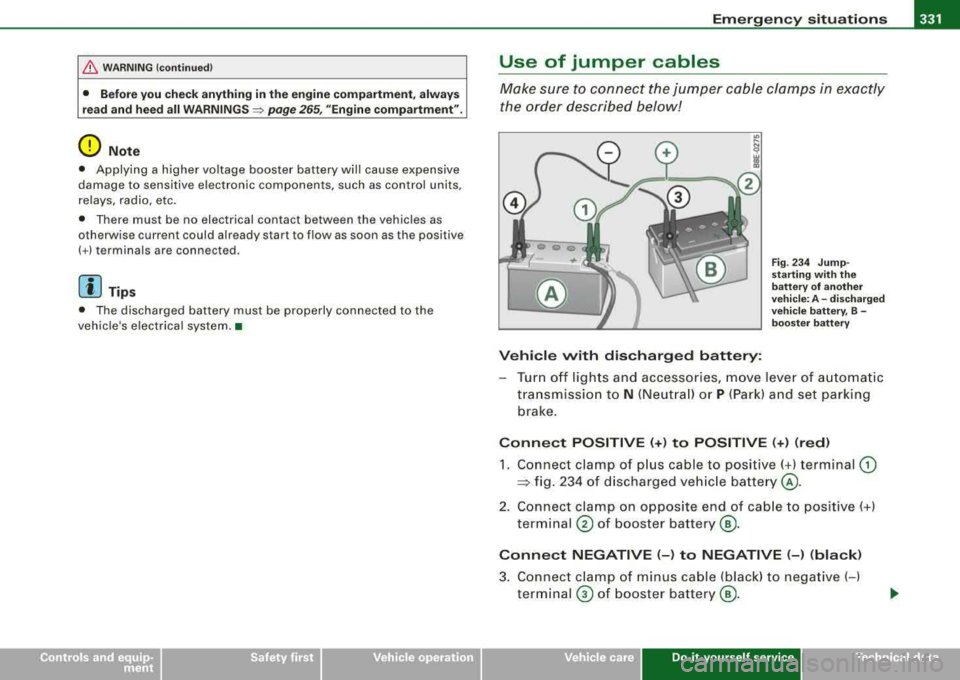
Make sure to connect the jumper cable clamps in exactly
the order described below!
Vehicle with discharged battery:
Fig. 234 Jump
starting with the
battery of another
vehicle: A -discharged
vehicle battery, B -
booster battery
- Turn off lights and accessories, move lever of automatic
transmission to
N (Neutral) or P (Park) and set parking
brake.
Connect POSITIVE (+) to POSITIVE (+) (red)
1. Connect clamp of plus cable to positive( +) terminal (D
:::> fig. 234 of discharged vehicle battery @.
2. Connect clamp on opposite end of cable to positive(+)
terminal
@ of booster battery ®·
Connect NEGATIVE (-) to NEGATIVE (-) (black)
3. Connect clamp of minus cable (black) to negative (-)
terminal
0 of booster battery®·
Do-it-yourse lf service irechnical data
Page 354 of 368
111'1_....::::A::.:l:.!: p :.:h..:.: a:::.:: b:.::e :.:t::i c::.::: a.:..l ..:.: in :..:.:: d:.:e :.:x::..... ___________________________________________ _
A
ABS (Anti- lock Brake System)
Warning/indicator lights ... .... .... 21
Accessories . .... .... .... .... .... ... 348
acoust ic park assist . . . . . . . . . . . . . . . . . 139
Adap tive light .. ... .... ... .. ...... ... 75
defective . . . . . . . . . . . . . . . . . . . . . . . . 35
Adding Engine coo lant
282
Engine oi l ... ... .. .... .... ... .... 278
Windshield washer fluid .... .... .. 291
Additiona l accessories .. ...... ...... . 348
Additives Eng ine oi l .. ....... ....... ....... 278
Adjustable steering whee l column .. ... 134
Adjusting Instrument cluster il lumina tion ... .. . 15
Steering wheel co lumn . ...... .... 134
Advanced A irbag System . .... ... .... 191
Ch ildren ... ........... .... ... ... 211
Components ...... .... ... .... ... 194
Fr ont airbags . . . . . . . . . . . . . . . . . . . . 192
How the c ompone nts wo rk togethe r 195
Monitoring . . . . . . . . . . . . . . . . . . . . . . 198
PASSE NGER AIR BAG O FF light ..... 199
Weight -sensing mat ....... ... .... 211
Air conditioner . . . . . . . . . . . . . . . . . . . . . 128
See also Climate controls . . . . . . . . . . 125
Air conditioning Switching on and off 128
A ir distribution
C limate controls . ...... ... .... ... 130 Air outlets
Adjusting the outlets for rapid defrosting/de fogging .. ...... .... 131
Cl imate con trols ...... .... .... ... 131
Air quality sensor . . . . . . . . . . . . . . . . . . . 129
Air recirculation .. ... .... .... .... ... 128
Clima te controls .. .... ..... .. .... 129
When should I use the air recircu lation?
129
Airbag Warning/indicator lights .... ... .... 20
Airbag system . . . . . . . . . . . . . . . . . . 187 , 205
Car e ...... .... .... .... .... .... .. 201
Child restraints .... .... .... .... .. 212
Componen ts (front airbags) .... ... . 194
Danger of fitting a chi ld safety seat on the
front passenger seat . . . . . . . . . . . . 189
Disposal .. ....... .... .... .... ... 201
Front airbags . .... ... .... .... .... 191
How do the front
ai rbags work? .... 196
How many airbags does my vehicle have? 194
I mportant things to know ....... .. 1 87
I ndicator light ... .. .... .... ... ... 198
Monitoring . . . . . . . . . . . . . . . . . . . . . . 198
Repairs ...... .... ... .... .... .... 201
Side airbags ... ...... .... ... .. ... 203
Side curtain airbags (SIDEGUARD) .. 207
When must the sys tem be inspec ted? ...
198
Alloy w heels . .... .... .... .... .... .. 260
All -wh ee l driv e 242
Winter tir es ..... .... .... ... .. ... 310 A
lternator
See Generator . . . . . . . . . . . . . . . . . . . . 22
Aluminum al loy wheels . ...... .... ... 260
Ambient light ing . ....... .... ... .. .... 82
Anti-free ze
See Engine coolant system ........ 280
Anti -glare inside day -ni ght mi rro r .. ... . 90
An ti- lock B rake System (ABS)
How the ABS system works . ....... 240
Warning/indicator l ights ........... . 21
Anti -Slip R egulation Syst em (ASR)
How the sys tem works .... .... .... 238
An ti- theft systems
Anti -theft ala rm system .. ...... .... 64
Electronic immobilizer .. ... .... ... . 5 4
Tilt sensors . .... .... ... .... .... ... 65
Armrest Adjusting ...... .... ... .... ..... . 102
Storage bi n
Ashtray 1
02
Front . .... .... .... .... ... .... ... 119
Rear ...... .... .... .... ... .... ... 119
ASR Anti- Slip Regulation System .... ... 238
Asterisk What does it mean when something is marked with an asterisk? .. ... .... .. 6
Attachment hooks ... .... .... .... ... 112
Aud i Service Repa ir Manuals and Lite rature
346
Page 355 of 368
Alph ab eti ca l ind ex -
-------------=----
AUTO
Climate controls ...... .... ...... .. 127
Switching on .................... 127
When should I use AUTO? ......... 127
Auto Safety Hotline ................. . 175
Auto-C heck Contro l ...... .... ... .... .. 28
Au toma tic transmission ...... .... .. 30
Manua l transmission .. ...... .... .. 29
Automa tic a ir recircu lation ........... 129
Automatic belt retractor .......... .... 181
Automat ic car was h
See Washing ...... .... ... .... .... 255
Automatic headlight control ........... 73
Automatic Sh ift Lock (ASU .. ..... 145, 152
Automatic transmission 6-speed automatic transmission 143, 144
Ign it ion key safety lock . ...... .... . 136
Shift but tons .. ...... .... .... 148, 155
Steering wheel wit h tiptronic® . 148,155
See also mu ltit ronic™ ... .. ...... .. 149
Automat ic trans mission (6 -speed)
Automat ic Shift Lock (ASU ... .. ... . 145
Driving .. .. .. .... .... ..... .. .... 1 43
Dynamic shift program ... .... .... . 146
Fa il- safe mode . ...... .... .... .... 149
Kic k-down ... .... .... .... ... .... . 146
Manual shift program (tiptronic®) .. 147
Average speed ....................... 41
Avoid damaging the vehicle .. ...... .. 245
Controls and equip
ment Safety first
B
Battery .....
.... .... .... .... ... 285, 288
Battery location ins ide the eng ine
compartment .. ...... .... .... ... 285
Charging . ............ ........... 289
Checking battery acid level . ........ 288
Connecting .... .. ..... .... .... ... 290
Disconnecting ............ .... ... 290
Important warnings when working on the
battery ... .. .... .... .... .... ... 286
Removing the battery ... .. .... .... 290
Replacing the battery ............. 29 1
Winter operation . ................ 285
Working on the battery ............ 286
Bat tery vo ltage .. ... ... .... .... .... .. 35
Before driving ...................... 167
Blended gasoline . .... ............... 267
Body cavity sealing ...... .... .... ... . 260
Booster seats .......... .... .... ..... 218
How do I properly instal l a booster seat in
my vehicle? ... .. .... .... .... ... 218
Safety inst ructions ... .. .... .... ... 218
Brake assista nt ..... .... .... .... .... 241
Brake booster .......... ...... .... ... 240
Brake f luid
Changing the brake flu id ...... .... 284
Check ing the brake fluid leve l ...... 284
Reservoi r .... .... .... ..... .. .... . 28 4
What is the correct brake f luid level? 284
What shou ld I do if
t he brake fluid warning
l igh t comes on? ... .. .... .... .... 284 Brake system
...... .... .... .... .. 31,284
Anti -lock Brake System (ABS) ........ 21
Brake fluid ....................... 284
Brake f lu id spec ificat ions for refi ll and
replacement ..... .... .... .... ... 28 4
Brake pads ...................... 244
Warning/indicator lights ...... ...... 23
Brakes ...... .... .... .... ... .... .... 239
Adverse cond itions affec ting bra ke
performance ...... .... .... ..... 239
Break -in period ....... ........ ...... 243
Brake pads ........... .... .... ... 244
Tires .. .... ....... .... ...... ..... 243
Bu lbs .. ...... .... .... ... .... .... ... 328
C
Ca lif o rnia Pr opo sit ion 65 War ning ... .. 274
Batte ry specific . ...... .... .... .... 287
Capacities .......................... 343
Car care . .... .... ........... .... .... 254
Interior .... ... .... .... .... .... ... 261
Plastic and vinyl .... ............. . 258
Weatherstrips .... ... .. ...... .... . 259
Ca re of exterior ..... .... .... .... .... 254
Care, service and disposal Safety belt tensioner .............. 186
Cargo area
See Loading the luggage compartment .
173
Cargo net .......................... 108
Catalytic converter ...... .... .... .... 24 4
Vehicle operation Vehicle care Do-it-yourself service Technical data