brake AUDI A4 AVANT 2008 Workshop Manual
[x] Cancel search | Manufacturer: AUDI, Model Year: 2008, Model line: A4 AVANT, Model: AUDI A4 AVANT 2008Pages: 368, PDF Size: 46.19 MB
Page 277 of 368
Checking and filling -
------------ ----=---a::;;._...a
©
©
(i)
Coolant expansion tank ( ... L) ...... ... .. ..... .. ... .
Windshield/headlight washer container
( 0 ) ...... . .
Power steering reservoir (green cap)
& WARNING
Before you check anything in the engine compartment, always
read and heed all WARNINGS
=> & in "Working in the engine
compartment" on
page 273. •
Applies to vehicles: with 6 -cy lin d er engine
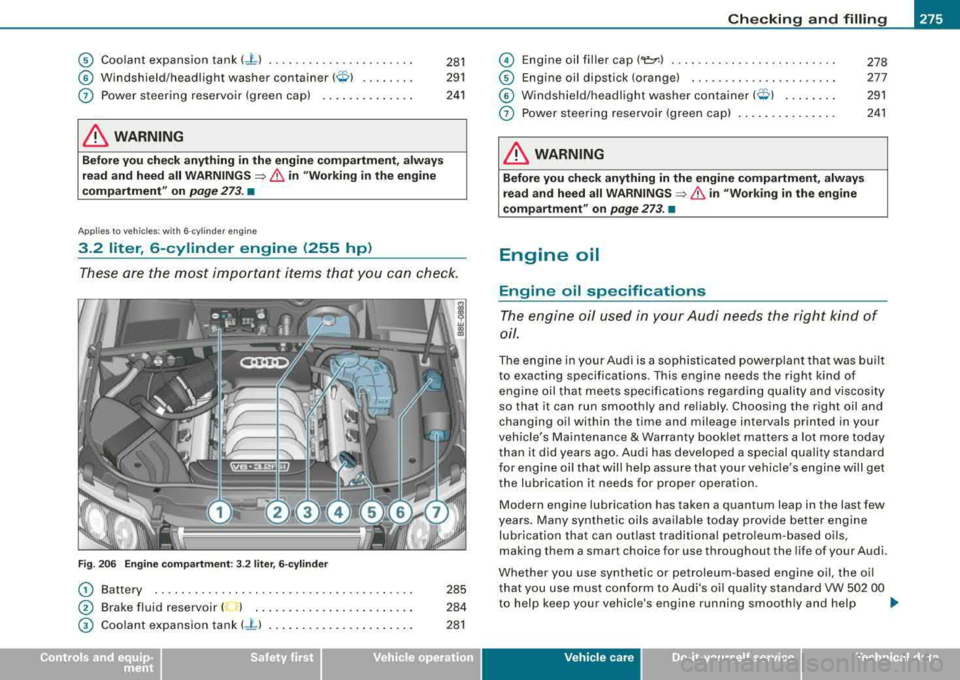
3.2 liter , 6-cylinder engine (255 hp)
281
291
241
These are the most important items that you can check.
Fig . 206 Engine compartment: 3 .2 liter , 6-cylinder
CD
0
©
Battery .. ............... ... .. ...... .... ...... .
Brake fluid reservoir (
... ) . .. ... ... .... .... ...... .
Coo lant expansion tank
(J _)
285
284
281
©
©
©
(i)
Engine oil filler cap (
Windshield/headlight washer container
( O ) ... .... .
Power steering reservoir (green cap)
& WARNING
Before you check anything in the engine compartment , always
read and heed all WARNINGS
=> & in "Working in the engine
compartment" on
page 273. •
Engine oil
Engine oil specifications
278
277
291
241
The engine oil used in your Audi needs the right kind of
oil.
The engine in your Audi is a sophisticated powerplant that was built
to exacting specifications . This engine needs the right kind of
engine oil that meets specifications regarding quality and viscosity
so that it can run smoothly and re liably . Choosing the right oil and
changing oil within the time and mileage intervals printed in your
vehicle's Maintenance
& Warranty booklet matters a lot more today
than it did years ago. Audi has developed a special quality standard
f or engine oil that wil l help assure that your vehicle's engine wi ll get
the lubrication it needs for proper operation .
Modern engine lubrication has taken a quantum leap in the last few
years. Many synthetic oils available today provide better engine
lubrication that can outlast traditional petroleum-based oils,
making them a smart choice for use throughout the life of your Audi .
Whether you use synthetic or petroleum -based engine oil, the oil
that you use must conform to Audi's oi l quality standard VW 502 00
to help keep your vehicle 's engine running smoothly and help
.,_
Ve hic le care Technical data
Page 286 of 368

ffl...__C_ h_ e_c _k_ i_n ..::g a- a_n_ d_ f_ il _li_ n""" g:::a.-___________________________________________ _
Brake f luid
Checking brake fluid level
The brake fluid level c an be checked with a quick glance .
Fig. 212 Engin e
co mp artm ent: B rak e
f lu id rese rvoi r
Before you check a nything in the e ngine compartment,
alway s re ad and he ed all WARNINGS ~ & in "Working in
the engi ne com partment" on
page 273.
- Pull the rubber st rip @ up partially and lift the cover @
slightly~ fig. 212 .
- Read the brake fluid level from the brake fluid reservoi r
@. The brake fluid level must be between the "MIN" and
"MAX" markings.
The brake fluid reservoir is located at the rear partition of the engine
compartment on the le ft side
~ page 275.
The fluid level may drop slightly after some time due to the auto
matic adjustment of the brake pads. This is not cause for alarm.
If the brake fluid level fal ls
considerably below the "MIN" mark, the
brake warning/indicator light (U .S . models :
BRAKE, Canadian models:
0) will come on=> page 23 and~ page 31 . Do not continue to
opera te the vehicle. The complete brake system should be thor
oughly checked by an authorized Audi dealer or qua lified workshop
and the cause corrected. If the brake fluid level is too low, the brake
warning/indicator light will illuminate . Contact an authorized Audi
dea ler
immedi atel y.•
Changing brake fluid
H ave the brake fluid changed by an experienced techni
cian.
Brake fluid absorbs mo isture from the air . If the water content in the
brake fluid is too high, corrosion in the brake system may result
after a period of time. The bo iling point of the brake fluid wil l a lso
decrease considerably and decrease braking performance.
Therefore, the brake fluid must be changed
e ver y tw o year s. Always
use new brake fluid which conforms to Federal Motor Vehic le Stan
dard "FMVSS 116 DOT
4".
The brake fluid rese rvo ir can be difficult to reach, therefore, we
recommend that you have the brake fluid changed by your autho
rized
Audi dealer . Your dealer has the correct tools, the right brake
fl uid and the know-how to do this for you.
& WARNING
• Brake fluid is po is o nou s. It m ust be stored only in the clo se d
orig inal container out of the re ach of children!
• Brake f ailure can resu lt from old o r inapp ropriat e brake fluid .
Ob serve the se precaution s:
- Use only brake fl uid that me ets SAE spe cific atio n
J 1703 and
conform s to F ederal Motor Vehicle Standard 11 6. Alway s check
with y our authorized A ud i dealer t o ma ke sure you are u sing
th e c orrect br ake fluid . The correct type of brake fluid i s al so
i ndicated on the brake flu id re ser voir .
..,_
Page 287 of 368
___________________________________________ C_ h_e _c_ k_ i_n ~g _ a_n _d_ f_il _li _n ~g __ _
& WARNING (continued)
-The brake fluid must be new. Heavy use of the brakes can
cause a vapor lock if the brake fluid is left in the system too
long. This can seriously affect the efficiency of the brakes as
well as your safety. This could result in an accident.
0 Note
Brake fluid will damage the paint of your vehicle.
W For the sake of the environment
Because of the problem of proper disposal of brake fluid as well as
the special tools required and the necessary expertise, we recom
mend that you have the brake fluid changed by your authorized Audi
dealer. •
Battery
General information
Under normal operating conditions, the battery in your Audi does
not need any maintenance. With
high outside temperatures it is
advisable however to check the fluid level at regular intervals
through the transparent battery housing. Also check the fluid level
each time you charge the battery. After charging the battery
~ page 289, you should likewise check the battery acid level.
Have the battery checked when you take your vehicle in for service.
You are well advised to replace a battery that is older than 5 years.
Preserving battery charge on a vehicle not operated
for a long time
Some components of the electrical equipment (for example, the
electronic immobilizer) will keep drawing a low current even when the car is
not running
. This will eventually drain the battery
completely if your vehicle is left sitting for a long period of time
without being driven . To prevent this, either charge the battery
occasionally or disconnect the battery negative (ground) cable.
Winter operation
During the winter months, battery capacity tends to decrease as
temperatures drop . This is because more power is also consumed
while starting, and the headlights, rear window defogger, etc., are
used more often.
Avoid unnecessary power consumpt ion, particularly in city traff ic or
when traveling only short distances. Let your authorized Audi dealer
check the capacity of the vehicle battery before winter sets in
~ page 289. A well charged battery will not only prevent starting
problems when the weather is cold, but will also last longer.
[ i] Tips
If your vehicle is left standing for several weeks at extremely low
temperatures, the vehicle battery should be removed and stored
where it will not freeze. This will prevent it from being damaged and
having to be replaced. •
Location of the vehicle battery
The vehicle battery is located in the plenum chamber at the back of
the engine
compartment~ page 275.
The positive(+) battery terminal is protected by a plastic cover. This cover must be removed to access to the positive(+) terminal when
connecting jumper cables to start the engine .
& WARNING
Before you check anything in the engine compartment, always
read and heed all WARNINGS
~ & in "Working in the engine
compartment" on
page 273. •
Vehicle care
Page 295 of 368
________________________________________________ T_ i
_ r_e _s_ a_n_ d_ w_ h_ e_e _ l_s __ lllll
Tires and wheels
Tires
General notes
Tires may be the least appreciated and most abused parts
of a motor vehicle.
T ires may be the least appreciated and most abused parts of a
motor vehic le. Tires are, however, one of the most important parts
of a vehicle, particu lar ly considering the comparat ive ly sma ll patch
of rubber on each tire that assures that a ll-important contact
between you, your vehicle and the road .
Maintaining the correct tire pressure, making sure that your vehicle
and i ts tires do not have to carry more weight than they can safely
handle, avoiding damage from road hazards and regular ly
inspecting tires for damage inc luding cuts, s lashes irregular wear
and overa ll condition are the most important things that you can do
to help avoid sudden tire failure including tread separation and
b lowou ts .
Av oiding d am ag e
If you have to drive over a curb or similar obstacle, drive very slowly
and as close as possible at a right angle to the curb.
A lways keep chemica ls including grease, o il, gasoline a nd brake
fluid off the tires.
I nspect the t ires regularly for damage (cuts, cracks or blisters, etc .l.
Remove any foreign bodies embedded in the treads.
Storing tire s
Mark tires when you remove them to indicate the direction of rota
t ion . This ensu res you to be ab le to mou nt them correctly w he n you
reinstal l them. When removed, the whee
ls or tires should be stored in a coo l, dry
and preferably dark place.
St ore tires in a vertical posit ion i f th ey are not mounted on r ims, in
a horizontal position if they are mounted on rims.
New tire s
New tires have to be broken in => &.
The tread dept h of new tires may vary, according to the type and
make of tire and the tread pattern .
Hidden damage
Damage to tires and rims is often not readily visible. If you notice
unusua l vibration or t he veh ic le pul ls to one side, this may indicate
that one of the tires has been damaged . The tires must be checked
immediately by an author ized Audi dealer or qualified workshop .
Unidire ction al tires
A unidirectio nal tire can be ide ntif ied by arr ows on the s idewa ll, t hat
point in the direction the tire is designed to rotate. You must fo llow
the specified direct ion of ro tation . This is necessary so t hat these
tires can deve lop their optimum characteristics regarding grip, road
noise, wear and hydroplaning resistance . For more info rmation
=> page 324.
& WARNING
Ne w tire s or tire s that are old , wo rn o r damaged cannot p ro vide
maximum control and braking abilit y.
• New tires tend to be slippery and mu st be brok en in . To redu ce
the ri sk of lo sing control , a c ollision and seriou s per sonal injuries ,
dri ve w ith special ca re for the fi rst 350 mile s (560 km l.
• Driving with worn or damaged tire s can lead to lo ss of control ,
sudden tire fa ilure , in cluding a blowout and sudden deflation ,
.,_
Vehicle care
Page 296 of 368
___ T_ ir_e _ s_ a_ n
_ d_ w_ h_ e_ e_ls _________________________________________________ _
&, WARNING (continued)
crashes and serious personal injuries . Have worn or damaged tires
replaced immediately.
• Tires age even if they are not being used and can fail suddenly,
especially at high speeds. Tires that are more than 6 years old can
only be used in an emergency and then with special care and at
low speed.
Glossary of tire and loading terminology
Accessory weight
means the combined weight (in excess of those standard items
which may be replaced) of automatic transmission, power steering,
power brakes, power windows, power seats, radio, and heater, to
the extent that these items are available as factory-installed equip
ment (whether installed or not).
Aspect ratio means the ratio of the height to the width of the tire in percent.
Numb ers of 55 or lower indicate a low sidewall for improved
steering response and better overall handling on dry pavement.
Bead means the part of the tire that is made of steel wires, wrapped or
reinforced by ply cords and that is shaped to fit the rim.
Bead separation
means a breakdown of the bond between components in the bead.
Cord
means the strands forming the plies in the tire.
&, WARNING (continued)
• Never mount used tires on your vehicle if you are not sure of
their "previous history." Old used tires may have been damaged
even though the damage cannot be seen that can lead to sudden
tire failure and loss of vehicle control.
• If you notice unusual vibration or if the vehicle pulls to one side
when driving, always stop as soon as it is safe to do so and check
the wheels and tires for damage.
•
Cold tire inflation pressure
means the tire pressure recommended by the vehicle manufacturer
for a tire of a designated size that has not been driven for more than
a couple of miles (kilometers) at low speeds in the three hour period
before the tire pressure is measured or adjusted .
Curb weight
means the weight of a motor vehicle with standard equipment
including the maximum capacity of fuel, oil, and coolant, air condi
tioning and additional weight of optional equipment.
Extra load tire
means a tire designed to operate at higher loads and at higher infla
tion pressures then the corresponding standard tire. Extra load tires
my be identified as "XL", "xi", "EXTRA LOAD", or
"RF" on the side
wall.
Gross Axle Weight Rating ("GAWR")
means the load-carrying capacity of a single axle system, measured
at the tire-ground interfaces .
Gross Vehicle Weight Rating ("GVWR")
means the maximum total loaded weight of the vehicle.
Page 297 of 368
__________________________________________________ T_ ir_e_ s_ a_ n_d _ w_ h_ e_ e_l_s _____ llll
Groove
means the space between two adjacent tread ribs.
L oa d ratin g (code)
means the maximum load that a t ire is rated to carry for a given
inflation pressure. You may not find this information on all tires
because it is not required by law.
M ax imum l oad r atin g
means the load rat ing for a t ire at the maximum permiss ib le infla
tion pressure for that tire.
Ma ximum l oaded vehicle we ight
means the sum of :
(al Curb weight
(b) Accessory weight
(c) Vehicle capacity weight, and
(d) Production opt ions weight
M ax imum (permissibl e) infl ati on press ure
means the maximum cold inflatio n pressure to wh ich a t ire may be
inflated. Also ca lled "maximum inflation pressure ."
No rm al occ upant we ight
means 150 lbs. (68 ki lograms) times the number of occupants
seated in the vehicle up to the total seati ng capacity of your vehicle .
Occupant distributi on
means distribution of occupants in a vehicle .
Outer diameter
means the overal l diameter of an inflated new tire.
Ove rall width
means the linear distance between the exteriors of the sidewa lls of
an inf lated t ire, including elevations due to labe ling, decorat ions, or
protective bands or ribs .
Ply
means a layer of rubber -coated para lle l cords.
Pr odu ction opt io ns weig ht
means the comb ined weight of those installed regular product ion
options weighing over 5 lbs . (2.3 kg) in excess of those standard
items which they replace, not previously cons idered in curb weight
or accessory weight, inc luding heavy duty brakes, ride levelers, roof
rack, heavy duty ba ttery, and specia l trim .
Radi al pl y tir e
means a pneumat ic tire in which the ply cords that extend to the
beads are laid at substantially 90 degrees to the centerline of the
tread .
Recomm ended infl ati on p ress ure
see => page 294, "Cold tire inflat io n pressure".
Reinfor ced tir e
means a tire designed to operate at higher loads and at higher infla
tion pressures then the corresponding standard tire. Reinforced
t ires my be ide ntified as "XL", "xi", "EXTRA LOAD", or "RF" on the
sidewall.
Rim
means a metal support for a tire or a tire and tube assembly upon
wh ich the t ire beads are seated.
Rim di ameter
means nom inal d iameter o f the bead seat. I f you change your whee l
size, you wi ll have to purchase new tires to match the new rim diam
eter.
Rim siz e design ation
means rim diameter and width.
R im width
means nominal distance between rim flanges .
Vehicle care
Page 301 of 368
________________________________________________ T_ i
_ r_e _s_ a_n_ d_ w_ h_ e_e _ l_s __ fflll
The correct tire pressure for the spore wheel is located on a label
either on the driver's side B-pillar or inside the fuel filler flap.
Because technical changes may be made to vehicle equipment
during the model year, always compare the tire size designation on
the tire pressure label on your vehicle with the tires on your vehicle.
Make sure that the tire size information on the vehicle label is the
same as the size of the tires on the vehicle. This is especially impor
tant if the vehicle belongs to someone else or you bought the
vehicle with different rims/tires or you bought the vehicle as a previ
ously owned vehicle .
Remember, your safety and that of your passengers also depends
on making sure that load limits are not exceeded. Vehicle load
includes everybody and everything in and on the vehicle. These load
limits are technically referred to as the vehicle's Gross Vehicle
Weight Rating ("GVWR"l. The Gross Axle Weight Rating ("GAWR"l is
the maximum load that can be applied at each of the vehicle's two
axles. The Gross Vehicle Weight Rating and the Gross Axle Weight
Rating are listed on the safety compliance sticker label located
either on the driver's side B-pillar or on the inside of the fuel filler
flap. The tire pressure label on your Audi lists the maximum
combined weight of all of the occupants and luggage or other cargo
that the vehicle can carry. For the location of the tire pressure label
=> page 297, fig. 217.
& WARNING
Overloading a vehicle can cause loss of vehicle control, a crash or
other accident, serious personal injury, and even death.
• Carrying more weight than your vehicle was designed to carry
will prevent the vehicle from handling properly and increase the risk of a loss of vehicle control.
• The brakes on a vehicle that has been overloaded may not be
able to stop the vehicle within a safe distance.
• Tires on a vehicle that has been overloaded can fail suddenly
causing loss of control and a crash.
& WARNING (continued)
• Always make sure that the total load being transported -
including the weight of a trailer hitch and the tongue weight of a
loaded trailer -does not make the vehicle heavier than the
vehicle's Gross Vehicle Weight Rating.
& WARNING
• Incorrect tire pressures and/or underinflation can lead to a
serious or fatal accident.
• Incorrect tire pressures and/or underinflation cause increased
tire wear and can affect the handling of the vehicle.
• Incorrect tire pressures and/or underinflation can also lead to
sudden tire failure, including a blowout and sudden deflation,
causing loss of vehicle control. •
Checking tire pressure
The correct tire pressure for the tires originally installed
on your vehicle is listed on the tire pressure label located
either on driver's side B-pillar or inside the fuel filler flap.
The recommended tire pressures are on the tire pressure label and
in the
table=> page 297, "Cold tire inflation pressure". This means
that the pressure must be checked and adjusted when the tire has
not been driven for more than a couple of miles (kilometers) at low
speeds during the previous three hours. Air in the tires expands
when the tire heats up as a result of internal friction as it flexes in
use. The tire pressure is higher when the tire has warmed up than
when it is "cold."
It is the inflation pressure in a "cold" tire that counts. Therefore, you
should never let air out of a warm tire to match "Cold tire inflation
pressure"
recommendations=> page 297. The tires would then be
underinflated and could fail suddenly. .,._
Vehicle care
Page 304 of 368
11!1 Tires and wheels
in the vehicle or passengers who are heavier than the standard
we ig ht s assume d mean that less weig ht ca n be carr ied as luggage.
T he tire pressure labe l on your Audi also lists the max imum
combined weight of a ll of t he occupants and luggage or other cargo
t h at t he ve hicle ca n ca rry. For t he location of t he
labe l~ page 2 97,
fig. 217.
LJ}. WARNING
Overloading a vehicle can cause loss of vehicle control, a crash or
other accident , serious personal injury, and even death .
• Carrying more weight than your vehicle was designed to carry
will prevent the vehi cle from handling properly and in crease the
risk of the loss of vehicle control.
• The brakes on a vehi cle that has been overloaded may not be
able to stop the vehicle within a safe distance .
• Tires on a veh icle that has been overloaded can fail suddenly ,
including a blowout and sudden deflation , causing loss of control
and a cra sh .
• Always make sure that the total load being transported -
including the weight of a trailer hitch and the tongue weight of a
loaded trailer -does not make the vehicle heavier than the
vehi cle 's Gro ss Vehicle Weight Rating .•
Determining correct load limit
Use the example below to calculate the
total weight of the passengers and luggage or other things that you plan to
transport so that you can make sure that
your vehicle will not be overloaded.
Steps for Determining Correct Load Limit
1. Locate the statement "THE COMBINED
WEIGHT OF OCCUPANTS AND CARGO SHOULD NEVER EXCEED XXX KG OR XXX
LBS " on your vehicle's placard (tire infla
tion pressure
label) => page 297, fig. 217.
2. Determine the combined weight of the driver and passengers that will be riding
in your vehicle.
3. Subtract the combined weight of the driver and passengers from
"XXX" kilo
grams or
"XXX" pounds shown on the
sticker=> page 297 , fig. 217.
4. The resulting figure equals the available amount of cargo and luggage load capacity. For example, if the
" XXX"
amount equals 1400 lbs. and there will
be five 150 lbs. passengers in your
vehicle, the amount of available cargo
and luggage load capacity is 650 lbs. (1400 -750 (5
X 150) = 650 lbs.) ..
Page 306 of 368
___ T_ ir_e _ s_ a_ n
_ d_ w_ h_ e_ e_ls _________________________________________________ _
make, there w ill be six to eight of t hem evenly p laced around the
tir e. M arks o n the tire s idewall ( for example "TWI " or oth er sy mb ols)
indicate th e positions of the tread wear indicators. Worn tires must
b e re placed . Di fferen t fig ure s m ay apply i n other
c ountr ies=> & .
Tire pressure
Incorr ect tir e p ress ure c auses prematu re wear a nd can ca use
sudden tir e blow -out . For th is r eason, tir e pressur e must b e check ed
at leas t once a month
=> pa ge 299 .
Dri ving style
Drivi ng fa st aro und curv es, heavy acce le ra ti on and ha rd bra kin g
increase tire wear .
Rotating tires for more even wear
For all four tires on your vehic le to have the same service life, we
r ecom mend t hat the front a nd rea r tires ar e rotate d accord ing to the
tire manufacturer 's suggested tire rotation interva ls. Please
r e m emb er t he fo llo wi ng :
• Ti re rotation interva ls m ay d iffer from th e vehic le servic e inter
vals outl ined in y our M aintenance and Warran ty Boo kle t.
• T he longer one tire is used in one location on the vehicle, the
mor e it wea rs a t ce rtain points ; the re fo re, we rec omm end that yo u
fo llow t he ti re manufactu rer's su ggested tir e rotat ion int ervals .
• Vehi cle s with front -wh eel d rive e xper ience mo re trea d wea r on
the front wheels compared to al l-wheel drive (quattro®l .
• Ple as e ro tat e ti res as
sh ow n=> page 303, fig. 220.
• Extra care must be taken when rotating direction -specific tires
=> pag e 32 4.
Wheel balancing
T he wheels on n ew vehic les are bala nced. However, various situa
tions during eve ryday driving can cause them to become unba l
ance d, res ulting i n vi brat ions you ca n us ual ly f eel thro ugh t he
steering whee l. U
nba lanc ed wh eels must be rebalanced to avoid excessive wear on
s tee ring, s uspen sio n an d tir es. A w heel m ust also be reba la nced
when a new tire is install ed.
Incorrect wheel alignment
Incorrect whee l alignment can cause excessive tire wear, impairing
t he sa fety o f the vehicl e. If ti res sh ow ex cessiv e w ear, h av e the
whee l al ignm ent check ed by an autho riz ed Aud i d eal er or qualifi ed
w ork shop.
All Wheel Drive
Ve hicl es wi th qu attr o® must alw ays h ave t ires of t he sa me siz e,
construction and tread type . For deta ils
see=> page 242 .
& WARNING
Sudden tire failure can lead to loss of control , a crash and serious
personal injury!
• Never drive a vehicle when the tread on any tire is worn down
to the wear indicators .
• Especially in wet and slick driving situations , a preferably large
profile depth of the tires is necessary , and an approximately
similar profile depth of the front and rear axle tires.
• The diminished driving safety , caused by too small of a tire
profile, is negatively perceivable especially in handling , in danger
of hydroplaning when driving through deep puddles and ponds,
when driving around curves , and in braking behavior.
• Worn tires are a safety hazard , they do not grip well on wet
roads and increase your risk of "hydroplaning" and loss of control.
• Always keep chem icals that can cause tire damage , such as
grease, oil, gasoline and brake fluid away from tires .
• Tires age even if they are not being used and can fail suddenly ,
especially at high speeds. Tires that are more than 6 years old can
only be used in an emergency and then with special care and at
lower speeds .
~
Page 310 of 368
___ T_ ir_e _ s_ a_ n
_ d_ w_ h_ e_ e_ls _________________________________________________ _
& WARNING
• Using incorrect or unmatched tires and / or wheels or improper
tire and wheel combinations can lead to loss of control , collision
and serious personal injury .
• Always u se tires , rims and wheel bolts that meet the specifica
tions of original factory -installed tires or other combinations that
have been specifically approved by the vehicle manufacturer.
• Tires age even if they are not being used and can fail suddenly ,
especially at high speeds . Tires that are more than 6 years old can
only be used in an emergen cy and then with special care and at
lower speed s.
• Never mount used tires on your vehi cle if you are not sure of
their "previous history." Old used tires may have been damaged
even though the damage cannot be seen that can lead to sudden
tire failure and loss of vehicle control.
• All four wheels must be fitted with radial tires of the same type ,
size (rolling circumference ) and the same tread pattern. Driving
with different tires reduces vehi cle handling and can lead to a loss
of control.
• If the spare t ire is not the same as the tires that are mounted
on the vehicle -for example with winter tires -only use the spare
tire for a short period of time and drive with extra care . Refit the
normal road wheel as soon as safely possible.
• Never drive faster than the ma ximum speed for wh ich the tires
on your vehicle are rated because tires that are driven faster than
their rated speed can fail suddenly .
• Overloading tire s cause heat build -up , sudden tire failure ,
including a blowout and sudden deflation and loss of control.
• Temperature grades apply to tires that are properly inflated and
not over or underinflated .
• For technical reasons it is not always possible to use wheel s
from other vehicles - in some cases not even wheels from the
same vehicle model.
& WARNING (continued )
• If you install wheel trim discs on the vehicle wheels, make sure
that the air flow to the brakes is not blocked . Reduced airflow to
the brakes can them to overheat , increasing stopping distances
and causing a collision .
• Run flat tires may only be used on vehicles that were equipped
with them at the factory. The vehicle must have a chassis designed
for run flat tires and a factory-installed tire pressure monitoring
s ystem that indicate s a loss of tire pressure . Incorrect use of run
flat tires can lead to vehicle damage or ac cidents . Check with an
authorized Audi dealer or tire specialist to see if your vehicle can
be equ ipped with run flat tires . If run flat tires are used , they must
be installed on all four wheels . Mixing tire types is not permitted.
0 Note
• For tec hnical r eas ons, it is no t gene rally possible to use the
whee l rims from other vehicles . ihis can hold true for wheels of the
same ve hicle type.
• I f the spare tire is different from the tires that you have mounted
on y our ve hicle (f or exampl e wi nter t ires or wide p ro fi le tir es), then
use the spa re tire fo r a short per iod of time on ly and d rive with extra
c a re . Rep lace the flat t ire wi th the ti re m atc h ing t he oth ers o n you r
vehic le as soon as possib le .
• If yo u should put diff eren t w heels a nd tires on yo ur vehi cle (e. g.
winter wheels and tires), you must be certa in that the wheels and
t ires a re co mpatibl e w ith the tire press ur e m onit orin g sys te m.
Otherwise the system will regist er a ma lfunction and a fau lt
mes sage wil l be d isp layed . Fo r mo re info rmation, contact yo ur Audi
dea ler .
0 Note
• When i nsta lling new ti res, be care fu l n ot to damage t he va lves o r
tire press ure mon itoring system* sensors . .,_