seats AUDI A4 AVANT 2008 Workshop Manual
[x] Cancel search | Manufacturer: AUDI, Model Year: 2008, Model line: A4 AVANT, Model: AUDI A4 AVANT 2008Pages: 368, PDF Size: 46.19 MB
Page 229 of 368
Child Safety -
---------------''------'
lower anchorages and help protect the seat material from
possible damage when installing child restraints that have
rigid lower anchorages and not straps with hooks.
Installing the guidance fixtures
- Push down on the seat cushion so that the lower anchor
ages are visible.
- Hold the guidance fixture with the part number facing downward and push it in the direction of the arrow onto
the
anchorage => fig. 193.
- Make sure that each of the two guidance fixtures per seat snaps into place.
Removing the guidance fixtures
- Remove the child restraint according the child restraint
manufacturer's instructions.
- Push down on the seat cushion so that the lower anchor
ages are visible.
- Pull off the guidance fixtures from the lower anchorages.
- Always remove the guidance fixtures and keep them in a
safe place when not in use.
You may find it easier to install child restraints equipped with hooks
attached to straps without the guidance fixtures in place. If this is
the case, remove the guidance fixtures by pulling them off the
anchorages. However, the guidance fixtures can help you to locate
the
LATCH anchorages.
& WARNING
Improper use of tether anchorages or lower anchorages can cause
serious personal injury in a crash.
Controls and equip ment Safety first Vehicle operation
& WARNING
(continued)
• Always carefully follow the child restraint manufacturer's
instructions for proper installation and use of child restraint
systems.
• Never use the
LATCH or tether anchorages to attach safety
belts or other kinds of occupant restraints.
• Child restraint tether attachments and lower attachments are
only designed to secure a child restraint that has been equipped
to use these anchorages.
• Tether anchorages and lower anchorages are designed to with
stand only those loads imposed by correctly fitted child restraints.
Under no circumstances can they be used safely for adult or child
safety belts or harnesses.
• Never mount more than one child restraint to a single tether or
to a lower anchorage point. Attaching two child restraints to a
single anchorage point can cause the anchorage to fail and cause
serious personal injury in a crash.
0 Note
• Remove the guidance fix tures before folding the rear seatback to
prevent damaging the seat cushion.
• If you leave the guidance fixtures ins talled for several days , they
could leave a mark on the upholstery on the seat cushion and back
rest in the area that the guidance fixtures were ins talled. The uphol
stery would also be permanently stretched around the guidance
fixtures. This applies especially to leather seats .
[ i] Tips
• Always remove the guidance fixtures when not in use.
• Please keep the guidance fixtures in a safe place with the vehicle
when not in use .•
Vehicle care Do-it-yourself service Technical data
Page 230 of 368
___ C_h_ i_ld _ S_ a_ f_ e_ t--= y'-------------------------------------------------
Installing a child restraint using the lower
anchorages of the LATCH system
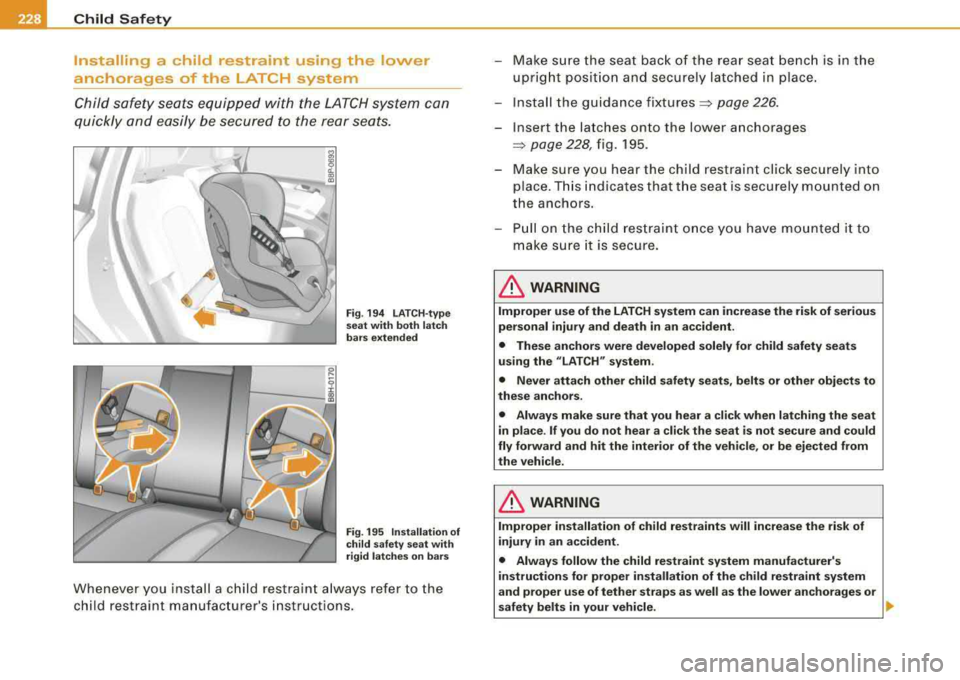
Child safety seats equipped with the LATCH system can
quickly and easily be secured to the rear seats.
Fig . 194 LATCH-type
seat with both latch
bars extended
Fig . 195 Installation of
child safety seat with
rigid latches on bars
Whenever you install a child restra int always refer to the
child restra int manufacturer's instructions.
-Make sure the seat back of the rear seat bench is in the
upright position and securely latched in place.
- Insta ll the guidance
fixtures ~ page 226.
- Insert the latche s onto the lower anchorages
=> page 228, fig. 195.
- Make sure you hear the child restraint click securely into
place. This indicates that the seat is securely mounted on
the anchors.
-Pull on the child restraint once you have mounted it to
make sure it is secure.
& WARNING
Improper use of the LATCH system can increase the risk of serious
personal injury and death in an accident.
• These anchors were developed solely for child safety seats
using the
" LATCH" system .
• Never attach other child safety seats, belts or other objects to
these anchors.
• Always make sure that you hear a click when latching the seat
in place. If you do not hear a click the seat is not secure and could
fly forward and hit the interior of the vehicle, or be ejected from
the vehicle.
& WARNING
Improper installation of child restraints will increase the risk of
injury in an accident.
• Always follow the child restraint system manufacturer's
instructions for proper installation of the child restraint system
and proper use of tether straps as well as the lower anchorages or
safety belts in your vehicle.
.,..
Page 232 of 368
•----=C:...:.h.:..: i.:..:ld ~ S=- a=- f.:....: e=- t~ Y:___ _____________________________________________ _
& W ARNING (continued )
• Improper use of child restraint anchors (tether anchors ) could
lead to injury in a collision . The anchors are des igned to withstand
only those loads imposed by correctly fitted child restraints .
• Never mount t wo child restraint systems on one LATCH lower
anchor point .
• Never attach two ch ild restraint systems to one tether strap or
tether anchorage .
• Always follow the instructions provided by the manufacturer of
the child re straint you intend to install in your Audi.
• Never use child restraint tether anchorages to secure safety
belts or other kinds of occupant restraints.
• Never attach a tether strap to a tie-down hook in the luggage
compartment.
• Never secure or attach any luggage or other items to the LATCH
lower anchorages or to the tether anchors.
• If a tether or other strap is used to attach a child restraint to the
front passenger seat , make sure that it is not so tight , that it
causes the weight-sensing mat to measure more weight than is
actually on the seat.
• The heavier weight registered can make the system work as
though an adult were on the seat and deploy the Advan ced Airbag
when it must be suppressed causing serious or even fatal injury to
the child .•
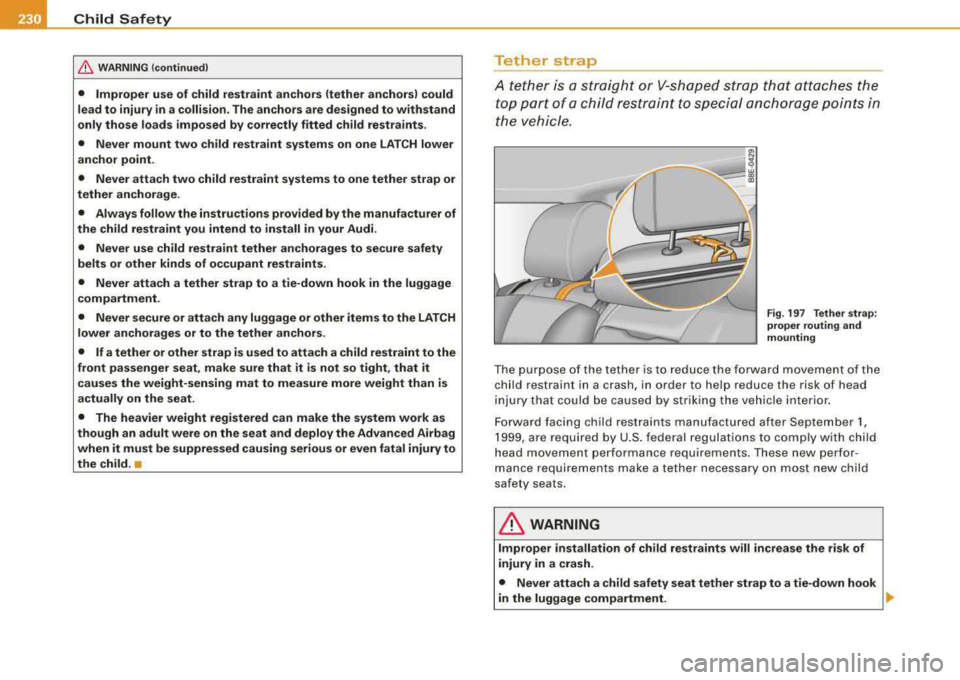
Tether strap
A teth er is a stra ight o r V -shap ed stra p th at attach es t he
t op par t o f a chil d rest rai nt t o spe cial anc hora ge p oints i n
the vehi cle.
Fig . 197 Tether strap:
proper rou ting and
mounting
The pur pose o f the tet her i s to reduce the forwar d move ment of th e
chi ld restraint in a crash, in order to he lp reduce the risk of head
i n jury t hat could be cause d by str ikin g th e v ehicle inte rior.
Forward facing child restraints manufactured after September
1 ,
19 99, a re requ ired by U .S . federal reg ula tio ns t o co mply w ith chi ld
head movement performance requirements. Th ese new perfor
mance requirements make a tether necessary on most new c hild
sa fety seats.
& WARNING
Improper installation of child restraints will increase the ris k of
injury in a crash .
• Never attach a child safety seat tether strap to a tie -down hook
in the luggage compartment.
...
Page 234 of 368
-Child Safety
P'U:1--''-----------------
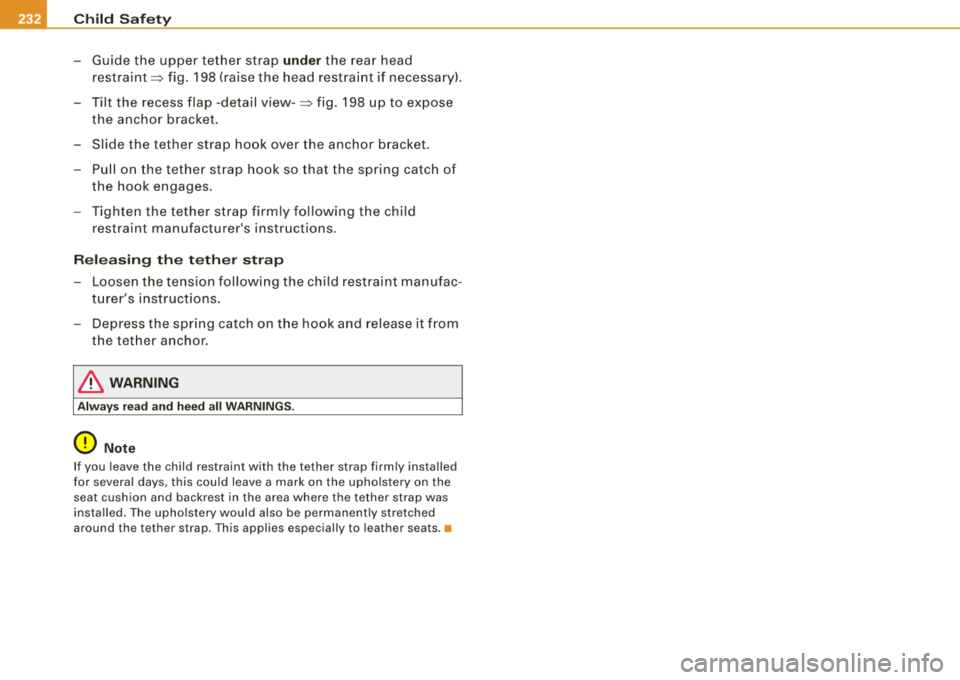
-Guide the upper tether strap under the rear head
restraint=> fig. 198 (raise the head restraint if necessary).
-Tilt the recess flap -detail view -=> fig. 198 up to expose
the anchor bracket.
-Slide the tether strap hook over the anchor bracket.
-Pull on the tether strap hook so that the spring catch of
the hook engages.
-Tighten the tether strap firmly following the child
restraint manufacturer's instructions.
Releasing the tether strap
-Loosen the tension following the child restraint manufac
turer 's instructions.
-Depress the spring catch on the hook and release it from
the tether anchor .
& WARNING
Always read and heed all WARNINGS.
0 Note
If you leave the child restraint with the tether strap firmly installed
for several days, this could leave a mark on the upholstery on the
seat cushion and backrest in the area where the tether strap was
installed. The upholstery would also be permanently stretched
around the tether strap . This applies especially to leather seats.•
Page 263 of 368
_____________________________________________ C_ l_ e _a_ n_ in~ g_a
_ n_d_ p_ r_ o_ t
_ e_ c_t _io _ n __ ffllll
Chassis
Have the undercoating checke d for dam age from time to
ti m e.
The lower body shell of your Audi is a lso thoroughly protected
against corros ion.
Any damage to the undercoating caused by road hazards shou ld be
repa ired promptly.
& WARNING
Too mu ch undercoating in the wrong place s can cause a fire.
• Do not apply additional undercoating or ru stproofing on or
near the e xhau st manifold , ex haust pipe s, cata lyti c con verter or
heat sh ields . While driving , the sub stance used for underco ating
could overheat and cau se a fire.
• Alw ays read and heed all WARNINGS and other informat ion
=> pa ge 254 . •
Care of interior
Aluminum trim
Use on ly neutral-pH products to remove spots and depos its from
a lum inum surfaces. Chrome care products and alka line cleaners
wi ll attack aluminum s urfaces and ca n damage them over t ime.
& WARNING
Alway s re ad and heed all WARNING S and the inform ation
=> pag e 254. •
Ap plies to veh ic les: with Fab rics an d fabric cove rings
Fabrics and fabric coverings
Fabrics a nd fabr ic coverings (e .g. seats, doo r tr im panels, etc .)
shou ld be c leaned at regular intervals with a vacuum cleaner. This
re moves surface d irt part ic les which could become embedded in
the fabric through use . Steam cleaners shou ld not be used, because
the steam tends to push the dirt deeper into the fab ric a nd lock it
there .
Norm al cleaning
Genera lly, we recommend using a soft sponge or a lint -free
m icrof iber c lo th to the clean fabric . Brushes should on ly be used for
carpets and floor mats, since other fabric surfaces could be harmed
by brushes.
Norma l sur face stains ca n be cleaned us ing a commercially ava il
able foam cleaner. Spread the foam on the surface of the fabric with
a soft sponge and work it in ge ntly . Do not saturate t he fabr ic. Then
pat the foam dry us ing absorbent, dry cloths (e .g . microfiber cloth)
a n d vacuum i t after it has dr ied comple tely.
Cleaning stains
Stains caused by beverages (e .g. coffee, fru it ju ice, etc.l can be
treated with a mild detergent solution. Apply the detergent so lution
with a sponge . In the case of stubborn stains, a de tergen t paste can
be applied direct ly to the stain and worked into the fabric . After
wards, use c opious a mounts of c lean water to rem ove the
remaining detergent . Apply the water with a damp cloth or sponge
a n d pat the fabric dry with an absorbe nt, dry c loth .
Stains from choco late or makeup should have detergent paste (e .g.
ox -ga ll soap) rubbed into them. Afterwards, remove the soap with
water (damp sponge).
A lcoho l can be used to treat stains from grease, oi l, lipstick or a ba ll
point pen . Melted grease or dye must be patted off us ing abs orbent
material. It may be necessary to retreat the areas with detergent
paste and water . .,,,
Vehicle care
Page 265 of 368
____________________________________________ ...:C :..: l:..: e :.: a:.: n:....:..:..: in~ g~ a~n .:..:d=-.! p::.. r
:..: o:::..:. te:::..::: c:..::t ..:..:io :::.:..: n'.,__ffllll
soiling, etc.I, you will need to be somewhat careful with these
leathers, and a certain type of care is required. For example, dark
clothing materials can discolor leather seats (especially if such
clothing is damp and was not dyed correctly). Dust and dirt particles
in pores, folds, and seams can have an abrasive effect and can
damage the leather surface as well as weaken seams.
The leather shou ld be c leaned regularly as needed. After having
been used for a relatively long time, your leather seats will acquire
a rich aged finish . This is a characteristic of natural leather and a
sign of true quality.
In order to maintain the value of this natural product over the life of
your vehic le , you should fo llow the recommendations below:
0 Note
• To keep your leather from bleaching out, do not allow it to be
exposed to bright sunlight for long periods of time. If you have to
leave the vehicle parked outside for long periods, cover the leather
to protect it from direct exposure to sunlight.
• Sharp objects on c lothing, such as zippers, rivets or sharp pieces
on belts can leave permanent scratches or scrape marks on the
surface of the leather.
[ i ] Tips
• After each time you clean the leather and at regu lar intervals, use
a leather preservative creme that contains UV -blockers and that
works into the leather. This creme wil l nourish and moisturize the
leather, helping it to breathe and stay supple . It also helps to build
up a protective coating on the surface .
• Clean the leather every 2 -3 months, and clean any areas that get
soiled.
• Remove fresh marks made by ballpoint pens, ink, lipstick, shoe
polish, etc . as soon as possible.
• Preserve the color of the leather as needed by using a special
colored leather care creme to touch up areas of uneven color .•
• I I • • I
Ap plies to veh ic les : wi th n atural leat her
Cleaning and caring for leather upholstery
and trim
Natural leather requires special care and attention.
Normal cleaning
-Clean soiled areas with a slightly moistened cotton or
woolen cloth.
More stubborn dirt
-More stubborn dirt can be removed using a cloth satu
rated with a mild soap solution (2 tablespoons mild
liquid soap).
-Never allow the soap solution to saturate the leather, and
make certain that no water soaks into the seams.
Wipe off the soap solution with a soft, dry cloth .
Cleaning spots
-Remove fresh water-based spots (such as coffee, tea,
juices, blood) with an absorbent cloth or paper towel.
-Remove fresh grease or oil-based spots (such as butter,
mayonnaise, chocolate) with an absorbent cloth or paper
towel, or use the cleaner from the leather care kit if the
spot has not yet penetrated into the surface of the
leather.
-Use an oil/grease dissolving spray, if oil/grease spots
have dried on.
-Remove specific kinds of spots (ballpoint pen, felt
marker, fingernail polish, water-based paint, shoe polish,
etc.) with a spot remover specifically formulated for
leather. _.,
Vehicle care
Page 296 of 368
___ T_ ir_e _ s_ a_ n
_ d_ w_ h_ e_ e_ls _________________________________________________ _
&, WARNING (continued)
crashes and serious personal injuries . Have worn or damaged tires
replaced immediately.
• Tires age even if they are not being used and can fail suddenly,
especially at high speeds. Tires that are more than 6 years old can
only be used in an emergency and then with special care and at
low speed.
Glossary of tire and loading terminology
Accessory weight
means the combined weight (in excess of those standard items
which may be replaced) of automatic transmission, power steering,
power brakes, power windows, power seats, radio, and heater, to
the extent that these items are available as factory-installed equip
ment (whether installed or not).
Aspect ratio means the ratio of the height to the width of the tire in percent.
Numb ers of 55 or lower indicate a low sidewall for improved
steering response and better overall handling on dry pavement.
Bead means the part of the tire that is made of steel wires, wrapped or
reinforced by ply cords and that is shaped to fit the rim.
Bead separation
means a breakdown of the bond between components in the bead.
Cord
means the strands forming the plies in the tire.
&, WARNING (continued)
• Never mount used tires on your vehicle if you are not sure of
their "previous history." Old used tires may have been damaged
even though the damage cannot be seen that can lead to sudden
tire failure and loss of vehicle control.
• If you notice unusual vibration or if the vehicle pulls to one side
when driving, always stop as soon as it is safe to do so and check
the wheels and tires for damage.
•
Cold tire inflation pressure
means the tire pressure recommended by the vehicle manufacturer
for a tire of a designated size that has not been driven for more than
a couple of miles (kilometers) at low speeds in the three hour period
before the tire pressure is measured or adjusted .
Curb weight
means the weight of a motor vehicle with standard equipment
including the maximum capacity of fuel, oil, and coolant, air condi
tioning and additional weight of optional equipment.
Extra load tire
means a tire designed to operate at higher loads and at higher infla
tion pressures then the corresponding standard tire. Extra load tires
my be identified as "XL", "xi", "EXTRA LOAD", or
"RF" on the side
wall.
Gross Axle Weight Rating ("GAWR")
means the load-carrying capacity of a single axle system, measured
at the tire-ground interfaces .
Gross Vehicle Weight Rating ("GVWR")
means the maximum total loaded weight of the vehicle.
Page 355 of 368
Alph ab eti ca l ind ex -
-------------=----
AUTO
Climate controls ...... .... ...... .. 127
Switching on .................... 127
When should I use AUTO? ......... 127
Auto Safety Hotline ................. . 175
Auto-C heck Contro l ...... .... ... .... .. 28
Au toma tic transmission ...... .... .. 30
Manua l transmission .. ...... .... .. 29
Automa tic a ir recircu lation ........... 129
Automatic belt retractor .......... .... 181
Automat ic car was h
See Washing ...... .... ... .... .... 255
Automatic headlight control ........... 73
Automatic Sh ift Lock (ASU .. ..... 145, 152
Automatic transmission 6-speed automatic transmission 143, 144
Ign it ion key safety lock . ...... .... . 136
Shift but tons .. ...... .... .... 148, 155
Steering wheel wit h tiptronic® . 148,155
See also mu ltit ronic™ ... .. ...... .. 149
Automat ic trans mission (6 -speed)
Automat ic Shift Lock (ASU ... .. ... . 145
Driving .. .. .. .... .... ..... .. .... 1 43
Dynamic shift program ... .... .... . 146
Fa il- safe mode . ...... .... .... .... 149
Kic k-down ... .... .... .... ... .... . 146
Manual shift program (tiptronic®) .. 147
Average speed ....................... 41
Avoid damaging the vehicle .. ...... .. 245
Controls and equip
ment Safety first
B
Battery .....
.... .... .... .... ... 285, 288
Battery location ins ide the eng ine
compartment .. ...... .... .... ... 285
Charging . ............ ........... 289
Checking battery acid level . ........ 288
Connecting .... .. ..... .... .... ... 290
Disconnecting ............ .... ... 290
Important warnings when working on the
battery ... .. .... .... .... .... ... 286
Removing the battery ... .. .... .... 290
Replacing the battery ............. 29 1
Winter operation . ................ 285
Working on the battery ............ 286
Bat tery vo ltage .. ... ... .... .... .... .. 35
Before driving ...................... 167
Blended gasoline . .... ............... 267
Body cavity sealing ...... .... .... ... . 260
Booster seats .......... .... .... ..... 218
How do I properly instal l a booster seat in
my vehicle? ... .. .... .... .... ... 218
Safety inst ructions ... .. .... .... ... 218
Brake assista nt ..... .... .... .... .... 241
Brake booster .......... ...... .... ... 240
Brake f luid
Changing the brake flu id ...... .... 284
Check ing the brake fluid leve l ...... 284
Reservoi r .... .... .... ..... .. .... . 28 4
What is the correct brake f luid level? 284
What shou ld I do if
t he brake fluid warning
l igh t comes on? ... .. .... .... .... 284 Brake system
...... .... .... .... .. 31,284
Anti -lock Brake System (ABS) ........ 21
Brake fluid ....................... 284
Brake f lu id spec ificat ions for refi ll and
replacement ..... .... .... .... ... 28 4
Brake pads ...................... 244
Warning/indicator lights ...... ...... 23
Brakes ...... .... .... .... ... .... .... 239
Adverse cond itions affec ting bra ke
performance ...... .... .... ..... 239
Break -in period ....... ........ ...... 243
Brake pads ........... .... .... ... 244
Tires .. .... ....... .... ...... ..... 243
Bu lbs .. ...... .... .... ... .... .... ... 328
C
Ca lif o rnia Pr opo sit ion 65 War ning ... .. 274
Batte ry specific . ...... .... .... .... 287
Capacities .......................... 343
Car care . .... .... ........... .... .... 254
Interior .... ... .... .... .... .... ... 261
Plastic and vinyl .... ............. . 258
Weatherstrips .... ... .. ...... .... . 259
Ca re of exterior ..... .... .... .... .... 254
Care, service and disposal Safety belt tensioner .............. 186
Cargo area
See Loading the luggage compartment .
173
Cargo net .......................... 108
Catalytic converter ...... .... .... .... 24 4
Vehicle operation Vehicle care Do-it-yourself service Technical data
Page 356 of 368
111'1_....::::A::.:l:.!: p :.:h..:.: a:::.:: b:.::e :.:t::i c::.::: a.:..l ..:.: in :..:.:: d:.:e :.:x::..... ___________________________________________ _
Centigrade
Switching between Centigrade and Fahre nheit ...... .... .... ... ....
128
Changing a flat tire .. .... .... .... 50,318
Changing a wheel ................... 318
Changing engine oil ...... .... ...... . 279
Chassis
Undercoating .. .... .... .... .... ..
261
CHECK button . . . . . . . . . . . . . . . . . . . . . . . 16
Checking
Battery acid leve l . . . . . . . . . . . . . . . . .
288
Eng ine coo lant level . ... .. .... .... 281
Checking tire pressure ............... 299
Child restraint
Danger of using child restraints in the front seat . . . . . . . . . . . . . . . . . . . . . .
189
Child restraints
What types of chi ld restraint anchors are
ava ilable? . .... .... .... ........
223
Where can I get additional information
about child restraints? ... .... ....
224
Child safety .. .... .... ....... ... 210 ,215
Additional information .... .... .... 229
Booster seats . . . . . . . . . . . . . . . . . . . . 218
Convertible child safety seats . . . . . . 216
Convertible locking retractor . . . . . . . 220
Guidance fixtures for lower anchorages
226
Important safety instructions for using
ch ild safety seats .... .... ... ....
213
Important things to know when driving
with chi ldren ...................
210
Infant seats ..................... 215
Installing a child restraint using the
LATCH system ... ... .... .... ....
228
Lower anchorages .... ....... .... . 225
Mounting and re leasing the anchorage
hook .... .... ...... .... ... .. ...
229
Older children and safety belts 219
Safety belts and o ld er children .. ... 219
Tether anchors ...... .... .... .... 229
Tether strap .. ....... .... .... .... 230
Which rest raint system should my o lder
chi ld wear? .. ...... .... ... .. ...
219
Child safety lock ... .... ... .. ...... ... 63
child safety seat
LATCH system ....... .... .... ....
228
Child safety seats .............. .... . 215
Convertible locking retractor ....... 220
How do I properly insta ll a child safety
· h ' I 7 213 seat in my ve 1c e, .. .... .... ... .
Installing .... .... ... .. .... ......
220
Safety instructions .... .... .... ... 213
Cigarette lighter ........ .... ... .. ... 120
Cleaning
Alcantara (synthetic suede) ........
264
Engine compartment .. ... ... .. ... 265
Fabrics and fabric coverings ... .... 261
Instrument pane l .. ... .. ...... .... 262
Interior ...... .... ... .. .... .... .. 261
Leather . . . . . . . . . . . . . . . . . . . . . . . . . 263
P lastic and vinyl . .... .... ... .. ... 258
Plastic parts . .... .... .... ... .... . 262
Safety belts . . . . . . . . . . . . . . . . . . . . . 265
Trim strips . .... .... ... .... .... .. 257
trim strips . .... ...... .... ... .. ... 258
Cleaning and protection ........ .... . 254
Climate controls ...... .... .......... 125
Air distribution .... .... ..... .. ... 130
Air outlets . .... .... ... ........... 131
Air recirculation ... .... .... ..... .. 128
AUTO (standard setting) .... .... ... 127
Automatic a ir recircu lation ... ..... 129
controls . . . . . . . . . . . . . . . . . . . . . . . . 126
Defrosting/defogging .... .... .... . 131
Description ... .... .... ........... 125
ECON .... ... .. .... ...... .... .... 128
Fan .. .... .... .... .... ... .... ... 129
Key -coded setting . .... .... .... ... 132
Recommended settings ........... 125
Setting the temperature .... .... ... 127
Switching between Fahrenheit and
Centigrade . .... .... .... .... ....
128
Switching the air conditioning on and off
128
Using the c limate control economically ..
132
Warm and cold ... .... .... .... ... 125
Clock ... .... .... .... ... .. ...... .... . 14
Closing
Power sunroof ....................
68
Coat hooks . . . . . . . . . . . . . . . . . . . . . . . . . 124
Co ld tire inflation pressure .... .... ... 297
Coming-home-function .... .... ...... . 77
Compartments in the door trims ..... . 124
Compass mirror .. .... .... ..... .. .... 93
Consumer Information .... ........... 345
Continuously Variable Transmission (CVT)
See multitronic™ .. .... ........... 149
Page 357 of 368
Alphabetical index -
-------------=----
Convertible child seats
How do I properly ins ta ll a conve rtible
child seat in my vehicle? ......... 216
Safety instructions . ...... ...... .. 216
Convertible locking retractor
Act ivating .. .. .... .... ........... 222
Deactivating ...... .... ........... 223
Using to secure a child safety seat 220,
222
Coolant system ... .. .... .... ........ 280
Coo ling System
Expansion tank .... ....... ... .... . 281
Cornering light .. .... .... ...... .... .. 75
Cruise control . ...... .... ........... 140
Changing a stored speed .... ... .. . 140
Setting and storing a vehic le speed . 140
Switching off . ........... .... .... 141
Switching off temporari ly .......... 141
Switching on .... .... .... .... .... 140
Warning/indicator lights .. ... .... ... 21
Cruising range .................. ..... 40
Cup holder ......................... 118
D
Data .............................. 343
Data recorder ... .... .... .... ..... .. . 236
Date display ......................... 14
D aytime running lights ................ 74
dEF indication .............. ......... 15
Defogging the windows .. .... .... .... 131
Defrosting the windows ...... .... .... 131
Defrosting /defogging windows .. .... .. 131
Controls and equip
ment Safety first
Determining
correct load limit ..... .. . 302 Dynamic shift program ... .... ...... .. 153
Digita l clock .. ...... ..... .. .... .... .. 14
Setting the time ..... ...... .... .... 14
E
Digita l compass ...................... 93
Dimensions . ....... ... .. .... .... ... 341
Dipstick Location .... .... ... .. .... .... ... 277
Doors, power locks .. ...... ....... .... 58
Drive Information System Help .. ...... .... ... .. .... .... .... 43
Driver
See Seating position ........... ... 168
Driver information display ....... .... .. 24
Mi les (ki lometers) to empty .... ... .. 26
Open door or rear lid warning .. .... . 26
Outside
temperatu ire disp lay ....... . 25 ECON
When should I use ECON? ...... ... . 128
EDL Electronic differential lock .... .... . 237
Ele ctrically heated front seats ..... ... . 132
Electronic differential lock
Warning/indicator lights ...... .... .. 21
Electronic differential lock (EDU
How the system works ............ 237
Elect ronic immobilizer . ... .... .... .... 16
Electronic power contro l
EPC warning/indicator light ....... .. 23
Parking brake warning .. .... ... .. .. 29 Electronic stabilization program
(ESP)
Sound system display
...... .... .... 25 How
the system works ............ 236
Text messages .. ....... ...... .... . 29 Warning/indicator
lights ...... ...... 22
Driver Informa tion System Emergency
closing
Menu display .. ... .... .... .... ... . 41 Power sunroof ...
.... ........... .. 69
Practical example .................. 44 Emergency
flasher .. ... .... .... ...... 79
Setting .. .... ....... ...... .... .... 43 Warning/indicator
lights ...... ...... 22
Types of disp lay ..... ...... ... .... . 42 Emergency
locking ................... 61
Driver's seat memory ................ 100 Emergency
starting ... .... ... .... .... 330
Assigning the keys ....... ... .. .... 102
Emergency towing .................. 332
Recalling a seat position .. .... .... . 101
Emergency un locking (on ly manually)
Storing a seat position ............ 101
Rear lid . ... .. .... .... ...... .... .. 62
Driver's seat cushion extension ...... .. 100
Engine
Driving messages .... .... .... .... .... 29
4-cylinder (200 hp) ...... .. .... .... 274
Driving safely ....... ... .. .... .... ... 166 6-cylinder (255
hp) ................ 275
Driving time ... .. ...... .... ... .. .... . 40 Coolant
......................... 280
Dup licate key .... .... .... ...... ... .. . 52 Hood ......
...... .... ...... ..... 272
Vehicle operation Vehicle care Do-it-yourself service Technical data