service AUDI A4 AVANT 2008 Workshop Manual
[x] Cancel search | Manufacturer: AUDI, Model Year: 2008, Model line: A4 AVANT, Model: AUDI A4 AVANT 2008Pages: 368, PDF Size: 46.19 MB
Page 281 of 368

_____________________________________________ C_h_ e_ c
_ k_in -= g_a
_ n_d _ f_il _li _n ..;::g ;;.___.ffllll
Fig. 21 O Oil filler cap
location: 3.2 liter, V6-
engine
Before you check anything in the engine compartment,
always read and heed all
WARNINGS=> & in "Working in
the engine compartment" on
page 273.
-Turn off the engine.
Unscrew the cap
"t=:r. to the engine oil filling hole
=> page 278, fig. 209 or=> fig. 210.
-Carefully top off with the appropriate oil in 0.5 liter doses.
-Check the oil level again after two minutes=> page 277.
-Top off the oil again, if necessary.
-Screw the cap back on the filling hole and slide the oil
dipstick in as far as it will go.
& WARNING
• While topping off, the oil must not come in contact with hot
engine parts
-fire hazard!
& WARNING (continued)
• The oil filler cap must be properly secured to prevent oil from
being sprayed on the hot engine and exhaust system when the
engine is running
-fire hazard!
• If your skin has come in contact with the engine oil, you must
subsequently cleanse it thoroughly.
0 Note
• The oil level must not be above range @-danger of converter or
engine damage! Contact an authorized dealership to draw off oil, if
necessary.
• Audi does not recommend the use of oil additives. They may
damage the engine and adversely affect your New Vehicle Warranty.
ffi For the sake of the environment
• Under no circumstances can the oil come in contact with the
sewage network or the soil.
• Observe and follow legal regulations when disposing of empty
oil containers. •
Changing the engine oil
We recommend that have your oil changed by an autho
rized Audi dealer or a qualified service station.
Before you check anything in the engine compartment, always read
and heed all WARNINGS =>
& in "Working in the engine compart
ment" on
page 273.
The engine oil must be changed according to the intervals specified
in your Maintenance
& Warranty booklet. This is very important
because the lubricating properties of oil diminish gradually during
normal vehicle use.
.,.
Vehic le care irechnical data
Page 282 of 368
-~_C_ h_ e_c _k _ i_n ..::g :..._ a_n_ d_ f_il _li _n_, g=-----------------------------------------------
Under some circumstances the engine oi l should be changed more
frequen tly . Change oil m ore often if you drive most ly shor t
distances, operate the vehicle in dusty areas or under predom i
n ant ly stop -and -go traffic conditions , or have yo ur vehicle whe re
temperatures remain below freezing for extended periods.
Detergent additives in the oil will make fresh oil look dark after the
engine has bee n run nin g fo r a sh ort time. This is nor mal and is not
a reason to change the oi l more often than recommended .
Beca use of the proble m of p roper d isposal, along wi th the s pec ia l
tools and necessary expertise required, we strongly recommend
t hat yo u have your oi l ch anged by an authorized
Audi dealer or a
qua lified serv ice stat ion .
If you choose to change your o il yourself , please note the follow ing
i mportan t informatio n:
& WARNING
To reduce the risk of personal injury if you must change the engine
oil in your vehicle yourself :
• Wear eye prote ction .
• To reduce the risk of burns from hot engine oil , let the engine
c ool down to the touch .
• When removing the oil drain plug with your fingers, stay as far
away as po ssible . Always keep your forearm parallel to the ground
to help prevent hot oil from running down your arm.
• Drain the oil into a container designed for this purpose , one
large enough to hold at least the total amount of oil in your engine.
• Engine oil is poisonous . Keep it well out of the rea ch of ch ildren .
• Continuous contact with used engine oil is harmful to your
skin . Always prote ct your skin by washing oil off thoroughly with
soap and water.
0 Note
Never m ix o il add it ives w ith your engine o il. These add it ives can
damage you r engine and adversely affect your A udi Limited New
Ve hicle Warranty.
'i> For the sake of the environment
• B efore chang ing you r oil, fi rst make sure you k now w here you
can properly dispose of the used o il.
• Always dispose o f used eng ine oil properly. Do not dump it o n
garden soi l, wooded areas, into open st reams or down sewage
drains .
• Recycle used engine oi l by ta king it to a used engine oi l collec
tion fac ility in your area, or contac t a service stat io n .•
Engine cooling system
Coolant
T he engine coolan t performs two fun ctions: it keeps the
engine from overhe ating and it pr otec ts the engine from
f reez ing i n th e win ter.
Th e cooling system is sea led and general ly requires l itt le attention.
T he coo ling system has been fi lled at the factory with a permanent
coo la nt which does not need to be c hange d. The c oolan t consis ts of
a mixture of water and the manufacturer's glycol -based coolant
additive G12 + an tifreeze wi th anticorros io n add itives (50% for USA
models; 60% for Canadian models). This mixture both assures the
necessary frost protection and protects me tal components in the
engine's cool ing system from corrosion and scaling . It also raises
the boiling poi nt of the coolant .
Do n ot reduce t he co ncentration o f the coolan t in the su mmer by
adding plain water .
The proportion of coolant additive must be at .,_
Page 287 of 368
___________________________________________ C_ h_e _c_ k_ i_n ~g _ a_n _d_ f_il _li _n ~g __ _
& WARNING (continued)
-The brake fluid must be new. Heavy use of the brakes can
cause a vapor lock if the brake fluid is left in the system too
long. This can seriously affect the efficiency of the brakes as
well as your safety. This could result in an accident.
0 Note
Brake fluid will damage the paint of your vehicle.
W For the sake of the environment
Because of the problem of proper disposal of brake fluid as well as
the special tools required and the necessary expertise, we recom
mend that you have the brake fluid changed by your authorized Audi
dealer. •
Battery
General information
Under normal operating conditions, the battery in your Audi does
not need any maintenance. With
high outside temperatures it is
advisable however to check the fluid level at regular intervals
through the transparent battery housing. Also check the fluid level
each time you charge the battery. After charging the battery
~ page 289, you should likewise check the battery acid level.
Have the battery checked when you take your vehicle in for service.
You are well advised to replace a battery that is older than 5 years.
Preserving battery charge on a vehicle not operated
for a long time
Some components of the electrical equipment (for example, the
electronic immobilizer) will keep drawing a low current even when the car is
not running
. This will eventually drain the battery
completely if your vehicle is left sitting for a long period of time
without being driven . To prevent this, either charge the battery
occasionally or disconnect the battery negative (ground) cable.
Winter operation
During the winter months, battery capacity tends to decrease as
temperatures drop . This is because more power is also consumed
while starting, and the headlights, rear window defogger, etc., are
used more often.
Avoid unnecessary power consumpt ion, particularly in city traff ic or
when traveling only short distances. Let your authorized Audi dealer
check the capacity of the vehicle battery before winter sets in
~ page 289. A well charged battery will not only prevent starting
problems when the weather is cold, but will also last longer.
[ i] Tips
If your vehicle is left standing for several weeks at extremely low
temperatures, the vehicle battery should be removed and stored
where it will not freeze. This will prevent it from being damaged and
having to be replaced. •
Location of the vehicle battery
The vehicle battery is located in the plenum chamber at the back of
the engine
compartment~ page 275.
The positive(+) battery terminal is protected by a plastic cover. This cover must be removed to access to the positive(+) terminal when
connecting jumper cables to start the engine .
& WARNING
Before you check anything in the engine compartment, always
read and heed all WARNINGS
~ & in "Working in the engine
compartment" on
page 273. •
Vehicle care
Page 303 of 368
________________________________________________ T_ i
_ r_e _s_ a_n_ d_ w_ h_ e_e _ l_s __ l'III
& W ARNING (continued )
• The driver is respon sible for the correct tire pre ssure s for all
tire s on the vehicle. The applicable pressure values are located on
a st icker on the driver 's side B-pillar or on the inside of the fuel
filler flap.
• Only when all tire s on the vehicle are filled to the correct pres
sure , the tire pressure monitoring system * can work correctly .
• The use of incorrect tire pressure values can lead to accidents
or other damage. Therefore it is essential that the driver observe
the specified tire pressure values for the tires and the correct pres
sures for the function of the tire pressure monitoring system*.
• Always inflate tires to the recommended and correct tire pres
sure before driving off.
• Driving with underinflated tires bend more , letting them get
too hot resulting in tread separation , sudden tire failure and loss
of control.
• Ex cessive speed and /overloading can cause heat build -up ,
sudden tire failure and loss of control .
• If the tire pressure is too low or too high, the tires will wear
prematurely and the vehicle will not handle well.
• If the tire is not flat and you do not have to change a wheel
immediately, drive at reduced speed to the nearest service station
to che ck the tire pressure and add air as required .
0 Note
Driving without valve stem caps can cause damage to the tire
valves. To preve nt th is, a lways make s ure th at f acto ry installed va lve
stem caps on al l whee ls are securely mounted on the va lve .
~ For the sake of the environment
Underinflated tires will a lso increase the fuel consumpt io n. •
Tires and vehicle load limits
There are limits to the amount of load or weight t hat any vehic le and
any tire can carry . A ve hicle that i s ove rloa ded will not handle well
and is more d iff icu lt to stop . Overload ing can not only lead to loss
o f vehi cle control, but can also damag e impor tan t p arts o f the
vehic le and can lead to sudden tire failure, including a blowout and
sudde n defla tion that ca n cause the veh ic le to c ra sh .
Your sa fety a nd t hat o f your passe ngers a lso depe nds o n maki ng
s u re that load li mits are not exceeded. Vehic le load incl udes every
b ody and everythi ng i n and on t he vehicle . T he se l oa d limi ts are
technical ly referred to as the ve hic le's
Gross Vehicle Weight Rating
("GVW R"l.
T he "GVWR" includes the wei ght of the basic vehic le, all factory
in sta lled acces so ries, a full t an k of f uel, o il, c oolant a nd oth e r flu ids
p lus max imum load . T he maximum load inc ludes th e number o f
p asse ngers tha t th e ve hicle i s intended t o carry ("seat ing ca paci ty")
with an assu med weight o f 150 l bs (68 kg) fo r each passe nger at a
designated seating position and the total weight of any luggage in
th e v ehic le. I f you tow a trai ler, the we ig ht o f the tra iler hitch a nd th e
tongue weight of the loaded trailer must be inc luded as part of the
ve hicle lo ad .
The
Gross Axle Weight Rating ("GAWR") is t he maximum load that
ca n b e app lie d at eac h of th e veh icle's two axle s.
T he G ross Ve hicle We ight Rati ng a nd th e G ross A xle Wei ght R ati ng
are listed on the safety comp liance stic ker label located either on
t he driver 's si de B-pi lla r o r on the in sid e of t he fue l fille r fl ap. You r
Aud i has 5 seating posit ions, 2 in the front and 3 in the rear for total
sea ting ca paci ty of 5. Each sea ting p osit ion has a safe ty b elt
=> page 176, "Saf ety be lts" .
The fact that there is an upper limit to your vehicle's Gro ss Vehicle
W eight Rat ing m eans that th e total weight o f whatever is b ein g
carried in the vehic le (including the weight of a traile r hitc h and the
ton gue we ight of the loaded tr aile r) is lim it e d. Th e m or e passe ng ers
~
Vehicle care
Page 305 of 368
5. Determine the combined weight of luggage and cargo being loaded on the
vehicle. That weight may not safely
exceed the available cargo and luggage
load capacity calculated in Step 4.
6. If your vehicle will be towing a trailer, load from your trailer will be transferred
to your vehicle. Consult this manual to
determine how this reduces the avail
able cargo and luggage load capacity of
your vehicle.
- Check the tire sidewall(::::>
page 305,
fig. 221) to determine the designated
load rating for a specific tire.•
Tires and wheels 1111
Tire service life
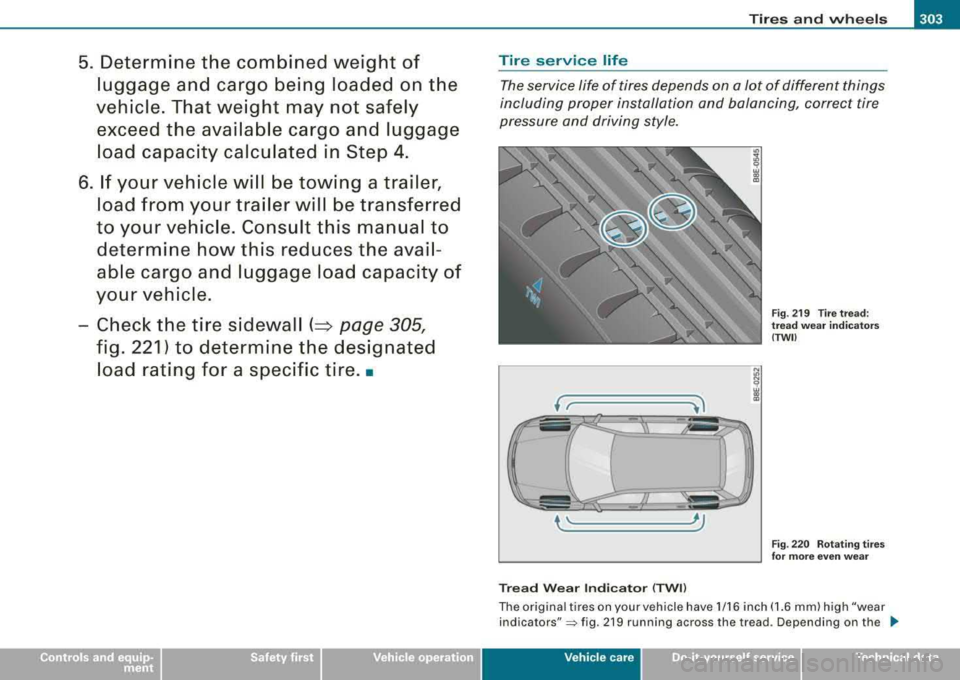
The service life of tires depends on a lot of different things
including proper installation and balancing, correct tire
pressure and driving style.
•,
.._ ____________ __,
Tread Wear Indicator {TWI)
Fig. 219 Tire tread:
tread wear indicators
(TWO
Fig . 220 Rotating tires
for more even wear
The origina l tires on your vehicle have 1 /16 inch (1.6 mm) high "wear
indicators"=> fig . 219 running across the tread . Depending on the .,.
Vehic le care irechnical data
Page 306 of 368
___ T_ ir_e _ s_ a_ n
_ d_ w_ h_ e_ e_ls _________________________________________________ _
make, there w ill be six to eight of t hem evenly p laced around the
tir e. M arks o n the tire s idewall ( for example "TWI " or oth er sy mb ols)
indicate th e positions of the tread wear indicators. Worn tires must
b e re placed . Di fferen t fig ure s m ay apply i n other
c ountr ies=> & .
Tire pressure
Incorr ect tir e p ress ure c auses prematu re wear a nd can ca use
sudden tir e blow -out . For th is r eason, tir e pressur e must b e check ed
at leas t once a month
=> pa ge 299 .
Dri ving style
Drivi ng fa st aro und curv es, heavy acce le ra ti on and ha rd bra kin g
increase tire wear .
Rotating tires for more even wear
For all four tires on your vehic le to have the same service life, we
r ecom mend t hat the front a nd rea r tires ar e rotate d accord ing to the
tire manufacturer 's suggested tire rotation interva ls. Please
r e m emb er t he fo llo wi ng :
• Ti re rotation interva ls m ay d iffer from th e vehic le servic e inter
vals outl ined in y our M aintenance and Warran ty Boo kle t.
• T he longer one tire is used in one location on the vehicle, the
mor e it wea rs a t ce rtain points ; the re fo re, we rec omm end that yo u
fo llow t he ti re manufactu rer's su ggested tir e rotat ion int ervals .
• Vehi cle s with front -wh eel d rive e xper ience mo re trea d wea r on
the front wheels compared to al l-wheel drive (quattro®l .
• Ple as e ro tat e ti res as
sh ow n=> page 303, fig. 220.
• Extra care must be taken when rotating direction -specific tires
=> pag e 32 4.
Wheel balancing
T he wheels on n ew vehic les are bala nced. However, various situa
tions during eve ryday driving can cause them to become unba l
ance d, res ulting i n vi brat ions you ca n us ual ly f eel thro ugh t he
steering whee l. U
nba lanc ed wh eels must be rebalanced to avoid excessive wear on
s tee ring, s uspen sio n an d tir es. A w heel m ust also be reba la nced
when a new tire is install ed.
Incorrect wheel alignment
Incorrect whee l alignment can cause excessive tire wear, impairing
t he sa fety o f the vehicl e. If ti res sh ow ex cessiv e w ear, h av e the
whee l al ignm ent check ed by an autho riz ed Aud i d eal er or qualifi ed
w ork shop.
All Wheel Drive
Ve hicl es wi th qu attr o® must alw ays h ave t ires of t he sa me siz e,
construction and tread type . For deta ils
see=> page 242 .
& WARNING
Sudden tire failure can lead to loss of control , a crash and serious
personal injury!
• Never drive a vehicle when the tread on any tire is worn down
to the wear indicators .
• Especially in wet and slick driving situations , a preferably large
profile depth of the tires is necessary , and an approximately
similar profile depth of the front and rear axle tires.
• The diminished driving safety , caused by too small of a tire
profile, is negatively perceivable especially in handling , in danger
of hydroplaning when driving through deep puddles and ponds,
when driving around curves , and in braking behavior.
• Worn tires are a safety hazard , they do not grip well on wet
roads and increase your risk of "hydroplaning" and loss of control.
• Always keep chem icals that can cause tire damage , such as
grease, oil, gasoline and brake fluid away from tires .
• Tires age even if they are not being used and can fail suddenly ,
especially at high speeds. Tires that are more than 6 years old can
only be used in an emergency and then with special care and at
lower speeds .
~
Page 309 of 368
________________________________________________ T_ i
_ r_e _s_ a_n_ d_ w_ h_ e_e _ l_s __ l!III
W up to 168 mph (270 km/h)3
)
Y up to 186 mph (298 km/h)3
l
Your vehicle is normally factory equipped tires, which possess
excellent driving characteristics and give your Audi optimum
driving comfort. An electronic speed
limiter => page 28will normally
prevent your vehicle from going faster than the tire speed rating
=> & .
U .S. DOT Tire Identification Number (TIN) and tire
manufacture date
This is the tire's "serial number". It begins with the letters "DOT"
and indicates that the tire meets all federal standards. The next two
numbers or letters indicate the plant where it was manufactured,
and the last four numbers represent the week and year of manufac
ture . For example, the numbers 2205 mean that the tire was
produced in the 22th week of 2005. The other numbers are
marketing codes that may or may not be used by the tire manufac
turer. This information is used to contact consumers if a tire defect
requires a recall.
Tire ply composition and materials used
The number of plies indicates the number of layers of rubber-coated
fabric in the tire. In general, the greater the number of plies, the
more weight a tire can support. Tire manufacturers also must indi
cate the materials in the tire, which include steel, nylon, polyester,
and others.
Maximum Load Rating
This number indicates the maximum load in kilograms and pounds
that can be carried by the tire.
Tire quality grading for treadwear, traction, and
temperature resistance
Tread wear, traction and temperature grades=> page 309 . Maximum Permissible Inflation Pressure
This number is
the greatest amount of air pressure that should ever
be put in the tire under normal driving conditions.
Replacing tires or rims on vehicles equipped with tire
pressure monitoring system*
The wheels on your vehicle are equipped with a sensor which
constantly monitors the air pressure inside the tire, and then trans
mits this information to the tire pressure monitoring system*. If you
are going to replace the wheel rims on your vehicle, make sure the
new rims also have these sensors. The sensors must be compatible
with the tire pressure monitoring system* on your vehicle.
If you install rims, which do not have the sensors, or have sensors
which are not compatible, then the tire pressure monitoring
system * will not work properly. In this case, the tire pressure moni
toring system* would not be able to monitor the tire pressure or
warn you if it is necessary .
• The battery inside of the tire pressure sensor has a limited
service life.
• Always drive with the valve stem caps securely mounted. We
recommend using factory installed valve stem caps . Ask your autho
rized Audi dealer to replace lost valve stem caps.
The installation of replacement tires with steel cord body plies in
the tire sidewall may cause malfunction of the tire pressure moni
toring system, and is not recommended (cord material information
in molded on the tire sidewall).
Always check your tire pressure monitoring system* indicator after
replacing one or more tires on your vehicle. If the tire pressure
monitoring system * indicator flashes, or is on, your system is not
working properly. Your replacement tire might be incompatible with
your tire pressure monitoring system*, or some component of the
tire pressure monitoring system* may be damaged.
....
Vehicle care
Page 311 of 368

__________________________________________________ T_ ir_e_ s_ a_ n_d _ w_ h_ e
_ e_l_s __ fflll
• Never drive without the valve stem cap. The valves could get
damaged.
• If the sensors must be replaced, then the valve must also be
replaced at the same time.
For the sake of the environment
Dispose of old tires in accordance with the local requirements.•
Uniform tire quality grading
• Tread wear
• Traction AA A B C
• Temperature A B C
Quality grades can be found where applicable on the tire side wall
between tread shoulder and maximum section width
=> page 305,
fig. 221.
For example: Tread wear 200, Traction AA, Temperature A.
All passenger car tires must conform to Federal Safety Require
ments in addition to these grades .
Tread wear
The tread wear grade is a comparative rating based on the wear rate
of the tire when tested under controlled conditions on a specified
government test course .
For example, a tire graded 150 would wear one and one half (1 1/2)
times as well on the government course as a tire graded 100.
The relative performance of tires depends upon the actual condi
tions of their use, however , and may depart significantly from the
norm due to variations in driving habits, service practices and differ
ences in road characteristics and climate.
Traction
The traction grades, from highest to lowest, are AA, A, Band C.
Those grades represent the tire's ability to stop on wet pavement as measured under controlled conditions on specified government
test surfaces of asphalt and concrete. A tire marked C may have
poor traction performance
=> & .
Temperature
The temperature grades are A (the highest), B, and C, representing
the tire's resistance to the generation of heat and its ability to dissi
pate heat when tested under controlled conditions on a specified
indoor laboratory test wheel.
Sustained high temperature can cause the material of the tire to
degenerate and reduce tire life, and excessive temperature can lead
to sudden tire
failure =>& .
The grade C corresponds to a level of performance which all
passenger car tires must meet under the Federal Motor Vehicle
Safety Standard No. 109. Grades Band A represent higher levels of
performance on the laboratory test wheel than the minimum
required by law .
& WARNING
The traction grade assigned to this tire is based on straight-ahead
braking traction tests, and does not include acceleration,
cornering, hydroplaning or peak traction characteristics.
& WARNING
The temperature grade for this tire is established for a tire that is
properly inflated and not overloaded. Excessive speed, underinfla
tion, or excessive loading, either separately or in combination, can
cause heat buildup and possible tire failure.
•
Vehicle care
Page 319 of 368
_____________________________________________ W_ h_ a_t _d_ o_l
_ d_o _ n_o_ w_ ? _ __,_
/b, WARNING (continued)
• Using a bumper jack to raise the vehicle will damage the
bumper system. The jack may slip, causing injury.
• Never support your vehicle on cinder blocks, bricks or other
objects. These may not be able to support the load and could
cause injury when they fail.
• Never start or run the engine while the vehicle is supported by
the jack.
• If you must work under the vehicle, always use safety stands
specifically designed for this purpose.
• Never try and use the hexagonal socket
in the handle of the
screwdriver to loosen or tighten the wheel bolts.
• Always make sure the spare tire and even a flat tire are secured
in place and not loose, otherwise they could fly forward, causing
personal injury to passengers in the vehicle in an accident or
sudden maneuver.
• Never use the jack supplied with your Audi on another vehicle,
particularly on a heavier one. The jack is only suitable for use on
the vehicle it came with.
•
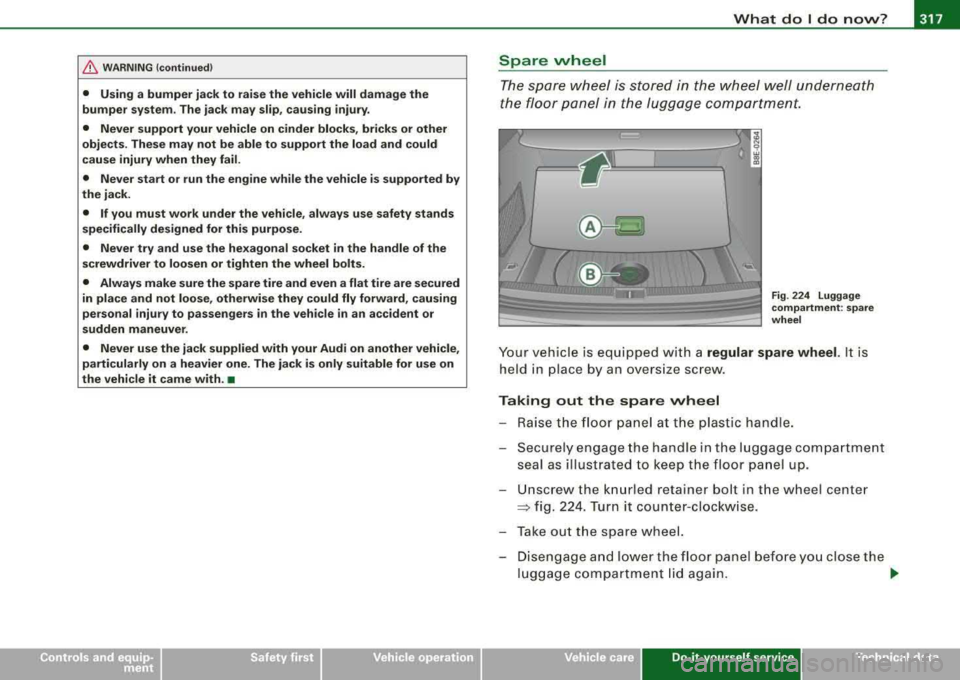
Spare wheel
The spare wheel is stored in the wheel well underneath
the floor panel in the luggage compartment.
Fig. 224 Luggage
compartment : spare
wheel
Your vehicle is equipped with a regular spare wheel. It is
held in place by an oversize screw.
Taking out the spare wheel
- Raise the floor panel at the plastic handle.
- Securely engage the handle in the luggage compartment
seal as illustrated to keep the floor panel up.
- Unscrew the knurled retainer bolt in the wheel center
=> fig. 224. Turn it counter -clockwise .
- Take out the spare wheel.
- Disengage and lower the floor panel before you close the
luggage compartment lid again.
..,.
Do-it-yourse lf service irechnical data
Page 321 of 368
What do I do now? 11111111
-----------------------------------
& WARNING (continued)
mission in "P" (Park), or engaging a gear in a manual transmission
will
not prevent the vehicle from moving.
• Before you change a wheel, be sure the ground is level and firm.
If necessary, use a sturdy board under the jack.
• After installing the spare wheel, make sure that you remount
the flat tire/wheel in its storage area properly and tighten the
knurled retaining screw securely . •
Changing a wheel
When you change a wheel, follow the sequence described
below step-by-step and exactly in that order.
1. Remove the decorative wheel cover*. For more details
see also
=> page 320, "Decorative wheel covers" or
=> page 320, "Wheels with cap -covered wheel bolts".
2. Loosen the wheel bolts => page 321.
3.
Locate the proper mounting point for the jack and align
the jack below that
point=> page 321.
4. Lift the car with the jack => page 321.
5.
Take the flat wheel off and then put the spare on
=> page 323.
6. Tighten all wheel bolts lightly.
7.
Lower the vehicle with the jack.
8. Use the wheel bolt wrench and
firmly tighten all wheel
bolts=> page 321.
9. Put the decorative wheel cover* back on.
LJ}. WARNING
Always read and head all WARNINGS and information :::::> & in
"Raising the vehicle" on
page 321 and :::::, page 324. •
After changing a wheel
A wheel change is not complete without the following
actions.
-Store and secure the replaced wheel in the spare wheel
well.
-Put the tool case and the jack back in place in the luggage
compartment.
-Check the tire pressure on the spare wheel immediately
after mounting it.
- As soon as possible, have the
tightening torques on all
wheel bolts checked with a torque wrench. The correct
tightening torque is
90 ft lb (120 Nml.
- Have the flat tire
replaced as soon as possible.
[ i] Tips
• If you notice while changing a tire that the wheel bolts are
corroded and difficult to turn, then they should be replaced before
you check the tightening torque.
• Drive at reduced speed until you have the tightening torques
checked .•
Do -it -yourself service