service AUDI A4 AVANT 2008 Repair Manual
[x] Cancel search | Manufacturer: AUDI, Model Year: 2008, Model line: A4 AVANT, Model: AUDI A4 AVANT 2008Pages: 368, PDF Size: 46.19 MB
Page 323 of 368
What do I do now ? -
------------------'
Loosening and tightening the wheel bolts
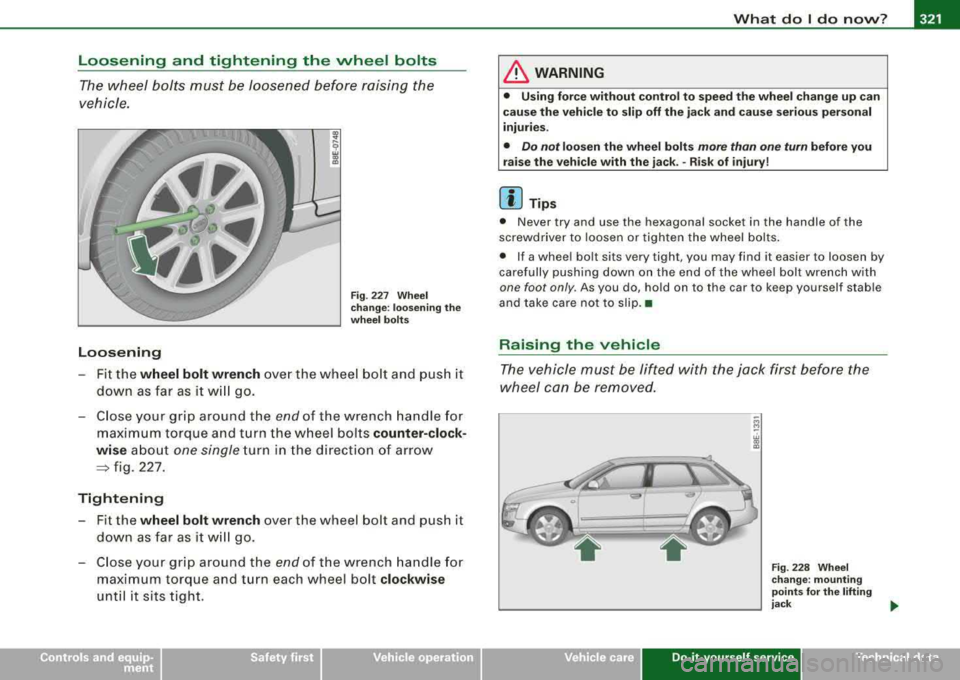
The wheel bolts must be loosened before raising the
vehicle .
Loosening
Fig . 227 Wheel
c h an ge : loose ning t he
w heel b olts
- Fit the wheel bolt wrench over the whee l bo lt and push it
down as far as it w ill go.
- C lose your grip around the
e n d of the wrench ha n dle for
maximum torque and t urn the wheel bolts counter-clock
wi se abo ut
one single turn in the direction of ar ro w
=> fig. 227.
Tight ening
Fit the wheel bolt wrench over the wheel bolt and push it
down as far as it w ill go .
- C lose your grip around the
end of the wrench handle for
maximum torque and turn each wheel bolt clockwise
until it sits tight.
LJ}. WARNING
• Using f orc e without control t o speed t he wh eel ch a nge up can
c au se th e vehicle t o slip off the jack and cau se seriou s per son al
injurie s.
• Do n ot lo osen the wheel b olt s more than one turn before y ou
r a is e th e vehi cle with the jack .
-Ris k of inju ry!
[ i] Tip s
• Never try and use the hexagonal socket in the handle of the
screwdriver to loosen or tighten the wheel bolts .
• If a whee l bolt sits very tight, you may find it easier to loosen by
carefully pushing down on the end of the whee l bolt wrench w ith
one foot only . As you do, ho ld on to the car to keep yourself stab le
and take care not to slip. •
Raising the vehicle
The vehicle must be lifted with the jack first before the
wheel can be removed.
F ig . 228 W hee l
c ha nge : m ount ing
po ints
for th e li fting
j ack _,.
Do-it-yourself service irechnical data
Page 325 of 368
What do I do now? -
------------------'
Taking the wheel off /putting the spare on
Follow these instructions step-by-step for changing the
wheel
Fig . 230 Wheel
change : using the
screwdriver handle
(with the blade
removed) to turn the
bolts
Fig . 231 Wheel
change : alignment pin
inside the top hole
After you have loosened all wheel bolts and jacked the
vehicle off the ground, perform the following steps to
remove and replace the wheel:
Removing the wheel
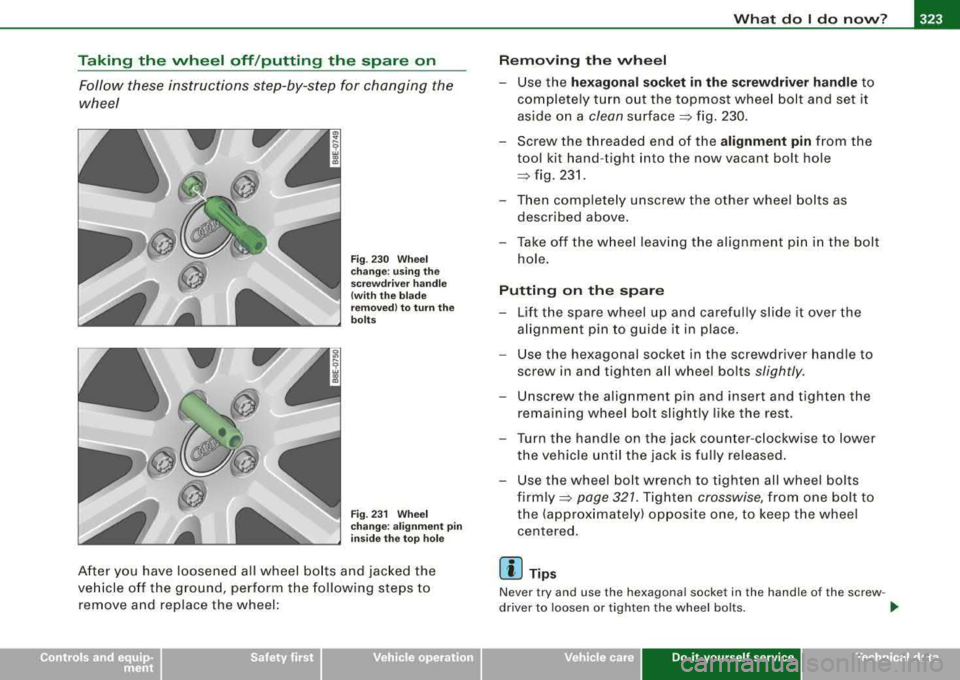
-Use the hexagonal socket in the screwdriver handle to
completely turn out the topmost wheel bolt and set it
aside on a
clean surface => fig. 230.
-Screw the threaded end of the alignment pin from the
tool kit hand -tight into the now vacant bolt hole
=> fig. 231 .
-Then completely unscrew the other wheel bolts as
described above.
-Take off the wheel leaving the alignment pin in t he bolt
hole.
Putting on the spare
-Lift the spare wheel up and carefully slide it over the
alignment pin to guide it in place.
-Use the hexagonal socket in the screwdriver handle to
screw in and t ighten all wheel bolts
slightly .
-Unscrew the alignment pin and insert and tighten the
remaining wheel bo lt slightly like the rest.
-Turn the handle on the jack counter-clockwise to lower
the vehicle until the jack is fully released.
-Use the wheel bolt wrench to tighten all wheel bolts
firmly =>
page 327. Tighten crosswise, from one bolt to
the (approximately) opposite one, to keep the wheel
centered.
[ i] Tips
Never try and use the h exagonal socket in the handle of the screw -
driver to loosen or tighten the wheel bolts.
.,
Do-it-yourse lf service irechnical data
Page 326 of 368
____ w_ h_ a_t _ d_ o_ l_d _ o_ n_ o_w _ ? ______________________________________________ _
• Pull the reversible b lade from the screwdriver before you use the
h exago nal soc ket i n the ha ndle to tur n the wheel bo lts.
• When mounting tires with
unidirectional tread design make sure
th e trea d pat tern is po inte d the rig ht
way => page 324.
• T he whee l bo lts should be clean and easy to turn. Check for dirt
and c orrosio n on the m ating su rfaces of bo th the whee l a nd th e
hub . Remove a ll dirt from these surfaces before remou nting the
w heel. •
Tires with unidirectional tread design
T ir es wit h unid irectio nal tr ea d d esign must b e moun ted
with th eir tread pattern po int ed the r ight direction .
Using a spare tire with a tread pattern intended for use
in a specific direction
Whe n usi ng a s pa re t ire wi th a tre ad patte rn inte nd ed for use in a
specific direct ion, please note the followin g:
• The di rec tio n of rot ation is marked by an arr ow on th e s ide o f the
tir e.
• If the s pare tir e ha s to be ins talle d in th e inco rrect directi on i n the
event of a flat tire, use th e spar e tire on ly temporarily since the tire
w ill n ot be a ble to achieve it s optimum pe rform ance cha rac te ri sti cs
wi th r egar d to a qua plani ng , noise an d w ear .
• W e rec om mend th at p arti cula r att ent ion be pai d to this fac t
dur in g wet weath er and that you adjust your sp eed to match road
c o nd it io ns.
• R eplace the flat ti re with a new one and have it instal led on your
v e hi cle as soo n as poss ib le to re st ore th e hand ling a dva ntages of a
p roper ly pointed direction -dependent t ire.•
Notes on wheel change
P lease read the information => page 305 , "N ew tire s and replacing
t ir es a nd whe els" if you are going to use a spa re tire w hich is
different from the t ires on you r ve h ic le.
Aft er you ch ange a tire:
• Check the tire pressure on the spare immediately after
mounting .
• Have the wheel bolt tightening torque checked with a torque
wrench as soon as possible by your authorized Audi dealer or a qualified service station .
• On steel and alloy wheel rims , the wheel bolts are correctly tight
ened with a torque of 90 ft lb (120 Nm ).
• If you notice while changing a tire that the wheel bolts are
corroded and difficult to turn while changing a tire , they should be
replaced before you check the tightening torque.
• Replace the flat tire with a new one and have it installed on your
vehicle as soon as possible . Remount the wheel cover.
Until then, drive with extra care and at reduced speeds .
& WARNING
• If you are going to equip your vehi cle with tires or rims which
differ from those which were factory installed , then be sure to read
the information
=> page 305 , "New tires and replacing tires and
wheels ".
• Always make sure the damaged wheel or even a flat tire and
the jack and tool kit are properly secured in the luggage compart
ment and are not loose in the passenger compartment .
• In an accident or sudden maneuver they could fly forward ,
injuring anyone in the vehicle .
• Always store damaged wheel, jack and tools securely in
luggage compartment . Otherwise, in an accident or sudden
Page 327 of 368

What do I do now? -
----------------
& WARNING (continued )
maneuver the y could fl y forward , causing injury to passengers in
the vehicle.
0 Note
Do no t use com merc ial ly availab le tire seala nts. O the rw ise, t he elec
trica l components of the tire pressure monitoring system * wil l no
l o nger work p roperly and t he sensor fo r the tir e pressure moni
toring system wi ll have to be replaced by a qua lified workshop .•
Do -it -yourself service
Page 329 of 368

Fuses and bulbs -
----------------
0 Note No. Equipment Amps
• On no account should fuses be repaired (e.g. patched up with tin 13 Steering column module 10
foil or wire) as this may cause serious damage elsewhere in the elec -14 Brake lights 10
trical circuit or cause fire.
15 Instrument cluster, Navigation system 10
• If a fuse blows repeatedly, do not keep replacing it. Instead, have
the cause for the repeated short circuit or overload tracked and Garage door opener
5
fixed.
•
Level, tire pressure control, park assist,
17 light/rain sensor 10
Fuse list Automatic headlight range control, left 5
Fuses which can be replaced. 19 Fog lights, rear fog light 15
20
Not used
No. Equipment Amps
21 Not used
1 Air conditioner 10 Front doors 15
2
Footwell illumination 5 23 Rear doors 15
3 Heated washer jets 5 Central convenience electrical system 20
4 Radiator fan 5 25 Heater blower 30
5
Telephone, oil level sensor, multifunction 10 26 Rear window defogger 30
switch, rear heated Seat, shift gate
27 Socket for trailer towing (controller) 30
6
Air conditioner (air quality sensor), air pressure 5 28 Fuel pump 20 sensor
Electronic Stabilization Program (ESP), brake
29 Not used
7 light switch, clutch pedal switch, steering angle 10 Power sunroof 20
sensor Automatic transmission, mirror dimming, diag-
31 15 8 Telephone 5 nosis socket
9 Brake booster (vacuum pump) 15 Towing assembly 15
10
Automatic headlight beam adjustment, auto -5 33 Cigarette
lighter 20
matic headlight range control, right
Electrical socket 20
11
Airbag 5 35 Luggage compartment socket 20
12
Diagnosis socket 10 Windshield wiper system 30
Do -it -yourself service
Page 330 of 368
11111.___F_ u_ s_ e_s _ a_ n_d _ b_u_ l_ b _ s ______________________________________________ _
No.
37
38
39
40
41
43
44
Equipm ent
Pump for windshie ld and headlight washer *
system
Central elect ric, anti -theft a larm system, rear
lid/ tr u nk release
Rad io
Horn
Auxiliary hea tin g
Electronic Stab ilization P rogram (ESP)
Engine timing
Seat heating
Automatic circuit bre akers : Amps
30
15
20
25
30
25
15
35
T he electric power windows and the electr ic seat adjusters are
pro tected with circu it breakers which reset automatica lly after the
circuit overload has been corrected .
[ i ] Tip s
• Whenever replacing a fuse, always consult the sticker on the
inside of the fuse panel cover . It contains the most up -to -date info r
mat ion regarding the fuse arrangement . If in doubt , ask your autho
rized Audi Service adv isor .
• Some of the equipment items listed are op tiona l o r only avail
able on certa in model configu rations .•
Bulbs
A pplies to vehicle s: wit h xenon he ad ligh ts
Replacing light bulbs
For your safety, we recommend that you have your autho
rized Audi dealer replace any bulbs for you.
I t is becoming increasing ly more and more difficult t o replace
vehic le light bulbs since in many cases, other parts of the car must
first be removed before yo u are able to get to the bu lb . T his applies
especia lly to the ligh t bu lbs in the front of your car which you can
only reach th rough the eng ine compartment.
Sheet metal and bulb ho lders can have sharp edges that can cause
s e rious cuts, and parts must be correctly taken apart and th en prop
erly put back together to help prevent breakage of par ts and long
te rm damage from water that can enter housings that have not
been properly resealed .
For your safety , we recommend that you have your authorized Audi
dea ler replace any bulbs for you, since your dealer has the prope r
tools, the correct bulbs and the expertise .
Gas di sc harge l amp s (x enon l ight s)*:
Due to the h igh e lectrical voltage, have t he bu lbs replaced by a qual
ified technician . Head lights with xenon light are identified by the
high voltage sticker .
& WARNING
Changing xenon lamps without the ne cessary equipment c an
c au se seriou s per sonal injury .
• Bulb s are pres surized and can explode when being changed.
Potential ri sk of injur y!
• On vehicle s equipped with ga s di scharge bulb s (xenon ligh t)*
life -threaten ing injurie s can re sult from impr oper h andling of the
high -voltage portion s of su ch lamp s!
~
Page 331 of 368
_________________________________________________ F_ u_ s_ e_s _ a_n _ d_ b_ u_lb _ s _____ fflll
& WARNING (continued)
• Only your authorized Audi dealer or a qualified workshop
should change the bulbs in gas discharge lamps.
[ i] Tips
• If you sti ll pr efer to replace t he li ght bu lbs yourself, be aware t hat
the eng ine compartment is a hazardous area to work
in => page 265,
"En gine co mpa rtme nt"=> &.
• S ince t he A ud i elect rical system feeds a slig htly highe r vo ltage to
your h eadlights t han common, w e strongly recommend that you
replace low beam front bulbs on ly with Long life bulbs designed for
e xte nded d urab ility.•
Do -it -yourself service
Page 333 of 368
________________________________________________ E=..:.; m:..:.:: e:.:.r.::g ~e::.:..: n:.:c :..y~ s:.: i:.:t .=u :.:a:. t:: i.=o :.:n..:.:: s~_J-
/b, WARNING (continued)
• Before you check anything in the engine compartment, always
read and heed all
WARNINGS~ page 265, "Engine compartment".
0 Note
• Applying a higher voltage booster battery will cause expensive
damage to sensitive electronic components, such as control units,
relays, radio, etc .
• There must be no electrical contact between the vehicles as
otherwise current could already start to flow as soon as the positive
( + ) terminals are connected.
[ i] Tips
• The discharged battery must be properly connected to the
vehicle's electrical system. •
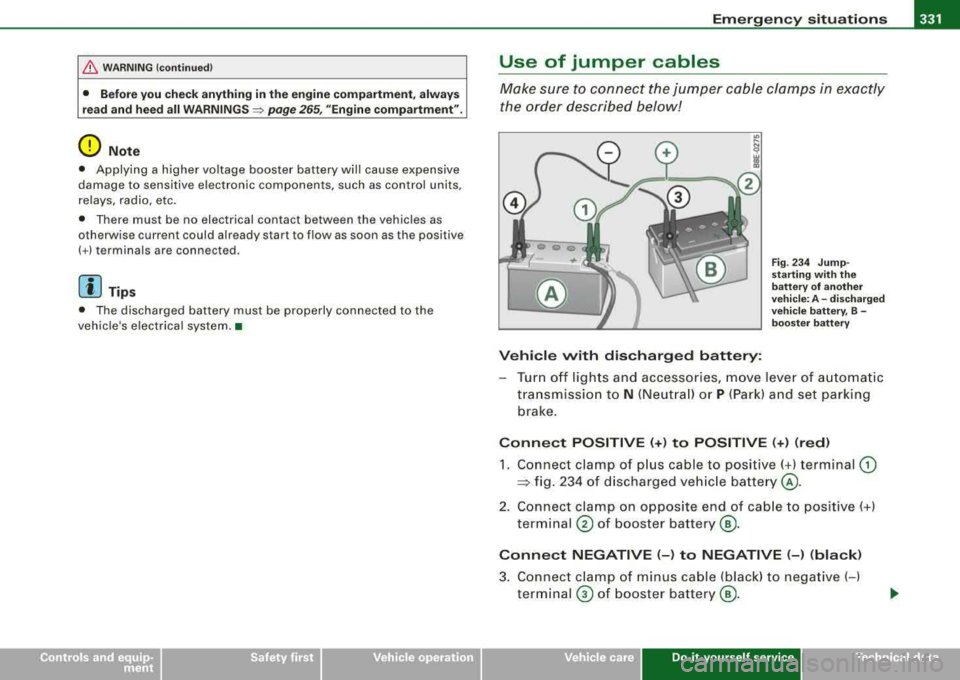
Use of jumper cables
Make sure to connect the jumper cable clamps in exactly
the order described below!
Vehicle with discharged battery:
Fig. 234 Jump
starting with the
battery of another
vehicle: A -discharged
vehicle battery, B -
booster battery
- Turn off lights and accessories, move lever of automatic
transmission to
N (Neutral) or P (Park) and set parking
brake.
Connect POSITIVE (+) to POSITIVE (+) (red)
1. Connect clamp of plus cable to positive( +) terminal (D
:::> fig. 234 of discharged vehicle battery @.
2. Connect clamp on opposite end of cable to positive(+)
terminal
@ of booster battery ®·
Connect NEGATIVE (-) to NEGATIVE (-) (black)
3. Connect clamp of minus cable (black) to negative (-)
terminal
0 of booster battery®·
Do-it-yourse lf service irechnical data
Page 334 of 368
-Emergency situations PW--------=----=---------------
4. Connect clamp on opposite end of negative cable to the
negative(-) terminal© of the discharged vehicle battery
@.
- Check that all screw plugs on the battery cells are
screwed in firmly. If not, tighten plugs prior to
connecting clamp on negative battery terminal.
Starting the engine
-Start the engine of the vehicle with the booster battery.
Run the engine at a moderate speed.
- Start engine with discharged vehicle battery in the usual
manner .
- If the engine fails to start: do not keep the starter
cranking for longer than 10 seconds. Wait for about 30
seconds and then try again.
- With engine running, remove jumper cables from both
vehicles in exact
reverse order.
The battery is vented to the outside to prevent gases from entering
the vehicle interior.
Make sure that the jumper clamps are well connected with their
metal parts in full contact with the battery terminals .
& WARNING
To avoid serious personal injury and damage to the vehicle, heed
all warnings and instructions of the jumper cable manufacturer. If
in doubt, call for road service.
• Jumper cables must be long enough so that the vehicles do not
touch.
• When connecting jumper cables, make sure that they cannot
get caught in any moving parts in the engine compartment.
& WARNING (continued)
• Before you check anything in the engine compartment, always
read and heed all
WARNINGS:::::, page 265, "Engine compartment".
0 Note
Improperly connected jumper cables can damage or destroy the
generator .
• Always connect POSITIVE (+l to POSITIVE(+), and NEGATIVE (-l to
NEGATIVE (- l terminal.
• Check that all screw plugs on the battery cells are screwed in
firmly. If not, tighten plugs prior to connecting clamp on negative
battery terminal.
• Please note that the procedure for connecting a jumper cable as
described above applies specifically to the case of your vehicle
being jump started. When you are giving a jump start to another
vehicle, do not connect the minus 1-1 cable to the minus (-1 terminal
on the discharged battery @::::, page 331, fig. 234. Instead, securely
connect the minus (-l cable to either a massive metal component
that is firmly bolted to the engine block or to the engine block itself .
If the battery that is being charged does not vent to the outside,
escaping battery gas could ignite and explode! •
Emergency towing with commercial
tow truck
General hints
Your Audi requires special handling for towing.
The following information is to be used by commercial tow truck
operators who know how to operate their equipment safely.
• Never tow your Audi, towing will cause damage to the engine
and transmission. .,_
Page 335 of 368
Emergency situations -
----------------=-----'
• Never wrap the safety chains or winch cables around the brake
lines.
• To prevent unnecessary damage, your Audi must be transported
with a car carrier (flat bed truck).
• To load the vehicle on to the flat bed, use the towing loop found
in the vehicle tools and attach to the front or rear anchorage
=> page 333 and => page 334.
& WARNING
A vehicle being towed is not safe for passengers. Never allow
anyone to ride in a vehicle being towed, for any reason. •
Front towline eye
Do not install the front towline eye until it is needed.
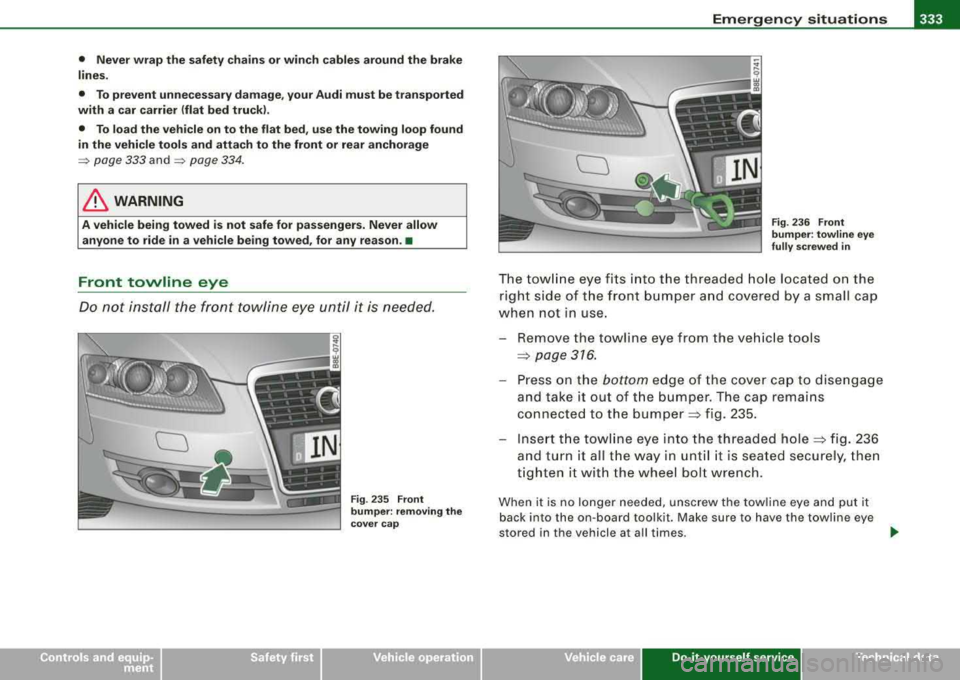
Fig. 235 Front
bumper: removing the
cover cap Fig. 236 Front
bumper: towline eye
fully screwed in
The towline eye fits into the threaded hole located on the
right side of the front bumper and covered by a small cap
when not in use .
-Remove the towline eye from the vehicle tools
=} page 316.
-Press on the bottom edge of the cover cap to disengage
and take it out of the bumper. The cap remains
connected to the bumper :::} fig. 235.
-Insert the towline eye into the threaded hole:::} fig. 236
and turn it all the way in until it is seated securely, then
tighten it with the wheel bolt wrench.
When it is no longer needed, unscrew the towline eye and put it
back into the on-board toolkit. Make sure to have the towline eye
stored in the vehicle at all times. .,_
Do-it-yourse lf service irechnical data