ignition AUDI A4 AVANT 2008 Manual PDF
[x] Cancel search | Manufacturer: AUDI, Model Year: 2008, Model line: A4 AVANT, Model: AUDI A4 AVANT 2008Pages: 368, PDF Size: 46.19 MB
Page 209 of 368
Side curtain airbags (SIDEGUARD™)
Description of SIDEGUARD™ airbags
The SIDEGUARD™ airbag system can provide supple
mental protection to properly restrained occupants.
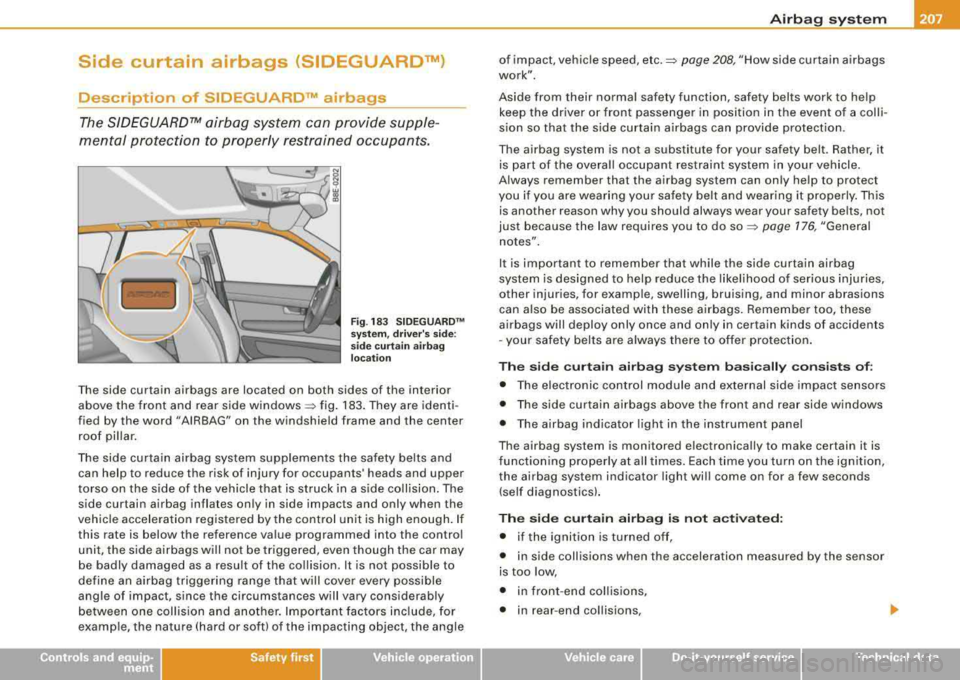
F ig . 18 3 S IDEGUARD ™
sys tem , driver's s id e:
s id e cu rtain air b a g
l oca tio n
The side curtain airbags are located on both sides of the interior
above the front and rear side
windows => fig. 183 . They are identi
fied by the word "AIRBAG" on the windshield frame and the center
roof pillar.
The side curtain airbag system supplements the safety belts and can help to reduce the risk of injury for occupants' heads and upper
torso on the s ide of the vehicle that is struck in a side collision . The
side curtain airbag inflates only in side impacts and only when the
vehicle accele ra tion reg istered by the contro l unit is high enough. If
this rate is below the reference va lue programmed into the contro l
unit, the side airbags w ill not be triggered, even though the car may
be badly damaged as a result of the co llision . It is not possible to
define an airbag triggering range that will cover every possible
angle of impact, since the circumstances will vary considerably
between one collision and ano the r. Important factors include, for
example, the nature (hard or soft) of the impacting object, the angle
Safety first
Airb ag syst em
of impact, vehicle speed, etc .=> page 208, "How side curtain airbags
work".
Aside from their norma l safety function, safety belts work to help
keep the driver or front passenger in position in the event of a colli
s ion so that the side curtain airbags can provide protection .
The airbag system is not a substitute for your safety belt . Rather, it
is part of the overall occupant restrain t system in your veh icle.
Always remember that the airbag system can only he lp to protect
you if you are wear ing your safety belt and wear ing it properly . This
is another reason why you should always wear your safety belts, not
just because the law requires you to do so
=> page 176, "General
notes".
It is important to remember that while the side curtain airbag
system is designed to help reduce the likelihood of serious injuries,
other injuries, for examp le, swelling, bruising, and minor abrasions
can a lso be associa ted with these a irbags . Remembe r too, these
airbags will deploy only once and on ly in certain kinds of accidents
- your safety belts are always there to offer protection .
The side curta in air b ag system b asi cally consists of :
• The elec tronic co ntrol mod ule and external side impact sensors
• The side curtain airbags above the front and rear side windows
• The airbag indicator light in the instrument panel
The airbag system is monitored electronica lly to make certain it is
f u n ction ing properly at all times. Each time you turn on the ignition,
the airbag system indicator light wi ll come on for a few seconds
(se lf diagnostics).
The s ide curt ain ai rbag is not acti vated :
• if the ignition is turned off,
• in side collisions when the acceleration measured by the sensor
is too low,
• in front -end collisions,
• in rear -end collisions,
.,
irechnical data
Page 213 of 368

& WARNING (conti nued )
• Alw ays install r ear-facing child saf ety s eats on the r ear seat.
• If you mu st in sta ll a re arwa rd f acing child safe ty s eat on the
front pas senger seat in exc eptional cir cum stances and the
PASSENGER AIR BAG OFF light doe s not come on and stay on,
immediat ely install th e rear-fa cing child safety s eat in a rear
s e ating po sit ion and h ave the airb ag sys tem in spe cted immedi
a tel y by y our Audi dealer .
& WARNING
If, in exceptional circum stance s, you must in stall a forward -fac ing
c hild re st ra int on the fr ont p assenge r's s eat:
• Alway s make sure the forward -facing seat ha s been de signed
and cert ified by it s m anuf acturer for u se on a front se at with a
pa ssenger front and side airbag .
• Always follow the m anufacturer's instruct ions provided w ith
the child safet y seat or c arrier.
• Alway s m ov e th e passeng er sea t into it s re arm ost p osit ion in
the seat' s fore and aft adju stment range , as far away from the
a irb ag as possible before installin g the ch ild r estr aint . The b ack
rest must be adjusted to an upright po sition.
• Alway s ma ke sure th at the PASSENGER AIR BAG OFF light
come s on and stay s on all the time wheneve r the ignition i s
s wit ched on . •
Advanced front airbag system and children
Your vehicle is equipped with a dual -stage front "Advanced Airbag
System" in comp liance with United States Federal Motor Vehicle
Safety Standard ( FMVSS) 208 as applicab le at the time your vehic le
was manufactured .
Controls and equip
ment Safety first Vehicle operation
Chi
ld Sa fe ty
The Advanced Airbag system in your vehic le has been certified to
meet the " low -risk" require ments for 3 and 6 yea r- old c hild ren on
the passenger side and small adu lts on the driver side . The low risk
deployment c rite ria are intended to reduce the risk of inju ry th rough
interaction with the airbag that can occur, for example, by being too
close to the steering whee l and instrument panel when the airbag
in flates . In add it ion, the system has been cert ified to comply with
the "suppression" requirements of the Safety Standard, to turn off
the front airbag for in fants up to 12 months who are restrained on
the front passeng er seat in child restraints that are listed in the
Standard.
Even though your vehic le is equipped with an Advanced Airbag
system, all ch ildren, especially those 12 years and younger, sho uld
a lways ride in the back seat proper ly restra ined for the ir age and
size . The airbag on the passenger side makes the front seat a poten
tially dangerous p lace for a chi ld to r ide. The front seat is not the
safest p lace for a chi ld in a forward -facing child safety seat. It can be
a very dangerous place for an infant or a larger chi ld in a rearward
facing seat. •
Advanced Airbags and the weight-sensing
mat in the front seat
The Advanced A irbag System in your ve hicle detects the p resence
of an infant or chi ld in a child restraint on the front passenger seat
using the weight -sensing mat in the seat cushion and the sensor
below the safety belt latch on the front passenger seat that
measures the tension on the safety belt .
The weight -sensing mat meas ures total we ig ht of the ch ild and the
child safety seat and a chi ld blanket on the front passenger seat. The
weight o n the fr ont passenge r seat is related to the desig n of the
child restraint and its "footprint" , the size and shape of the bottom
of the child restraint as it sits on the seat. The weight of a child
restraint and its "footprint" vary for different kinds of chi ld
_..
Vehicle care Do-it-yourself service Technical data
Page 215 of 368
Child Safety -
---------------''------'
C. Forward-facing convertible child restraint systems,
manufactured on or after September 1, 2004:
• Britax Roundabo ut 161
• Brit ax Expressway
• Century Encor e 4612
• Century STE 1000 4416
• Cosco Olympian 02803
• Cosco Touriva 02519
• Evenflo Horizon V 425
• Evenflo M edallion 254
• Safety First Comfor t Ride 22-400
& WARNING
To reduce the risk of serious injury, make sure that the PASSENGER
AIR BAG OFF light comes on and stays on whenever a child restraint is installed on the front passenger seat and the ignition
is switched on.
• Take the child restraint off the front passenger seat and install
it properly at one of the rear seat positions if the PASSENGER AIR
BAG OFF light does not stay on.
• Have the airbag system inspected by your authorized Audi
dealer immediately.
[ i] Tips
Th e child s eats lis ted in cat egori es A to C have been tes ted by Audi
only for the Advanced Airbag function. •
Controls and equip
ment Safety first Vehicle operation
Important safety instructions for using child
safety seats
Correct use of child safety seats substantially reduces the
risk of injury in an accident!
As the driver, you are responsible for the safety of every
body in the vehicle, especially children:
- Always use the right child safety seat for each child and
always use it properly :::>
page 215.
-Always carefully follow the child safety seat manufac
turer's instructions on how to route the safety belt prop
erly through the child safety seat.
- When using the vehicle safety belt to install a child safety
seat , you must first activate the convertible locking
retractor on the safety belt to prevent the child safety
seat from
moving => page 220.
- Push the child safety seat down with your full weight to
get the safety belt really tight so that the seat cannot
move forward or sideways more than one inch (2.5 cm).
- If a strap or tether is being used to tie the child safety
seat to the front passenger seat, make sure that it is not
so tight that it causes the weight-sensing mat to
measure more weight than is actually on the seat.
Always remember: Even though your vehicle is equipped with an
Advanced Airbag system, all children, especially those 12 years and
younger, should always ride in the back seat properly restrained for
their age and size .
..,_
Vehicle care Do-it-yourself service Technical data
Page 217 of 368
/b, WARNING (continued)
-Always move the front passenger seat into the rearmost
position of the passenger seat's fore and aft adjustment range,
and as far away from the airbag as possible before installing
the child restraint.
- Always make sure that nothing prevents the front
passenger's seat from being moved to the rearmost position in
its fore and aft adjustment range.
- Always make sure that the backrest is in the upright posi
tion.
• Always buckle the child safety seat firmly
in place even if a
child is not sitting in it. A loose child safety seat can fly around
during a sudden stop or in a collision.
• Always read and heed all WARNINGS whenever using a child
restrained in a vehicle is being
used=> page 176, "Safety belts",
=> page 187, "Airbag system" and=> page 210, "Child Safety".
& WARNING
To reduce the risk of serious injury, make sure that the PASSENGER
AIR BAG OFF light comes on and stays on whenever a child
restraint is installed on the front passenger seat and the ignition
is switched on.
• Take the child restraint off the front passenger seat and install
it properly at one of the rear seat positions if the PASSENGER AIR
BAG OFF light does not stay on.
• Have the airbag system inspected by your authorized Audi
dealer immediately. •
Safety first
Child Safety
Child safety seats
Infant seats
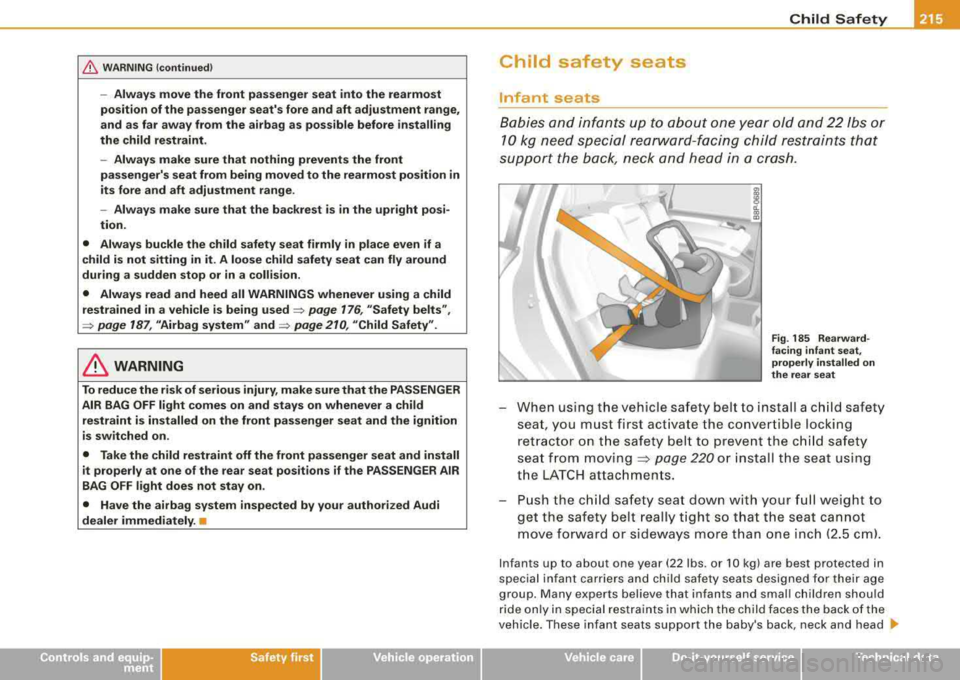
Babies and infants up to about one year old and 22 lbs or
10 kg need special rearward-facing child restraints that
support the back, neck and head in a crash.
I a. C0 a,
Fig . 185 Rearward
facing infant seat,
properly installed on
the rear seat
- When using the vehicle safety belt to install a child safety
seat, you must first activate the convertible locking retractor on the safety belt to prevent the child safety
seat from
moving~ page 220 or install the seat using
the LATCH attachments.
-Push the child safety seat down with your full weight to
get the safety belt really tight so that the seat cannot
move forward or sideways more than one inch (2.5 cml.
Infants up to about one year (22 lbs . or 10 kg) are best protected in
special infant carriers and child safety seats designed for their age
group. Many experts believe that infants and small children should
ride only in special restraints in which the child faces the back of the
vehicle. These infant seats support the baby's back, neck and head
.,_
irechnical data
Page 219 of 368
Child Safety -
---------------''------'
Toddle rs and chi ldren who ar e older than one y ear up to about 4
ye ars old and wei gh m ore th an 2 2 lbs (1 0 kg) u p to 40 lbs. (1 8 kg)
shou ld be prope rly restrained in a c hild saf ety s eat c ertifi ed for their
si ze and we igh t=> fig. 18 6.
T he a irba g on t he passe nger s id e m akes t he fr ont seat a p otentially
dangerou s place fo r a child to ride. The front seat is not the safest
pl ace fo r a c hild in a forw ard -f ac ing child safety sea t. It is a very
dangerous place for an infant o r a larger ch ild in a rearward-facing
s e at .
& WARNING
Not using a child safety seat, using the wrong child safety seat or
improperly installing a child restraint increases the risk of serious
personal injury and death in a collision or other emergency situa
tion .
• Children on the front seat of any car, even with Advanced
Airbags, can be seriously injured or even killed when an airbag inflates . A child in a rearward-facing child safety seat installed on
the front passenger seat will be seriously injured and can be killed
if the front airbag inflates - even with an Advanced Airbag System .
• The inflating airbag will hit the child safety seat or infant
carrier with great force and will smash the child safety seat and
child against the backrest, center arm rest, or door.
• Always install rear -facing child safety seats on the rear seat.
• If you must install a rearward facing child safety seat on the
front passenger seat because of exceptional circumstances and
the PASSENGER AIR BAG
OFF light does not come on and stay on ,
immediately install the rear -facing child safety seat in a rear
seating position and have the airbag system inspected by your
Audi dealer .
• Always read and heed all WARNINGS whenever using a child
restrained in a vehicle is being used => page 176, "Safety
belts" ,
=> page 187, "Airbag system " and => page 210, "Important things
to know".
Controls and equip ment Safety first
Vehicle operation
& WARNING
If exceptional circumstances require the use of a forward -facing
child restraint on the front passenger's seat , the child's safety and
well -being require that the following special precautions be taken:
• Make sure the forward -facing seat has been designed and certi
fied by its manufa cturer for use on a front seat with a passenger
front and side airbag.
• Always follow the manufacturer's instructions provided with
the child safety seat or carrier.
• Always move the front passenger seat into the rearmost posi
tion of the passenger seat's fore and aft adjustment range , and as
far away from the airbag as possible before installing the child
restraint.
• Always make sure that nothing prevents the front passenger's
seat from being moved to the rearmost position in its fore and aft
adjustment range .
• Always make sure the backrest is in an upright position .
• Make sure that the PASSENGER AIR BAG
OFF light comes on
and stays on all the time whenever the ignition is switched on.
• If the light does not stay on , perform the
checks => page 198,
" Monitoring the Advanced Airbag System ".
• Take the child restraint off the front passenger seat and install
it properly at one of the rear seat positions if the PASSENGER AIR
BAG
OFF light does not stay on whenever the ignition is switched
on .•
Vehicle care Do-it-yourself service Technical data
Page 221 of 368
child's or other occupant's body and the front of the passeng er
c o m pa rtm ent, th e a ir ba g ca n i nfl ate fully and completely and
p rov ide supp lem ental p rotection in cert ain fr ontal crash es.
& WARNING
Not using a booster seat, using the booster seat improperly, incor
rectly installing a booster seat or using the vehicle safety belt
improperly increases the risk of serious personal injury and death
in a collision or other emergency situation. To help reduce the risk
of serious personal injury and /or death :
• Always make sure to position the shoulder portion of the three
point belt over the middle of child's shoulder .
• Never let the shoulder portion of the belt rest against or across
the neck , face , chin , or throat of the child .
• Always make sure the lap belt portion of the three -point belt is
worn snug and passes as low as possible across the child's pelvis .
Never let the belt pass over the soft abdomen.
• Failure to properly route safety belts over a child's body will
cause severe injuries in an accident or other emergency situation
=> page 176 .
• Children on the front seat of any car, even with Advanced
Airbags, can be seriously injured or even killed when an airbag
inflates . A child in a rearward-facing child safety seat installed on
the front passenger seat will be seriously injured and can be killed
if the front airbag inflates.
• Never let a child stand o r kneel on any seat , for example the
front seat .
• Never let a child ride in the cargo area of your vehicle.
• Always remember that a child leaning forward , sitting side
ways or out of position in any way during an accident can be
struck by a deploy ing a irbag. This will result in serious personal
injury or death .
• If you must install a rearward facing child safety seat on the
front passenger seat because of exceptional circumstances the
Safety
first
Child Safety
& WARNING (continued )
PASSENGER AIR BAG OFF light must come on and stay on , when
ever the ignition is switched on.
• If the PASSENGER AIR BAG OFF light does not come on and stay
on , perform the checks
described => page 198, "Monitoring the
Advanced Airbag System" .
• Take the child restraint off the front passenger seat and install
it properly at one of the rear seat positions if the PASSENGER AIR
BAG OF F light does not stay on whenever the ignition is switched
on .
• Always read and heed all WARNINGS whenever using a child
restrained in a vehicle is being
used => page 176 , "Safety belts" ,
=> page 187, "Airbag system" and => page 210 , "Important thing s
to know ".•
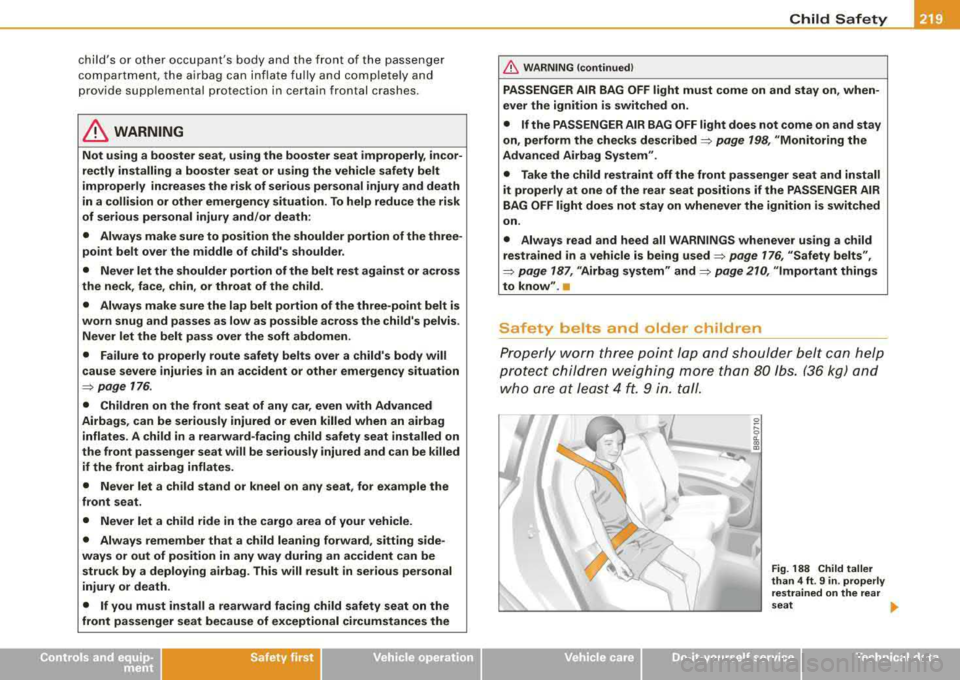
Safety belts and older children
Prop erl y worn t hree point la p and sho ulder belt can h elp
p ro te ct childre n weighing more th an 8 0 lbs . (36 kg) and
w ho a re at lea st 4 ft. 9 in. tall .
~ .... 0 cL (X) a,
Fig . 18 8 Child taller
than 4 ft . 9 in . properly
restrained on the rear
s eat
.,_
•
irechnical data
Page 223 of 368
& WARNING (continued)
• If the backrest is not securely latched, the child and the child
restraint will be thrown forward together with the backrest and
will strike parts of the vehicle interior . The child can be seriously
injured or killed.
• Never install rear-facing child safety seats or infant carriers on
the front passenger seat. A child will be seriously injured and can be killed when the passenger airbag inflates .
• The inflating airbag will hit the child safety seat or infant
carrier with great force and will smash the child safety seat and
child against the backrest, center arm rest, door or roof.
• Always install rear-facing child safety seats or infant carriers on
the rear seat.
• Forward-facing child safety seats or infant carriers installed on
the front passenger's seat may interfere with the deployment of
the airbag and cause serious injury to the child.
• It is safer to install a forward-facing child safety seat on the rear
seat.
• Always read and heed all WARNINGS whenever using a child
restrained in a vehicle is being used
=> page 210. Special precau
tions apply when installing a child safety seat on the front
passenger
seat => page 189, "Child restraints on the front seat -
some important things to know".
& WARNING
Always take special precautions if you must install a forward or
rearward -facing child restraint on the front passenger's seat in
exceptional situations :
• Whenever a forward or rearward-facing child restraint is
installed on the front passenger seat, the PASSENGER AIR BAG
OFF light must come on and stay on whenever the ignition is
switched on.
Controls and equip ment Safety first
Vehicle operation
Child Safety
& WARNING (continued)
• If the PASSENGER AIR BAG OFF light does not come on and stay
on, perform the checks described
=> page 198, "Monitoring the
Advanced Airbag System" .
• Take the child restraint off the front passenger seat and install
it properly at one of the rear seat positions if the PASSENGER AIR
BAG OFF light does not stay on whenever the ignition is switched
on .
• Improper installation of child restraints can reduce their effec
tiveness or even prevent them from providing any protection.
• An improperly installed child restraint can interfere with the
airbag as it deploys and seriously injure or even kill the child.
• Always carefully follow the manufacturer's instructions
provided with the child safety seat or carrier.
• Never place additional items on the seat that can increase the
total weight registered by the weight -sensing mat and can cause
injury in a crash.
& WARNING
Forward-facing child restraints:
• Always make sure the forward-facing seat has been designed
and certified by its manufacturer for use on a front seat with a
passenger front and side airbag.
• Never put the forward-facing child restraint up, against or very
near the instrument panel .
• Always move the passenger seat into its rearmost position in
the seat's fore and aft adjustment range, as far away from the airbag as possible before installing the forward-facing child
restraint. The backrest must be adjusted to an upright position.
• Make sure that the PASSENGER AIR BAG OFF light comes on
and stays on all the time whenever the ignition is switched on. ...
Vehicle care Do-it-yourself service Technical data
Page 224 of 368
llfflJ_....:::C:.:.h :.:.i::.::
ld :...:: S::.::a :.:f .:::e ::.::t .!..y ____________________________________________ _
& WARNING
Rearward-facing child restraints:
• A child in a rearward-facing child safety seat installed on the
front passenger seat will be seriously injured and can be killed if
the front airbag inflates -even with an Advanced Airbag System.
• The inflating airbag will hit the child safety seat or infant
carrier with great force and will smash the child safety seat and
child against the backrest, center arm rest, door or roof.
• Always be especially careful if you must install a rearward
facing child safety seat on the front passenger seat in exceptional
circumstances.
• A tight tether strap on a rearward-facing child restraint
attached to the front passenger seat can put too much pressure
on the weight-mat in the seat and register a heavier weight in the
Advanced Airbag System. The heavier weight registered can make
the system work as though an adult were on the seat and deploy
the Advanced Airbag when it must be suppressed causing serious or even fatal injury to the child.
• Make sure that the PASSENGER AIR BAG OFF light comes on
and stays on all the time whenever the ignition is switched on.
• If the PASSENGER AIR BAG OFF light does not come on and stay
on, immediately install the rear-facing child safety seat in a rear
seating position and have the airbag system inspected by your
Audi dealer. •
Activating the convertible locking retractor
Use the convertible locking retractor to secure a child
restraint.
Always heed the child safety seat manufacturer's instruc
tions when installing a child restraint in your vehicle. To
activate the convertible locking retractor:
-Place the child restraint on a seat, preferably on the rear
seat.
-Slowly pull the belt all the way out.
-Route it around or through the child restraint belt path
=>& .
-Push the child safety seat down with your full weight to
get the safety belt really tight.
-Insert the belt tongue into the buckle for that seating
position.
-Guide the safety belt back into the retractor until the belt
lies flat and snug on the child safety seat.
-You should hear a "clicking" noise as the belt winds back
into the inertia reel. Test the convertible locking retractor
by pulling on the belt. You should no longer be able to
pull the belt out of the retractor. The convertible locking
retractor is now activated.
-Make sure that the red release button is facing away from
the child restraint so that it can be unbuckled quickly.
-Pull on the belt to make sure the safety belt is properly
tight and fastened so that the seat cannot move forward
or sideways more than one inch (2.5 cm).
& WARNING
Using the wrong child restraint or an improperly installed child
restraint can cause serious personal injury or death in a crash.
• Always make sure that the safety belt retractor is locked when
installing a child safety seat. An unlocked safety belt retractor
cannot hold the child safety seat in place during normal driving or
in a crash.
~
Page 246 of 368
llffll.,__ __ D_r_ iv _ in_.... g,_ a_n_ d __ e_n _v_ ir_o_ n_ m_ e_n_ t _____________________________________________ _
New brake pads
Remember that new brake pads do not have a full braking
effec t during the first 250 miles (400 kilometers) after they
are i nstalled .
New brake pads have to be "burn ished in" befo re they have opti mal
grab =>& .
During the break -in period, you s hou ld avo id putti ng severe loads
on the brakes . Severe loads include, for examp le, sudden hard
braking, in particular at very h igh speeds or, for example, on moun
t ain passes .
& WARNING
New brake p ad s don't h ave th e be st sto pping p ower a nd mu st b e
" brok en -in " durin g th e initial 100 to 1 50 mil es (150 t o 200 kil ome
t e rs) of norm al cit y dri ving . You can comp en sa te for thi s by
pr ess ing the brak e ped al mor e firmly . Thi s al so appli es later when
ne w pad s a re in sta lled. •
Catalytic converter
It is very important that your emission control sys tem
(catalytic conver ter) is functioning properly to ensure that
y o ur vehicle is running in an environmentally sound
manner.
-Always use lead-free gasoline => page 267, "Fuel supply".
-Never run the tank down a ll the way to empty.
-Never put too much motor o il in your engine => page 278,
"Add ing eng ine oil
The catalytic converter is an efficient "clean-up " device built into the
exhaust system of the vehicle. The catalyt ic converter burns many
of the po llutants in the exhaust gas before they are released into the
atmosphere.
T he exc lusive use o f un leaded fue l is critica lly important for the l ife
of the catalytic converter and proper functioning of the engine.
& WARNING
• Do not park or operate th e veh icle in ar eas wh ere the hot
ex hau st sys tem m ay come in contac t w ith dr y gra ss, bru sh , fuel
s pill or other material which can cau se a fire .
• Do not appl y additi ona l under coating or ru stpr oofing on or
ne ar the e xhau st m anifol d, ex haust pipe s, ca ta lytic converter or
he at shield s. Du ring dri ving , the sub sta nce u sed f or under coating
c ould overhe at and cau se a fir e.
0 Note
• Be aware that just one tank filling with leaded fue l wi ll already
ser iously degrade the performance of the catalyt ic converter.
• Do not exceed the correct engine oi l
level=> page 278.
• Do not drive until the fuel tank becomes comp letely empty . The
engine could misfire . Unburned fuel could also get into the exhaust
system and this could cause the catalytic conver ter to overheat .
• Do not turn off the ignition wh ile the vehicle is moving.
• Do not continue to operate your vehicle under these conditions,
as otherwise fuel can reach the cata lyt ic converter . This cou ld result
in overheating of the converter, requiring its rep lacement .
• To assure eff icient operat ion of the Em iss ion Control System:
- Have your vehicle maintained properly and in accordance with
the service recommendations in your Maintenance
& Warranty
booklet.
..,
Page 248 of 368

lffll.,__ __ D_r_ i_v _i_n _.g..,_ a_ n_d_ e_ n_v _ i
_ r_o _ n_ m_ e_ n_ t _______________________________________________ _
one half. Never drive faster than the posted speed limit and weather
conditions permit. •
Reducing unnecessary idling
Even when your car is just idling it burns up fuel.
- Shut the engine off when you are not driving the vehicle .
- Do not warm up the vehic le by letting the engine run at
id le .
It makes sense to shut off the engine in traff ic jams, when waiting
for tra ins to pass at rai lroad crossings , or at traffic lights that have
long waits on red. Turning the engine off for just 30 -40 seconds
saves more fue l than is burned starting the engine again .
It takes a long time for the engine to warm up fu lly when it is
running at idle. However, wear and noxious emiss ions are espec ially
high when the engine is warming up . So you should drive away as
soon as you sta rt the engine and avoid running at high rpms w hile
the engine is sti ll warming up.
0 Note
Do not leave engine idling unattended after starting . If warning
lights should come on to indicate improper operation, they would
go unheeded. Extended id ling also produces heat, which could
resu lt in overheating or other damage to the vehic le or other
property .•
Regular maintenance
A badly tuned engine unnecessarily wastes a lot of fuel.
- Have your ve hicle serviced at regular intervals .
By having your vehicle regularly serviced by an Audi dealer helps to
ensure that it runs properly and economical ly . The cond ition of your
vehic le not only affects its safety and abi lity to hold its value, it also
affects
fuel consumpt ion .
Check your oil ea ch time you fill your t ank .
The amount of oil used is related to engine load and speed.
I t is norma l for the oi l consumption of a new engine to reach its
lowest value after a certain mi leage has been driven.
You must drive your vehicle about 3,000 miles (5,000 kilometers) before you can properly assess oil consumption .
This also applies to fue l consump tion and engine output .
0 Note
• Have your vehicle maintained properly and in accordance with
t he service recom mendat io n s in your Maintenance
& Wa rranty
booklet. Lack of proper ma intenance as well as improper use of the
vehic le wi ll impai r the function of the emission cont rol system and
cou ld lead to damage.
• Do no t alte r or remove any component of the Emission Contro l
System unless approved by the manufacturer .
• Do not alte r or remove any dev ice, such as heat shields,
switches, ignition wires, valves, which are designed to protec t your
vehic le's Emission Control System and other important veh ic le
components .•
Fewer short trips
Fuel consumption will alw ays be rel atively high on short
t r ips.
- Try to avo id driving short dis ta n ces wi th a cold engine. ~