warning light AUDI A4 CABRIOLET 2009 Owners Manual
[x] Cancel search | Manufacturer: AUDI, Model Year: 2009, Model line: A4 CABRIOLET, Model: AUDI A4 CABRIOLET 2009Pages: 340, PDF Size: 77.32 MB
Page 264 of 340
-~_C_ h_e _c _ k_ i_ n ...,,g,:...._ a_n_ d_ f_ i_ll _in ....;g=---------------------------------------------
Have the battery checked when you take your vehicle in for service .
You are well advised to replace a battery that is older than 5 years.
Disconnecting the battery terminals
Some vehicle functions (power window regulators, for example) are
lost if the battery terminals are disconnected . Th ese functions have
to be relearned after the battery terminals are connected again. To
prevent this, the battery should only be disconnected from the
vehicle electrical system when absolutely necessary for repairs .
Vehicles not driven for long periods
If you are going to let your vehicle stand for a long time and not
drive it, you should remember there are electrical components
which are still functioning and they will draw energy from the
battery and drain it, for example, the engine immobilizer. To prevent
this, you can either charge the battery occasionally to keep it in
good working condition or you can disconnect the negative cable
on the battery.
Winter operation
During the winter months, battery capacity tends to decrease as
temperatures drop. This is because more power is also consumed
while starting, and the headlights, rear window defogger, etc., are
used more often.
Avoid unnecessary power consumption, particularly in city traffic or
when traveling only short distances . Let your authorized Audi dea ler
check the capacity of the vehicle battery before winter sets in
=>
page 265 . A we ll charged battery wil l not only prevent starting
problems when the weather is cold, but will also last longer.
Replacing battery
The new battery must have the same capacity, voltage (12 volts),
amperage, construction and plug sea ling, as the origina l battery.
Specifications are listed on the battery housing. Batteries specially
developed by Audi fulfill the maintenance, output, and safety
requirements. When installing the battery, make sure the ignition and all electrical
consumers are switched off=>
0.
We recommend that you use maintenance -free or cyc le-resis
tant/leak-proof
batteries according to the standards TL 825 06 (from
December 1997) and VW 7 50 73 (from August 2001).
Replacing the battery should be carried by a qualified workshop.
Please follow the instructions on the battery cover.
0 Note
• All work on the battery requires technical knowledge. Please
contact an Audi dealership or another authorized facility for ques
tions about the battery -danger of acid burns and exp losion hazard!
• Make sure the ventilation hose on the side of the battery is
connected, otherwise fumes or battery acid can leak out.
• Battery holder and terminals always have to be secured correctly.
• Before all work on the battery follow the
warnings below=> & in
"Working on the battery" on
page 263.
mend your authorized Audi dealer change the battery for you.
Batteries contain sulfuric acid and lead and must always be
disposed of properly in compliance with all environmental regula
tions . Disposing of vehicle batteries improperly is very dangerous to
the environment . Make sure that the removed battery cannot over
balance, otherwise sulfuric acid might escape!
[ i ] Tips
If your vehicle is left standing for several weeks at extremely low
temperatures, the vehicle battery should be removed and stored
where it will not freeze. This will prevent it from being damaged and
having to be replaced.•
Page 265 of 340
_____________________________________________ C_h_ e_ c _ k_in -= g_a _ n_d _ f_il _li _n """g ;;..._____..
Working on the battery
Be especially careful when working on or near the battery.
•·•·•·•
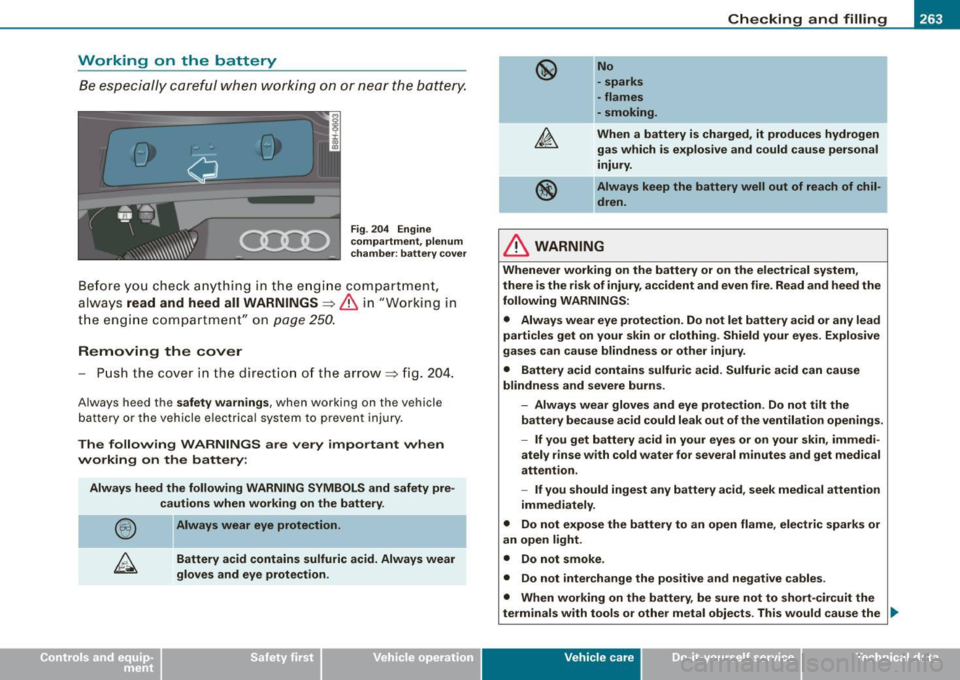
Fig. 204 Engine
compartment, plenum
chamber : battery cover
Before you check anything in the engine compartment,
always read and heed all WARNINGS=>
& in "Working in
the engine compartment" on
page 250.
Removing the cover
-Push the cover in the direction of the arrow => fig. 204.
Always heed the safety warnings, when working on the vehicle
battery or the vehicle electrical system to prevent injury.
The following WARNINGS are very important when
working on the battery:
Always heed the following WARNING SYMBOLS and safety pre
cautions when working on the battery .
®
Always wear eye protection.
Battery acid contains sulfuric acid. Always wear
gloves and eye protection.
No
- sparks
- flames
- smoking.
When a battery is charged, it produces hydrogen
gas which is explosive and could cause personal
injury.
Always keep the battery well out of reach of chil
dren.
& WARNING
Whenever working on the battery or on the electrical system,
there is the risk of injury, accident and even fire. Read and heed the
following WARNINGS:
• Always wear eye protection. Do not let battery acid or any lead
particles get on your skin or clothing. Shield your eyes. Explosive
gases can cause blindness or other injury.
• Battery acid contains sulfuric acid. Sulfuric acid can cause
blindness and severe burns .
- Always wear gloves and eye protection. Do not tilt the battery because acid could leak out of the ventilation openings .
- If you get battery acid in your eyes or on your skin, immedi
ately rinse with cold water for several minutes and get medical
attention.
- If you should ingest any battery acid, seek medical attention
immediately.
• Do not expose the battery to an open flame , electric sparks or
an open light.
• Do not smoke.
• Do not interchange the positive and negative cables .
• When working on the battery, be sure not to short-circuit the
terminals with tools or other metal objects. This would cause the .,,.
Vehic le care irechnical data
Page 266 of 340
•---=C:.:h..:. e=-= c..:.k :..:.in =-=-= g~ a..:.n :.:d::....:. f.:.:il .:.:li ..:.n :..::g:!..- ___________________________________________ _
& WARNING (continued )
battery to heat up very q uickly, which could lead to damage or
explo sion and per sonal injury .
• When a battery is charged , it produces hydrogen gas whic h i s
explo sive and could cause per son al injury .
• Always keep the battery well out of the re ach of children.
• Before work i s done on the electrical system , di sconne ct the
negative ground cable .
• Before per forming any work on the ele ctri cal system , switch off
the engine and ignition as well as any electrical equipment. The
negative cable on the battery must be disconnected .
If you are just
going to replace a light bulb , then it is enough to switch off the
light s.
• Before disconnecting the battery , switch off the anti -theft
alarm system! Otherw ise you will set off the alarm .
• When di sconne cting the battery , fir st di sconnect the negative
c able and then the positive cable .
• Before reconnecting the battery , make sure all electrical
c onsumers are sw itched off . Reconnect the posit ive cable first and
then the negative cable. Never interchange the cables -this could
start a fire !
• Never charge a frozen or a thawed -out battery. It could
e xplode! If a battery has frozen , then it must be replaced. A
discharged batte ry can freeze over at 32 °F (0 °C ).
• Make sure the vent hose is always attached to the opening on
the side of the battery.
• Never use batteries which are damaged . There is the danger of
an explosion! Alway s replace a damaged battery.
& WARNING
California Propo sition 65 Warning :
& WARNING (continued )
• Battery post s, terminals and related accessories contain le ad
and lead compounds , chemicals known to the State of California
to cause can cer and reproduct ive problems . Wash hand s after
handling .
0 Note
• Do not disco nnect t he vehicle battery when the igni tion is
switched on or when the engine is running , otherwise, you wi ll
damage e le ctronic c ompone nts in the electrical syst em.
• I f your vehicle is going to stand for a long period of time without
being dr iven, protect the battery from "freezing" otherwise it wil l be
damaged and wi ll then have to be replaced .•
Checking the battery acid level
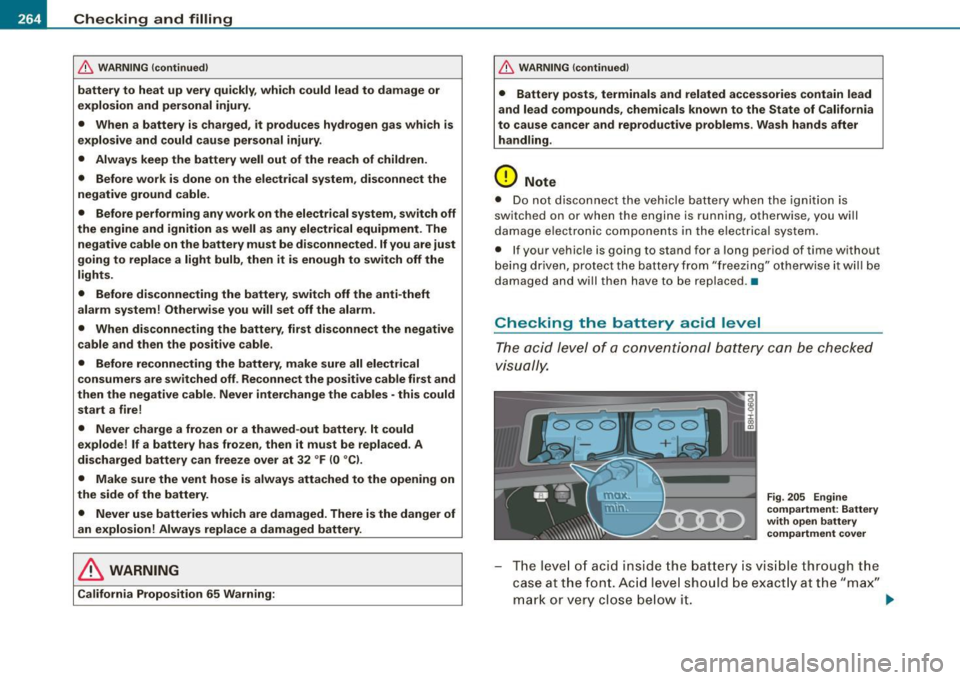
T he aci d l evel of a co nv enti onal ba ttery c an be c hecke d
vis ually.
·•
Fig . 2 05 Engine
c ompartment : Battery
w it h o pen b atter y
compartment cover
T he leve l of acid inside the b atte ry is vis ib le th rough the
case a t the fo nt. Ac id le ve l shou ld be ex actly at t he " max "
m ark or v ery clo se belo w it.
~
Page 268 of 340
___ C_h_ e_ c_k _in --== g'-- a_n _d_ f_il _li _n ..::g=-- --------------------------------------------
Windshield /headlight washer
reservoir
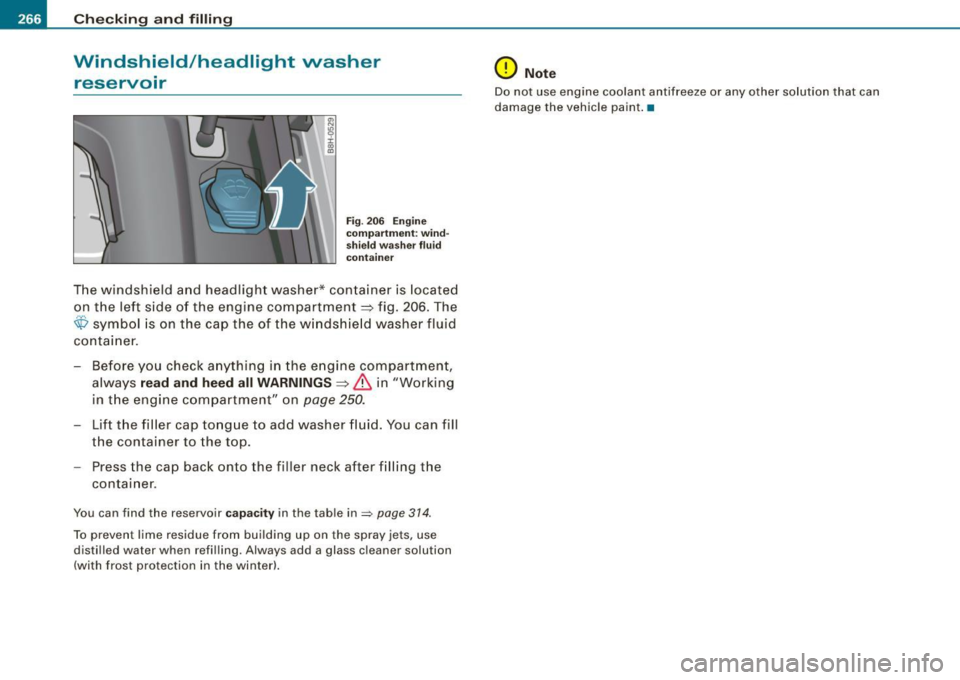
Fig . 206 Engine
compartment : wind
shield washer fluid
container
The windshield and headlight washer* container is located
on the left side of the engine compartment
~ fig. 206. The
~ symbol is on the cap the of the windshield washer fluid
container.
- Before you check anything in the engine compartment,
always
read and heed all WARNINGS~ & in "Working
in the engine compartment" on
page 250.
-Lift the filler cap tongue to add washer fluid. You can fill
the container to the top.
- Press the cap back onto the filler neck after filling the
container .
You can find the reservoir capacity in the table in~ page 314.
To prevent lime residue from building up on the spray jets , use
dis tilled water when refilling . Always add a glass cleaner solution
(with frost protection in the winter).
(D Note
Do not use engine coolant antifreeze or any other solution that can
damage the vehicle paint. •
Page 277 of 340

Tires and wheels -
----------------
•
• The tire pressures should only be checked and adjusted when
t he t ires are co ld . The s lightly raised press ures of warm tires must
not be reduced .
• Adjust t he tire p re ssure to the load you are carrying.
• Reinstall the va lve stem cap on the valve.
When should I check the tire pressure?
The correc t tire p re ssur e is espec ially i mportant at high speeds. The
pressure should there fore be c hecked at least once a month and
a lways before starting a journey. Do not forget to check the tire pres
su re for t he spare whee l::::>
page 291.
When should I adjust the tire pressures?
Adjust the ti re pressur e to the load you are carrying. A fter chang in g
a wheel
or replacing whee ls you have to adj ust t he t ire pressure s on
a ll whee ls. In addition, o n ve hicles w ith t ire pressure monito ring
system * you must then store the new tire pressures in the system
=> page 41.
& WARNING
Incorrect tire pres sures and /or underinflation can lead sudden tire
failure, loss of control , collision, serious personal injury or even
death .
• When the warning symbol ( appears in the instrument
cluster , stop and inspect the tires .
• Incorrect tire pressure and /or underinflation can cause
increased tire wear and can affe ct the handling of the vehicle and
stopping ability .
• Incorre ct tire pressures and /or underinflat ion can also lead to
sudden tire failure, including a blowout and sudden deflation,
causing loss of vehi cle control.
• The driver is responsible for the correct tire pressures for all
tires on the vehicle . The appli cable pre ssure values are located on
a sticker on the driver 's side 8-pillar or on the inside of the fuel
filler flap .
& WARNING (continued )
• Only when all tires on the veh icle are filled to the correct pres
s ure, the tire pressure monitoring system * can work correctly .
• The use of incorrect tire pressure values can lead to accidents
or other damage . Therefore it is essential that the driver observe
the specified tire pressure values for the tires and the correct pres
sures for the function of the tire pressure monitoring system*.
• Alway s inflate tires to the recommended and corre ct tire pres
sure before driving off.
• Driving with underinflated tires bend more , letting them get
too hot resulting in tread separation , sudden tire failure and loss
of control.
• Excessive speed and /overloading can cause he at build -up ,
sudden tire failure and loss of control.
• If the tire pressure is too low or too high , the tires will wear
prematurely and the vehicle will not handle well.
• If the tire is not flat and you do not have to change a wheel
immediately, drive at reduced speed to the nearest service station
to che ck the tire pressure and add air as required .
0 Note
Driving without valve stem caps can cause damage to the tire
valves. To p revent this, a lways make sure tha t factory installe d va lve
stem caps on al l wheels are securely mounted on the va lve .
<£> For the sake of the environment
Underinflated tires wi ll a lso increase the fue l consumption. •
Tires and vehicle load limits
There are limits to the amount of load or weight that any vehic le and
any tire can carry. A vehicle that is overloa ded wil l n o t handle well _,.
Vehic le care
Page 296 of 340

_1.--_W:...:....: h..:.. a=-.: t..:..d= o....:... I .=d .:..;o:......;. n..:.. o.::...;. vv..:....:.. ? ______________________________________________ _
5. Take the flat wheel off and then put the spare on
=> page 297.
6. Tighten all wheel bolts lightly.
7.
Lower the vehicle with the jack.
8. Use the wheel bolt wrench and
firmly tighten all wheel
bolts
=> page 295.
9. Put the decorative wheel cover* back on.
& WARNING
Always read and head all WARNINGS and information ~ & in
"Raising the vehicle" on
page 296 and ~ page 298. •
After changing a wheel
A wheel change is not complete without the following
actions.
- Store and secure the replaced wheel in the spare wheel
well.
- Put the tool case and the jack back in place in the luggage
compartment .
- Check the
tire pressure on the spare wheel immediately
after mounting it.
- As soon as possible , have the
tightening torques on all
wheel bolts checked with a torque wrench. The correct
tightening torque is 90 ft lb (120 Nm).
- Have the flat tire
replaced as soon as possible.
[ i ] Tips
• If you notice while changing a tire that the wheel bolts are
corroded and difficult to turn, then they should be replaced before
you check the tightening torque.
• Drive at reduced speed until you have the tightening torques
checked .•
A pp lies to vehicle s: wi th dec orat ive w heel cove rs
Decorative wheel covers
The decorative wheel covers must be removed first to
access the wheel bolts.
Removing
"' ....
"' 0 ±. .,
"'
Fig. 216 Wheel
change : removing the
wheel cover
- Insert the hook provided with the onboard tool kit into
the hole on the center hub piece.
- Pull off the
decorative wheel cover=> fig. 216. •
Page 304 of 340
111!11.--___;;F...; u::. s.::..:: e~s :.....:: a..:..n .:..; d::....; b.:..:. u..:..lb ;:..:: s _______________________________________________ _
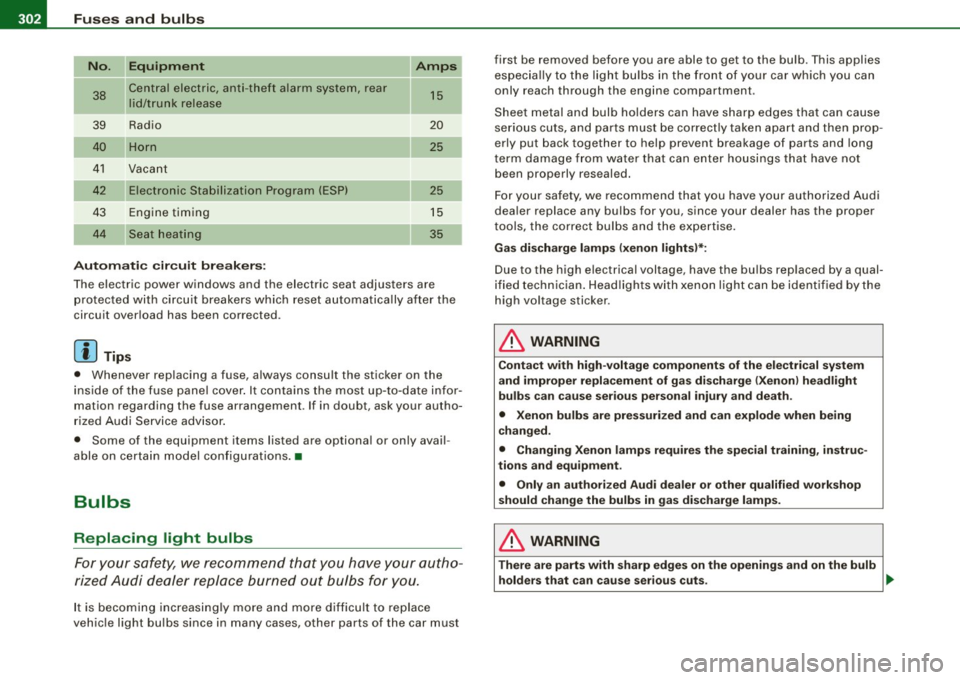
No.
38
39
41
42
43
Equipment
Central electric, anti -theft alarm system, rear
lid/trunk release
Radio
Horn
Vacant
Electronic Stabilization Program (ESP)
Engine timing
Seat heating
Automatic circuit breakers: Amps
15
20
25
25
15
35
The electric power windows and the electric seat adjusters are
protected with circuit breakers which reset automatically after the
circuit overload has been corrected .
[ i] Tips
• Whenever replacing a fuse, always consult the sticker on the
inside of the fuse panel cover. It contains the most up-to-date infor
mation regarding the fuse arrangement . If in doubt, ask your autho
rized Audi Service advisor.
• Some of the equipment items listed are optional or only avail
able on certain model configurations. •
Bulbs
Replacing light bulbs
For your safety, we recommend that you have your autho
rized Audi dealer replace burned out bulbs for you.
It is becoming increasingly more and more difficult to replace
vehicle light bulbs since in many cases, other parts of the car must first be removed before
you are able to get to the bulb. This applies
especially to the light bulbs in the front of your car which you can
only reach through the engine compartment.
Sheet metal and bulb holders can have sharp edges that can cause
serious cuts, and parts must be correctly taken apart and then prop
erly put back together to help prevent breakage of parts and long
term damage from water that can enter housings that have not
been properly resealed.
For your safety, we recommend that you have your authorized Audi
dealer replace any bulbs for you, since your dealer has the proper
tools, the correct bulbs and the expertise.
Gas discharge lamps (xenon lights)*:
Due to the high electrical voltage, have the bulbs replaced by a qual
ified technician. Headlights with xenon light can be identified by the
high voltage sticker.
& WARNING
Contact with high-voltage components of the electrical system
and improper replacement of gas discharge (Xenon) headlight
bulbs can cause serious personal injury and death.
• Xenon bulbs are pressurized and can explode when being
changed.
• Changing Xenon lamps requires the special training, instruc
tions and equipment.
• Only an authorized Audi dealer or other qualified workshop
should change the bulbs in gas discharge lamps.
& WARNING
There are parts with sharp edges on the openings and on the bulb holders that can cause serious cuts .
~
Page 306 of 340
111!1.___E_ m __ e_r -=g :...e_ n_ c-=y _ s_ i_t _u _a _t_ i_o _n_ s _______________________________________________ _
Emergency situations
General
This chapter is intended for trained emergency crew s and working
personnel who have the necessary tools and equipment to perform
these operations. •
Starting by pushing or towing
0 Note
Vehicles with an automatic tran smission cannot be started by
push ing o r towing . •
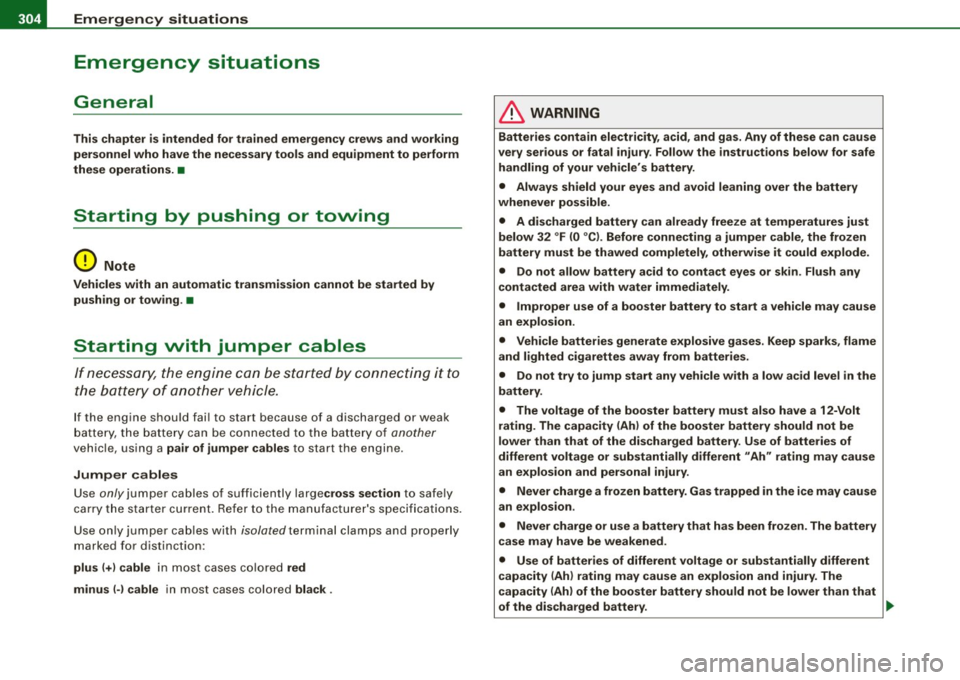
Starting with jumper cables
If n ece ssa ry, th e engin e ca n be sta rte d by conne cti ng it to
the battery of another veh ic le .
If the engin e should fai l to start because of a discharge d or weak
b at te ry, the batt ery can be con nected t o the batt er y of
another
ve hic le, using a pair of jumper cables to start the engine.
Jumper cables
Use
only jumper cables of suffici ently large cross section to safely
c arry the st ar ter curre nt. Refer to th e m anuf actu rer's sp ec ificati ons.
Use on ly j umper ca bles with
isolated termi na l clam ps and properly
marked fo r distinct ion :
plus (+l cable in mo st c ases c olor ed red
minus (-l cable in most cases colored black.
& WARNING
Batteries contain electricity , acid, and gas. Any of these can cause
very serious or fatal injury. Follow the instructions below for safe
handling of your vehicle 's battery .
• Always shield your eyes and avoid leaning over the battery
whenever possible .
• A discharged battery can already freeze at temperatures just
below 32 °F (0 °C). Before connecting a jumper cable, the frozen
battery must be thawed completely, otherwise it could explode.
• Do not allow battery acid to contact eyes or skin . Flush any
contacted area with water immediately.
• Improper use of a booster battery to start a vehicle may cause
an explosion.
• Vehicle batteries generate e xplosive gases . Keep sparks , flame
and lighted cigarettes away from batteries.
• Do not try to jump start any vehicle with a low acid level in the
battery.
• The voltage of the booster battery must also have a 12-Volt
rating . The capacity (Ahl of the booster battery should not be
lower than that of the discharged battery . Use of batteries of
diffe rent voltage or substantially different "Ah " rating may cause
an explosion and personal injury .
• Never charge a frozen battery. Gas trapped in the ice may cau se
an explosion .
• Never charge or use a battery that has been frozen . The battery
case may have be weakened.
• Use of batteries of different voltage or substantially different
capacity (Ah ) rating may cause an explosion and injury . The
capacity (Ahl of the booster battery should not be lower than that of the discharged battery . ...
Page 307 of 340

______________________________________________ E_ m_ e_r -=g :...e _ n_ c __a. y_ s_it _u_ a_ ti_o _ n_ s _ __,11111
& WARNING (continued)
• Before you check anything in the engine compartment, always
read and heed all WARNINGS~ page 242, "Engine compartment".
0 Note
• Applying a higher voltage booster battery will cause expensive
damage to sensitive electronic components, such as control units,
relays, radio, etc .
• There must be no electrical contact between the vehicles as
otherwise current could already start to flow as soon as the positive
(+) terminals are connected.
[ i] Tips
The discharged battery must be properly connected to the vehicle's
electrical system. •
Use of jumper cables
Make sure to connect the jumper cable clamps in exactly
the order described below!
Fig. 225 Jump·
starting with the
battery of another
vehicle : A -discharged
vehicle battery, B -
booster battery
Vehicle with discharged battery:
- Turn off lights and accessories, move lever of automatic
transmission to
N (Neutral) or P (Park) and set parking
brake.
Connect POSITIVE (+) to POSITIVE (+) (red)
1. Connect clamp of plus cable to positive(+) terminal G)
~ fig. 225 of discharged vehicle battery@.
2. Connect clamp on opposite end of cable to positive(+)
terminal
® of booster battery@.
Connect NEGATIVE (-) to NEGATIVE (-) (black)
3. Connect clamp of minus cable (black) to negative( -)
terminal
0 of booster battery@.
4. Connect clamp on opposite end of negative cable to the
negative( -) terminal © of the discharged vehicle battery
@.
- Check that all screw plugs on the battery cells are
screwed in firmly. If not, tighten plugs prior to
connecting clamp on negative battery terminal.
Starting the engine
- Start the engine of the vehicle with the booster battery.
Run the engine at a moderate speed.
- Start engine with discharged vehicle battery in the usual
manner.
- If the engine fails to start: do not keep the starter
cranking for longer than 10 seconds. Wait for about 30
seconds and then try again. .,,.
~ehicle care Do-it-yourse lf service Technical data
Page 326 of 340

llffl __ A_l-=- p _h_ a_ b_e _t_ic _ a_l _in _ d_e _x ____________________________________________ _
A
Accessories . . . . . . . . . . . . . . . . . . . . . . . . 318
Acoustic park assist . . . . . . . . . . . . . . . . . 122
Adaptive Light Air outlets
Climate controls .. .... ...... ..... 115
How should I adjus t the air outlets to de
frost my windows as quickly as
possible? . . . . . . . . . . . . . . . . . . . . . . 115 Warning/indicator lights
... ... .... .. 20
When must the system be inspected? . ..
179
All Wheel Drive ... .... .... ...... .... 218
Alloy wheels . . . . . . . . . . . . . . . . . . . . . . . 237
defective ............. ........ .. . 34 Air quality sensor .
.... .... .... .... .. 114 All-whee l drive
adaptive light .. ... .... .... ... ...... . 79 Air recirculation
............... ..... 113
Winter tires .. ......... .... .... .. 284
Adding Engine coolant ... .... .... ...... .
259
Engine oi l ..... .... ... .... .... .. .
255
Windshield washer fluid .... .... . .
266
Additiona l accessories .. ...... ...... . 318
Additives Engine oil . ..... .. ..... ... ...... . 255
Adjusting Instrument cluster illumination .. .... 15
Steering wheel co lumn .... ... .... 118
Adjusting the seats
Manual seats ...... .... ........... 94
Advanced Airbag System . . . . . . . . . . . . 172
Children ... ........... .... ... ... 191
Components ...... .... .......... 175
Front airbags . . . . . . . . . . . . . . . . . . . . 173
How the components work together 176
Monitoring . . . . . . . . . . . . . . . . . . . . . . 179
Weight -sensing mat . .... ... .. .... 191
Air conditioning
See Climate controls . . . . . . . . . . . . . . 110
Air distribution Clima te con trols ... .... ... .... ... 114 Climate controls
...... ...... ... .. 114 Alternator
When should I use the air recircu lation?
114
Air ventilation in the glove compartment ...
108
Airbag system ..... ... .... ..... . 168, 188
Care ... ... .... .... .... .... .... .. 182
Child restraints .............. .... 192
Components (front airbags) .. ... ... 175
Danger of fitting a child safety seat on the
front passenger seat . . . . . . . . . . . . 170
Disposal . . . . . . . . . . . . . . . . . . . . . . . . 182
Front airbags . ....... ..... .... ... 172
How do the front airbags work? . . . . 177
How many airbags does my vehicle have? 175
Important safety instructions on the knee
airbag system .... .... .... .... .. 186
Important things to know ... .... .. 168
Indicator light ... .......... ... ... 179
Knee airbags .... . .. .. ........... 184
Monitoring .... .... .... .... .... .. 179
PASSENGER AIR BAG OFF light ..... 180
Repairs . . . . . . . . . . . . . . . . . . . . . . . . . 182
Side airbags . . . . . . . . . . . . . . . . . . . . . 187
See Generator . . . . . . . . . . . . . . . . . . . . 22
Anti -freeze
S ee Engine coolant system .. ...... 257
Anti-glare inside day-night mirror ...... 88
Anti-lock brake system How the ABS system works . .... ... 216
Warning/indicator lights ........... . 20
An ti- Slip Regulation System (ASR)
How the sys tem works .. ... .... ... 214
Anti-Theft Alarm System Tilt sensors ..... ....... ..... ...... 58
Anti-theft alarm system .. .. .. .... .... . 57
Anti -theft systems
Electronic immobilizer ......... .... 49
Armrest Adjusting ...... .... ..... .. ..... . 100
Storage bin
Ashtray 100
Front ....... .................... 104
Rear .......... .... .... ........ .. 105
Asterisk What does it mean when something is marked with an asterisk? . ..... ... .. 6
Audi Service Repair Manuals and Literature 316