change wheel AUDI A4 CABRIOLET 2009 User Guide
[x] Cancel search | Manufacturer: AUDI, Model Year: 2009, Model line: A4 CABRIOLET, Model: AUDI A4 CABRIOLET 2009Pages: 340, PDF Size: 77.32 MB
Page 217 of 340

Braking
General information
What affects braking efficiency?
O pera tin g co ndition s and drivi ng h abit s
The brakes on today's automobiles are still subject to wear,
depending large ly on operating conditions and dr iving habits~
&
On vehicles that are either driven mostly in stop -and -go city traffic
or are driven hard, the brake pads shou ld be checked by your autho
rized Audi dealer more often than specified in the
W arr anty & Main
t e nanc e bo okle t.
Fai lure to have you r brake pads inspec ted ca n
resu lt in reduced brake performance.
On steep slopes, you shou ld use the braking effect of the engine.
This way, you prevent unnecessary wear on the brake system. If you must use your brakes, do not hold the brakes down continuous ly.
Pump the brakes at intervals.
Moi sture or road salt
If you are driv ing faster than 50 mph (80 km/h) and the windshie ld
wipers are on, the brake pads wi ll briefly touch the brake discs in
regu lar intervals so as to improve reaction time when braking on
wet surfaces. You, the driver, wil l not notice anything.
Under ce rta in conditions, for example, when dr iving through water
or very heavy rain, or even after washing your vehicle, the braking
effect can be reduced due to moisture (or in freezing conditions ice)
on the brake pads. A few cautious brake applications should dry off
the b rake pads or remove any ice coatings .
At speeds
over80 km/h and with the windshie ld wiper turned on, the
brake pads are app lied briefly to the brake discs. This occurs at
regu lar interva ls wi thout the driver not icing and provides for better
brake response time under wet conditions.
The effectiveness of the brakes can be reduced when the vehicle is driven on a sa lt-covered road and the brakes are not used. Likewise,
Controls and equip
ment Safety first Vehicle operation
Int
ellig ent tec hnol ogy
you clean off accumulated sa lt coating from brake discs and pads
with a few ca utious applications of the brake ~
&-
Cor rosi on
There may be a tendency for dirt to build up on the brake pads and
corrosion to form on the discs if the car is not driven regularly or
only f or sho rt trips with little use of the brakes.
If the brakes are not used frequently, or if corrosion has formed on
the discs, it is advisable to clean off the pads and discs by braking
firm ly a few times from a moderately high speed~
&-
Fa ults in the brake system
If you shou ld notice a sudden increase in brake pedal trave l, then
one of the two brake circuits may have failed~
&-
Lo w brak e fluid l evel
Malfunctions can occur in the brake system i f the brake fluid level is
too low . The brake fluid level is monitored electronically .
Brake lining wear statu s
Brake lining wear may be checked by visua l inspection of the condi
tion o f the brake pads through the open ings in the wheel. If neces
sary, the wheel may be removed for this inspection
~ page 293,
"Whee l change".
& WARNING
• You should perform braking maneuver s for the purpo se of
cl eani ng th e br ake sy stem onl y if ro ad condition s permit . Other
road u se rs mu st not be put a t ris k -you may cau se an accident!
• Before des cending a steep gr ade , reduce sp eed and sh ift tr ans
mi ssion into a lower gear or lower driving po sition . Do not ride the
brake s or hold the pedal d ow n too long or t oo often . This could
cau se the brake s to get hot and dimini sh brakin g efficien cy . _.
Vehicle care Do-it-yourself service Technical data
Page 269 of 340

Tires a nd wh eels BIii ________________________________ :....:.:.....::.=.....::.:..:..:..::..:___:___:..__ __
•
Tires and wheels
Tires
General notes
Tires may be the least appreciated and most abused parts
of a motor vehicle.
Tires may be the least appreciated and most abused parts of a
motor vehicle. Tires are, however, one of the most important parts
of a vehicle, particular ly considering the comparative ly sma ll patch
of rubber on each tire that assures that all -important contact
between you, your vehicle and the road .
Maintaining the correct tire pressure, making sure that your vehicle
and its tires do not have to carry more weight than they can safely
handle, avoiding damage from road hazards and regular ly
inspecting tires for damage inc luding cuts , slashes irregular wear
and overal l condition are the most important things that you can do
to help avoid sudden tire failure including tread separation and
b lowouts .
Avo iding d am age
If you have to drive over a curb or similar obstacle, drive very slowly
and as close as possible at a right angle to the curb.
A lways keep chemica ls including grease, oil, gasoline and brake
flu id off the ti res .
I nspect the tires regularly for damage (cuts, cracks or blisters, etc .!.
Remove any foreign bodies embedded in the treads .
Storing tire s
Mark tires when you remove them to indicate the direction of rota
tion. This ensures you to be ab le to mount them correctly when you
reinstall them. When removed, the whee
ls or tires should be stored in a coo l, dry
and preferably dark place.
Store tires in a vertical position i f they are not mounted on r ims, in
a horizontal position if they are mounted on rims.
N ew tire s
New tires have to be broken in => &.
The tread depth of new tires may vary, according to the type and
make of tire and the tread pattern.
Hidd en d am ag e
Damage to tires and rims is often not readily visible . If you notice
unusua l vibration or the vehic le pul ls to one side, this may indicate
that one of the tires has been damaged . The tires must be checked
immediately by an author ized Audi dealer or qualified workshop .
Uni dir ection al tire s
A unidirect ional tire can be identified by arrows on the sidewa ll, that
point in the direction the tire is designed to rotate. You must fo llow
the specified direction of ro tation . This is necessary so that these
tires can deve lop their optimum characteristics regarding grip, road
noise, wear and hydroplaning resistance . For more information
=> page 298.
Rim s with bolted rim ring *
Light-alloy wheels with a bo lted rim ring consist of several parts .
These parts are screwed together with special bo lts, using a specific
technique. This ensures proper function, seal, safety, and true running of the wheel. For this reason, damaged rims shou ld be
replaced, and you should never repair or dismantle them
=> & .
Rim s with screw -on decorative co vers *
Light-a lloy whee ls can be furnished with interchangeab le decora -
tive covers that are mounted to the rim with se lf -locking bolts. ...
Vehic le care
Page 272 of 340
-~_T_ ir_e_ s_ a_ n_d _ w_ h_ e_e _l_s _________________________________________________ _
Rei nf orced tire
means a tire designed to operate at higher loads and at higher inf la
tion pressures then the corresponding standard tire. Reinforced
tires my be identified as "XL",
"xi", "EXTRA LOAD", or "RF" on the
sidewall.
Rim
means a metal support for a tire or a tire and tube assembly upon
which the t ire beads are seated.
R im di am eter
means nomina l diameter o f the bead seat. If you change your wheel
size, you wi ll have to purchase new tires to match the new rim diam
eter.
R im size des ig nati on
means rim diameter and width.
Rim width
means nominal distance between rim flanges .
Sidewall
means that portion of a tire between the tread and bead.
Speed rating (le tter code )
means the speed at which a tire is designed to be driven for
extended periods of time . The ratings range from 93 mph ( 150 km/h)
to 186 mph (298 km/h)~
page 281. You may not find this informa
tion on a ll tires because it is not required by law .
The speed rating letter code, where appl icable, is molded on the tire
sidewal l and indicates the maximum permissible road speeds~
&
in "Winter tires" on page 284 .
Tire pres su re m onitoring s yste m*
means a system that detects when one or more of a vehicle's tires
are underinflated and i lluminates a low tire pressure warning te ll
tale .
Trea d
means that portion of a tire that comes into contact with the road .
Trea d se parati on
means pulling away of the tread from the tire carcass .
Treadw ear indi cato rs (TWI)
means the projections within the princ ipal grooves designed to give
a visual indication of the degrees of wear of the tread. See
~ page 278, "Tread Wear Indicator (TWI)" for more informatio n on
measuring tire wear.
Uniform Tire Q uality Gra ding
is a tire information system developed by the United States National
Highway Traffic Safety Administration (N HTSA) that is designed to
help buyers make relative comparisons among tires. The U TQG is
not a safety rating and not a guarantee that a tire wil l last for a
prescribed number of miles or perform in a certain way. It simply
gives tire buyers additiona l information to combine wit h other
considerations, such as price, brand loyalty and dea ler recommen
dations. Under UTQG, tires are graded by the tire manufacturers in
three areas: treadwear, traction and temperature resistance . The
UTQG information on the tires, molded into the sidewalls.
U.S . D OT T ir e Ident ifi ca tion Num ber (T IN )
This is the tire's "serial number" It begins with the le tters "DOT" and
indicates that the tire meets all federa l standards . The next two
numbers or letters indicate the plant where it was manufactured,
and the last four numbers represent the week and year of manufac
ture. For example,
D OT ... 2 209 ...
means that the tire was produced in the 22th week of 2009 . The
other numbers are marketing codes that may o r may not be used by
the tire manufacturer . This information is used to contact
consumers if a tire defect requires a reca ll. -.,
Page 274 of 340
-Tires and wheels
P'U:1-------------------
warmed up than when it is "cold." It is the inflation pressure in a
"cold" tire that counts. Therefore, you should never let air out of a
warm tire to match "cold tire inflation pressure" recommendations .
The tires would then be underinflated and could fail suddenly.
Maintaining proper tire pressure is one of the most important
things you can do to help avoid sudden tire failure. Underinflated
tires are a major cause of sudden tire failure. Keeping tires at the
right pressure is also important for safe and responsive vehicle
handling, traction, braking and load carrying.
Tire pressures are
particularly important when the vehicle is being driven at higher
speeds, and then especially when heavily loaded even within the
permissible load-carrying capacities approved for your vehicle .
The recommended tire pressures for your Audi depend on the kind
of tires on your vehicle and the number of passengers and/or
amount of luggage you will be transporting.
On USA vehicles, the tire pressure label is located on the driver's
side B-pillar . On Canada vehicles, the tire pressure label is located
either on the driver's side B-pillar or inside the fuel filler flap. The tire
pressure label lists the recommended cold tire inflation pressures
for the vehicle at its maximum capacity weight and tires that were
on your vehicle at the time it was manufactured.
If you wish to improve comfort when operating the vehicle at
normal load (up to 2 occupants), you can adjust tire pressures to
-
those specified for normal vehicle load. Before operating the vehicle
at maximum load, you must increase the tire pressures to those
specified for maximum vehicle load
=> & .
If your vehicle is equipped with a tire pressure monitoring system *,
bear in mind that the system can only monitor the tire pressures you
have stored. The system does not recognize the load condition of
your vehicle.
The effectiveness of the tire pressure monitoring system will be
impaired if you store normal load pressures but then operate the
vehicle at its maximum load=>&.
See the illustration =>
page 271, fig. 207 for the location of the label
either on driver's side B-pillar or inside the fuel filler flap (color of
the actual label and exact location on the vehicle will vary slightly).
Note that the following table is accurate at the time of going to
press and is subject to change. In the event of discrepancies, the tire
pressure label (either on driver's side B-pillar or inside the fuel filler
flap) always takes precedence .
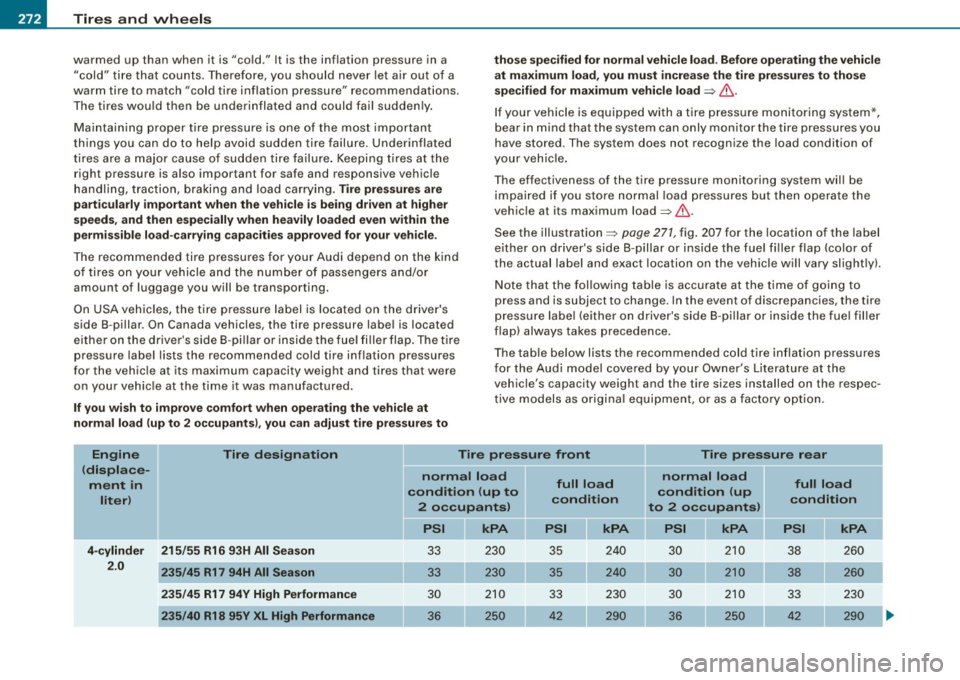
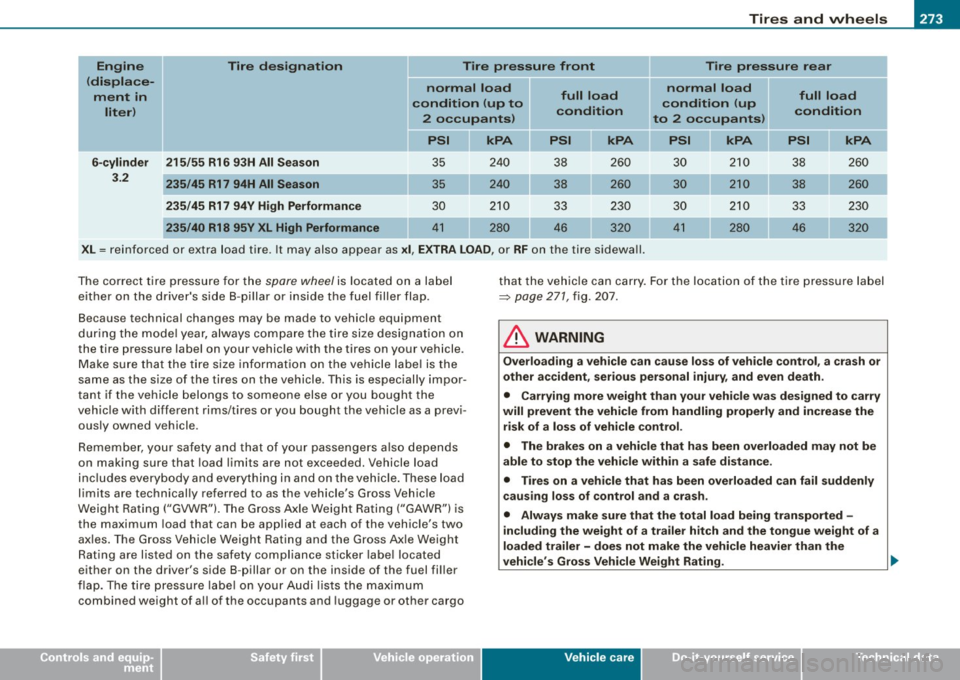
The table below lists the recommended cold tire inflation pressures
for the Audi model covered by your Owner's Literature at the
vehicle's capacity weight and the tire sizes installed on the respec
tive models as original equipment, or as a factory option.
Engine
(displace
ment in liter) Tire designation
Tire pressure front Tire pressure rear
4-cylinder
2.0 215/55 R16 93H All Season
235/45 R17 94H All Season
235/45 R17 94Y High Performance
235/40 R18 95Y XL High Performance
normal load
condition (up to
2 occupants)
PSI
33
33
30
36
kPA
230
230
210
250
full load
condition
PSI
35
35 33
42
II kPA
240
240
230
290
normal load
condition (up
to 2 occupants)
PSI
30
30
30
36
JI kPA
210
210
210
250
11 full load
condition
PSI
38
38
33
42
JI kPA
260
260
230
290
I
Page 275 of 340
Tires and wheels -
----------------
•
Engine Tire designation Tire pressure front Tire pressure rear
(displace- normal load normal load
ment in full load
full load
liter ) c
ondit ion (up to
condition c
ondition (up
condition
2 occupants ) to 2 occupants)
PSI kPA PSI kPA PSI kPA PSI kPA
6 -cylinder 215 /55 R16 93H All Season 35 240
38 260
30 2
10
38 260
3.2
235/45 R17 94H All Season 35 2
4 0
38 260 30 2
10
38 260
235/45 R17 94V High Performance 30 2 10 3 3 230 30 2 10 33 230
235 /40 R18 95V XL High Performance 41 280 46 320 41 280 4 6 320
XL= reinforced or extra load tire. It may also appear as x i, EXTRA LOAD , or RF on the tire sidewa ll.
The correct tire pressure for the
spare wheel is located on a label
either on the dr iver's side B-pilla r or i nside the fuel filler flap.
Because technical changes may be made to vehicle equipment
dur ing the mode l year, a lways co mpare the tire size designatio n on
the tire pressure label on your vehicle with the tires on your vehicle .
Make sure t hat the tire s ize informa tion o n the vehi cle labe l is the
same as the size of the tires on the vehicle . This is especially impor
t a nt if th e ve hicle belo ngs to someone else or you bough t the
vehic le with different rims/tires or you bought the vehicle as a previ
ously owned vehicle.
Re member, your safety and that of your passeng ers a ls o depends
on making sure that load limits are not exceeded. Vehicle load
inc lude s every body and everyt hin g i n and o n the vehic le . These load
limits are techn ically referred to as the vehicle's Gross Vehic le
Weight Ra tin g ("GVWR") . The Gross Axle Weig ht Ra ting ("GAWR") is
the maximum load that can be applied at each of the veh icle's two
ax les . The Gross Vehic le W eight Rating and the Gross Ax le Weight
Rating are listed on the safety compliance sticker label located
either on the driver's s ide 8 -pillar or on the inside of the fuel fi ller
fl ap. T he ti re pressure labe l on your Aud i lists the max imum
combined weight of a ll of the occupants and luggage or other cargo that the vehicle can car
ry. Fo r the l ocat io n of the tire pressure la bel
=> page 271, fig. 207.
LJ}. WARNING
Overload ing a vehicle can cause loss of vehi cle cont rol , a crash or
other ac cident , serious per sonal injury , and even death .
• Carrying more weight than your vehicle wa s designed to carry
will prevent the vehicle from handling properly and increase the
risk of a loss of vehicle control .
• The brakes on a vehicle that has been overloaded may not be
able to stop the vehi cle within a safe dist ance.
• Tires on a vehicle that has been overloaded can fail suddenly
cau sing lo ss of control and a crash .
• Always make sure that the total load being transported -
including the weight of a trailer h itch and the tongue weight of a
loaded trailer -does not make the vehicle heavier than the
vehi cle 's Gross Vehicle Weight Rating . .,,_
Vehic le care
Page 277 of 340

Tires and wheels -
----------------
•
• The tire pressures should only be checked and adjusted when
t he t ires are co ld . The s lightly raised press ures of warm tires must
not be reduced .
• Adjust t he tire p re ssure to the load you are carrying.
• Reinstall the va lve stem cap on the valve.
When should I check the tire pressure?
The correc t tire p re ssur e is espec ially i mportant at high speeds. The
pressure should there fore be c hecked at least once a month and
a lways before starting a journey. Do not forget to check the tire pres
su re for t he spare whee l::::>
page 291.
When should I adjust the tire pressures?
Adjust the ti re pressur e to the load you are carrying. A fter chang in g
a wheel
or replacing whee ls you have to adj ust t he t ire pressure s on
a ll whee ls. In addition, o n ve hicles w ith t ire pressure monito ring
system * you must then store the new tire pressures in the system
=> page 41.
& WARNING
Incorrect tire pres sures and /or underinflation can lead sudden tire
failure, loss of control , collision, serious personal injury or even
death .
• When the warning symbol ( appears in the instrument
cluster , stop and inspect the tires .
• Incorrect tire pressure and /or underinflation can cause
increased tire wear and can affe ct the handling of the vehicle and
stopping ability .
• Incorre ct tire pressures and /or underinflat ion can also lead to
sudden tire failure, including a blowout and sudden deflation,
causing loss of vehi cle control.
• The driver is responsible for the correct tire pressures for all
tires on the vehicle . The appli cable pre ssure values are located on
a sticker on the driver 's side 8-pillar or on the inside of the fuel
filler flap .
& WARNING (continued )
• Only when all tires on the veh icle are filled to the correct pres
s ure, the tire pressure monitoring system * can work correctly .
• The use of incorrect tire pressure values can lead to accidents
or other damage . Therefore it is essential that the driver observe
the specified tire pressure values for the tires and the correct pres
sures for the function of the tire pressure monitoring system*.
• Alway s inflate tires to the recommended and corre ct tire pres
sure before driving off.
• Driving with underinflated tires bend more , letting them get
too hot resulting in tread separation , sudden tire failure and loss
of control.
• Excessive speed and /overloading can cause he at build -up ,
sudden tire failure and loss of control.
• If the tire pressure is too low or too high , the tires will wear
prematurely and the vehicle will not handle well.
• If the tire is not flat and you do not have to change a wheel
immediately, drive at reduced speed to the nearest service station
to che ck the tire pressure and add air as required .
0 Note
Driving without valve stem caps can cause damage to the tire
valves. To p revent this, a lways make sure tha t factory installe d va lve
stem caps on al l wheels are securely mounted on the va lve .
<£> For the sake of the environment
Underinflated tires wi ll a lso increase the fue l consumption. •
Tires and vehicle load limits
There are limits to the amount of load or weight that any vehic le and
any tire can carry. A vehicle that is overloa ded wil l n o t handle well _,.
Vehic le care
Page 294 of 340

11111.___W_ h_ a_ t_d_ o_ l _d _o_ n_ o_ w_ ? ______________________________________________ _
Taking out the spare wheel
- Raise the floor panel at the plastic handle.
- Securely engage the handle in the luggage compartment
seal as illustrated to keep the floor panel up.
- Unscrew the knurled retainer bolt in the wheel center
==> page 291, fig. 215. Turn it counter-clockwise.
- Take out the spare wheel.
- Disengage and lower the floor panel before you close the
luggage compartment lid again.
Storing the replaced wheel
-Place the replaced wheel inside the spare wheel well in
the luggage compartment.
- Tighten the knurled retaining screw clockwise to secure
the wheel in place.
- Disengage and lower the floor panel before you close the
luggage compartment lid again.
& WARNING
Loose items in the passenger compartment can cause serious
personal injury during hard braking or in an accident .
• Never store the spare wheel or jack and tools in the passenger
compartment.
• Always store all jacking equipment, tools, and the spare wheel
in the luggage compartment.
• Tighten the knurled retaining screw for the spare wheel
securely.
[ i] Tips
Check the inflation pressure of the spare tire periodically to keep the
tire ready for use. •
Applies to vehic les: w ith a space -saving spare wheel
Space-saving spare wheel
The compact spare wheel is only intended to be used for
a short time.
Using the space-saving spare wheel
The space -saving spare wheel is only intended for emergencies
until you can reach a repair shop. Replace it as quickly as possible
with a normal wheel.
There are some restrictions on the use of the space -saving spare
wheel
=> ,&. . The space-saving spare wheel has been developed
especially for your type of vehicle. It must not be exchanged for the
space-saving spare wheel from another type of vehicle.
Normal summer or winter tires must not be fitted on the space
saving spare wheel rim.
Snow chains
For technical reasons, the use of snow chains on the space-saving
spare wheel
not permitted .
If you do have to drive with snow chains and have a tire failure on a
front wheel, install the space-saving spare wheel in place of a rear
wheel. Install the snow chains on the rear wheel and use it to
replace the defective front wheel.
& WARNING
• After installing the space-saving spare wheel, the tire pressure
must be checked as soon as possible. The tire pressure must be
adapted to the load condition of the vehicle according to the tire .,_
Page 295 of 340

_____________________________________________ W_ h _a_t _ d_ o_ l _d _o _ n_o_ w_ ?_ . _ ..... 19111
•
& WARNING (continued)
pressure table - risk of accident! Use the highest tire pressure in
the table.
• Do not drive faster than 50 mph (80 km/h) - risk of accident!
• Avoid full-throttle acceleration, sharp braking, and fast
cornering - risk of accident!
• Never drive using more than one space-saving spare wheel -
risk of accident!
• Normal summer or winter tires must not be fitted on the space
saving spare wheel rim. •
Wheel change
Before changing a wheel
Follow these points for your own and your passenger's
safety when replacing a wheel.
-After you experience a tire failure, pull the car well away
from moving traffic and try to reach level ground before
you stop => & .
- All passengers should leave the car and move to a safe
location (for instance, behind the guardrail)=>& .
- Apply the parking brake firmly=>&.
- Move selector lever to position Pon an automatic trans-
mission; put manual transmission in first gear =>& .
- If you are towing a trailer: unhitch the trailer from your
vehicle.
- Take the tool case and the spare tire=>
page 290 out of
the luggage compartment.
& WARNING
You or your passengers could be injured while changing a wheel if
you do not follow these safety precautions:
• If you have a flat tire, move a safe distance off the road. Turn off
the engine, turn the emergency flasher on and use other warning devices to alert other motorists .
• Make sure that passengers wait in a safe place away from the
vehicle and well away from the roadway and traffic.
• To help prevent the vehicle from moving suddenly and possibly
slipping off the jack, always fully set the parking brake and block
the wheel diagonally opposite the wheel being changed. When one
front wheel is lifted off the ground, placing the Automatic Trans
mission in "P" (Park), or engaging a gear in a manual transmission
will
not prevent the vehicle from moving .
• Before you change a wheel, be sure the ground is level and firm.
If necessary, use a sturdy board under the jack.
• After installing the spare wheel, make sure that you remount
the flat tire/wheel in its storage area properly and tighten the
knurled retaining screw securely. •
Changing a wheel
When you change a wheel, follow the sequence described
below step-by -step and exactly in that order.
1. Remove the decorative wheel cover*. For more details
see also =>
page 294, "Decorative wheel covers" or
=>
page 295, "Wheels with cap-covered wheel bolts".
2. Loosen the wheel bolts=>
page 295.
3. Locate the proper mounting point for the jack and align
the jack below that point=>
page 296.
4. Lift the car with the jack=> page 296. _,..
Do-it-yourself service
Page 296 of 340

_1.--_W:...:....: h..:.. a=-.: t..:..d= o....:... I .=d .:..;o:......;. n..:.. o.::...;. vv..:....:.. ? ______________________________________________ _
5. Take the flat wheel off and then put the spare on
=> page 297.
6. Tighten all wheel bolts lightly.
7.
Lower the vehicle with the jack.
8. Use the wheel bolt wrench and
firmly tighten all wheel
bolts
=> page 295.
9. Put the decorative wheel cover* back on.
& WARNING
Always read and head all WARNINGS and information ~ & in
"Raising the vehicle" on
page 296 and ~ page 298. •
After changing a wheel
A wheel change is not complete without the following
actions.
- Store and secure the replaced wheel in the spare wheel
well.
- Put the tool case and the jack back in place in the luggage
compartment .
- Check the
tire pressure on the spare wheel immediately
after mounting it.
- As soon as possible , have the
tightening torques on all
wheel bolts checked with a torque wrench. The correct
tightening torque is 90 ft lb (120 Nm).
- Have the flat tire
replaced as soon as possible.
[ i ] Tips
• If you notice while changing a tire that the wheel bolts are
corroded and difficult to turn, then they should be replaced before
you check the tightening torque.
• Drive at reduced speed until you have the tightening torques
checked .•
A pp lies to vehicle s: wi th dec orat ive w heel cove rs
Decorative wheel covers
The decorative wheel covers must be removed first to
access the wheel bolts.
Removing
"' ....
"' 0 ±. .,
"'
Fig. 216 Wheel
change : removing the
wheel cover
- Insert the hook provided with the onboard tool kit into
the hole on the center hub piece.
- Pull off the
decorative wheel cover=> fig. 216. •
Page 297 of 340

_______________________________________________ W_ h_ a _ t_d_ o_ l _d _o_ n_ o_ w_ ? _ __.1111
Ap plies to vehic les: with cap-covered wheel bolts
Wheels with cap-covered wheel bolts
The caps must be removed first from the wheel bolts
before the bolts can be unscrewed.
Removing
Fig . 217 Wheel
change : removing the
wheel bolt caps
- Push the plastic clip provided with the onboard tool kit
down over the wheel bolt cap until it engages.
- Pull on the properly engaged plastic clip to extract the
cap:::> fig. 217.
Refitting
- Place the caps over the wheel bolts and push them back
1n.
The caps are there to protect and keep the wheel bolts clean.•
Loosening and tightening the wheel bolts
The wheel bolts must be loosened before raising the
vehicle.
Loosening
Fig . 218 Wheel
change : loosening the
wheel bolts
-Fit the wheel bolt wrench over the wheel bolt and push it
down as far as it will go.
- Close your grip around the end of the wrench handle for
maximum torque and turn the wheel bolts counter-clock
wise about one single turn in the direction of arrow
:::> fig. 218 .
Tightening Fit the wheel bolt wrench over the wheel bolt and push it
down as far as it will go.
- Close your grip around the end of the wrench handle for
maximum torque and turn each wheel bolt clockwise
until it sits tight. .,
~ehicle care Do-it-yourse lf service irechnical data