ECO mode AUDI A4 CABRIOLET 2009 Owner's Manual
[x] Cancel search | Manufacturer: AUDI, Model Year: 2009, Model line: A4 CABRIOLET, Model: AUDI A4 CABRIOLET 2009Pages: 340, PDF Size: 77.32 MB
Page 142 of 340

• .___H_ o_m _ e_ L_ i_ n _k_ ®_R __________________________________________________ _
App lies to vehicles: w ith Homelin k® un ive rsal remote contro l
Programmi ng th e Hom eLink ® transmitt er
The transmitter is programmed in two phases. For rolling
code transmitters, a third phase is also necessary .
Fig. 151 Overhead
console : Homelink®
keypad
Fig.152 Frontbumper,
driver side: location of
transmitter unit
Phase 1: programming the overhead keypad
1. Make sure your vehicle is w ithin operat ing range o f the
remote controlled garage door opener .
2. Set the parking brake=>
& in "General information" on
page 139.
3. Turn the ignit ion on. Do not sta rt the engine! 4. Press and ho
ld the two outside Homelink® buttons
(D
and @for app roximately 20 seconds until indicator
light ©=:> fig.
151 beg ins to flash. Then release both
buttons . Do not hold the buttons for longer than
30
seconds.
This procedure only needs to be performed
once. It
erases the factory-set default codes and does not have to
be repeated to program additional remote controls.
5. Press and hold the Homelink ® button (D, ® or @ until
the indicator light © starts flashing
slowly. Release the
button.
- The system will remain in programming mode for 5
minutes.
Go to the front of the v ehicle and proceed w ith
phase 2.
Phase 2:
programming the bumper mounted transmitter
6. Hold the original remote control at a distance between 0-
6 in. (0-15 cm) from the b umper below the appropriate
headlight for your vehicle => fig.
152 (use the shortest
distance possible) .
7. Aim the remote control just below the
driver side head
lig ht.
8. Press and hold the act ivation button on the remote
control.
- May be different in Canada . If so, press and re-press
(cycle) the activation button on your remote control every
two seconds. -.,
Page 144 of 340
• .___H_ o_m_ e_ L_ · _,n _k_ ® __________________________________________________ _
- Press the appropriate programmed button 0,@ or@
to activate the desired remote control function~
& in
"General information" on
page 139. •
Applies to vehicles: with Homelink® universal remote contro l
Reprogramming a single button
A HomeLink® button can be reprogrammed individually without affecting the other button a/locations.
Programming the overhead keypad
- Press the appropriate Homelink® button until the indi
cator light begins flashing slowly.
Programming the bumper mounted transmitter 1. Hold t he
original remote control at a distance between 0-
5 in. (0-13 cm) from the bumper below the appropriate
headlight for your vehicle (use the shortest distance
possible).
2. Aim the remote control just below the
driver side head
light.
3. Press and hold the activation button on the remote control.
4. The emergency flashers will flash
three times (after
about
15-60 seconds) when the programming is
successful. Now release the button on the remote
control.
- If the device utilizes a rolling code, please follow phase 3
of ~
page 140, "Programming the Homelink® trans
mitter" for rolling code programming.
This procedure will cause the existing programming on the
Homelink ® button to be erased! •
App lies to vehicles: with Homelink® unive rsa l remote contro l
Erasing the programming of the Homelink ®
transmitter
When you erase the programming, the programming on
all three of the transmitter channels with be lost!
- Perform steps 1 to 4 as described on~ page 140, "Phase
1: programming the overhead keypad".
When completed , the Homelink® system will be in the prog ram
ming mode and is then ready to learn the codes for remote
controlled devices.
[I) Tips
• Programmed buttons cannot be erased individually.
• For security reasons you are advised to erase the programming
of the Homelink ® system befo re you sell your vehicle.•
Page 185 of 340
__________________________________________________ A_ i_ r _b _a...; g::- s_ y=--- s_t _e _m ___ lffllll
& WARNING (continued )
• Always make sure that the side airbag can inflate without inter
ference :
- Never install seat covers or replacement upholstery over the
front seatbacks that have not been specifically approved by
Audi.
- Never use additional seat cushions that cover the areas
where the side airbags inflate.
- Damage to the original seat covers or to the seam in the area
of the side airbag module must always be repaired immedi
ately by an authorized Audi dealer.
• The airbag system can be activated only once. After an airbag
has inflated, it must be replaced by an authorized Audi dealer or
qualified technician who has the technical information , training
and special equipment nece ssary.
• The airbag system can be deployed only once . After an airbag
has been deployed , it must be replaced with new replacement
part s designed and approved especially for your Audi model
version. Replacement of complete a irbag systems or airbag
components must be performed by qualified workshops only .
Make sure that any airbag service action is entered in your Audi
Warranty
& Maintenance booklet under AIRBAG REPLACEMENT
RECORD .
• In accidents when an airbag is deployed , the vehicle battery
s eparates the alternator and the starter from the vehicle electrical
system for safety reasons with a pyrotechnic circuit interrupter.
-Work on the pyrotechnic circuit interrupter must only be
performed by a qualified dealer -risk of an accident !
- If the vehi cle or the circuit interrupter is scrapped , all appli
cable safety precautions must be followed . •
Controls and equip ment Safety first
Vehicle operation
Other things that can affect Advanced Airbag
performance
Changing the vehicle 's suspension system can cha nge the way that
the Advanc ed Ai rbag Syste m perfor ms in a cras h. Fo r ex amp le,
u sing tire -rim combinations not a pproved by Audi, lowering the
ve hicle , c hang ing the st iffness o f the suspe nsion, inclu din g the
spr ings, s uspension struts, shock absorbers etc. can change the
fo rc es that ar e meas ured by th e a irbag sens ors and sent to the e lec
tronic control un it. Some suspens ion changes can, for example,
in crea se th e fo rc e leve ls meas ured by th e se nsors and ma ke t he
airbag system dep loy in crash es in wh ich it wou ld not dep loy if the
c h anges had no t been m ade . Ot her k in ds of cha nge s m ay red uce
the fo rce levels measured by the sensors and p revent t he airba g
fr om depl oyin g whe n it should.
T he sensors in the safe ty b elt b uckle fo r the driver a nd front
passenger seat te ll the electronic control module if the safety belt is
l a tc h e d or not. If the s afe ty be lt is bei ng use d, t he fr ont ai rbag w ill
dep loy at a s lightly higher rate of vehic le dece leration than if the
sa fe ty belt is not be ing used . T here for e, in a partic ular co lli sion , it is
possible t hat an airbag will not dep loy at a seating position w here
the safe ty belt is b ein g us ed b ut will infl ate a t th e po siti on w here the
safety belt is not being used. It is important that nothi ng interfere
with the safety belt b uck les so that the sensors can send the correct
i nformat ion about safety b elt use to the electronic control un it.
& WARNING
Changing the vehicle's suspension including use of unapproved
tire -rim combinations can change Advanced Airbag performance
and increase the risk of serious personal injury in a crash.
• Never install suspension components that do not have the
same performance characteristics as the components originally
installed on your vehicle .
• Never use tire-r im combinations that have not been approved
by Audi. .,.
Vehicle care Do-it-yourself service Technical data
Page 194 of 340
-Child Safety ____ .:....__ __________________________ _
restraints and for the different models of the same kind of child
restraint offered by child restraint manufacturers.
The weight ranges for the individual types, makes and models of child restraints that the NHTSA has specified in the Safety Standard
together with the weight ranges of typical infants and typical 1 year
old child have been stored in the control unit of the Advanced
Airbag System. When a child restraint is being used on the front passenger seat with a typical 1 year-old child, the Advanced Airbag
System compares the weight measured by the weight sensing mat
with the information stored in the electronic control unit.
The electronic control unit also registers the tension on the front
passenger safety belt. The tension on the safety belt for the front
passenger seat will be different for an adult who is properly using
the safety belt as compared to the tension on the belt when it is used to attach a child restraint to the seat. The sensor below the
latch for the safety belt for the front seat passenger measures the
tension on the belt . The input from this sensor is then used with the
weight to "decide", whether there is a child restraint with a typical 1
year-old child on the front passenger seat and whether or not the airbag must be turned off.•
Child restraints and Advanced Airbags
Regardless of the child restraint that you use, make sure that it has
been certified to meet United States Federal Motor Vehicle Safety
Standards and has been certified by its manufacturer for use with
an airbag. Always be sure that the child restraint is properly
installed at one of the rear seating positions. If in exceptional
circumstances you must use it on the front passenger seat, carefully read all of the information on child safety and Advanced Airbags
and heed all of the applicable WARNINGS. Make certain that the
child restraint is correctly recognized by the weight -sensing mat
inside the front passenger seat, that the front passenger airbag is
turned off and that the airbag status is always correctly signaled by
the
PASSENGER AIR BAG OFF light. Many types and models of child restraints have been available over
the years, new models are introduced regularly incorporating new
and improved designs and older models are taken out of produc
tion. Child restraints are not standardized. Child restraints of the
same type typically have different weights and sizes and different
'footprints,' the size and shape of the bottom of the child restraint
that sits on the seat, when they are installed on a vehicle seat. These
differences make it virtually impossible to certify compliance with
the requirements for advanced airbags with each and every child
restraint that has ever been sold in the past or will be sold over the
course of the useful life of your vehicle.
For this reason, the United States National Highway Traffic Safety
Administration has published a list of specific type, makes and
models of child restraints that must be used to certify compliance
of the Advanced Airbag System in your vehicle with the suppression
requirements of Federal Motor Vehicle Safety Standard 208. These
child restraints are:
A. Car beds, manufactured on or after September 1,
2004:
• Cosco Dream Ride 02-719
B. Rear facing child restraint systems, manufactured
on or after September 1, 2004:
(When the restraint system comes equipped with a removable base,
compliance has to be certified with or without the basel.
• Britax Handle with Care 191
• Century Assura 4553
• Century Smart Fit 4543
• Cosco Arriva 02727
• Evenflo Discovery Adjust Right 212
• Evenflo First Choice 204
• Graco Infant 8457
Page 223 of 340

- Lack of proper maintenance as wel l as improper use of the
vehic le wi ll impair the function of the emission control system
and could lead to damage.
'£> For the sake of the environm ent
Even when the Emission Control System is operating properly, the
exhaust gas can have a su lfur -like exhaust gas sme ll under some
operating states. This depends on the sulfur content of the fuel
being used. Using a different brand of fue l may help, or filling the
tank with lead-free super grade gasoline. •
Avoid damaging the vehicle
When you are driving on poor roads, or over curbs, steep ramps,
etc., make certain that low- lying parts such as spoilers and exhaust
system parts do not bottom out and get damaged.
This is especially true for vehicles with low -slung chassis (sports
chassis)* and fully loaded vehicles.
a
Operate your vehicle economically
and minimize pollution
General
Your personal style of driving will determine the economy
of your vehicle, as well as exhaust and noise levels.
Fuel economy, environmental impact, and wear on your engine,
brakes and tires largely depend on three factors:
• your personal driving style
• operating cond itions
• technica l limitat ions
Controls and equip
ment Safety first Vehicle operation
Driving
and environm ent
If you anticipate what you need to do next and drive economica lly,
you can easily cut your fuel consumpt ion by 10 -15 percent . This
section wil l give you some tips on how you can help the environ
ment and your pocketbook.
[ i ] Tips
The consumption est imates as published by ENV IRONMENTAL
PROTECTION AGENCY (EPA) and Transport Canada may not corre
spond to your actua l consumption on the road, which will vary
depending upon vehicle load and speed, road and weather condi
tions, trip length, etc. •
Drive smoothly and keep a lookout ahead
Vehicles use the most fuel when they ore accelerating .
-Avoid unnecessary accelerating and brak ing.
Vehicles use the most fue l when they are accelerating . If you antici
pate what is going to happen next, you wi ll need to brake less and,
thus, acce lerate less. Let the vehicle coast whenever possib le - for
examp le when you see that the next traffic light is red. •
Avoid full throttle
Driving at moderate speeds saves fuel and improves your
mileage.
-Try and keep well below your car's maximum speed.
Acce lerating gently reduces fuel consumption, engine wear, and
does not disturb the environment.
Fue l consumption, exhaust emissions and engine noise increase
disproportionately at high speeds . If you drive at approximately
three quarters of top speed, fuel consumption wil l be reduced by •
Vehicle care Do-it-yourself service Technical data
Page 263 of 340
_____________________________________________ C_ h_ e _ c_k _in ---= g'--- a_n _d_ f_il _li _n __.,g==----•
•
The brake fluid reservoir is located at the rear partition of the engine
compartment on the left side~
page 252 .
The fluid level may drop slightly after some time due to the auto
matic adjustment of the brake pads. This is not cause for alarm .
If the brake fluid level falls
considerably below the "MIN" mark, the
brake warning/indicator light (U .S. models :
BRAKE, Canadian models :
(CD) ) wi ll come on
~ page 23 and ~ page 30. Do not continue to
operate the vehicle. The complete brake system should be thor
oughly checked by an authorized Audi dealer or qualified workshop
and the cause corrected . If the brake fluid level is too low, the brake
warning/indicator light will illuminate. Contact an authorized Audi
dea ler
immediately .•
Changing brake fluid
Have the brake fluid changed by an experienced techni
cian.
Brake fluid absorbs moisture from the air . If the water content in the
brake fluid is too high, corrosion in the brake system may result
after a period of time. The boiling point of the brake fluid wil l also
decrease considerably and decrease braking performance.
Therefore, the brake fluid must be changed
every two years. Always
use new brake fluid which conforms to Federa l Motor Vehic le Stan
dard "FMVSS 116 DOT 4".
The brake fluid reservoir can be difficult to reach, therefore, we
recommend that you have the brake fluid changed by your autho
rized
Audi dealer. Your dealer has the correct tools, the right brake
fluid and the know -how to do this for you.
& WARNING
• Brake fluid is poisonous. It must be stored only in the closed
original container out of the reach of children!
& WARNING (continued)
• Brake failure can result from old or inappropriate brake fluid.
Observe these precautions :
- Use only brake fluid that meets SAE specification
J 1703 and
conforms to Federal Motor Vehicle Standard 116. Always check
with your authorized Audi dealer to make sure you are using
the correct brake fluid. The correct type of brake fluid is also
indicated on the brake fluid reservoir .
- The brake fluid must be new . Heavy use of the brakes can
cause a vapor lock if the brake fluid is left in the system too
long. This can seriously affect the efficiency of the brakes as
well as your safety . This could result in an accident.
0 Note
Brake fluid wil l damage the paint of your vehicle .
ci> For the sake of the environment
Because of the problem of proper disposal of brake fluid as well as
the special tools required and the necessary expertise, we recom
mend that you have the brake fluid changed by your authorized Audi
dealer. •
Battery
General information
Under normal operating conditions, the battery in your Audi does
not need any maintenance. With
high outside temperatures it is
advisab le however to check the fluid level at regular intervals
through the transparent battery housing. Also check the fluid level
each time you charge the battery . After charging the battery
~ page 265, you shou ld likewise check the battery acid level. ...
Vehic le care
Page 274 of 340
-Tires and wheels
P'U:1-------------------
warmed up than when it is "cold." It is the inflation pressure in a
"cold" tire that counts. Therefore, you should never let air out of a
warm tire to match "cold tire inflation pressure" recommendations .
The tires would then be underinflated and could fail suddenly.
Maintaining proper tire pressure is one of the most important
things you can do to help avoid sudden tire failure. Underinflated
tires are a major cause of sudden tire failure. Keeping tires at the
right pressure is also important for safe and responsive vehicle
handling, traction, braking and load carrying.
Tire pressures are
particularly important when the vehicle is being driven at higher
speeds, and then especially when heavily loaded even within the
permissible load-carrying capacities approved for your vehicle .
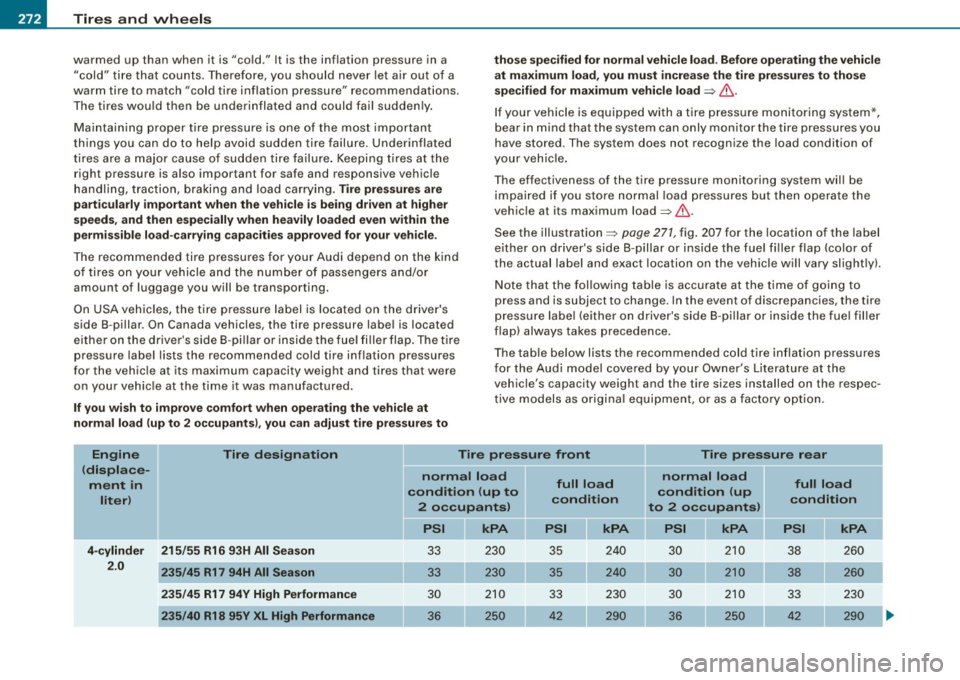
The recommended tire pressures for your Audi depend on the kind
of tires on your vehicle and the number of passengers and/or
amount of luggage you will be transporting.
On USA vehicles, the tire pressure label is located on the driver's
side B-pillar . On Canada vehicles, the tire pressure label is located
either on the driver's side B-pillar or inside the fuel filler flap. The tire
pressure label lists the recommended cold tire inflation pressures
for the vehicle at its maximum capacity weight and tires that were
on your vehicle at the time it was manufactured.
If you wish to improve comfort when operating the vehicle at
normal load (up to 2 occupants), you can adjust tire pressures to
-
those specified for normal vehicle load. Before operating the vehicle
at maximum load, you must increase the tire pressures to those
specified for maximum vehicle load
=> & .
If your vehicle is equipped with a tire pressure monitoring system *,
bear in mind that the system can only monitor the tire pressures you
have stored. The system does not recognize the load condition of
your vehicle.
The effectiveness of the tire pressure monitoring system will be
impaired if you store normal load pressures but then operate the
vehicle at its maximum load=>&.
See the illustration =>
page 271, fig. 207 for the location of the label
either on driver's side B-pillar or inside the fuel filler flap (color of
the actual label and exact location on the vehicle will vary slightly).
Note that the following table is accurate at the time of going to
press and is subject to change. In the event of discrepancies, the tire
pressure label (either on driver's side B-pillar or inside the fuel filler
flap) always takes precedence .
The table below lists the recommended cold tire inflation pressures
for the Audi model covered by your Owner's Literature at the
vehicle's capacity weight and the tire sizes installed on the respec
tive models as original equipment, or as a factory option.
Engine
(displace
ment in liter) Tire designation
Tire pressure front Tire pressure rear
4-cylinder
2.0 215/55 R16 93H All Season
235/45 R17 94H All Season
235/45 R17 94Y High Performance
235/40 R18 95Y XL High Performance
normal load
condition (up to
2 occupants)
PSI
33
33
30
36
kPA
230
230
210
250
full load
condition
PSI
35
35 33
42
II kPA
240
240
230
290
normal load
condition (up
to 2 occupants)
PSI
30
30
30
36
JI kPA
210
210
210
250
11 full load
condition
PSI
38
38
33
42
JI kPA
260
260
230
290
I
Page 282 of 340

-~_T_ ir_e_ s_ a_ n_d _ w_ h_ e_e _l_s _________________________________________________ _
0
©
@
U.S. DOT tire identification number
Sever snow conditions
Tire ply composition and materials used
Maximum load rating
Treadwear, traction and temperature grades Maximum permissible inflation pressure
The tires and rims are essential parts of the vehicle's design. The
tires and rims approved by Audi are specially matched to the char acteristics of the vehicle and can make a major contribution to good
road holding and safe handl ing when in good condition and prop
erly inflated =>& .
We recommend that al l work on tires and wheels be performed by
an authorized Audi dealer . They are familiar with recommended
procedures and have the necessary special too ls and spare parts as
we ll as the proper facilities for disposing of the o ld tires .
Authorized Audi dealers have the necessary information about tech
n ical requirements for insta lling o r changing tires and rims .
Repl ac ing t ires and wheels
Tires should be replaced at least in pairs and not individually (for
example both front tires or both rear tires together).
On vehicles with tire pressure moni toring system*, be sure to read
and heed the information=>
page 287.
Always buy replace ment radia l tires tha t have the same specifica
tions as the tires approved for your vehicle by Audi . Replacement
tires must always have the same load rating specification as the
original equipment or approved optional tires listed in the table
=>
page 271.
A udi -appr oved specificat ion tires a re specially matched t o your
vehic le and its load limits, and can contribute to the important road- holding, driving characteristics, and safety of the vehicle
. T he tab le
( =>
page 271) lists specifications of the tires approved for the Audi
models covered by your Owner's Literature.
The tire pressure label located either on driver's side B -pi llar or
insi de the fuel filler flap(=>
page 271, fig. 208) lists the specifica
tions of the original equipment tires installed on your vehicle at the
time it was manufactured.
Federa l law requires tire manufacturers to place standardized infor
mation on the sidewa ll of all tires=>
page 279, fig. 211. This informa
tion identifies and descr ibes the fundamenta l characteristics, the
quality grade of the tire and a lso prov ides a tire identification
number for safety standa rd certif ication and in case o f a recall.
Tire sp ecifi cations
Knowledge of tire specifications makes it easier to choose the
correct t ires. Rad ial tires have the tire specifications mar ked on the
sidewal l, for example:
P235 / 45 R 18 95 Y
This c onta ins the fo llowing informatio n:
P Indicates the tire is fo r passenger cars (where appl icab le)
2 3 5 Nominal tire width in mm of the tire from sidewall edge to s ide -
wa ll edge. In general, the larger the number, the wider the tire
45 Height/width ratio in percent (aspect ratio)
R Tire construction: Radial
18 Rim d iameter c ode (in inches)
95 Load rat ing code
V Speed rating letter code
X L (or "xi", "EXTRA LOAD" or "RF") indicates that the tire is a "Rein
forced" or an "Ex tra Load" ti re
M +S (or "M/S") Indicates that the tire has some mud and snow capa
bility
The ti res cou ld also have the information of direction of rotation
=>
page 267 .
Page 284 of 340
-~_T_ ir_e_ s_ a_ n_d _ w_ h_ e_e _l_s _________________________________________________ _
toring system* would not be able to monitor the tire pressure or
warn you if it is necessa ry.
• T he battery inside of the tire pressure sensor has a limited
service life.
• Always drive with the valve stem caps securely mounted. We
r ecommend us ing facto ry insta lled va lve stem caps. Ask you r autho
rized Audi dealer to replace lost va lve stem caps.
T he installation of rep lacement tires with steel cord body p lies in
t he tire sidewall may cause mal functi on of the tir e pressure mo ni
toring system , and is not recommended (cord material information
in mo lded o n th e ti re sid ewa ll) .
Always check your tire pressure monitoring system * indicator after
r eplacing one or mo re ti res on your veh ic le . I f the ti re p ress ure
m onito ring syste m* ind icator flashes, or is o n, your s ystem is not
wo rking properly . Your replacement t ire might be incompatible with
yo ur tir e pressure mon ito ring system* , o r so me compo nen t of th e
tire p ressure monitoring system * may be damaged .
& WARNING
• Using incorrect or unmatched tires and I or wheels or improper
tire and wheel combinations can lead to loss of control , collision
and serious personal injury .
• Always use t ires , rims and wheel bolts that meet the specifica
tions of original factory-installed tires or other combinations that
have been specifically approved by the vehicle manufacturer.
• Tires age even if they are not being used and can fa il suddenly,
espe cially at high speeds . Tires that are more than 6 years old can
only be used in an emergency and then with special care and at
lower speed s.
• Never mount used tire s on your vehicle if you are not sure of
their "previous history ." Old used tire s may have been damaged
even though the damage cannot be seen that can lead to sudden
tire f ailure and loss of vehicle control.
& W ARNING (continued )
• All four wheels mu st be fitted with radial tires of the same type,
size (rolling circumference ) and the same tread pattern. Driv ing
with different tires redu ces vehicle h andling and can lead to a loss
of control.
• If the spare tire is not the same as the tires that are mounted
on the vehicle - for e xample with winter tire s - only u se the spare
tire for a short period of time and drive with extra care . Refit the
normal road wheel as soon as safely possible.
• Never drive faster than the maximum speed for which the tires
on your vehicle are rated because tires that are driven faster than
the ir rated speed can fail suddenly .
• Overloading tires cause heat build-up, sudden tire failure ,
including a blowout and sudden deflation and loss of control .
• Temperature grades apply to tires that are properly inflated and
not over or underinflated .
• For te chnical reasons it is not always possible to use wheels
from other vehicle s -in some cases not even wheels from the
same vehicle model.
• If you install wheel trim discs on the vehicle wheels, make sure
that the air flow to the brakes is not blocked. Redu ced airflow to
the brakes can them to overheat , increasing stopping distances
and causing a collision.
• Run flat tire s may only be used on vehicle s that were equipped
with them at the fa ctory . The vehicle must have a cha ssis designed
for run flat tires and a factory -installed tire pressure monitoring
s ystem that indicate s a loss of tire pressure . Incorre ct use of run
flat tires can lead to vehicle damage or accidents . Check with an
autho rized Audi dealer or t ire specialist to see if your vehicle can
be equipped with run flat tires .
If run flat tires are used , they mu st
be installed on all four wheels . Mixing tire types is not permitted. .,
Page 288 of 340

IIIJIL_T~ ir~e =s~ a~n~ d~ w~ h ~e~e~ l~ s '.,_ ______________________________________________ _
Wheel bolts
Wheel bolts must always be tightened to the correct
torque .
The design of wheel bo lts is matched to the factory installed rims . If
different rims are fitted, the correct wheel bolts with the right length
and correctly shaped bolt heads must be used. This ensures that
whee ls are fitted securely and that the brake system functions
correctly .
I n certain circumstances, you may not use wheel bolts from a
different vehicle -even if it is the same model~ page 318.
& WARNING
Improperl y tightened or maintained wheel bolt s can be come loose
c au sing lo ss of control , a co llis ion and seriou s personal injur y.
• Alwa ys keep the wheel bolt s and the th reads in the wheel hubs
c lean so the wheel bolt s can turn ea sily and be properl y tightened.
• Never gre ase or oil the wheel bolt s and the thre ad s i n the wheel
hub s. They can become lo ose while drivin g if gre ased or oiled ,
e ven if tig hten ed to th e specifi ed torque .
• Onl y use wheel bo lt s th at bel ong to the rim being in sta lled.
• Nev er use differ ent wheel s bolt s on your vehicle.
• Alway s m aintai n the corre ct t ightenin g to rq ue for the whee l
bo lt s to r edu ce the ri sk of a whe el los s. If the tighten ing torque of
t h e w heel bolt s is too l ow, they c an loose n a nd com e out when th e
v ehicl e is mov ing . If th e tighte ning torque is t oo high, the whe el
b ol ts an d threads can be dam ag ed and the whee l can become
loo se .
0 Note
The specified torque for the wheel bolts is 90 ft lb (120 Nm) with a
tolerance of ± 7,4 ft lb(± 10 Nm). Torque whee l bolts diagonally.
After changing a wheel, the torque must be checked as soon as possible with a torque wrench
-preferably by an authorized Audi
dea ler or qua lified workshop .•
Low aspect ratio tires
Your Audi is fac tory-equipped with low aspect ratio tires. These tires
have been thorough ly tested and been selected specifically for your
model for their superb performance, road feel and hand ling under
a variety of driving conditions . Ask your authorized Audi dealer for
more details.
The low aspect ratio of these t ires is ind icated by a numera l of 55 or
l e ss in the tire's size designation . The numera l represents the ratio
of the tire's sidewa ll height in relat ion to its tread w idth expressed
in percentage. Conventiona l tires have a height/width ratio of 60 or
more .
T he perform ance of lo w-as pect-rati o tire s is part ic ul arl y s ensit ive to
improp er infla tion pr essure. It i s there fore important that low
a s pect ra tio tir es are inflated to the sp ec ified pre ssure an d th at th e
i nfl ation pre ssure is regularl y checked and m aintained . T ir e pres
s ure s should b e checked a t lea st once a month and alw ays before a
long trip~ page 274, "Checking tire pressure".
What you can d o to avoid tire a nd rim dama ge
Low aspect ratio tires can be damaged more easi ly by impact with
potho les, curbs, gull ies or ridges on the road, particularly if the tire
is underinflated.
In order to minimize the occurrence of impact damage to the tires
of your vehic le, we recommend that you observe the fo llowing
precautions:
• Always maintain recommended inflation pressures . Check your
tire pressure every 2,000 miles (3,000 km) and add air if necessary .
• Drive careful ly on roads with potholes, deep gullies or ridges.
The impact from driving through or over such obstacles can
damage your tires. Impact with a curb may also cause damage to
your tires . .,_