radiator AUDI A4 SEDAN 2013 User Guide
[x] Cancel search | Manufacturer: AUDI, Model Year: 2013, Model line: A4 SEDAN, Model: AUDI A4 SEDAN 2013Pages: 294, PDF Size: 73.71 MB
Page 224 of 294
222 Check ing and filling
Engine cooling system
Coolant
The engine coolant performs two functions: it
keeps the engine from overheating and it pro
tects the engine from freezing in the winter .
The cooling system is sealed and generally re
quires little attention.
The cooling system has been filled at the fac
tory with a permanent coolant which does not need to be changed. The coolant consists of a
mixture of water and the manufacturer's gly
col-basedcoolant additive G 13 antifreeze with
anticorrosion add itives (SO% for USA mode ls;
60% for Canadian models). This mixture both
assures the necessary frost protection and protects metal components in the engine's
cooling system from corrosion and scaling. It
a lso raises the boiling point of the coolant .
Do not reduce the concentration of the coo l
ant in the summer by adding plain water .
The
p ro po rti on of c ool ant add it iv e mu st b e at
lea st 50 % but not mo re th an 60%
to main
tain antifree ze protection and cooling efficien
cy. If the coolant frost protect ion is too low,
the coolant could freeze and damage the veh i
cle heating and eng ine cooling system .
For year-round driving, antifreeze is added at
the factory for temperatures down to:
- -31° F(-3S°C)USA
- - 40 ° F ( - 40 °C) Canada.
_& WARNING
Before yo u check anything in the engine
compartment, always read and heed all
WARNINGS
¢ &. in Working in the engine
compartment on page 215.
(]) Note
-
- Before winter sets in, have the coolant
checked to see if the coo lant additive in
your vehicle is s uffic ient to meet the cli
mate cond it ions . Th is is especially impor
tant if you live in a region where the w in
ter is extremely cold . If necessary, in- crease the p
roportion of coo lant additive
to 60%.
- When adding coolant additive to your
cooling system, remember:
- We recommend us ing on ly coolant ad
d itive G12++ or G13 for your veh icle .
This coolant additive is availab le at au
thor ized Audi dealers. Other types of
ant ifreeze can s ignificantly reduce cor
rosion pro tection. The resulting cor ro
sion can cause a loss o f coolant and se
rious engine damage.
- Do not add any type of rad iator leak seal
ant to yo ur vehicle's engine coolant .
Adding radiator repair fl uid may adverse
ly affect the function and performance of
your cooling system and cou ld resu lt in
damage not covered by your New Veh icle
Limited Warranty.
' Checking the engine coolant level
The engine coolant level can be checked with
a quick glance.
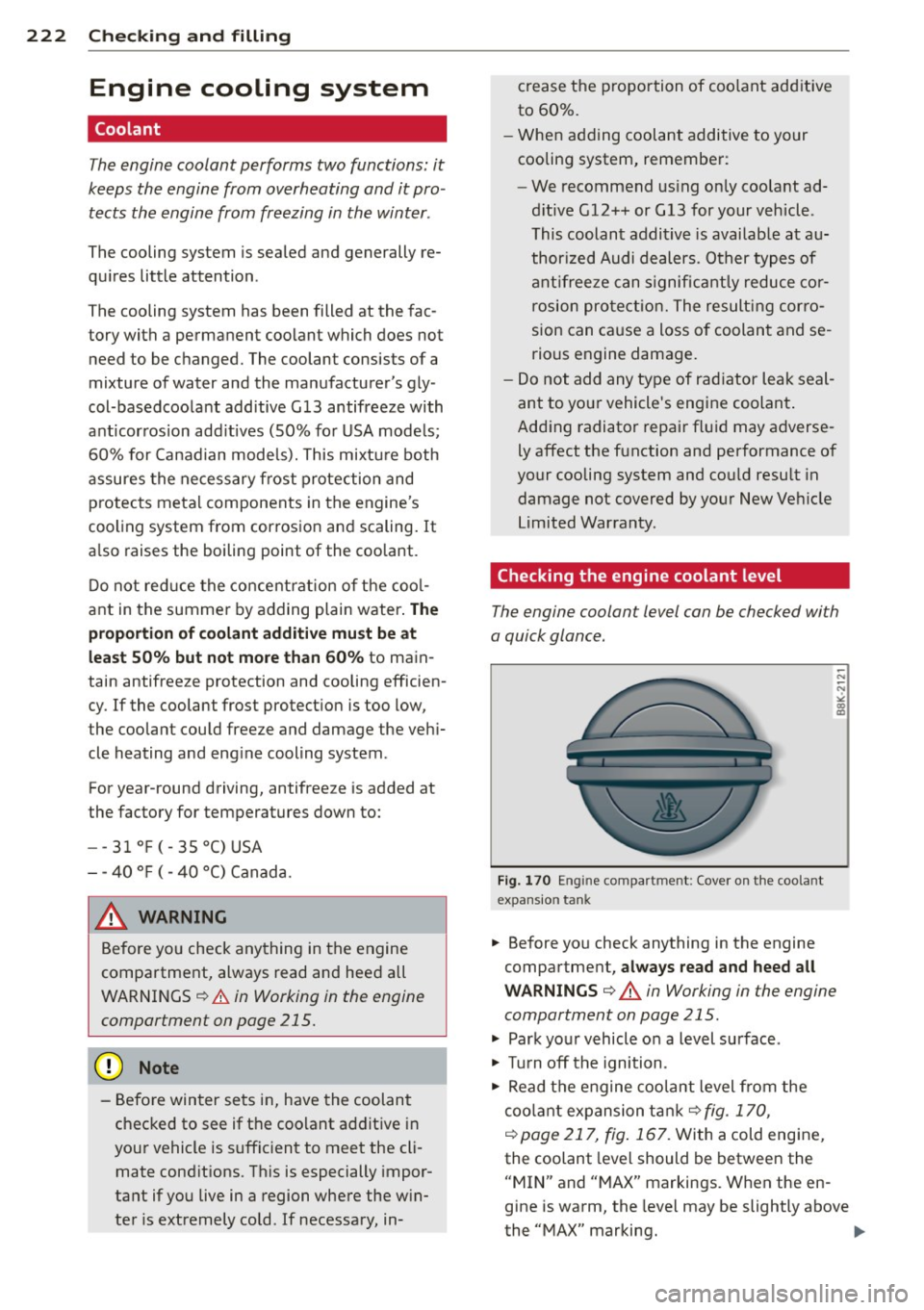
F ig. 170 En gin e compa rtm en t: Cover o n the coo la n t
expans io n ta nk
-"' -"' >< .,
"'
.. Before yo u check anything in the engine
compartment,
alwa ys read and heed all
W ARNINGS ¢ .&. in Working in the engine
compartment on page 215 .
.,. Park your vehicle o n a level surface .
.,. Tu rn off the ignition .
.. Read t he engine coolant level from the
coo la nt expansion tank ¢
fig. 170 ,
r=:> page 217, fig . 167. With a cold engine,
the coolant leve l should be between the
"MIN" and "MAX" markings . When the en
gine is warm, the level may be slightly above
the "MAX" marking.
IJII,
Page 225 of 294
The location of the coolant expansion tank
can be seen in the engine compartment illus
tration
q page 217 .
To obtain an accurate read ing , the eng ine
must be switched off .
The expa nsion tank in you r vehicle is equipped
with an elec tric coolant level sensor.
When the coolant level is too low, the warning
light in the Auto-Check System
q page 18 wi ll
b lin k until you add coo lant and the level has
been restored to norma l. Even t hough the re is
an e lec tric coolant level sensor, we s till rec
ommend you check the coolant leve l from
time to time .
Coolant loss
Coolant loss may indi cate a leak in the coo ling
sys tem. In the event of coolant loss, the cool
ing system should be inspected immedia tely
by your authorized A udi dealer. It is not
enough merely to add coolant.
I n a
s ealed system, losses can occur only if
the boiling point of the coolant is exceeded as
a result of overheating.
A WARNING
The cooling system is unde r press ure and
can get ve ry hot. Reduce the risk of sca ld
ing from hot coolant by following these
steps.
- Turn off the engine and allow it to coo l
down.
- Protect yo ur face, hands and arms from
escaping fluid and steam by covering the
cap with a large, thick rag.
- Turn the cap slowly and very carefu lly in
a counter-clockwise direction wh ile ap
plying light, downward pressure on the
t op of the cap .
- To avoid being bu rned, do not spill ant i
freeze or coo lant on the exhaust system
o r hot eng ine parts . Unde r certai n condi
t ions, the ethy lene g lycol in engine cool
an t ca n catc h fire.
Checkin g and fillin g 223
@ Note
Do not ad d any type of radiator leak sea l
ant to your ve hicle's engine coolant. Add
i ng radiator repa ir flui d may adverse ly af
fect the funct ion and performance of your
cooling system and could result in damage not cove red by your New Vehicle l imi ted
Warranty .
Adding coolant
Be very careful when adding engine coolant.
Before you check anyth ing in the eng ine com
partment,
always read and heed all WARN
INGS q & in Working in the engine compart
ment on page
215 .
.,. Turn off the engine.
.,. let the engi ne cool down.
.,. Place a thick rag over the coolant expansion
tank
q page 222, fig . 170 and carefully turn
the cap counter-clockwise
q &_ .
.,. Add coo la nt.
.,. Twist the cap o n aga in
tightly.
Rep lacement engine coo lant must confo rm to
exact spec ificat ions
q page 222, Coolant. We
recommend using on ly coo lant additive G 12+
+ , G 13 or in an eme rgency G12+. Do
not use a
different additive. In an emergency use pla in
water until you can get the correct additive
and can restore the correct ratio . This sho uld
be done as soon as possible.
If you have los t a cons iderab le amount o f
coolant , then you sho uld add cold antifreeze
and co ld water on ly when the engine is cold.
A lw ays use
new engine coo lant w hen refilling.
Do not f ill coo lant above t he "MAX" mark. Ex
cess coola nt w ill be fo rced o ut through t he
pressure relief valve in the cap when the en
gine becomes hot.
A WARNING
- The cooling system is under pressure and
can get very hot. Reduce the risk of ..,.
•
•
Page 226 of 294
224 Checking and filling
scalding from hot coolant by following
these steps.
- Turn off the eng ine and a llow it to cool
down.
- Protect your face, hands and arms from escaping flu id and steam by cover ing
the cap with a large, thick rag.
- Turn the cap slowly and very carefully
i n a counter-clockwise direction while
apply ing l ight, downwa rd p ress ure on
the top of the cap .
- To avo id being burned, do not sp ill an
tifreeze or coolant on the exhaust sys
tem or hot engine parts . Under certain
conditions, the ethylene glyco l in en
gine coolant can catch f ire .
- Antifreeze is poisonous . Always store an
tifreeze in its or iginal container and we ll
out of the reach of children .
- If you drain the coolant, it must be
caught and safely stored in a proper con
tainer clear ly marked "poison".
@ Note
- Coolant po llutes the env ironment and
could cause an engine fire . Excess coo l
ant will be forced out through the pres
sure relief valve in the cap when the en
gine becomes hot.
- If, in an emergency, on ly water can be
added, the correct ratio between water
and antifreeze
c::> page 222 must be re
stored as soon as possible .
@ For the sake of the environment
Drained coolant should not be re used. Al
ways dispose of used coolant while observ
ing all environmental regulat ions.
Radiator fan
The radiator fan switches on automatically by
itself
The radiator fan is driven by the engine via the
V-be lt . The viscous clutch regulates the speed
of the fan according to the temperature of the
coolant. An a
uxiliary electric radiator fan* switches on
and off depending on coolant temperature
and other vehicle operat ing condit ions .
After yo u sw itch the engine off, the aux iliary
f an can continue running for up to 10 minutes
- eve n wit h the ignition off. It can even switc h
on again later by itself
c::> &. , if
- t he tempe rature of the engine coo lant rises
due to the heat build -up from the engine in
the engine compartment, or
- the engine compa rtment heats up because
the vehicle is parked in i ntense sunlight.
_& WARNING
- To reduce the risk of personal in jury nev
er touch the radiator fan.
- The auxiliary electric fan is temperat ure
controlled and can sw itch on suddenly
even when the engine is not running.
- The a uxiliary radiator fan sw itches on a u
tomatically when the engine coo lant
reaches a certai n temperature and will
continue to run until the coolant temper
ature drops.
Brake fluid
Checking brake fluid level
The brake fluid level can be checked with a
quick glance.
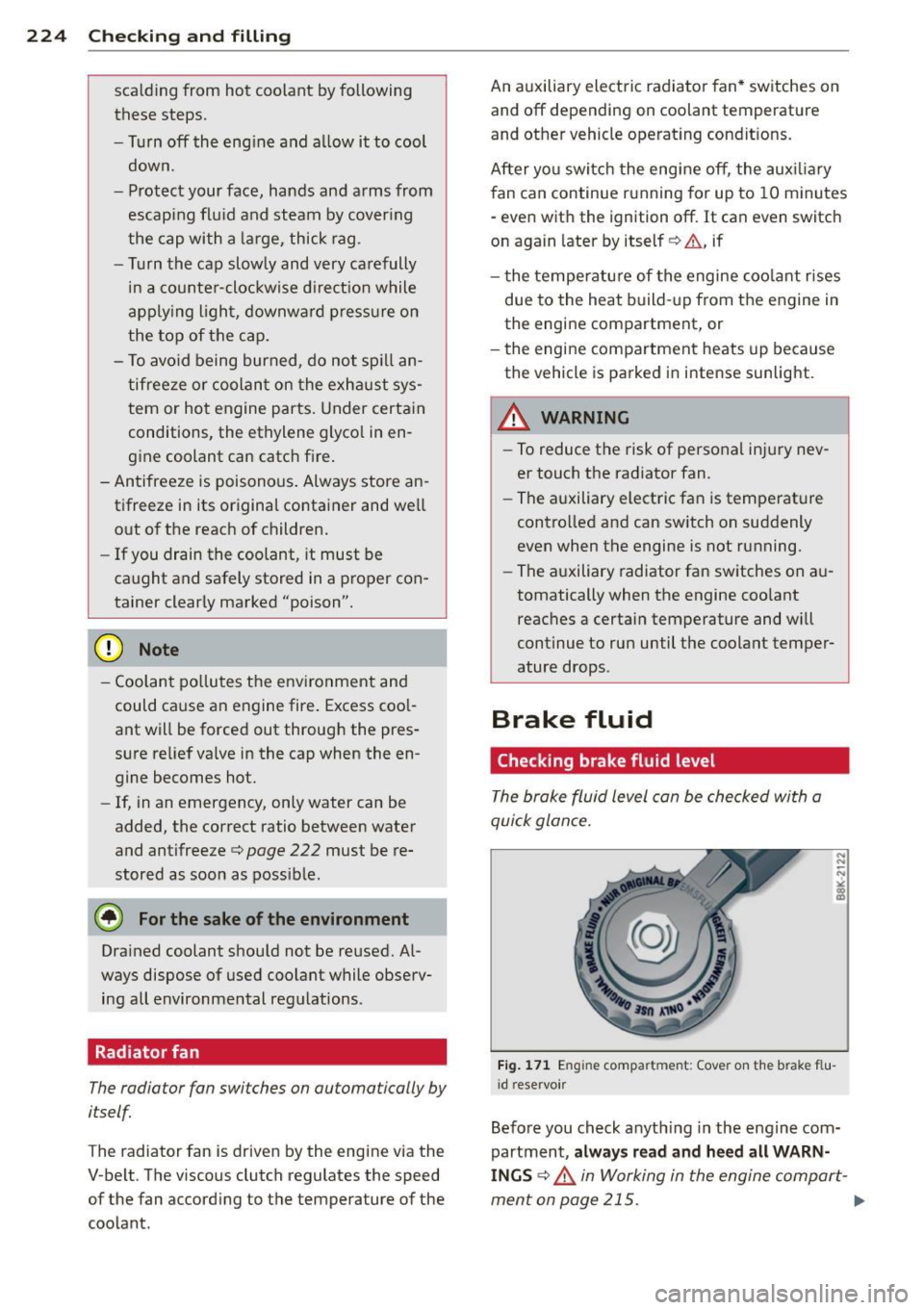
F ig . 17 1 Eng ine compartment: Cover on the brake flu
i d reservo ir
Before you check a nyth ing in the engine com
partment,
always read and h eed all WARN
INGS c::> .&. in Working in the engine compart-
ment on page 215. .,..
Page 283 of 294
Engine Compartment ................ .. ... 217
Coolant .. .. ................. .. .. . 222
Hood .... .. ................. .. ... 215
Starting . . . . . . . . . . . . . . . . . . . . . . 72, 75
Starting with jumper cables .. .. . ... . 262
Stopping . . . . . . . . . . . . . . . . . . . . . . 74, 76
Engine compartment Safety instructions ........ .. .. .. .. . 215
Working the engine compartment 215
Engine coolant
Indicator light . . . . . . . . . . . . . . . . . . . . . 18
Engine coolant system ...... .. .. .. .. . 222
Adding coolant ........... .... .. .. . 223
Checking coolant leve l ..... .. .. .. .. . 222
Checking the engine coolant level .. .. . 222
Radiator fan ................ ... ... 224
Engine coolant temperature
Temperatu re gauge ....... .. .. .. .. .. 10
Engine data .. ............. .... .. ... 270
Engine hood Closing . . . . . . . . . . . . . . . . . . . . . . . . . . 215
How to release the hood ... .. .. .. .. . 215
Engine oil ... .. ........... .. .. .. ... 217
Adding .. .. ............. .... .. ... 220
Additives ... ................ ... ... 220
Changing . ................. ... ... 221
Check oil level ........... .. .. .. ... 220
Consumption ............ .... .. .. . 220
Indicator light ........... .. .. .. 17,21
Oil consumption . ............. ... .. 219
Oil grades ................ ... ... .. 217
O il level symbol ............. ... ... . 21
Pressure malfunction ...... .. .. .. .. .. 17
Sensor defective . . . . . . . . . . . . . . . . . . . . 21
Specification and viscosity . . . . . . . . . . . 217
Engine speed limitation ........ .... ... 21
Environment Break-in period ........... .... .. ... 192
Catalytic converter ........ .. .. .. .. . 193
Disposing of your vehicle battery .. .. . 229
Driving at high speeds .......... .... 194
Driving to minimize pollution and noise 194
Fuel ..... .. ................. .. ... 212
Fuel economy . ........... .. .. .. ... 194
Leaks under your vehicle ... .. .. .. .. . 215
Letting the vehicle stand and warm up. 194
Proper disposal of drained brake fluid . 225
Index 281
Proper disposal of drained engine cool-
ant ....... ... .... ............... 223
Proper disposal of drained eng ine
oil . . . . . . . . . . . . . . . . . . . . . . . . . 220, 221
Recycling used engine oil ............ 220
Roof rack . . . . . . . . . . . . . . . . . . . . . . . . . 64
Unleaded fuel .. .. .. . .. .... ........ 210
What should I do with an old battery? . 229
EPC
refer to E lectronic power control . . . . . . 20
ESC (Electronic Stabilization Control)
Warning/indicator lights ............. 19
Ethyl alcohol (Fuel) . . . . . . . . . . . . . . . . . . 211
Event Data Recorder (EDR) ............ 184
Exhaust tail pipes
Cleaning ... ..... .. ............... 204
Expansion tank .. .. .. ............... 222
Exterior lighting . .. ............... .. .
44
Exterior mirrors
Adjusting ..... .... ................ 47
Dimming ... ..... .. ................ 48
Heating ....... .... ................ 47
F
Fan
Radiator 224
Fastening Booster seats .. .. .... ......... .... 173
Convertib le child safety seats .... .. .. 172
Infant seats ..... ................. 171
Flat tire
Chang ing ... .. .... ... .......... .. 252
flexible fuel . .. .. .. .. .. ........... .. 211
Floor mats ... ... .... ............... 131
Fog lights/rear fog light(s) ............. 44
Fo lding the rear seats ............... .. 64
Foot pedals . .. .. .. .. . .............. 131
For the sake of the environment Gasoline fumes and the environment .. 212
Letting the engine warm up . . . . . . 72, 75
Refueling . .. .. .. .. ............... 212
Saving fuel by early upsh ifting ..... .. . 11
Front airbags Description . . . . . . . . . . . . . . . . . . . . . . . 148
How they work ... .. ... ....... .... . 153
Frontal collisions and the laws of physics 137
•
•
Page 287 of 294
-----------------------------~I~ n~d~ e~x 285
Parking system (rear, with rea r view cam
era) Park ing mode 1 ......... ... .. .. .. . 1 18
Park ing mode 2 .......... .... .. ... 119
Safety precautions ........ .. .. .. .. . 116
Sw itching on/off .............. .... 117
Sw itching rear view camera on/off ... . 120
Parts rep lacement . ..... ... .. .. .. .. . 274
P ass-t hrough . . . . . . . . . . . . . . . . . . . . . . . . 66
PASSENGER AIR BAG OFF light . . . . . . . . 155
P assive safety system .... ... .. .. .. .. . 126
P eda ls .. .. ... ...... ............. .. 13 1
Phys ica l pr inc iples of a frontal coll is ion . 137
P olishing .. .. ............. .. .. .. .. . 20 1
Pollutant filter (automatic AC system) . .. 68
Powe r
seat adjustment . . . . . . . . . . . . . . . . . . . . 56
P ower locking sys tem ....... .. .. .. .. .. 3 2
E mergency locking . . . . . . . . . . . . . . . . . . 3 7
Power windows ... .... ... .. .. .. .... 41
Rear lid .... .... .. .... ... .. .. .. .... 39
Selective unlock feat ure ... .. .. .. .. .. 37
Sett ings . .. ............. .... .. .... 37
Sliding/tilting sunroof ..... .. .. .. .. .. 41
P owe r steering
refer to Electro-mechanical power as
sist
. .. ... . .... ............. .. .. .
Powe r window 188
Conven ien ce opening/ closing . .. .. .. .. 41
Powe r windows ......... ...... .... ... 40
C hi ld safety locks ............ .... ... 40
M alf unct io ns ............ .... .. .. .. 42
Pregnant women Special cons iderations when weari ng a
safety belt . . . . . . . . . . . . . . . . . . . . . . . 141
Proper occupa nt seating positions .. .. . 127
P rope r safe ty belt pos it ion ... .. .. .. .. . 14 0
Proper seat ing pos ition
Front passenger . ............. ... .. 128
Occupa nts ..... ........... ... ... .. 127
Rear passengers ............... .... 129
Q
Quartz clock ............... ... ... ... 12
quattro ®
refer to all-whee l dr ive
189 Question
What happens to unbe lted occupants? 137
Why safety belts? . . . . . . . . . . . . . . . . . 136
R
Radiator fan 224
Rain/ light sensor
H ead ligh ts .. .. .. ................. . 44
Inte rmit ten t (w indshie ld w ipers) . .. .. . SO
Senso r defec tive . . . . . . . . . . . . . . . . . . . . 22
Read ing lights . .. .... ... ....... ...... 47
Rear door su n shade . .. ... .... ... .. .. . 49
Rea r fog lights .. .. ................. . 44
Rear lid
Emergency re lease .. .............. .. 39
E scape handle ... .. . .. .. .. ... ... .. . 40
Open ing and closing ... ..... ... .... . 39
Rear light
Defective . . . . . . . . . . . . . . . . . . . . . . . . . 21
Rea r view came ra
118
119
Pa
rking mode 1
Parking mode 2
Rea r view m irror
· · · · · .. ......... .. .. . 48
Rear window heat ing 70
Rear window sun shade .. ..... ... .. .. . 49
Recircu lation mode (automat ic cl imat e
control) . . . . . . . . . . . . . . . . . . . . . . . . . . . . 69
Refuel ling .. .. .. .. ................. 212
Re lease lever for hood
Remote control 215
Homel in k ... .. .. ................. 121
Remote contro l key. . . . . . . . . . . . . . . . . . . 33
Pe rsonalizing .. .. .. . .. .. ..... ... .. . 33
unlocking/locking .. .............. .. 35
Remote rear lid re lease .. ..... ... .. .. . 39
Repair ma nuals .. .. ... ............ .. 272
Repairs Airbag system ... .. . .. .. .. ... ... .. 157
Rep lacement key .... . .. ..... ... .. .. . 33
Rep lac ing
Windsh ie ld wiper b lades ........ ..... 51
Rep lacing bu lbs . .. ................. 261
Rep lacing tires and wheels ..... ... .. . .
Repo rting Saf ety Defects ............ .
Reset button
. ... .. .. . ...............
Retr actor ... .. .. .. .. .. ........... ..
242
134
12
139
•
•