seats AUDI A4 SEDAN 2013 User Guide
[x] Cancel search | Manufacturer: AUDI, Model Year: 2013, Model line: A4 SEDAN, Model: AUDI A4 SEDAN 2013Pages: 294, PDF Size: 73.71 MB
Page 67 of 294
Folding the backrest back into the upright
position
• Fold the backrest back up again until it
latches and the red marking @ is no longer
visible ¢&_ .
You can lock the backrest when it is latched in
p lace using the mechanica l key ¢
page 34 ©
¢ fig. 65. This prevents any access to the lug
gage compartment from the vehicle interior.
You can only enlarge the luggage compart
ment if the backrest is not locked.
A WARNING
-The backrest must always be securely
latched so that the safety belt of the cen
ter seating position can work properly to
help protect the occupant.
- The backrest must be securely latched in
posit ion so that no items contained in
the luggage compartment can slide for
ward upon sudden braking .
-Always check whether the latch is fully
engaged by pulling the seatback for
ward.
- Never allow safety belts to become dam
aged by being caught in door or seat
hardware.
- Torn or frayed safety belts can tear and
damaged belt hardware can break in a
crash . Inspect the belts periodically .
Belts showing damage to webbing, bind
ings, buckles, or retractors must be re
placed.
(D Note
- If yo u move the front seat back when the
rear seat backrest is fo lded forward, yo u
could damage the head restraints on the
rear seat.
- Slide the belt guide on the outside safety
belt all the way up before folding the
backrest back forward. Make sure the
seat belt is not pinched or damaged
when the rear seat backrest if folded
back. Other objects should be removed
Seats and storage 65
from the rear seat bench to protect the
seatback from damage.
Tie-downs and cargo net
Applies to veh icles: w ith cargo net
The cargo net prevents small objects from
sliding.
Fig. 66 Lu gga ge compa rtm ent: cargo net str etch ed
o ut
Fig . 67 Lu ggage compart men t: ca rgo net at the top of
the lu gg age compartment
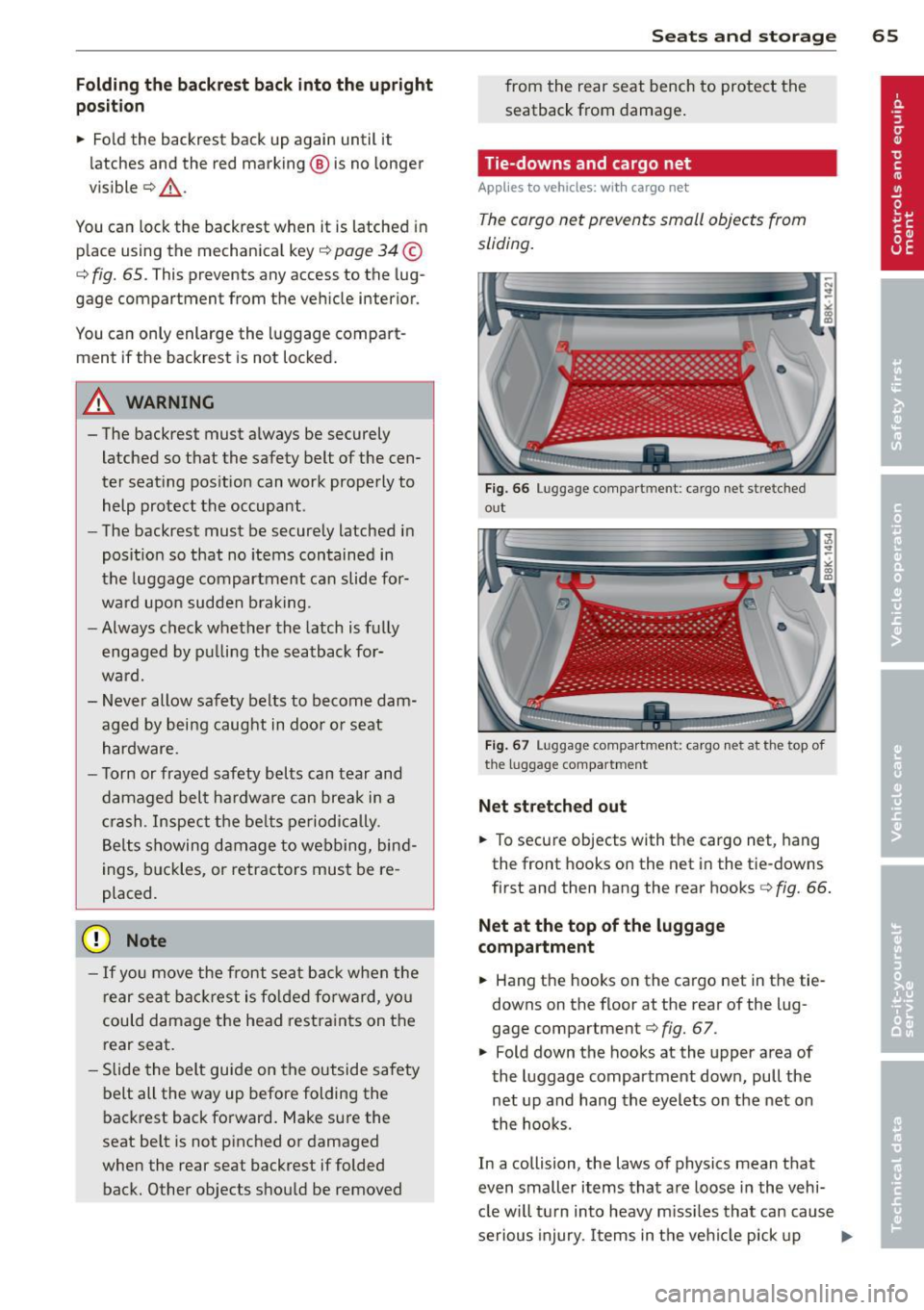
Net stretched out
• To secure objects with the cargo net , hang
the front hooks on the net in the tie-downs
first and then hang the rear hooks¢
fig. 66.
Net at the top of the luggage
compartment
• Hang the hooks on the cargo net in the tie
downs on the floor at the rear of the lug
gage compartment¢
fig. 67.
• Fold down the hooks at the upper area of
the luggage compartment down, pull the
net up and hang the eyelets on the net on
the hooks .
In a collision, the laws of physics mean that
even smaller items that are loose in the vehi
cle w ill turn into heavy m iss iles that can cause
serious injury. Items in the vehicle pick up
IJi,,-
Page 68 of 294
66 Seats and st o rage
kinetic energy which varies with the vehicle
and the weight of the item . Vehicle speed is
the most significant factor .
F or example, in a frontal coll is ion at a speed
of 30 mph ( 48 km/h), the forces acting on a
10 -lb (5 kg) object are about 20 times the
normal weight of the item. Th is means that
the weight of the item would suddenly be the
equivalent of about 200 lbs (90 kg). One can
eas ily imagine the injur ies that an item of that
weight flying freely through the passenger compartment can cause in a co llision at a
speed conside red relat ively low.
& WARNING
Weak, d amaged or improper s traps used
to secure items to t ie-downs can fail du r
ing hard brak ing or in a coll ision and cause
serious persona l in jury .
- Always use suitab le retaining straps and
properly secure items to the tie-downs in
the luggage compartment to help pre
vent items from shifting or flying for
ward.
- Never attach a child seat tether strap to
a tie-down.
- For strength-related reasons, the mount
ing hooks can only be used to secure ob
jects weighing up to 10 lb. (5 kg). Heav i
er objects w ill not be adequately secured
- there is a r isk of injury .
Ski sack
Applies to vehicles: with sk i sack
Long objects such as skis or snowboards can
be transported in the ski sack.
F ig . 6 8 Backre st: pass-t hrough cover
Fig. 69 Rear bench seat: secu ring the sk i sack
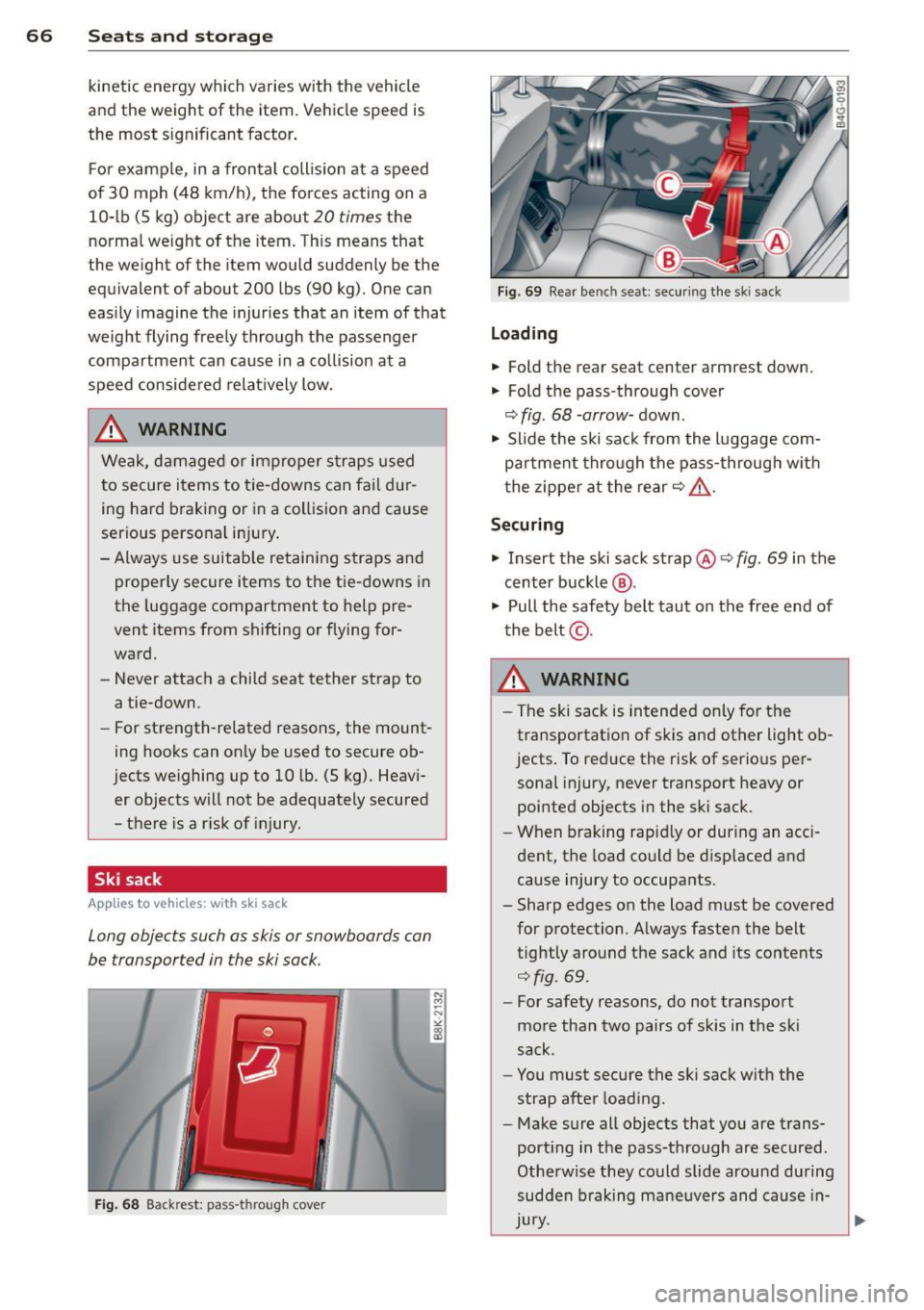
Loading
.,. Fold t he rear seat center armrest down.
.,. Fold the pass-through cover
¢ fig. 68 -arrow- down.
.,. Slide the ski sack from the luggage com
pa rtment thro ugh the pass-through w it h
t he zipper at the rear¢ .&,.
Securing
.,. Insert the ski sack strap @¢ fig . 69 in the
center buckle @.
.,. Pull the safety belt taut on the free end of
the belt @.
A WARNING
-
-The ski sa ck is intende d only for the
transportat io n of skis and other light ob
jects . To red uce the risk of serio us per
sonal injury , never transport heavy or
pointed objects in the ski sack.
- When braking rapi dly or during an acci
dent, the load could be d isplaced and
cause injury to occupants .
- Sharp edges on the load must be covered
for protection. A lways fasten the belt
tightly around the sack and its contents
¢fig.
69.
- For safety reasons, do not transport
mo re than two pairs of sk is in the ski
sack.
- You must secure the ski sack with the
strap afte r load ing.
- Make sure all objects that you are trans
porting in the pass-through are sec ured .
Otherwise they could slide around du ring
sudden b rak ing maneuvers and cause in-
Jury. ..,.
Page 72 of 294
70 Warm and cold
switching recirculation mode on when driving
through a tunnel or when sitting in traffic
c:::> &. .
The IAU TO I button or I@ FRON T I butt on
switches recircu lation mode off .
IAUTO I Switching automatic mode on
Automatic mode mainta ins a constant tem
perature inside the vehicle. Air temperature,
airflow and air distribution are controlled au
tomatically.
Adjusting the temperature
Temperatures between 60 °F (+16 °C) and
84 °F ( +28 °C) can be set . Outside of this
range,
LO or HI will appea r in the climate con
trol system disp lay. At both of these settings,
the climate control system runs continuously
at maximum cooling or heating power . There
is no temperature regu lation.
~ Adjusting the airflow
You can adjust the airflow manually to su it
your needs . To have the airflow regulated au
tomatically , press the
!AUTO ! button.
~ Adjusting the air distribution
You can manually select the vents where the
a ir will flow . To have the air d istribution regu
lated automatically, press the
IAUTOI button .
~ Adjusting seat heating*
Pressing the button switches the seat heating
on at the highest sett ing (level 3) . The LEDs
indicate the temperature leve l. To reduce the
temperature, press the button again . To
switch the seat heating off , press the button
repeatedly until the LED turns off .
After 10 minutes , the seat heating automati
cally switches from level 3 to leve l 2.
I@ FR ON T I Switch the defroster on/off
The windshield and s ide windows are defrost
ed or cleared of condensation as quickly as
possible . The max imum amount of air flows
mainly from the vents below the windshield.
Recirculation mode switches off . Th e tempera
ture is controlled automatically. T
he
!AUTO I button switches the defroster off.
l !iiil R EAR I Switching rear window heater
on/off
T he rea r window heater only operates when
the engine is running. It switches off auto
matically after a few m inutes, depending on
the outside temperature .
T o prevent the rea r window heater from
switching off automatically, press and hold
the
l oo REAR I button for more than 2 seconds .
This remains stored until the ignition is
switched off.
Air vents
You can open and close the center and rear air
vents using the thumbwhee ls. The levers ad
just the direction of the airflow from the
vents.
In vehicles with a 3-zone deluxe automatic cli
mate control system*, you can adjust the air
temperature in the rear by turning the thumb
wheel toward the red side to make it warmer
or toward the b lue s ide to make it cooler.
A WARNING
-- Do not use the recirculation for extended
periods of time . The windows could fog
up since no fresh air can enter the vehi
cle . If the windows fog up, press the air
recir culation butto n aga in imm ediately
to switch off the air recirculation func
tion or se lect defrost.
- I ndivid uals w ith reduced sensitivity to
pa in or temperature could develop burns
when using the seat heating function . To
red uce the risk of injury, these individu
als shou ld not use seat heating.
(D Note
To avoid damage to the heating elements
in the seats, do not kneel on the seats or
place heavy loads on a small area of the
seat.
Page 128 of 294
126 Driving Saf ely
Driving Safely
General notes
Safe driving habits
Please remember -safety first!
This chapter contains important information,
tips, instructions and warnings that you need
to read and observe for your own safety, the
safety of your passengers and others. We have
summarized here what you need to know
about safety belts, a irbags, ch ild restra ints as
well as child safety. Your safety is for us
priori
ty number 1.
Always observe the info rmat ion
and warn ings in th is sect ion -fo r yo ur own
safety as well as that of your passengers .
The information in this se ction app lies to all
model ve rsions of your veh icle. Some of the
feat ures described in this sec tions may be
standard equipment on some models, or may
be optional equipment on others. If you are
not sure, ask your authorized Audi dealer.
A WARNING
-Always make sure that you follow the in
struct ions and heed the WARNINGS in
this Manual. It is in your interest and in
the inte rest of you r passengers.
- Always keep the complete Owner's Liter
ature in your Audi when you lend or sell
your vehicle so that this important info r
mation will always be ava ilable to the
dr iver and passengers.
- Always keep the Owner's literature handy
so that you can find i t eas ily if you have
ques tions.
Safety equipment
The safety features are part of the occupant
restraint system and work together to help
redu ce the risk of injury in a wide variety of
accident situations.
Your safety and the safety of your passenge rs
should not be left to chance. Advances in
technology have made a varie ty o f fea tures
avai la bl e to he lp re duce the risk of injury in an accident
. The following is a list of just a few of
the safety features in your Audi:
- sophis tic ated s afety be lts fo r drive r and a ll
passenger sea ting pos it ions,
- be lt fo rce limi ters fo r the seats,
- belt p retensioners for the seats,
- head restra ints for each seating positio n,
- front airbags,
- side airbags in the front seats,
- side curtain a irbags,
- specia l LATCH anchorages for child re-
s tr aints,
- ad justab le steer ing colum n.
These ind iv idual safety features, can work to
gether as a system to he lp protect you and
you r passengers in a w ide range of accidents.
T hese fe atures canno t work as a system if
they a re not always correct ly adjusted and co r
rect ly used.
Safety i s everybody' s respon sibility!
Important things to do before driving
Safety is everybody's job! Vehicle and occu
pant safety always depends on the informed and careful driver.
Fo r yo ur safety and the safety of your passen
gers,
before driv ing alway s:
.,. Make sure that all lights and signals a re op
erati ng correctly .
.,. Make su re that the tire pressu re is co rrect.
.,. Make su re that all w indows are clean and
afford good v is ib il ity to the o utside.
.,. Sec ure a ll lugg age and o ther items caref ully
qpage 60 .
.,. Make s ure that nothing can interfere with
the peda ls .
.,. Adjust front seat, head restraint and mir
rors correctly for your height.
.,. Instruct rear seat passengers to adjust the
head restra ints according to their he ight.
.,. Make su re to use the right child restraint
co rrectly to p rotect chi ldren¢
page 165,
Child Safety. "'
Page 129 of 294
.. Sit properly in your seat and make sure that
your passengers do the same
¢page 54,
Seats and storage.
.. Fasten your safety belt and wear it properly.
Also instruct your passengers to fasten their
safety belts properly¢
page 136 .
What impairs driving safety?
Safe driving is directly related to the condi
tion of the vehicle , the driver as well as the
driver's ability to concentrate on the road
without being distracted .
The driver is responsible for the safety of the
vehicle and all of its occupants. If your ability
to drive is impaired, safety r isks for everybody
in the vehicle increase and you a lso become a
hazard to everyone else on the road
~ .&_.
Therefo re:
.. Do not let yourself be distracted by passen
gers or by using a cellular telephone .
.. NEVE R drive when yo ur driv ing ability is im
paired (by medicat ions, alcohol, drugs, etc.).
.. Observe all traffic laws, rules of the road
and speed limits and plain common sense .
.. ALWAYS adjust your speed to road, traffic
and weather conditions .
.,. Take frequent breaks on long trips. Do not
drive for more than two hours at a stretch.
.. Do NOT drive when you are tired, under
pressure or when you are stressed .
& WARNING
Impaired driving safety increases the risk
of serious personal injury and death when
ever a vehicle is being used.
Driving Safely 12 7
Proper occupant
seating positions
Proper seating position for the driver
The proper driver seating position is impor
tant for safe, relaxed driving.
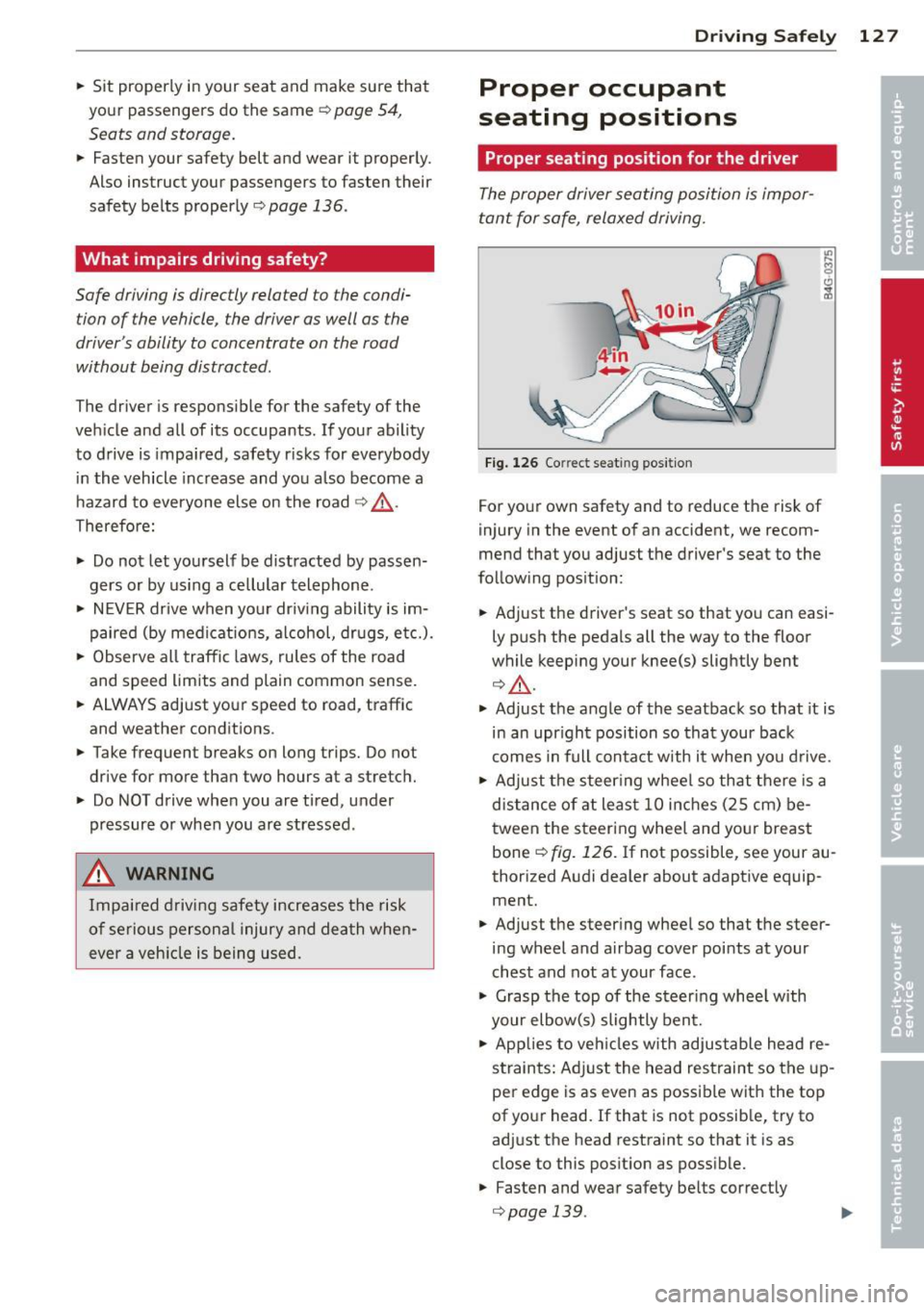
Fig. 126 Correct seat ing pos it ion
For your own safety and to reduce the risk of
injury in the event of an accident, we recom
mend that you adjust the driver's seat to the
follow ing pos ition:
.. Adjust the driver's seat so that you can easi
ly push the pedals all the way to the floor
wh ile keeping your knee(s) slightly bent
¢&_ .
.. Adjust the angle of the seatback so that it is
in an upr ight position so that your back
comes in full contact w ith it when you drive.
.. Adjust the steering wheel so that there is a
distance of at least 10 inches (25 cm) be
tween the steering wheel and yo ur breast
bone
~ fig. 126. If not possible, see your au
thorized Audi dealer about adaptive equip
ment.
.. Adjust the steer ing wheel so that the steer
ing wheel and airbag cover points at your
chest and not at your face .
.,. Grasp the top of the steering whee l with
your elbow(s) slightly bent .
.. App lies to vehicles with adjustable head re
s tra ints: Ad just the head restraint so the up
per edge is as even as possible with the top
of your head. If that is not possible, try to
adjust the head restraint so that it is as
close to this pos it ion as possible .
.. Fasten and wear safety be lts correctly
¢ page 139 . .,._
Page 130 of 294
128 Driving Safely
• Always keep both feet in the footwell so
that you are in control of the vehicle at all
times.
For detailed information on how to adjust the
driver's seat, see
¢ page 56.
A WARNING
Drivers who are unbelted, out of position
or too close to the airbag can be seriously
injured by an airbag as it unfolds. To help
reduce the risk of serious personal injury:
- Always adjust the driver's seat and the
steering wheel so that there are at least
10 inches (25 cm) between your breast
bone and the steering wheel.
- Always hold the steering wheel on the
outside of the steering wheel rim with
your hands at the 9 o'clock and 3 o'clock positions to help reduce the risk of per
sonal injury if the driver's airbag inflates.
- Never hold the steering wheel at the
12 o'clock position or with your hands at
other positions inside the steering wheel
rim or on the steering wheel hub. Hold
ing the steering wheel the wrong way
can cause serious injuries to the hands,
arms and head if the driver's airbag de
ploys.
- Pointing the steering wheel toward your
face decreases the ability of the supple
mental driver 's airbag to protect you in a
collision .
- Always sit in an upright position and nev
er lean against or place any part of your
body too close to the area where the air
bags are located.
- Before driving, always adjust the front
seats and head restraints properly and
make sure that all passengers are prop
erly restrained.
- Never adjust the seats while the vehicle
is moving . Your seat may move unexpect
edly and you could lose control of the ve
hicle.
- Never drive with the backrest reclined or
tilted far back! The farther the backrests
are tilted back, the greater the risk of in- jury due to incorrect positioning of the
safety belt and improper seating posi
tion.
- Children must always ride in child safety
seats ¢
page 165. Special precautions
apply when installing a child safety seat
on the front passenger seat¢
page 144 .
Proper seating position for the front
passenger
The proper front passenger seating position
is important for safe, relaxed driving .
For your own safety and to reduce the risk of
injury in the event of an accident, we recom
mend that you adjust the seat for the front
passenger to the following position :
• Move the front passenger seat back as far
as possible . There must be a minimum of
10 inches (25 cm) between the breastbone
and the instrument panel¢,&. .
• Adjust the angle of the seatback so that it is
in an upright position and your back comes
in full contact with it whenever the vehicle is
moving.
• Applies to vehicles with adjustable head re
straints: Adjust the head restraint so the up
per edge is as even as possible with the top
of your head. If tha t is not possible, try to
adjust the head restraint so that it is as
close to this position as possible.
• Keep both feet flat on the floor in front of
the front passenger seat.
• Fasten and wear safety belts correctly
¢page 139.
For detailed information on how to adjust the
front passenger's seat, see
¢ page 54.
A WARNING
-
Front seat passengers who are unbelted,
out of position or too close to the airbag
can be seriously injured or killed by the air
bag as it unfolds. To help reduce the risk of
serious personal injury:
Page 131 of 294
-Passengers must always sit in an upright
position and never lean against or place
any part of their body too close to the
area where the airbags are located.
- Passengers who are unbelted, out of po
sition or too close to the airbag can be
seriously injured by an airbag as it un
folds with great force in the blink of an
eye .
- Always make sure that there are at least
10 inches (25 cm) between the front
passenger's breastbone and the instru
ment panel.
- Each passenger must always sit on a seat
of their own and properly fasten and
wear the safety belt belonging to that seat.
- Before driving, always adjust the front
passenger seat and head restraint prop
erly.
- Always keep your feet on the floor in
front of the seat. Never rest them on the
seat, instrument panel, out of the win
dow, etc. The airbag system and safety
belt will not be able to protect you prop
erly and can even increase the risk of in
jury in a crash .
- Never drive with the backrest reclined or
tilted far back! The farther the backrests
are tilted back, the greater the risk of in
jury due to incorrect positioning of the
safety belt and improper seating posi
tion.
- Children must always ride in child safety
seats <=:>
page 165 . Special precautions
apply when installing a child safety seat
on the front passenger seat <=:>
page 144.
Proper seating positions for passengers
in rear seats
Rear seat passengers must sit upright with
both feet on the floor consistent with their
physical size and be properly restrained whenever the vehicle is in use.
To reduce the risk of injury caused by an incor
rect seating position in the event of a sudden
braking maneuver or an accident, your pas-
Driving Safely 129
sengers on the rear bench seat must always
observe the following:
.,. Make sure that the seatback is securely
latched in the upright position
<=:> page 64 .
.,. If there is a passenger on the rear center
seating position, slide the center head re
straint upward at least to the next notch.
.,. Keep both feet flat in the footwell in front
of the rear seat.
.,. Fasten and wear safety belts properly
<=:> page 139 .
.,. Make sure that children are always properly
restrained in a child restraint that is appro
priate for their size and age
<=:> page 165.
& WARNING ~
Passengers who are improperly seated on
the rear seat can be seriously injured in a
crash.
- Each passenger must always sit on a seat
of their own and properly fasten and
wear the safety belt belonging to that seat.
- Safety belts only offer maximum protec
tion when the seatback is securely latch
ed in the upright position and the safety
belts are properly positioned on the
body. By not sitting upright, a rear seat
passenger increases the risk of personal
injury from improperly positioned safety
belts!
- Always adjust the head restraint properly
so that it can give maximum protection . •
•
Page 132 of 294
130 Driving Safely
Proper adjustment of head restraints
Applies to vehicles: with adj ustable head restraints
Correctly adjusted head restraints ore on im
portant port of your vehicle's occupant re
straint system and con help to reduce the risk of injuries in occident situations.
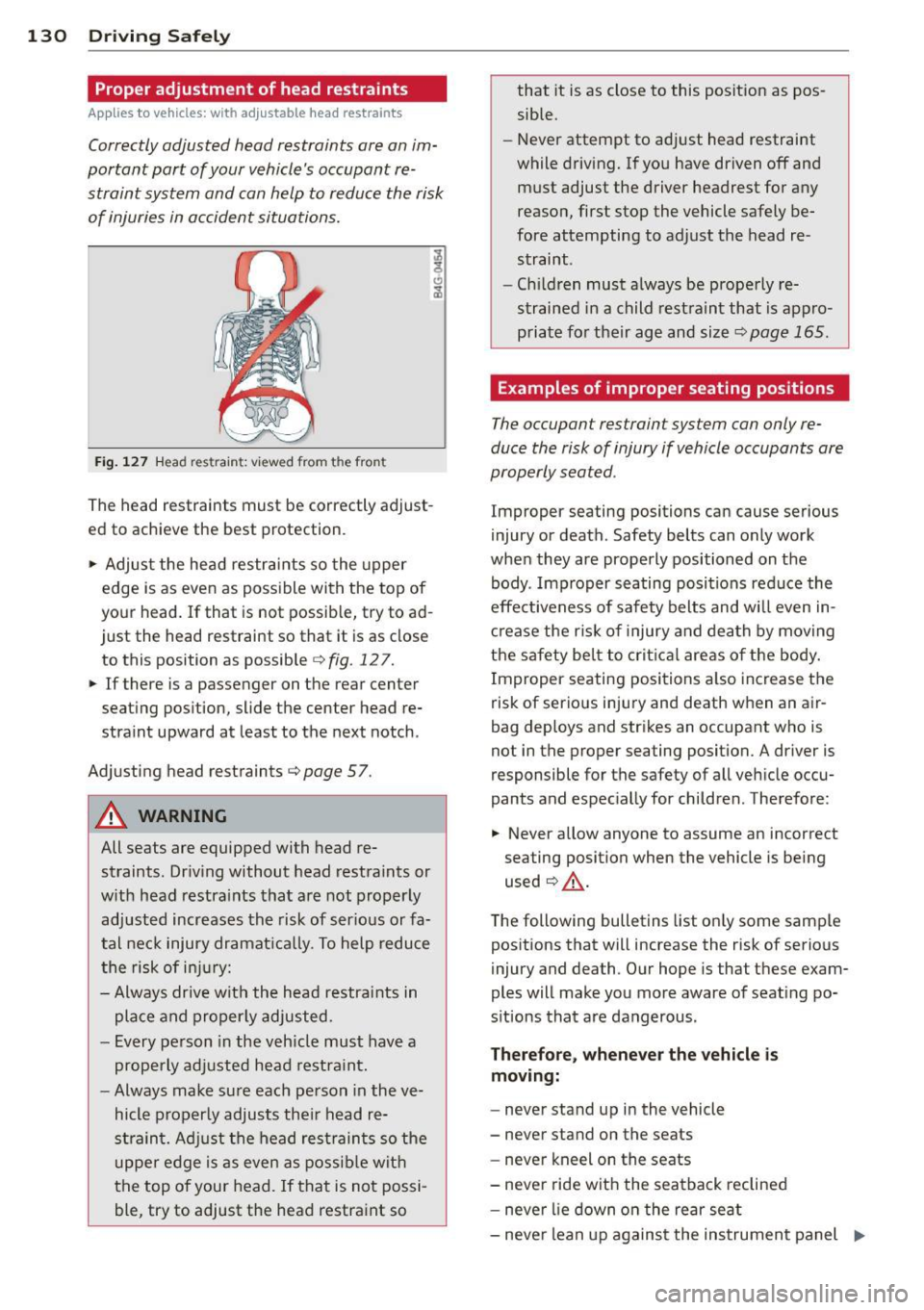
Fig. 127 H ead re str ain t: vi ew ed fro m the front
The head restraints must be correctly adjust
ed to achieve the best protection .
.. Adjust the head restraints so the upper
edge is as even as possible with the top of
your head. If that is not possible, try to ad
just the head restraint so that it is as close
to this position as possible
e> fig. 12 7 .
.. If there is a passenger on the rear center
seating position, slide the center head re
straint upward at least to the next notch .
Adjusting head restraints
e> page 57 .
A WARNING
All seats are equipped with head re
straints. Driving without head restraints or
with head restraints that are not properly
adjusted increases the risk of serious or fa
tal neck injury dramatically. To help reduce
the risk of injury:
- Always drive with the head restraints in
place and properly adjusted.
- Every person in the vehicle must have a
properly adjusted head restraint.
-Always make sure each person in the ve
hicle properly adjusts their head re
straint. Adjust the head restraints so the
upper edge is as even as possible with
the top of your head.
If that is not possi
ble, try to adjust the head restraint so that
it is as close to this position as pos
sible.
- Never attempt to adjust head restraint
while driving. If you have driven off and
must adjust the driver headrest for any
reason, first stop the vehicle safely be
fore attempting to adjust the head re
straint .
- Children must always be properly re
strained in a child restraint that is appro
priate for their age and size
e> page 165.
Examples of improper seating positions
The occupant restraint system con only re
duce the risk of injury if vehicle occupants ore
properly seated .
Improper seating positions can cause serious
injury or death. Safety belts can only work
when they are properly positioned on the body . Improper seating positions reduce the
effectiveness of safety belts and will even in
crease the risk of injury and death by moving
the safety belt to critical areas of the body.
Improper seating positions also increase the
risk of serious injury and death when an air
bag deploys and strikes an occupant who is
not in the proper seating position. A driver is
responsible for the safety of all vehicle occu
pants and especially for children . Therefore :
.. Never allow anyone to assume an incorrect
seating position when the vehicle is being
used
e> _& .
The following bulletins list only some sample
positions that will increase the risk of serious
injury and death . Our hope is that these exam
ples will make you more aware of seating po
sitions that are dangerous .
Therefore, whenever the vehicle is
moving :
-never stand up in the vehicle
- never stand on the seats
- never kneel on the seats
- never ride with the seatback reclined
- never lie down on the rear seat
- never lean up against the instrument panel ..,.
Page 138 of 294
136 Safety belts
Safety belts
General notes
Always wear safety belts!
Wearing safety belts correctly saves lives!
This chapter explains why safety be lts are nec
essary, how they work and how to adjust and
wear them correctly .
.. Read a ll the information that fo llows and
heed all of the instruct ions and WARNINGS.
A WARNING
Not wearing safety belts or wearing them
improperly increases the risk of ser ious
personal in jury and death .
- Safety belts are the sing le most effective
means avai lab le to reduce the risk of se
r ious injury and dea th in a utomob ile acci
dents. For your protection and that of
yo ur passenge rs, always co rrectly wear
safety belts when the vehicle is moving.
- P regnant women, injured, or physically
im paired perso ns mu st also use safety
bel ts. Lik e all veh icle occup ants, they are
more like ly to be ser iously injured if they
do not wea r safety be lts . The best way to
protect a fetus is to protect the mother -
throughout the entire pregnancy.
Number of seats
Your Audi has a total of five seating positions: two in the front and three in the rear. Each
seating position has a safety belt.
A WARNING
Not wea ring safety belts or weari ng them
improp erly increases th e risk of ser ious
pe rsonal i njury and dea th.
- N ever st rap more than one pe rson, in
cl uding small ch ild ren, into any belt.
It is
e speci ally dange rous to pla ce a safety
belt over a child s itting on yo ur lap.
- N ever le t mo re people ride in the ve hicl e
than there are s afe ty be lts avail able. -
Be s ure everyone riding in the vehicle is
properly restrained w ith a separate safe
ty belt or child restra int.
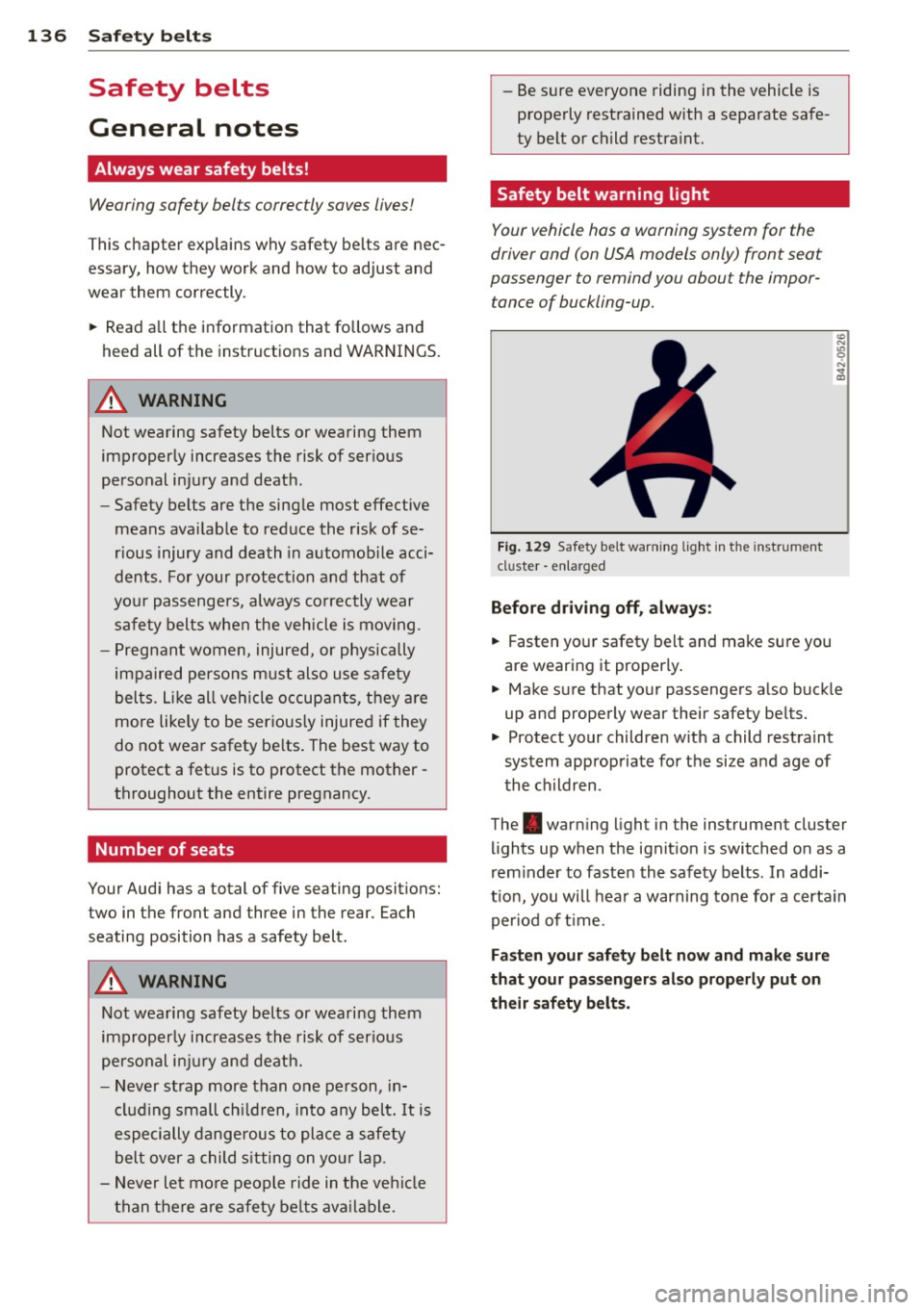
Safety belt warning light
Your vehicle hos o warning system for the
driver and (on USA models only) front seat
passenger to remind you about the impor
tance of buckling-up .
Fi g. 129 Safety belt warni ng lig ht in the instrument
cluster -e nl arge d
Before driving off, always :
.. Fasten you r safety belt and make sure you
are wearing it properly .
.. Make s ure that yo ur passengers a lso buck le
up and properly wear their safety be lts.
.. Protect your children w ith a child rest raint
system approp riate fo r the size and age of
t he children.
The . war ning light in the instrument cluster
lights up when the ignit ion is switched on as a
rem inder to faste n the safety belts. In addi
t ion, you will hea r a warning tone for a certa in
per iod of t ime.
Fasten your safety b elt now and make sure
that your pas sengers also properly put on
their safety belts.
Page 140 of 294
138 Safet y belt s
with the vehicle interior has all the energy
they had just before the crash.
Neve r rely on airbags a lone for p rotec tion.
Even when they deploy, airbags provide only
addit io nal p rotection . Airbags are not sup
posed to deploy in all kinds of accidents. Al
though your Audi is equipped with a irbags, all
vehicle occupants, including the driver, must
wear safety belts correctly in order to min i
mize the risk of severe injury or death in a
crash .
Remember too, that airbags wi ll deploy on ly
once and that your safety belts are always
there to offer protection in those accidents in
which airbags are not supposed to deploy or when they have a lready deployed . Unbelted
occupants can also be thrown out of the vehi
cle whe re even more severe o r fatal in juries
can occu r.
It is also impo rtant for the rear passenge rs to
wear safety belts correctly. Unbelted passen
gers in the re ar seats end anger no t on ly them
selves but a lso the d river a nd other passen
gers ~
fig. 133. In a frontal collision they will
be thrown forward violent ly, where they can
h it and injure the dr iver and/or front seat pas
senger.
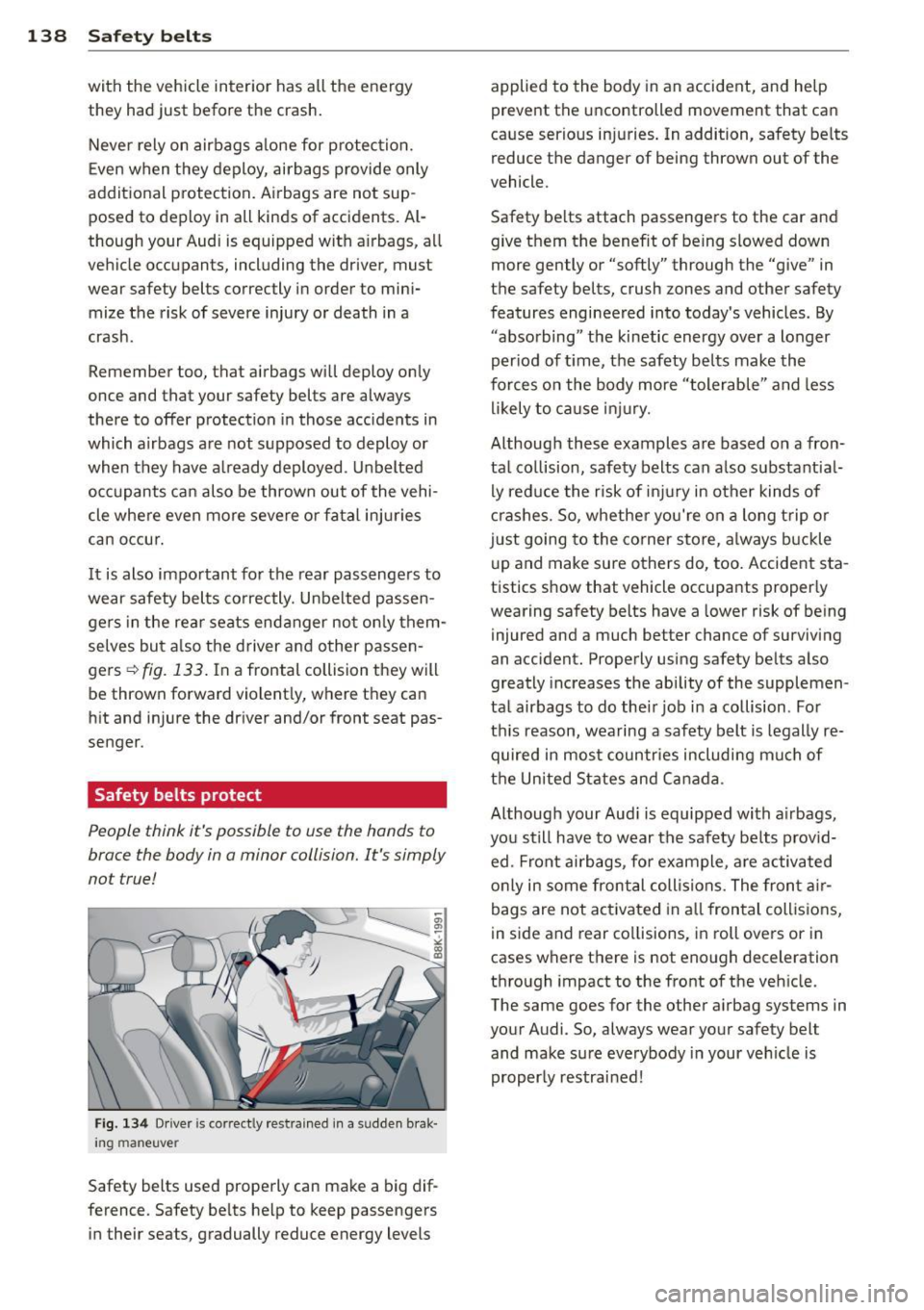
Safety belts protect
People think it's possible to use the hands to
brace the body in a minor collision. It's simply
not true!
F ig . 13 4 Driver is co rrectly re st ra ined in a s udden b rak ·
i n g m an euve r
Safety belts used properly can make a big dif
ference . Safety be lts he lp to keep passengers
in their seats, gradually reduce energy levels applied to the body in an accident, and help
prevent the
uncontrolled movement that can
ca use serio us in juries . In addition, safety be lts
reduce the danger of being thrown out of the
vehicle .
Safety be lts attach passengers to the car and
give them the benefit of being slowed down
more gently or "softly" through the "give" in
the safety belts, crush zones and other safety
features engineered into today's vehicles. By
"abso rbing" t he kinetic energy over a longer
per iod of t ime, the safety belts make the
forces o n the body more " tolerable" and less
l ikely to ca u se inju ry.
Although these examples are based on a fron
ta l co llision, saf ety belts can a lso substantia l
ly red uce the r isk of injury in other kinds of
cr ashes. So, whether you're on a long t rip o r
j u st going to the corner store, a lways buckle
u p and make sure others do, too. Accident sta
tistics show that veh icle occupants properly
wearing safety belts have a lower risk of be ing
injured and a much better chance of surviving
an accident. Properly using safety be lts also
greatly increases the ability of the supplemen
tal airbags to do the ir job i n a collision. Fo r
t hi s reason, wea ring a safety belt is legally re
quired in mos t countr ies includi ng mu ch of
t h e Un ited States and C anada .
Althoug h your Aud i is equipped with a irbags,
you still have to wear the safety be lts prov id
ed . F ront ai rbags, fo r example , a re ac tivated
o nly in some front al coll isions. The fron t air
bags are not act ivated in a ll fron tal collis ions,
in side and rear co llisions, in roll overs or in
cases where there is not eno ugh deceleration
through impact to the front o f the veh icle.
The same goes for the other a irbag systems in
your Audi. So, always wear your safety belt and make su re everybody in your veh icle is
properly restrai ned !