ignition AUDI A4 SEDAN 2013 Manual Online
[x] Cancel search | Manufacturer: AUDI, Model Year: 2013, Model line: A4 SEDAN, Model: AUDI A4 SEDAN 2013Pages: 294, PDF Size: 73.71 MB
Page 224 of 294
222 Check ing and filling
Engine cooling system
Coolant
The engine coolant performs two functions: it
keeps the engine from overheating and it pro
tects the engine from freezing in the winter .
The cooling system is sealed and generally re
quires little attention.
The cooling system has been filled at the fac
tory with a permanent coolant which does not need to be changed. The coolant consists of a
mixture of water and the manufacturer's gly
col-basedcoolant additive G 13 antifreeze with
anticorrosion add itives (SO% for USA mode ls;
60% for Canadian models). This mixture both
assures the necessary frost protection and protects metal components in the engine's
cooling system from corrosion and scaling. It
a lso raises the boiling point of the coolant .
Do not reduce the concentration of the coo l
ant in the summer by adding plain water .
The
p ro po rti on of c ool ant add it iv e mu st b e at
lea st 50 % but not mo re th an 60%
to main
tain antifree ze protection and cooling efficien
cy. If the coolant frost protect ion is too low,
the coolant could freeze and damage the veh i
cle heating and eng ine cooling system .
For year-round driving, antifreeze is added at
the factory for temperatures down to:
- -31° F(-3S°C)USA
- - 40 ° F ( - 40 °C) Canada.
_& WARNING
Before yo u check anything in the engine
compartment, always read and heed all
WARNINGS
¢ &. in Working in the engine
compartment on page 215.
(]) Note
-
- Before winter sets in, have the coolant
checked to see if the coo lant additive in
your vehicle is s uffic ient to meet the cli
mate cond it ions . Th is is especially impor
tant if you live in a region where the w in
ter is extremely cold . If necessary, in- crease the p
roportion of coo lant additive
to 60%.
- When adding coolant additive to your
cooling system, remember:
- We recommend us ing on ly coolant ad
d itive G12++ or G13 for your veh icle .
This coolant additive is availab le at au
thor ized Audi dealers. Other types of
ant ifreeze can s ignificantly reduce cor
rosion pro tection. The resulting cor ro
sion can cause a loss o f coolant and se
rious engine damage.
- Do not add any type of rad iator leak seal
ant to yo ur vehicle's engine coolant .
Adding radiator repair fl uid may adverse
ly affect the function and performance of
your cooling system and cou ld resu lt in
damage not covered by your New Veh icle
Limited Warranty.
' Checking the engine coolant level
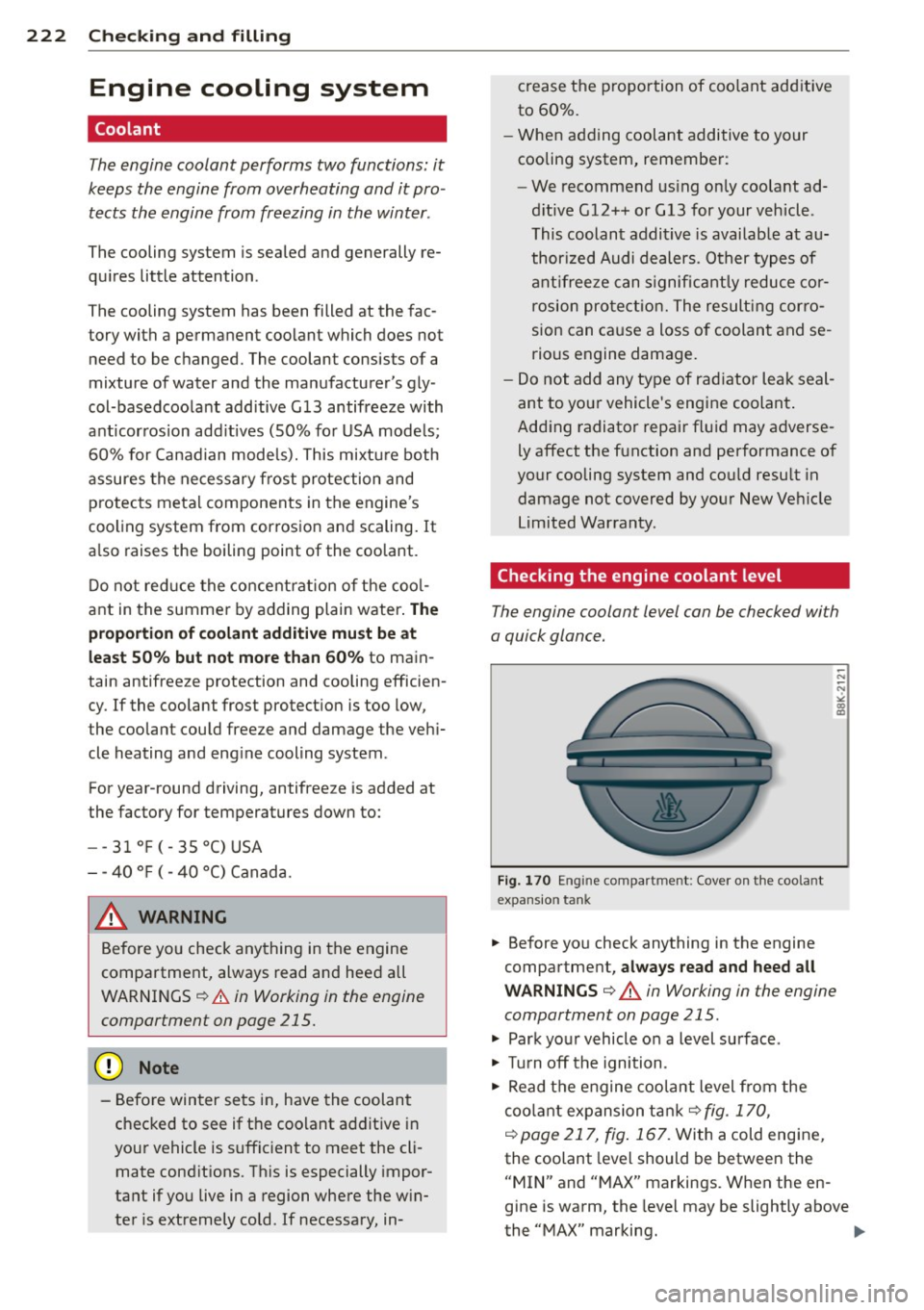
The engine coolant level can be checked with
a quick glance.
F ig. 170 En gin e compa rtm en t: Cover o n the coo la n t
expans io n ta nk
-"' -"' >< .,
"'
.. Before yo u check anything in the engine
compartment,
alwa ys read and heed all
W ARNINGS ¢ .&. in Working in the engine
compartment on page 215 .
.,. Park your vehicle o n a level surface .
.,. Tu rn off the ignition .
.. Read t he engine coolant level from the
coo la nt expansion tank ¢
fig. 170 ,
r=:> page 217, fig . 167. With a cold engine,
the coolant leve l should be between the
"MIN" and "MAX" markings . When the en
gine is warm, the level may be slightly above
the "MAX" marking.
IJII,
Page 226 of 294
224 Checking and filling
scalding from hot coolant by following
these steps.
- Turn off the eng ine and a llow it to cool
down.
- Protect your face, hands and arms from escaping flu id and steam by cover ing
the cap with a large, thick rag.
- Turn the cap slowly and very carefully
i n a counter-clockwise direction while
apply ing l ight, downwa rd p ress ure on
the top of the cap .
- To avo id being burned, do not sp ill an
tifreeze or coolant on the exhaust sys
tem or hot engine parts . Under certain
conditions, the ethylene glyco l in en
gine coolant can catch f ire .
- Antifreeze is poisonous . Always store an
tifreeze in its or iginal container and we ll
out of the reach of children .
- If you drain the coolant, it must be
caught and safely stored in a proper con
tainer clear ly marked "poison".
@ Note
- Coolant po llutes the env ironment and
could cause an engine fire . Excess coo l
ant will be forced out through the pres
sure relief valve in the cap when the en
gine becomes hot.
- If, in an emergency, on ly water can be
added, the correct ratio between water
and antifreeze
c::> page 222 must be re
stored as soon as possible .
@ For the sake of the environment
Drained coolant should not be re used. Al
ways dispose of used coolant while observ
ing all environmental regulat ions.
Radiator fan
The radiator fan switches on automatically by
itself
The radiator fan is driven by the engine via the
V-be lt . The viscous clutch regulates the speed
of the fan according to the temperature of the
coolant. An a
uxiliary electric radiator fan* switches on
and off depending on coolant temperature
and other vehicle operat ing condit ions .
After yo u sw itch the engine off, the aux iliary
f an can continue running for up to 10 minutes
- eve n wit h the ignition off. It can even switc h
on again later by itself
c::> &. , if
- t he tempe rature of the engine coo lant rises
due to the heat build -up from the engine in
the engine compartment, or
- the engine compa rtment heats up because
the vehicle is parked in i ntense sunlight.
_& WARNING
- To reduce the risk of personal in jury nev
er touch the radiator fan.
- The auxiliary electric fan is temperat ure
controlled and can sw itch on suddenly
even when the engine is not running.
- The a uxiliary radiator fan sw itches on a u
tomatically when the engine coo lant
reaches a certai n temperature and will
continue to run until the coolant temper
ature drops.
Brake fluid
Checking brake fluid level
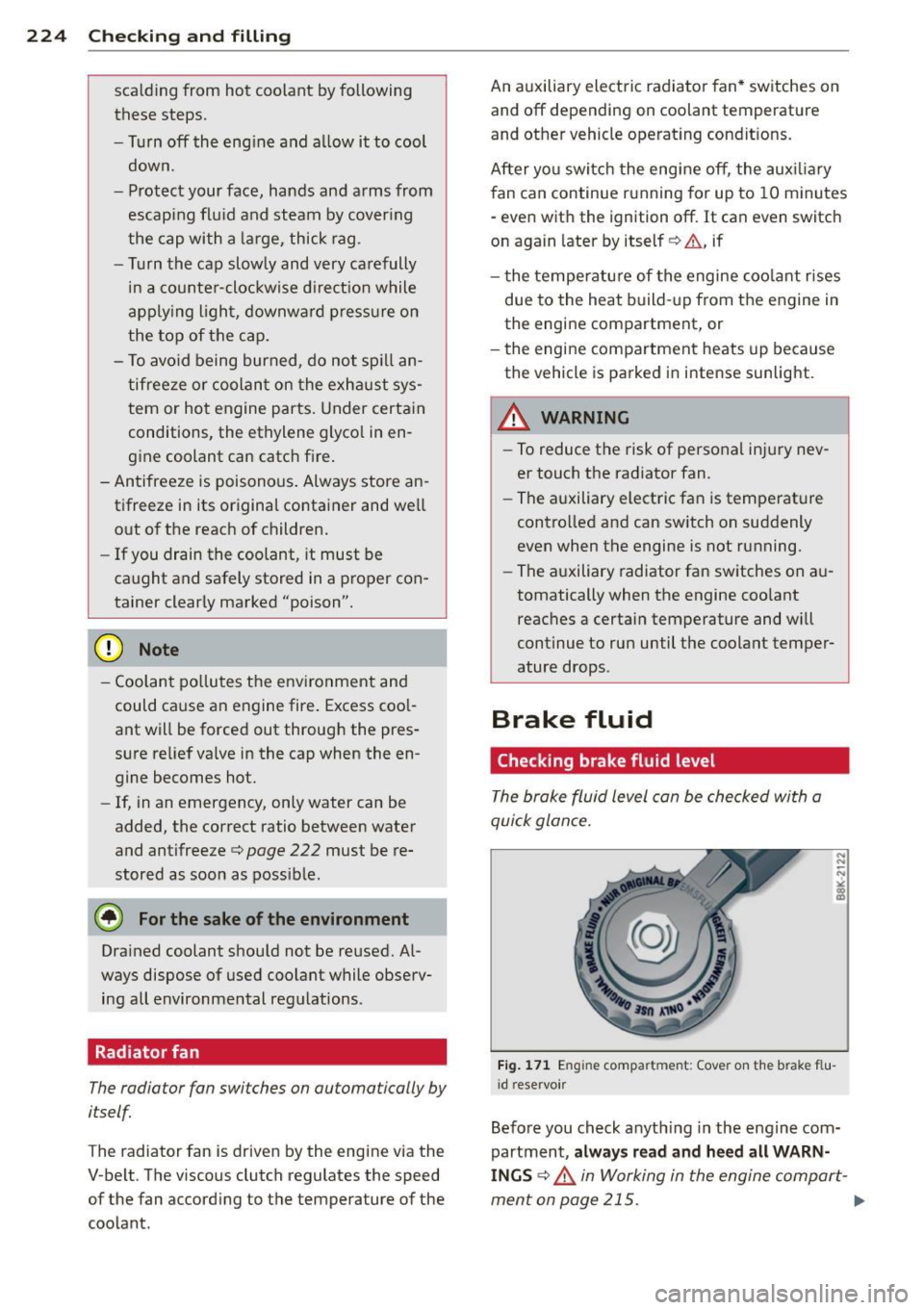
The brake fluid level can be checked with a
quick glance.
F ig . 17 1 Eng ine compartment: Cover on the brake flu
i d reservo ir
Before you check a nyth ing in the engine com
partment,
always read and h eed all WARN
INGS c::> .&. in Working in the engine compart-
ment on page 215. .,..
Page 228 of 294
226 Check ing and filling
Have the battery checked when you take your
vehicle in for service. You are well advised to replace a battery that is older than 5 years.
W ith certa in types o f airbag deployment, the
battery is disconnected from the vehicle elec
trica l system for safety reasons¢
& in Re
pair, core and disposal of the airbags on
page 158.
Disconn ect ing the battery terminal s
Some vehicle functions (power window regu
lators, for example) are lost if the battery ter
minals are disconnected . These functions have
to be re learned after the battery terminals are
connected again. To prevent this, the battery
should only be disconnected from the vehicle
electrical system when absolutely necessary
for repairs .
Vehicles not dri ven fo r lo ng p eriod s
If you do not drive your vehicle over a period
of several days or weeks, electrical compo
nents are gradually cut back or switched off.
This reduces energy consumption and main
tains starting capabil ity over a longer period
¢ page 190.
Some of the conven ience functions may not
operate, such as the inter ior lights or the
power seat adjustment. The conven ience
functions will be ava ilable again when you
turn on the ignition and start the eng ine.
Winter operati on
During the winter months, battery capacity
tends to decrease as temperatu res drop . This
is because more power is also consumed while
start ing , and the headlights, rea r window de
fogger, etc., are used more often .
Avoid unnecessary power consumption, par
ticularly in c ity traffic or when traveling on ly
short distances. Let you r authorized Audi
dea ler check the capacity of the vehicle bat
tery before winter sets in
¢ page 228. A well
charged batte ry w ill not only prevent sta rting
prob lems when the weather is cold, but wi ll
a lso last longer.
(D Tips
If your vehicle is left standing for seve ral
weeks at extremely low temperatures, the
vehicle battery sho uld be removed and
stored where it w ill not freeze . This will
prevent it from be ing damaged and having
to be replaced .
Working on the battery
Be especially careful when working on or near
the battery.
The battery is located in the luggage compart
ment under the floor. Before you check any
t hi ng in the luggage compartment,
read and
heed all WARNINGS
¢ ,& .
Always heed the safety warnings , when work
ing on the vehicle battery or the vehicle e lec
trical system to prevent injury.
Th e follo wing WARNINGS are very
important when working on the battery :
Al ways heed the follo wing WARNING SYM
BOLS and safety prec aution s when working
on the battery .
® Always wear eye protection .
,0,. Battery acid contains sulfuric acid . Al
~ way s wear glov es and ey e prot ectio n.
~ No
\!SI -sparks
-flames
-smoking.
A Wh en a battery is charged , it produ ce s
~ hydro gen gas which is e xplosi ve and
c o uld cau se pe rson al injur y.
~ Always keep the battery well out of
'if!:11 reach of children .
_& WARNING
Whenever working on the battery or on
the electrical system, there is the risk of
injury, accident and even fire . Read and
heed the following WARNINGS:
-
Page 229 of 294
-Always wear eye protection. Do not let
battery acid or any lead particles get on
your skin or clothing. Shield your eyes .
Explosive gases can cause blindness or
other injury.
- Battery acid contains sulfuric acid . Sulfu
ric acid can cause blindness and severe
burns.
- Always wear gloves and eye protection.
Do not tilt the battery because acid
could leak out of the ventilation open
ings.
- If you get battery acid in your eyes or
on your skin, immediately rinse with
cold water for several minutes and get
medical attention .
- If you should ingest any battery acid,
seek medical attention immediately.
- Do not expose the battery to an open
flame, electric sparks or an open light.
- Do not smoke.
- Do not interchange the positive and neg-
ative cables .
= When working on the battery, be sure
not to short-circuit the terminals with
tools or other metal objects. This would cause the battery to heat up very quickly,
which could lead to damage or explosion and personal injury.
- When a battery is charged, it produces
hydrogen gas which is explosive and
could cause personal injury .
- Always keep the battery well out of the
reach of children.
- Before work is done on the electrical sys
tem, disconnect the negative ground ca ble .
- Before performing any work on the elec
trical system, switch off the engine and
ignition as well as any electrical equip
ment. The negative cable on the battery
must be disconnected . If you are just go
ing to replace a light bulb, then it is
enough to switch off the lights.
- Before disconnecting the battery, switch
off the anti-theft alarm system! Other
wise you will set off the alarm.
Checking and filling 22 7
-When disconnecting the battery, first
disconnect the negative cable and then
the positive cable.
- Before reconnecting the battery, make
sure all electrical consumers are switch
ed off. Reconnect the positive cable first
and then the negative cable . Never inter
change the cables -this could start a fire!
- Never charge a frozen or a thawed-out
battery . It could explode! If a battery has
frozen , then it must be replaced . A dis
charged battery can freeze over at 32°F
(QOC),
-Make sure the vent hose is always attach
ed to the opening on the side of the bat
tery .
- Never use batteries which are damaged.
There is the danger of an explosion! Al
ways replace a damaged battery.
&_ WARNING
California Proposition 65 Warning:
- Battery posts, terminals and related ac
cessories contain lead and lead com
pounds, chemicals known to the State of
California to cause cancer and reproduc
tive problems. Wash hands after han dling.
(D Note
- Do not disconnect the vehicle battery
when the ignition is switched on or when the engine is running, otherwise, you will
damage electronic components in the
electrical system.
- If your vehicle is going to stand for a
long period of time without being driven,
protect the battery from "freezing", oth
erwise it will be damaged and will then
have to be replaced.
•
•
Page 251 of 294
When the malfunction indicator is illuminat
ed, the system may not be able to detect or
signal low tire pressure as intended. TPMS
malfunctions may occur for a variety of rea
sons, including the installation of replace
ment or alternate tires or whee ls on the veh i
cle that prevent the TPMS from funct io ni ng
p roperly . Always check the T PMS malfunct ion
tellta le afte r replacing one or more t ires or
wheels on your veh icle to ensure that the re
p lacement or a lternate tires and wheels allow
the TPMS to continue to function properly .
Tire pressure indicator appears
Applies to vehicles: with tire pressure monitoring system
The tire pressure indicator in the instrument
cluster informs you if the tire pressure is too
low or if there is a system malfunction.
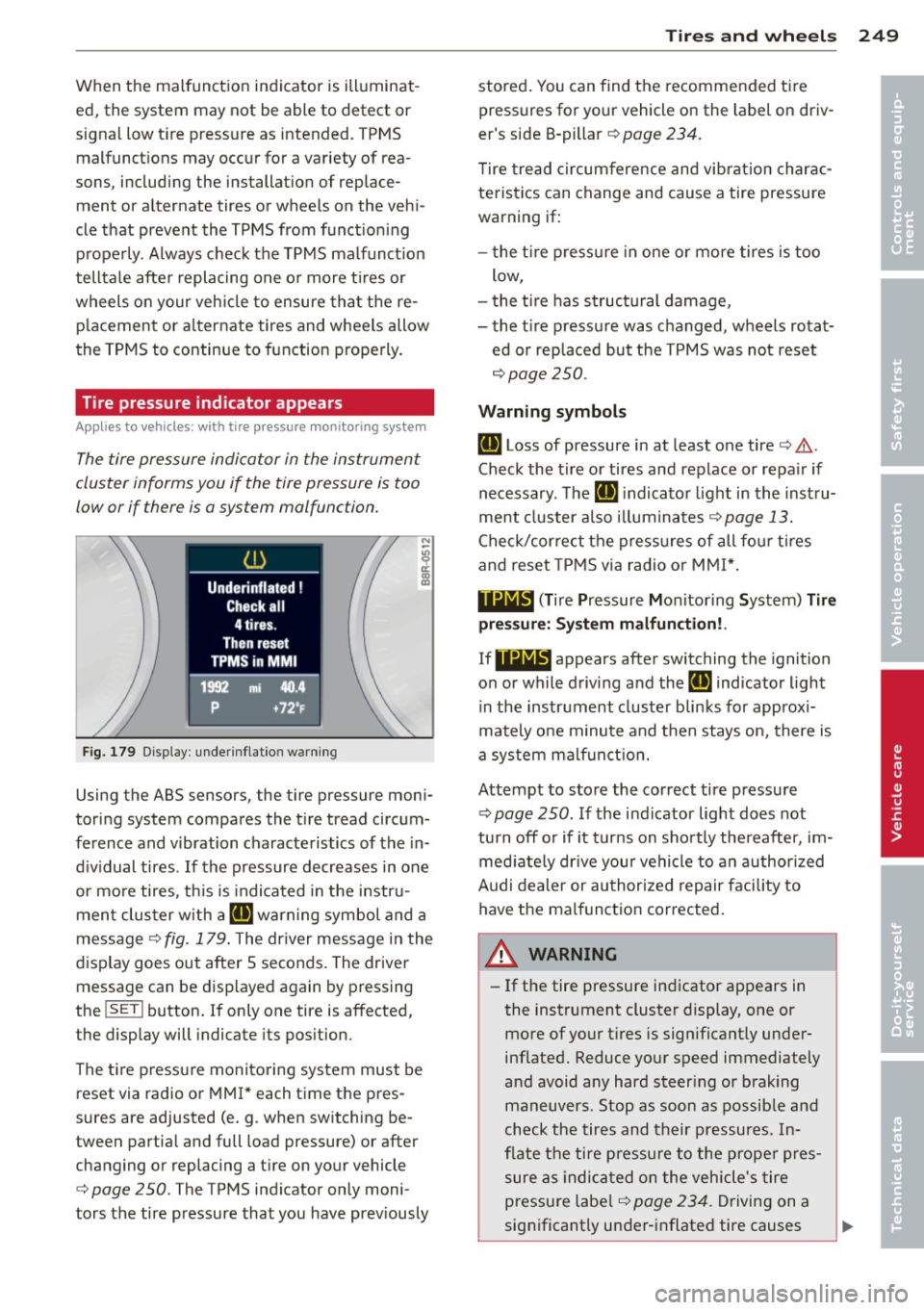
Fig. 179 Display : underinflatio n warning
Using the ABS sensors, the tire pressure moni
toring system compares the t ire tread circum
ference and vibration characteristics of the in
d iv idual tires . If the pressure decreases in one
or mo re tires, th is is indicated in the instru
ment clus ter with a
IE warning symbol and a
message ¢
fig. 179. The driver message in the
display goes out after 5 seconds. The driver message can be displayed again by pressing
the
! SET ! button. If only one tire is affected,
the display will indicate its pos ition.
The tire pressure monitoring system must be reset via radio or MMI* each time the pres
sures are adjusted (e.g . when switching be
tween partia l and full load pressure) or after
changing or replacing a t ire on your vehicle
¢
page 250. The TPMS indicator only moni
tors the tire pressure that you have prev iously
Tire s an d wheel s 249
stored . You can find the recommended t ire
pressures for yo ur vehicle on the label on driv
er's side B-pillar ¢
page 234.
Tire tread circum ference and vibration charac
teristics can change and cause a tire pressure
warning if:
- the t ire p ress ure in one or more tires is too
low,
- t he t ire has structural damage,
- the t ire pressure was changed, wheels rotat-
ed or replaced but the TPMS was not reset
¢ page 250.
Warning symbo ls
IE Loss of pressure in at least one tire¢.&,.
Check the tire or tires and replace or repa ir if
necessary. The
IE indicato r light in the inst ru
ment cluster a lso illuminates
c::!;> page 13.
Check/correct the press ures of all fou r tires
and reset TPMS via radio o r MMI*.
119;~, (T ir e Pressure Mon itoring System) Tire
pre ssure: Syst em malfun ction!.
If 11Nlf:1 appears afte r switching the ignition
on or while driving and the
IE indicator light
i n the instrument cluster blinks fo r approx i
mately one minute and then stays on, there is
a system malf unct ion.
Attempt to store the correct tire pressure
¢ page 250 . If the ind icator light does not
tu rn off o r if it turns on sho rtly the reafter, im
med iate ly dr ive your vehicle to a n author ized
Audi dealer or au thorized repair faci lity to
have the malfunc tion corrected .
A WARNING
-=
-If the tire pressure indicator appears in
the instrument cluster display, one or
more of your t ires is significant ly under
inflated. Reduce your speed immediately
and avoid any hard steer ing or braking
maneuvers. Stop as soon as possible and
check the tires and their pressures. In
flate the tire p ressure to the prope r pres
sure as indica ted on the vehicle's tire
pressu re labe l
¢page 234. Driving on a
significantly under-i nflated tire causes
•
•
Page 252 of 294
250 Tires and wheels
the tire to overheat and can lead to tire
failure. Under-inflation also is likely to
impair the vehicle's handling and stop
ping ability .
- The driver is responsible for maintaining
the correct tire pressures. You must
check the tire pressures regularly .
- Under certain conditions (such as a spor
ty driving style, winter conditions or un paved roads), the pressure monitor indi
cator may be delayed .
-Ask your authorized Audi dealer if run flat tires may be used on your vehicle.
Your vehicle registration becomes invalid
if you use these tires when not permit
ted. Damage to your vehicle or accidents
could also result.
@ Tips
- The tire pressure monitoring system
stops working when there is an ESC/ABS
malfunction.
- Using snow chains may result in a system
malfunction.
- The tire pressure monitoring system on
your Audi was developed using tires with the "AO" or "RO" identification on the
tire sidewall ¢
page 241. We recom
mend using these tires.
Reset tire pressure monitoring system
Applies to vehicles: with tire pressure monitoring system
If the tire pressure is adjusted, wheels are ro
tated or changed, the TPMS must be reset via
radio or MMI*.
11> Before resetting the TPMS, the current pres
sures of all four tires must correspond to
the specified values. Adjust the tire pressure and reset the pressure in the tire pressure
monitoring system according to the load
you are carrying
¢ page 234.
11> Turn on the ignition.
11> Select : the ICARI function button > Tire
pressure monitoring > Store now .
Or
i,. Select: the ICARI function button > Car sys·
terns
control button > Servicing & checks> Tire pressure monitoring
> Store tire pres
sures.
@ Tips
Do not store the tire pressure if there are
snow chains on the tire.
Page 262 of 294
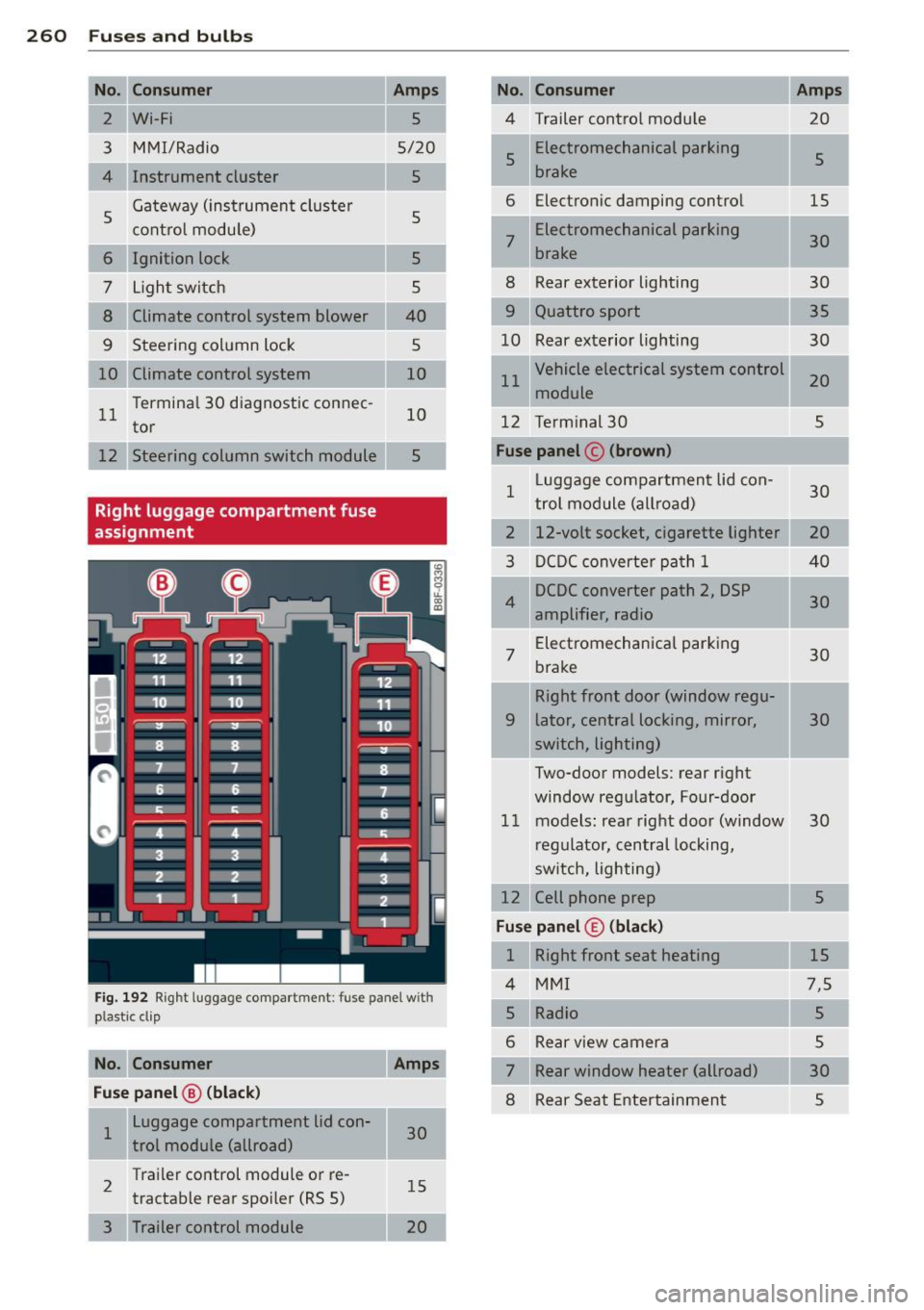
260 Fuses a nd bulb s
I
-No. Consumer
2 Wi-Fi
3 MMI/Radio
4 Instrument cluster
5 Ga
teway (instrument cluster
control module)
6 Ignition lock
7 L igh t switch
8 Climate control system blower
9 Steer ing column lock
10 Climate control system
11 Termina
l 30 diagnostic connec-
tor
12 Steering column switch module
Right luggage compartment fuse
assignment
Amps
5
5/20
5
5 5
5
40 5
10
10
5
Fig. 192 R ig ht l uggag e compar tmen t: fu se pan el w ith
plas tic cl ip
No. Con sumer Amps
Fu se pan el
@ (bl ack )
1 Luggage compartment lid con-
30
trol module (allroad)
2 Trail
er control module or re-
15
tractable rear spoiler (RS 5)
3 Trailer control module
20
No . Consumer
4 Trailer contro l modu le
5 Electromechanical parking
5
brake
6 Elec tronic damping control
15
--
7 Electromechanical parking
30
brake
8 Rear exterior lighting 30
9 Quattro sport
10 Rear exterior lighting
11 Vehicle electrical system control
20
module
12 Te rminal 30 5
Fuse panel© (brown )
1 L
uggage compartment lid con-
30
trol module (all road)
2 12-volt socket, cigarette lighter
20
3 DCDC converter pa th 1 40
4 DCDC converter path 2, DSP
30
amplifier , radio
7 Electromechanical parking
30
b rake
Right front door (window regu-
9 lator, central locking, mirror, 30
switch, lighting)
Two-door models : rear righ t
window regu lator, Four-door
11 models : rear right door (window
30
regulator, central locking,
switch, lighting)
Cell phone prep 5
Fuse panel © (blac k)
1 Right front seat heating
15
4 MMI 7,5
5 Radio 5
6 Rear view camera 5
7 Rear window heater (allroad)
30
8 Rear Seat Entertainment 5
Page 270 of 294
268 General information
General information Explanation of
technical data
Some of the technical data listed in this man
ual requires further explanation .
The technical data for your vehicle is listed in
the charts starting on
r:::> page 2 70. This sec
tion provides general information, notes and restrictions which apply to this data .
Vehicle identification
The key data is given on the vehicle identifica
tion number (VIN) plate and the vehicle data
sticker.
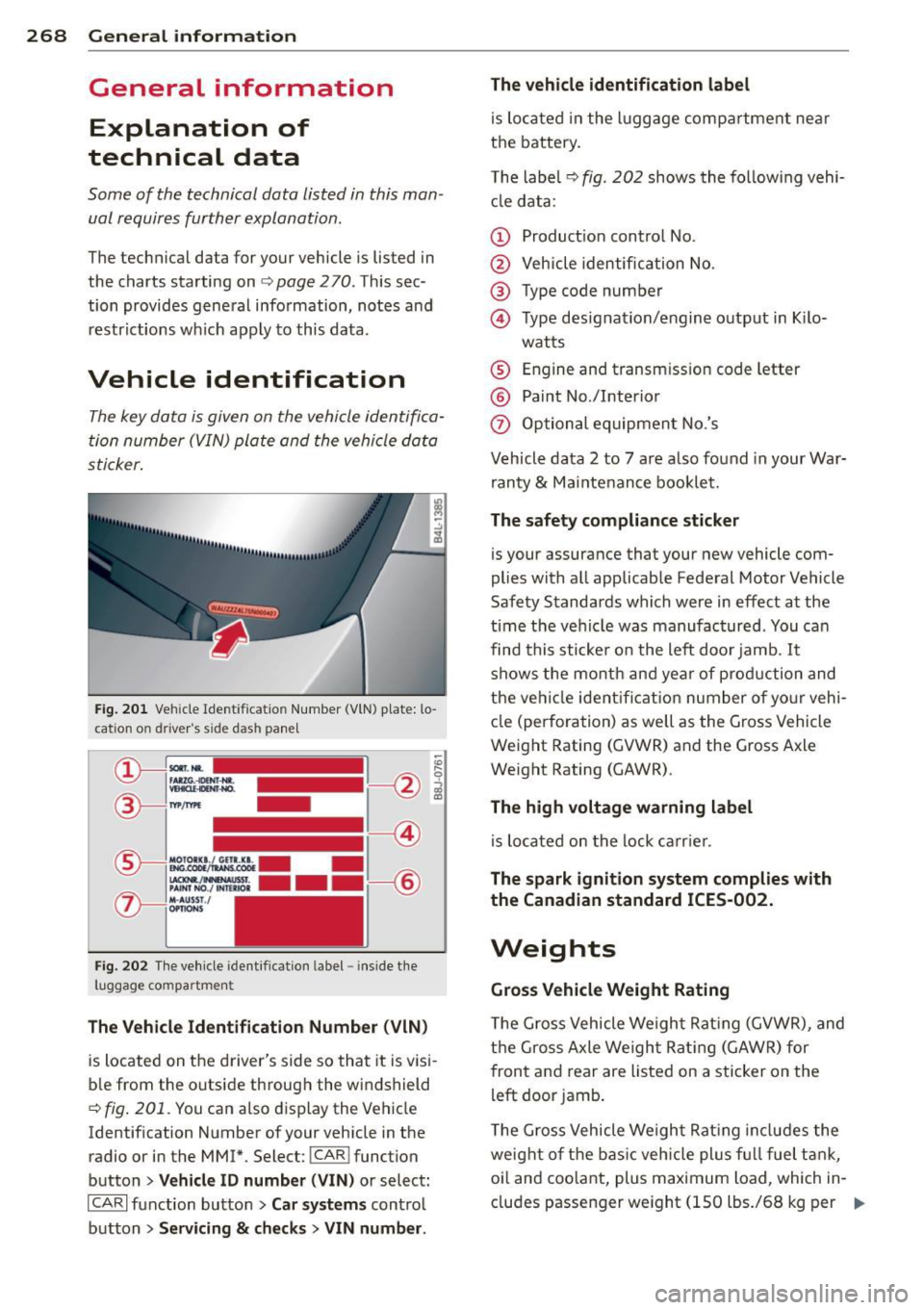
Fig. 201 Veh icle Ide ntific atio n Number (VlN) p late: lo
cation on driver 's sid e das h panel
Fig. 202 The vehicle identi fication label -inside the
luggage co mpa rtmen t
The Vehicle Identification Number (VIN)
is located on the driver's side so that it is visi
ble from the outside through the windshield
r:::> fig . 201 . You can also display the Vehicle
Identification Number of your vehicle in the
radio or in the MM!*. Select :
!CAR ! function
button
> Vehicle ID number (VIN) or select:
ICARI function button > Car systems control
button
> Servicing & checks > VIN number . The
vehicle identification label
is located in the luggage compartment near
the battery .
The label¢
fig. 202 shows the following vehi
cle data :
(D Production control No .
@ Vehicle identification No.
® Type code number
@ Type designation/engine output in Kilo-
watts
® Engine and transmission code letter
@ Paint No./Interior
(f) Optional equipment No.'s
Vehicle data 2 to 7 are also found in your War
ranty
& Maintenance booklet.
The safety compliance sticker
is you r assurance that your new vehicle com
plies with all applicable Federal Motor Vehicle
Safety Standards which were in effect at the
time the vehicle was manufactured . You can
find this sticker on the left door jamb.
It
shows the month and year of production and
the ve hicle ident ification number of your vehi
cle (perforation) as well as the Gross Vehicle
Weight Rating (GVWR) and the Gross Axle
Weight Rating (GAWR) .
The high voltage warning label
is located on the lock carr ier .
The spark ignition system complies with
the Canadian standard ICES-002.
Weights
Gross Vehicle Weight Rating
The Gross Vehicle Weight Rating (GVWR), and
the Gross Axle Weight Rating (GAWR) for
front and rear are Listed on a sticker on the
left door jamb.
The Gross Vehicle Weight Rating includes the
weight of the basic vehicle plus full fuel tank,
oi l and coolant, plus maximum load, wh ich in
cludes passenger weight (150 lbs./68 kg per
Ill>
Page 280 of 294
278 Index
Automatic Shift Lock (ASL) . . . . . . . . . . . . 86
Automatic transmission . . . . . . . . . . . 83, 89
Automatic Shift Lock (ASL) . . . . . . . . . . . 86
Driving .. .. .... .. ... .... .. .. .. .. .. 84
Dynamic shift program . . . . . . . . . . . . . . 87
Emergency mode . . . . . . . . . . . . . . . . . . . 88
Emergency release . . . . . . . . . . . . . . 89, 95
Kick-down . . . . . . . . . . . . . . . . . . . . . . . . . 87
Manual shift program . . . . . . . . . . . . . . . 88
multitronic . . . . . . . . . . . . . . . . . . . . . . . . 83
Removal lock (ignition key) ..... .. .. .. 72
Selector lever . . . . . . . . . . . . . . . . . . . . . . 85
S tron ic .. .. ................ ... ... . 89
tiptronic . . . . . . . . . . . . . . . . . . . . . . . . . . 83
also refer to S tron ic transmission ..... 89
Automatic wipers . . . . . . . . . . . . . . . . . . . . 50
Auto Safety Hotline ................. 134
Average speed . . . . . . . . . . . . . . . . . . . . . . . 25
Avoid damaging the vehicle .. .. .. .... . 192
B
Battery ..... ................ .. 17,225
Battery location inside the luggage com-
partment ........ ....... .. .. .... .
226
Charging . .. ... .. ..... ... .... .. .. . 228
Important warnings when working on
the battery .... ... .... ..... .. .. .. .
226
Jump starting . ........... .. .. .. .. . 262
Low . .. .. .. ............. .. .. .. .. . 190
Replacing the battery . .. .. .. .. .. .. . 229
State of charge ............ ... .... . 190
Winter operation .......... ... .... . 225
Working on the battery ..... .... ... . 226
Before driving .. ........... .... .... . 126
Bio-ethanol (Fuel) ............ .. .. .. . 211
Blended gasoline ................... 210
Blower (automatic climate control) . . . . . . 70
Body cavity sealing ........... .. .. .. . 204
Booster seats ...... ....... .. .. .... . 173
Brake fluid
Changing the brake flu id . ........ .. .
225
Check ing the brake fluid level . .. .. ... 224
Reservoir ... ............ .. .. .. .. . 224
What is the correct brake fluid level? . . 224
What should I do if the brake fluid warn-
ing light comes on? ........ ... .. ...
224
Brake system .... .. ............. .... 224
Anti- lock braking system ............. 19
Brake assist system ................ 184
Brake fluid .... .. ......... .... .... 224
Brake fluid specifications for refill and re-
placement ...... ................ .
225
Brake light defective . . . . . . . . . . . . . . . . 21
Brake power assist unit .......... ... 187
Brakes .. .. .. .. . ............ .... .. 187
Ceramic brakes . .. ... ... ... .... .. .. 187
Electromechanical parking brake ...... 77
Warning/indicator lights .......... .. . 15
Worn brake pads symbol . . . . . . . . . . . . . 20
Braking
Emergency braking funct ion ... .. .. .. .
79
braking guard . . . . . . . . . . . . . . . . . . . . . . . 97
Messages ..... .. .. ... ........... . 105
Settings .. ... ... .. .............. . 104
Break-in period . . . . . . . . . . . . . . . . . . . . . 192
Tires . .. .. .. .. .. ............. .. .. 192
Bulbs .......... .. ............. .... 261
C
Californ ia Proposition 65 Warn ing . .... 216
Battery specific .. ... .......... .. .. 227
Capac1t1es .. ... ... .. .............. . 270
Car care ........ .. ............. .... 199
Interior . .. .. .. .. ............. .. .. 205
Plastic and vinyl .. ... ...... .... .. .. 202
Care of exterior .... ................. 199
Cargo area
refer to Luggage compartment. . . 64, 132
Catalytic converter . . . . . . . . . . . . . . . . . . 193
Center armrest . . . . . . . . . . . . . . . . . . . . . . 56
Central lock ing .. .. .......... ...... .. 32
Central lock ing switch .... ...... .. .. . 36
Convenience key . . . . . . . . . . . . . . . . . . . . 36
Remote control key ............ .... . 35
Ceramic b rake ro tors
New brake pads .. ..... ........... .
18 7
Certification . ..... ................ . 275
Changing a flat t ire . ......... .... .... 252
Changing a wheel .. ......... .... .... 252
Changing engine oil
Chassis 221
Undercoating .. .. ... .. ... ..... .. .. 204
Page 281 of 294
Checking Engin e coolant leve l .... ... .. .. .. .. . 222
Chec king tire p ressure .. .... .. .. .. .. . 236
Ch ild rest ra ints
Danger of us ing ch ild restra ints in the
front seat . . . . . . . . . . . . . . . . . . . . . . . . 145
Where can I get add it ional information
about ch ild restra ints and thei r use? . . 183
Ch ild rest ra int system anchors . .. .. .. . 179
Ch ild safety . ... .... .... ... .. .. .. ... 165
Convertible locking retracto r .. .. .. .. . 17 5
Important safety instructions fo r using
child safety seats ......... .. .. .. .. . 168
Important things to know when dr iv ing
wi th chi ldren ............ .... .. .. . 165
Instal ling a child restraint us ing t he
L ATC H system ............. ... ... .. 180
M ounting and releasing the ancho rag e
h ook .... .. .. ............. .. .. ... 180
Tet he r anchors ........... .... .. .. . 18 1
Tether straps ..... .... ... .. .. .. ... 181
Ch ild safety locks
P owe r windows . ...... ... .. .. .. .. .. 40
R ear doors ................. ... .. .. 4 0
Ch ild safety seats . . . . . . . . . . . . . . . . . . . 171
Booster seats . . . . . . . . . . . . . . . . . . . . . 173
Convertible ch ild seats .... .. .. .. .. . 172
Convertibl e locking retracto r .. .. . ... . 175
D anger of using c hild restra ints in the
fron t se at . . . . . . . . . . . . . . . . . . . . . . . . 1 45
H ow do I properly ins tall a child safety
seat in my vehicle ? ..... ... .. .. .. .. . 168
Infant seats . ..... .... ... .. .. .. ... 171
Install ing .. ............. .... .. .. . 175
LATCH system . . . . . . . . . . . . . . . . . . . . . 180
Safety instructions . . . . . . . . . . . . . . . . . 168
Unused safety belts on the rear seat 170
Child seats Lower anchorages ........ .. .. .. .. . 180
C igare tte lig hter . . . . . . . . . . . . . . . . . . . . . 59
Clea ning
A lcantara ® (synthetic suede) .. .. . ... . 208
E ng ine compartment .......... ... .. 208
E xhaust tail p ipes ......... .. .. .. .. . 204
Fabr ics and fabr ic coveri ngs .. .. .. .. . 205
I ns trumen t panel ......... .. .. .. .. . 20 6
I n terior .... .. .... .... ... .. .. .. ... 205
L eather .... .. ... ..... ... .. .. .. ... 207
Inde x 279
MMI display/cont ro ls . .. ..... ... .. .. 205
P lastic and vinyl .. .. . ... .... ... .. .. 202
P last ic parts ... .. .. . .. ... .... ... .. 206
Safety be lts . .. .. ................. 208
Tr im strips .. .. .. .... ............. 202
Cleaning and protection ... .... ... .. .. 199
Cl imat e controls ... .. ................ 68
C limate control system
Automat ic recircu lation ......... .... . 71
synchronizing .. .. .... ........... .. . 71
C lock . ... .. .. .... .. . .. .. ..... ... .. . 12
Clos ing
P ower w indows .. .. . .......... .... . 40
S lid ing/ti lting s unroo f .......... .. .. . 42
S unshade ... .. .. .. .. .. ...... ... .. . 42
Clos ing/ope ning
at the lock cy linder .. .............. .. 37
by remo te control ................. . 35
with t he centra l locki ng sw itch ... .. .. . 36
with the conve nien ce key ..... ... .. .. . 36
Cold tire infla tion p ressure . .......... . 234
Coming home ... .... . ... ...... ... .. . 45
Compac t spa re tire . ............. .... 251
also refer to Spa re t ire .......... .. .. 251
Compartments . . . . . . . . . . . . . . . . . . . . . . 62
Compass in the mi rror . .. ..... ... .. .. . 52
Compliance . .. .. .. ............... .. 275
Consumer Information . . . . . . . . . . 134, 272
Contacting NHTSA .... .. ..... ... .. .. 134
Co nvenie nce key
Ind icator lights .. .. . .. ..... ... .... . 76
Star ting engi ne (S TART ENGIN E STO P
button) ... .. .. .. .... ........... .. . 75
S topping the eng ine (S TART ENG INE
STOP b utton) . . . . . . . . . . . . . . . . . . . . . . 76
Switching on ignition . ... .... ... .. .. . 75
u nlocking/locking ............. .... . 36
Convenience opening/clos ing
Convertib le child safety seats
Co nvertib le loc king retractor .....
.. .. . 41
172
Activating ... .. .. .. .. .. .. .... ... .. 177
Deact ivating . .. .. ................. 178
U sing to secure a child safety seat 1.75, 177
Coolant system . ...... .. .. ..... ... .. 222
Cooling mode (automat ic cl imate control) 69
Cooling System Expansion tank . .. .... ........... .. 222
•
•