parking brake AUDI A5 2015 Owner´s Manual
[x] Cancel search | Manufacturer: AUDI, Model Year: 2015, Model line: A5, Model: AUDI A5 2015Pages: 264, PDF Size: 66.83 MB
Page 88 of 264
Automatic transmission
¢ page 191. Otherwise, any increase in en
gine speed may set the veh icle in motion,
even with the parking brake applied.
(D Note
- When stopping on an incline, do not try to
hold the vehicle in place by pressing the ac
ce lerator pedal while a driving gear is se
lected. This can cause the transmission to
overheat and can damage it . Activate the
parking brake or press the brake pedal to
prevent the vehicle from rolling.
- Allowing the vehicle to roll when the engine
i s stopped and the selector lever is in
N w ill
damage the transm ission because it is not
lubr icated under those circumstances.
@ Tips
For safety reasons, the park ing brake is re
leased automatically only when the dr iver's
safety belt is engaged in the buckle.
Hill descent control
A pp lies to veh icles: w ith 5 tro nic/t iptronic
The hill descent control system assists the driver
when driving down declines.
Hill descent control is activated when the selec
tor lever is in D/S and you press the brake pedal.
The transmission automatica lly selects a gear
that is suitable for the incline. Hill descent con
trol tries to maintain the speed achieved at the
tim e of braking, within physical and technical
limitations. It may still be necessary to adjust the
speed with the brakes.
Hill descent control switches off once the decline
levels out or you press the acce lerator pedal.
On veh icles w ith the cruise control system*
¢ page 80, hill descent control is also act ivated
when the speed is set.
& WARNING
Hi ll descent control cannot overcome physical
limitations, so it may not be ab le to maintain
a constant speed under all conditions. Always
be ready to apply the brakes.
86
Manual sh ift program
App lies to vehicles: wit h S tron ic/tip tro nic
Using the manual shift program you can man
ually select gears.
'
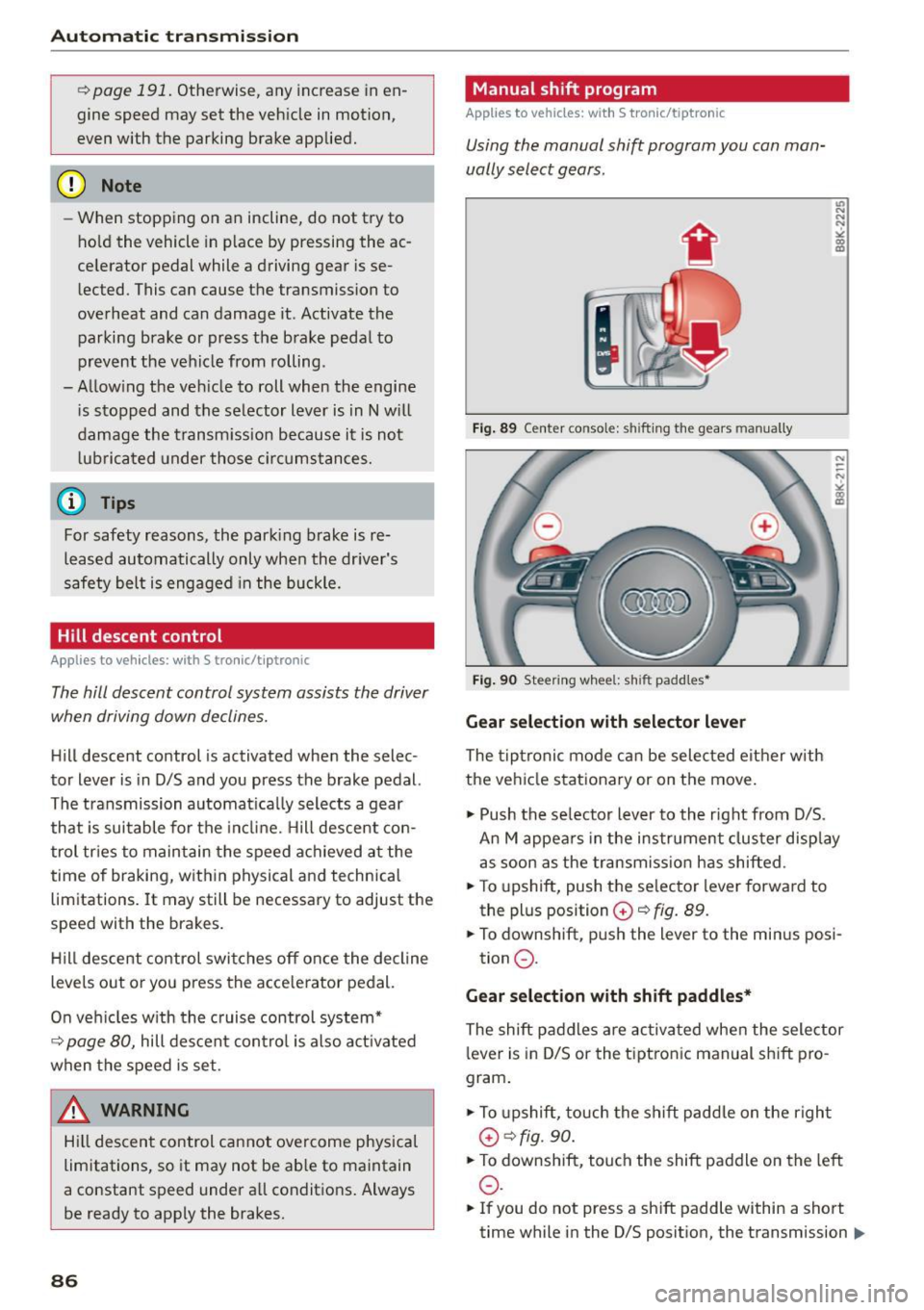
Fig. 89 Center console: shifting the gears manually
Fig. 90 Steering wheel: sh ift padd les•
Gear selection with selector lever
The tiptronic mode can be selected either w ith
the vehicle stationary or on the move.
11> Push the se lector lever to the right from D/S.
An M appears in the instrument cluster display
as soon as the transmission has shifted .
"T o upshift, push the se lector lever forwa rd to
the plus position
G) ¢ fig. 89.
" To downshift, push the lever to the minus posi-
tion
0 .
Gear selection with shift paddles*
The shift paddles are activated when the selector
l ever is in D/S or the tiptronic manual sh ift pro
gram .
" To upshift, touch the shift padd le on the r ight
G) ¢fig. 90.
"To downshift, touch the shift paddle on the left
0 .
11o Ifyou do not press a shift p addle within a short
time while in the 0/5 position, the transmission .,.
Page 99 of 264
M N
i? co ,...., \!) 1.1'1
N 1.1'1 ,....,
Audi adaptive cruise control and braking guard
Engine speed!
This d rive r message appea rs in vehi cles w it h
m anu al t ran smis sion if the d river h ad not up
shi fted o r downshifted in time while using adap
tive cruise contro l braking or accelera ting, ca us
ing the vehicle to exceed or not reac h the permit
ted limit s peed. The adaptive c ruise control turns
off. A chime s ounds as a reminder.
Shift leve r po sition!
Ve hicles w it h an autom atic transmission: the
d river me ssage appe ars if the sele ctor leve r is
shi fted to the N pos it io n. The a daptive cru ise con
trol is not avai lab le while in this pos ition .
Ve hicles w it h manual tra nsmission : the d river
m essage appe ars for vehi cles w it h manu al tra ns
miss io n if there is no forward ge ar engaged,
meanin g if the reverse gear o r the 1s t gear is en
gaged o r if the selecto r leve r is in the neutra l po
sition . The adaptive cruise control is not ava ilab le
while in this p osit ion.
Stabilization cont rol (ESC )
This message appea rs if the elec troni c stab ili za
ti on con trol ( ESC) i s takin g action to stabi lize t he
ve hicl e. The a daptive cru ise contro l tur ns off. A
chime soun ds as a remin der .
Speed too low
This message appea rs if the current speed is too
l ow
to set or to maintain the des ired speed.
The speed being saved must be at least 20 mph (30 km/h). T he cr uise control is turned off for
speeds lowe r th an 12 mph (20 km/h) . The adap
tive c ruise co ntrol re m ains turned o n for speeds
above 9 5 mph (150 km/ h) (override).
It w ill sta
biliz e again at 9 5 mph (15 0 km/h) whe n the dr iv
e r ta ke s his foot off of the g as pedal.
Parking brake!
The drive r message appears when the park ing
b rake is activated. Adaptive cru ise cont ro l is
turned off . A ch ime sounds as a remi nder .
97
Page 185 of 264
Trailer mode notes
Important to know
Your vehicle hand les differently when tow ing a
trailer because of the additional weight and dif
ferent weight distribution. Safety, performance
and economy will greatly depend on how careful
ly you load your trailer and operate your rig.
Before you actually tow your trailer, practice
turning, stopping and backing up in an area away
from traffic. Keep practicing until you have be
come completely familiar with the way your vehi
cle-trailer combination behaves and responds.
Backing up is difficult and requires practice. Back
ing up with a trailer generally requires steering
action opposite to that when backing up your ve hicle without a trailer .
Maintain a greater distance between your vehicle
and the one in front of you. You wi ll need more
room to stop. To compensate for the trailer, you
will need a larger than normal turning radius.
When passing, remember that you cannot acce l
erate as fast as you normally would because of
the added load. Make sure you have enough room
to pass. After passing, allow plenty of room for
your trailer before changing lanes again.
Avoid jerky starts, sharp turns or rapid lane
changes.
(D Tips
- Do not tow a trailer during the break-in peri
od of your vehicle.
- If you tow a trailer, your A udi may require
more frequent maintenance due to the ex
tra load
¢ page 244 .
Parking on a slope
Do not park on a slope with a trailer. If it cannot
be avoided, do so only after doing the following:
When parking:
~ .. Apply the foot brake.
~ .. Have someone place chocks under both the ve-
~ hide and the trailer wheels . ..,.,
N ..,., ,....,
Trailer mode
.. With chocks in place, slowly release the brakes
until the wheel chocks absorb the load.
.. Turn the whee ls towards the curb .
.. App ly the parking brake.
.. Place an automatic transmission* in P, respec
tively a manual transmission in first or reverse
gear .
When restarting after parking:
.. App ly the foot brake.
.. Start the engine.
.. Move the selector lever to D/S, respectively a
manual transmission in first gear .
.. Release the parking brake and slowly pull out
and away from the wheel chocks.
.. Stop and have someone retr ieve the wheel
chocks .
(D Tips
If you move the selector lever of the automat
ic transmission* to P before applying the
parking brak e and before blocking the wheels,
you may have to use more force later to move
the lever out of the P position.
183
Page 193 of 264
M N
0 loo
rl I.O
"' N
"' rl
Checking and Filling Hood
Releasing and opening the engine hood
The engine hood is released from inside the vehi
cle.
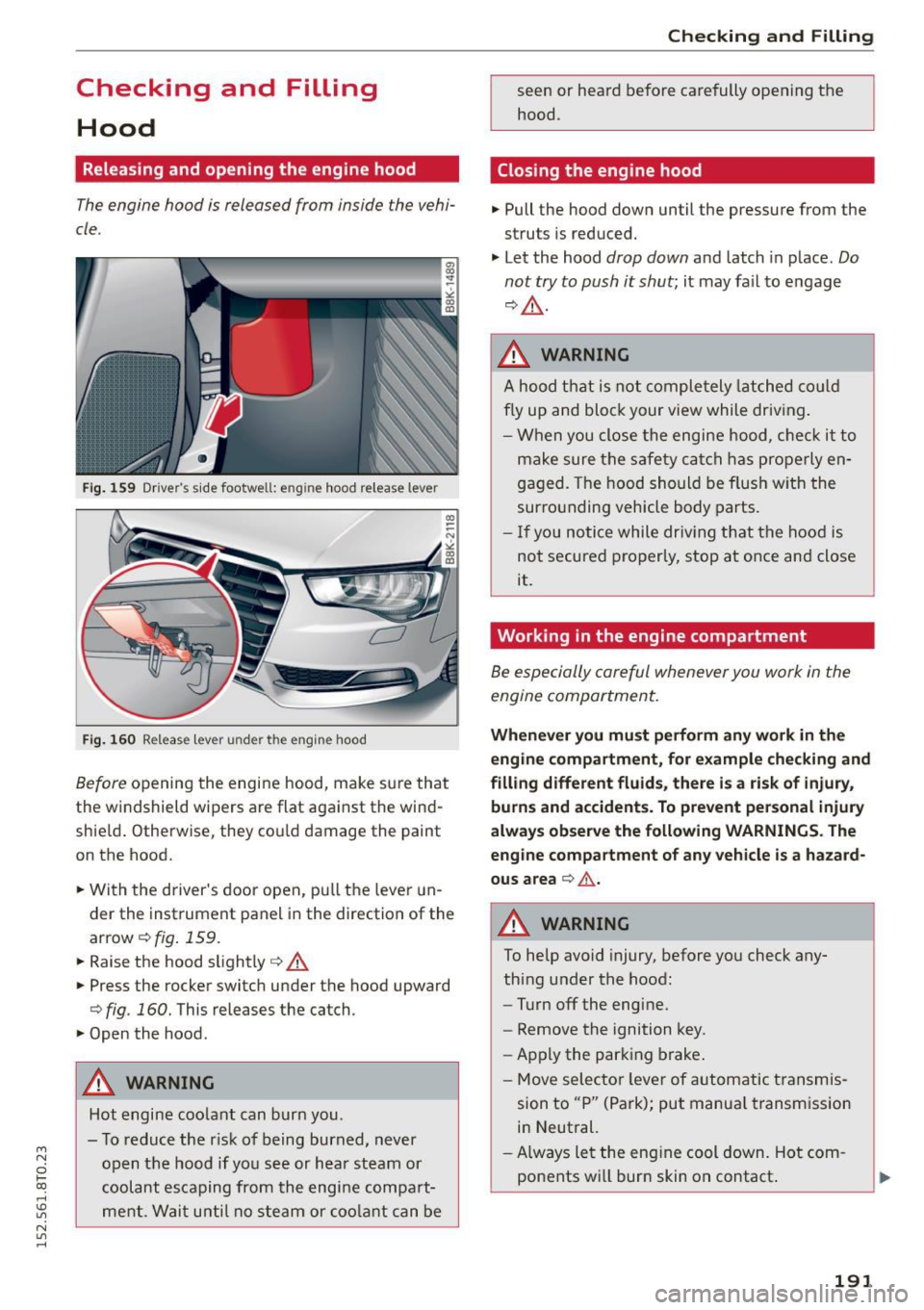
Fig. 159 Driver's side footwell: e ng in e hood release lever
Fig. 160 Releas e lev er un der t he e ngin e hood
Before opening the engine hood, make sure that
the windshield wipers are flat against the wind
shield . Otherwise, they could damage the paint
on the hood.
.. With the driver's door open, pu ll the lever un
der the instrument panel in the direction of the
arrow
c::> fig . 159.
.. Ra ise the hood slightly c::> &.
.. Press the rocker switch under the hood upward
c::> fig . 160. This releases the catch .
.. Open the hood.
A WARNING
Hot engine coolant can burn you.
- To reduce the r isk of being burned, never
open the hood if you see or hear steam or
coolant escaping from the engine compa rt
ment. Wait until no steam or coolant can be
Checking and Filling
seen or heard before carefully opening the
hood .
Closing the engine hood
.. Pull the hood down until the pressure from the
struts is reduced.
"' Let the hood
drop down and latch in place. Do
not try to push it shut;
it may fa il to engage
c::> &. -
A WARNING
A hood that is not comp letely latched could
fly up and block your view while driving.
- When you close the engine hood, check it to
make sure the safety catch has properly en
gaged . The hood should be flush with the
surrounding vehicle body parts.
- If you notice while driv ing that the hood is
not secured properly, stop at once and close
it.
Working in the engine compartment
Be especially careful whenever you work in the
engine compartment.
-
Whenever you must perform any work in the
engine compartment, for example checking and
filling different fluids , there i s a risk of injury ,
burns and accidents. To prevent personal injury
always observe the following WARNINGS . The
engine compartment of any vehicle is a hazard
ous area
c:> .&. .
A WARNING
-
To help avoid injury, before you check any-
thing under the hood:
- Turn off the engine.
- Remove the ignition key .
- Apply the parking brake.
- Move selector lever of automatic transmis-
sion to "P" (Park); put manua l transmission
in Neutral.
-Always let the engine cool down. Hot com
ponents wi ll burn skin on contact .
191
Page 194 of 264
Checking and Filling
-To reduce the risk of being burned, never
open the hood if you see or hear steam or
coolant escaping from the engine compart
ment . Wait until no steam or coolant can be
seen or heard before carefully opening the hood.
- Keep children away from the engine com
partment.
- Never spill fluids on hot engine compo
nents. They can cause a fire.
- Never touch the radiator fan. The auxiliary
electric fan is temperature controlled and
can switch on suddenly .
- Never open the coolant reservoir cap when
the engine is still warm. The coolant system
is pressurized and hot coolant could spray
out.
- Protect your face, hands and arm from
steam or hot engine coolant by placing a
thick rag over the cap when you open the
coolant reservoir .
- Do not remove the engine cover under any
circumstances. This increases the risk of
burns.
- If work on the fuel system or the electrical
system is necessary :
- Always disconnect the battery.
- Never smoke or work near heaters or open
flames. Fluids in the engine compartment could start a fire.
- Keep an approved fire extinguisher imme
diately available .
- To avoid electrical shock and personal injury
while the engine is running or being started,
never touch:
- Ignition cables
- Other components of the high voltage electronic ignition system.
- If you must perform a check or repair with
the engine running:
- First, fully apply the parking brake, move
selector lever of automatic transmission
192
to "P" (Park); put manual transmission in
Neutral.
- Always use extreme caution to prevent
clothing, jewelry, or long hair from getting
caught in the radiator fan, V-belts or other
moving parts, or from contacting hot
parts . Tie back hair before starting, and do
not wear clothing that will hang or droop
into the engine.
- Minimize exposure to emission and chemi cal hazards
~ ,& .
A WARNING
California Proposition 65 Warning:
- Engine exhaust, some of its constituents, and certain vehicle components contain or
emit chemicals known to the State of Cali
fornia to cause cancer and birth defects and
reproductive harm. In addition, certain flu
ids contained in vehicles and certain prod
ucts of component wear contain or emit
chemicals known to the State of California
to cause cancer and birth defects or other
reproductive harm.
- Battery posts, terminals and related acces
sories contain lead and lead compounds,
chemicals known to the State of California
to cause cancer and reproductive harms .
Wash hands after handling .
(D Note
When adding fluids, always make sure that
they are poured into the proper container or
filler opening, otherwise serious damage to
vehicle systems will occur.
@ For the sake of the environment
To detect leaks in time, inspect the vehicle
floor pan from underneath regularly. If you
see spots from oil or other vehicle fluids, have
your vehicle inspected by an authorized Audi
dealer.
Page 228 of 264
Emerg enc y ass is tance
There are some restrictions on the use of the
compact spare tire. The compact spare tire has
been designed specifically for your type of vehi
cle. It must not be swapped w ith a compact
spare tire from another type of vehicle.
Snow chain s
For technical reasons, the use of snow chains on
the compact spare tire is
n ot permitted .
If you do have to drive w ith snow cha ins and a
front tire f ails, mount the spare whee l with tire
instead of a rear tire. Install the snow chains on
the rear tire and use it to replace the defective
front tire .
A WARNING
-Never use the spare tire if it is damaged or if
it is worn down to the tread wear ind icators.
- If the spare t ire is more than 6 years o ld,
use it only in an emergency and w ith ex
treme caut ion and careful driving.
- The spare tire is intended only for tempora
ry and short-term use.
It should be replaced
as soon as possible with the norma l wheel
and t ire.
- After mounti ng the compact spare tire, the
t ire pressure must be checked as soon as
poss ible. The tire pressure of the compact
spare t ire must be 4.2 bar; otherwise, you
risk having an a cc ident.
- Do not drive faster than 50 mph (80 km/h) .
You r isk having an accident.
- Avoid full-throttle acce lerat ion, heavy brak
ing, and fast corneri ng. You r is k having an
a cc ident.
- Never dr ive using more than one spare
wheel and tire. You risk hav ing an accident.
- Norma l summer or winter tires must not be
mounted on the compact spare whee l rim.
- For technical reasons, the use of tire chains
on the spare tire is not permitted. If it is
necessary to drive w ith tire chains, the spare
wheel m ust be mounted on the front axle in
the event of a flat in a rear tire. The new ly
available front wheel must then be installed
in place of the rear wheel with the flat tire .
226
Installing the tire chain before mounting
the wheel and tire is recommended.
- Loose items in the passenger compartment
can cause serious personal injury during
hard braking or in an accident. Never store
the spare t ire or jack and tools in the pas
senger compartment .
Replacing wheels
Before changing a wheel
Observe the following precautions for your own
and your passenger 's safety when changing a
wheel.
~ After you experience a t ire failure, pu ll the ca r
wel l away from mov ing traffic and t ry to reac h
le vel ground before you stop ¢ ,& .
~ All passengers should lea ve the car and move
to a safe location (for instance, behind the
guardrail) ¢,& .
~ Engage the pa rking brake to prevent your vehi
cle from ro lling unintent ionally¢ ,&.
~ Shift into 1st gear on veh icles with manual
transm iss ion, or move the
selector lev er to the
P po sition
on vehicles with automatic transmis
sion .
~ If you are towing a trai le r: unhit ch the trailer
from your ve hicle.
~ Take the jack ¢ page 225 and the spare tire
¢ page 225 out of the luggage compartment .
A WARNING
You or your passengers could be injured wh ile
changing a whee l if you do not follow these
safety precautions:
- If you have a flat tire, move a safe d ista nee
off the road. Turn off the eng ine, turn the
emergency flashers on and use other warn ing dev ices to alert other motor ists.
- Make sure that passengers wait in a safe
place away from the vehicle and well away
from the road and traffic.
- To help preve nt the vehicle from moving
suddenly and possibly slipping off the jack,
always fully set the parking b rake and block
liJ,,
Page 235 of 264
M N
0 loo
rl I.O
"' N
"' rl
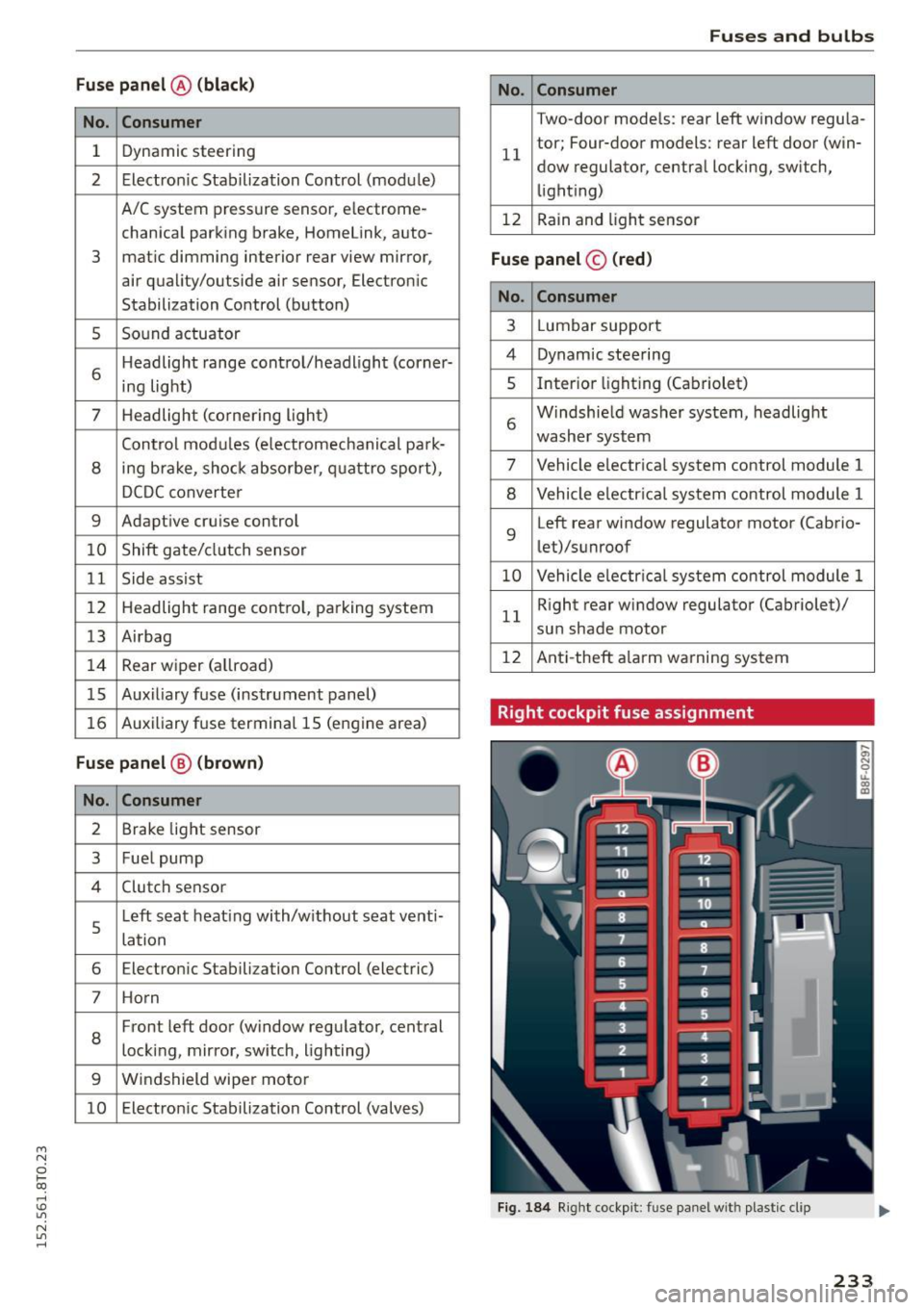
Fu se pa nel @ (black )
No. Consumer
1 Dynamic steering
2 Electron ic Stabilization Control (module)
A/C system pressure sensor, electrome-
chanical parking brake, HomeLink, auto-
3 mat
ic dimming interior rear view mirror,
air quality/outside air sensor, Electron ic
Stabilization Control (button)
s Sound actuator
6 Headlight range control/headl
ight (corner-
ing light)
7 Headlight (cornering light)
Control modu les (electromechanical park-
8 ing brake, shock absorber, q uattro sport),
DCDC converte r
9 Adaptive
cruise control
10 Shift gate/clutch sensor
11 Side assist
1 2 Headlight range cont ro l, parking system
13 Airbag
14 Rear
wiper (a llroad)
15 Auxiliary fuse (instrument panel)
16 Auxiliary
fuse termina l 15 (engine area)
Fuse p anel @ (brown )
No. C onsumer
2 Brake light sensor
3 Fuel pump
4 Clutch sensor
5
Left seat heating with/without seat venti-
lation
6 Electronic Stabilization Control (electric)
7 Ho rn
8
Front left door (window regulator, central
locking, mirror, switch, lighting)
9 Windshield wiper motor
10 Electronic Stabilization Control (valves) Fu
ses a nd bulb s
No. Consumer
Two-door mode ls: rear left window regula-
11 tor; Four-door
models: rear left door (win-
dow regulator, central locking, switch,
light ing)
12 Rain and l
ight sensor
Fuse panel © (r e d )
No . Con sumer
3 Lumbar support
4 Dynamic steering
5 Inter
ior l ight ing (Cabriolet)
6 Windshie
ld washer system, headlight
washer system
7 Vehicle electrica l system control module 1
8 Vehicle electr ica l system control module 1
9 Left rear
window regulator motor (Ca brio-
let)/su nroof
10 Vehicle electr ica l system co ntrol module 1
11 Right rear
window regulator (Cabriolet)/
sun shade motor
12 Anti-theft
alarm warning system
Right cockpit fuse assignment
Fig. 184 Right cockpit: fu se panel with plastic cl ip
233
Page 237 of 264
M N
i? co ,...., \!) 1.1'1
N 1.1'1 ,....,
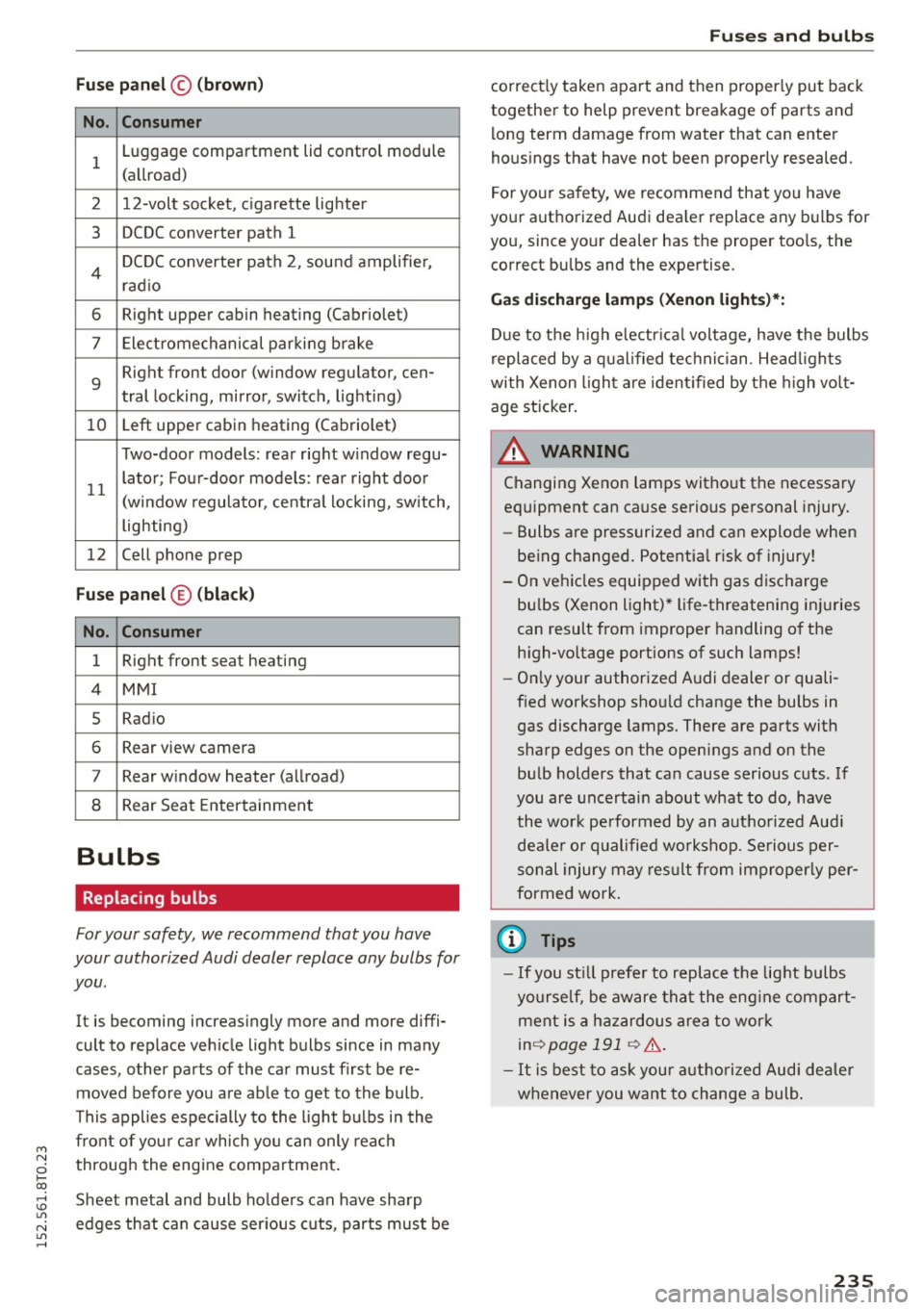
Fuse panel© (brown)
No. Consumer
1 Luggage compartment lid control module
(allroad)
2 12-volt socket, cigarette lighter
3 DCDC converter path 1
4 DCDC converter path 2, sound amplifie r,
rad io
6 Right upper cabin heating (Cabriolet)
7 Electromechanical parking brake
9
Right front door (window regulator, cen-
tral locking, mirror, switch, lighting)
10 Left upper cabin
heating (Cabriolet)
Two-door models: rear right w indow regu-
11 lator; Four-door models: rear
right door
(window regulator, central locking, switch,
lighting)
12 Cell phone prep
Fuse
panel © (black)
No. Consumer
1 Right front seat heating
4 MMI
5 Radio
6 Rear view camera
7 Rear window heater (allroad)
8 Rear
Seat Entertainment
Bulbs
Replacing bulbs
For your safety, we recommend that you have
your authorized Audi dealer replace any bulbs for
you .
It is becoming increasingly more and more diffi
cult to replace vehicle light bulbs since in many
cases , other parts of the car must first be re
moved before you are ab le to get to the bulb .
This applies especially to the light bulbs in the
front of you r ca r which you can only reach
through the engine compartment .
Sheet metal and bulb holders can have sharp
edges that can cause ser ious cuts, parts must be
Fuses and bulbs
correct ly taken apart and then properly put back
together to help prevent breakage of parts and
long term damage from water that can enter
housings that have not been properly resealed.
For your safety, we recommend that you have
your authorized Audi dea ler replace any bulbs for
you, since your dealer has the proper tools, the
correct bulbs and the expertise.
Gas discharge lamp s (Xenon lights)*:
Due to the high electr ical voltage, have the bulbs
replaced by a qualified technician . Head lights
with Xenon light are identified by the high volt
age sticker.
A WARNING
Changing Xenon lamps without the necessary
equipment can cause serious personal injury.
- Bulbs are pressurized and can explode when
being changed . Potential risk of injury!
- On vehicles equipped with gas discharge
bu lbs (Xenon light) * life -threatening injuries
can result from improper handling of the
high -vo ltage portions of such lamps!
-On ly your authorized Audi dealer or quali
fied workshop shou ld change the bulbs in
gas discharge lamps. There are parts with
sharp edges on the openings and on the
bulb holders that can cause serious cuts . If
you are uncertain about what to do, have
the wor k performed by an autho rized Audi
dealer or qualified workshop. Serious per
sonal injury may result from improperly per
formed work .
(D Tips
-If you st ill prefer to replace the light bulbs
yourself, be aware that the eng ine compart
ment is a hazardous area to work
inq page191 q&_ ,
-It is best to ask your authorized Audi dealer
whenever you want to change a bulb.
235
Page 239 of 264
M N
0 loo
rl I.O
"' N
"' rl
When jump starting or charging the battery,
never connect the negative ground cable to
the battery negat ive post because the battery
manager system must be able to detect the
battery's state of charge. Always connect the
negative g round cab le to the negative ground
post of the battery manager control unit.
Use of jumper cables
Make sure to connect the jumper cable clamps in
exactly the order described below!
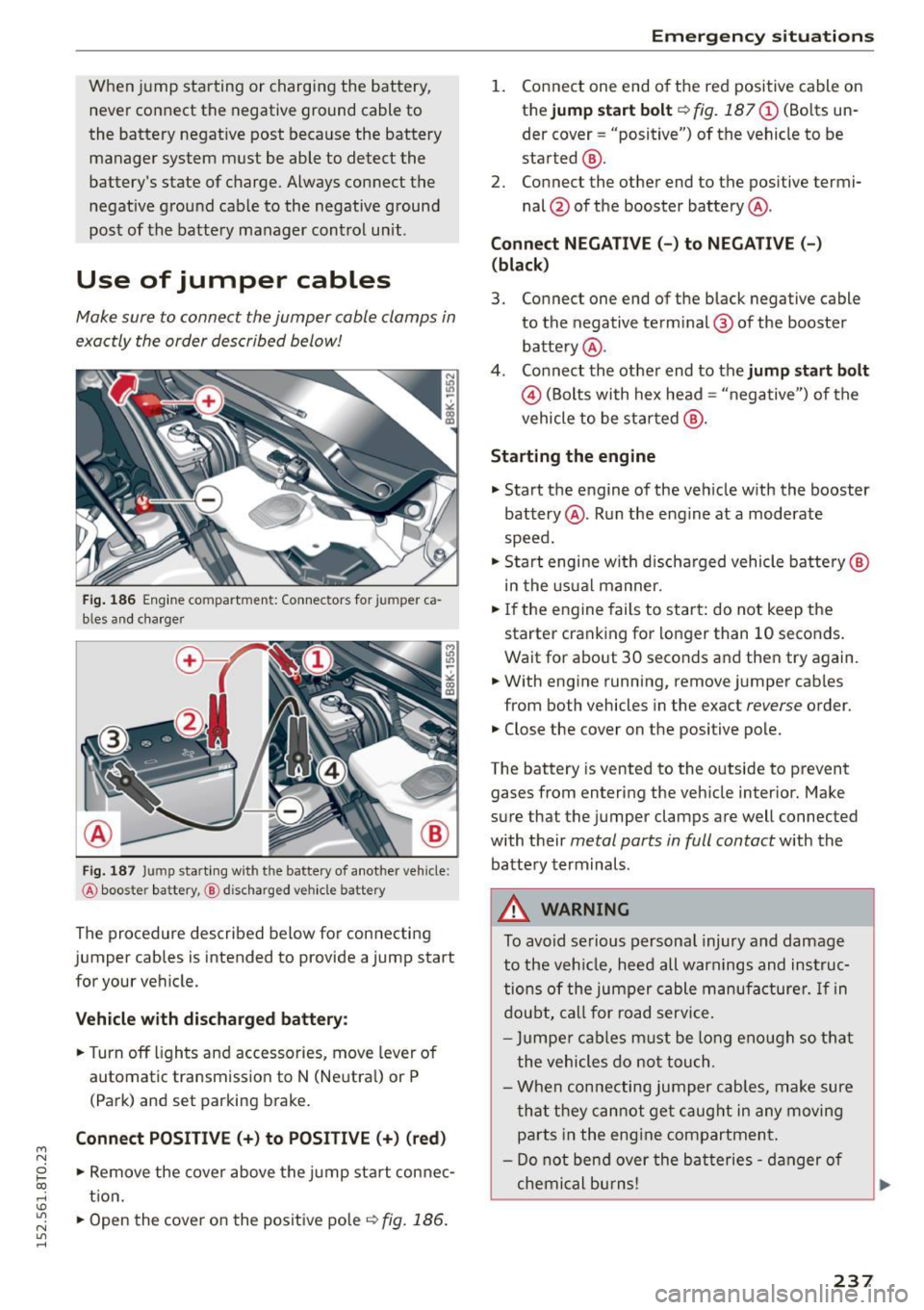
Fig. 186 Engine compa rtment: Connectors for jumper ca
b les and c harger
Fig. 187 Jum p sta rting with the battery of anot her veh icle :
@ boos te r ba ttery, @ discharged veh icle battery
The procedure described below for connecting
jumper cables is intended to provide a jump start
for your vehicle.
Vehicle with discharged battery :
.. Turn
off lights and accessories, move lever of
automatic transmission to N (Ne utra l) or P
(Park) and set parking brake.
Connect POSITIVE(+) to POSITIVE(+) (red)
.. Remove the cover above the jump start connec
t ion.
.. Open the cover on the posit ive pole ¢
fig. 186.
Emergency situations
1. Connect one end of the red positive cable on
the jump start bolt~
fig. 187 (D (Bolts un
der cover= "positive") of the vehicle to be
started @.
2. Connect the other end to the positive termi- nal@of the booster battery @.
Connect NEGATIVE (-) to NEGATIVE(-)
(black)
3. Connect one end of the black negative cable
to the negative terminal ® of the booster
battery @.
4 . Connect the other end to the jump start bolt
@ (Bolts with hex head= "negative") of the
vehicle to be started @.
Starting the engine .. Start the engine of the veh icle with the booster
battery @. Run the eng ine at a moderate
speed .
.. Start engine with discharged vehicle battery @
in the usual manner.
.. If the engine fails to start: do not keep the
starter cranking for longer than 10 seconds.
Wait for about 30 seconds and then try again .
.. With engine running, remove jumper cables
from both vehicles in the exact
reverse order .
.. Close the cover on the positive pole.
The battery is vented to the outside to prevent
gases from entering the vehicle inter ior. Make
sure that the jumper clamps are well connected
with their
metal parts in full contact with the
batte ry terminals.
A WARNING
To avoid serious personal injury and damage
to the vehicle, heed all warnings and instruc
tions of the jumper cable manufacturer. If in
doubt, call for road service.
- Jumper cables must be long enough so that
the vehicles do not touch .
- When connecting jumper cables, make sure
that they cannot get caug ht in any moving
parts in the eng ine compartment.
- Do not bend over the batteries -danger of
chemi cal burns!
237
Page 254 of 264
Index
Driving at high speeds . . . . . . . . . . . . . . . . 179
Fuel . . . . . . . . . . . . . . . . . . . . . . . . . . . . . . . 188
Leaks under your veh icle ....... .. .. ... 191
Letting the vehicle stand and warm up... 179
Proper disposal of drained brake fluid . . . 200
Proper disposal of drained engine coolant 198
Proper disposal of drained engine oil 195, 196
Recycling used engine oil . . . . . . . . . . . . . . 195
Roof rack . . . . . . . . . . . . . . . . . . . . . . . . . . . 63
Unleaded fuel . . . . . . . . . . . . . . . . . . . . . . . 186
What should I do with an old battery? . . . 203
EPC
refer to Electronic power control . . . . . . . . 20
Ethyl alcohol (Fuel) . . . . . . . . . . . . . . . . . . . . 187
Event Data Recorder (EDR) . . . . . . . . . . . . . . 169
E xpansion tank . . . . . . . . . . . . . . . . . . . . . . . 197
Exterior lighting . . . . . . . . . . . . . . . . . . . . . . . 44
Exterior mirrors
Adjusting . . . . . . . . . . . . . . . . . . . . . . . . . . . 47
D immi ng ... .. .. ................ ..... 48
Heating. ... .... ................ ..... 47
F
Fan
Radiator
Fastening 199
Booster seats . . . . . . . . . . . . . . . . . . . . . . . 159
Convertible ch ild safety seats . . . . . . . . . . 157
I nfant seats . . . . . . . . . . . . . . . . . . . . . . . . 156
flexible fuel . . . . . . . . . . . . . . . . . . . . . . . . . . 187
Floor mats . . . . . . . . . . . . . . . . . . . . . . . . . . . 117
Fog lights/rear fog light(s) . . . . . . . . . . . . . . . 44
Folding the rear seats . . . . . . . . . . . . . . . . . . . 64
Foot pedals . . . . . . . . . . . . . . . . . . . . . . . . . . 117
For the sake of the environment Environmentally-friendly driving . . . . . . . 179
Gasoline fumes and the environment . . . . 188
L ett ing the engine warm up . . . . . . . . . 72, 75
Refueling . . . . . . . . . . . . . . . . . . . . . . . . . . 188
Saving fuel by early upshifting . . . . . . . . . . 11
Fro nt airbags
Description . . . . . . . . . . . . . . . . . . . . . . . . . 133
H ow they work . . . . . . . . . . . . . . . . . . . . . . 137
Fronta l collisions and the laws of physics . . 122
Front passenger's door emergency locking . . 36
252
Front seats
Adjusting . . . . . . . . . . . . . . . . . . . . . . . . . . 114
Child restraints in the front seat . . . . . . . . 130
Fuel Additives . . . . . . . . . . . . . . . . . . . . . . . . . . . 186
B lended gasoline . . . . . . . . . . . . . . . . . . . . 186
Consumption . . . . . . . . . . . . . . . . . . . . . . . . 24
F u el gauge . . . . . . . . . . . . . . . . . . . . . . . . . . 12
Gasoline additive s . . . . . . . . . . . . . . . . . . . 188
Low fuel level symbol . . . . . . . . . . . . . . . . . 20
Octane rat ing . . . . . . . . . . . . . . . . . . . . . . . 186
Recommendation . . . . . . . . . . . . . . . . . . . . 186
Refuelling . . . . . . . . . . . . . . . . . . . . . . . . . . 188
Reserve . . . . . . . . . . . . . . . . . . . . . . . . . . . . . 12
Saving fuel . . . . . . . . . . . . . . . . . . . . . . . . . 179
Tank capac ity . . . . . . . . . . . . . . . . . . . . . . . 242
Tank system . . . . . . . . . . . . . . . . . . . . . . . . . 20
Unlock ingthefuelfi llerflapbyhand .. .. 190
Fuel economy messages (efficiency program) 28
Fuel filler flap
Unlocking the fuel filler flap by hand . . . . 190
Fuses Assignment ..... .. .. ....... 232, 233, 234
Rep lacing . . . . . . . . . . . . . . . . . . . . . . . . . . 232
G
Garage door opener (Homelink) . . . . . . . . . . 41
Garment hooks . . . . . . . . . . . . . . . . . . . . . . . . 61
Gas discharge lamps . . . . . . . . . . . . . . . . . . . 235
Gauges Engine coolant temperature . . . . . . . . . . . . 10
Fuel gauge . . . . . . . . . . . . . . . . . . . . . . . . . . 12
Tachometer . . . . . . . . . . . . . . . . . . . . . . . . . 11
Gear recommendation . . . . . . . . . . . . . . . . . . 27
Gearshift indicator . . . . . . . . . . . . . . . . . . . . . 26
Gearshift leve r
6-speed manual transmission . . . . . . . . . . . 82
General illustration
Instruments and controls . . . . . . . . . . . . . . . 8
Generator Warning/indicator lights . . . . . . . . . . . . . . . 16
Glossary of tire and loading terminology . . 207
G love compartment . . . . . . . . . . . . . . . . . . . . 61
Valet parking . . . . . . . . . . . . . . . . . . . . . . . . 40
GPS controlled clock . . . . . . . . . . . . . . . . . . . . 12
Gross Vehicle Weight Rating (GVWR) . . . . . 241