heating AUDI A5 CABRIOLET 2010 User Guide
[x] Cancel search | Manufacturer: AUDI, Model Year: 2010, Model line: A5 CABRIOLET, Model: AUDI A5 CABRIOLET 2010Pages: 364, PDF Size: 86.51 MB
Page 105 of 364

_________________________________________________ W_ a_ r_m _ a_ n_d_ c_ o_ ld _ ___.lfll
Seat heating
Ap plies to vehicles: w it h fr ont se at heat in g
Front seat heating ~
The seat cushion and the seat back of the front seats can
be heated electrically.
- Press the (g button.
s ci: ., m
Fig. 104 Sea t heati ng
button and r egul ator
- Rotate the regulator to the des ired setting .
In position 0, seat heating is turned off . The contro l range is from 1
t o 6.
The seat heating only works when the seat detects body weight on it .
Do no t swi tc h s eat he ating on when the re is no one in the front se ats.
0 Note
To avoid damage to t he heat ing e lements in the seats, do not kneel
on t he seats o r place heavy loads on a small area of the seat .
[I) Tips
Remember that objects placed on the seats may be detected . The
we ight of the objects may be enough to switch the seat heating on •
Contro ls a nd e quip
m en t Vehicle
OP-eration
Applies to ve hicles : w ith rea r sea t heat ing
Seat heating for the rear seats
T he seat cushion and the seat back of the two outer rear
seats c an be heated electrically.
- Turn the left thumbwheel (on t he center conso le) to
switch o n and reg ulate seating heat ing fo r the left rear
seat.
Turn t he right t humbwhee l (on the center co nsole) to
switch on and regulate seat ing heating for the r ight rear
seat.
If the thumbwhee l is i n position 0, seat heating is switched off . The
control range is from 1 to 6.
Rear sea t heating only funct ions when the seats are loaded with body
we igh t. If a pe rson is no t sitting on t he rear sea ts, sea t heat ing
should be sw itched off to preve nt unintentional heating of the seat
surfaces.
0 Note
T o avoid damage to the heatin g elements in the seats, do not kneel
on the sea ts or p lace heavy loads on a small area of the seat .•
Vehicle care Do-it-yourselt service iTechnical data
Page 106 of 364
ffl Warm and cold .._ ____ .....;_____,;,;_ _______________________________ _
Applie s to veh icles : wi th upp er cabi n heat in g
Upper cabin heating
The upper cabin area of the front seats can be heated at
three levels when the engine is running .
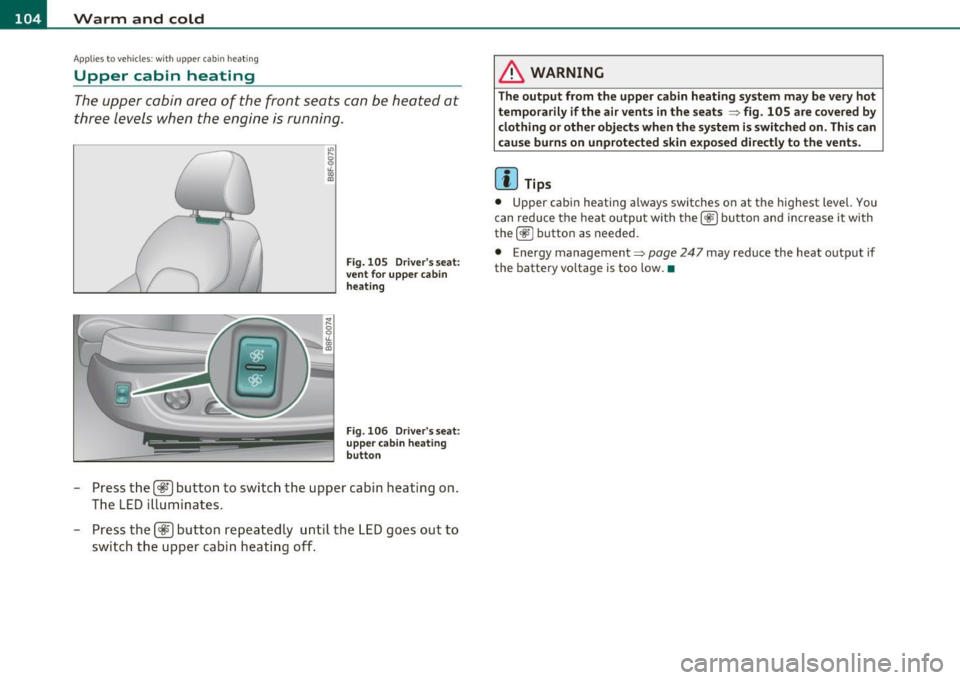
Fig. 105 Driver's seat:
vent for upper cabin
heating
Fig . 106 Driver's seat:
upper cabin heating
button
- Press the [~l button to switch the upper cabin heating on.
The LED illuminates.
- Press the
[
& WARNING
The output from the upper cabin heating system may be very hot
temporarily if the air vents in the seats
~ fig. 105 are covered by
clothing or other objects when the system is switched on. This can
cause burns on unprotected skin exposed directly to the vents.
[ i ] Tips
• Upper cabin heating a lways switches on at the highest level. You
can reduce the heat output with the
[cg;) button and increase it with
the[~] button as needed.
• Energy management ~
page 247 may reduce the heat output if
the battery voltage is too low.•
Page 244 of 364

Intelligent t echnology
---------------------------------------
Electronic differential lock (EDL)
The elec tronic differen tial lock monitors the rotational
speed of the drive wheels.
G en era l not es
The electronic differentia l lock (EDL) helps the ca r to sta rt moving,
accelerate and climb a gradient on surfaces provid ing poor or almost
no grip . W ithout ED L, this would be d iff icu lt, if not impossible.
How the sy stem works
The EDL operates automatically. It mo nitors the rota tional speed of
wheels with the help of the ABS sensors=>
page 245. If a not iceab le
slip is detected at the wheels (e.g. on slippery g round on one side),
the spinn ing wheels are braked and power is transferred to the other
wheels . This is done up to a speed of about 60 mph (100 km/h).
No ises from the brake system signal that wheel sp in is being
controlled.
Driv ing off
When d riving off, always be s ure to keep road conditions in mind as
you accelerate. If one drive wheel spins because it is on a surface with
less grip, apply
plenty of throttle until the car starts to move.
O verheating of bra kes
To prevent the disc b rake of the bra ked wheel from ove rhea ting if
subjected to excessive loads on this wheel, the EDL cuts out tempo
ra rily. The vehicle remains operat io nal and be haves in the same way
as a veh icle without EDL.
As soon as the brake has coo led down, EDL switches on again auto
matically.
Electronic limited slip differential
In vehicles w ith front wheel drive *, an e lectron ic lim ited slip d ifferen
tial engages when driving on curves . The brakes are applied spec ifi
cally to the front wheel that is on the inside of the curve. T his m ini
m izes sliding on the front wheels and enables precise and neutral dr
iv ing t hrouge curves. The electronic lim ited slip differentia l does
no t engage whe n driving in we t cond it io ns or snow.
& WARNING
• Wh en acc elerating on slipp ery s urface s, such a s on ice or snow,
always be careful when depre ssing the accele rator pedal. Even
with the EDL and the electroni c limited slip differential working,
the dr ive wh eels can spin and reduce you r ability to control your
c ar . -Ri sk of cra sh!
• The increased safet y afforded b y EDL and the electronic l imited
slip differ ential d oes not mean th at you can take safety risks .
Alw ay s adapt your d riving st yle to the road c onditions and traffi c
si tuation.
[ i ] Tips
If a fa ult occurs in the ABS, the EDL is also not funct ioning. This is
ind icated by the ABS warn ing light=>
page 16 . •
Anti-Slip Regulation System (ASR)
The Anti-Slip Regulation System prevents the driven
wheels from spinning when the car is a ccelerating.
General notes
T he Anti-Slip Regu lation System (ASR) is in tegrated in the electronic
stabilization program (ESP) . When the veh icle starts up and acceler
a tes, the wheels are preven ted from sp inning by adjust ing the engine
power to match the amount of grip ava ilable from the road surface.
How the system works
ASR performs automatica lly, i.e. without the driver's intervent ion.
With the a id o f the ABS sensors=>
page 245, ASR moni tors the speed
of the driven wheels. If the wheels start to spin, engine torque is
reduced automatically unti l the tires find enough grip to lock onto
the road s urface. The system is active across the entire speed range . .,
Page 250 of 364

Intelligent technology
'-------------------------------------------------
vi dual components. It regulates consumption, so that more electrical
energy is not being used than is being generated and ensures an
optimal state of charge for the battery .
[I] Tips
• But even energy management cannot negate the limits of physics.
Consider that the power and life of a battery are limited.
• If starting ability is threatened, you are informed by a warning
~ page 249, "Driver notification in the instrument cluster display" .•
What you should know
The highest priority is given to maintaining starting capa
bility.
Th e battery is severe ly taxed in short-distance driving, in city traffic
and during the cold time of year. Abundant electrical energy is
required, but only a little is generated.
It is also critical if the engine
is not running and electrical components are turned on. In this
instance energy is being consumed but none is being generated.
It is in prec ise ly these sit uations that you will notice energy manage
ment actively regulating the distribution of energy.
Vehicle stands for an extended period
If you do not drive your vehicle over a period of several days or weeks,
electrical components are gradually cut back or sw itched off. This
reduces energy consumption and maintains starting capability over a
longer period.
Take into consideration that when you unlock your vehicle, some
convenience functions, such as the remo te key or power seat adjust
ment, may not be available. The convenience functions will be avail
able again when you turn on the ignition and start the engine.
W ith the engine turned off
If you listen to the radio, for example, with the engine turned off or
use other MMI functions, the battery is being discharged .
If starting capability is jeopardized due to energy consumption, the
following warning appears in the MMI display:
Please start engine, otherwise system will switch off in
3 minutes.
Th e warn ing indicates that the system will be turned off automati
cally after 3 m inutes. If you wish to continue using the functions, you
have to start the engine.
With the engine running
Although electrica l energy is generated when the vehicle is being
driven, the battery can become discharged. This happens most ly
when little energy is being generated and a great deal consumed and
the battery's state of charge is not optimal.
T o br ing the ene rgy balance back into equilibrium, consumers which
require especially large amounts of energy are temporarily cut back
or switched off. Heating systems in particular require a great deal of
energy .
If you notice, for example, that the heated seats* or the
heated rear window are not heating, they have been temporarily cut
back or switched off. These systems will be ava ilable again as soon as
the energy ba lance has been restored.
You will also notice that engine idle speed has been increased
slightly. This is normal and not a cause for concern. By increasing
eng ine id le speed the additional energy required is generated and the
battery is charged. •
Page 288 of 364

___ C_ h_ e_c _k _i _ n _g ~ a_n _d_ f_il _l_in _ g _________________________________________ _
Det ergent add it ives in the o il w ill make fres h oil look dark a fter the
e n g in e has bee n ru nning for a s hort time. This is n orma l and is not a
reason to cha nge the oil mo re often t ha n recomme nded .
Beca use of the prob lem of proper disposal, a long w it h the s pec ia l
t o ols and n ecessa ry e xper tise req uire d, we stro ng ly recom men d th at
you have your o il changed by an a utho rize d
Audi dealer or a qualified
s erv ice stat ion.
If you choose to change your oil yourself , please note the following
im portant info rmat io n:
& WARNING
To reduce the risk of personal injury if you must change the engine
oil in your vehicle yourself:
• Wear eye protection .
• To reduce the risk of burns from hot engine oil, let the engine
cool down to the touch .
• When removing the oil drain plug with your fingers , stay as far
away as possible. Always keep your forearm parallel to the ground
to help prevent hot oil from running down your arm.
• Drain the oil into a container designed for this purpose, one
large enough to hold at least the total amount of oil in your
engine .
• Engine oil is poisonous . Keep it well out of the reach of chil
dren.
• Continuous contact with used engine oil is harmful to your
skin. Always protect your skin by washing oil off thoroughly with
soap and water .
0 Note
Never m ix o il additives w ith your eng ine o il. The se a ddi tives c an
damage your engine and adverse ly affect your Audi Limi ted New
V ehicle Warranty .
W For the sake of the environment
• Before changi ng yo ur oil, fir st ma ke s ure you know w here you c an
pro perly dis pose of the used oi l.
• Always dispose of used eng ine o il prope rly . Do no t dump it on
garden soi l, wooded areas, into ope n streams o r down sewa ge dr ains.
• Recycle used engin e oil by taking it to a used eng ine oi l collect ion
facility in your area, or contact a serv ice station .•
Engine cooling system
Coolant
The engin e coolan t p erforms two fun ctions: it ke ep s t he
en gine from overheati ng and i t protects the engine fr om
fr eez in g in th e winte r.
Th e cooling system is sea le d and genera lly requ ires lit tle at tention.
Th e cooling system has been f illed at th e factory w it h a p erm anent
coo lant which does not need to be changed. T he coolant cons ists o f a
mix tur e of wa ter a nd the manufacturer's gly co l-basedcoolan t addi
tive
Gl2+ + antifreeze with anticorros ion addit ives (50% for USA
m odels; 60 % fo r C an ad ian models). This mixture both as su re s th e
necessary frost protect ion and protects meta l components in the
eng ine's coolin g sy stem fr om co rrosion and scaling .
It als o ra ises the
boiling point of th e coolant.
Do not re duce the concentration of the coo lant in the summer by
add ing p la in wate r.
The proportion of coolant additive must be at
least 50 % but not more than 60%
to mai ntain antifreeze protection
an d co olin g efficiency . If the co ola nt frost p ro te ct ion i s to o low , the
coo lant co uld freeze and damage the veh icle heating and engine
cooling system.
For year -round drivi ng, antifreeze is added at t he factory for tempe r-
atures down to: .,,
Page 290 of 364

-~_C_ h_e _c_ k_ i_ n ....: g:::e._ a_ n _ d_ f_il _l _in _ g =- --------------------------------------------
The expansion tank in your vehicle is equipped with an electric coolant
level sensor.
When the coolant level is too low, the warn ing light in the Auto-Check
System ~
page 29 will blink until you add coolant and the level has
been restored to normal. Even though there is an electric coolant
level sensor, we still recommend you check the coolant level from
time to time.
Coolant loss
Coolant loss may indicate a leak in the cooling system. In the event of
coo lant loss, the cooling system should be inspected immed iate ly by
your authorized Audi dealer .
It is not enough merely to add coolant.
In a
sealed system, losses can occur only if the boiling point of the
coolant is exceeded as a result of overheating.
& WARNING
The cooling system is under pressure and can get very hot. Reduce
the risk of scalding from hot coolant by following these steps.
• Turn off the engine and allow it to cool down.
• Protect your face, hands and arms from escaping fluid and
steam by covering the cap with a large, thick rag.
• Turn the cap slowly and very carefully in a counter-clockwise
direction while applying light, downward pressure on the top of
the cap.
• To avoid being burned, do not spill antifreeze or coolant on the
exhaust system or hot engine parts. Under certain conditions, the
ethylene glycol in engine coolant can catch fire.
0 Note
Do not add any type of radiator leak sealant to your vehicle's engine
coo lant. Adding radiator repair fluid may adverse ly affect the func
tion and performance of your cooling system and could result in
damage not covered by your New Vehicle Limited Warranty.•
Adding coolant
Be very careful when adding engine coolant.
Before you check anything in the engine compartment,
always read and heed all WARNINGS::::::> & in "Working in
the engine compartment" on
page 280.
-Turn off the engine .
- Let the engine cool down.
- Place a thick rag over the coolant expansion tank
=> page 287, fig. 223 and carefully turn the cap counter
clockwise ::::,
&.
- Add coolant .
- Twist the cap on again
tightly.
Replacement engine coolant must conform to exact specifications
~ page 286, "Coolant". Even in an emergency, if coolant additive
G12 ++, G12+ or G12 is not available, do not use a different additive.
Use plain water instead until you can get the correct additive and can
restore the correct ratio. This should be done as soon as possible .
If you have lost a considerable amount of coolant, then you should
add cold antifreeze and cold water only when the engine is cold.
Always use
new engine coolant when refilling.
Do not fill coolant above the ''MAX" mark. Excess coolant will be
forced out through the press ure re lief va lve in the cap when the
eng ine becomes hot .
& WARNING
• The cooling system is under pressure and can get very hot.
Reduce the risk of scalding from hot coolant by following these
steps.
-Turn off the engine and allow it to cool down. _.,
Page 330 of 364

-Fuses and bulbs ..._ __________________________________________ _
Fuse Location, Instrument Panel left
Fig. 2 45 F use panel
lay out
Some o f the eq uipmen t items lis ted are op tiona l o r only a vailable on
certain mode l configurations .
Note that the following table is a ccurate at the time of going t o
press and is subject to change. In the event of discrepanc ies , the
label on the inside of the cover always take s pr eceden ce.
The powe r seats are pro te cted by circuit brea kers , which automa ti
cally reset after a few seconds a fter the ov erload has been remed ied.
No. Consumer
Fuse panel (black)
1 Dynamic steering
2 Not used
3 Homelink
4 Lane Assist
5 Climate control
6 R ight head light range adjustment
7 Left headlight range adjustment
8 Vehicl e elect ric al sys tem co ntrol mo dule 1
9 Adaptive Cruise Control 5
5
10
5
5
5
5
5
No . Consumer Amps
10 Shift gate 5
1 1 Heate r washer fluid no zzles 5
1 2 Climate con trol
5
13 Cell phone prep 5
14 Airbag 5
15 Terminal 15 25
16 Terminal 15 engine
40
Fuse panel (brown)
1 Automatic dimm ing in terior rearv iew mir ror
5
2 Not used
3 Gaso line fuel pump 25
4 Auxiliary water pump 3.2L FSI 5
5 Left seat heati
ng with/witho ut seat heating
15/30
6 Electronic Stabiliza tion Program 10
7 Horn 25
8 Left door window regulator motor
30
9 Wiper motor 30
10 Electronic Stabilization Program 25
11 Driver side doo
r co ntro l modu le
15
12 Rain and light sensor 5
Fuse panel (red)
1 Not used
2 N ot u sed
3 Lumbar support
10
4 Dynamic steering
35
Page 332 of 364
.,.,___F_ u_ s_e _ s_ a_n_d _b_u _ l_ b_s _______________________________________________ _
No. Consumer Amps
10 Climate control 10
11 Terminal 30 diagnostic connector 10
12 Steering column switch module 5
Fuse Location, Luggage Compartment
right
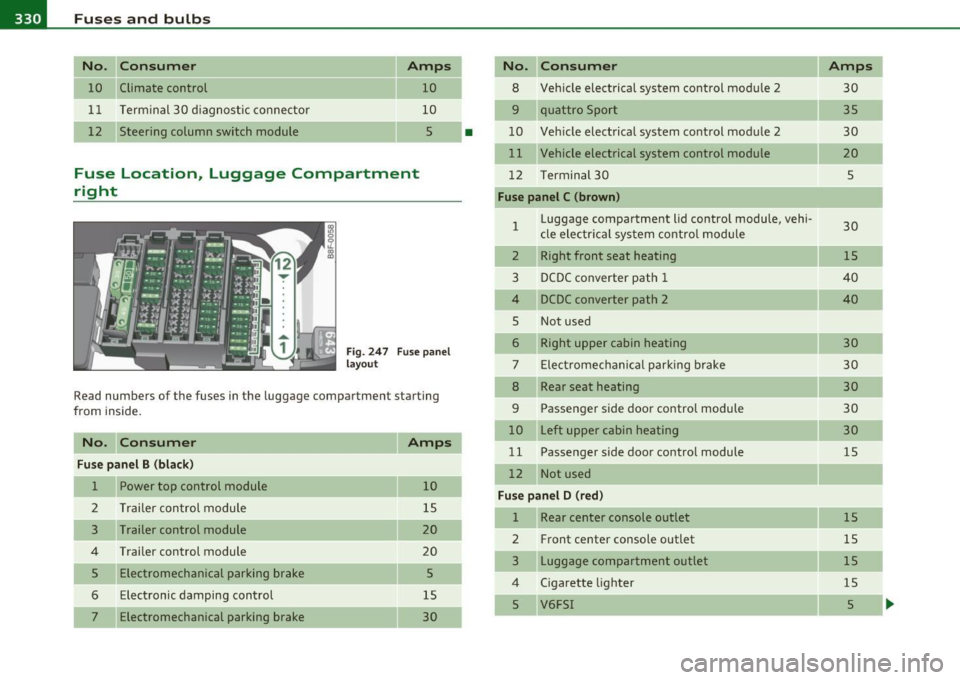
Fig. 247 Fuse panel
layout
Read numbers of the fuses in the luggage compartment starting
from inside.
No. Consumer
Fuse panel B (black)
1 Power top control module
2 Trailer control module
3 Trailer control module
4 Trailer control module
5 Electromechanical parking brake
6 Electronic damping control
7 Electromechanical parking brake
Amps
10
15
20
20 5
15
30
•
No. Consumer
8 Vehicle electrical system control module 2
9 quattro Sport
10 Vehicle electrical system control module 2
11 Vehicle electrical system control module
12 Terminal 30
Fuse panel C (brown)
1
2
3
4
Luggage compartment lid control module, vehi
cle electrical system control module
Right front seat heating
DCDC converter path 1
DCDC converter path 2
5 Not used
6 Right upper cabin heating
7 Electromechanical parking brake
8 Rear seat heating
9 Passenger side door control module
10 Left upper cabin heating
11 Passenger side door control module
12 Not used
Fuse panel D (red)
1 Rear center console outlet
2 Front center console outlet
3 Luggage compartment outlet
4 Cigarette lighter
5 V6FSI
Amps
30
35
30
20 5
30 15
40
40
30
30
30
30
30 15
15
15
15
15 5
Page 333 of 364

Fuses and bulbs -________________ Ef"I
No. Consumer
6 Rear Seat Entertainment supply
7 Parking system
8 Not used Electromechanical park ing brake switch
1 0 Aud i side assist
11 Rear sea t heating
12 Terminal 15 control modules
Fuse panel E (black)
1 Not used
2 Not used
3 DSP amplifier, radio
4 M MI
5 Radio/navigation/cell phone prep
6 Rearview c
amer a
7 No t used
8 Not used
9 Not use d
10 Not used
11 N
ot used
1 2 N ot used
Safety first
Amps
5
7,5
5
5
5
5
20/ 30
7,5
7,5
5
•
Bulbs
Replacing bulbs
F or your safety, we recommend that you have your autho
ri zed Audi dealer replace any bulbs for you.
It is becoming increasingly more and more diff icult to rep lace vehicle
ligh t bulbs since in many cases, other parts o f the car must fi rst be
removed before yo u are able to get to the bulb . This applies especially
to the light bu lbs in the front of your car which you can on ly reach
throug h the engi ne compartment .
Sheet meta l and bu lb holders can have sharp edges that can ca use
ser ious cuts, parts must be co rrectly t aken ap art and the n properly
put back together to he lp prevent breakage of parts and long term
d am age fro m water t hat c an enter housings that have no t been p rop
erly resea led.
For your safety, we recommend that you have you r authorized Audi
dealer replace any bulbs fo r you, since yo ur dealer has t he p roper
too ls, the correct bu lbs and the expertise.
Gas discharge lamp s (Xenon light s)* :
Due to the high electr ica l voltage , have the bulbs replaced by a qual
ified technicia n. Hea dlights w ith Xenon light are ident ified by the
high voltage sticker .
& WARNING
Changing Xenon lamps w ithout the necessary equipment can
cause serious personal injury.
• Bulbs are pressur ized and can explode when being changed.
Potential risk of injury !
• On vehicles equipped with gas discharge bulbs (Xenon light )*
lif e-threatening injurie s can re sult from improper handling of the
high- voltage port ions of such lamps ! .,_
Vehicle care Do-it-yourself service Technical data
Page 353 of 364

Alphabetical index -________________ f!:VII
Electronic immobilizer ..... .. .. .. . 346
Homel ink® un iversal remote control . 346
Remote control key .......... ..... 346
Tire pressure monitoring system . .. . 346
Defective light bulb warning ... ... . .. .. 34
Defrost ing the windows . . . . . . . . . . . 92, 99
Deluxe automatic climate control ....... 88
A/C mode ............. ... ........ 93
Air distribution .. .. .. .......... ... 92
Air vents .. .. ... .......... .... .. .. 93
Automatic mode .... .. .. .. .. .... .. 90
Controls .. .. ................. .. .. 89
Defrost ...... ...... .. .. .. .. .... .. 92
Description ........ ....... .. .. .. .. 88
Economical use ................... 94
Fan . ... .................... ..... 91
Rear window defogger ......... .. .. 92
Recirculation mode ................ 91
Temperature ..................... 91
Turning on and off ............ .... . 90
Deluxe automatic climate control plus ... 95
A/C mode ......... ..... .... .... . 100
Air distribution . ... ............... 99
Air vents .. ............. .. .... .. . 101
Air vents (rear) . ............... .. . 101
Automatic mode .... .. .. .. .. .... .. 97
Automatic recirculation ........... . 102
Basic settings ............... ..... 102
Controls .. .. .. .. .. ...... .. .. ... .. 96
Defrost .......................... 99
Description ....................... 95
Economical use .................. 102
Fan .. .. .................... ..... 98
Front seat heating ............ .... 103
Controls and equip
ment Safety first
Rear window defogger
... .. .. .. .. . 100
Recirculation mode ............... . 99
Synchronization ..... .. .. ......... 102
Temperature ..................... 98
Turning on and off . .... ........... . 97
Determining correct load limit ... .. .. .. 305
Digital clock ..... ............. .. .. .. . 10
Digital compass ............... ... ... 75
Digital speedometer ... ............... 20
Dimensions ... .. ................... 341
Doors Emergency locking .............. .. 46
Driver informat ion system .......... ... 18
Defective light bulb warning ......... 34
Digital speedometer ....... ... .. .. . 20
Driver information messages ........ 26
Open door or rear lid warn ing ........ 20
Outside temperature display ........ 19
Sound system display .............. 19
Driver seat
See Seating position .............. 178
Drive r's seat memory
Act ivat ing remote control key .... .. . 81
Driving lights ........................ 62
Driving messages ........... .. ... .... 26
Dr iving safely . .. .... .... .. ... ...... 176
Driving through water ... .. . ... .. .. . . 251
Dr iving time .. .. .... ............. ... 22
Duplicate key ........................ 3 7
Dust filter . . . . . . . . . . . . . . . . . . . . . . 88, 95
Dynamic shift program .. ............. 159
Dynamic stee ring . . . . . . . . . . . . . . . . 13, 32
E
Easy entry function .......... ......... 79
Electrica l seat adjustment
See Seat adjustment .. ..... .. .. .. .. 78
Electromechanical parking brake
Emergency braking ............ .. . 112
Ma lfunction ..................... 112
Operation ....................... 110
Parking ............ .. .. .. .... ... 111
Releasing and closing ............. 110
Starting assist ...... ... ... .... ... 111
Starting from rest ... .. .... .. . ... . 111
Starting off with a trailer ....... .. . 112
Warning/indicator lights ... .. .. .. .. 16
Electronic differential lock (EDL) How the system works ........... . 242
Warning/indicator lights . .. .. .. .. .. 16
Electronic immobilizer . . . . . . . . . . . . 11, 40
Electron ic power control
(EPC) warning/indicator light ........ 13
Electronic stabilization program (ESP)
How the system works ............ 240
Warning/indica tor lights ... .... .. .. 14
Emergency braking . ... .............. 112
Emergency flasher .......... ......... 66
Warning/indicator lights .... ...... . 15
Emergency key ... .. .. ............... 3 7
Starting engine ................... 40
Emergency locking of the doors .. .. ..... 46
Emergency operation
Luggage compartment lid ....... ... 47
Power top .... .................... 56
Vehicle operation Vehicle care Do-it-yourself service Technical data