battery AUDI A5 CABRIOLET 2010 Owner's Manual
[x] Cancel search | Manufacturer: AUDI, Model Year: 2010, Model line: A5 CABRIOLET, Model: AUDI A5 CABRIOLET 2010Pages: 364, PDF Size: 86.51 MB
Page 251 of 364

Intelligent technology
--------------------------------------------------' '----'----
Driver notification in the instrument
cluster display
If battery power drops into the range where it can limit the ability of
the engine to start, this is shown in the instrument cluster display
with the following driver message:
Lo w b attery charge : batt ery will be charged while driving
Th is notification rem inds you that the starting capability of the
engine may be limited . As soon as you start driving again, the batte ry
w ill be recharged and the notification w ill go out.
Dri ver notification appears and goes out again
If th is dr iver notification appears after the ignition is turned o n or
while driving a nd it goes out again afte r a w hile, the battery has been
adequate ly recharged.
Driver no tification appears and does not go out
again
If th is dr iver notifica tion appears afte r the ignition is turned o n or
while driving and does not go out again, the battery 's state of charge
is not in the optimal range . Starting ability is restricted. Have the
battery checked as soon as poss ible by an au thor ized Aud i dea le r o r
qualified workshop. •
Controls and equip ment Safety first Vehicle operation
Vehicle care Do-it-yourself service Technical data
Page 282 of 364
-Checking and filling
-------=------=---------------------------------------------------
Closing the engine hood
-Pull the hood down until the pressure from the struts is
reduced.
- Let the hood
drop down and latch in place . Do not try to
push it shut;
it may fail to engage=> &.
& WARNING
A hood that is not completely latched could fly up and block your
view while driving.
• When you close the engine hood, check it to make sure the
safety catch has properly engaged. The hood should be flush with
the surrounding vehicle body parts.
• If you notice while driving that the hood is not secured prop
erly, stop at once and close it. •
Working in the engine compartment
Be especially careful whenever you work in the engine
compartment.
Whenever you must perform any work in the engine compartment,
for example checking and filling different fluids, there is a risk of
injury, burns and accidents. To prevent personal injury always
observe the following WARNINGS. The engine compartment of any
vehicle is a hazardous area
=> & .
& WARNING
To help avoid injury, before you check anything under the hood :
• Turn off the engine.
• Remove the ignition key.
• Apply the parking brake.
& WARNING (continued)
• Move selector lever of automatic transmission to "P" (Park).
• Always let the engine cool down. Hot components will burn
skin on contact.
• To reduce the risk of being burned, never open the hood if you
see or hear steam or coolant escaping from the engine compart
ment. Wait until no steam or coolant can be seen or heard before
carefully opening the hood.
• Keep children away from the engine compartment.
• Never spill fluids on hot engine components. They can cause a
fire.
• Never touch the radiator fan. The auxiliary electric fan is
temperature controlled and can switch on suddenly.
• Never open the coolant reservoir cap when the engine is still
warm. The coolant system is pressurized and hot coolant could
spray out.
• Protect your face, hands and arm from steam or hot engine
coolant by placing a thick rag over the cap when you open the
coolant reservoir.
• If work on the fuel system or the electrical system is necessary:
-Always disconnect the battery.
- Never smoke or work near heaters or open flames. Fluids in
the engine compartment could start a fire.
- Keep an approved fire extinguisher immediately available.
• To avoid electrical shock and personal injury while the engine is
running or being started, never touch: -Ignition cables
- Other components of the high voltage electronic ignition system.
• If you must perform a check or repair with the engine running: -First, fully apply the parking brake, move selector lever of
automatic transmission to "P" (Park). ..,
Page 283 of 364
_____________________________________________ C_h _ e_ c_ k_in --= g'-- a_n _d_ f_i _ll _i_n -=g ::;__ ____.1111
& WARNING (co ntinued )
-Alway s use extreme caution to prevent clothing , jewelry , or
long hair from getting caught in the radiator fan, V-belts or
other moving parts, or from contacting hot parts. Tie back hair
before start ing , and do not wear clothing that will hang or
d roop into the engine.
• Minimize expo sure to emis sion and chemical hazards~& .
& WARNING
California Proposition 65 Warning:
• Engine exhaust, some of it s constituents, and certain vehicle
components contain or emit chemicals known to the State of Cali
fornia to cause can cer and birth defects and reproductive harm . In
addition, certain fluids contained in vehicles and ce rtain products
of component wear contain or emit chemicals known to the State
of California to cause cancer and birth defects or othe r reproduc
tive harm.
• Battery posts, terminals and related accessories contain lead
and lead compounds, chemicals known to the State of California
to cause cancer and reproductive harms . Wash hands after
handling.
0 Note
When adding fluids , a lways make sure that they are poured into the
proper co nta iner o r filler opening, otherwise serio us damage to
vehicle systems will occur.
<£> For the sake of the environment
To detect leaks in time, inspect the vehicle floor pan from underneath
reg ula rly . If yo u see spot s from o il or o ther vehicle fluid s, have your
vehicle inspected by an authorized Aud i dea ler. •
Vehicle OP-eration
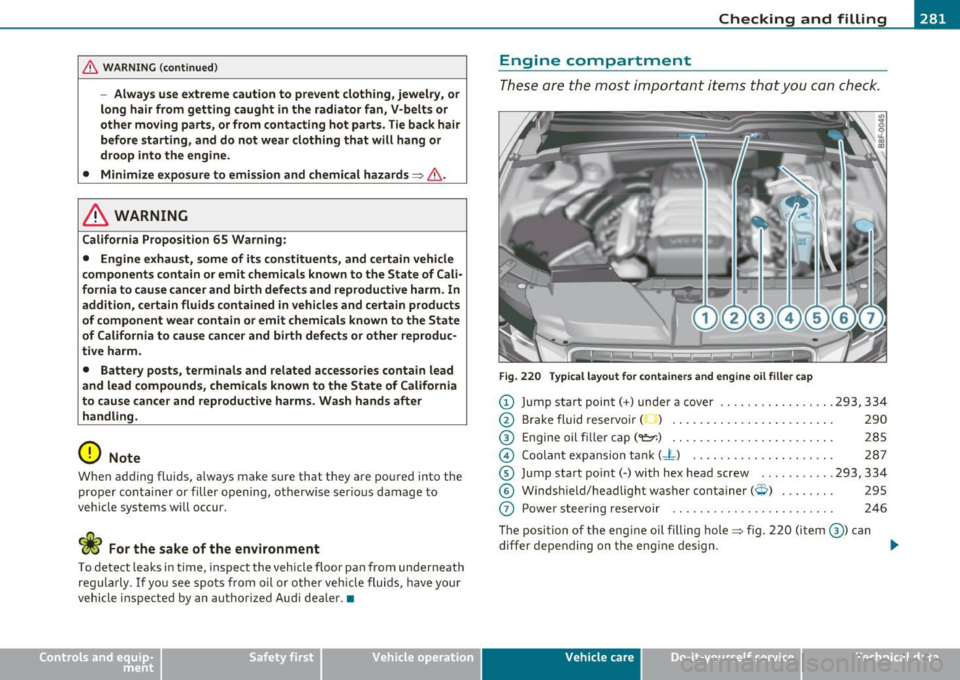
Engine compartment
These are the most i mportan t it ems that you can check.
Fig . 220 Typ ical layout for c ontainer s and engine oil filler cap
(D Jump start point( +) under a cover ........ .. .. .. .. . 293, 334
@ Brake fluid reservo ir ( ) . . . . . . . . . . . . . . . . . . . . . . . . 290
@ Engine oil f iller c ap
('1::r. ) . . . . . . . . . . . . . . . . . . . . . . . . 285
© Coolant ex pansion ta nk (-L ) . . . . . . . . . . . . . . . . . . . . . 28 7
© Jump start point( -) w ith he x head screw ..... ... .. . 293 , 33 4
© Winds hield/head light washer container (0 ) . . . . . . . . 295
(j) Power steering reservoir . . . . . . . . . . . . . . . . . . . . . . . . 246
Th e posi tion of the eng ine o il filling hole ~ fig. 220 (i tem @) can
differ depending on the eng ine des ign . ..,.
Vehicle care Do-it-yourselt service iTechnical data
Page 293 of 364

_____________________________________________ C_h_ e_ c_k _in --= g'-- a_n _ d_ f_ i_ll _i_n __ g ____ _
& WARNING (co ntinued )
-The brake fluid mu st be new. Heavy use of the brake s can
cause a vapor lock if the brake fluid i s left in the sy stem too
long. This can seriously affect the efficiency of the brakes as
well as your safety . This could result in an accident.
0 Note
B rake fluid will damage the pain t of your ve hicle.
c£> For the sake of the environment
Because of the p rob lem of proper d isposal of b rake fl uid as we ll as
the spec ia l too ls requ ired and the necessary expert ise , we recom
mend th at yo u have the brake fl uid ch anged by your authori ze d Audi
dealer. •
Battery
General information
Under normal operating cond itions, t he battery in your Audi does not
need any maintenance. W ith
high o uts ide temperatures or long daily
dr ives we recomme nd that yo u have the electro lyte level ch ecked by
an a utho rized Audi dealer o r q ua lified workshop. The e lectrolyte leve l
sho uld also be che cked ea ch t ime the battery i s ch arge d=>
page 293 .
Have t he battery checked when yo u take you r vehicle in for serv ice .
You a re well a dvised to rep lace a batte ry that is o lde r than 5 years.
With certa in ty pes of a irbag deployment, the ba tte ry is disconnected
from the vehicle e lectr ica l system for safety reasons=>
& in "Repair,
c are and disposal of the air bags " on
page 214.
Safety first
Disconnecting the battery terminals
Some vehicle f unctions ( power w indow reg ulators, for examp le) are
lost if the batte ry termina ls a re disconnected . These funct ions have
to be re learned after the battery terminals are connected again . To
prevent this, the battery should only be disconnected from the
vehicle electr ica l system when absolute ly necessary for repairs.
Vehicles not driven for long periods
If yo u do not drive your ve hicle over a period of severa l days o r wee ks,
elect rical compo nents are g radually cut bac k or swi tched off. This
re du ces ene rgy consumption and maintains start ing capability over a
longer period=>
page 2 47.
Take into consideration that when you unlock your vehicle, some
c onvenie nce func tions, such as the master key remote func tion o r
power seat adjustme nt, may not be avai lable. The convenience func
tions will be available again w he n you t urn on the ign it ion and sta rt
the engine .
Winter operation
During the winter months , battery capacity tends to decrease as
t empe ra tu res drop . This is beca use more power is a lso cons umed
wh ile starting, and the headlights, rear w indow defogger , etc ., are
used more o ften .
Avoid unne cessa ry powe r consum ption, part icu larly in city traffic o r
when traveling only short distances. Let your authori zed Audi dealer
che ck t he capa city of the vehicle b atte ry befo re w inte r sets in
=>
page 293 . A well charged battery will not only prevent start ing
pro blems when t he we ather is co ld, bu t w ill also last l onge r.
[ i ] Tips
If yo ur vehicl e is lef t standi ng fo r seve ral weeks at extremely low
temperatures, the veh icle battery should be removed and stored
whe re it will no t free ze . This will preven t it from being dam aged and
having to be replaced .•
Vehicle care Technical data
Page 294 of 364

lffl) __ C_ h_e _c_ k_ i_ n _ g_ a_ n _ d_ f_il _l _in ____ g ___________________________________________ _
Working on the battery
Be especially careful when working on or near the
battery.
The battery is located in the luggage compartment under the
floor. Before you check anything in the lu~gage compart
ment, read and heed all WARNINGS=>
&-
Always heed the safety warnings, when working on the vehicle
battery or the vehicle electrical system to prevent injury.
The following WARNINGS are very important when
working on the battery:
Always heed the following WARNING SYMBOLS and safety pre cautions when working on the battery.
@
®
Always wear eye protection.
Battery acid contains sulfuric acid. Always wear
gloves and eye protection.
No
- sparks
- flames
- smoking .
When a battery is charged, it produces hydrogen
gas which is explosive and could cause personal
injury.
Always keep the battery well out of reach of chil
dren .
& WARNING
Whenever working on the battery or on the electrical system,
there is the risk of injury, accident and even fire. Read and heed
the following WARNINGS:
& WARNING (continued)
• Always wear eye protection. Do not let battery acid or any lead
particles get on your skin or clothing. Shield your eyes. Explosive
gases can cause blindness or other injury.
• Battery acid contains sulfuric acid. Sulfuric acid can cause
blindness and severe burns.
-Always wear gloves and eye protection. Do not tilt the
battery because acid could leak out of the ventilation open
ings.
- If you get battery acid in your eyes or on your skin, immedi
ately rinse with cold water for several minutes and get medical
attention.
- If you should ingest any battery acid, seek medical attention
immediately.
• Do not expose the battery to an open flame, electric sparks or
an open light.
• Do not smoke.
• Do not interchange the positive and negative cables.
• When working on the battery, be sure not to short-circuit the
terminals with tools or other metal objects. This would cause the
battery to heat up very quickly, which could lead to damage or
explosion and personal injury.
• When a battery is charged, it produces hydrogen gas which is
explosive and could cause personal injury.
• Always keep the battery well out of the reach of children.
• Before work is done on the electrical system, disconnect the
negative ground cable.
• Before performing any work on the electrical system, switch
off the engine and ignition as well as any electrical equipment.
The negative cable on the battery must be disconnected. If you are
just going to replace a light bulb, then it is enough to switch off the lights. ..,_
Page 295 of 364

___________________________________________ C_ h _ e_c _k _ i_n -=g .._ a_n _ d_ f_i _ll _i _ n -=g '-- ....... JIII
& WARNING (continued)
• Before disconnecting the battery, switch off the anti-theft
alarm system! Otherwise you will set off the alarm.
• When disconnecting the battery, first disconnect the negative
cable and then the positive cable.
• Before reconnecting the battery, make sure all electrical
consumers are switched off. Reconnect the positive cable first and
then the negative cable. Never interchange the cables -this could
start a fire!
• Never charge a frozen or a thawed-out battery. It could
explode! If a battery has frozen, then it must be replaced. A
discharged battery can freeze over at 32°F (0°C).
• Make sure the vent hose is always attached to the opening on
the side of the battery.
• Never use batteries which are damaged. There is the danger of
an explosion! Always replace a damaged battery.
& WARNING
California Proposition 65 Warning:
• Battery posts, terminals and related accessories contain lead
and lead compounds, chemicals known to the State of California
to cause cancer and reproductive problems. Wash hands after
handling.
0 Note
• Do not disconnect the vehicle battery when the ignition is
switched on or when the engine is running, otherwise, you will
damage electronic components in the electrical system.
• If your vehicle is going to stand for a long period of time without
being driven, protect the battery from "freezing", otherwise it will be
damaged and will then have to be replaced. •
Vehicle OP-eration
Battery charging
Starting the engine requires a well charged battery.
Fig. 225 Engine
compartment: Connec
tors for charger and
jumper cables
Always read and heed all WARNINGS below::::;, & and::::;, &
in "Working on the battery" on
page 292.
-Turn off the ignition and all electrical consumers.
- Make sure the area is well ventilated when you charge the
battery .
- Open the engine hood ::::;,
page 2 79.
- Remove the cover over the positive terminal in the plenum
chamber.
- Open the red cover on the positive pole::::;, fig. 225.
- Connect the charger connectors according to the instruc-
tions to the jump start bolts . (Bolts under the red cover=
"pos itive", Bolts with hex head = "negative").
- Only now plug the mains lead for the charging equipment
into the wall outlet and turn it on::::;, &.
- Make sure the charging rate is not over 30 arnps/14.8
Volt. ....
Vehicle care Do-it-yourselt service iTechnical data
Page 296 of 364
lffll __ C_ h_ e_c _k _i _ n _g ~ a_n _d_ f_il _l_in _ g _________________________________________ _
- When the battery is fully charge d: T urn th e charg ing
equ ipment off an d remove the ma ins lea d from t he wall
ou tle t.
- Now remove the clamps for th e ch ar ging equip men t.
- Close the red cover o n the posit ive po le.
- Close the hood
=:> page 280 .
A discharged battery can freeze at tempe ra tu res of only 3 2 °F ( 0 °C) .
Allow a froze n battery to thaw comp lete ly before attempt ing to
charge it~ & . H owever, we recommend not using a thawed batte ry
again because the battery casing can be c rack ed d ue to ice format ion
and can lea k battery acid.
Battery charging (Maximum charging rate of 30
amps/14.8 Volt)
Wh en charging a t /ow voltages (e.g. with a trickle charger), t h e
battery cables do not have to be disconnected first. The battery caps
should not be opened w hen c ha rging a ba ttery.
It is not necessary to remove the battery from the luggage compart
me nt.
Fast charging the battery (charging rate above 14.8
Volts)
For technical reasons do not use a battery cha rger that uses voltage
grea ter than 14.8 Vol ts to cha rge yo ur vehicle's batte ry.
& WARNING
Charging a battery can be dangerous .
• Always follow the operating instructions provided by the
battery charger manufacturer when charging your battery .
• Never charge a frozen battery . It may explode because of gas
trapped in the ice. Allow a frozen battery to thaw out first.
& WARNING (c on tinued )
• Do not reuse batteries which were frozen. The battery housing
may have cracked and weakened when the battery froze.
• Charge the battery in a well ventilated area. Keep away from
open flame or electr ical spark . Do not smoke . Hydrogen gas gener
ated by the battery is explosive .
• To reduce the danger of explosion, never connect or disconnect
charger cable s while the charger i s operating.
• Fast charging a battery is dangerous and should only be
attempted by a competent technician with the proper equipment .
• Battery acid that may spill during charging should be washed
off with a solution of warm water and baking soda to neutralize
the ac id.
0 Note
N ever use a fast charger as a booster to start the engine. This w ill seri·
ously d amage sens it ive e lec tronic components, suc h as con trol units,
re lays, rad io, etc., as well as t he battery charger. •
Battery replacement
Th e ne w batt ery m us t hove the s ome speci fic ati ons and
d imensio ns as the origi nal e quip ment battery.
Inte lligent e ne rgy management in yo ur vehicle is respo nsib le for
dis tribu ting the elec trical energy througho ut yo ur vehicle
~ page 247. The intelligent energy management system will keep
t he e ngine bat tery ch arged bette r then vehicles wi thou t this syste m.
T o make sure the addi tional e lectr ica l energy is available once aga in
after you have changed the batte ry, we recommend that yo u inst all
batter ies of the same type a nd m anuf actu re only ( the same as t hose
installed at the time yo ur vehicle was delive red). Specificat ions are
listed o n the batte ry hous ing . You r a utho rized Audi dealer w ill then
code the battery management control unit. .,_
Page 297 of 364

_____________________________________________ C_h _ e_ c_ k_in --= g'-- a_n _d_ f_i _ll _i_n -=g ::;__ ____.lftll
If it is not poss ible to use a ba ttery of this type, the new battery must
h ave the same capacity, voltage (12 volts), amperage, const ruct ion
and plug sealing .
When installing the battery, make sure the ignition and all electrical
consumers are turned off .
0 Note
Make sure the vent ilation hose on the side of the battery is
connected, otherwise fumes or battery acid can leak out.
c£' For the sake of the environment
Because of the problem of proper disposal of a battery, we recom
mend you r author ized Audi dealer change the battery fo r you .
Batteries contain sulfuric acid and lead and must always be disposed
of properly in compliance with all env ironmenta l regu lations.
Disposing of vehicle batteries improperly is very dangerous to the
environment. •
Windshield/headlight washer
container
Fig. 226 Engin e
c o mpa rt m ent : W in d
s hiel d an d hea dlight*
wa sh er fl uid containe r
Vehicle OP-eration
The washer fluid container is marked with the symbol¢, on
i t s cap.
- Before you check anything in the engine compartment,
always read and heed all WARNINGS ~ & in "Working
in the engi ne compar tment" on
page 280 .
-Lift the filler cap tongue to add washer fluid. You can fill
the container to the top.
- Press the cap back onto the filler neck after filling the
co ntainer.
You can find the reservoir capacit y in the table in=> page 342.
To prevent lime res idue from build ing up on the sp ray jets, use
distilled water when refilling . Always add a glass cleaner solution
(with frost protection in the winter) .
0 Note
Do not mix engine coo lant antifreeze or any other additives to fill up
the windsh ield washer reservo ir. •
Vehicle care Do-it-yourselt service iTechnical data
Page 300 of 364

-~_T_ ir_e_ s_ a_ n_ d_ w_ h_e_ e_ ls _______________________________________________ _
Groove
means the space between two adjacent tread ribs.
Load rating (code)
means the maximum load that a tire is rated to carry for a given infla
tion pressure. You may not find this information on all tires because
it is not required by law.
Maximum load rating
means the load rating fo r a tir e at the maximum permissible inflation
pressure for that tire.
Maximum loaded vehicle weight
means the sum of:
(a) Curb weight
(b) Accessory weight
(c) Vehicle capacity weight, and
(d) Production options weight
Maximum (permissible) inflation pressure
means the maximum cold inflation pressure to which a tire may be
inflated. Also called "maximum inflation pressure."
Normal occupant weight
means 150 lbs. (68 kilograms) times the number of occupants seated
in the vehicle up to the total seating capacity of your vehicle.
Occupant distribution
means distr ibution of occupants in a vehicle .
Outer diameter
means the overall diameter of an inflated new tire.
Overall width
means the linear distance between the exteriors of the sidewalls of
an inflated tire, including elevations due to labeling, decorations, or
protective bands or ribs.
Ply
means a layer of rubber -coated paralle l cords.
Production options weight
means the combined weight of those installed regular production
options weigh ing over 5 lbs. (2.3 kg) in excess of those standard
items which they replace, not previously considered in curb weight or
accessory weight, including heavy duty brakes, ride levelers, heavy
duty battery, and specia l trim .
Radial ply tire
means a pneumatic tire in which the ply cords that extend to the
beads are laid at substantially 90 degrees to the centerline of the
tread .
Recommended inflation pressure
see=> page 297, "Cold tire inflation pressure".
Reinforced tire
means a tire design to operate at higher loads and at higher inflation
pressures than the corresponding standard tire. Reinforced t ires may
be identified as "XL ", "x l", "EXTRA LOAD", or "RF" on the sidewall.
Rim
means a metal support for a tire or a tire and tube assembly upon
wh ich the tire beads are seated .
Rim diameter
means nominal diameter of the bead seat . If you change your wheel
size, you w ill have to purchase new tires to match the new rim diam
eter .
Rim size designation
means rim diameter and width.
Rim width
means nominal distance between rim flanges.
Page 335 of 364

Emergency situations --------------=----Efffll
Emergency situations
General
This chapter is intended for trained emergency crew s and working
personnel who ha ve the necessar y tools and equipment to perform
the se operations . •
Starting by pushing or towing
(D Note
Vehicles with an automatic transmis sion cannot be started by
pushing or towing .•
Starting with jumper cables
If necess ary, the engine can be started by connecting it to
the battery of an other vehicle .
If the engine shou ld fai l to start because of a discharged or weak
battery, t he battery can be co nnecte d to the battery of
another
vehicle, using a pair of jumper cable s to start the engine .
Jumper cables
Use only jumper cables of suffic ient ly large cross section to carry the
sta rter cur ren t safely . Refe r to the manufacture r's specifications.
Use on ly j umper cab les with
insulated te rm ina l clamps w hich are
distinct ly marked :
plus(+) cable in most cases colo red red
minus (-) cable i n most cases colored black.
Safety first
& WARNING
Batterie s contain electricity, acid, and gas . Any of these can cause
very serious or fatal injury . Follow the inst ructions below for safe
handling of your vehicle 's battery .
• Always shield your eyes and avoid leaning over the battery
whenever possible.
• A discharged battery can freeze at temperatures just below
32 °F (0 °C). Before connecting a jumper cable, you must thaw the
frozen battery completely , otherwise it could explode.
• Do not allow battery acid to contact eyes or skin . Flush any
contacted area with water immediately .
• Improper use of a booster battery to start a vehicle may cause
an e xplosion.
• Vehicle batteries generate e xplos ive gases. Keep spa rks, flame
and lighted cigarettes away from batteries.
• Do not try to jump start any vehicle with a low acid level in the
battery.
• The voltage of the booster battery must also h ave a 12 -Volt
rating. The capacity (Ah) of the booster battery should not be
lower than that of the discharged battery. Use of batter ies of
different voltage or sub stantially different "Ah " rating may cau se
an explosion and personal injury.
• Never charge a frozen battery . Ga s trapped in the ice may cause
an e xplosion.
• Never charge or use a battery that has been frozen. The battery
case may have be weakened.
• Use of batteries of different voltage or substantially different
capacity (Ah ) rating may cause an explosion and injury . The
capacity (Ah ) of the booster battery should not be lower than that
of the discharged battery. _..
Vehicle care Do-it-yourself service Technical data