ESP AUDI A5 CABRIOLET 2010 Repair Manual
[x] Cancel search | Manufacturer: AUDI, Model Year: 2010, Model line: A5 CABRIOLET, Model: AUDI A5 CABRIOLET 2010Pages: 364, PDF Size: 86.51 MB
Page 213 of 364

Airbag system -----------------=--=---
& WARNING (co ntinued )
airbag during braking or in a sudden maneuver. Objects near the
airbags can b ecome projectiles and cause injury , particularly when
the seat is reclined.
& WARNING
The fine dust created when airbags deploy can c ause breathing
problems
for people with a history of asthma or other breathing
conditions.
• To
reduce the risk of breathing probl ems, those with asthma or
other respiratory conditions should get fresh air right away by
getting out of the vehicle or opening windows or doors.
• If you are in a colli sion in which airbags deploy, wash your
hands and face with
mild soap and water before eating .
• Be careful
not to get the dust into your eyes, or into any cuts or
scratches.
• If the residue should get into your eyes, flush them with
water. •
Monitoring the Advanced Airbag
System
Airbag monitoring indicator Light~~
Two sep ara te i ndic a to rs mo nit o r the func tio n of the
A dvan ced Ai rb ag Sy stem: th e airbag mo nito ring i ndic ator
lig ht and th e
PASSENGER AIR BAG OFF light.
The A dvanced A irbag System ( includ ing the elect ronic contro l unit,
senso r circu it s and system wir ing) is mon it or ed co ntinuous ly to make
sure that it is function ing p roperly whenever the ignition is on. Eac h
tim e you turn on the igni tion, the airba g mo nitoring indicat or ligh t
t:.
will come o n for a few seconds (se lf diagnostics) .
Controls and equip
ment Safety first Vehicle operation
The system must be inspected when the indicator
light ~:
• does not come o n when the ignit io n i s switched on,
• does not go o ut a few se conds a fter you h ave switche d on t he ig ni
tion, or
• co mes on whil e dr iving.
If a n airbag system malfunction is detected, the ind icator light will
fi rst start flashing to catc h the dr iver 's attention and t hen stay on
cont inuo usly to s erve as a constan t rem inder to have the system
inspected immediately .
If a ma lf u ncti on oc curs that tur ns th e fron t air bag on the passe nger
side off, the
PASSENGER AIR BAG OFF light will come on and stay on
w henever the ignition is on.
& WARNING
An airbag system that is not functioning properly cannot provide
supplemental p rotect ion in a frontal crash .
• If the airbag indicator light comes on, it means that there may
be something wrong with the Advanced Airbag System. It is
possible that the airbag will inflate when it is not supposed to, or
will not inflate when it should .
• Have the airbag system inspected immediately by your autho
rized Audi dealer. •
Vehicle care Do-it-yourself service Technical data
Page 215 of 364

Airbag system Ill
----------------=--=---
the weight-sensing mat to measure more weight t han is act ua lly on
t he sea t.
If the PASSENGER AIR BAG OFF light still does not come on and
does not stay on cont in uou sly (when the ignition is sw itched on),
• t ake the child re st raint o ff the fr ont pa ssenge r seat and in stall it
prope rly at one of t he rear seat pos itions. Have t he a irbag system
i n sp ec ted by y ou r au thorized A udi dea ler im medi ately.
• move the child to a rear seat posit io n and make sure that the child
i s prop erly re stra ined in a chi ld restr aint t hat is a ppr opr iate for i ts
size and age.
Th e
PASSENGER AIR BAG OFF light sho uld NOT come on when t he
ign ition is on and an adult is si tting in a proper seating pos it io n on the
front passenge r seat. If the
PASSENGER AIR BAG OFF light comes on
and st ays o n or flashes for abou t 5 seco nds w hile drivi ng, under these
circumstances, make sure that:
• t he adult on t he fr on t p asse nger sea t is pro pe rly se ate d on the
center of the seat cushion with his or her back up against the backrest
and the bac kres t is not recli ned => page 178, "Proper occ upant
seating posit ions",
• t he adult is n ot tak ing weig ht off t he se at by h olding on to t he
passenger assist handle above the fro nt passenger doo r or
s up po rting their weight on the armrest,
• the safety belt is be ing properly worn and th at there is not a lot of
s la ck in t he safe ty be lt webb in g,
• accessory seat cove rs or cushions o r othe r th ings that may cause
an in cor rect readin g or i mpress io n o n the weight -sen sing m at under
the upholstery of the seat have been removed from the front
pas senge r sea t,
• a safety be lt extender has not been left in the safety belt latch fo r
t he fr ont p asse n ge r se at.
In addition to the
PASSENGER AIR BAG OFF light in t he center of the
instrument pa nel, the message
PASSENGER AIR BAG OFF or
PASSENGER AIR BAG ON w ill b riefly appear in th e inst rume nt clus ter
Controls and equip
ment Safety first Vehicle operation
display.
This is to inform the dr iver of the current front passenger
a ir bag s tatus. •
Important safety instructions on
monitoring the Advanced Airbag System
& WARNING
An airbag system that is not functioning properly cannot provide
supplemental protection in a frontal crash.
• If the airbag indicator light comes on, it means that there may
be something wrong with the Advanced Airbag System. It is possible that the airbag will inflate when it is not supposed to, or
will not inflate when it should .
• Have the airbag system inspected immediately by your autho
rized Audi dealer.
& WARNING
If the front airbag inflates, a child without a child restraint, in a
rearward-facing child safety seat or in a forward-facing child
restraint that has not been properly installed will be seriously
injured and can be killed .
• Even though your vehicle is equipped with an Advanced Airbag
System, make certain that all children, especially 12 years and
younger , always ride on the back seat properly restrained for their
age and size .
• Always install forward or rear-facing child safety seats on the
rear seat -even with an Advanced Airbag System.
• If you must install a rearward-facing child safety seat on the
front passenger seat because of e xceptional circumstances and
the PASSENGER AIR BAG OFF light does not appear and stay on, immediately install the rear-facing child safety seat in a rear ..,
Vehicle care Do-it-yourself service Technical data
Page 222 of 364
Ill Airbag system
----=------------------------------
• in rear-end collisions
• in rollovers.
In some types of accidents the front a irbags a nd side a irbags may be
t riggered together.
& WARNING
• Safety belt s and the airbag sy stem will only provide prote ction
when occupants are in the proper seating position=>
page 220.
• If the airbag indicator l ight comes on when the vehicle is being
used , have the system inspected immediately by your authorized
Audi dealer. The airbag may not work properly when the vehicl e
accele ration in a side collision is h igh enough to activate the
airbag .•
How supplemental side airbags work
Side airbags deploy instantly and con help reduce the risk
of upper torso injuries for occupants who ore properly
restrained.
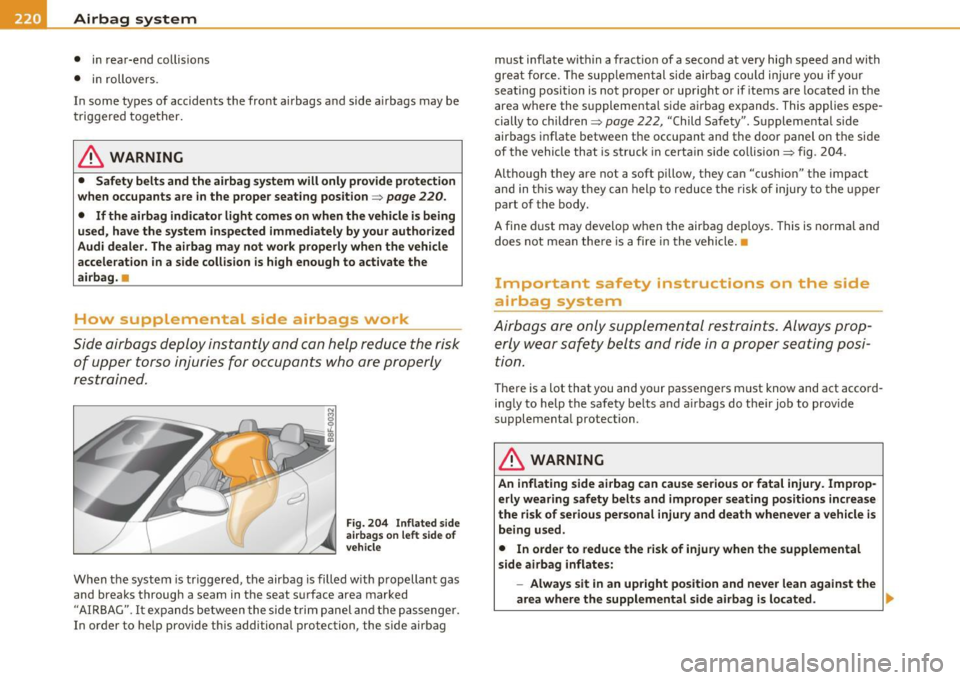
F ig. 2 04 Inflated side
ai rbag s on left s ide o f
veh icle
When the system is triggered, the airbag is filled with p ropellant gas
and breaks through a seam in the seat surface area marked
"AIRBAG". I t expands between the side t rim panel and the passenger.
In order to he lp provide this additional protection, the side airbag must inflate within a fraction of a second at very hig
h speed and with
great force. The supp lemen tal side airbag cou ld inju re you if yo ur
seat ing position is not proper or upr ight or if items are located in the
area where the s upplemental s ide a irbag expands. This applies espe
cially to children=>
page 222 , "Child Safety". Suppleme nta l s ide
airbags inflate between the occupant and the door panel on the side
of the vehicle that is s truck in certa in side collision=> fig. 204.
Although they are not a soft pi llow, they can "cush ion" the impact
and in t his way t hey can help to reduce the risk of injury to the upper
part of the body.
A fine dust may develop w hen the airbag dep loys. This is norma l and
does not mean the re is a fire i n the vehicle. •
Important safety instructions on the side
airbag system
Airba gs are only supplemental restraints. Always prop
erly wear safety belts and ride in a proper sea ting posi
tion .
There is a lot that you and your passengers m ust know and act acco rd
ing ly to he lp the safety be lts and a irbags do the ir job to prov ide
supplementa l protection .
& WARNING
An inflating side airbag can caus e serious or fatal inju ry. Improp
erly wearing safety belts and improper seating po sition s increa se
the risk of serious personal injury and death whenever a vehicle is
being used .
• In order to reduce the risk of injury when the supplemental
side airbag inflates:
-Alway s sit in an upright position and never lean against the
area where the supplement al side airbag is located . _,
Page 224 of 364
-Child Safety P:llf..,____ ______________ _
Child Safety
Important things to know
Introduction
The rear seat is generally the safest place in a collision.
The physi cal pr in ci ples of wha t happe ns when yo ur vehicl e is in a cras h
apply a lso to chi ldren=>
page 192, "What happens to occupants not
wearing safety belts?" . B ut unlike a dults and teenage rs, their
muscles and bones are not fully deve loped. In many respects c hildren
are at greater risk of ser io us injury in c rashes than adults.
Beca use child ren's bodies are not fu lly d ev el op ed, they requ ire
restra int systems especially designed fo r their size, weight, and body
st ruct ure. M any count ries a nd a ll states of t he Uni ted St ates and
prov inces of Canada have laws requ iring the use of approved c hild
restrain t sys tems for infants and sm all chi ldr en .
In a frontal crash at a speed o f 20-35 mph (30-56 km/ h) the forces
act ing on a 13-poun d (6 kg) infant w ill be more than 20 times t he
we ight of the c hild . This means t he weigh t of the child would
sudden ly be more than 260 po unds (120 kg). Under these conditions,
only a n app ropr iate child restra int properly use d can red uce t he risk
of serious in jury. Child restra ints must be used properly to be effec
t ive. Use d im properly, they c an increase the risk of ser io u s injury in an
acc ident.
Consult the c hild safety sea t manufac ture r's ins truc tion s in order to
be sure the seat is right for your c hild's size=>
page 225, "Im por tan t
safety instructions fo r using chi ld safety seats". P lease be s ure to
read and heed all of t he impo rtant informa tion and WAR NINGS
about ch ild safety, Advanced Airba gs, and the installation of c hild
restrain ts i n t his chapte r.
The re is a lot you need to know about the Advanced Airbags in your
veh icle and how t hey wo rk when inf ants and childre n in child
restra in ts are o n the front passenger seat . Beca use of the la rge amount of importan
t informat ion, we can not rep eat i t all he re . We
urge you to read the detai led information in this owner's manual
abou t ai rb ags a nd th e Adva nced Airbag Syste m in your vehicle an d the
very important information abo ut transporting children on the front
pa ssen ger s eat. P lease be sure to heed the W ARN IN GS -th ey are
extremely important fo r your safety a nd the sa fety of your passe n
g ers , especially infants and small childre n.
& WARNING
• Accident statistics have shown that children are generally safer
in the rear seat area than in the front seating position. Always
restrain any child age 12 and under in the rear.
• All vehicle occupants and especially children must be
restrained properly whenever riding in a vehicle. An unrestrained
or improperly restrained child could be inju red by striking the
interior or by being ejected from the vehicle during a sudden
maneuver or impact. An unrestrained or improperly restrained
child is also at greater risk of injury or death through contact with
an inflating airbag.
• A suitable child re straint properly installed and used at one of
the rear seating posit ions provides the highest degree of protec
tion for infants and small children in most accident situations .
& WARNING
Children on the front seat of any car even with Advanced Airbags
can be seriously injured or even killed when an airbag inflates. A
child in a rearward -facing child safety seat installed on the front
passenger seat will be seriously injured and can be killed if the
front airbag inflates .
• The inflating airbag will hit the child safety seat or infant
carrier with great for ce and will sma sh the child safety seat and
child against the backrest, or door.
IJll,
Page 227 of 364

Child Safety Ill
-------------------"'---
C. Forward-facing convertible child restraint
systems, manufactured on or after September 1,
2004:
• Britax Roundabout 161
• Century Encore 4612
• Century STE 1000 4416
• Cosco Olympian 02803
• Cosco Touriva 02519
• Evenflo Horizon V 425
• Evenflo Medallion 254
• Safety First Comfort Ride 22-400
& WARNING
To reduce the risk of serious injury, make sure that the
PASSENGER AIR BAG OFF light comes on and stays on whenever a
child restraint is installed on the front passenger seat and the
ignition is switched on.
• Take the child restraint off the front passenger seat and install
it properly at one of the rear seat positions if the PASSENGER AIR
BAG OFF light does not stay on.
• Have the airbag system inspected by your authorized Audi
dealer immediately.
(I} Tips
The child seats listed in categories A to C have been tested by Audi
only for the Advanced Airbag function. •
Controls and equip
ment Safety first Vehicle operation
Important safety instructions for using
child safety seats
Correct use of child safety seats substantially reduces the
risk of injury in an accident!
As the driver, you are responsible for the safety of everybody
in the vehicle, especially children:
- Always use the right child safety seat for each child and
always use it properly::::>
page 227.
- Always carefully follow the child safety seat manufac
turer's instructions on how to route the safety belt prop
erly through the child safety seat.
- When using the vehicle safety belt to install a child safety
seat, you must first activate the convertible locking
retractor on the safety belt to prevent the child safety seat
from moving ::::>
page 232.
-Push the child safety seat down with your full weight to
get the safety belt really tight so that the seat cannot
move forward or sideways more than one inch (2.5 cm).
- If a strap or tether is being used to tie the child safety seat
to the front passenger seat, make sure that it is not so
tight that it causes the weight-sensing mat to measure more weight than is actually on the seat.
Always remember: Even though your vehicle is equipped with an
Advanced Airbag system, all children, especially those 12 years and
younger, should always ride in the back seat properly restrained for
their age and size . ..,
Vehicle care Do-it-yourself service Technical data
Page 228 of 364
111,___C_ h_ il_d _ S_a _ f_ e _ t-= y ;....._ ____________________________________________ _
in. WARNING
Not using a child safety seat, using the wrong child safety seat or
improperly installing a child restraint increases the risk of serious
personal injury and death.
• All vehicle occupants and especially children must always be
restrained properly whenever riding in a vehicle .
- An unrestrained or improperly restrained child can be injured or killed by being thrown against the inside of the
vehicle or by being ejected from it during a sudden maneuver or impact.
- An unrestrained or improperly restrained child is at much greater risk of injury or death by being struck by an inflating
airbag.
• Commercially available child safety seats are required to
comply with U.S. Federal Motor Vehicle Safety Standard (FMVSS)
213 (in Canada CMVSS 213).
- When buying a child restraint, select one that fits your child and the vehicle.
- Only use child restraint systems that fully contact the flat portion of the seat cushion. The child restraint must not tip or
lean to either side. Audi does not recommend using child
safety seats that rest on legs or tube-like frames . They do not
provide adequate contact with the seat .
- Always heed all legal requirements pertaining to the instal
lation and use of child safety seats and carefully follow the instructions provided by the manufacturer of the seat you are
using.
• Never allow children under 57 inches (1.5 meters) to wear a
normal safety belt . They must always be restrained by a proper
child restraint system. Otherwise, they could sustain injuries to
the abdomen and neck areas during sudden braking maneuvers or accidents.
• Never let more than one child occupy a child safety seat.
& WARNING (co ntinued )
• Never let babies or older children ride in a vehicle while sitting
on the lap of another passenger .
- Holding a child in your arms is never a substitute for a child
restraint system.
- The strongest person could not hold the child with the forces
that exist in an accident. The child will strike the interior of the
vehicle and can also be struck by the passenger.
- The child and the passenger can also injure each other in an
accident .
• Never install rear-facing child safety seats or infant carriers on
the front passenger seat. A child will be seriously injured and can be killed when the passenger airbag inflates -even with an
Advanced Airbag System.
• The inflating airbag will hit the child safety seat or infant
carrier with great force and will smash the child safety seat and
child against the backrest, center arm rest, door or roof.
• Always install rear-facing child safety seats or infant carriers
on the rear seat.
• Forward-facing child safety seats installed on the front
passenger 's seat can interfere with the airbag when it inflates and
cause serious injury to the child . Always install forward-facing
child safety seats on the rear seat.
• If exceptional circumstances require the use of a forward·
facing child restraint on the front passenger's seat , the child's
safety and well-being require that the following special precau
tions be taken:
- Make sure the forward-facing seat has been designed and certified by its manufacturer for use on a front seat with a
passenger front and side airbag .
- Always carefully follow the manufacturer's instructions
provided with the child safety seat or carrier.
Page 233 of 364

Child Safety -
-------------------"'---
- Always make su re t hat t he chi ld can proper ly wear the lap
port ion of the belt low across the th ighs or pe lvis a nd
never over the s tomac h or a bdo men.
Child ren up to at leas t 8 yea rs o ld (o ver 40 lbs. o r 18 kg) are best
protected in c hild safety seats designed for their age and weight.
E xpe rts say t hat the s ke letal str uctu re, pa rticularly t he pe lvis, of
these ch ildren is not fully deve loped, and they must not use the
vehicle safety belts without a suitable ch ild restraint.
Children up to abou t 40 lb s ( 18 kg) are bes t pro tec ted in child safety
seats des igned for the ir age and weight. Experts say that the ske letal
s tr uct ure, particula rly t he pe lv is, o f these ch ildren is no t fully deve l
oped, and they must not use the vehicle safety belts without a suit
able child r estrain t.
It is usually best to p ut these ch ild ren in approp riate booster seats .
Be sure the booster seat meets all a pplicable safety standar ds.
B ooster se ats raise the sea ting pos it io n of the c hild a nd reposi tion
both t he lap and shoulder parts of the safety belt so that they pass
acro ss t he child' s body i n t he righ t pla ces . Th e routin g of th e be lt ove r
the ch ild's body is very important fo r the ch ild's protection, w het her
or not a boos ter seat is used . Children age 12 and unde r m ust always
r ide in the rea r seat.
Children who are at least 4 ft. 9 in . (57 inches/1.45 meters) ta ll can
gen erally use th e vehi cle' s three poin t lap an d should er b elts. Never
use the lap belt port ion of the vehicle's safe ty be lt a lone to restra in
a ny child, reg ardl ess of how big the child is . A lw ay s re membe r tha t
children do not have the p ronounced pelvic structure required for the
pr op er f unc tion of l ap bel t po rt io n o f the vehicle 's three poin t la p an d
shoulder be lts . The child's safe ty abso lutely requires that a lap belt
port ion o f the safe ty be lt be fastened snugly and as low a s possible
around the pelvis. Never let t he lap bel t po rtion of the safety belt
pass over t he child's stomach o r ab dome n.
I n a cr ash, airbags must in flate wi thin a blink o f an eye and with
considera ble force. In order to do its job, the airbag needs room to
Controls and equip
ment Safety first Vehicle operation
inflate so
tha t it w ill be the re to protect the occ upa nt as the occupant
mo ves forwar d into th e airba g.
A vehicle occ upant who is o ut of po sit ion and too close to the a irbag
gets in the way of an inflati ng airbag . W hen an occ upant is too close,
he or sh e will be s truck violently and will re ce ive serio us or po ssibly
even fatal in jury.
I n or der for the air bag to o ffer pr ote ction , it is import an t that all
veh icle occupa nts, espec ia lly any chi ldre n, who m ust be in the front
seat beca use of exceptiona l ci rcumstances, be p ro perly restra ined
and as far away from t he a irbag as possib le. By keepi ng room
between the child 's body and t he front of the passenge r com part
men t, the airbag ca n infl at e co mple tely a nd pro vid e su pp le ment al
protection in certa in frontal colli sions .
& WARNING
Not using a booster seat, using the booster seat improperly, incor
rectly installing a booster seat or using the vehicle safety belt
improperly increases the risk of serious personal injury and death
in a collision or other emergency situation . To help reduce the risk
of serious personal injury and/or death:
• Always make sure to position the shoulder portion of the three
point belt over the middle of child's shoulder.
• Never let the shoulder portion of the belt rest against or across
the neck , face , chin , or thro at of the child.
• Always make sure the lap belt portion of the three-po int belt is
worn snug and passes as low as possible across the child's pelvi s.
Never let the belt pass over the soft abdomen.
• Failure to properly route safety belts over a child 's body will
cause severe injuries in an accident or other emergency situation
~ page 190 .
• Children on the front seat of any car, even with Advanced
Airbags, can be seriously injured or even killed when an airbag inflates.
Vehicle care Do-it-yourself service Technical data
Page 234 of 364
lffllL___:C:..:h..:.. i:..: l .=d ~S=-= a..:..f .= e ~ty ~ --------------------------------------------
& WA RNING (conti nued)
• Never let a child stand or kneel on an y seat, for example the
front seat.
• Never let a child ride in the cargo area of your vehicle.
• Alwa ys remember that a child leaning forward , sitting s ide·
ways or out of po sition in an y way during an accident can be struck
by a deploying airbag. Th is will result in serious personal injury or
death.
• If you must install a booster seat on the front passenger seat
because of e xceptional circumstance s the PASSENGER AIR BAG
OFF light must come on and stay on, whenever the ignit ion is
switched on.
• If the PASSENGER AIR BAG OFF light does not come on and
s tay on, perform the checks described =>
page 211, "Monitoring
the Advanced Airbag System ".
• Take the child re straint off the front pa ssenger seat and install
it prope rly at one of the rear seat positions if the PASSENGER AIR
BAG OFF light does not stay on whenever the ignition i s swit ched
on.
• Always read and heed all WARNINGS whenever u sing a child
restrained in a vehicle is being used=>
page 190, "Safety belts ",
=> page 200, "Airbag system " and => page 222, "Impo rtant
th ings to know ". •
Installing a child safety seat
Securing a child safety seat using a safety
belt
S afet y belts for the re ar seats a nd the front passenger's
seat c an be locked with the c onvertible locking retract or
to pro perly secure child safety seats.
T he safety belts emergency loc king retractors for the rear seats
saf ety belts and fo r the front passe nger's seat safety be lt have a
convertib le locking retractor for child restraints. The safety be lt m ust
be loc ked so that belt webbing ca n not u nreel. The re tractor can be
activated to lock the safety belt and prevent the safety belt webbing
from loosening up d uring norm al driving. A chi ld safety seat can only
be properly installed when the safety belt is locked so that the child
and child safe ty seat will stay in p lace .
Always remembe r: Even though your vehicle is equipped with an
Advanced Airbag system, all chi ld ren, especially those 12 yea rs and
younger, should always ride in th e bac k seat p roperly restra ined for
their age and size.
& WARNING
Improperl y in stalled child safety se ats increase the risk of serious
per sonal injury and death in a collision.
• Always make sure that the safety belt retractor is locked when
i nstalling a child safety seat . An unlocked safety belt retractor
cannot hold the child safety seat in place during normal driving or
in a crash.
• Always buckle the child safety seat firmly in place even if a
child is not s itting in it. A loose child safety seat can fly around
during a sudden stop or in a collision.
• If the back rest is not securely latched , the child and the child
restraint will be thrown forward together with the backre st and ._
Page 236 of 364
ffl.___C_ h_ il_d _ S_a _ f_ e _ t--= y '------------------------------------------------
& WARNING (continued)
• A child in a rearward-facing child safety seat installed on the
front passenger seat will be seriously injured and can be killed if
the front airbag inflates -even with an Advanced Airbag System.
• The inflating airbag will hit the child safety seat or infant
carrier with great force and will smash the child safety seat and
child against the backrest, center arm rest, door or roof.
• Always be especially careful if you must install a rearward
facing child safety seat on the front passenger seat in exceptional
circumstances.
• A tight tether strap on a rearward-facing child restraint
attached to the front passenger seat can put too much pressure on
the weight-mat in the seat and register a heavier weight in the
Advanced Airbag System. The heavier weight registered can make
the system work as though an adult were on the seat and deploy the Advanced Airbag when it must be suppressed causing serious
or even fatal injury to the child.
• Make sure that the PASSENGER AIR BAG OFF light comes on
and stays on all the time whenever the ignition is switched on.
• If the PASSENGER AIR BAG OFF light does not come on and
stay on, immediately install the rearward-facing child safety seat
in a rear seating position and have the airbag system inspected by
your authorized Audi dealer. •
Activating the convertible locking retractor
Use the convertible locking retractor to secure a child
restraint.
Always heed the child safety seat manufacturer's instruc
tions when installing a child restraint in your vehicle. To acti
vate the convertible locking retractor:
- Place the child restraint on a seat, preferably on the rear
seat. -
Slowly pull the belt
all the way out.
- Route it around or through the child restraint belt path
=>& .
- Push the child safety seat down with your full weight to
get the safety belt really tight.
- Insert the belt tongue into the buckle for that seating
position.
- Guide the safety belt back into the retractor until the belt
lies flat and snug on the child safety seat.
- You should hear a "clicking" noise as the belt winds back
into the inertia reel. Test the convertible locking retractor
by pulling on the belt. You should no longer be able to pull
the belt out of the retractor. The convertible locking
retractor is now activated.
- Make sure that the red release button is facing away from
the child restraint so that it can be unbuckled quickly.
- Pull on the belt to make sure the safety belt is properly
tight and fastened so that the seat cannot move forward
or sideways more than one inch (2.5 cm).
& WARNING
Using the wrong child restraint or an improperly installed child
restraint can cause serious personal injury or death in a crash.
• Always make sure that the safety belt retractor is locked when
installing a child safety seat. An unlocked safety belt retractor
cannot hold the child safety seat in place during normal driving or
in a crash.
• Always buckle the child safety seat firmly in place even if a
child is not sitting in it. A loose child safety seat can fly around
during a sudden stop or in a crash.
Page 242 of 364
Intelligent technology
~----------------------------------------------
Intelligent technology
Notice about data recorded by
vehicle control modu Les
Your vehicle is not equipped with an Event Data Recorder (EDR),
installed by some manufacturers for the express purpose of
capturing data for retrieval after an accident or crash event. EDR's are
sometimes called "crash recorders".
Some state laws restrict the retrieval or downloading of data stored
by ED R's that were installed in a vehicle for the express purpose of
retrieving data after an accident or crash event without the owner's
consent.
Although your vehicle is not equipped with an EDR, it is equipped with
a number of e lectronic control modules for various vehicle systems
such as, for example, eng ine function, emission control, as well as for
the airbags and safety belts.
These electronic control modules also record vehicle-related data
during normal vehicle operation for diagnostic and repair purposes .
The recording capacity of the electronic control modu les is limited to
data (no sound is recorded) and only a sma ll amount of data is actu
ally recorded over a very limited period of time and stored when a
system fault or other condition is sensed by a control unit. Some of
the data then stored may relate to vehicle speed, direction, braking
as well as restraint system use and performance in the event of a
crash or other condition. Stored data can only be read and down
loaded with special equipment .•
Electronic Stabilization Program
(ESP}
Ce-ieral lnforrrc:t~on
The ESP improves the vehicle stability.
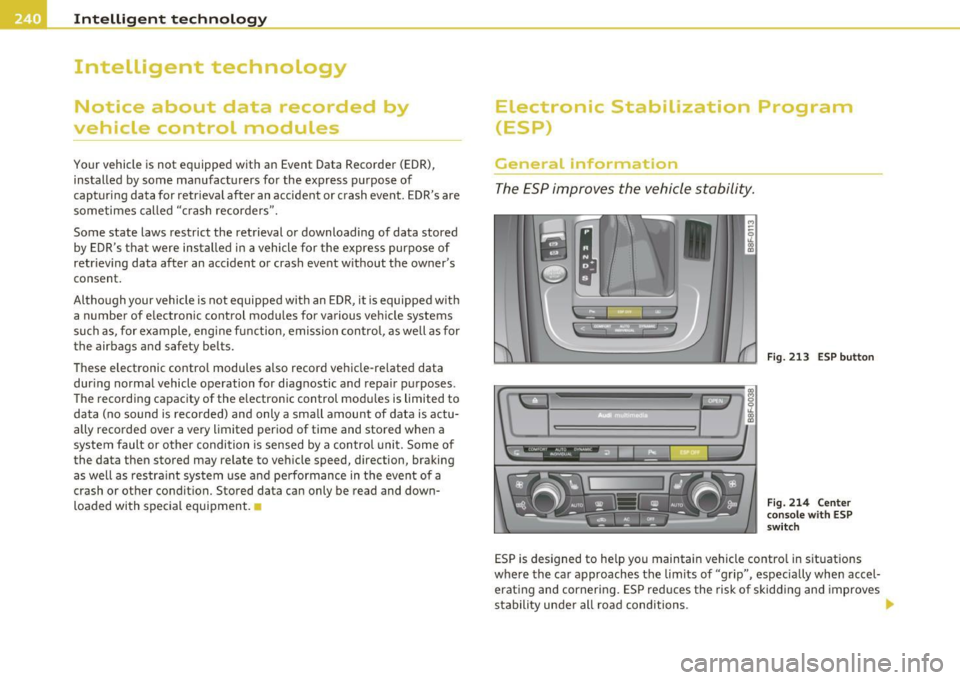
Fig. 213 ESP button
Fig. 214 Center
console with ESP
switch
ESP is designed to he lp you maintain vehicle control in situations
where the car approaches the limits of "grip", especially when accel
erating and cornering. ESP reduces the risk of skidding and improves
stability under all road conditions.