ignition AUDI A5 CABRIOLET 2011 Owners Manual
[x] Cancel search | Manufacturer: AUDI, Model Year: 2011, Model line: A5 CABRIOLET, Model: AUDI A5 CABRIOLET 2011Pages: 364, PDF Size: 86.48 MB
Page 276 of 364
Fuel supply and filling your fuel tank
Fuel supply and filling your fuel tank
Gasoline
Fuel supply
Using the right fuel helps keep the environment clean and
prevents engine damage.
Fuel recommendation
The f ue l recommended for yo ur vehicle is unleaded premium grade
gasoline. See also=>
page 342, "D at a". Aud i recommends using TO P
TIER Detergent Gasoline with a m inimum octane rating of 91 AKI (9S
R ON ). For more inform ation on TOP TIE R De tergent Gasoline, please
go to the official website (www .topt iergas .com) .
Th e recommended gasoline octane rating for your engine can a lso be
found on a labe l located o n the i nside of t he fue l fille r flap. This rating
may be specified as AKI o r RON .
Yo ur vehicle may a lso be opera ted u sing unle aded reg ula r gaso line
w ith a minim um octane rating of 87 AKI/91 RON. However, using 87
AKI/91 RON octane fue l will slig htly reduce engi ne pe rformance.
Use unleaded gasoline only . Unleaded gaso line is available
througho ut the USA, Canada, and in most E uropean countries. We
recommend tha t you do not take your ve hicl e to a reas or countries
where unleaded gasoline may not be availab le.
For mo re in format io n on refueling your vehi cle, see =>
page 275 .
Octane rating
Octane r atin g indica tes a gaso line's ability to resis t eng ine dam ag ing
"knock" caused by premature ignition and detonatio n. Therefore,
buying the co rr ec t gr ade o f gas oline is very im port an t to help prevent
poss ible engine damage and a loss of engi ne performance .
Gaso line most common ly used in the United States and Canada has
the following octa ne rat ings that can usually be fou nd on the filler
pump: •
Premium Grade : 9 1 -96 AKI
• Regu lar Grade: 87 - 90 AKI
E xp lanation o f the a bbrev iations:
AKI= Anti Knock Index= (R +M)/2 = (RON+MON)/2
RON= Resea rch Octane Number
M ON= M otor Octane Number.
(D Note
• Do not use any f uel w ith oc tane ra tings lower than 87 AKI or 91
RO N othe rw ise ex pensive engine damage will occu r.
• Do
not use leade d gasoline. The use of leaded gasoline w ill
severely damage you r vehicle's catalytic co nve rter and i ts ab ility to
control exhaust emissions.•
Blended gasoline
Use of gasoline containing alcohol or MTBE (methyl
tertiary butyl ether)
You may use unleade d gasoline blended w ith alcoho l or M TBE
( c ommon ly refe rred to as oxygenates) if the blen ded mixture meets
the fo llowing c riter ia:
Blend of g asoline methanol (wood alcohol or methyl alcohol)
• Anti -k nock inde x must be 87 AKI or higher.
• B lend must con tain no mo re t han 3% met hano l.
• Blend must contain more than 2% co-solvents.
Blend of gasoline and ethanol (grain alcohol or ethyl alcohol)
• Anti- knock index must be 87 AKI o r higher.
• B lend must no t conta in mo re than 10% e thanol.
Page 278 of 364
Fuel supply and filling your fuel tank
In order to fill the tank properly while protecting the environment,
please follow this refueling procedure carefully.
& WARNING
Under normal operating conditions, never carry additional fuel
containers in your car. Gas canisters and other containers used to
transport fuel can be dangerous. Such containers, full or empty,
may leak and could cause a fire in a collision. If you must transport
fuel to use for your lawn mower, snow blower, etc., be very careful
and always observe local and state laws regarding the use, trans
portation and storage of such fuel containers. Make certain the
container meets industry standards (ANSI/ASTM F852 -86).
0 Note
Never drive your vehicle until the fuel tank is completely empty . The
irregular supply of fuel can cause misfiring. Gasoline could enter the
exhaust system and damage the catalytic converter. •
Refuelling
-
Fig. 214 Right rear
veh icle side: Opening
the fuel filler flap Fig
. 215 Fuel filler
flap with attached fuel cap
When activating the central locking, the fuel filler flap is
automatically unlocked or locked. Refuel the vehicle with the
ignition turned
off.
Taking the fuel cap off
- Turn off the ignition.
- Press the left side of the fuel filler flap to open it
~ fig. 214 -arrow-.
- Unscr ew fuel cap counter-clockwise and hang it on the fuel
filler flap~ fig. 215.
Refuelling procedure
- Ins ert the fuel nozzle from the gasoline pump into the
fuel filler neck as far as it will go.
- Select a medium refuelling rate so that the nozzle switches off automatically when the tank is full.
Putting the fuel cap back on
- After filling your tank, twist the fuel cap clockwise as far
as it will go.
- Close the fuel filler flap. .,
Page 282 of 364
-Checking and filling
-------=------=---------------------------------------------------
Closing the engine hood
-Pull the hood down until the pressure from the struts is
reduced.
- Let the hood
drop down and latch in place . Do not try to
push it shut;
it may fail to engage=> &.
& WARNING
A hood that is not completely latched could fly up and block your
view while driving.
• When you close the engine hood, check it to make sure the
safety catch has properly engaged. The hood should be flush with
the surrounding vehicle body parts.
• If you notice while driving that the hood is not secured prop
erly, stop at once and close it. •
Working in the engine compartment
Be especially careful whenever you work in the engine
compartment.
Whenever you must perform any work in the engine compartment,
for example checking and filling different fluids, there is a risk of
injury, burns and accidents. To prevent personal injury always
observe the following WARNINGS. The engine compartment of any
vehicle is a hazardous area
=> & .
& WARNING
To help avoid injury, before you check anything under the hood :
• Turn off the engine.
• Remove the ignition key.
• Apply the parking brake.
& WARNING (continued)
• Move selector lever of automatic transmission to "P" (Park).
• Always let the engine cool down. Hot components will burn
skin on contact.
• To reduce the risk of being burned, never open the hood if you
see or hear steam or coolant escaping from the engine compart
ment. Wait until no steam or coolant can be seen or heard before
carefully opening the hood.
• Keep children away from the engine compartment.
• Never spill fluids on hot engine components. They can cause a
fire.
• Never touch the radiator fan. The auxiliary electric fan is
temperature controlled and can switch on suddenly.
• Never open the coolant reservoir cap when the engine is still
warm. The coolant system is pressurized and hot coolant could
spray out.
• Protect your face, hands and arm from steam or hot engine
coolant by placing a thick rag over the cap when you open the
coolant reservoir.
• If work on the fuel system or the electrical system is necessary:
-Always disconnect the battery.
- Never smoke or work near heaters or open flames. Fluids in
the engine compartment could start a fire.
- Keep an approved fire extinguisher immediately available.
• To avoid electrical shock and personal injury while the engine is
running or being started, never touch: -Ignition cables
- Other components of the high voltage electronic ignition system.
• If you must perform a check or repair with the engine running: -First, fully apply the parking brake, move selector lever of
automatic transmission to "P" (Park). ..,
Page 286 of 364

•--=C:.:.h.:.. e=. c=.:..:: k .:.:in ..:. g ~ a::..:..: n~d .:...:.. f:....:il ..:.li :.:.n.;.: g~ ------------------------------------------
0 Note
Driv ing with an insufficient o il level is likely to cause severe damage
to the engine .
[ i J Tips
• The oil pressure wa rning display 9:!::r. is not an ind icator of the oil
level. Do not rely on it. Instead, check the oil level
in your engine at
r egula r inte rvals , prefe rably ea ch time you refuel , and always
before going on a long trip.
• If you have the impression your engine consumes excessive
amounts of o il, we recommend th at yo u consult an autho riz ed Aud i
dealer to have the cause of your concern properly diagnosed . Keep in
m ind that the accurate measu rement of oil consumption re quires
great care and may take some t ime. An authorized Audi dealer has
instructions about how to meas ure oil consumption accu rately .•
Checking the engine oil level
Fig. 2 21 MMI D isplay :
Oil le vel ind icat or
Read oil level
-Park your vehicle on a level sur face.
- S hut the engine off when it is warm. -
Switc h only th e ignition back on .
- Wa it appro ximately two minutes.
- Select: Function button
[CAR ]> Oil level.
- Check the oi l level in the display=> fig. 2 2 1. Add e ngi ne oil
if t he ba r of the oil level ind icator is near "min"
=>
page 284 .
The oil leve l needs to be c hec ked at regular intervals. The bes t times
to do this are whe neve r you refuel and p rior to long tr ips.
Depending on the way the vehicle is driven and the operating condi
ti ons, oi l cons ump tion can be u p to 1/2 q uart per 600 m iles (0.5 l iter
per 1,000 km). Consumpt ion may be higher with in the first 3,000
m iles (5,0 00 km).
[ i J Tips
T he oil leve l ind icator in the MM I Display is only an informa tion
display . If the oil level is too low, a minim um oil warning appea rs in
the inst rument cl uster . Add oil=>
page 284 . If th e hood has been
opened, the current oil level is shown in the instrument cluster the
ne xt time the ignition is switched on. •
Adding engine oil ce:i,-:
Fig. 222 Engine
com partment : Oil fill er
c a p l oca tion ...
Page 289 of 364

___________________________________________ C_ h _ e_c _k _ i_n -=g .._ a_n _ d_ f_i _ll _i _ n -=g '--- ........ 11'1
0 Note
• Before winter sets in, have the coolant checked to see if the
coolant additive in your vehicle is sufficient to meet the climate
conditions. This is especially important if you live in a region where
the winter is extremely cold. If necessary, increase the proportion of
coo lant additive to 60% .
• When adding coolant additive to your cooling system, remember:
-We recommend using only coolant additive G12++ (check the
label) for your vehicle. This coolant additive is available at autho
r iz ed Audi dealers. Other types of antifreeze can s ignificantly
reduce corrosion protection. The resulting corrosion can cause a
loss of coolant and serious engine damage.
• Do not add any type of radiator leak sealant to your vehicle 's
eng ine coolant. Adding radiator repair fluid may adversely affect the
function and performance of your cooling system and could result in
damage not covered by your New Vehicle Limited Warranty. •
Checking the engine coolant level
The engine coolant level can be checked with a quick
glance.
Fig. 223 Engine
compartment: Coolant
expansion tank
Vehicle OP-eration
Before you check anything in the engine compartment,
always read and heed all WARNINGS=:> & in "Working in
the engine compartment" on
page 280.
-Turn off the ignition.
- Let the engine cool down .
- Place a thick rag over the coolant expansion tank
=:> fi.9. 223 and carefully twist the cap counter -clockwise
=> & .
- Read the engine coolant level in the open coolant expan
sion tank=:> fig. 223. With a cold engine, the coolant level
should be between the "min" and "max" markings. When
the engine is warm, the level may be slightly above the
"max" marking.
The location of the coo lant expansion tank can be seen in the engine
compartment illustration =>
page 281.
To obtain an accurate reading, the engine must be sw itched off.
The expansion tank in your vehicle is equipped with an electric coolant level sensor.
When the coolant level is too low, the warn ing light in the Auto-Check
System =>
page 31 will blink until you add coolant and the level has
been restored to normal. Even though there is an electric coolant
level sensor, we st ill recommend you check the coolant leve l from
t ime to time .
Coolant loss
Coolant loss may indicate a leak in the cooling system . In the event of
coolant loss , the cooling system should be inspected immediately by
your authorized Aud i dealer . It is not enough merely to add coolant .
In a
sealed system, losses can occur only if the boiling point of the
coo lant is exceeded as a result of overheating . .,
Vehicle care Do-it-yourselt service iTechnical data
Page 291 of 364

___________________________________________ C_;_ h _.:. e_c _k _ i_n -=g ~ a_n _ d_ f_i _ll _i _ n -=g '--.......J-
0 Note
• Coolan t poll utes the environment and co uld cause an engine fire.
Excess coolant w ill be forced out throug h the pressure relief valve in
t he cap w hen the eng ine becomes ho t.
• If, i n an emer gency, only water can be adde d, the correct ratio
between wate r an d an tifree ze=>
page 28 6 must be restored as soon
as possib le.
<£> For the sake of the environment
Dra ined coolant should not be reused. A lways dispose of used coolant
w hile observ ing a ll enviro nmental regula tions. •
Radiator fan
The r adia tor fan switc hes on au tomatic ally by its elf .
Th e radiator fan is dr iven by the e ngine vi a the V-bel t. Th e v iscous
clutch regu lates the speed of the fan accord ing to the temperature of
th e co olan t.
An auxiliary e lectr ic rad iator fan* sw itches on a nd off depend ing o n
coo la nt temperat ure and other vehicle ope rating conditions .
After you sw itch t he engi ne off, the a uxiliary f an can con tinue r unning
for up to 10 minutes -even w ith the ignition off . It can even switch on
a g ain lat er by itse lf=> &, if
• the temperature of the e ngine coola nt rises due to the heat build
up from the eng ine in the engi ne compa rtment, o r
• the engine compartment heats up because the vehicle is parked in
intense s unlight .
& WARNING
• To reduce the risk of personal injury never touch the radiator
fan.
Vehicle OP-eration
& WARNING (continued )
• The auxiliary ele ctric fan is temperature controlled and can
switch on suddenly even when the engine is not running.
• The auxiliary radiator fan switches on automatically when the
engine coolant reaches a certain temperature and will continue to
run until the coolant temperature drops. •
Brake fluid
Checking brake fluid level
The brake flu id level ca n be chec ked wit h a quick gl an ce.
Fig . 224 Engi ne
c ompartm ent : Brake
fluid re se rvoir
B efo re you check anyth ing i n the e ngine compartment ,
always read and heed all WARNINGS~ & in " Workin g in
t h e e ng in e co mpartme nt" on
p age 280.
- Rea d the b rak e fl uid le ve l f ro m t he brak e fluid re serv oir
~ f ig. 224. The br ak e fl uid le vel mus t be be tw ee n the
" M IN " an d "MAX " m ar kin gs.
Th e br ake fl uid re se rvoir is loca ted at th e rear pa rt iti on of the engine
compartment on the left side=>
page 281. .,_
Vehicle care Do-it-yourselt service iTechnical data
Page 293 of 364

___________________________________________ C_ h_e _c _k_ i_n ~g_ a_n_ d_ f_ i_ll _i_n _g __ _
Have the battery checked when you take your vehicle in for service .
You are well advised to replace a battery that is older than 5 years.
With certain types of a irbag deployment, the battery is disconnected
from the vehicle electrica l system for safety reasons~
& in "Repair,
care and disposal of the airbags" on
page 213.
Disconnecting the battery terminals
Some vehicle funct ions (power window regulators, for example) are
lost if the battery terminals are disconnected. These functions have
to be relearned after the battery termina ls are connected aga in . To
prevent this, the battery should only be disconnected from the
vehicle electr ica l system when absolute ly necessary for repairs.
Vehicles not driven for long periods
If you do not drive your veh icle over a period of several days or weeks,
electrical components are gradually cut back or switched off. This
reduces energy consumption and maintains starting capability ove r a
longer period
~ page 247.
Take into consideration that when you unlock your vehicle, some
convenience functions, such as the master key remote function or
powe r seat adjustment, may not be available. The convenience func
tions will be available again when you turn on the ignition and start
the engine.
Winter operation
During the winter months, battery capacity tends to decrease as
temperatures drop. This is because more power is also consumed
while starting, and the headlights, rear window defogger, etc., are
used more often .
Avoid unnecessary power consumption, particu larly in city traffic or
when travel ing only short distances. Let your authorized Audi dealer
check the capacity of the vehicle battery before winter sets in
~ page 293. A well charged battery will not only p revent start ing
problems when the weather is cold, but will also last longer.
Safety first
(I] Tips
If your vehicle is left standing for several weeks at extremely low
temperatures, the vehicle battery shou ld be removed and stored
where it will not freeze. This will prevent it from being damaged and
having to be replaced. •
Working on the battery
Be especially careful when working on or near the
battery.
The battery is located in the luggage compartment under the
floor. Before you check anything in the lu~gage compart
ment,
read and heed all WARNINGS =:,& .
Always heed the safety warnings, when working on the vehicle
battery or the vehicle electrical system to prevent injury .
The following WARNINGS are very important when
working on the battery:
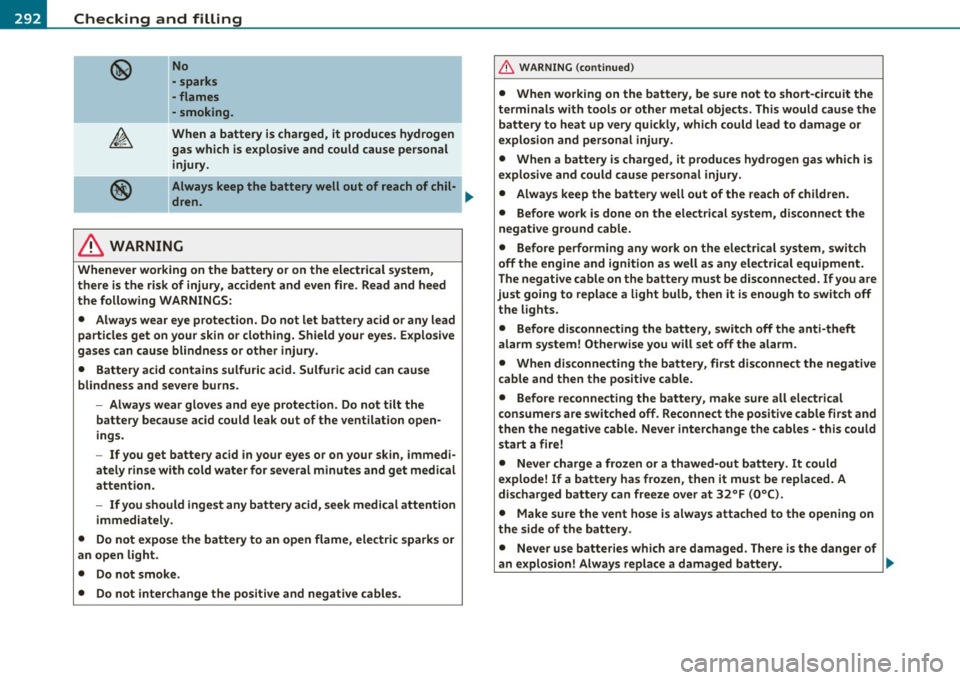
Always heed the following WARNING SYMBOLS and safety pre
cautions when working on the battery.
Always wear eye protection.
Battery acid contains sulfuric acid. Always wear
gloves and eye protection. .,_
Vehicle care Technical data
Page 294 of 364
lfflJL_JC~h~e~c~k~i~n~g~a~n~d:!._!f~il~l:!!in~g L_ ________________________________________ _
No
• sparks
- flames
- smoking .
When a battery is charged, it produces hydrogen
gas which is explosive and could cause personal injury .
Always keep the battery well out of reach of chil- _,.
dren .
& WARNING
Whenever working on the battery or on the electrical system,
there is the risk of injury, accident and even fire. Read and heed
the following WARNINGS:
• Always wear eye protection. Do not let battery acid or any l~ad
particles get on your skin or clothing. Shield your eyes . Explosive
gases can cause blindness or other injury.
• Battery acid contains sulfuric acid. Sulfuric acid can cause
blindness and severe burns.
-Always wear gloves and eye protection. Do not tilt the
battery because acid could leak out of the ventilation open
ings.
- If you get battery acid in your eyes or on your skin, immedi·
ately rinse with cold water for several minutes and get medical
attention.
- If you should ingest any battery acid, seek medical attention
immediately.
• Do not expose the battery to an open flame, electric sparks or
an open light. • Do not smoke.
• Do not interchange the positive and negative cables.
& WARNING (co ntinued )
• When working on the battery , be sure not to short-circuit the
terminals with tools or other metal objects. This would cause the battery to heat up very quickly, which could lead to damage or
explosion and personal injury.
• When a battery is charged , it produces hydrogen gas which is
explosive and could cause personal injury.
• Always keep the battery well out of the reach of children.
• Before work is done on the electrical system, disconnect the
negative ground cable.
• Before performing any work on the electrical system, switch
off the engine and ignition as well as any electrical equipment.
The negative cable on the battery must be disconnected. If you are
just going to replace a light bulb, then it is enough to switch off
the lights.
• Before disconnecting the battery, switch off the anti-theft
alarm system! Otherwise you will set
off the alarm.
• When disconnecting the battery, first disconnect the negative
cable and then the positive cable.
• Before reconnecting the battery, make sure all electrical
consumers are switched off. Reconnect the positive cable first and
then the negative cable. Never interchange the cables· this could start a fire!
• Never charge a frozen or a thawed-out battery. It could
explode! If a battery has frozen , then it must be replaced. A
discharged battery can freeze over at 32°F (0°C).
• Make sure the vent hose is always attached to the opening on
the side of the battery .
• Never use batteries which are damaged . There is the danger of
an explosion! Always replace a damaged battery. _,.
Page 295 of 364
___________________________________________ C_ h _ e_c _k _ i_n -=g .._ a_n _ d_ f_i _ll _i _ n -=g '-- ....... JIII
& WARNING
California Proposition 65 Warning:
• Battery posts, terminals and related accessories contain lead
and lead compounds, chemicals known to the State of California
to cause cancer and reproductive problems. Wash hands after
handling.
0 Note
• Do not disconnect the vehicle battery when the ignition is
sw itched on or wh en the eng ine is running, otherw ise , you will
damage electronic components in the electrical system.
• If your vehicle is going to stand for a long period of time without
being driven , protect the battery from "freezing" , otherwise it will be
damaged and will then have to be replaced. •
Battery charging
Starting the engine requires a well charged battery.
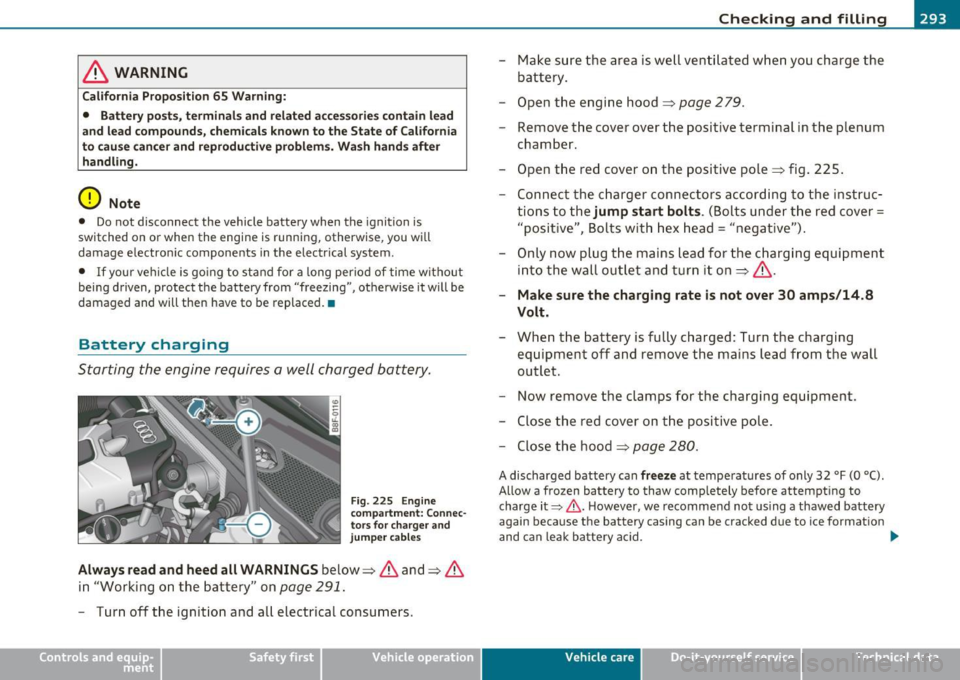
Fig. 225 Engine
compartment: Connec·
tors for charger and
jumper cables
Always read and heed all WARNINGS below=:> & and =:> &
in "Working on the battery " on
page 291.
- Turn off the ignition and all electrical consumers.
Vehicle OP-eration
-Make sure the area is well ventilated when you charge the
battery.
- Open the engine hood=:>
page 279.
- Remove the cover over the positive terminal in the plenum
chamber.
- Open the red cover on the positive pole=:> fig. 225.
- Connect the charger connectors according to the instruc-
tions to the
jump start bolts. (Bolts under the red cover =
"positive", Bolts with hex head
= "negative").
- Only now plug the mains lead for the charging equipment
into the wall outlet and turn it on =>& .
-Make sure the charging rate is not over 30 amps/14.8
Volt.
- When the battery is fully charged: Turn the charging
equipment off and remove the mains lead from the wall
outlet.
- Now remove the clamps for the charging equipment .
- Close the red cover on the positive pole.
- Close the hood=:>
page 280.
A discharged battery can freeze at temperatures of only 32 °F (0 °C) .
Allow a fro zen battery to thaw completely before attempting to
charge it=>&. However , we recommend not using a thawed battery
aga in because the battery casing can be cracked due to i ce formation
and can leak battery acid. .,_
Vehicle care Do-it-yourselt service iTechnical data
Page 318 of 364

IIIIL-_T.:..:..: ir:....:e~ s=---= a~ n:..:..: d:......: w..:....:.. h:....:e~ e= ls=--------------------------------------------------
The tire pressure monitor ing must be reset via rad io or MMI* each
t ime t he press ures are adjusted (e.g. w hen sw itching be tween p artial
and full load pressure) o r after changing or replac ing a tire on yo ur
vehicle => page
316. You ca n find t he recommen ded tire pressures
for your veh icle on the labe l on driver's s ide B-pilla r => page
300.
Tire tread circ umference and vibrat ion characteristics can change and
c a u se a tir e pressure war ning if:
• the t ire pressure in one or more tires is too low,
• t he tire ha s structur al dam age,
• the tire press ure was changed, wheels rotated or rep laced but the
TPM S was no t reset=> page
316.
Warning symbols
1..1' Loss of press ure in at least one tire=> &. Check the tire or tires
and replace or repair if necessary. The indicator light (• in the instru
me nt cluste r a lso illuminates=> page
12. Check/correct the p res
sures o f all four tires and reset TPMS via rad io or MMI *.
rr :; (T ire Pressu re M on itor ing System) Tire pres sure! System
malfunction.
If T ,.;> appears after switching the ignition on or w hile
dr iv ing => page
315, fig. 23 3 and the indica to r lig ht 'in th e instr u
me nt clus ter b links for approx ima tely one m inute and the n stays on,
there is a system ma lf u nct io n. See your authorized Audi dealer as
soon as poss ible.
& WARNING
• If the tir e pres sure indicator appears in the instrument cluster
display, one or more of your tires i s significantly under-inflated.
Reduce your speed immediately and avoid any hard steering or
braking maneuvers. Stop as soon a s possible and check the tires
and their pressures . Inflate the tire pressure to the proper pres
sure as indicated on the vehicle 's tire pressure label=>
page 300.
Driving on a significantly under -inflated tire causes the tire to
overheat and can lead to tire failure. Under -inflation also is likely
to impair the vehicle's handling and stopping ability.
& WARNING (co ntinued )
• The driver is re sponsible for maintaining the correct tire pres
sures . You must check the tire pres sures regularly .
• Under certain conditions (such as a sporty driving style , winter
conditions or unpaved roads) , the pressure monitor indicator may
be delayed.
• Ask your authorized Audi dealer if run-flat tires may be used on
your vehicle . Your vehicle registration becomes invalid if you u se
the se tires when not permitted. Damage to your vehicle or acci
dents could also result.
[ i ] Tips
• T he tire pressure monito ring system stops working when there is
an ES P/ABS malf u nctio n.
• Using snow cha ins may res ult in a system ma lf u n ct ion .
• The tire pressure mon itor ing system on your Au di was calibrated
using t ires with the "AO" or "RO " id ent ificat ion . We re comme nd
using these tires. •
Applies to vehicles: with tire p ressure monito ring sys tem
Reset tire pressure monitoring system
I f the tire pressure is adjus ted, wheels are rotated or
changed, th e TPfvf S must b e re set via radio or fv1fv1 I*.
- Turn on the ign it ion .
- Sele ct: Fu nct ion bu tton
[C AR]> Tire pressure monitoring
> Store now.
[ i ] Tips
Before resett ing the TPMS, the current pressures of all four t ires
mus t co rrespo nd to the specifie d val ues. A djust the tire pre ssure and
~