ignition AUDI A5 CABRIOLET 2011 Manual Online
[x] Cancel search | Manufacturer: AUDI, Model Year: 2011, Model line: A5 CABRIOLET, Model: AUDI A5 CABRIOLET 2011Pages: 364, PDF Size: 86.48 MB
Page 231 of 364
& WARNING (continued)
• If you must install a rearward facing child safety seat on the
front passenger seat because of exceptional circumstances and
the PASSENGER AIR BAG
OFF light does not come on and stay on,
immediately install the rearward-facing child safety seat in a rear
seating position and have the airbag system inspected by your
authorized Audi dealer.
• Always read and heed all WARNINGS whenever using a child
restrained in a vehicle is being used
=> page 189, "Safety belts",
=>
page 199, "Airbag system" and=> page 221, "Important
things to know".
& WARNING
If exceptional circumstances require the use of a forward-facing
child restraint on the front passenger's seat, the child's safety and
well-being require that the following special precautions be
taken:
• Make sure the forward-facing seat has been designed and certi
fied by its manufacturer for use on a front seat with a passenger
front and side airbag.
• Always follow the manufacturer's instructions provided with
the child safety seat or infant carrier.
• Always move the front passenger seat into the rearmost posi
tion of the passenger seat's fore and aft adjustment range, and as
far away from the airbag as possible before installing the child
restraint.
• Always make sure that nothing prevents the front passenger's
seat from being moved to the rearmost position in its fore and aft
adjustment range.
• Always make sure the backrest is in an upright position.
• Make sure that the PASSENGER AIR BAG OFF light comes on
and stays on all the time whenever the ignition is switched on.
Safety first Vehicle OP-eration
Child Safety
& WARNING (continued)
• If the light does not stay on, perform the checks=> page 210,
"Monitoring the Advanced Airbag System".
• Take the child restraint off the front passenger seat and install
it properly at one of the rear seat positions if the PASSENGER AIR
BAG
OFF light does not stay on whenever the ignition is switched
on. a
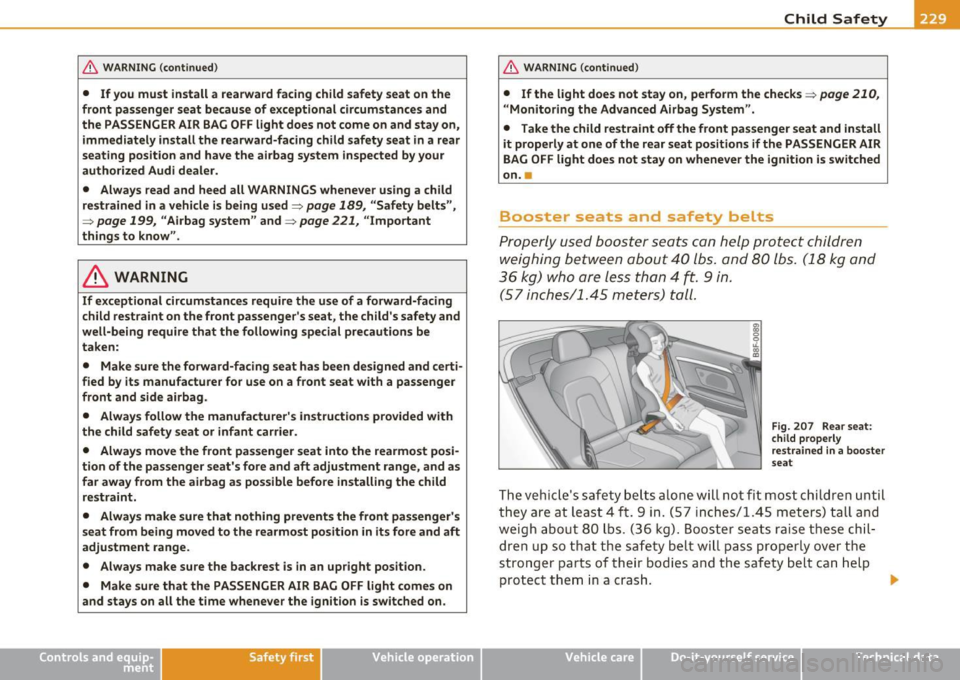
Booster seats and safety belts
Properly used booster seats can help protect children
weighing between about 40 lbs. and 80 lbs. (18 kg and
36 kg) who are less than 4 ft.
9 in.
(57 inches/1.45 meters) tall.
Fig. 207 Rear seat:
child properly
restrained in a booster
seat
The vehicle's safety belts alone will not fit most children until
they are at least 4 ft. 9 in. (57 inches/1.45 meters) tall and
weigh about 80 lbs. (36 kg). Booster seats raise these chil
dren up so that the safety belt will pass properly
over the
stronger parts of their bodies and the safety belt can help
protect them in a crash. •
Vehicle care Do-it-yourselt service iTechnical data
Page 233 of 364
_______________________________________________ C_ h_ il_d _ S_a _ f_ e _ t..,. Y :...._ __
& WA RNING (c on tinued )
• Always make sure the lap belt portion of the three-point belt is
worn snug and pa sses as low a s pos sible across the ch ild 's pelvis .
Never let the belt pass over the soft abdomen.
• Failure to properly route safety belts over a child's body will
c ause severe injurie s in an accident or other emergen cy situation
:::> page 189.
• Children on the front seat of any car, even with Advanced
Airbags, can be seriously injured or even killed when an airbag
inflates .
• Never let a child stand or kneel on any seat, for e xample the
front seat.
• Ne ver let a child ride in the cargo area of your vehicle .
• Alway s remember that a child leaning forward, sitting side
ways or out of position in any way during an accident can be struck
by a deploying airbag . This will result in seriou s personal injury or
death.
• If you must install a booster seat on the front pas senger seat
because of exceptional circumstances the PASSENGER AIR BAG
OFF light must come on and stay on, whenever the ignition is
switched on.
• If the PASSENGER AIR BAG OFF light does not come on and
stay on, perform the checks described=>
page 210, "Monitoring
the Advanced Airbag System ".
• Take the child restraint off the front passenger seat and install
it properly at one of the rear seat positions if the PASSENGER AIR BAG OFF light does not stay on wheneve r the ignition is sw itched
on.
• Always read and heed all WARNINGS whenever using a child
restrained in a vehicle i s being used =>
page 189, "Safety belts ",
=>
page 199 , "Airbag system " and => page 221, "Important
things to know ".•
Controls and equip ment Safety first Vehicle operation
lnstalli ng a child safety seat
Securing a child safety seat using a safety
belt
S
afety belts for the rear se ats an d the fro nt passen ger 's
seat can be l ock ed with th e conv ertible loc kin g ret ractor
to pro perly secur e ch ild safety seats.
T he safety belts emergency locking retractors for the rear seats
safety belts an d for the front passenge r's se at safety b elt hav e a
convertib le locking retractor for child restrai nts. The safety belt must
be locked so that belt webbing canno t unreel. The retra ctor can be
act ivated to lock the safety belt and prevent the safety belt webb ing
fr om loosen ing up du ring normal dr iv ing. A child sa fe ty sea t can on ly
be properly installed when the safety belt is locked so that the child
and child s afety sea t will s tay in place .
A lways r emembe r: Even tho ugh yo ur vehicle is equipped w ith a n
Advanced Air bag system, all ch ild ren, espec ia lly those 12 yea rs and
younge r, should always ride in t he back seat properly res tra ined for
their age and size.
& WARNING
Improperly installed child safety seats increase the risk of serious
personal injury and death in a collision.
• Always make sure that the safety belt retractor is locked when
installing a chi ld safety seat . An unlocked safety belt retractor
cannot hold the child safety seat in place during normal driving or
in a crash .
• Always buckle the child safety seat firmly in place even if a
child is not sitting in it. A loose child safety seat can fly around
during a sudden stop or in a collision.
• If the backrest is not securely latched, the child and the child
restraint will be thrown forward together with the backre st and
~
Vehicle care Do-it-yourself service Technical data
Page 234 of 364
-L-___::C~h...:.: i:.:: l .:::d ~S:::.::: a..:..f .::. e ..::tY L- ___________________________________________ _
& WARNING (continued)
will strike parts of the vehicle interior. The child can be seriously
injured or killed.
• Never install rearward-facing child safety seats or infant
carriers on the front passenger seat. A child will be seriously injured and can be killed when the passenger airbag inflates .
• The inflating airbag will hit the child safety seat or infant
carrier with great force and will smash the child safety seat and
child against the backrest, center arm rest, door or roof.
• Always install rearward-facing child safety seats or infant
carriers on the rear seat.
• Forward-facing child safety seats or infant carriers installed on
the front passenger's seat may interfere with the deployment of
the airbag and cause serious injury to the child.
• It is safer to install a forward-facing child safety seat on the
rear seat.
• Always read and heed all WARNINGS whenever using a child restrained in a vehicle is being used==>
page 221. Special precau
tions apply when installing a child safety seat on the front
passenger seat==>
page 201, "Child restraints on the front seat -
some important things to know".
& WARNING
Always take special precautions if you must install a forward or
rearward-facing child restraint on the front passenger's seat in
exceptional situations:
• Whenever a forward or rearward -facing child restraint is
installed on the front passenger seat, the PASSENGER AIR BAG
OFF light must come on and stay on whenever the ignition is
switched on.
• If the PASSENGER
AIR BAG OFF light does not come on and
stay on, perform the checks described==>
page 210, "Monitoring
the Advanced Airbag System ".
& WARNING (co ntinued )
• Take the child restraint off the front passenger seat and install
it properly at one of the rear seat positions if the PASSENGER AIR
BAG OFF light does not stay on whenever the ignition is switched
on.
• Improper installation of child restraints can reduce their effec
tiveness or even prevent them from providing any protection.
• An improperly installed child restraint can interfere with the
airbag as it deploys and seriously injure or even kill the child .
• Always carefully follow the manufacturer's instructions
provided with the child safety seat or carrier.
• Never place additional items on the seat that can increase the
total weight registered by the weight-sensing mat and can cause injury in a crash.
& WARNING
Forward-facing child restraints:
• Always make sure the forward-facing seat has been designed
and certified by its manufacturer for use on a front seat with a
passenger front and side airbag .
• Never put the forward-facing child restraint up, against or very
near the instrument panel.
• Always move the passenger seat into its rearmost position in
the seat's fore and aft adjustment range, as far away from the
airbag as possible before installing the forward-facing child
restraint. The backrest must be adjusted to an upright position.
• Make sure that the PASSENGER AIR BAG OFF light comes on
and stays on all the time whenever the ignition is switched on.
& WARNING
Rearward-facing child restraints:
Page 235 of 364
Child Safety Ill
-------------------"'---
& WARNING (continued)
• A child in a rearward-facing child safety seat installed on the
front passenger seat will be seriously injured and can be killed if
the front airbag inflates -even with an Advanced Airbag System.
• The inflating airbag will hit the child safety seat or infant
carrier with great force and will smash the child safety seat and
child against the backrest, center arm rest, door or roof.
• Always be especially careful if you must install a rearward
facing child safety seat on the front passenger seat in exceptional
circumstances.
• A tight tether strap on a rearward-facing child restraint
attached to the front passenger seat can put too much pressure on
the weight-mat in the seat and register a heavier weight in the
Advanced Airbag System. The heavier weight registered can make
the system work as though an adult were on the seat and deploy
the Advanced Airbag when it must be suppressed causing serious
or even fatal injury to the child.
• Make sure that the PASSENGER AIR BAG OFF light comes on
and stays on all the time whenever the ignition is switched on.
• If the PASSENGER AIR BAG OFF light does not come on and
stay on, immediately install the rearward-facing child safety seat
in a rear seating position and have the airbag system inspected by
your authorized Audi dealer. •
Activating the convertible locking retractor
Use the convertible locking retractor to secure a child
restraint.
Always heed the child safety seat manufacturer 's instruc
tions when installing a child restraint in your vehicle. To acti
vate the convertible locking retractor:
- Place the child restraint on a seat, preferably on the rear
seat .
Controls and equip
ment Safety first Vehicle operation
-
Slowly pull the belt all the way out.
-Route it around or through the child restraint belt path
=>& .
- Push the child safety seat down w ith your full weight to
get the safety belt really tight .
- Insert the belt tongue into the buckle for that seating
position.
- Guide the safety belt back into the retractor until the belt
lies flat and snug on the child safety seat.
- You should hear a "clicking" noise as the belt winds back
into the inertia reel. Test the convertible locking retractor
by pulling on the belt. You should no longer be able to pull
the belt out of the retractor. The convertible locking
retractor is now activated.
- Make sure that the red release button is facing away from
the child restraint so that it can be unbuckled quickly.
- Pull on the belt to make sure the safety belt is properly
tight and fastened so that the seat cannot move forward
or sideways more than one inch (2.5 cm).
& WARNING
Using the wrong child restraint or an improperly installed child
restraint can cause serious personal injury or death in a crash.
• Always make sure that the safety belt retractor is locked when
installing a child safety seat. An unlocked safety belt retractor
cannot hold the child safety seat in place during normal driving or
in a crash.
• Always buckle the child safety seat firmly in place even if a
child is not sitting in it. A loose child safety seat can fly around
during a sudden stop or in a crash.
Vehicle care Do-it-yourself service Technical data
Page 250 of 364
Intelligent technology
'-------------------------------------------------
vi dual components. It regulates consumption, so that more electrical
energy is not being used than is being generated and ensures an
optimal state of charge for the battery .
[I] Tips
• But even energy management cannot negate the limits of physics.
Consider that the power and life of a battery are limited.
• If starting ability is threatened, you are informed by a warning
~ page 249, "Driver notification in the instrument cluster display" .•
What you should know
The highest priority is given to maintaining starting capa
bility.
Th e battery is severe ly taxed in short-distance driving, in city traffic
and during the cold time of year. Abundant electrical energy is
required, but only a little is generated.
It is also critical if the engine
is not running and electrical components are turned on. In this
instance energy is being consumed but none is being generated.
It is in prec ise ly these sit uations that you will notice energy manage
ment actively regulating the distribution of energy.
Vehicle stands for an extended period
If you do not drive your vehicle over a period of several days or weeks,
electrical components are gradually cut back or sw itched off. This
reduces energy consumption and maintains starting capability over a
longer period.
Take into consideration that when you unlock your vehicle, some
convenience functions, such as the remo te key or power seat adjust
ment, may not be available. The convenience functions will be avail
able again when you turn on the ignition and start the engine.
W ith the engine turned off
If you listen to the radio, for example, with the engine turned off or
use other MMI functions, the battery is being discharged .
If starting capability is jeopardized due to energy consumption, the
following warning appears in the MMI display:
Please start engine, otherwise system will switch off in
3 minutes.
Th e warn ing indicates that the system will be turned off automati
cally after 3 m inutes. If you wish to continue using the functions, you
have to start the engine.
With the engine running
Although electrica l energy is generated when the vehicle is being
driven, the battery can become discharged. This happens most ly
when little energy is being generated and a great deal consumed and
the battery's state of charge is not optimal.
T o br ing the ene rgy balance back into equilibrium, consumers which
require especially large amounts of energy are temporarily cut back
or switched off. Heating systems in particular require a great deal of
energy .
If you notice, for example, that the heated seats* or the
heated rear window are not heating, they have been temporarily cut
back or switched off. These systems will be ava ilable again as soon as
the energy ba lance has been restored.
You will also notice that engine idle speed has been increased
slightly. This is normal and not a cause for concern. By increasing
eng ine id le speed the additional energy required is generated and the
battery is charged. •
Page 251 of 364

Intelligent technology
--------------------------------------------------' '----'----
Driver notification in the instrument
cluster display
If battery power drops into the range where it can limit the ability of
the engine to start, this is shown in the instrument cluster display
with the following driver message:
Lo w b attery charge : batt ery will be charged while driving
Th is notification rem inds you that the starting capability of the
engine may be limited . As soon as you start driving again, the batte ry
w ill be recharged and the notification w ill go out.
Dri ver notification appears and goes out again
If th is dr iver notification appears after the ignition is turned o n or
while driving a nd it goes out again afte r a w hile, the battery has been
adequate ly recharged.
Driver no tification appears and does not go out
again
If th is dr iver notifica tion appears afte r the ignition is turned o n or
while driving and does not go out again, the battery 's state of charge
is not in the optimal range . Starting ability is restricted. Have the
battery checked as soon as poss ible by an au thor ized Aud i dea le r o r
qualified workshop. •
Controls and equip ment Safety first Vehicle operation
Vehicle care Do-it-yourself service Technical data
Page 254 of 364
Driving and environment
- Never put too much motor oil in your engine=> page 284,
"Adding engine oil~".
- Never try to pus h- or tow-sta rt your vehicle.
The catalytic converter is an efficient "clean-up" dev ice built into the
exhaust system of the vehicle. The catalytic converter burns many of
the pollutants in the exhaust gas before they are released into the
atmosphere.
T he exclusive use of unleaded fuel is c riti cal ly import ant for the life of
the catalytic converter and proper funct io ni ng of the eng ine.
& WARNING
• Do not park or operate the vehicle in areas where the hot
exhaust sy stem may come in conta ct with dry gras s, brush, fuel
spill or other material which can cause a fire.
• Do not apply addit ional undercoat ing or rustproofing on or
near the exhaust manifold , exhau st pipes , catalytic converte r or
heat shield s. During driving, the sub stan ce u sed f or under coating
c ould o ve rheat and cause a fire.
0 Note
• Be aware that just one tank filling with leaded fuel w ill already
ser iously degr ade the performance of the ca talytic co nve rter.
• Do not exceed the correct engine oil level =>
page 284.
• Do not dr ive until the f uel tank becomes com plete ly empty . T he
engine could misfire . Unburned fuel cou ld also get into the ex ha ust
system and t his co ul d cause t he ca talyt ic converter to ove rheat .
• Do not turn off the ignition while the vehicle is moving.
• Do not continue to operate your vehicle u nder these conditions, as
otherwise f uel can reac h the c ata ly tic conve rter. This co uld res ult in
over heat ing of the converter, requir ing its replacement.
• T o ass ure eff icien t operat ion of the Emission Cont rol System: -
Have your vehicle maintained properly and in accordance with
th e se rvice reco mmend ations in your W arran ty
& M ain ten ance
booklet.
- Lack of prope r main ten anc e as well as imp roper use of the
veh icle w ill impair the fu nction of the emission control system and
c o uld l ead to d amage.
~ For the sake of the environment
Even when the Emission Contro l System is operat ing proper ly, the
exhaust gas can have a sulfur-like exhaust gas smell u nder some
operating states. This depends on t he sulfur content of the fue l being
used . Using a different brand of fuel may help , o r fil lin g the tank with
lead-free supe r grade gasoline. •
Operate your vehicle economically
and minimize pollution
General
Yo ur person al sty le of drivi ng will determine the e cono my
of your vehicle, as well as e xhaust and noise levels .
Fuel economy, environmenta l impact, and wear on your engine,
bra kes and tires large ly depe nd on three fa ctors:
• your perso nal driv ing style
• operat ing cond itions
• technical lim itations
If you an ticipa te wh at yo u nee d to do nex t and drive e co nom ically,
you can easily cut your fuel consumption by 10- 15 percent. This
se ct io n w ill give you so me tips on how you ca n he lp the env ironment
and your pocketbook .
9>
Page 256 of 364
Driving and environment
The amount of oil used is related to engine load and speed.
It is normal for the oil consumption of a new engine to reach its
lowest value after a certain mileage has been driven.
You must drive your vehicle about 3,000 mi les (S,000 kilometers)
before you can properly assess oil consumption.
Th is also applies to fuel consumption and engine output .
0 Note
• Have your vehicle maintained properly and in accordance with the
service recommendations in your Warranty
& Maintenance booklet.
Lack of proper maintenance as well as improper use of the vehicle w ill
impair the function of the emission control system and could lead to
damage.
• Do not alter or remove any component of the Emission Control
System unless approved by the manufacturer.
• Do not a lter or remove any device, such as heat shields, switches,
ignition wires, valves, which are designed to protect your vehicle's Emission Contro l System and other important vehicle components .•
Fewer short trips
Fuel consumption will always be relatively high on short
trips .
-Try to avoid driving short distances with a cold engine.
The engine and catalytic converter have to reach their optimal oper·
ating temperature
to reduce fuel consumption and noxious emis
sions effectively.
Just after starting, a cold engine in a mid-size car only achieves a fuel
economy of 6-8 m iles per gallon (30-40 l/100 km) . After about a half
a mile, fuel economy climbs to 12 mpg (20 l/100 km). After about
2.5 mi les (4 km), the engine is at its proper operat ing temperature and fuel economy has reached a normal
level. So you can see that you
should avoid short trips whenever possible .
The
outside temperature is also crit ical in this regard . Your car
consumes more fue l in the winter than in the summer. •
Page 274 of 364
-Cleaning and protection pn, _____________________ _
0 Note
• Never use chemical so lvents (e.g. lig hte r fluid, turpentine), waxes,
shoe po lish or simi lar p roducts on Alca ntara ® surfaces .
• To avo id damage, have stubborn stains removed by a commerc ia l
cleaning specialist .
• Do not use brushes, stiff sponges or sim ila rly abrasive cleaning
aids. •
Safety belts
Only well-maintain ed safety belts work reliably when
needed .
-Keep be lts clea n.
- For cleani ng, use a mi ld soap and wa ter solution. Let be lts
d ry thoroug hly and away fro m dir ect sun light.
- Do not allow in ertia re el s afety b elts to ret ra ct bef ore t hey
are comp le tel y dry .
- C heck the condi tion of y our safety bel ts
regularly .
Heavily soiled safety belts may no t re tract p roper ly .
& WARNING
Damaged safety belts can break in a crash.
• Anything that might damage your safety belts could mean
that you and your passengers would not be adequately protected
in an a ccident.
• Safety belt performance depends on correct installation. Never
remove belts from the vehicle to clean them.
• Do not use chemical cleaning agents , bleach or dyes. They have
corro sive properties which weaken the webbing .
& WARNING (c on tinued )
• When cleaning your safety belts , inspect them for damage. If
you discover damage , see your authorized Audi d ealer .
• Always read and heed all WARNINGS and other info rmation
=:> page 260 . •
Engine compartment
B e especi ally care ful w hen cleaning the engine comp art
men t.
Always switch off the ignition before cleaning the engine=>& .
Plenum panel
Remove leaves from the plenum panel in front of the windsh ield
un der th e eng ine hoo d. This p revents the wate r drain holes from
becom ing b locked, and it prevents debris from entering the ve hicle
inter io r thr ough the heat ing and ventila tion ducts.
Corrosion protection
Th e engine compartment and tran smission have been cor rosion
protected at the factory.
Goo d an ti- cor ros ion treatmen t is very impo rtan t, pa rtic ula rly in the
w inte r. If the vehicle is frequently driven on sa lt treated roads, t he
entire eng ine compa rtment and plenum pane l sho uld be thoroug hly
cleaned at the end of w inter and retreated to prevent sa lt damage . At
the same time, the underside of the vehicle should be washed as we ll.
If the eng ine co m par tment is clea ned at any time wi th grease
removing solutions
2l, or if you have the engine washed, the anti
c o rrosion treatment is a lmost always remove d as we ll.
It is the refore
essential to have a long-last ing corrosion protect io n reapplied to all
s u rfaces, seams, joints and components in the engine compartmen t. ~
2
l Use on ly the co rrect clean ing so lut ions . Neve r use gaso line or d iese l fuel.
Page 275 of 364
Cleaning and protection Ill
---------------=---------=----
& WARNING
Be aware: The engine compartment of any motor vehicle is a
potentially hazardous area.
• Before working in the engine compartment, be sure to read the
information =:>
page 272.
• Before reaching into the front plenum panel, always remove
the ignition key. Otherwise, the windshield wiper system could unintentionally be switched on, possibly causing personal injury
from the moving wiper linkage.
• Never reach into the area around or touch the radiator fan. The
auxiliary fan is temperature controlled and can switch on suddenly
- even when the ignition is off.
• Do not wash, wax or dry the engine with the engine running.
Moving or hot parts could injure you.
• Do not clean the underside of the chassis, fenders, wheel
covers, or other hard to reach parts without protecting your hands
and arms. You may cut yourself on sharp-edged metal parts.
• Always read and heed all WARNINGS and other information
=:>
page 260. •
Safety first Vehicle care Technical data