Fluid AUDI A5 CABRIOLET 2011 User Guide
[x] Cancel search | Manufacturer: AUDI, Model Year: 2011, Model line: A5 CABRIOLET, Model: AUDI A5 CABRIOLET 2011Pages: 364, PDF Size: 86.48 MB
Page 258 of 364

Trailer towing
"-------------------------------------------------
Trailer load distribution
Be sure the load in the trailer is held securely in pla ce to prevent it
from shifting forward, backward or s ideways.
Never allow a passenger to ride in a trailer => & in "Driving instruc
tions" on
page 256.
Engine cooling system
Towing a trailer makes the eng ine work harde r. It is important that
the cooling system's performance is up to the additional load. Make
sure that the cooling system has enough fluid.
Tire pressure
When towing a trailer, inflate the tires of your vehicle to the cold tire
pressure listed under "Full load" on the label located either on the
dr iver's side B-pillar (visible when the door is open) or inside the fuel
filler flap . Inflate trailer tires to trailer and tire manufacturers' spec
ifications.
Lights
The headl ight settings should be checked w ith the trailer attached
before driving off. Check to make sure both vehicle and trai ler lights
are working properly.
Safety chains
Be sure trailer safety cha ins are properly connected from the trailer
to the hitch on the vehicle. Leave enough s lack in the chains to permit
turning corners. When you install safety chains, make sure they will
not drag on the road when you are driving.
T he chains should cross under the trailer tongue to p revent it from
dropping in case of separation from the hitch.
Driving instruct!ons
Driving with a trailer always requires extra care and
consideration.
To obtain the best possible handling of vehicle and trailer,
please note the following:
- Do not tow a loaded trailer when your car itself is not
loaded.
- Be especially careful when passing other veh icles .
- Observe speed limits.
- Do not drive at the maximum permissible speed.
- Always apply brakes early.
- Monitor the temperature gauge .
Weight distribution
Towing a loaded trailer w ith an empty car results in a highly unstable
distr ibution of weight. If this cannot be avoided, drive at very low
speeds only to avo id the r isk of losing steer ing control.
A "balanced" rig is easier to operate and control. Th is means that the
tow vehicle should be loaded to the extent possible and permissible,
wh ile keeping the trailer as light as possible under the c ircumstances.
Whenever possible, trans fer some cargo to the luggage compart
ment of the tow vehicle while observing tongue load requirements
and vehicle loading considerations.
Speed
Th e higher the speed, the more difficult it becomes for the driver to
control the r ig . Do not drive at the maximum permiss ible speed.
Reduce your speed even more if load, weather or wind conditions are
unfavorable -part icularly when go ing downhill.
Reduce vehicle speed
immediately i f the trailer shows the slightest
sign of swaying.
Do not try to stop the swaying by accelerating. _,
Page 262 of 364
-~_C_ le_ a_n_ i_ n_ g=- a_ n_d___. p_ ro_ t_e _c_ t_ i_o _n ___________________________________________ _
Cleaning and protection
General information
Regular care preserves vehicl e val ue.
Any automobile is exposed to industria l fumes, co rrosive road salt,
e tc. A well ca red for Audi c an look lik e new many ye ars after pur cha se.
Regu lar and correct care w ill contribute to mai nta in ing t he bea uty
a nd valu e of your Au di.
Furthermore, good care may be a condition for substantiating a
warranty claim should corrosion damage or paint defects occur.
Yo ur au thori zed Audi d eale r h as a var iety of dedicated vehicle-care
products
and can advise w hich ones to use for clea ning the exterior
a n d inter io r of your ve hicle.
W het her you use products recommended by Aud i or other comme r
cia lly availab le cleaning agents , please make sure yo u appl y them
co rrectly .
& WARNING
• Cleaning agents may be poisonous . Keep them out of the reach
of children.
• Heed all caution labels .
• Always read directions on the container before using any
product. Follow the directions carefully.
• Most chemical cleaners are concentrated and have to be
diluted .
• Use spot removing fluids only in well ventilated areas.
• Do not use gasoline, kero sene , diesel fuel , nail polish remover
or other volatile fluids . They may be toxic, flammable or
hazardous in other ways. Do not wash, wax or dry the vehicle with
the ign ition on or the engine running .
& WARNING (continued )
• Do not clean the under sides of chassi s, fenders , wheel covers,
etc. without protecting your hands and arms. You may cut your
self on sharp-edged metal parts.
• Moisture and ice on brakes may impair braking efficiency
~ page 243, "General information ". Test the brakes carefully
each time you wash the vehicle .
'£> For the sake of the environment
Select only envir onmenta lly fr iendly clea ning produc ts . Leftover
cleaning pro ducts sho uld not dis posed of i n the household waste .•
Care of exterior
Washing
F re quent w ashin g protec ts th e vehicle.
T he best protection aga inst env ironmental influences is frequent
w ashi ng and w ax ing. How oft en thi s is requ ired depen ds on :
• How m uch the vehicle is used
• Whe re the ve hicle is parke d (gar age, in the o pen un der tr ees, etc.)
• The seasona l and weather conditions
• Environ mental influences
T he longer bird droppings , insects , tree resin, road and industria l
gr ime, t ar, soo t, road sa lt and o ther ma ter ia ls remain on t he veh icle
body, the more lasti ng their destructive effects w ill be. H igh temper
atu res cause d by ex pos ure to intense s unlight int ensify the co rrosive
effect, part icu larly when humid ity is high as we ll.
~
Page 270 of 364
-~_C_ le_ a_n_ i_ n_ g=- a_ n_d___. p_ ro_ t_e _c_ t_ i_o _n ___________________________________________ _
Your authorized Audi dealer can provide cleaning products that have
been tested and approved for your vehicle.•
Care of interior
App lies to ve hicles : w ith MM I
MMI display
-Clean the MMI display with a soft clean cloth and an LCD
cleaner .
The MMI display can be cleaned with a professionally available "LCD
cleaner" . The cloth should be slightly dampened w ith the cleaning
fluid to clean the display.
0 Note
To avoid scratch ing the MMI display, you should never clean it dry. •
Appli es to ve hicles : with MM I
MMI control console
-First clean the MMI control console with a brush to
remove dust from the housing.
- Then wipe the MMI control console with a clean, soft,
slightly damp cloth.
T he MM I control console should be cleaned with a brush first so that
no dirt is trapped between the buttons and the housing. We recom
mend g iv ing the MM I control console a final wipe with a cloth moist
ened with water and dish washing detergent .
0 Note
To prevent damage, make su re that no fluid ever gets into the MMI
control console. •
Aluminum trim
Use only neutral-pH products to remove spots and deposits from
aluminum su rfaces . Chrome care p roducts and alkaline cleane rs will
attack aluminum surfaces and can damage them over time.
& WARNING
Always read and heed all WARNINGS and other information
=:>page 260. •
Fabrics and fabric coverings
Fabrics and fabric coverings (e .g . seats, door tr im panels, etc.) should
be cleaned at regular intervals with a vacuum cleaner . This removes
surface dirt particles which could become embedded in the fabric
through use. Steam cleaners should not be used, because the steam
tends to push the d irt deeper in to the fabric and lock it there.
Normal cleaning
Generally, we recommend using a soft sponge or a lint-free
microfiber cloth to the clean fabric. Brushes should on ly be used for
carpets and floor mats, since other fabric surfaces could be harmed
by brushes.
Normal surface stains can be cleaned using a commercially available
foam cleaner. Spread the foam on the surface of the fabric with a soft
sponge and work it in gently. Do not saturate the fabric. Then pat the
foam dry using absorbent, dry cloths (e.g. m icrofiber cloth) and
vacuum it after it has dried complete ly. _.,
Page 273 of 364
Cleaning and protection -
---------------=---------=----
Cleaning spots
- Remove fresh water-based spots (such as coffee, tea,
juices, blood) with a n abso rbe nt cloth or paper towe l.
- Remove fresh
grease or oil-based spots (such as butter,
mayonnaise, chocolate) w ith an absorbent cloth or paper
towel, or use the cleaner from t he leat her care kit if the
spot has not yet penet rated into the s urface of the
leather.
- Use an oil/grease dissolv ing spray, if
oil/grease spots
have dried on .
-Remove specific kinds of spots (ballpo int pe n, fe lt marker,
fingernai l polish , water -based pa int , shoe polish, etc .)
with a spot remover speci fica lly formu lated for leat her .
Leather care
- Ev ery half ye ar us e an a pproved leath er car e product
(avai lab le fro m yo ur authori zed Audi d eale r) to ca re for
the le ather .
- A pply the produc t very spa rin gly .
- Wipe it o ff with a da mp cloth.
If you have any quest ions about cleaning and car ing for the leather in
yo ur vehi cle, it i s be st t o co ntac t you r author ized Aud i dealer, who w ill
be glad to help you and tell you about our fu ll range of leather care
prod ucts, s uch as:
• Leather cleaning and ca re k it
• Creams to ca re for colored leat her
• Spot removers for ballpoint pens, s hoe polish, etc.
• O il/gre ase di sso lv in g sp ray
• N ew and upcoming prod ucts.
Safety first
& WARNING
Always read and heed all WARNINGS and other information
:=> page 260 .
0 Note
• Never use chemical so lvents (e.g. lighter fluid, turpentine), waxes,
shoe po lish or similar products on the leather surfaces in your Audi.
• T o avo id da mage, have st ubbor n sta in s removed by a co mmerci al
clean ing specialist .•
A pp lies to v ehicle s: w it h Alcan ta ra upho lst ery
Cleaning Alcantara ® (synthetic suede)
Removing dust and dirt
- Moiste n a c loth, squ eez e out e xce ss wat er and wipe down
th e sea t surfaces .
Removing stains
-Mo iste n a clo th with luk ewarm wa ter or wi th dilut ed ethyl
(rubbing) alcohol.
- Dab at the stai n. Sta rt a t the outside and wor k in wards.
- Once the sta in is no lo nger vis ible , use a soft dry clot h or
t iss ue to soak up t he m oisture .
Do not use leather cleaning products on A lcantara .
Yo u m ay use a suit ab le sh am poo for removing dus t and d irt.
Dust and gr it in the pores and seams ca n scratch a nd damage the
s u rface . If the car is left s tanding in the s un fo r long periods, the
Alcanta ra sho uld b e prot ected aga inst direct su nlight to preve nt it
from fading. Slight co lor var iat ions will deve lop in no rma l use and are
not a n ind icatio n of material deterioration .
~
Vehicle care Technical data
Page 274 of 364
-Cleaning and protection pn, _____________________ _
0 Note
• Never use chemical so lvents (e.g. lig hte r fluid, turpentine), waxes,
shoe po lish or simi lar p roducts on Alca ntara ® surfaces .
• To avo id damage, have stubborn stains removed by a commerc ia l
cleaning specialist .
• Do not use brushes, stiff sponges or sim ila rly abrasive cleaning
aids. •
Safety belts
Only well-maintain ed safety belts work reliably when
needed .
-Keep be lts clea n.
- For cleani ng, use a mi ld soap and wa ter solution. Let be lts
d ry thoroug hly and away fro m dir ect sun light.
- Do not allow in ertia re el s afety b elts to ret ra ct bef ore t hey
are comp le tel y dry .
- C heck the condi tion of y our safety bel ts
regularly .
Heavily soiled safety belts may no t re tract p roper ly .
& WARNING
Damaged safety belts can break in a crash.
• Anything that might damage your safety belts could mean
that you and your passengers would not be adequately protected
in an a ccident.
• Safety belt performance depends on correct installation. Never
remove belts from the vehicle to clean them.
• Do not use chemical cleaning agents , bleach or dyes. They have
corro sive properties which weaken the webbing .
& WARNING (c on tinued )
• When cleaning your safety belts , inspect them for damage. If
you discover damage , see your authorized Audi d ealer .
• Always read and heed all WARNINGS and other info rmation
=:> page 260 . •
Engine compartment
B e especi ally care ful w hen cleaning the engine comp art
men t.
Always switch off the ignition before cleaning the engine=>& .
Plenum panel
Remove leaves from the plenum panel in front of the windsh ield
un der th e eng ine hoo d. This p revents the wate r drain holes from
becom ing b locked, and it prevents debris from entering the ve hicle
inter io r thr ough the heat ing and ventila tion ducts.
Corrosion protection
Th e engine compartment and tran smission have been cor rosion
protected at the factory.
Goo d an ti- cor ros ion treatmen t is very impo rtan t, pa rtic ula rly in the
w inte r. If the vehicle is frequently driven on sa lt treated roads, t he
entire eng ine compa rtment and plenum pane l sho uld be thoroug hly
cleaned at the end of w inter and retreated to prevent sa lt damage . At
the same time, the underside of the vehicle should be washed as we ll.
If the eng ine co m par tment is clea ned at any time wi th grease
removing solutions
2l, or if you have the engine washed, the anti
c o rrosion treatment is a lmost always remove d as we ll.
It is the refore
essential to have a long-last ing corrosion protect io n reapplied to all
s u rfaces, seams, joints and components in the engine compartmen t. ~
2
l Use on ly the co rrect clean ing so lut ions . Neve r use gaso line or d iese l fuel.
Page 282 of 364
-Checking and filling
-------=------=---------------------------------------------------
Closing the engine hood
-Pull the hood down until the pressure from the struts is
reduced.
- Let the hood
drop down and latch in place . Do not try to
push it shut;
it may fail to engage=> &.
& WARNING
A hood that is not completely latched could fly up and block your
view while driving.
• When you close the engine hood, check it to make sure the
safety catch has properly engaged. The hood should be flush with
the surrounding vehicle body parts.
• If you notice while driving that the hood is not secured prop
erly, stop at once and close it. •
Working in the engine compartment
Be especially careful whenever you work in the engine
compartment.
Whenever you must perform any work in the engine compartment,
for example checking and filling different fluids, there is a risk of
injury, burns and accidents. To prevent personal injury always
observe the following WARNINGS. The engine compartment of any
vehicle is a hazardous area
=> & .
& WARNING
To help avoid injury, before you check anything under the hood :
• Turn off the engine.
• Remove the ignition key.
• Apply the parking brake.
& WARNING (continued)
• Move selector lever of automatic transmission to "P" (Park).
• Always let the engine cool down. Hot components will burn
skin on contact.
• To reduce the risk of being burned, never open the hood if you
see or hear steam or coolant escaping from the engine compart
ment. Wait until no steam or coolant can be seen or heard before
carefully opening the hood.
• Keep children away from the engine compartment.
• Never spill fluids on hot engine components. They can cause a
fire.
• Never touch the radiator fan. The auxiliary electric fan is
temperature controlled and can switch on suddenly.
• Never open the coolant reservoir cap when the engine is still
warm. The coolant system is pressurized and hot coolant could
spray out.
• Protect your face, hands and arm from steam or hot engine
coolant by placing a thick rag over the cap when you open the
coolant reservoir.
• If work on the fuel system or the electrical system is necessary:
-Always disconnect the battery.
- Never smoke or work near heaters or open flames. Fluids in
the engine compartment could start a fire.
- Keep an approved fire extinguisher immediately available.
• To avoid electrical shock and personal injury while the engine is
running or being started, never touch: -Ignition cables
- Other components of the high voltage electronic ignition system.
• If you must perform a check or repair with the engine running: -First, fully apply the parking brake, move selector lever of
automatic transmission to "P" (Park). ..,
Page 283 of 364
_____________________________________________ C_h _ e_ c_ k_in --= g'-- a_n _d_ f_i _ll _i_n -=g ::;__ ____.1111
& WARNING (co ntinued )
-Alway s use extreme caution to prevent clothing , jewelry , or
long hair from getting caught in the radiator fan, V-belts or
other moving parts, or from contacting hot parts. Tie back hair
before start ing , and do not wear clothing that will hang or
d roop into the engine.
• Minimize expo sure to emis sion and chemical hazards~& .
& WARNING
California Proposition 65 Warning:
• Engine exhaust, some of it s constituents, and certain vehicle
components contain or emit chemicals known to the State of Cali
fornia to cause can cer and birth defects and reproductive harm . In
addition, certain fluids contained in vehicles and ce rtain products
of component wear contain or emit chemicals known to the State
of California to cause cancer and birth defects or othe r reproduc
tive harm.
• Battery posts, terminals and related accessories contain lead
and lead compounds, chemicals known to the State of California
to cause cancer and reproductive harms . Wash hands after
handling.
0 Note
When adding fluids , a lways make sure that they are poured into the
proper co nta iner o r filler opening, otherwise serio us damage to
vehicle systems will occur.
<£> For the sake of the environment
To detect leaks in time, inspect the vehicle floor pan from underneath
reg ula rly . If yo u see spot s from o il or o ther vehicle fluid s, have your
vehicle inspected by an authorized Aud i dea ler. •
Vehicle OP-eration
Engine compartment
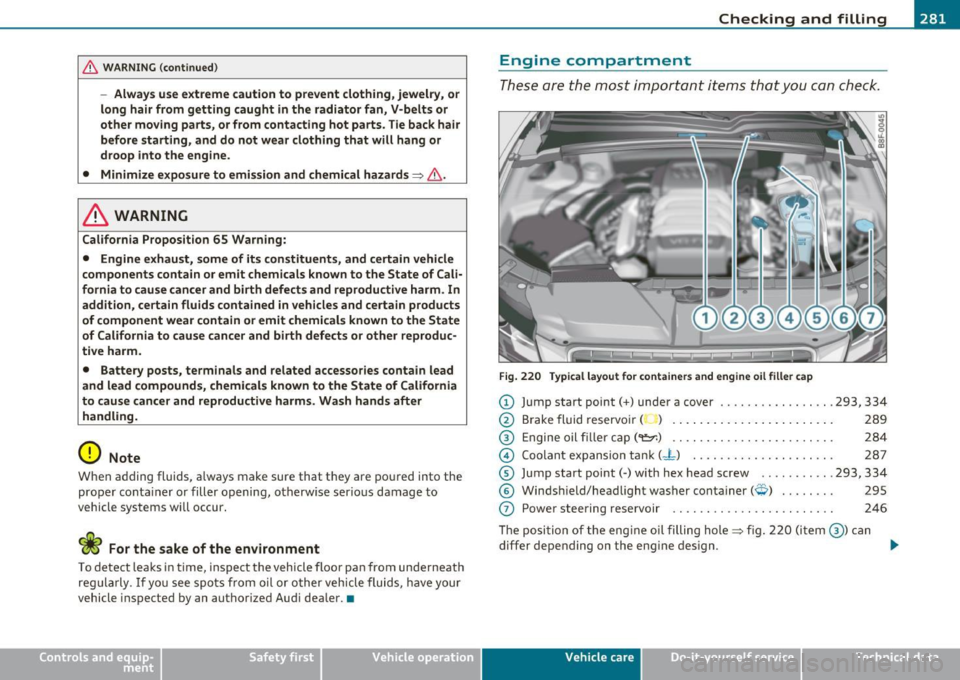
These are the most i mportan t it ems that you can check.
Fig . 220 Typ ical layout for c ontainer s and engine oil filler cap
(D Jump start point( +) under a cover ........ .. .. .. .. . 293, 334
@ Brake fluid reservo ir ( ) . . . . . . . . . . . . . . . . . . . . . . . . 289
@ Engine oil f iller c ap
('1::r. ) . . . . . . . . . . . . . . . . . . . . . . . . 28 4
© Coolant ex pansion ta nk (-L ) . . . . . . . . . . . . . . . . . . . . . 28 7
© Jump start point( -) w ith he x head screw ..... ... .. . 293 , 33 4
© Winds hield/head light washer container (0 ) . . . . . . . . 295
(j) Power steering reservoir . . . . . . . . . . . . . . . . . . . . . . . . 246
Th e posi tion of the eng ine o il filling hole ~ fig. 220 (i tem @) can
differ depending on the eng ine des ign . ..,.
Vehicle care Do-it-yourselt service iTechnical data
Page 289 of 364

___________________________________________ C_ h _ e_c _k _ i_n -=g .._ a_n _ d_ f_i _ll _i _ n -=g '--- ........ 11'1
0 Note
• Before winter sets in, have the coolant checked to see if the
coolant additive in your vehicle is sufficient to meet the climate
conditions. This is especially important if you live in a region where
the winter is extremely cold. If necessary, increase the proportion of
coo lant additive to 60% .
• When adding coolant additive to your cooling system, remember:
-We recommend using only coolant additive G12++ (check the
label) for your vehicle. This coolant additive is available at autho
r iz ed Audi dealers. Other types of antifreeze can s ignificantly
reduce corrosion protection. The resulting corrosion can cause a
loss of coolant and serious engine damage.
• Do not add any type of radiator leak sealant to your vehicle 's
eng ine coolant. Adding radiator repair fluid may adversely affect the
function and performance of your cooling system and could result in
damage not covered by your New Vehicle Limited Warranty. •
Checking the engine coolant level
The engine coolant level can be checked with a quick
glance.
Fig. 223 Engine
compartment: Coolant
expansion tank
Vehicle OP-eration
Before you check anything in the engine compartment,
always read and heed all WARNINGS=:> & in "Working in
the engine compartment" on
page 280.
-Turn off the ignition.
- Let the engine cool down .
- Place a thick rag over the coolant expansion tank
=:> fi.9. 223 and carefully twist the cap counter -clockwise
=> & .
- Read the engine coolant level in the open coolant expan
sion tank=:> fig. 223. With a cold engine, the coolant level
should be between the "min" and "max" markings. When
the engine is warm, the level may be slightly above the
"max" marking.
The location of the coo lant expansion tank can be seen in the engine
compartment illustration =>
page 281.
To obtain an accurate reading, the engine must be sw itched off.
The expansion tank in your vehicle is equipped with an electric coolant level sensor.
When the coolant level is too low, the warn ing light in the Auto-Check
System =>
page 31 will blink until you add coolant and the level has
been restored to normal. Even though there is an electric coolant
level sensor, we st ill recommend you check the coolant leve l from
t ime to time .
Coolant loss
Coolant loss may indicate a leak in the cooling system . In the event of
coolant loss , the cooling system should be inspected immediately by
your authorized Aud i dealer . It is not enough merely to add coolant .
In a
sealed system, losses can occur only if the boiling point of the
coo lant is exceeded as a result of overheating . .,
Vehicle care Do-it-yourselt service iTechnical data
Page 290 of 364

___ C_ h_ e_c _k _i _ n _g ~ a_n _d_ f_il _l_in _ g _________________________________________ _
in. WARNING
The cooling system is under pressure and can get very hot. Reduce
the ri sk of scalding from hot coolant by following the se steps .
• Tu rn off the engine and allow it to cool down .
• Protect your face, hands and arms from e scaping fluid and
steam by covering the cap with a large , thick rag.
• Turn the cap slowly and very c arefully in a counter-clockwise
direction while applying light , downward pressure on the top of
the cap.
• To avoid being burned, do not spill antifreeze or coolant on the
exhaust system or hot engine parts. Under certain conditions, the
ethylene glycol in engine coolant can catch fire.
0 Note
Do not add any type of radiator leak sealant to yo ur vehicle 's engine
coo lant. Adding radiator repair fluid may adverse ly affect the func
tion and performance of your cooling system and could result in
damage no t c ove red by y our New Vehi cle Limited Warr anty. •
Adding coolant
Be very careful when adding engine coolant.
Before you check anyt hing in th e eng ine compartment ,
always read and heed all WARNINGS=> & in "Wor king i n
t h e e ngine compa rtment" on page
280.
-Tur n off the e ng ine.
- Let t he engi ne co ol d ow n.
- Place a t hick rag over the coolant expans ion tank
=> page 2 87, fig . 223 a nd carefully turn the ca p cou nte r
clo ckwise
=> & .
- Add coo lant .
- Tw ist t he cap o n agai n
tightly.
Replacement eng ine coolant must conform to exact specificat ions
~ page 28 6, "Coolant" . Even in an emergency, if coolant a dditive
Gl2 ++, Gl2+ or Gl2 is not available, do not use a d ifferent add it ive.
Use plain water instead until you can get the correct additive a nd can
restore the co rrect ra tio. This s hould be done as soon as possib le.
If you have lost a considerable amount of coolant, then you shou ld
add co ld a ntifree ze and cold wa ter only when t he e ngine is cold.
Always use
new engine coo lant when refilling .
Do not fill coolant above the "M AX" mark. Excess coo lant wi ll be
for ced out through t he p ress ure relief va lve in t he cap w hen the
eng ine becomes hot .
& WARNING
• The cooling system is under pressure and can get very hot.
Reduce the risk of scalding from hot coolant by following these
steps.
-Turn off the engine and allow it to cool down.
- Protect your face , hands and arms from escaping fluid and
s team by covering the cap with a large, thi ck rag.
- Turn the cap slowly and very carefully
in a counter-clockwise
direction while applying light , downward pre ssure on the top
of the cap.
- To avoid being burned, do not spill ant ifreeze or coolant on
the exhaust system or hot engine parts. Under certain condi
tions, the ethylene glycol in engine coolant can catch fire .
• Antifreeze is poisonous. Always store antifreeze
in its original
container and well out of the reach of children .
• If you drain the coolant , it mu st be caught and safely stored in
a proper container clearly marked "poison ".
~
Page 291 of 364

___________________________________________ C_;_ h _.:. e_c _k _ i_n -=g ~ a_n _ d_ f_i _ll _i _ n -=g '--.......J-
0 Note
• Coolan t poll utes the environment and co uld cause an engine fire.
Excess coolant w ill be forced out throug h the pressure relief valve in
t he cap w hen the eng ine becomes ho t.
• If, i n an emer gency, only water can be adde d, the correct ratio
between wate r an d an tifree ze=>
page 28 6 must be restored as soon
as possib le.
<£> For the sake of the environment
Dra ined coolant should not be reused. A lways dispose of used coolant
w hile observ ing a ll enviro nmental regula tions. •
Radiator fan
The r adia tor fan switc hes on au tomatic ally by its elf .
Th e radiator fan is dr iven by the e ngine vi a the V-bel t. Th e v iscous
clutch regu lates the speed of the fan accord ing to the temperature of
th e co olan t.
An auxiliary e lectr ic rad iator fan* sw itches on a nd off depend ing o n
coo la nt temperat ure and other vehicle ope rating conditions .
After you sw itch t he engi ne off, the a uxiliary f an can con tinue r unning
for up to 10 minutes -even w ith the ignition off . It can even switch on
a g ain lat er by itse lf=> &, if
• the temperature of the e ngine coola nt rises due to the heat build
up from the eng ine in the engi ne compa rtment, o r
• the engine compartment heats up because the vehicle is parked in
intense s unlight .
& WARNING
• To reduce the risk of personal injury never touch the radiator
fan.
Vehicle OP-eration
& WARNING (continued )
• The auxiliary ele ctric fan is temperature controlled and can
switch on suddenly even when the engine is not running.
• The auxiliary radiator fan switches on automatically when the
engine coolant reaches a certain temperature and will continue to
run until the coolant temperature drops. •
Brake fluid
Checking brake fluid level
The brake flu id level ca n be chec ked wit h a quick gl an ce.
Fig . 224 Engi ne
c ompartm ent : Brake
fluid re se rvoir
B efo re you check anyth ing i n the e ngine compartment ,
always read and heed all WARNINGS~ & in " Workin g in
t h e e ng in e co mpartme nt" on
p age 280.
- Rea d the b rak e fl uid le ve l f ro m t he brak e fluid re serv oir
~ f ig. 224. The br ak e fl uid le vel mus t be be tw ee n the
" M IN " an d "MAX " m ar kin gs.
Th e br ake fl uid re se rvoir is loca ted at th e rear pa rt iti on of the engine
compartment on the left side=>
page 281. .,_
Vehicle care Do-it-yourselt service iTechnical data