Fluid AUDI A5 CABRIOLET 2011 Owner's Manual
[x] Cancel search | Manufacturer: AUDI, Model Year: 2011, Model line: A5 CABRIOLET, Model: AUDI A5 CABRIOLET 2011Pages: 364, PDF Size: 86.48 MB
Page 292 of 364
___ C_ h_ e_c _k _i _ n _g ~ a_n _d_ f_il _l_in _ g _________________________________________ _
The fluid level may drop slightly after some time d ue to the auto
m atic adjus tment o f th e b rake pads. This is no t ca use for alarm.
If the brake flu id level falls considerably below the "MIN" mark, the
brake warning/indicator light ( U.S. models:
BRAKE , Canadian mode ls:
ID ) will come on=> page 17 and=> page 30. Do not contin ue to
operate the vehicle. The complete brake system should be thoro ughly
c he cked by an au thor ized Aud i deale r or q ualified works hop and t he
cause corrected. If the brake fluid level is too low, the brake
w ar ning/ind ic a tor ligh t will illum ina te. Con ta ct a n au thori ze d Audi
dealer
immediately .
rn Tips
The brake fluid reservoir is located underneath t he cover. •
Changing brake fluid
Have the brake fluid cha nged b y an experienced tech ni
c ia n.
Brake fluid absorbs mo isture from the a ir . If the water content in the
bra ke fl uid i s too hig h, cor ros io n in th e bra ke system may res ult afte r
a period of time. The boiling po int of the brake fluid will also decrease
cons iderab ly and decrease brak ing perfo rmance .
Th erefo re, th e brake fl uid must be changed
every two years . Always
use new bra ke fluid w hich conforms to Federal Motor Vehicle Stan
dard "F MVSS 1 16 DO T 4".
The brake flu id reservoir can be diffic ult to reac h, therefore, we
recommend that you have the bra ke fluid c hanged by your author ized
Audi dealer . Your dealer has the correct tools, the right brake flu id
and the know -how to do t his for you .
LJ}. WARNING
• Brake fluid is poisonou s. It mu st be stored only in the closed
original containe r out of the reach of children!
& WARNING (co ntinued )
• Brake failure can result from old or inappropriate brake fluid.
Observe these precaution s:
- Use only brake fluid that meets SAE specification
J 1703 and
conforms to Federal Motor Vehicle Standard 116 . Always check
with your authorized Audi dealer to make sure you are using
the correct brake fluid. The correct type of brake fluid is also indicated on the brake fluid reservo ir.
- The brake flu id must be new . Heavy use of the brakes can
cause a vapor lock if the brake fluid is left in the system too
long. This can seriously affect the efficiency of the brakes as
well as your safety. This could result in an accident.
0 Note
Bra ke fluid will damage the paint of your veh icle.
For the sake of the environment
Because of the prob lem of proper disposal of brake fl uid as well as
t he s pecial tool s required a nd the nece ssary ex pert ise, we recom
mend that you have t he brake f lu id changed by your authorized Audi
de aler. •
Battery
General information
Under normal operat ing con dit ions, the battery in your Aud i does not
need any main tenance . Wit h high outs ide temperatures o r long daily
dr ives we recommend that yo u have the electrolyte level checked by
an a uth orized Audi dealer o r q ua lified wor kshop. The electro lyte lev el
should also be checked each time the battery is charged=> page 293 . .,_
Page 297 of 364
Checking and filling IJl!II
--------------------------------------------=------- =------
<£> For the sake of the environment
Because of the problem of proper disposal of a battery, we recom
mend your authorized Audi dealer change the battery for you.
Batte ries contain sulfuric acid and lead and must always be disposed
of properly in compliance with all environmental regulations.
Disposing of vehicle batter ies improperly is very dangerous to the
environment. •
Windshield/headlight washer
container
Fig. 226 Engine
co mp artmen t: Wind
sh ield and headlight*
washer fluid container
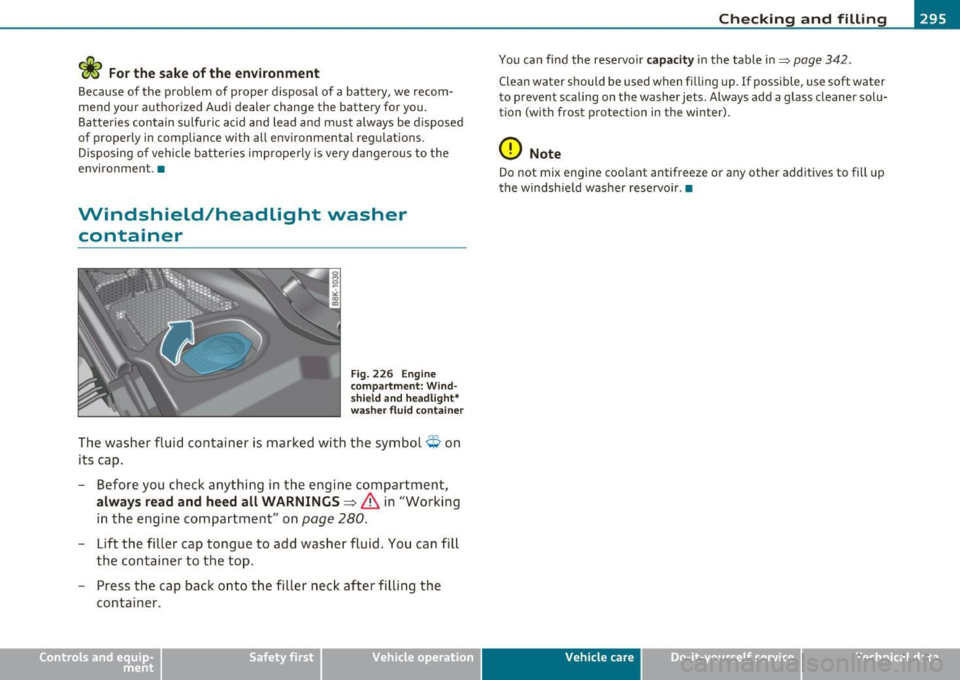
The washer fluid container is marked with the symbol Q on
its cap.
- Before you check anything in the engine compartment,
always read and heed all WARNINGS => & in "Working
in the engine compartme nt" on
page 280 .
-Lift the filler cap tongue to add washer fluid. You can fill
the container to the top.
- Press the cap back onto the filler neck after filling the
container.
Vehicle OP-eration
You can find the reservoir capacity in the table in::::, page 342.
Clean water should be used when filling up. If possible, use soft water
to prevent scaling on the washer jets. Always add a glass cleaner solu
tion (with frost protection in the winter).
0 Note
Do not mix engine coolant antifreeze or any other additives to fill up
the windshie ld washer reservoir .•
Vehicle care Do-it-yourselt service iTechnical data
Page 306 of 364
-~_T_ i_ re _ s_ a_n _ d_ w_ h _e_ e_ ls _________________________________________________ _
& WARNING (conti nu ed )
• If the tire i s not flat and you do not ha ve to change a wheel
immediately, drive at reduced speed to the nearest service station
to check the tire pressure and add air as required.
0 Note
Driv ing without valve stem caps can cause damage to the tire valves.
T o preven t this, a lways make sure that fac tory ins talle d valve stem
caps on all wheels are securely mo unted on the valve.
<£> For the sake of the environment
Under inflated t ires will also increase the fuel consumption .•
Tires and vehicle load limits
There are limits to the amo unt of load or weig ht that any vehicle and
any t ire ca n carry. A veh icle th at is overlo ade d w ill n ot handle well and
is more difficult to stop . Overload ing can not on ly lead to loss of
vehicle co ntro l, bu t can also d amage important pa rts of the vehi cle
and can lead to sudden t ire failure, including a b lowo ut and sudden
deflation that can ca use the vehicle to c rash.
Yo ur safety and t hat of your passengers also depends o n mak ing s ure
that load limits are not e xceeded. Vehicle load incl udes eve rybody
and everyth ing in and on the ve hicle. These load limits are tech nically
refer red to as the veh icle's
Gross Vehicle We ight Rating ("GVWR").
T he "GVWR" includes t he weight of the basic vehi cle, all factory
installed accessories, a fu ll tank of fue l, o il, coo la nt and other fluids
plus maxim um load . The maxim um load includes the number of
passenge rs that the vehi cle is intended to car ry ("seating capacity ")
w ith an ass umed we ight of 150 lbs (68 kg) for each pa ssenger at a
designat ed seating position and the tota l w eight of any l uggage in
the vehicle. If you tow a trai le r, the weight o f the t railer hitch and the tongue weight of the
loaded tra ile r must be included as part of the
veh icle lo ad .
T he
Gross Axle Weight Rating ("GAWR ") is the max imum load t hat
can be a pplied at each of the ve hicle's two axles .
Th e Gross Vehicle Weight Rat ing and the Gro ss Axle Weight Ra ting
are listed on the safety compliance s ticker label located on the
dr iver 's s ide B-pillar. Audi h as 4 seat ing pos it ions, 2 in t he fro nt and
2 in the rear for total seating capacity of 4 . Each seating pos it io n has
a seat belt =>
page 189, "Safety belts" .
Th e fa ct t hat there is an upper lim it to your veh icle 's Gross Vehicle
We ight Rating means that the total weight of whatever is being
c arrie d in t he ve hicle (incl uding t he weight o f a trail er hi tch and the
tongue weig ht of the loaded tra iler) is limited . The more passengers
in the veh icle or p assenge rs who are he avier than the st anda rd
we ights assumed mean that less we ight can be carried as luggage.
Th e tire pressure labe l o n yo ur Audi a lso lists the max imum combine d
we ight of alt of the o ccupants and l uggage or o ther cargo that the
vehicle ca n carry . For t he locat ion of the label=>
page 300, fig. 22 7.
& WARNING
Overloading a vehicle can cause loss of vehicle control, a crash or
other accident, serious personal injury, and even death.
• Carrying more weight than your vehicle was de signed to carry
will prevent the vehicle from handling properly and increase the
risk of the loss of vehicle control.
• The brakes on a vehicle that has been overloaded may not be
able to stop the vehicle within a safe di stan ce.
• Tires on a vehicle that has been o verloaded can fail suddenly ,
including a blowout and sudden deflation, causing loss of control
and a crash .
• Always make sure that the total load being transported -
i ncluding the weight of a trailer hitch and the tongue weight of a .,_
Page 309 of 364

________________________________________________ T_ i_ re _ s_ a_ n_d_ w_ h_ e_ e_l _s _ ....... JIII
Unbalanced wh eels must be rebalanced to avoid e xcessive w ear o n
st eeri ng, sus pens ion and tires. A w heel must a lso be re balan ced
w hen a new tire is installed.
Incorrect wheel alignment
Incorrect whee l alignm ent can ca use excessive ti re wea r, impairing
th e safe ty o f the vehicle. If tir es show excessive we ar, ha ve the w heel
alignment checked by a n authorized A udi dealer or qualif ied wo rk
s hop .
All wheel drive
Vehicle s wi th qu att ro ® mus t alw ay s ha ve tires of the sa m e siz e,
construct ion a nd tread type. For details see~
page 246.
& WARNING
Sudden tire failure can lead to loss of control , a crash and serious
personal injury!
• Never drive a vehicle when the tread on any tire is worn down
to the wear indicators.
• Worn tires are a safety hazard, they do not grip well on wet
roads and increase your risk of "hydroplaning " and loss of control.
• Always keep chemicals that can cause tire damage, such as
grease, oil, gasoline and brake fluid away from tires.
• Tires age even if they are not being used and can fail suddenly,
especially at high speeds. Tires that are more than 6 years old can
only be used in an emergency and then with special care and at
lower speeds.
• Never mount used tires on your vehicle if you are not sure of
their "previous history ." Old used tires may have been damaged
even though the damage cannot be seen that can lead to sudden
tire failure and loss of vehicle control. •
Vehicle OP-eration
New tires and replacing tires and wheels
New tires and w heel s hav e to b e brok en in .
Fig. 231 Tire specificat ion codes on the sidewall of a tire
No.
©
®
®
©
©
©
Description
Passenger car tire (where app licable)
Nom inal width of ti re in mil lim eters
Ratio of hei9ht to width (aspect ratio)
Radial
jj Rim diameter code
L oa d index and speed rating
Vehicle care Do-it-yourselt service iTechnical data
Page 331 of 364
__________________________________________ __!F~U!_.:!S~e:.:s~ a~n~d:!_..!:b~u:!!l~b~s~ _J
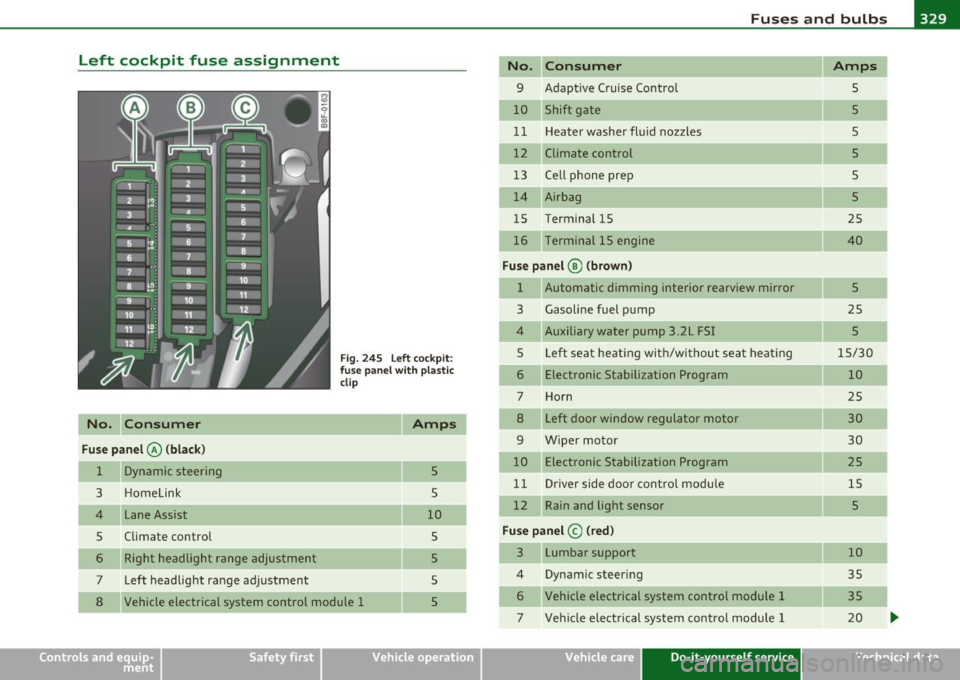
Left cockpit fuse assignment
No. C onsumer
Fus e pa nel @ (black )
1 Dynamic steering
3 Homelink
4 Lane Assist
5 Climate control Right headlight range adjustment
7 Left headlight range adjustment
Fig. 2 4 5 Left cock pit :
fuse pan el with plastic
cl ip
5
5
10 5
5
5
8 Vehicle electrical system control module 1 5
Vehicle OP-eration
No. Consumer Amps
9 Adaptive Cruise Control
5
10 Shift gate 5
1 1 Heater washer fluid nozzles
5
12 Climate control 5
13 Ce lt phone prep
s
14 Airbag
5
15 Term
inal 15
25
16 Terminal 15 engine 40
Fus e pa nel ® (brow n)
1 Automatic dimming interior rearview mirror 5
3 Gasoline fuel p ump 25
4 Auxiliary water pump 3 .2L FSI 5
5 Left seat heating with/wi tho ut seat heat ing 15/30
6 Electronic Stabilization Program
10
7 Horn 25
8 Left door window regulator motor 30
9 Wiper motor 30
10 Electronic Stabilization Program
25
11 Driver side door control modu le 15
12 Rain and light sensor 5
Fuse panel © (red)
3 Lumbar support 10
4 Dynamic steer
ing
35
6 Vehicle electrical system control module 1 35
7 Veh icle elect rical system control module 1 20
Vehicle care Do-it-yourself service iTechnical data
Page 344 of 364
___ D_ a_t _a _____________________________________________________ _
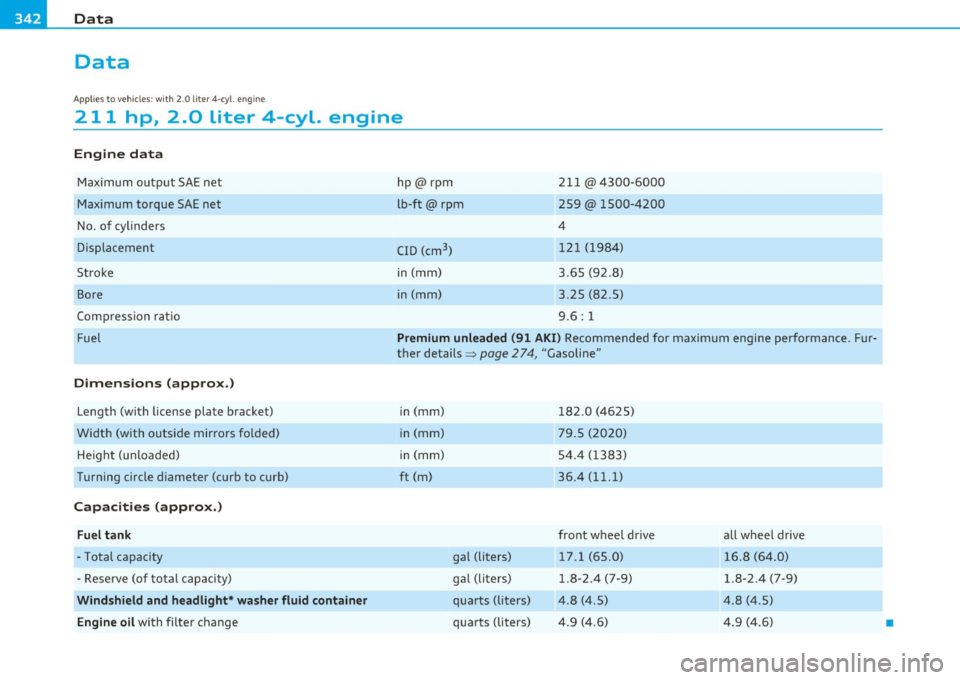
Data
Applie s to ve hicle s: with 2 .0 lit er 4- cyl. engin e
211 hp, 2.0 liter 4-cyl. engine
Engine data
Max imum outpu t SAE net
Max imum torque SAE net
No. of cy linde rs
Displacement
Stroke
Bore
Compression rat io
Fu el
Dimensions (approx .)
Length (with license plate bracket)
Width (with outside mirrors fol ded)
He ight (un loaded)
Turning circle d iameter (curb to curb)
Capacities (approx.)
Fuel tank
- Total capacity
- Reserve (of to tal c apaci ty)
Windshield and headlight * washer fluid container
Engine oil
with filter change hp@rpm
lb-ft@
rpm
C ID (cm
3
)
in (mm)
in (mm) 2
11 @ 4300- 6000
259@ 1500-4200
4
12 1 (198 4)
3.65 (92.8)
3.25 (82.5)
9 .6 : 1
Premium unleaded (91 AKI) R eco mmend ed for maximum engi ne per formanc e. Fur
ther details ~
page 274, "Gasoline"
in (mm)
in (mm)
i n (mm)
ft (m)
gal (Liters)
g al (Liters)
qua rts (liters)
quar ts (lite rs) 182
.0 (4625)
79 .5 (2020)
54.4 (1383)
36.4 (11. 1)
front wheel drive 17.1 (65.0)
1.8 -2.4 ( 7-9)
4.8 (4 .5)
4.9 (4.6) all whee
l drive
16.8 (64 .0)
1.8- 2.4 (7 -9)
4 .8 (4 .5)
4 .9 (4.6)
•
Page 351 of 364

___________________________________________ A_ l::.. p _h _a_ b_ e_t _ic _a_ l_ in_ d _ e_x __ _
Auto Lock .. .. ... ..... ... ... ... .. .. .. 42 B
Auto Safety Hotline ... ... ... . .. ..... 185
Auto-Check Control .. ..... ... .... ... .. 27
Automatic belt retractor .......... ... 194
Automatic car wash
See Washing ......... .... .. .... . 261
Automatic climate control . . . . . . . . . 88, 9S
Automatic driving light control ......... 63
Automatic power top ..... .. .. .. .... .. 51
Automatic Shift Lock (ASL) ... .. .. 150, 157
Automatic transmission Automatic Shift Lock (ASL) .... 150, 157
automatic transmission ........ ... 148
Driving ...... ...... .. .. .. .. .. .. . 148
Dynamic shift program ... .... .. ... 151
Emergency release ............. .. . 154
Emergency release for selector lever
(mu ltitron ic®) ............... .. . 161
Fail-safe mode .............. 153, 160
Kick-down ...................... 151
Manual shift program ............. 152
multitronic ® ..................... 154
Selector lever ........... .. .. 149, 156
Shift buttons ....... .. .. .... 153, 160
Steering wheel with tiptronic ® . 153, 160
Automatic wipe/wash system .......... 69
Average speed .. ....... .... .. .. .. .. .. 21
Avoid damaging the vehicle .. .. .. .. .. . 251 Battery
... .. ... ... ................. 290
Charging . .. .. .. .... .. .. ... ... .. . 293
Important warnings when work ing on the
battery ..... ........... ...... .. 291
Jump starting . ........... ........ 333
Low ... .. .. .. .... .... .. ......... 247
Replacing the battery .. .. .. .... ... 294
State of charge ..... .. ... ...... .. 247
Winter operation ..... ..... ....... 290
Working on the battery .... .... .... 291
Battery voltage .. ........... ...... .. . 36
Before driving .. ... .... .. .. .. .. ..... 177
Belt positioner .. .. .... .. ... ... ..... 193
Blended gasoline ................ ... 27 4
Body cavity sealing . ................. 267
Booster seats ... .. ...... .. ......... 229
Brake assist ..................... ... 245
Brake booster . ........ ... .......... 244
Brake fluid
Changing the brake fluid ........... 290
Checking the brake fluid level ..... .. 289
Reservoir .. .. .. .... .... ......... 289
What is the correct brake fluid level? . 289
What should I do if the brake fluid warning light comes on? . ... ... .......... 289
Brake system .. .. .. ..... .... ........ 289
Anti-lock brake system . .. .......... 15
Brake fluid ... .... ............... 289
Brake fluid specifications for refill and
replacement ................... 290
Brake light defective ....... .... ... . 35 Brake pads
.. .. .... ..... .... .... . 251
Electromechanical parking brake .... 110
General information .............. 243
How does moisture or road salt affect the
brakes? ... .... .............. .. 243
Malfunction .............. .... .. .. 30
Warning/indicator lights ....... .. .. 17
Worn brake pads symbol ........... 35
Braking guard
See Audi braking guard ............ 129
Break-in period ... .. .. .............. 250
Brake pads .. ...... ........... .. . 251
Tir es ... .. .. ................. .. . 250
Bulbs ................ .. .... .... .. . 332
C
California Proposition 65 Warning .. ... 281
Battery specific .................. 293
Capacities ......................... 342
Car care .. .... .............. ...... . 260
Interior ............ .. .. .. .. .. .. . 268
Plastic and vinyl .... ............. . 264
Weatherstrips ............ .. .. .. . 266
Care of exterior ... .... .. . .. .. .. .. .. . 260
Cargo area
See Loading the luggage compartment ..
183
Catalytic converter .. ..... ........... 251
Certification ......... .............. 346
Changing a flat tire .. ................ 320
Changing a wheel ...... ...... .... .. . 320
Changing engine oil ... .. .. ......... . 285
Controls and equip
ment Safety first Vehicle operation
Vehicle care Do-it-yourself service Technical data
Page 354 of 364

___ A_l_,_ p _ h_ a _ b_e _ t_ i_c __ a _l _i_n :...::d __ e::..: x:...::...,_ _________________________________________ _
Emergency locking of the doors .. .. ....
47
Emergency operation
Luggage compartment lid .... ... .. .
48
Power top ... .. .. .. ... ... .... .... 57
Emergency release
Sele ctor lever ...................
154
Emergency starting .. .. ............. 333
Emergency towing ..... .. .. ..... .... 336
Emergency u nlocking
Ignition key .. ................. ...
40
Energy management .............. .. 247
Battery power ................ ... 249
Dr iver not ification ......... .... ... 249
Engine
Compartment .. .. ... . .. ... ... . ..
281
Coolant ................ .. .... .. 286
Hood .................. ...... .. 279
Starting ... ............. ...... ..
106
Starting w ith jumper cables ........ 333
Stopping .. .. ... .... ........ .... 1 07
Engine compartment
Safety instructions .. ... ... .... . ..
280
Work ing the eng ine compartment 280
Engine coo lant system
Ma lf u nct ion . . . . . . . . . . . . . . . . . . . . . .
31
Radiator fan ... .... .. . ... ... .. .. 289
Engine coo lant tempe rature
T empera ture gauge ............ .. .. 8
Engine cooling system ...............
286
Adding coolant ... .. .. .. ... ...... 288
Checking coo lant level . ........... 287
Checking the engine coolant level ... 287
Engine data ....... .. ... . .. ... ... ... 342
Engine hood
Closing ............... ... .......
280
How to re lease the hood ........... 279
Engine oil .... ..... ... ... ... .. .. .. . 282
Add ing ......................... 284
Add itives ....................... 284
Changing ............ .... .. ..... 285
Check o il level ....... ... .. .. .. .. . 284
Consumption ............. ....... 284
Oi l co nsumption ............... .. 283
Oi l grades ...................... 282
Specification and viscosity .. .. .. .. . 2 82
Engine oil leve l .. . .. ............... .. 36
Engine oil p ressure
Ma lf u nction . . . . . . . . . . . . . . . . . . . . . .
31
Engine oil se nsor defec tive . .. .. ... .... 36
Engine speed limitatio n ............... 36
Environmen t
B reak -in period .. .... .. .. ... .... .
250
Catalytic converter .... ... ... .. .. . 251
Disposing of your vehicle battery ... . 29 4
Driv ing at high speeds ............ 253
Driv ing to minimi ze po llution and noise ..
252
Fuel ... ............... .. .. .. .. . 27 6
Fuel e co nomy ............ .. .... . 252
Leaks unde r yo ur vehicle .. ... ..... . 280
Letting the vehicle stand and wa rm up . ..
253
Prope r disposa l of dra ined bra ke fluid 290
Pro per disposal of dra ined engine coo la nt
288
Proper disposal of dra ined engine oil 284,
2 85
Recycl ing used eng ine o il ... .. .... . 284
Unleaded fue l ................... 274
What should I do w it h an old battery?
294
Environmental note
Rear window defogger ........ .
92, 100
EPC
See Electronic power contro l . . . . . . . . 13
ES P
See Electronic stabilization program (ESP)
240
Event Data Recorder ( EDR) 240
Exhaust ta il pipes
Cleaning ... .... .... .. .. ...... ..
267
Expans ion tank ..... ................ 28 7
F
Fan ..................... .... ... 9 1, 98
Rad iator ................. ... .... 289
Fastening
Booster seats ...................
229
Convertible child safety seats ...... 228
Infant seats ...... ............... 227
Flat tire
Changing ................. .... ..
320
Floo r mats ............ .. .. .. .. .. .. 182
Fog lights .. ... ........ ...... .. . ... . 64
Folding the rear seat backrests . ... .. .. . 8 4
Foot pedals ................... ... .. 182
Page 355 of 364
Alphabetical index -________________ fWI
For the sake of the environment
Gasol ine fumes and the env ironment 276
Refueling ..... .. .. .. ............ 276
Saving fuel by early upshifting ..... .. . 9
F ront ai rbags
Description ....... ... . .. .. .. ..... 203
How they work ................ .. . 208
Front armrest Adjusting ........................ 83
Storage compartment ............ .. 83
Front ashtray . .. .. .. ...... ....... ... . 85
Front seats .. .. .. .. ............. .... 77
Adjus ting . .. ... .... ... .. .. ..... . 179
Child restraints in the front seat .... 201
Conven ience side view . .. ...... ..... 82
Symmetrical seat posit ions .......... 82
Upper cabin heati ng ........... .. . 104
Frontal collisions and the laws of physics 190
Fuel Add itives ....................... 274
Blended gasoline ................ . 274
Consumpt ion ....... ...... .. .. .. .. 21
Filler neck ..... .. .. .... .......... 275
Fuel gauge ......... ...... .. .... .. 10
Gasoline .................... .... 274
Gasoline additives .. .... ... ... ... . 275
Octane rating ............... .. .. . 274
Recommendation ... .... .... .. .. . 274
Refuell ing ... ... . ...... ......... . 276
Reserve ...... ...... .. .. .. .. .... .. 10
Tank capacity ............. .. .... . 342
Unlocking the fuel filler flap by hand . 278
Controls and equip
ment Safety first
Fuel economy messages (efficiency
program)
25
Fuel filler flap Unlocking the fuel filler flap by hand . 278
Fuel supply too low ..... .. .. .. .. ...... 36
Fuse arrangement ........... ...... .. 328
Fuses Assignment ............ 329,330,331
Replacing . ... .. .... .. .. .. .. .. .. . 328
G
Garage door opener (Homelink ®) .. .. .. 171
Gas d ischarge lamps ...... ........... 332
Gauges Engine coolant tern perature .......... 8
Fuel gauge .. ..... .. .............. 10
Ta chometer ............. .. .. .. .... 9
General illustration
Instruments and controls ........ .. .. 7
Glossary of tire and loading terminology 297
Glove compartment ............... ... 87
Gross Vehicle Weight Rating (GVWR) ... 341
H
Head restraints .................. ... 180
Adjusting .. .. ... ... .. ... ...... .. 180
Front seats . .. .. .................. 82
Headlight washer reservoir ..... .. .. .. 295
Headlights Adaptive light ........... .. ....... 66
Fog lights . ... ................ .... 64 Headlight range control defective
.. .. 37
Rear fog lights .............. .. ... . 64
Washer system ................... 69
Heated Front seats ............... ...... . 103
Rear seats .. .. .. .. ............. . 103
Rear window . . . . . . . . . . . . . . . . 92, 100
Washer fluid nozzles ...... ... . ... .. 69
Heated outside mirrors ............... 73
Heating . . . . . . . . . . . . . . . . . . . . . . . . 88 , 95
Heavy clothing and safety belts ....... . 192
High beam ............ ...... .... .. .. 67
Warning/indicator lights ....... .. .. 15
High voltage warning label .... ..... .. 340
Homelink ® universal remote control ... 171
Hood Opening ........... .. .. .. .. .. .. . 279
Release lever ............. .... .. . 279
Horn ........ ........ .. . ... ... .. ... .. 7
How are child restraint system anchors related to child safety .. .. .... .......... 234
How many airbags does my vehicle have? ...
206
How often should I check my tire pressures? 303
How safety belt pretensioners work .... 197
Hydroplaning . ..................... 307
I
Ignition key ........... ...... .... ... 106
Emergency unlocking ............ .. 40
Vehicle operation Vehicle care Do-it-yourself service Technical data
Page 361 of 364
___________________________________________ A_ l::.. p _h _a_ b_ e_t _ic _a_ l_ in_ d _ e_x __ _
u
Undercoating ............... .... ... . 267
Unfastening safety be lts ......... .... 196
Unidirectional tires ....... .. .. .... .. . 296
Uniform tire quality grading .. .. .. ... .. 311
Unlocking Power locking switch ............... 46
Rear lid/trunk lid ...... ... ..... .... 47
Remote control key .. ...... .. .... .. 43
Using the mechanical key . .. .... .. .. 45
Upper cabin heating .... .. .. .. .. .... . 104
Use of jumper cables . .. ... ... .. ..... 334
V
Vanity mirror ................... .... . 69
Vehicle Identification Number (VIN) ... . 340
Vehicle jack .................... ... . 323
Vehicle literature ... ............. .. ... 4
Vehicle tool kit ....... ... .. .. .. ..... 318
Vehicle -care products .... ......... .. . 260
Ventilation . . . . . . . . . . . . . . . . . . . . . 91, 98
Warning/indicator lights .... ...... .. .. 12
adaptive cruise control ... .. ... . .. . 123
Airbag system ............ .... .. .. 14
Anti-lock brake system (ABS) ........ 15 Brake system ...... ... ... ... .. .. .. 17
Cruise control ............. ... ... .. 15
Electromechanical parking brake ... .. 16
Controls and equip
ment Safety first
Electronic power control
.. ...... ... . 13
Electronic stabilization program (ESP) . 14
H igh beam ................... .... 15
Malfunction Ind icator Lamp (MIL) ... . 15
Safety belt . .. .. ................. . 15
T ire pressure monitoring system ..... 14
T urn signals ................... ... 15
Warranty coverages .... .. .. .. .. .. .. . 343
Washer reservoir .................... 295
Wash ing . .... .. ........... ...... .. 260
Automatic car was h .... .. ......... 261
by hand .. .. .. ................. .. 261
General information .............. 260
Power top cleaning .......... ... .. 263
with a power washer .............. 262
Waxing .. .. .. .. .. .... .. ... ...... .. 263
Wear indicator .. ... ................ 306
Weatherstr ips ............. ......... 266
Weights ....... .... ... ............. 341
What happens if you wear your safety be lt too
loose? ... .. .. ... ..... ..... .. .. 1 95
What happens to unbelted occupants? .. 191
What impairs driving safety? ........ .. 177
What should I do after changing a wheel? . .
303
What should I do after replacing wheels? .. .
303
Wheel bolts Torque .... ................... .. 313
Wheels .. .. .. .. ... ................ 296
Cast alloy ....................... 266
Checking tire pressure .. .. .... .... . 302
Cold tire inflation pressure ......... 300 General notes
........ ... ... .. .. . 296
Glossary of tire and loading terminology. 297
New tires and wheels ........... .. 307
Tires and vehicle load limits ........ 304
When must a safety belt be replaced? .. 192
When must the airbag system be inspected?
210
When should I adjust the tire pressures? 303
When should I check the tire pressures? . 303
Where are lower anchorages located? .. . 236
Where can I find the tire pressures for my car? 302
Why safety belts? . . . . . . . . . . . . . . 189, 190
Wind deflector ..... .. ............... 55
Cleaning ............ .... ..... ... 263
Window regulators
Malfunctions ............ ...... ... 50
Powe r locks ....... ............... 49
Windows Cleaning ........... .. ... ... .. .. . 265
Windshield defogging/defrosting . . 92, 100
Windshield washer fluid
Low level ........................ 35
Windshield wipers .. .. .. .. .......... . 69
Faulty .................. ... .. ... . 37
Folding up .. .. .. .. .... ... ........ 71
Serv ice position .. .. .... ........... 70
Washer reservoir ... .............. 295
Winter operation Battery ......... ... .. .. ... ... ... 290
Coolant system ..... ..... ... . ... . 286
Defrosting windows . . . . . . . . . . . 92, 99
Vehicle operation Vehicle care Do-it-yourself service Technical data